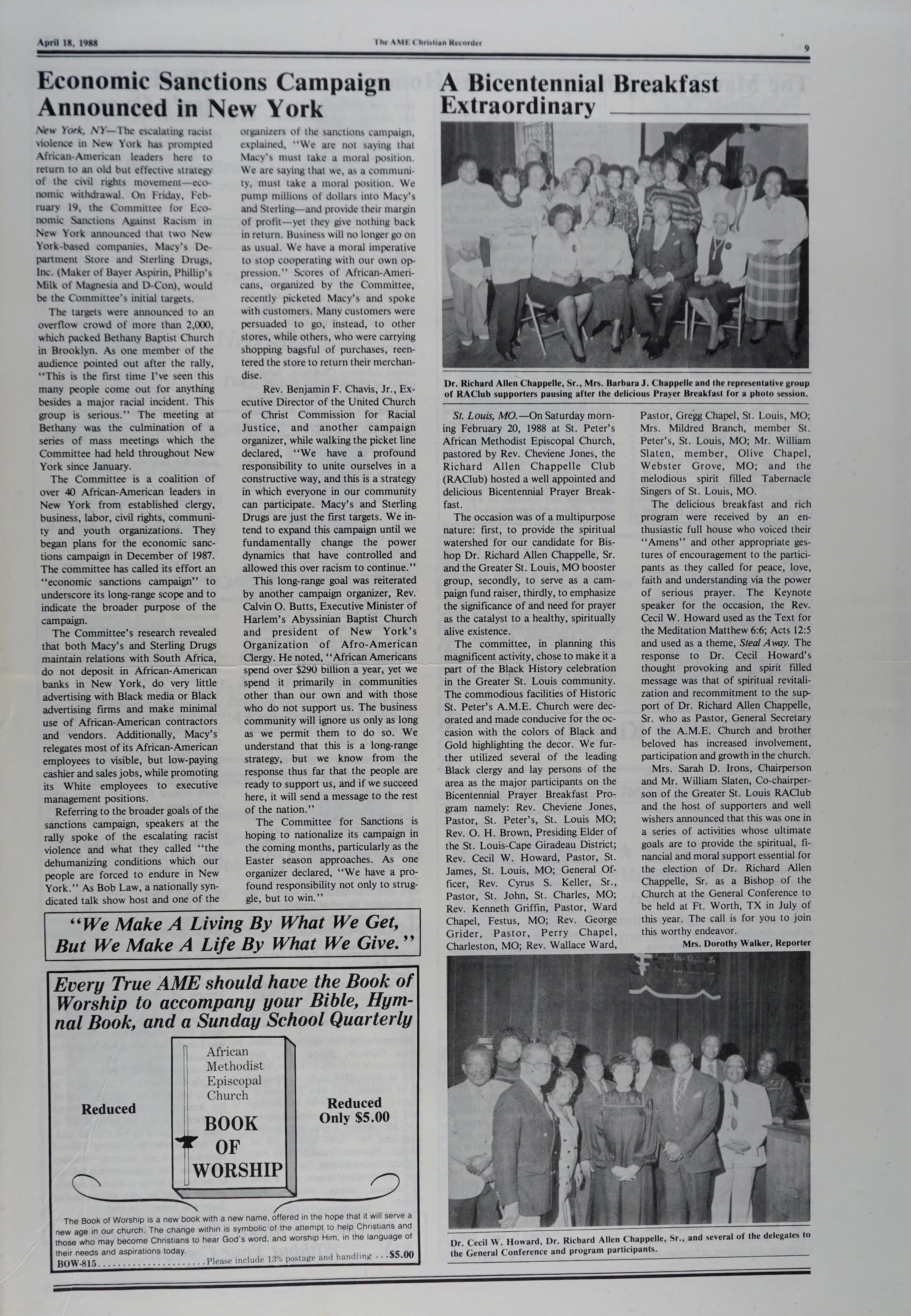
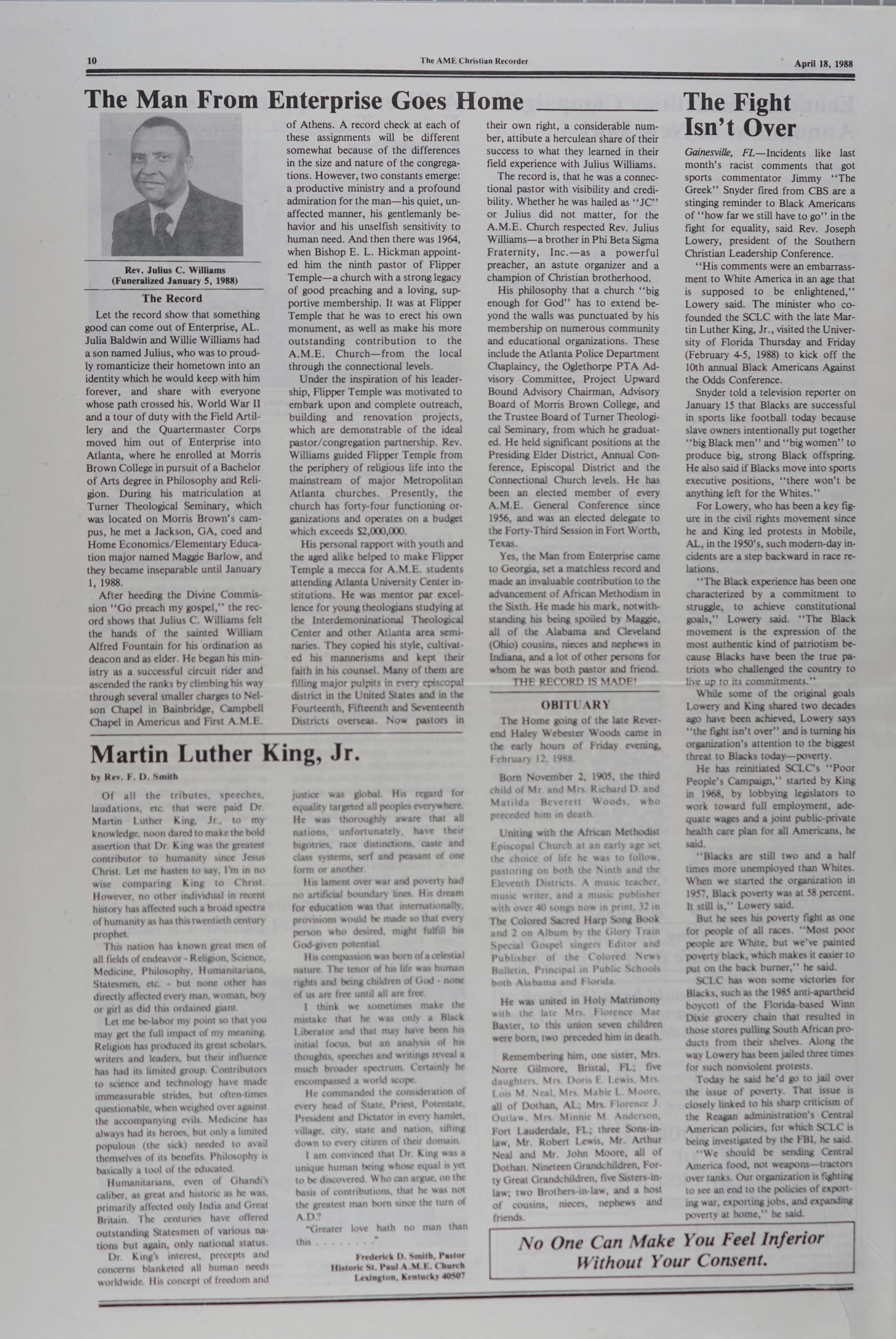
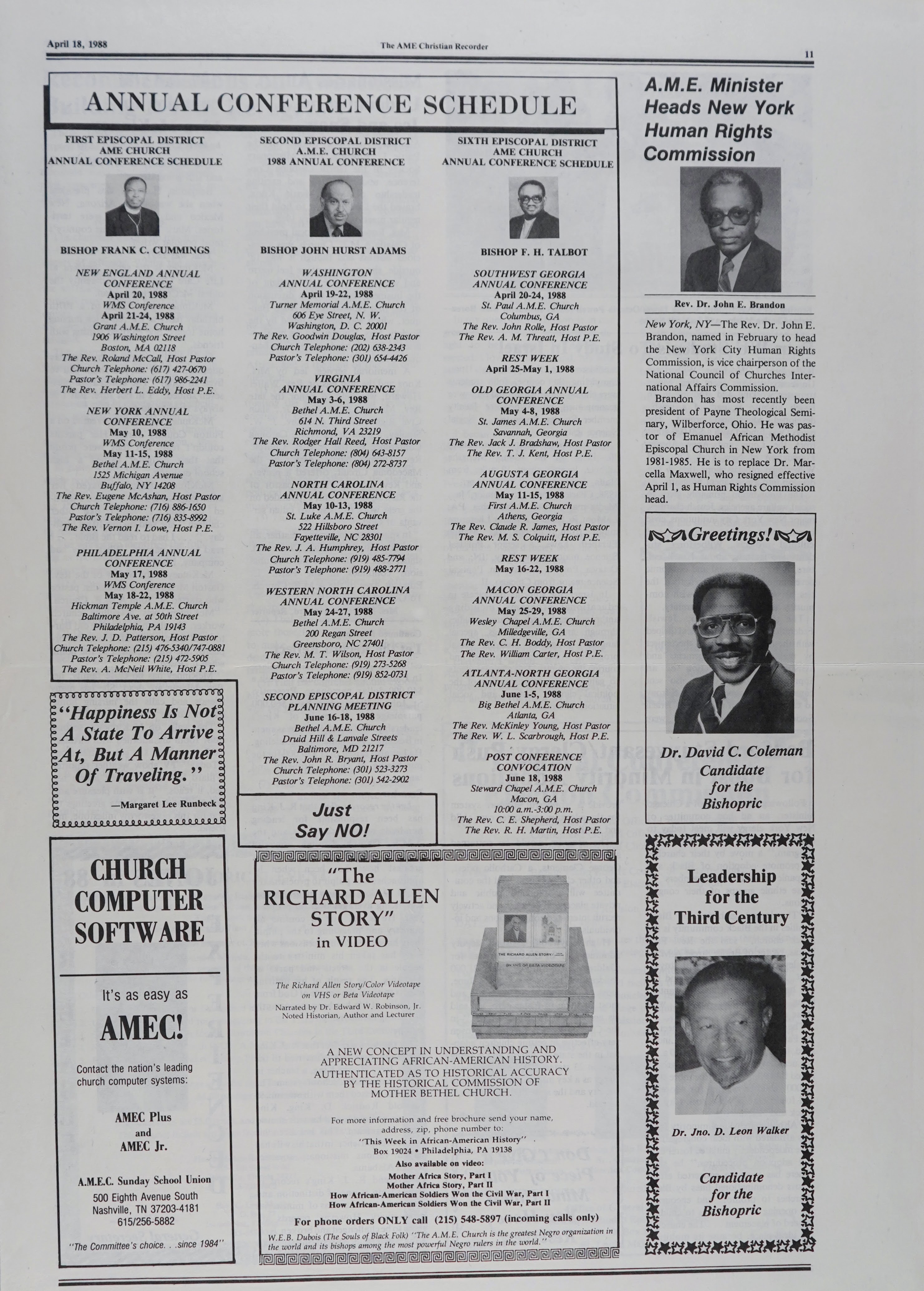
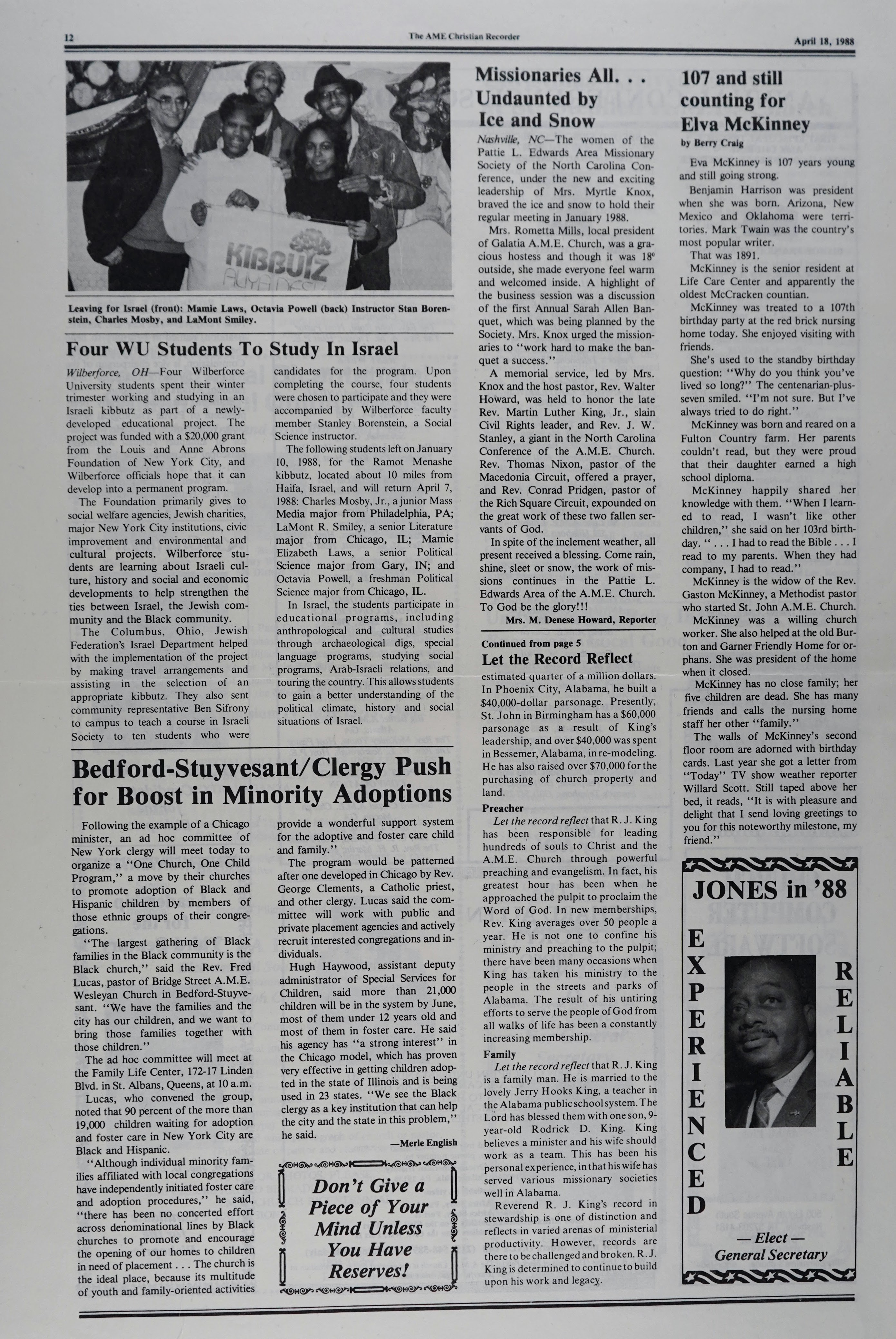
-
Title
-
April 18, 1988
-
Description
-
===== DSC05487.JPG =====
Vol. 137, No. 14
April 18, 1988
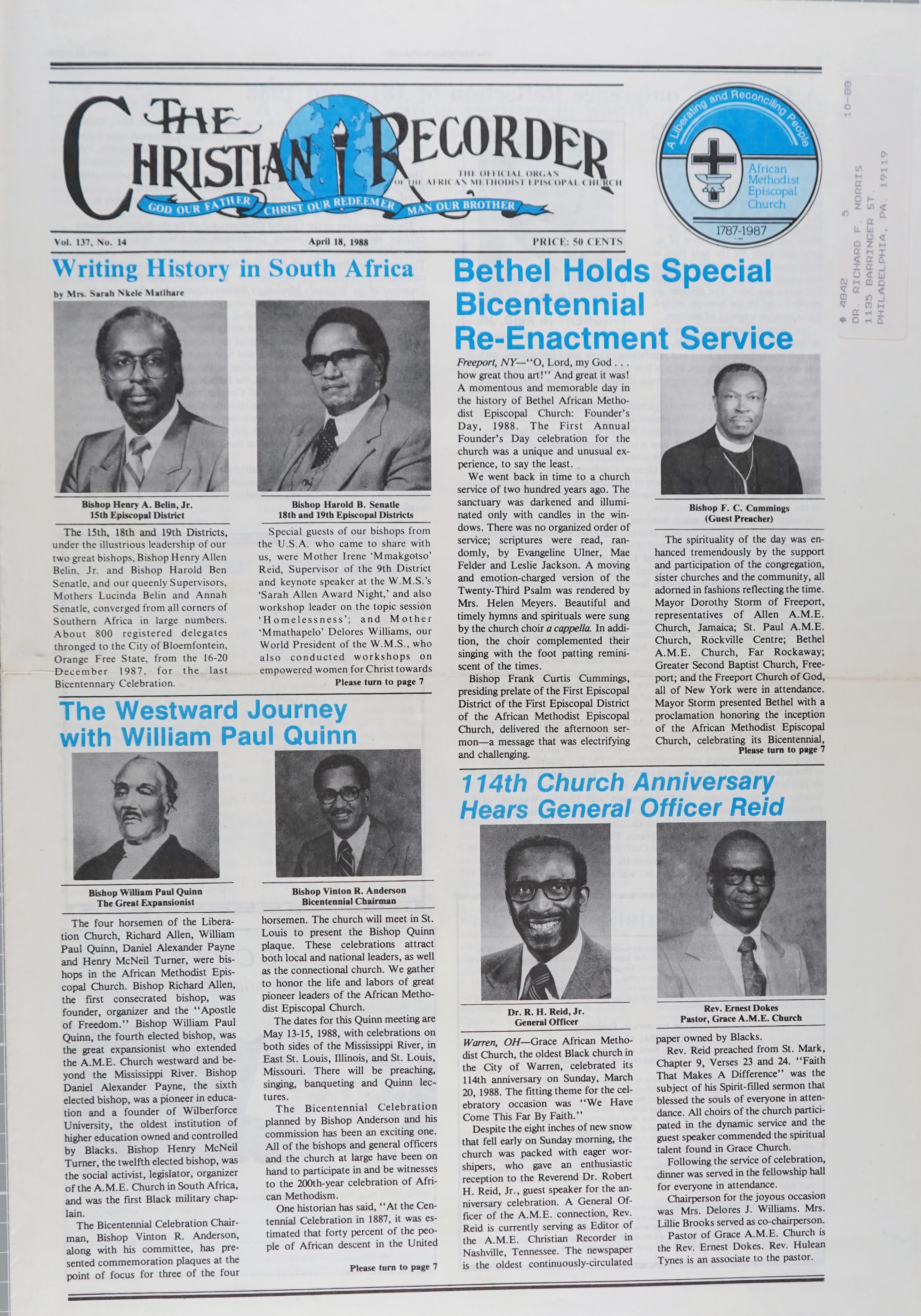
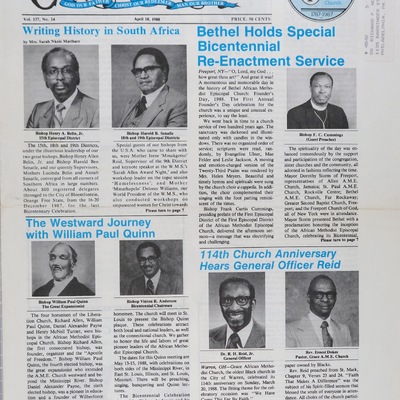
Writing History in South Africa
by Mrs. Sarah Nkele Matlhare
a
Bishop Henry A. Belin, Jr.
15th Episcopal District
The 15th, 18th and 19th Districts,
under the illustrious leadership of our
two great bishops, Bishop Henry Allen
Belin, Jr. and Bishop Harold Ben
Senatle, and our queenly Supervisors,
Mothers Lucinda Belin and Annah
Senatle, converged from all corners of
Southern Africa in large numbers.
About 800 registered delegates
thronged to the City of Bloemfontein,
Orange Free State, from the 16-20
Becember 1987, for the last
Bicentennary Celebration.
Bishop Harold B. Senatle
18th and 19th Episcopal Districts
Special guests of our bishops from
the U.S.A. who came to share with
us, were Mother Irene ‘Mmakgotso’
Reid, Supervisor of the 9th District
and keynote speaker at the W.M.S.’s
‘Sarah Allen Award Night,’ and also
workshop leader on the topic session
‘Homelessness’; and Mother
‘Mmathapelo’ Delores Williams, our
World President of the W.M.S., who
also conducted workshops on
empowered women for Christ towards
Please turn to page 7
The Westward Journey
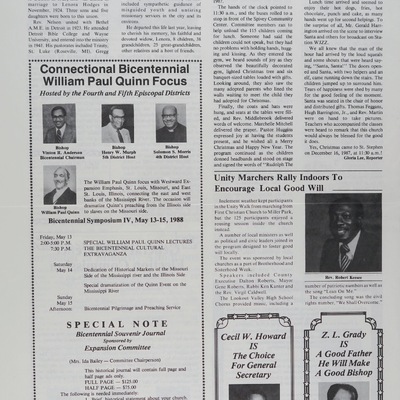
with William Paul Quinn
Bishop William Paul Quinn
The Great Expansionist
The four horsemen of the Libera-
tion Church, Richard Allen, William
Paul Quinn, Daniel Alexander Payne
and Henry McNeil Turner, were bis-
hops in the African Methodist Epis-
copal Church. Bishop Richard Allen,
the first consecrated bishop, was
founder, organizer and the ‘‘Apostle
of Freedom.’’ Bishop William Paul
Quinn, the fourth elected bishop, was
the great expansionist who extended
the A.M.E. Church westward and be-
yond the Mississippi River. Bishop
Daniel Alexander Payne, the sixth
elected bishop, was a pioneer in educa-
tion and a founder of Wilberforce
University, the oldest institution of
higher education owned and controlled
by Blacks. Bishop Henry McNeil
Turner, the twelfth elected bishop, was
the social activist, legislator, organizer
of the A.M.E. Church in South Africa,
and was the first Black military chap-
lain.
The Bicentennial Celebration Chair-
man, Bishop Vinton R. Anderson,
along with his committee, has pre-
sented commemoration plaques at the
point of focus for three of the four
Bishop Vinton R. Anderson
Bicentennial Chairman
horsemen. The church will meet in St.
Louis to present the Bishop Quinn
plaque. These celebrations attract
both local and national leaders, as well
as the connectional church. We gather
to honor the life and labors of great
pioneer leaders of the African Metho-
dist Episcopal Church.
The dates for this Quinn meeting are
May 13-15, 1988, with celebrations on
both sides of the Mississippi River, in
East St. Louis, Illinois, and St. Louis,
Missouri. There will be preaching,
singing, banqueting and Quinn lec-
tures.
The Bicentennial Celebration
planned by Bishop Anderson and his
commission has been an exciting one.
All of the bishops and general officers
and the church at large have been on
hand to participate in and be witnesses
to the 200th-year celebration of Afri-
can Methodism.
One historian has said, ‘‘At the Cen-
tennial Celebration in 1887, it was es-
timated that forty percent of the peo-
ple of African descent in the United
Please turn to page 7
PRICE: 50 CENTS
1787-1987
Bethel Holds Special
Bicentennial
Re-Enactment Service
Freeport, NY—‘‘O, Lord, my God...
how great thou art!’’ And great it was!
A momentous and memorable day in
the history of Bethel African Metho-
dist Episcopal Church: Founder’s
Day, 1988. The First Annual
Founder’s Day celebration for the
church was a unique and unusual ex-
perience, to say the least.
We went back in time to a church
service of two hundred years ago. The
sanctuary was darkened and illumi-
nated only with candles in the win-
dows. There was no organized order of
service; scriptures were read, ran-
domly, by Evangeline Ulner, Mae
Felder and Leslie Jackson. A moving
and emotion-charged version of the
Twenty-Third Psalm was rendered by
Mrs. Helen Meyers. Beautiful and
timely hymns and spirituals were sung
by the church choir a cappella. In addi-
tion, the choir complemented their
singing with the foot patting remini-
scent of the times.
Bishop Frank Curtis Cummings,
presiding prelate of the First Episcopal
District of the First Episcopal District
of the African Methodist Episcopal
Church, delivered the afternoon ser-
mon—a message that was electrifying
and challenging.
Bishop F. C. Cummings
(Guest Preacher)
The spirituality of the day was en-
hanced tremendously by the support
and participation of the congregation,
sister churches and the community, all
adorned in fashions reflecting the time.
Mayor Dorothy Storm of Freeport,
representatives of Allen A.M.E.
Church, Jamaica; St. Paul A.M.E.
Church, Rockville Centre; Bethel
A.M.E. Church, Far Rockaway;
Greater Second Baptist Church, Free-
port; and the Freeport Church of God,
all of New York were in attendance.
Mayor Storm presented Bethel with a
proclamation honoring the inception
of the African Methodist Episcopal
Church, celebrating its Bicentennial,
Please turn to page 7
114th Church Anniversary
Hears General Officer Reid
Dr. R. H. Reid, Jr.
General Officer
ee ee
Warren, OH—Grace African Metho-
dist Church, the oldest Black church in
the City of Warren, celebrated its
114th anniversary on Sunday, March
20, 1988. The fitting theme for the cel-
ebratory occasion was ‘‘We Have
Come This Far By Faith.”
Despite the eight inches of new snow
that fell early on Sunday morning, the
church was packed with eager wor-
shipers, who gave an enthusiastic
reception to the Reverend Dr. Robert
H. Reid, Jr., guest speaker for the an-
niversary celebration. A General Of-
ficer of the A.M.E. connection, Rev.
Reid is currently serving as Editor of
the A.M.E. Christian Recorder in
Nashville, Tennessee. The newspaper
is the oldest continuously-circulated
Rev. Ernest Dokes
Pastor, Grace A.M.E. Church
paper owned by Blacks.
Rev. Reid preached from St. Mark,
Chapter 9, Verses 23 and 24. “Faith
That Makes A Difference’? was the
subject of his Spirit-filled sermon that
blessed the souls of everyone in atten-
dance. All choirs of the church partici-
pated in the dynamic service and the
guest speaker commended the spiritual
talent found in Grace Church.
Following the service of celebration,
dinner was served in the fellowship hall
for everyone in attendance.
Chairperson for the joyous occasion
was Mrs. Delores J. Williams. Mrs.
Lillie Brooks served as co-chairperson.
Pastor of Grace A.M.E. Church is
the Rev. Ernest Dokes. Rev. Hulean
Tynes is an associate to the pastor.
oo
# 4842
DR
8)
wi
wi
===== DSC05488.JPG =====
The AME Christian Recorder April 18, 1988
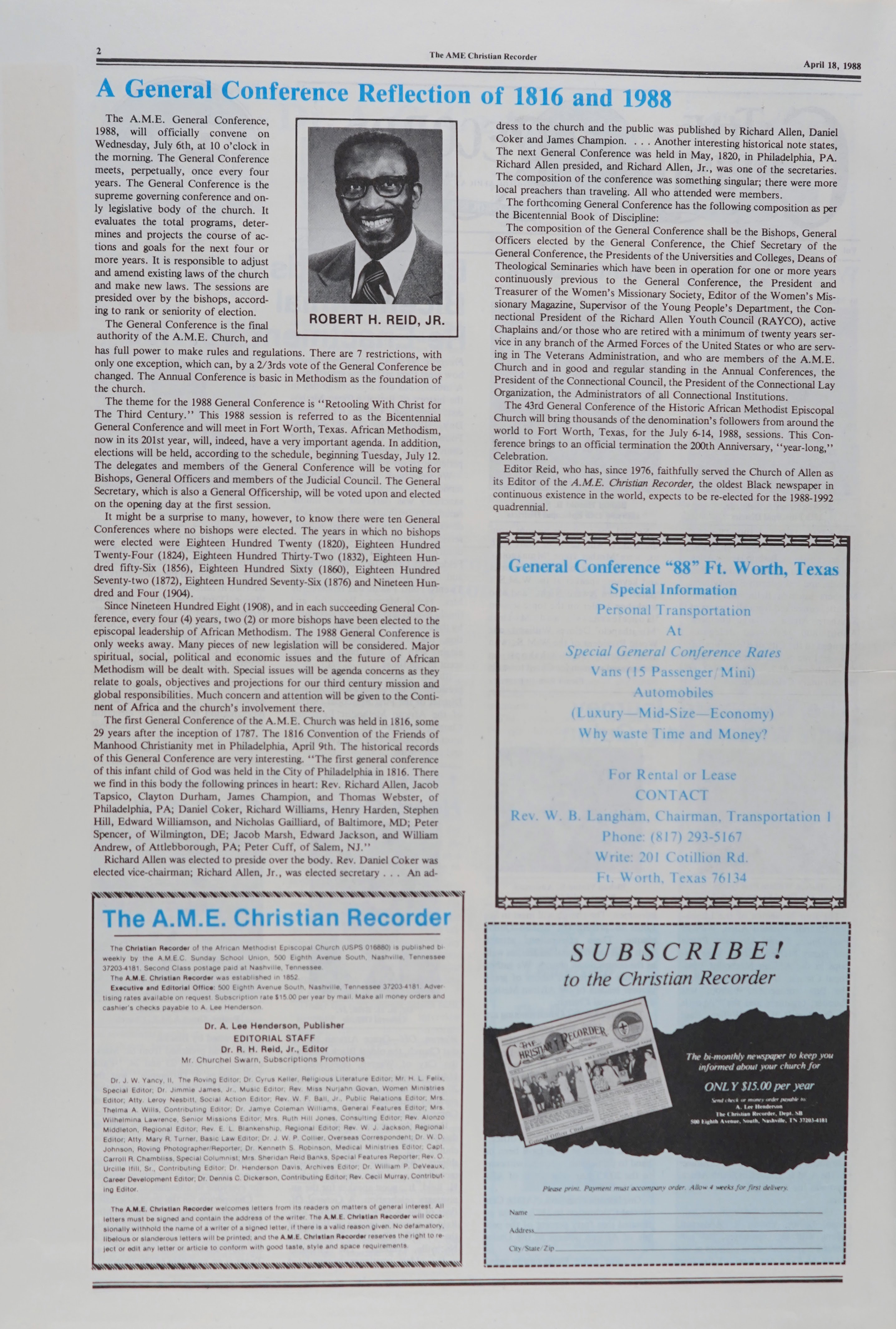
A General Conference Reflection of 1816 and 1988
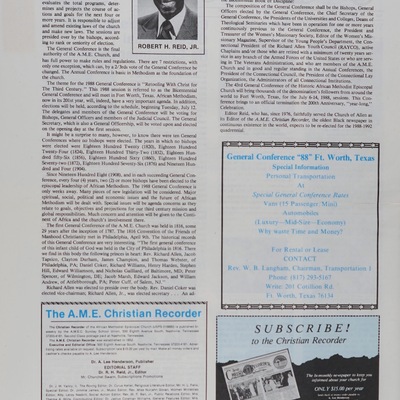
The A.M.E. General Conference,
1988, will officially convene on
Wednesday, July 6th, at 10 o’clock in
the morning. The General Conference
meets, perpetually, once every four
years. The General Conference is the
supreme governing conference and on-
ly legislative body of the church. It
evaluates the total programs, deter-
mines and projects the course of ac-
tions and goals for the next four or
more years. It is responsible to adjust
and amend existing laws of the church
and make new laws. The sessions are
presided over by the bishops, accord-
ing to rank or seniority of election.
The General Conference is the final
authority of the A.M.E. Church, and
has full power to make rules and regulations. There are 7 restrictions, with
only one exception, which can, by a 2/3rds vote of the General Conference be
changed. The Annual Conference is basic in Methodism as the foundation of
the church.
The theme for the 1988 General Conference is “Retooling With Christ for
The Third Century.’’ This 1988 session is referred to as the Bicentennial
General Conference and will meet in Fort Worth, Texas. African Methodism,
now in its 201st year, will, indeed, have a very important agenda. In addition,
elections will be held, according to the schedule, beginning Tuesday, July 12.
The delegates and members of the General Conference will be voting for
Bishops, General Officers and members of the Judicial Council. The General
Secretary, which is also a General Officership, will be voted upon and elected
on the opening day at the first session.
ROBERT H. REID, JR.
dress to the church and the public was published by Richard Allen, Daniel
Coker and James Champion. . . . Another interesting historical note states,
The next General Conference was held in May, 1820, in Philadelphia, PA.
Richard Allen presided, and Richard Allen, Jr., was one of the secretaries.
The composition of the conference was something singular; there were more
local preachers than traveling. All who attended were members.
The forthcoming General Conference has the following composition as per
the Bicentennial Book of Discipline:
The composition of the General Conference shall be the Bishops, General
Officers elected by the General Conference, the Chief Secretary of the
General Conference, the Presidents of the Universities and Colleges, Deans of
Theological Seminaries which have been in operation for one or more years
continuously previous to the General Conference, the President and
Treasurer of the Women’s Missionary Society, Editor of the Women’s Mis-
sionary Magazine, Supervisor of the Young People’s Department, the Con-
nectional President of the Richard Allen Youth Council (RAYCO), active
Chaplains and/or those who are retired with a minimum of twenty years ser-
vice in any branch of the Armed Forces of the United States or who are serv-
ing in The Veterans Administration, and who are members of the A.M.E.
Church and in good and regular standing in the Annual Conferences, the
President of the Connectional Council, the President of the Connectional Lay
Organization, the Administrators of all Connectional Institutions.
The 43rd General Conference of the Historic African Methodist Episcopal
Church will bring thousands of the denomination’s followers from around the
world to Fort Worth, Texas, for the July 6-14, 1988, sessions. This Con-
ference brings to an official termination the 200th Anniversary, ‘‘year-long,’’
Celebration.
Editor Reid, who has, since 1976, faithfully served the Church of Allen as
its Editor of the A.M.E. Christian Recorder, the oldest Black newspaper in
continuous existence in the world, expects to be re-elected for the 1988-1992
quadrennial.
It might be a surprise to many, however, to know there were ten General
Conferences where no bishops were elected. The years in which no bishops
were elected were Eighteen Hundred Twenty (1820), Eighteen Hundred
Twenty-Four (1824), Eighteen Hundred Thirty-Two (1832), Eighteen Hun-
dred fifty-Six (1856), Eighteen Hundred Sixty (1860), Eighteen Hundred
Seventy-two (1872), Eighteen Hundred Seventy-Six (1876) and Nineteen Hun-
dred and Four (1904).
Since Nineteen Hundred Eight (1908), and in each succeeding General Con-
ference, every four (4) years, two (2) or more bishops have been elected to the
episcopal leadership of African Methodism. The 1988 General Conference is At
only weeks away. Many pieces of new legislation will be considered. Major
spiritual, social, political and economic issues and the future of African
Methodism will be dealt with. Special issues will be agenda concerns as they
relate to goals, objectives and projections for our third century mission and
global responsibilities. Much concern and attention will be given to the Conti-
nent of Africa and the church’s involvement there.
The first General Conference of the A.M.E. Church was held in 1816, some
29 years after the inception of 1787. The 1816 Convention of the Friends of
Manhood Christianity met in Philadelphia, April 9th. The historical records
of this General Conference are very interesting. ‘“The first general conference
of this infant child of God was held in the City of Philadelphia in 1816. There
we find in this body the following princes in heart: Rev. Richard Allen, Jacob
Tapsico, Clayton Durham, James Champion, and Thomas Webster, of
Philadelphia, PA; Daniel Coker, Richard Williams, Henry Harden, Stephen
Hill, Edward Williamson, and Nicholas Gailliard, of Baltimore, MD; Peter
Spencer, of Wilmington, DE; Jacob Marsh, Edward Jackson, and William Phone: (817) 293-5167
Andrew, of Attlebborough, PA; Peter Cuff, of Salem, NJ.’’ i
Richard Allen was elected to preside over the body. Rev. Daniel Coker was Write: 201 Cotillion Rd
elected vice-chairman; Richard Allen, Jr., was elected secretary ... An ad- Ft. Worth. Texas 76134
General Conference “88” Ft. Worth, Texas
Special Information
Personal Transportation
Special General Conference Rates
Vans (15 Passenger/ Mini)
Automobiles
(Luxury—Mid-Size—Economy)
Why waste Time and Money?
For Rental or Lease
CONTACT
Rev. W. B. Langham, Chairman, Transportation |
J NNEANSN ANA NA NANA NA NANNING
The A.M.E. Christian Recorder
The Christian Recorder o! the African Methodist Episcopal Church (USPS 016880) is published bi
weekly by the A.M.E.C. Sunday School Union, 500 Eighth Avenue South, Nashville, Tennessee
37203-4181. Second Class postage paid at Nashville, Tennessee
The A.M.E. Christian Recorder was established in 1652
Executive and Editorial Office: 500 Eigntn Avenue South, Nashville, Tennessee 37203-4181. Adver
tising rates available on request. Subscription rate $15.00 per year by mail Make all money orders and
SUBSCRIBE?
to the Christian Recorder
cashier's checks payabie to A. Lee Henderson
Dr. A. Lee Henderson, Publisher
EDITORIAL STAFF
Dr. R. H. Reid, Jr., Editor
The bi-monthly newspaper to keep you
Mr. Churchel Swarn, Subscriptions Promotions
informed about your church for
7 101 rature Editor: Mr. H. L. Felix ie aed
Or. J. W. Yancy, tl, The Roving Editor, Or. Cyrus Keller, Religious Literature Ed M l eet : $15 sober nee
Special Editor; Dr. Jimmie James, Jr, Music Editor, Rev. Miss Nurjann Govan, Women Ministries !
S Public Fi tions Editor, Mrs x PES cs SER
Editor; Atty. Leroy Nesbitt, Social Action Editor, Rev. W. F. Ba b ela . tr money er
Thelma A. Willis, Contributing Editor, Or, Jamye Coleman Williams, General Features Edito’ s The Christian Recorder, Dept. SB 3
sir ‘ . . TN med
Wiiheimina Lawrence, Senior Missions Editor, Mrs. Ruth Hill Jones, Consulting Editor; Rev. Alonz saa usin Atanen, Besth, Nesbelle, TW YEND-I01
Middleton, Regional Editor, Rev E. L. Blankenship, Regiona Editor, Rev. W. J. Jackson, Regiona
rondent; Or re)
Editor; Atty. Mary R. Turner, Basic Law Editor, Dr. J. W. P. Collier, Overseas Correspondent, & Ww
Johnson, Roving Photographer/Reporter, Dr. Kenneth S. Robinson, Medical Ministries Editor, Capt i
§ res Reporter, A )
Carroll R. Chambliss, Special Columnist; Mrs. Sheridan Reid Banks, Special Features Reporter, Rev. C ;
f on . hiv or, Or, William P, DeVeaux
Urcille Ifill, Sr., Contributing Editor, Or. Henderson Davis, Archives Eo . Or x piri '
> a] ontributing Editor, Rev. Ceci! Murray, Co!
lopment Editor; Or, Dennis C. Dickerson, Con ; |
ing econ. a Please print. Payment must accornpany order, Allow 4 weeks for first delivery. 1
ing Editor ' :
1
on of general interest. All H
The AM.E. Christian Recorder welcomes letters trom its readers on matters of 9 * . i hie Bah ae '
letters must be signed and contain the address of the writer, The A.M.E. Christian Recorder wil! occ '
\ on gi © detamatory a
sionally withhold the name of a writer of a signed letter it there is a valid reason given. No detar ; ia, : haa ad '
r ight to r
libelous or slanderous letters will be printed; and the A.M.E. Christian Recorder reserves (he right to re ' '
0 \ J space requirements State/Zip - $$ $$ 1
ject or edit any letter or article to conform with good taste, style and ap QU ' Oty State/Zig i
: eee ew en ee ce eee nae eneeeeasesasesesanonad
NANAAANANANANANARANANANA NANA ATA ATT AA ee
===== DSC05489.JPG =====
Age WA Re
the «ee
Wer deobbecd Migu verdes
The Voice of the Episcopac
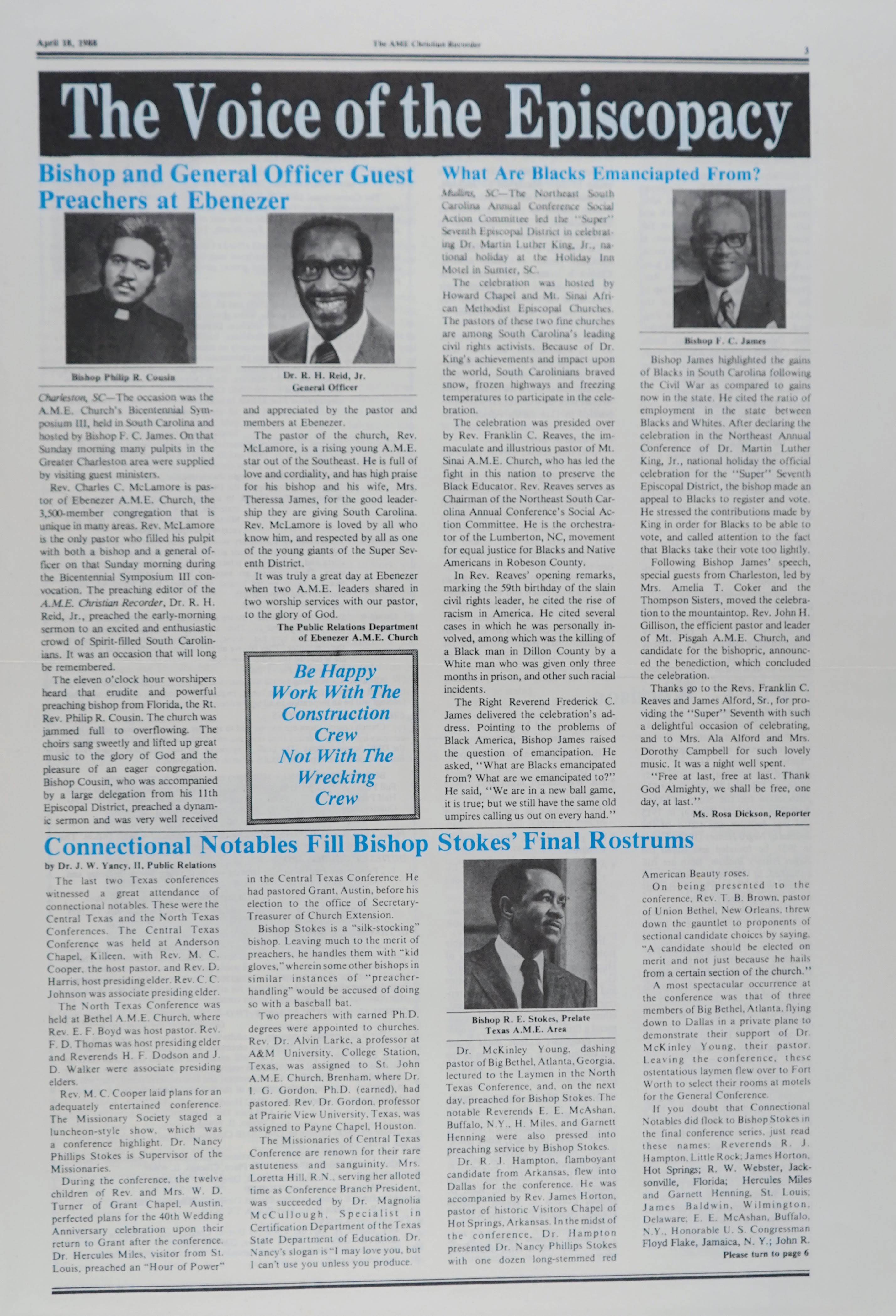
Bishop and General Officer Guest
Preachers at Ebenezer
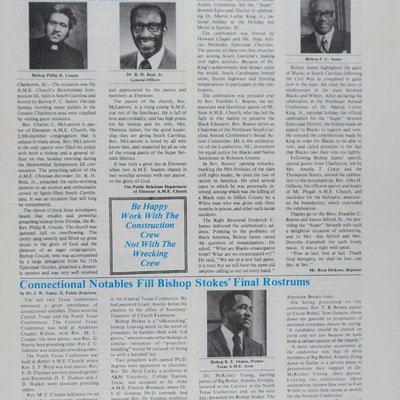
Bahop Philip R. Cousin
Chariesion, SC The Gocasion was the
A.M.E. Church's Bicentenmal Sym
posium [1], held in South Carolina and
hosted by Bishop F.C. James. On that
Sunday morning many pulpits in the
Greater Charleston area were supplied
by visiting gues! ministers.
Rev. Charles C. McLamore ts pas-
tor of Ebenezer A.M.E. Church, the
3,500-member congregation that is
unique in many areas. Rev. McLamore
is the only pastor who filled his pulpit
with both a bishop and a general of-
ficer on that Sunday morning during
the Bicentennial Symposium III con-
vocation. The preaching editor of the
A.M.E. Christian Recorder, Dr. R. H.
Reid, Jr., preached the early-morning
sermon to an excited and enthusiastic
crowd of Spirit-filled South Carolin-
ians. It was an occasion that will long
be remembered.
The eleven o'clock hour worshipers
heard that erudite and powerful
preaching bishop from Florida, the Rt.
Rev. Philip R. Cousin. The church was
jammed full to overflowing. The
choirs sang sweetly and lifted up great
music to the glory of God and the
pleasure of an eager congregation.
Bishop Cousin, who was accompanied
by a large delegation from his 11th
Episcopal District, preached a dynam-
ic sermon and was very well received
by Dr. J. W. Yancy, II, Public Relations
The last two Texas conferences
witnessed a great attendance of
connectional notables. These were the
Central Texas and the North Texas
Conferences. The Central Texas
Conference was held at Anderson
Chapel, Killeen, with Rev. M. C
Cooper. the host pastor. and Rev. D.
Harris, host presiding elder. Rev.C.C
Johnson was associate presiding elder
The North Texas Conference was
held at Bethe! A-M.E. Church, where
Rev. E. F. Boyd was host pastor. Rev
F. D. Thomas was host presiding elder
and Reverends H. F. Dodson and J
D. Walker were associate presiding
elders
Rev. M. C. Cooper laid plans for an
adequately entertained conference
The Missionary Society
luncheon-style show, which was
a conference highlight. Dr. Nancy
Phillips Stokes is Supervisor of the
Missionaries
During the conference, the twelve
children of Rev. and Mrs. W. D
Turner of Grant Chapel, Austin.
perfected plans for the 40th Wedding
Anniversary celebration upon their
return to Grant after the conference
Dr. Hercules Miles, visitor from St
staged a
Louis, preached an “Hour of Power”
Dr. R. H. Reid, Jr.
General Officer
ami appreciated by the pastor and
members at Ebenezer
The pastor of the church, Rev.
McLamore, is a rising young A.M.E.
star out of the Southeast. He is full of
love and cordiality, and has high praise
for his bishop and his wife, Mrs.
Theressa James, for the good leader-
ship they are giving South Carolina.
Rev. McLamore is loved by all who
know him, and respected by all as one
of the young giants of the Super Sev-
enth District.
It was truly a great day at Ebenezer
when two A.M.E. leaders shared in
two worship services with our pastor,
to the glory of God.
The Public Relations Department
of Ebenezer A.M.E. Church
Be Happy
Work With The
Construction
Crew
Not With The
Wrecking
Crew
DASSAULT is
in the Central Texas Conference. He
had pastored Grant, Austin, before his
election to the office of Secretary-
Treasurer of Church Extension.
Bishop Stokes is a “silk-stocking”
bishop. Leaving much to the merit of
preachers, he handles them with “kid
gloves,” wherein some other bishops in
similar instances of “preacher-
handling” would be accused of doing
so with a baseball bat
Two preachers with earned Ph.D.
degrees were appointed to churches.
Rev. Dr. Alvin Larke, a professor at
A&M University, College Station,
Texas, was assigned to St. John
A.M.E. Church, Brenham, where Dr
1. G. Gordon. Ph.D. (earned), had
pastored. Rev. Dr. Gordon, professor
at Prairie View University, Texas, was
assigned to Payne Chapel, Houston
The Missionaries of Central Texas
Conference are renown for their rare
astuteness and sanguinity. Mrs
Loretta Hill. R.N.. serving her alloted
time as Conference Branch President,
was succeeded by Dr. Magnolia
McCullough,
Certification Department of the Texas
State Department of Education. Dr
Nancy’s slogan is “] may love you, but
Specialist in
I can't use you unless you produce
What Are Blacks Emanciapted From?
Khadirs MM Tie Nottheast South
(aolim Amwal Con!
Action males led
ing Dr. Martin Luther King, Jr., na
omal holnday af the Holulay le
Moicl in Sumter,
The celebration was hosted by
Howard Chapel and Mi. Sinai Afni
can Methodist Epescopal Churches
The pastors of these two fine churches
are among South Carolina's icading
cil nghis activists. Because of Di
King's achievements and impact upon
the world, South Carolinians braved
snow, frozen highways and freezing
temperatures lo participate in the cele
bration.
The celebration was presided over
by Rev, Franklin C. Reaves, the im
maculate and illustrious pastor of Mt
Sinai A.M.E. Church, who has led the
fight in this nation to preserve the
Black Educator. Rev. Reaves serves as
Chairman of the Northeast South Car-
olina Annual Conference's Social Ac-
tion Committee, He is the orchestra-
tor of the Lumberton, NC, movement
for equal justice for Blacks and Native
Americans in Robeson County.
In Rev. Reaves’ opening remarks,
marking the 59th birthday of the slain
civil rights leader, he cited the rise of
racism in America. He cited several
cases in which he was personally in-
volved, among which was the killing of
a Black man in Dillon County by a
White man who was given only three
months in prison, and other such racial
incidents.
The Right Reverend Frederick C.
James delivered the celebration’s ad-
dress. Pointing to the problems of
Black America, Bishop James raised
the question of emancipation. He
asked, ‘‘What are Blacks emancipated
from? What are we emancipated to?’’
He said, ‘‘We are in a new ball game,
it is true; but we still have the same old
umpires calling us out on every hand.”’
Bishop R. E. Stokes, Prelate
Texas A.M.E. Area
Dr. McKinley Young, dashing
pastor of Big Bethel, Atlanta, Georgia,
lectured to the Laymen in the North
Texas Conference, and, on the next
day, preached for Bishop Stokes The
notable Reverends E. E. McAshan,
Buffalo, N.Y., H. Miles, and Garnett
Henning were also pressed into
preaching service by Bishop Stokes
Dr. R. J. Hampton, flamboyant
candidate from Arkansas, flew into
Dallas for the conference. He was
accompanied by Rey. James Horton,
pastor of historic Visitors Chapel of
Hot Springs, Arkansas. Inthe midst of
the conference, Dr. Hampton
presented Dr. Nancy Phillips Stokes
with one dozen long-stemmed red
Bishop F. ©, James
Bishop James highlighted the gains
of Blacks in South Carolina following
the Civil War as compared to gains
now in the state. He cited the ratio of
employment in the state between
Blacks and Whites, After declaring the
celebration in the Northeast Annual
Conference of Dr. Martin Luther
King, Jr., national holiday the official
celebration for the ‘*Super’’ Seventh
Episcopal District, the bishop made an
appeal to Blacks to register and vote
He stressed the contributions made by
King in order for Blacks to be able to
vote, and called attention to the fact
that Blacks take their vote too lightly.
Following Bishop James’ speech,
special guests from Charleston, led by
Mrs. Amelia T. Coker and the
Thompson Sisters, moved the celebra-
tion Lo the mountaintop. Rev. John H.
Gillison, the efficient pastor and leader
of Mt. Pisgah A.M.E. Church, and
candidate for the bishopric, announc-
ed the benediction, which concluded
the celebration.
Thanks go to the Revs. Franklin C.
Reaves and James Alford, Sr., for pro-
viding the ‘‘Super’’ Seventh with such
a delightful occasion of celebrating,
and to Mrs. Ala Alford and Mrs.
Dorothy Campbell for such lovely
music. It was a night well spent.
‘Free at last, free at last. Thank
God Almighty, we shall be free, one
day, at last.’’
Ms. Rosa Dickson, Reporter
American Beauty roses
On being presented to the
conference, Rev. T. B. Brown, pastor
of Union Bethel, New Orleans, threw
down the gauntlet to proponents of
sectional candidate choices by saying.
“A candidate should be elected on
merit and not just because he hails
from a certain section of the church.”’
A most spectacular occurrence at
the conference was that of three
members of Big Bethel, Atlanta, flying
down to Dallas in a private plane to
demonstrate their support of Dr
McKinley Young, thei pastor
Leaving the conference, these
ostentatious laymen flew over to Fort
Worth to select their rooms at motels
for the General Conference
If you doubt that Connectional
Notables did flock to Bishop Stokes in
the final conference series, just read
these names: Reverends R. J
Hampton, Little Rock; James Horton,
Hot Springs; R. W. Webster, Jack-
sonville, Florida; Hercules Miles
and Garnett Henning, St. Louis;
James Baldwin, Wilmington
Delaware; E. E. McAshan, Buffalo,
N_Y., Honorable U. S. Congressman
Floyd Flake, Jamaica, N. Y.; John R.
Please turn to page 6
SE
===== DSC05490.JPG =====
The AME Christian Recorder
Church Celebrating
222nd Anniversary
by Merle English
Brooklyn's oldest Black church, the
Bridge Street A.M.E. Wesleyan
Church, is observing its 222nd anni-
versary this year, and the church and
city officials, headed by Mayor Ed-
ward I Koch, will join parishioners at
weekend services celebrating the event.
The keynote preacher at an 11 a.m.
service on Saturday will be Rt. Rev.
Frank Cummings, presiding bishop of
the First Episcopal District of the
A.M.E. Church (including New Eng-
land, New York, New Jersey, Philadel-
phia, Deleware and Bermuda). Koch,
City Council President Andrew Stein,
City Comptroller Harrison J. Goldin,
State Sen. Velmanette Montgomery,
Assemb. Albert Van, Councilwoman
Mary Pinkett, Councilman Enoch
Williams and civic and business leaders
are among those expected to attend.
As part of the service, the mortgage
documents for a $346,000 loan on a
completed $750,000 expansion project
at the church, at 277 Stuyvesant
Avenue, will be burned. The church
raised the remainder of the funds,
which were used to refurbish a
200-seat chapel, install an elevator,
add a new floor of administrative of-
fices for 14 employees, a lounge for
the elderly and a new kitchen and con-
ference room.
The church is also celebrating the
purchase of an adjourning apartment
building that is to be converted into a
preparatory school and community
center with day care and senior citizens
facilities. The model for the new pro-
ject will be unveiled at the service, and
the renovated chapel rededicated in the
name of Rev. Mansfield E. Jackson,
the pastor under whose leadership the
church moved 50 years ago from its
first location at 309 Bridge Street in
Downtown Brooklyn.
On Sunday, Rep. Floyd Flake (D-
Queens), pastor of Allen A.M.E.
Church in Jamaica, will preach at the
11 a.m. service. The special guest
preacher at the 8 a.m. service that day
will be the Rev. Gregory Groover of
Bright Temple in the Bronx.
Bridge Street Church traces its roots
to 1776 when Blacks, who were rele-
gated to the back of a White Metho-
dist church in Downtown Brooklyn
and required to pay a fee to attend, left
to start their own church. It was incor-
porated in 1818 as the African Wes-
leyan Methodist Episcopal Church of
the Village of Brooklyn Inc.
At its former site, the church served
as a stop on the Underground Railroad
for slaves fleeing the South. It produc-
ed many outstanding Black leaders, in-
cluding Brooklyn’s first Black licensed
undertaker, its first Black policeman
and its first Black doctor. The church
also organized the first school for
Black children in Brooklyn and created
one of the earliest relief societies de-
signed to help indigent Black widows
and orphans, which still exists today.
The Rev. Fred Lucas, pastor of the
church, said the 4,000-member con-
gregation has chosen as its theme for
the anniversary year: ‘‘To dream the
Impossible Dream: With God all
things are possible.”’
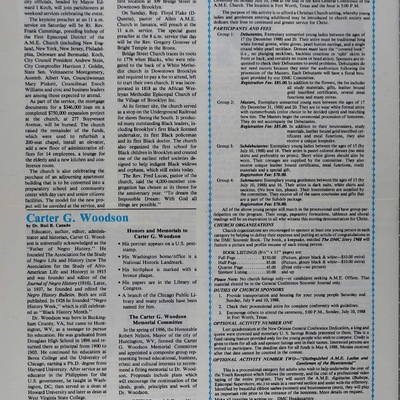
Carter G. Woodson
by Dr. Roii B. Canado
Educator, author, editor, adminis-
trator and historian, Carter G. Wood-
son is universally acknowledged as the
“Father of Negro History.’’ He
founded The Association for the Study
of Negro Life and History (now The
Association for the Study of Afro-
American Life and History) in 1915
and was founder and editor of the
Journal of Negro History (1916). Later,
in 1937, he founded and edited the
Negro History Bulletin. Both are still
published. In 1926 he founded ‘‘Negro
History Week,”’ which is still celebrat-
ed as ‘‘Black History Month.”’
Dr. Woodson was born in Bucking-
ham County, VA, but came to Hunt-
ington, WV, as a teenager to pursue
his education. He was graduated from
Honors and Memorials to
Carter G. Woodson
© His portrait appears on a U.S. post-
stamp.
e His Washington home/office is a
National Historic Landmark.
e His birthplace is marked with a
bronze plaque.
e His papers are in the Library of
Congress.
e A branch of the Chicago Public Li-
brary and many schools have been
named for him.
The Carter G. Woodson
Memorial Committee
In the spring of 1986, the Honorable
Robert Nelson, Mayor of the city of
Please Note: No church listings only—or candidates seeking A.M.E. Offices. That
DUTIES OF CHURCH SPONSORS
OPTIONAL ACTIVITY NUMBER ONE
April 18, 1988
Connectional Christian Debutante—
Master Dedication Commission
TO; Presiding Elders, Pastors, Directors of Christian Education, Y.P.D. and
W.M.S, Presidents, Sunday School Superintendents and Teachers, Youth
Choir, and Youth Usher Supervisors, Youth Lay Organization Leaders,
Other Youth Group Leaders of the A.M.E. Local Church, Concerned
Parents, Relatives and Interested Friends of Young People.
FROM: Dr. Julma B, Crawford, Connectional Administrator, Connectional Chris-
tain DMC, 1744 East 73rd Place, Chicago, IL 60649 (1-312-752-6199).
The Connectional DMC Planning Committee is requesting your cooperation in
the presentation of the Tenth Quadrennial Christian Debutante-Master Dedication ¢
Ceremony on Sunday July 10, 1988 at the seat of the 43rd General Conference of the 4
A.M.E. Church, The location is Fort Worth, Texas and the hour is 5:00 P.M.
The purpose of this activity is to afford a Christian Church setting, whereby young ¢
ladies and gentlemen entering adulthood may be introduced to church society and ¢
dedicate their lives to continued and greater service for Christ.
PARTICIPANTS AND FEES
Group 1: Debutantes, Exemplary unmarried young ladies between the ages of
17 (by December 1988) and 20. Their attire must be traditional long
white formal gowns, white gloves, pearl button earrings, and a single
strand white pearl necklace. Dresses must have the ‘‘covered look’’
(i.e., no plunging necklines, backless creations or ‘split’ skirts in
front or back, and certainly no trains or head attire). Sponsors are re-
quested to check their Debutantes to avoid problems. Debutantes do
not need escorts because they enter the auditorium following the
procession of the Masters. Each Debutante will have a floral bou-
quet provided by our DMC Committee.
Registration Fee: $85.00. 1n addition to the flowers, the fee includes
all study materials, gifts, leather bound
gold inscribed certificates, several meal
functions and many extras.
Group 2: Masters, Exemplary unmarried young men between the ages of 17
(by December 31, 1988) and 20. They are to wear white formal attire
with cummerbunds (color choice to be decided upon) and matching
bow ties. The Masters begin the ceremonial procession of honorees.
They do not accompany the Debutantes.
Registration Fee: $85.00. In addition to their boutonniere, study
materials, leather bound gold inscribed cer-
tificates and meal functions, they also
receive a unique keepsake.
Group 3: Subdebutantes: Exemplary young ladies between the ages of 15 (by
July 10, 1988) and 16. Their attire is pastel colored dresses (no mini
skirts and preferably no prints). Short white gloves should also be
worn. Their corsages are supplied by the committee. They also
receive unique leather bound certificates, meal, functions, study
materials and a special gift.
Registration Fee: $70.00.
Group 4: Submasters: Exemplary young gentlemen between the ages of 15 (by
July 10, 1988) and 16. Their attire is dark suits, white shirts and
neckties. (No bow ties, please). Their boutonnieres are supplied by
the committee. They receive all of the same courtesies and gifts that
are a part of the Subdeb package.
Registration Fee: $70.00.
All of the above young people will march in the processional and have group par- 4
ticipation on the program. Their songs, pageantry formations, tableaux and choral ¢
readings will be an inspiration to all who witness this moving demonstration for Christ.
CHURCH ORGANIZATIONS
Church organizations are encouraged to sponsor at least one young person in each }
category by helping to defray their expenses and putting an article of congratulations in
the DMC Souvenir Book. The book, a keepsake, entitled The DMC Story 1988 will \
feature a picture and profile resume of each young person.
BOOK LISTINGS (8%”’ x 11’’ pages) are:
Full Pageji1 0.2207 - $150.00 (Picture, glossy black & white—$10.00 extra)
Half Page pie sce 85.00 (Picture, glossy black & white—$10.00 extra)
Quarter Page........... 45.00 (Print only—no picture)
Sponsor Listing......... 10.00 and up
material should be in the General Conference Souvenir Journal only.
1. Provide transportation and housing for your young people Saturday and
Sunday, July 9 and 10, 1988.
2. Check their processional attire for complete conformity with guidelines.
3. Encourage others to attend the ceremony, 5:00 P.M., Sunday, July 10, 1988
in Fort Worth, Texas.
Last quadrennium at the New Orleans General Conference Dedication, a king and
queen were crowned and monetary U. S. Savings Bonds presented to them. This isa }
fund raising feature provided only for the young people who wish to compete. Credit is
given to them for all ads and sponsor listings sent in their names. Interested persons are
invited to participate. The deadline date for all funds is May 4, 1988. Monies received
after that date cannot be counted in the contest.
OPTIONAL ACTIVITY NUMBER TWO—“‘Distinguished A.M.E. Ladies and
Douglass High School in 1896 and re-
turned there as principal from 1900 to
1903. He continued his education at
Berea College and the University of
Huntington, WV, formed the Carter
G. Woodson Memorial Committee
and appointed a composite group rep-
resenting broad educational, business,
Chicago, earning a Ph.D. degree from
Harvard University. After service as an
educator in the Philippines for the
U.S. government, he taught in Wash-
ington, DC, then served as a dean at
Howard University and later as dean at
West Virginia State College.
From 1922 onward, Dr. Woodson
devoted himself full-time to his life’s
goal of gathering, preserving and dis-
seminating information on the politi-
cal, socioeconomic and cultural con-
tributions of Negroes to American his-
tory. Although Dr. Woodson lived in
Washington, DC, for the last period of
his life, he maintained a close connec-
tion with Huntington, where several of
his relatives and friends have remained.
He died on April 3, 1950, and is buried
in Lincoln Memorial Cemetery, Suit-
ethnic and cultural interests to recom-
mend a fitting memorial to Dr. Wood-
son. Proposals include plans which
will encourage the continuation of the
ideals, goals, principles and work of
Dr. Woodson.
The CGW Memorial Committee
R. B. Canado, Chairman; Joseph J.
Bostar III, Vice-Chairman, Treasurer;
Nancy Whear, Secretary; Edna Duck-
worth, Assistant Secretary; Eloise
Slash Barnett; William E. Coffey;
Pauline Fairfax (deceased); Ruth
Finley; James W. Gipson; Alan B.
Gould; Loretta R. Hagler; Charles
Hunter; Newatha Perry, and Ruth C.
Sullivan.
Interested persons contact: R. B.
Canado, 1630 10th Avenue, Huntington,
wy.
\ For further information, contact:
For 6th District contact:
Gentlemen of the Bicentennial’’
This is a processional category for adults who wish to help underwrite the cost of 4
the Youth Reception which follows the ceremony, and the cost of a professional video
taping of the entire program. They will escort the A.M.E. dignitaries (Bishops,
Episcopal Supervisors, etc.) to seats ina reserved section and assist with the offertory.
Identified by beautiful ribbon sashes (women) and boutonnieres (men), they will play
‘an important role prior to the entrance of the honorees. More details on request.
Make all inquiries in writing to: DMC Headquarters
1744 East 73rd Place
Chicago, IL 60649
Make all checks payable to: DMC-AME Church—and send to the above address.
Dr. Julma B. Crawford, Connectional Administrator, Debutante-Master
Commission (DMC), 1744 East 73rd Place, Chicago, IL 60649
Mrs. Sally B. Coleman, 10th District, Director YPD-AMEC
3129 Avenue N, Galveston, TX 77550
Mrs. Izean F. Davidson, 10th District Director of Christian Education
4509 Rolling Hills Drive, Fort Worth, TX 76119
Mrs. Estoria H. Lee, 6th Episcopal District Connectional Dedication Coordi-
nator, Post Office Box 19673, Atlanta, GA NW 30325 — si :
Please help us make this occasion a grandeur ‘‘mountain top’’ experience to be
long remembered!
===== DSC05491.JPG =====
April 18, 1988
The AME Christian Recorder
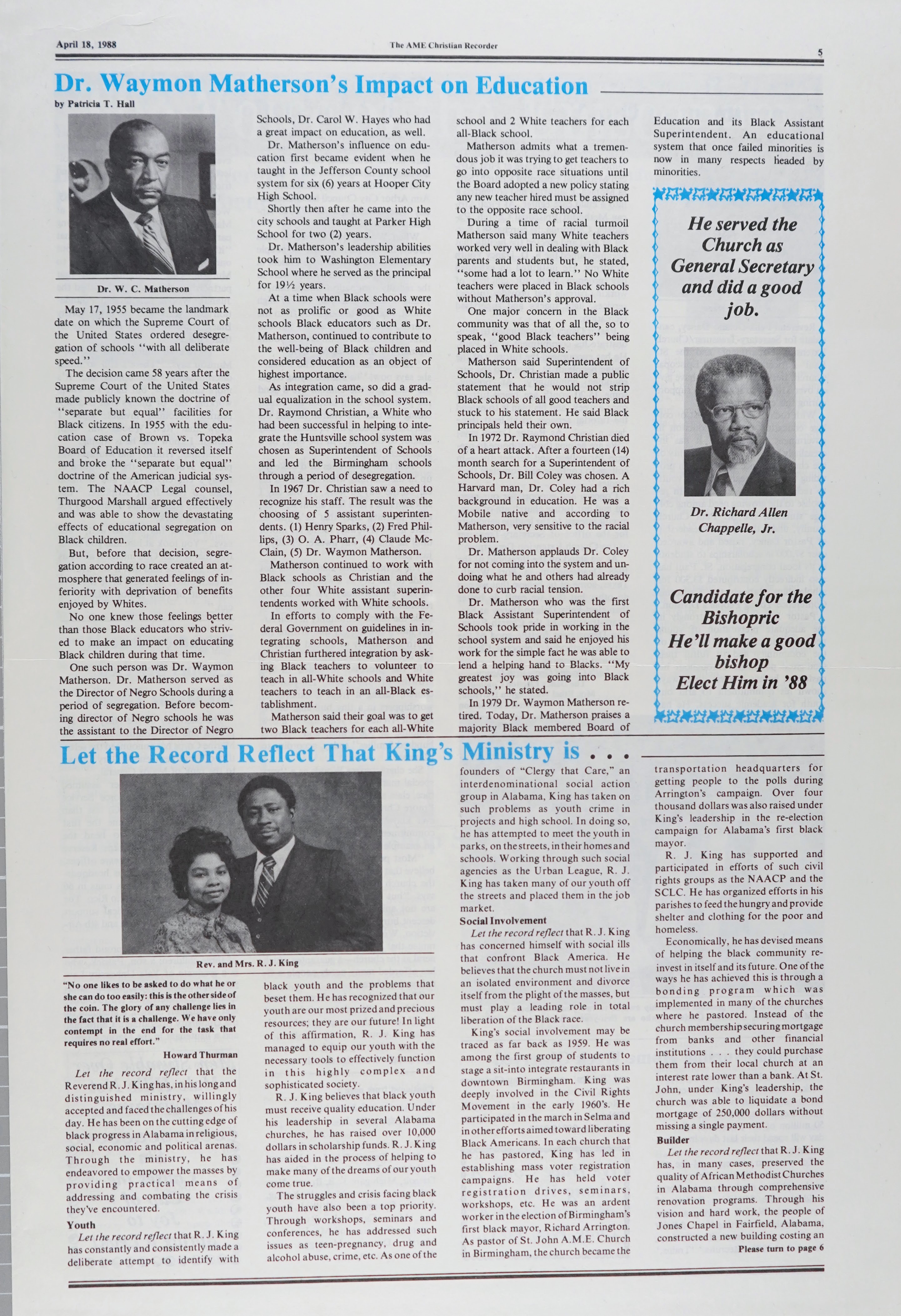
Dr. Waymon Matherson’s Impact on Education
by Patricia T. Hall
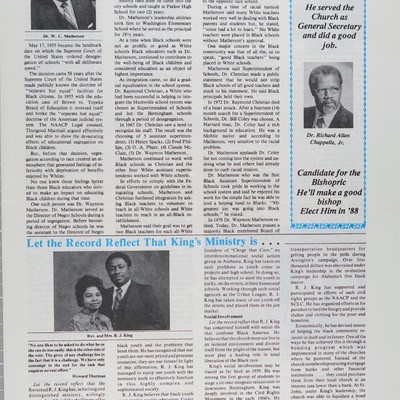
Dr. W. C. Matherson
May 17, 1955 became the landmark
date on which the Supreme Court of
the United States ordered desegre-
gation of schools ‘‘with all deliberate
speed.”’
The decision came 58 years after the
Supreme Court of the United States
made publicly known the doctrine of
“separate but equal’’ facilities for
Black citizens. In 1955 with the edu-
cation case of Brown vs. Topeka
Board of Education it reversed itself
and broke the ‘‘separate but equal’’
doctrine of the American judicial sys-
tem. The NAACP Legal counsel,
Thurgood Marshall argued effectively
and was able to show the devastating
effects of educational segregation on
Black children.
But, before that decision, segre-
gation according to race created an at-
mosphere that generated feelings of in-
feriority with deprivation of benefits
enjoyed by Whites.
No one knew those feelings better
than those Black educators who striv-
ed to make an impact on educating
Black children during that time.
One such person was Dr. Waymon
Matherson. Dr. Matherson served as
the Director of Negro Schools during a
period of segregation. Before becom-
ing director of Negro schools he was
the assistant to the Director of Negro
Schools, Dr. Carol W. Hayes who had
a great impact on education, as well.
Dr. Matherson’s influence on edu-
cation first became evident when he
taught in the Jefferson County school
system for six (6) years at Hooper City
High School.
Shortly then after he came into the
city schools and taught at Parker High
School for two (2) years.
Dr. Matherson’s leadership abilities
took him to Washington Elementary
School where he served as the principal
for 19% years.
At a time when Black schools were
not as prolific or good as White
schools Black educators such as Dr.
Matherson, continued to contribute to
the well-being of Black children and
considered education as an object of
highest importance.
As integration came, so did a grad-
ual equalization in the school system.
Dr. Raymond Christian, a White who
had been successful in helping to inte-
grate the Huntsville school system was
chosen as Superintendent of Schools
and led the Birmingham schools
through a period of desegregation.
In 1967 Dr. Christian saw a need to
recognize his staff. The result was the
choosing of 5 assistant superinten-
dents. (1) Henry Sparks, (2) Fred Phil-
lips, (3) O. A. Pharr, (4) Claude Mc-
Clain, (5) Dr. Waymon Matherson.
Matherson continued to work with
Black schools as Christian and the
other four White assistant superin-
tendents worked with White schools.
In efforts to comply with the Fe-
deral Government on guidelines in in-
tegrating schools, Matherson and
Christian furthered integration by ask-
ing Black teachers to volunteer to
teach in all-White schools and White
teachers to teach in an all-Black es-
tablishment.
Matherson said their goal was to get
two Black teachers for each all-White
school and 2 White teachers for each
all-Black school.
Matherson admits what a tremen-
dous job it was trying to get teachers to
go into opposite race situations until
the Board adopted a new policy stating
any new teacher hired must be assigned
to the opposite race school.
During a time of racial turmoil
Matherson said many White teachers
worked very well in dealing with Black
parents and students but, he stated,
“some had a lot to learn.’? No White
teachers were placed in Black schools
without Matherson’s approval.
One major concern in the Black
community was that of all the, so to
speak, ‘‘good Black teachers’’ being
placed in White schools.
Matherson said Superintendent of
Schools, Dr. Christian made a public
statement that he would not strip
Black schools of all good teachers and
stuck to his statement. He said Black
principals held their own.
In 1972 Dr. Raymond Christian died
of a heart attack. After a fourteen (14)
month search for a Superintendent of
Schools, Dr. Bill Coley was chosen. A
Harvard man, Dr. Coley had a rich
background in education. He was a
Mobile native and according to
Matherson, very sensitive to the racial
problem.
Dr. Matherson applauds Dr. Coley
for not coming into the system and un-
doing what he and others had already
done to curb racial tension.
Dr. Matherson who was the first
Black Assistant Superintendent of
Schools took pride in working in the
school system and said he enjoyed his
work for the simple fact he was able to
lend a helping hand to Blacks. ‘‘My
greatest joy was going into Black
schools,’’ he stated.
In 1979 Dr. Waymon Matherson re-
tired. Today, Dr. Matherson praises a
majority Black membered Board of
Let the Record Reflect That King’s Ministry is...
Rev. and Mrs. R. J. King
“No one likes to be asked to do what he or
she can do too easily: this is the other side of
the coin. The glory of any challenge lies in
the fact that it is a challenge. We have only
contempt in the end for the task that
requires no real effort.”
Howard Thurman
Let the record reflect that the
Reverend R. J. King has, in his longand
distinguished ministry, willingly
accepted and faced the challenges of his
day. He has been on the cutting edge of
black progress in Alabama in religious,
social, economic and political arenas.
Through the ministry, he has
endeavored to empower the masses by
providing practical means of
addressing and combating the crisis
they’ve encountered.
Youth
Let the record reflect that R. J. King
has constantly and consistently made a
deliberate attempt to identify with
black youth and the problems that
beset them. He has recognized that our
youth are our most prizedand precious
resources; they are our future! In light
of this affirmation, R. J. King has
managed to equip our youth with the
necessary tools to effectively function
in this highly complex and
sophisticated society.
R. J. King believes that black youth
must receive quality education. Under
his leadership in several Alabama
churches, he has raised over 10,000
dollars in scholarship funds. R. J. King
has aided in the process of helping to
make many of the dreams of our youth
come true.
The struggles and crisis facing black
youth have also been a top priority.
Through workshops, seminars and
conferences, he has addressed such
issues as teen-pregnancy, drug and
alcohol abuse, crime, etc. As one of the
founders of “Clergy that Care,” an
interdenominational social action
group in Alabama, King has taken on
such problems as youth crime in
projects and high school. In doing so,
he has attempted to meet the youth in
parks, on thestreets, intheir homes and
schools. Working through such social
agencies as the Urban League, R. J.
King has taken many of our youth off
the streets and placed them in the job
market.
Social Involvement
Let the record reflect that R. J. King
has concerned himself with social ills
that confront Black America. He
believes that the church must not livein
an isolated environment and divorce
itself from the plight of the masses, but
must play a leading role in total
liberation of the Black race.
King’s social involvement may be
traced as far back as 1959. He was
among the first group of students to
stage a sit-into integrate restaurants in
downtown Birmingham. King was
deeply involved in the Civil Rights
Movement in the early 1960's. He
participated in the march in Selma and
in other efforts aimed toward liberating
Black Americans. In each church that
he has pastored, King has led in
establishing mass voter registration
campaigns. He has held voter
registration drives, seminars,
workshops, etc. He was an ardent
worker in the election of Birmingham’s
first black mayor, Richard Arrington.
As pastor of St. John A.M.E. Church
in Birmingham, the church became the
Education and its Black Assistant
Superintendent. An educational
system that once failed minorities is
now in many respects headed by
He served the
Church as
General Secretary
and did a good
job.
Dr. Richard Allen
Chappelle, Jr.
Candidate for the
Bishopric
He’ll make a good
bishop
Elect Him in ’88
ELI AEN RIOR a
transportation headquarters for
getting people to the polls during
Arrington’s campaign. Over four
thousand dollars was also raised under
King’s leadership in the re-election
campaign for Alabama's first black
mayor.
R. J. King has supported and
participated in efforts of such civil
rights groups as the NAACP and the
SCLC. He has organized efforts in his
parishes to feed the hungry and provide
shelter and clothing for the poor and
homeless.
Economically, he has devised means
of helping the black community re-
invest in itself and its future. One of the
ways he has achieved this is through a
bonding program which was
implemented in many of the churches
where he pastored. Instead of the
church membership securing mortgage
from banks and other financial
institutions . . . they could purchase
them from their local church at an
interest rate lower than a bank. At St.
John, under King’s leadership, the
church was able to liquidate a bond
mortgage of 250,000 dollars without
missing a single payment.
Builder
Let the record reflect that R. J. King
has, in many cases, preserved the
quality of African Methodist Churches
in Alabama through comprehensive
renovation programs. Through his
vision and hard work, the people of
Jones Chapel in Fairfield, Alabama,
constructed a new building costing an
Please turn to page 6
ee
===== DSC05492.JPG =====
6
The AME Christian Recorder
—eeeeaeueeuuesE= EEE
April 18, 1988
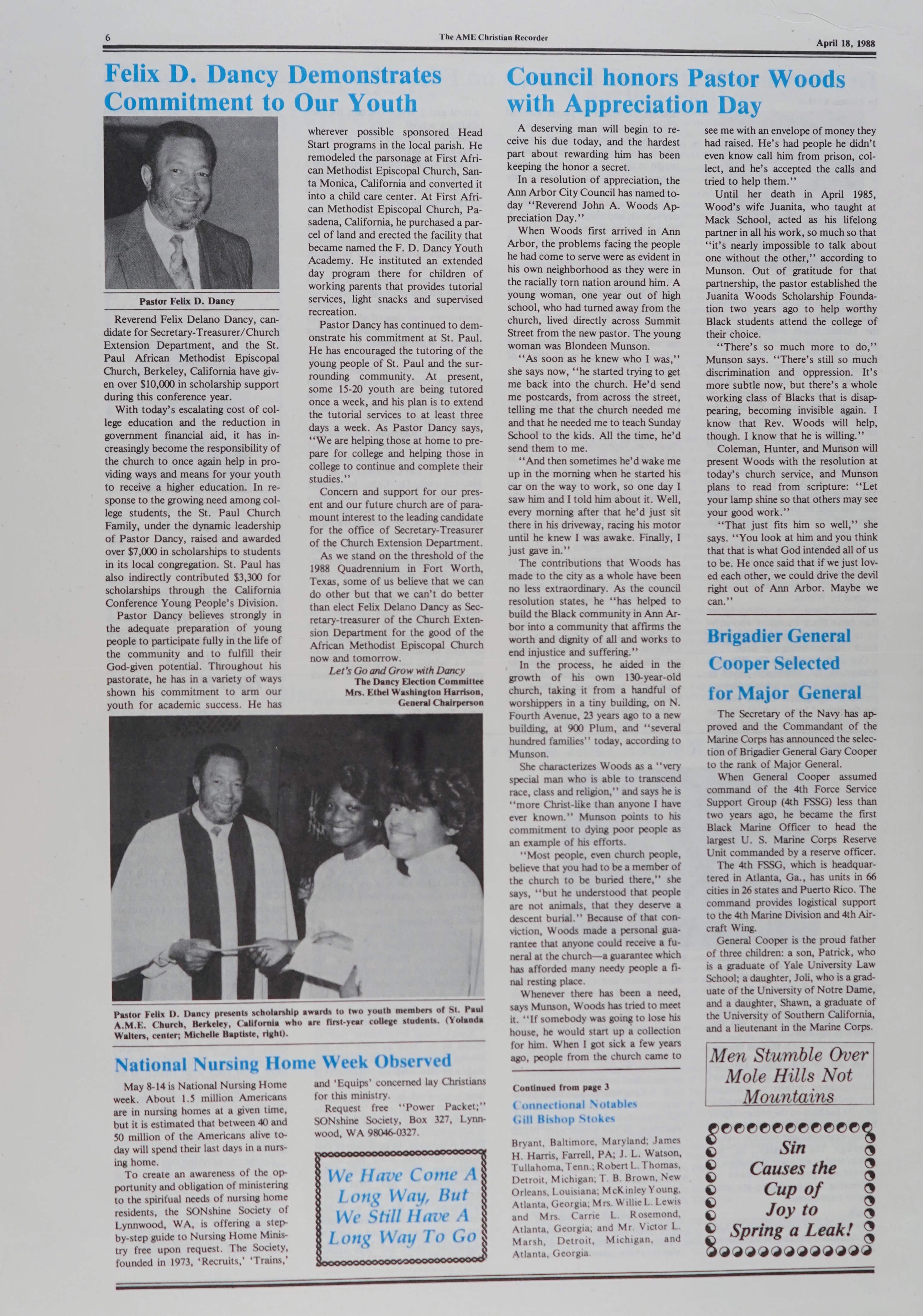
Felix D. Dancy Demonstrates
Pastor Felix D. Dancy
Reverend Felix Delano Dancy, can-
didate for Secretary-Treasurer/Church
Extension Department, and the St.
Paul African Methodist Episcopal
Church, Berkeley, California have giv-
en over $10,000 in scholarship support
during this conference year.
With today’s escalating cost of col-
lege education and the reduction in
government financial aid, it has in-
creasingly become the responsibility of
the church to once again help in pro-
viding ways and means for your youth
to receive a higher education. In re-
sponse to the growing need among col-
lege students, the St. Paul Church
Family, under the dynamic leadership
of Pastor Dancy, raised and awarded
over $7,000 in scholarships to students
in its local congregation. St. Paul has
also indirectly contributed $3,300 for
scholarships through the California
Conference Young People’s Division.
Pastor Dancy believes strongly in
the adequate preparation of young
people to participate fully in the life of
the community and to fulfill their
God-given potential. Throughout his
pastorate, he has in a variety of ways
shown his commitment to arm our
youth for academic success. He has
Commitment to Our Youth
wherever possible sponsored Head
Start programs in the local parish. He
remodeled the parsonage at First Afri-
can Methodist Episcopal Church, San-
ta Monica, California and converted it
into a child care center. At First Afri-
can Methodist Episcopal Church, Pa-
sadena, California, he purchased a par-
cel of land and erected the facility that
became named the F. D. Dancy Youth
Academy. He instituted an extended
day program there for children of
working parents that provides tutorial
services, light snacks and supervised
recreation.
Pastor Dancy has continued to dem-
onstrate his commitment at St. Paul.
He has encouraged the tutoring of the
young people of St. Paul and the sur-
rounding community. At present,
some 15-20 youth are being tutored
once a week, and his plan is to extend
the tutorial services to at least three
days a week. As Pastor Dancy says,
‘*We are helping those at home to pre-
pare for college and helping those in
college to continue and complete their
studies.”’
Concern and support for our pres-
ent and our future church are of para-
mount interest to the leading candidate
for the office of Secretary-Treasurer
of the Church Extension Department.
As we stand on the threshold of the
1988 Quadrennium in Fort Worth,
Texas, some of us believe that we can
do other but that we can’t do better
than elect Felix Delano Dancy as Sec-
retary-treasurer of the Church Exten-
sion Department for the good of the
African Methodist Episcopal Church
now and tomorrow.
Let’s Go and Grow with Dancy
The Dancy Election Committee
Mrs. Ethel Washington Harrison,
General Chairperson
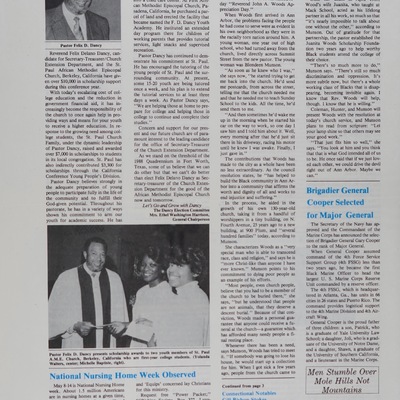
Pastor Felix D. Dancy presents scholarship awards to two youth members of St. Paul
A.M.E. Church, Berkeley, California who are first-year college students, (Yolanda
Walters, center; Michelle Baptiste, right).
National Nursing Home Week Observed
May 8-14 is National Nursing Home
week. About 1.5 million Americans
are in nursing homes at a given time,
but it is estimated that between 40 and
50 million of the Americans alive to-
day will spend their last days in a nurs-
ing home.
To create an awareness of the op-
portunity and obligation of ministering
to the spiritual needs of nursing home
residents, the SONshine Society of
Lynnwood, WA, is offering a step-
by-step guide to Nursing Home Minis-
try free upon request. The Society,
founded in 1973, ‘Recruits,’ ‘Trains,’
and ‘Equips’ concerned lay Christians
for this ministry.
Request free ‘‘Power Packet;"
SONshine Society, Box 327, Lynn-
wood, WA 98046-0327.
We Have Come A
Long Way, But
We Still Have A N
Long Way To Goy
Council honors Pastor Woods
with Appreciation Day
A deserving man will begin to re-
ceive his due today, and the hardest
part about rewarding him has been
keeping the honor a secret.
In a resolution of appreciation, the
Ann Arbor City Council has named to-
day ‘‘Reverend John A. Woods Ap-
preciation Day.’’
When Woods first arrived in Ann
Arbor, the problems facing the people
he had come to serve were as evident in
his own neighborhood as they were in
the racially torn nation around him. A
young woman, one year out of high
school, who had turned away from the
church, lived directly across Summit
Street from the new pastor. The young
woman was Blondeen Munson.
‘*As soon as he knew who I was,’’
she says now, ‘‘he started trying to get
me back into the church. He’d send
me postcards, from across the street,
telling me that the church needed me
and that he needed me to teach Sunday
School to the kids. All the time, he’d
send them to me.
**And then sometimes he’d wake me
up in the morning when he started his
car on the way to work, so one day I
saw him and I told him about it. Well,
every morning after that he’d just sit
there in his driveway, racing his motor
until he knew I was awake. Finally, I
just gave in.’’
The contributions that Woods has
made to the city as a whole have been
no less extraordinary. As the council
resolution states, he ‘‘has helped to
build the Black community in Ann Ar-
bor into a community that affirms the
worth and dignity of all and works to
end injustice and suffering.’’
In the process, he aided in the
growth of his own 130-year-old
church, taking it from a handful of
worshippers in a tiny building, on N.
Fourth Avenue, 23 years ago to a new
building, at 900 Plum, and ‘“‘several
hundred families’’ today, according to
Munson.
She characterizes Woods as a ‘“‘very
special man who is able to transcend
race, class and religion,’’ and says he is
‘*more Christ-like than anyone I have
ever known.’’ Munson points to his
commitment to dying poor people as
an example of his efforts.
‘*Most people, even church people,
believe that you had to be a member of
the church to be buried there,’’ she
says, ‘‘but he understood that people
are not animals, that they deserve a
descent burial.’’ Because of that con-
viction, Woods made a personal gua-
rantee that anyone could receive a fu-
neral at the church—a guarantee which
has afforded many needy people a fi-
nal resting place.
Whenever there has been a need,
says Munson, Woods has tried to meet
it. ‘If somebody was going to lose his
house, he would start up a collection
for him. When I got sick a few years
ago, people from the church came to
ET
Continued from page 3
Connectional Notables
Gill Bishop Stokes
Bryant, Baltimore, Maryland; James
H. Harris, Farrell, PA; J. L. Watson,
Tullahoma, Tenn.; Robert L. Thomas,
Detroit, Michigan; T. B. Brown, New
Orleans, Louisiana; McKinley Young,
Atlanta, Georgia; Mrs. Willie L. Lewis
and Mrs. Carrie L. Rosemond,
Atlanta, Georgia; and Mr. Victor L.
Marsh, Detroit, Michigan, and
Atlanta, Georgia
see me with an envelope of money they
had raised. He’s had people he didn’t
even know call him from prison, col-
lect, and he’s accepted the calls and
tried to help them.”’
Until her death in April 1985,
Wood’s wife Juanita, who taught at
Mack School, acted as his lifelong
partner in all his work, so much so that
“it’s nearly impossible to talk about
one without the other,’’ according to
Munson. Out of gratitude for that
partnership, the pastor established the
Juanita Woods Scholarship Founda-
tion two years ago to help worthy
Black students attend the college of
their choice.
“‘There’s so much more to do,”’
Munson says. ‘‘There’s still so much
discrimination and oppression. It’s
more subtle now, but there’s a whole
working class of Blacks that is disap-
pearing, becoming invisible again. I
know that Rev. Woods will help,
though. I know that he is willing.”’
Coleman, Hunter, and Munson will
present Woods with the resolution at
today’s church service, and Munson
plans to read from scripture: ‘‘Let
your lamp shine so that others may see
your good work.”’
“That just fits him so well,’’ she
says. ‘‘You look at him and you think
that that is what God intended all of us
to be. He once said that if we just lov-
ed each other, we could drive the devil
right out of Ann Arbor. Maybe we
can.”’
Brigadier General
Cooper Selected
for Major General
The Secretary of the Navy has ap-
proved and the Commandant of the
Marine Corps has announced the selec-
tion of Brigadier General Gary Cooper
to the rank of Major General.
When General Cooper assumed
command of the 4th Force Service
Support Group (4th FSSG) less than
two years ago, he became the first
Black Marine Officer to head the
largest U. S. Marine Corps Reserve
Unit commanded by a reserve officer.
The 4th FSSG, which is headquar-
tered in Atlanta, Ga., has units in 66
cities in 26 states and Puerto Rico. The
command provides logistical support
to the 4th Marine Division and 4th Air-
craft Wing.
General Cooper is the proud father
of three children: a son, Patrick, who
is a graduate of Yale University Law
School; a daughter, Joli, who is a grad-
uate of the University of Notre Dame,
and a daughter, Shawn, a graduate of
the University of Southern California,
and a lieutenant in the Marine Corps.
Men Stumble Over
Mole Hills Not
Mountains
gocoooccccee
© Sin =
Causes the .
© Cup o fa)
© P i e
© A)
R)
CQPQQPQIBWBIVIVIIO
===== DSC05493.JPG =====
April 18, 1983
The AME Christian Recorder
nee...
Continued from page 1
Bethel Holds Special
Bicentennial
and Bethel, Freeport’s, eighty-sixth an-
niversary.
Rev. William H. Muldrow, Pre-
siding Elder of the Jamaica-Long Is-
land District, and Rev. Vernon Lowe,
Presiding Elder, newly-transferred
from the Buffalo-Albany District to
the Brooklyn-Westchester District,
were present among our celebrated
leaders.
At the conclusion, the congregation
retired to the fellowship hall for a
most enticing meal in keeping with
time period. All of the fixings of yes-
teryear were there: ham, chicken, tur-
key, pigs’ feet, red rice, collard greens,
lima beans, biscuits and corn bread.
Culinary talents were highlighted by
the magnificent desserts: peach cobb-
ler, cherry pie, bread pudding, sweet
potato pie and cakes—especially, but-
ter pound cake. The meal was served
buffet style and eaten on “‘tin foil’’ pie
plates.
The enlightening event continued
Sunday morning with a program pre-
pared for the youth, revealing the
“Legacy of Richard Allen,’? and
culminated with the eleven o’clock ser-
vice, showing the progression of the
A.M.E. Church with the inclusion of
litanies and chants which are prevalent
in the order of service today.
This extraordinary experience was
chaired by Mrs. Leslie Jackson. The
Rev. Dr. Simon P. Bowie is the Senior
Minister of Bethel. Various commit-
tees involved included publicity,
music, research, decorations and kit-
chen; and a job was well done by all
concerned.
Continued from page 1
The Westward Journey
with William Paul Quinn
States belonged to the A.M.E.
Church.’’ The leaders of this present
age must, likewise, be committed to
keep the A.M.E. Church out front and
involved in serving all of humanity as a
“liberating and reconciling’? church.
Bishop Quinn was, indeed, a great
missionary expansionist who took the
West for the A.M.E. Church. He de-
fied slavery and organized a church in
St. Louis, Missouri. Later he organ-
ized the Missouri Conference. Bishop
Quinn presided over the General Con-
ference of 1848 where he, for the first
time, delivered a written episcopal ad-
dress. This practice continues to this
date.
Quinn was elected bishop and conse-
crated May 19, 1844. He was the first
to recommend the presiding elder sys-
tem. He became Senior Bishop May 9,
1849, after the death of Bishop Morris
Brown, and was senior until his death
February 3, 1873. He served as a
bishop for 24 years and 8 months. He
was active Senior Bishop longer than
any other active senior.
The church surely will want to join
the two hosting Bishops: Henry W.
Murph, 5th Episcopal District, and
Samuel Solomon Morris, Jr., 4th Epis-
copal District, in a solemn salute to
the memory of one of the great men of
African Methodism.
Notice
Don’t forget the
Gerieral Conference
Prayer Quake
Ft. Worth Texas
Sunday, July 3, 1988
—Read full details in the next issue—
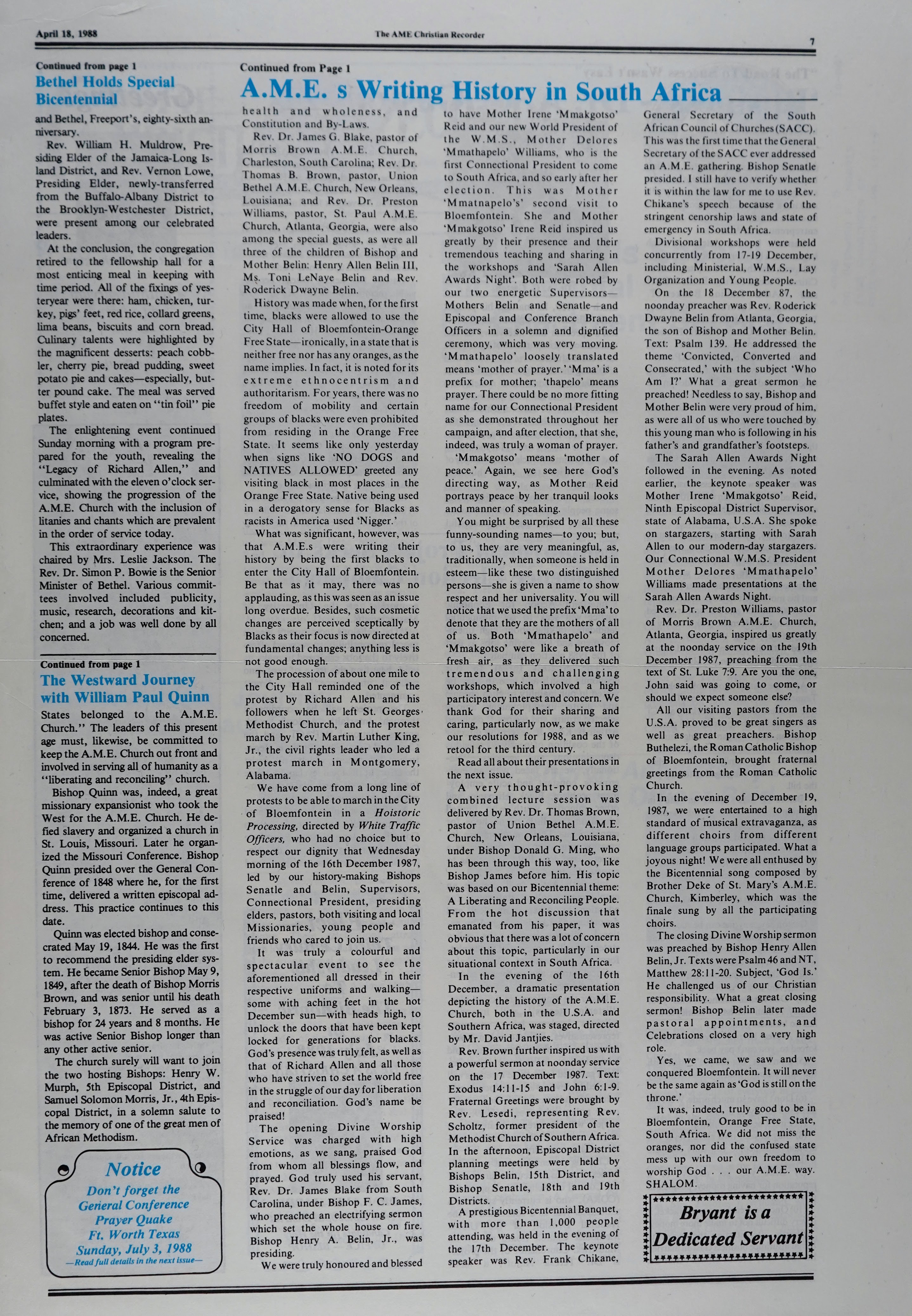
Continued from Page 1
A.M.E. s Writing History in South Africa —____
health and wholeness, and
Constitution and By-Laws.
Rey, Dr. James G, Blake, pastor of
Morris Brown A.M.E. Church,
Charleston, South Carolina; Rev. Dr.
Thomas B. Brown, pastor, Union
Bethel A.M.E. Church, New Orleans,
Louisiana; and Rev. Dr. Preston
Williams, pastor, St. Paul A.M.E.
Church, Atlanta, Georgia, were also
among the special guests, as were all
three of the children of Bishop and
Mother Belin: Henry Allen Belin III,
Ms. Toni LeNaye Belin and Rev.
Roderick Dwayne Belin.
History was made when, for the first
time, blacks were allowed to use the
City Hall of Bloemfontein-Orange
Free State—ironically, ina state that is
neither free nor has any oranges, as the
name implies. In fact, it is noted for its
extreme ethnocentrism and
authoritarism. For years, there was no
freedom of mobility and certain
groups of blacks were even prohibited
from residing in the Orange Free
State. It seems like only yesterday
when signs like ‘NO DOGS and
NATIVES ALLOWED?” greeted any
visiting black in most places in the
Orange Free State. Native being used
in a derogatory sense for Blacks as
racists in America used ‘Nigger.’
What was significant, however, was
that A.M.E.s were writing their
history by being the first blacks to
enter the City Hall of Bloemfontein.
Be that as it may, there was no
applauding, as this was seen as an issue
long overdue. Besides, such cosmetic
changes are perceived sceptically by
Blacks as their focus is now directed at
fundamental changes; anything less is
not good enough.
The procession of about one mile to
the City Hall reminded one of the
protest by Richard Allen and his
followers when he left St. Georges:
Methodist Church, and the protest
march by Rev. Martin Luther King,
Jr., the civil rights leader who led a
protest march in Montgomery,
Alabama.
We have come from a long line of
protests to be able to march in the City
of Bloemfontein in a HAHoistoric
Processing, directed by White Traffic
Officers, who had no choice but to
respect our dignity that Wednesday
morning of the 16th December 1987,
led by our history-making Bishops
Senatle and Belin, Supervisors,
Connectional President, presiding
elders, pastors, both visiting and local
Missionaries, young people and
friends who cared to join us.
It was truly a colourful and
spectacular event to see the
aforementioned all dressed in their
respective uniforms and walking—
some with aching feet in the hot
December sun—with heads high, to
unlock the doors that have been kept
locked for generations for blacks.
God’s presence was truly felt, as well as
that of Richard Allen and all those
who have striven to set the world free
in the struggle of our day for liberation
and reconciliation. God’s name be
praised!
The opening Divine Worship
Service was charged with high
emotions, as we sang, praised God
from whom all blessings flow, and
prayed. God truly used his servant,
Rev. Dr. James Blake from South
Carolina, under Bishop F. C. James,
who preached an electrifying sermon
which set the whole house on fire.
Bishop Henry A. Belin, Jr., was
presiding.
We were truly honoured and blessed
to have Mother Irene ‘Mmakgotso’
Reid and our new World President of
the W.M.S., Mother Delores
‘Mmathapelo’ Williams, who is the
first Connectional President to come
to South Africa, and so early after her
election. This was Mother
*‘Mmatnapelo’s’ second visit to
Bloemfontein. She and Mother
‘Mmakgotso’ Irene Reid inspired us
greatly by their presence and their
tremendous teaching and sharing in
the workshops and ‘Sarah Allen
Awards Night’. Both were robed by
our two energetic Supervisors—
Mothers Belin and Senatle—and
Episcopal and Conference Branch
Officers in a solemn and dignified
ceremony, which was very moving.
‘Mmathapelo’ loosely translated
means ‘mother of prayer.’ ‘Mma’ is a
prefix for mother; ‘thapelo’ means
prayer. There could be no more fitting
name for our Connectional President
as she demonstrated throughout her
campaign, and after election, that she,
indeed, was truly a woman of prayer.
‘Mmakgotso’ means ‘mother of
peace.’ Again, we see here God’s
directing way, as Mother Reid
portrays peace by her tranquil looks
and manner of speaking.
You might be surprised by all these
funny-sounding names—to you; but,
to us, they are very meaningful, as,
traditionally, when someone is held in
esteem—like these two distinguished
persons—she is given a name to show
respect and her universality. You will
notice that we used the prefix ‘Mma’ to
denote that they are the mothers of all
of us. Both ‘Mmathapelo’ and
‘Mmakgotso’ were like a breath of
fresh air, as they delivered such
tremendous and challenging
workshops, which involved a high
participatory interest and concern. We
thank God for their sharing and
caring, particularly now, as we make
our resolutions for 1988, and as we
retool for the third century.
Read all about their presentations in
the next issue.
A very thought-provoking
combined lecture session was
delivered by Rev. Dr. Thomas Brown,
pastor of Union Bethel A.M.E.
Church, New Orleans, Louisiana,
under Bishop Donald G. Ming, who
has been through this way, too, like
Bishop James before him. His topic
was based on our Bicentennial theme:
A Liberating and Reconciling People.
From the hot discussion that
emanated from his paper, it was
obvious that there was a lot of concern
about this topic, particularly in our
situational context in South Africa.
In the evening of the 16th
December, a dramatic presentation
depicting the history of the A.M.E.
Church, both in the U.S.A. and
Southern Africa, was staged, directed
by Mr. David Jantjies.
Rev. Brown further inspired us with
a powerful sermon at noonday service
on the 17 December 1987. Text:
Exodus 14:11-15 and John 6:1-9.
Fraternal Greetings were brought by
Rev. Lesedi, representing Rev.
Scholtz, former president of the
Methodist Church of Southern Africa.
In the afternoon, Episcopal District
planning meetings were held by
Bishops Belin, 15th District, and
Bishop Senatle, 18th and 19th
Districts. ; :
A prestigious Bicentennial Banquet,
with more than 1,000 people
attending, was held in the evening of
the 17th December. The keynote
speaker was Rev. Frank Chikane,
General Secretary of the South
African Council of Churches(SACC).
his was the first time that the General
Secretary of the SACC ever addressed
an A.M.E. gathering. Bishop Senatle
presided. | still have to verify whether
it is within the law for me to use Rey.
Chikane’s speech because of the
stringent cenorship laws and state of
emergency in South Africa.
Divisional workshops were held
concurrently from 17-19 December,
including Ministerial, W.M.S., Lay
Organization and Young People.
On the 18 December 87, the
noonday preacher was Rey, Roderick
Dwayne Belin from Atlanta, Georgia,
the son of Bishop and Mother Belin.
Text: Psalm 139, He addressed the
theme ‘Convicted, Converted and
Consecrated,’ with the subject ‘Who
Am I?’ What a great sermon he
preached! Needless to say, Bishop and
Mother Belin were very proud of him,
as were all of us who were touched by
this young man who is following in his
father’s and grandfather’s footsteps.
The Sarah Allen Awards Night
followed in the evening. As noted
earlier, the keynote speaker was
Mother Irene ‘Mmakgotso’ Reid,
Ninth Episcopal District Supervisor,
state of Alabama, U.S.A. She spoke
on stargazers, starting with Sarah
Allen to our modern-day stargazers.
Our Connectional W.M.S. President
Mother Delores ‘Mmathapelo’
Williams made presentations at the
Sarah Allen Awards Night.
Rev. Dr. Preston Williams, pastor
of Morris Brown A.M.E. Church,
Atlanta, Georgia, inspired us greatly
at the noonday service on the 19th
December 1987, preaching from the
text of St. Luke 7:9. Are you the one,
John said was going to come, or
should we expect someone else?
All our visiting pastors from the
U.S.A. proved to be great singers as
well as great preachers. Bishop
Buthelezi, the Roman Catholic Bishop
of Bloemfontein, brought fraternal
greetings from the Roman Catholic
Church.
In the evening of December 19,
1987, we were entertained to a high
standard of musical extravaganza, as
different choirs from different
language groups participated. What a
joyous night! We were all enthused by
the Bicentennial song composed by
Brother Deke of St. Mary’s A.M.E.
Church, Kimberley, which was the
finale sung by all the participating
choirs.
The closing Divine Worship sermon
was preached by Bishop Henry Allen
Belin, Jr. Texts were Psalm 46 and NT,
Matthew 28:11-20. Subject, ‘God Is.’
He challenged us of our Christian
responsibility. What a great closing
sermon! Bishop Belin later made
pastoral appointments, and
Celebrations closed on a very high
role.
Yes, we came, we saw and we
conquered Bloemfontein. It will never
be the same again as ‘God is still on the
throne.’
It was, indeed, truly good to be in
Bloemfontein, Orange Free State,
South Africa. We did not miss the
oranges, nor did the confused state
mess up with our own freedom to
worship God . . . our A.M.E. way.
SHALOM.
Bryant isa
Pee eee yer
Dedicated Servant
===== DSC05494.JPG =====
The AME Christian Recorder
April 18, 1988
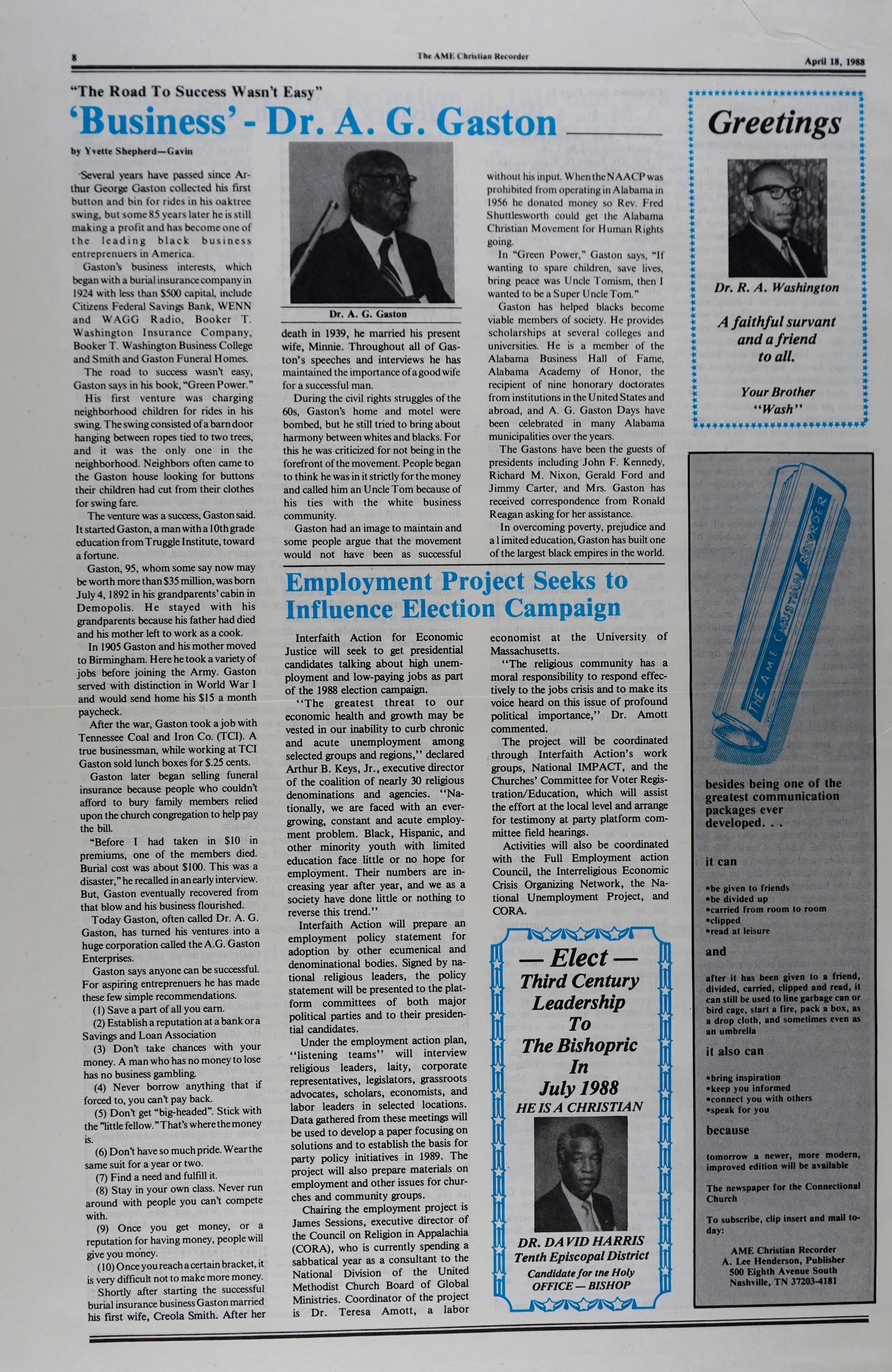
“The Road To Success Wasn't Easy”
‘Business’ - Dr. A. G. Gaston __
by Yvette Shepherd—Gavin
‘Several years have passed since Ar-
thur George Gaston collected his first
button and bin for rides in his oaktree
swing, but some 85 years later he is still
making a profit and has become one of
the leading black business
entreprenuers in America.
Gaston's business interests, which
began with a burial insurance company in
1924 with less than $500 capital, include
Citizens Federal Savings Bank, WENN
and WAGG Radio, Booker T.
Washington Insurance Company,
Booker T. Washington Business College
and Smith and Gaston Funeral Homes.
The road to success wasn't easy,
Gaston says in his book, “Green Power.”
His first venture was charging
neighborhood children for rides in his
swing. The swing consisted ofa barn door
hanging between ropes tied to two trees,
and it was the only one in the
neighborhood. Neighbors often came to
the Gaston house looking for buttons
their children had cut from their clothes
for swing fare.
The venture was a success, Gaston said.
It started Gaston, a man witha 10th grade
education from Truggle Institute, toward
a fortune.
Gaston, 95, whom some say now may
be worth more than $35 million, was born
July 4, 1892 in his grandparents’ cabin in
Demopolis. He stayed with his
grandparents because his father had died
and his mother left to work as a cook.
In 1905 Gaston and his mother moved
to Birmingham. Here he took a variety of
jobs before joining the Army. Gaston
served with distinction in World War I
and would send home his $15 a month
paycheck.
After the war, Gaston took a job with
Tennessee Coal and Iron Co. (TCI). A
true businessman, while working at TCI
Gaston sold lunch boxes for $.25 cents.
Gaston later began selling funeral
insurance because people who couldn't
afford to bury family members relied
upon the church congregation to help pay
the bill.
“Before I had taken in $10 in
premiums, one of the members died.
Burial cost was about $100. This was a
disaster,” he recalled in anearly interview.
But, Gaston eventually recovered from
that blow and his business flourished.
Today Gaston, often called Dr. A. G.
Gaston, has turned his ventures into a
huge corporation called the A.G. Gaston
Enterprises.
Gaston says anyone can be successful.
For aspiring entreprenuers he has made
these few simple recommendations.
(1) Save a part of all you earn.
(2) Establish a reputation at a bank ora
Savings and Loan Association
(3) Don’t take chances with your
money. A man who has no money to lose
has no business gambling.
(4) Never borrow anything that if
forced to, you can’t pay back.
(5) Don’t get “big-headed”. Stick with
the “little fellow.” That’s where the money
is.
(6) Don't have so much pride. Wear the
same suit for a year or two.
(7) Find a need and fulfill it.
(8) Stay in your own class. Never run
around with people you can’t compete
with.
(9) Once you get money, or a
reputation for having money, people will
give you money.
(10) Once youreachacertain bracket, it
is very difficult not to make more money.
Shortly after starting the successful
burial insurance business Gaston married
his first wife, Creola Smith. After her
eve
Dr. A. G, Gaston
death in 1939, he married his present
wife, Minnie. Throughout all of Gas-
ton’s speeches and interviews he has
maintained the importance ofa good wife
for a successful man.
During the civil rights struggles of the
60s, Gaston’s home and motel were
bombed, but he still tried to bring about
harmony between whites and blacks. For
this he was criticized for not being in the
forefront of the movement. People began
to think he was in it strictly for the money
and called him an Uncle Tom because of
his ties with the white business
community.
Gaston had an image to maintain and
some people argue that the movement
would not have been as successful
without his input. When the NAACP was
prohibited from operating in Alabama in
1956 he donated money so Rev. Fred
Shuttlesworth could get the Alabama
Christian Movement for Human Rights
going.
In “Green Power,” Gaston says, “If
wanting to spare children, save lives,
bring peace was Uncle Tomism, then |
wanted to be a Super Uncle Tom.”
Gaston has helped blacks become
viable members of society. He provides
scholarships at several colleges and
universities. He is a member of the
Alabama Business Hall of Fame,
Alabama Academy of Honor, the
recipient of nine honorary doctorates
from institutions in the United States and
abroad, and A. G. Gaston Days have
been celebrated in many Alabama
municipalities over the years.
The Gastons have been the guests of
presidents including John F. Kennedy,
Richard M. Nixon, Gerald Ford and
Jimmy Carter, and Mrs. Gaston has
received correspondence from Ronald
Reagan asking for her assistance.
In overcoming poverty, prejudice and
alimited education, Gaston has built one
of the largest black empires in the world.
Employment Project Seeks to
Influence Election Campaign
Interfaith Action for Economic
Justice will seek to get presidential
candidates talking about high unem-
ployment and low-paying jobs as part
of the 1988 election campaign.
“The greatest threat to our
economic health and growth may be
vested in our inability to curb chronic
and acute unemployment among
selected groups and regions,’’ declared
Arthur B. Keys, Jr., executive director
of the coalition of nearly 30 religious
denominations and agencies. ‘‘Na-
tionally, we are faced with an ever-
growing, constant and acute employ-
ment problem. Black, Hispanic, and
other minority youth with limited
education face little or no hope for
employment. Their numbers are in-
creasing year after year, and we as a
society have done little or nothing to
reverse this trend.’’
Interfaith Action will prepare an
employment policy statement for
adoption by other ecumenical and
denominational bodies. Signed by na-
tional religious leaders, the policy
statement will be presented to the plat-
form committees of both major
political parties and to their presiden-
tial candidates.
Under the employment action plan,
‘listening teams’’ will interview
religious leaders, laity, corporate
representatives, legislators, grassroots
advocates, scholars, economists, and
labor leaders in selected locations.
Data gathered from these meetings will
be used to develop a paper focusing on
solutions and to establish the basis for
party policy initiatives in 1989. The
project will also prepare materials on
employment and other issues for chur-
ches and community groups.
Chairing the employment project is
James Sessions, executive director of
the Council on Religion in Appalachia
(CORA), who is currently spending a
sabbatical year as a consultant to the
National Division of the United
Methodist Church Board of Global
Ministries. Coordinator of the project
is Dr. Teresa Amott, a labor
economist at the University of
Massachusetts.
“The religious community has a
moral responsibility to respond effec-
tively to the jobs crisis and to make its
voice heard on this issue of profound
political importance,’ Dr. Amott
commented.
The project will be coordinated
through Interfaith Action’s work
groups, National IMPACT, and the
Churches’ Committee for Voter Regis-
tration/Education, which will assist
the effort at the local level and arrange
for testimony at party platform com-
mittee field hearings.
Activities will also be coordinated
with the Full Employment action
Council, the Interreligious Economic
Crisis Organizing Network, the Na-
tional Unemployment Project, and
Third Century
Leadership
To
The Bishopric
In
July 1988
HEIS A CHRISTIAN
\
DR. DAVID HARRIS
Tenth Episcopal District
Candidate for the Holy
OFFICE — BISHOP
RAKE EERE ee ee ee
Greetings
auue
Dr. R. A. Washington
A faithful survant
and a friend
to all.
Your Brother
“ee Was h ”
26 A a Oa Oa ap a OO a
SRR ITI II HI I ASK A IAI EAA IIIA IIIS IISA IIA IESE
Mg ERAN R ERE ERR RERER EAE RER EERE REE ER ERE ERE EE EE
Ce ee ee ee, EE
===== DSC05495.JPG =====
April 18, 1988
The AME Christian Recorder
Economic Sanctions Campaign
Announced in New York
New York, NY—The escalating racist
violence in New York has prompted
African-American leaders here to
return to an old but effective strategy
of the civil rights movement—eco-
nomic withdrawal. On Friday, Feb-
Tuary 19, the Committee for Eco-
nomic Sanctions Against Racism in
New York announced that two New
York-based companies, Macy’s De-
partment Store and Sterling Drugs,
Inc. (Maker of Bayer Aspirin, Phillip’s
Milk of Magnesia and D-Con), would
be the Committee’s initial targets.
The targets were announced to an
overflow crowd of more than 2,000,
which packed Bethany Baptist Church
in Brooklyn. As one member of the
audience pointed out after the rally,
“This is the first time I’ve seen this
many people come out for anything
besides a major racial incident. This
group is serious.’ The meeting at
Bethany was the culmination of a
series of mass meetings which the
Committee had held throughout New
York since January.
The Committee is a coalition of
over 40 African-American leaders in
New York from established clergy,
business, labor, civil rights, communi-
ty and youth organizations. They
began plans for the economic sanc-
tions campaign in December of 1987.
The committee has called its effort an
“economic sanctions campaign’’ to
underscore its long-range scope and to
indicate the broader purpose of the
campaign.
The Committee’s research revealed
that both Macy’s and Sterling Drugs
maintain relations with South Africa,
do not deposit in African-American
banks in New York, do very little
advertising with Black media or Black
advertising firms and make minimal
use of African-American contractors
and vendors. Additionally, Macy’s
relegates most of its African-American
employees to visible, but low-paying
cashier and sales jobs, while promoting
its White employees to executive
management positions.
Referring to the broader goals of the
sanctions campaign, speakers at the
rally spoke of the escalating racist
violence and what they called ‘‘the
dehumanizing conditions which our
people are forced to endure in New
York.’’ As Bob Law, a nationally syn-
dicated talk show host and one of the
U
their needs and aspirations today.
“‘We Make A Living By What We Get,
But We Make A Life By What We Give.”’
Every True AME should have the Book of
Worship to accompany your Bible, Hym-
nal Book, and a Sunday School Quarterly
African
| Methodist
Episcopal
Reduced eS Reduced
BOOK Only $5.00
® OF
WORSHIP]
The Book of Worship is a new book with a new name, offered in the hope that it will serve a
new age in our church. The change within is symbolic of the attempt to help Christians and
those who may become Christians to hear God's word, and worship Him, in the language of
BOW Siar ee 6c cares sees Please include 13%
organizers of the sanctions campaign,
explained, ‘‘We are not saying that
Macy’s must take a moral position.
We are saying that we, as a communi-
ty, must take a moral position. We
pump millions of dollars into Macy’s
and Sterling—and provide their margin
of profit—yet they give nothing back
in return, Business will no longer go on
as usual. We have a moral imperative
to stop cooperating with our own op-
pression.’’ Scores of African-Ameri-
cans, organized by the Committee,
recently picketed Macy’s and spoke
with customers. Many customers were
persuaded to go, instead, to other
stores, while others, who were carrying
shopping bagsful of purchases, reen-
tered the store to return their merchan-
dise.
Rev. Benjamin F. Chavis, Jr., Ex-
ecutive Director of the United Church
of Christ Commission for Racial
Justice, and another campaign
organizer, while walking the picket line
declared, ‘‘We have a_ profound
responsibility to unite ourselves in a
constructive way, and this is a strategy
in which everyone in our community
can participate. Macy’s and Sterling
Drugs are just the first targets. We in-
tend to expand this campaign until we
fundamentally change the power
dynamics that have controlled and
allowed this over racism to continue.”’
This long-range goal was reiterated
by another campaign organizer, Rev.
Calvin O. Butts, Executive Minister of
Harlem’s Abyssinian Baptist Church
and president of New York’s
Organization of Afro-American
Clergy. He noted, ‘‘African Americans
spend over $290 billion a year, yet we
spend it primarily in communities
other than our own and with those
who do not support us. The business
community will ignore us only as long
as we permit them to do so. We
understand that this is a long-range
strategy, but we know from the
response thus far that the people are
ready to support us, and if we succeed
here, it will send a message to the rest
of the nation.”’
The Committee for Sanctions is
hoping to nationalize its campaign in
the coming months, particularly as the
Easter season approaches. As one
organizer declared, ‘‘We have a pro-
found responsibility not only to strug-
gle, but to win.”’
» postage and handling «+ - $5.00
A Bicentennial Breakfast
Extraordinary
Dr. Richard Allen Chappelle, Sr., Mrs. Barbara J. Chappelle and the representative group
of RAClub supporters pausing after the delicious Prayer Breakfast for a photo session.
St. Louis, MO.—On Saturday morn-
ing February 20, 1988 at St. Peter’s
African Methodist Episcopal Church,
pastored by Rev. Cheviene Jones, the
Richard Allen Chappelle Club
(RAClub) hosted a well appointed and
delicious Bicentennial Prayer Break-
fast.
The occasion was of a multipurpose
nature: first, to provide the spiritual
watershed for our candidate for Bis-
hop Dr. Richard Allen Chappelle, Sr.
and the Greater St. Louis, MO booster
group, secondly, to serve as a cam-
paign fund raiser, thirdly, to emphasize
the significance of and need for prayer
as the catalyst to a healthy, spiritually
alive existence.
The committee, in planning this
magnificent activity, chose to make it a
part of the Black History celebration
in the Greater St. Louis community.
The commodious facilities of Historic
St. Peter’s A.M.E. Church were dec-
orated and made conducive for the oc-
casion with the colors of Black and
Gold highlighting the decor. We fur-
ther utilized several of the leading
Black clergy and lay persons of the
area as the major participants on the
Bicentennial Prayer Breakfast Pro-
gram namely: Rev. Cheviene Jones,
Pastor, St. Peter’s, St. Louis MO;
Rev. O. H. Brown, Presiding Elder of
the St. Louis-Cape Giradeau District;
Rev. Cecil W. Howard, Pastor, St.
James, St. Louis, MO; General Of-
ficer, Rev. Cyrus S. Keller, Sr.,
Pastor, St. John, St. Charles, MO;
Rev. Kenneth Griffin, Pastor, Ward
Chapel, Festus, MO; Rev. George
Grider, Pastor, Perry Chapel,
Charleston, MO; Rev. Wallace Ward,
Pastor, Gregg Chapel, St. Louis, MO;
Mrs. Mildred Branch, member St.
Peter’s, St. Louis, MO; Mr. William
Slaten, member, Olive Chapel,
Webster Grove, MO; and the
melodious spirit filled Tabernacle
Singers of St. Louis, MO.
The delicious breakfast and rich
program were received by an en-
thusiastic full house who voiced their
“‘Amens’”’ and other appropriate ges-
tures of encouragement to the partici-
pants as they called for peace, love,
faith and understanding via the power
of serious prayer. The Keynote
speaker for the occasion, the Rev.
Cecil W. Howard used as the Text for
the Meditation Matthew 6:6; Acts 12:5
and used as a theme, Steal Away. The
response to Dr. Cecil MHoward’s
thought’ provoking and spirit filled
message was that of spiritual revitali-
zation and recommitment to the sup-
port of Dr. Richard Allen Chappelle,
Sr. who as Pastor, General Secretary
of the A.M.E. Church and brother
beloved has increased involvement,
participation and growth in the church.
Mrs. Sarah D. Irons, Chairperson
and Mr. William Slaten, Co-chairper-
son of the Greater St. Louis RAClub
and the host of supporters and well
wishers announced that this was one in
a series of activities whose ultimate
goals are to provide the spiritual, fi-
nancial and moral support essential for
the election of Dr. Richard Allen
Chappelle, Sr. as a Bishop of the
Church at the General Conference to
be held at Ft. Worth, TX in July of
this year. The call is for you to join
this worthy endeavor.
Mrs. Dorothy Walker, Reporter
Dr. Cecil W. Howard, Dr. Richard Allen Chappelle, Sr., and several of the delegates to
the General Conference and program participants.
===== DSC05496.JPG =====
10
The AME Christian Recorder
April 18, 1988
The Man From Enterprise Goes Home
Rev. Julius C. Williams
(Funeralized January 5, 1988)
The Record
Let the record show that something
good can come out of Enterprise, AL.
Julia Baldwin and Willie Williams had
ason named Julius, who was to proud-
ly romanticize their hometown into an
identity which he would keep with him
forever, and share with everyone
whose path crossed his. World War II
and a tour of duty with the Field Artil-
lery and the Quartermaster Corps
moved him out of Enterprise into
Atlanta, where he enrolled at Morris
Brown College in pursuit of a Bachelor
of Arts degree in Philosophy and Reli-
gion. During his matriculation at
Turner Theological Seminary, which
was located on Morris Brown’s cam-
pus, he met a Jackson, GA, coed and
Home Economics/Elementary Educa-
tion major named Maggie Barlow, and
they became inseparable until January
1, 1988.
After heeding the Divine Commis-
sion ‘‘Go preach my gospel,’’ the rec-
ord shows that Julius C. Williams felt
the hands of the sainted William
Alfred Fountain for his ordination as
deacon and as elder. He began his min-
istry as a successful circuit rider and
ascended the ranks by climbing his way
through several smaller charges to Nel-
son Chapel in Bainbridge, Campbell
Chapel in Americus and First A.M.E.
of Athens. A record check at each of
these assignments will be different
somewhat because of the differences
in the size and nature of the congrega-
tions. However, two constants emerge:
a productive ministry and a profound
admiration for the man—his quiet, un-
affected manner, his gentlemanly be-
havior and his unselfish sensitivity to
human need. And then there was 1964,
when Bishop E. L. Hickman appoint-
ed him the ninth pastor of Flipper
Temple—a church with a strong legacy
of good preaching and a loving, sup-
portive membership. It was at Flipper
Temple that he was to erect his own
monument, as well as make his more
outstanding contribution to the
A.M.E. Church—from the local
through the connectional levels.
Under the inspiration of his leader-
ship, Flipper Temple was motivated to
embark upon and complete outreach,
building and renovation projects,
which are demonstrable of the ideal
pastor/congregation partnership. Rev.
Williams guided Flipper Temple from
the periphery of religious life into the
mainstream of major Metropolitan
Atlanta churches. Presently, the
church has forty-four functioning or-
ganizations and operates on a budget
which exceeds $2,000,000.
His personal rapport with youth and
the aged alike helped to make Flipper
Temple a mecca for A.M.E. students
attending Atlanta University Center in-
stitutions. He was mentor par excel-
lence for young theologians studying at
the Interdemoninational Theological
Center and other Atlanta area semi-
naries. They copied his style, cultivat-
ed his mannerisms and kept their
faith in his counsel, Many of them are
filling major pulpits in every episcopal
district in the United States and in the
Fourteenth, Fifteenth and Seventeenth
Districts overseas. Now pastors in
Martin Luther King, Jr.
by Rey. F. D, Smith
Of all the tributes, speeches,
laudations, etc. that were paid Dr
Martin Luther King, Jr, to my
knowledge, noon dared to make the bold
assertion that Dr. King was the greatest
contributor to humanity since Jesus
Christ. Let me hasten to say, I'm in no
wise comparing King to Christ.
However, no other individual in recent
history has affected such a broad spectra
of humanity as has this twentieth century
prophet.
This nation has known great men of
all fields of endeavor - Religion, Science,
Medicine, Philosophy, Humanitanans,
Statesmen, etc. - but none other has
directly affected every man, woman, boy
or girl as did this ordained giant
Let me be-labor my point so that you
may get the full impact of my meaning,
Religion has produced its great scholars,
writers and leaders, but their influence
has had its limited group, Contributors
to science and technology have made
immeasurable strides, but often-times
questionable, when weighed over against
the accompanying evils, Medicine has
always had its heroes, but only a limited
populous (the sick) needed to avail
themselves of its benefits. Philosophy ts
basically a tool of the educated
Humanitarians, even of Ghandi’
caliber, as great and historic as he was,
primarily affected only India and Great
Britain, The centuries have offered
outstanding Statesmen of various na-
tions but again, only national status,
Dr. King's interest, precepts and
concerns blanketed all human needs
worldwide. His concept of freedom and
justice was global. His regard for
equality targeted all peoples everywhere.
He was thoroughly aware that all
nations, unfortunately, have their
bigotries, race distinctions, caste and
class systems, serf and peasant of one
form or another
His lament over war and poverty had
no artificial boundary lines. His dream
for education was that internationally,
provisions would be made so that every
person who desired, might fulfill his
God-given potential
His compassion was born of a celestial
nature. The tenor of his life was human
rights and being children of God - none
of us are free until all are free.
1 think we sometimes make the
mistake that he was only a Black
Liberator and that may have been his
initial focus, but an analysis of his
thoughts, speeches and writings reveal a
much broader spectrum, Certainly he
encompassed a world scope
He commanded the consideration of
every head of State, Priest, Potentate,
President and Dictator in every hamlet,
village, city, state and nation, sifting
down to every citizen of their domain
1 am convinced that Dr. King was a
unique human being whose equal is yet
to be discovered. Who ean argue, on the
basis of contributions, that he was not
the greatest man born since the turn of
A.D.?
“Greater love hath no man than
this “
Frederick D, Smith, Pastor
Historie St, Paul A.M.E, Church
Lexington, Kentucky 40507
their own right, a considerable num-
ber, attibute a herculean share of their
success to what they learned in their
field experience with Julius Williams.
The record is, that he was a connec-
tional pastor with visibility and credi-
bility. Whether he was hailed as ‘‘JC’’
or Julius did not matter, for the
A.M.E. Church respected Rev. Julius
Williams—a brother in Phi Beta Sigma
Fraternity, Inc.—as a powerful
preacher, an astute organizer and a
champion of Christian brotherhood.
His philosophy that a church ‘‘big
enough for God’’ has to extend be-
yond the walls was punctuated by his
membership on numerous community
and educational organizations. These
include the Atlanta Police Department
Chaplaincy, the Oglethorpe PTA Ad-
visory Committee, Project Upward
Bound Advisory Chairman, Advisory
Board of Morris Brown College, and
the Trustee Board of Turner Theologi-
cal Seminary, from which he graduat-
ed. He held significant positions at the
Presiding Elder District, Annual Con-
ference, Episcopal District and the
Connectional Church levels. He has
been an elected member of every
A.M.E. General Conference since
1956, and was an elected delegate to
the Forty-Third Session in Fort Worth,
Texas.
Yes, the Man from Enterprise came
to Georgia, set a matchless record and
made an invaluable contribution to the
advancement of African Methodism in
the Sixth. He made his mark, notwith-
standing his being spoiled by Maggie,
all of the Alabama and Cleveland
(Ohio) cousins, nieces and nephews in
Indiana, and a lot of other persons for
whom he was both pastor and friend.
THE RECORD IS MADE!
OBITUARY
The Home going of the late Rever-
end Haley Webester Woods came in
the early hours of Friday evening,
February 12, 1988.
Born November 2, 1905, the third
child of Mr. and Mrs. Richard D. and
Matilda Beverett Woods, who
preceded him in death
Uniting with the African Methodist
Episcopal Church at an early age set
the choice of life he was to follow,
pastoring on both the Ninth and the
Eleventh Districts. A music teacher,
music writer, and a music publisher
with over 40 songs now in print, 32 in
The Colored Sacred Harp Song Book
and 2 on Album by the Glory Train
Special Gospel singers Editor and
Publisher of the Colored News
Bulletin, Principal in Public Schools
beth Alabama and Florida
He was united in Holy Matrimony
with the late Mrs, Florence Mae
Baxter, to this union seven children
were born, two preceded him in death.
Remembering him, one sister, Mrs.
Norre Gilmore, Bristal, FL; five
daughters, Mrs. Doris E, Lewis, Mrs
Lois M. Neal, Mrs. Mable L. Moore,
all of Dothan, AL; Mrs. Florence J
Outlaw, Mrs. Minnie M. Anderson,
Fort Lauderdale, FL; three Sons-in-
law, Mr. Robert Lewis, Mr. Arthur
Neal and Mr. John Moore, all of
Dothan. Nineteen Grandchildren, For-
ty Great Grandchildren, five Sisters-in-
law; two Brothers-in-law, and a host
of cousins, nieces, nephews and
friends
The Fight
Isn’t Over
Gainesville, FL—Incidents like last
month’s racist comments that got
sports commentator Jimmy ‘‘The
Greek’’ Snyder fired from CBS are a
stinging reminder to Black Americans
of ‘‘how far we still have to go’’ in the
fight for equality, said Rev. Joseph
Lowery, president of the Southern
Christian Leadership Conference.
“‘His comments were an embarrass-
ment to White America in an age that
is supposed to be _ enlightened,’’
Lowery said. The minister who co-
founded the SCLC with the late Mar-
tin Luther King, Jr., visited the Univer-
sity of Florida Thursday and Friday
(February 45, 1988) to kick off the
10th annual Black Americans Against
the Odds Conference.
Snyder told a television reporter on
January 15 that Blacks are successful
in sports like football today because
slave owners intentionally put together
“*big Black men’’ and ‘‘big women’’ to
produce big, strong Black offspring.
He also said if Blacks move into sports
executive positions, ‘‘there won’t be
anything left for the Whites.”’
For Lowery, who has been a key fig-
ure in the civil rights movement since
he and King led protests in Mobile,
AL, in the 1950’s, such modern-day in-
cidents are a step backward in race re-
lations.
“*The Black experience has been one
characterized by a commitment to
struggle, to achieve constitutional
goals,’’ Lowery said. ‘‘The Black
movement is the expression of the
most authentic kind of patriotism be-
cause Blacks have been the true pa-
triots who challenged the country to
live up to its commitments.”
While some of the original goals
Lowery and King shared two decades
ago have been achieved, Lowery says
“the fight isn’t over’’ and is turning his
organization’s attention to the biggest
threat to Blacks today—poverty.
He has reinitiated SCLC’s *‘Poor
People’s Campaign,’ started by King
in 1968, by lobbying legislators to
work toward full employment, ade-
quate wages and a joint public-private
health care plan for all Americans, he
said.
“Blacks are still two and a half
times more unemployed than Whites.
When we started the organization in
1957, Black poverty was at 58 percent.
It still is,"’ Lowery said,
But he sees his poverty fight as one
for people of all races. ‘‘Most poor
people are White, but we've painted
poverty black, which makes it easier to
put on the back burner,”’ he said.
SCLC has won some victories for
Blacks, such as the 1985 anti-apartheid
boycott of the Florida-based Winn
Dixie grocery chain that resulted in
those stores pulling South African pro-
ducts from their shelves. Along the
way Lowery has been jailed three times
for such nonviolent protests.
Today he said he’d go to jail over
the issue of poverty, That issue is
closely linked to his sharp criticism of
the Reagan administration’s Central
American policies, for which SCLC is
being investigated by the FBI, he said.
“We should be sending Central
America food, not weapons—tractors
over tanks, Our organization is fighting
to see an end to the policies of export-
ing war, exporting jobs, and expanding
poverty at home,”” he said.
No One Can Make You Feel Inferior
Without Your Consent.
===== DSC05497.JPG =====
CITT Ts sooo OOOO OOOO 0
SUOOO TOOOUO
April 18, 1988
The AME Christian Recorder
FIRST EPISCOPAL DISTRICT
AME CHURCH
ANNUAL CONFERENCE SCHEDULE
BISHOP FRANK C. CUMMINGS
NEW ENGLAND ANNUAL
CONFERENCE
April 20, 1988
WMS Conference
April 21-24, 1988
Grant A.M.E. Church
1906 Washington Street
Boston, MA 02118
The Rev. Roland McCall, Host Pastor
Church Telephone: (617) 427-0670
Pastor’s Telephone: (617) 986-2241
The Rev. Herbert L. Eddy, Host P.E.
NEW YORK ANNUAL
CONFERENCE
May 10, 1988
WMS Conference
May 11-15, 1988
Bethel A.M.E. Church
1525 Michigan Avenue
Buffalo, NY 14208
The Rev. Eugene McAshan, Host Pastor
Church Telephone: (716) 886-1650
Pastor’s Telephone: (716) 835-8992
The Rev. Vernon I. Lowe, Host P.E.
PHILADELPHIA ANNUAL
CONFERENCE
May 17, 1988
WMS Conference
May 18-22, 1988
Hickman Temple A.M.E. Church
Baltimore Ave. at 50th Street
Philadelphia, PA 19143
The Rev. J. D. Patterson, Host Pastor
Church Telephone: (215) 476-5340/747-0881
Pastor’s Telephone: (215) 472-5905
The Rev. A. McNeil White, Host P.E.
> **Happiness Is Not:
=A State To Arrive:
=At, But A Manner:
= Of Traveling.”’ :
—Margaret Lee Runbeck ¢
CHURCH
COMPUTER
SOFTWARE
It’s aS easy aS
AMEC!
Contact the nation’s leading
church computer systems:
AMEC Plus
and
AMEC Jr.
A.MLE.C. Sunday School Union
500 Eighth Avenue South
Nashville, TN 37203-4181
615/256-5882
“The Committee's choice. . .since 1984"
ANNUAL CONFERENCE SCHEDULE
SECOND EPISCOPAL DISTRICT
A.M.E, CHURCH
1988 ANNUAL CONFERENCE
BISHOP JOHN HURST ADAMS
WASHINGTON
ANNUAL CONFERENCE
April 19-22, 1988
Turner Memorial A.M.E. Church
606 Eye Street, N. W.
Washington, D. C. 20001
The Rev. Goodwin Douglas, Host Pastor
Church Telephone: (202) 638-2343
Pastor’s Telephone: (301) 654-4426
VIRGINIA
ANNUAL CONFERENCE
May 3-6, 1988
Bethel A.M.E. Church
614 N. Third Street
Richmond, VA 23219
The Rev. Rodger Hall Reed, Host Pastor
Church Telephone: (804) 643-8157
Pastor’s Telephone: (804) 272-8737
NORTH CAROLINA
ANNUAL CONFERENCE
May 10-13, 1988
St. Luke A.M.E. Church
522 Hillsboro Street
Fayetteville, NC 28301
The Rey. J. A. Humphrey, Host Pastor
Church Telephone: (919) 485-7794
Pastor’s Telephone: (919) 488-2771
WESTERN NORTH CAROLINA
ANNUAL CONFERENCE
May 24-27, 1988
Bethel A.M.E. Church
200 Regan Street
Greensboro, NC 27401
The Rev. M. T. Wilson, Host Pastor
Church Telephone: (919) 273-5268
Pastor’s Telephone: (919) 852-0731
SECOND EPISCOPAL DISTRICT
PLANNING MEETING
June 16-18, 1988
Bethel A.M.E. Church
Druid Hill & Lanvale Streets
Baltimore, MD 21217
The Rey. John R. Bryant, Host Pastor
Church Telephone: (301) 523-3273
Pastor’s Telephone: (301) 542-2902
STORY”
in VIDEO
The Richard Allen Story/Color Videotape
on VHS or Beta Videotape
Narrated by Dr. Edward W. Robinson, Jr.
Noted Historian, Author and Lecturer
ANNUAL CONFERENCE SCHEDULE
RICHARD ALLEN
A NEW CONCEPT IN UNDERSTANDING AND
APPRECIATING AFRICAN-AMERICAN HISTORY.
AUTHENTICATED AS TO HISTORICAL ACCURACY
BY THE HISTORICAL COMMISSION OF
MOTHER BETHEL CHURCH.
For more information and free brochure send your name,
address, zip, phone number to:
“This Week in African-American History’ .
Box 19024 ¢ Philadelphia, PA 19138
Also available on video:
Mother Africa Story, Part I
Mother Africa Story, Part II
How African-American Soldiers Won the Civil War, Part I
How African-American Soldiers Won the Civil War, Part II
For phone orders ONLY call (215) 548-5897 (incoming calls only)
W.E.B. Dubois (The Souls of Black Folk) ‘‘The A.M.E. Church is the greatest Negro organization in
the world and its bishops among the most powerful Negro rulers in the world.
SIXTH EPISCOPAL DISTRICT
AME CHURCH
BISHOP F. H. TALBOT
SOUTHWEST GEORGIA
ANNUAL CONFERENCE
April 20-24, 1988
St. Paul A.M.E. Church
Columbus, GA
The Rev. John Rolle, Host Pastor
The Rev. A. M. Threatt, Host P.E.
REST WEEK
April 25-May 1, 1988
OLD GEORGIA ANNUAL
CONFERENCE
May 4-8, 1988
St. James A.M.E. Church
Savannah, Georgia
The Rey. Jack J. Bradshaw, Host Pastor
The Rev. T. J. Kent, Host P.E.
AUGUSTA GEORGIA
ANNUAL CONFERENCE
May 11-15, 1988
First A.M.E. Church
Athens, Georgia
The Rev. Claude R. James, Host Pastor
The Rev. M. S. Colquitt, Host P.E.
REST WEEK
May 16-22, 1988
MACON GEORGIA
ANNUAL CONFERENCE
May 25-29, 1988
Wesley Chapel A.M.E. Church
Milledgeville, GA
The Rev. C. H. Boddy, Host Pastor
The Rev. William Carter, Host P.E.
ATLANTA-NORTH GEORGIA
ANNUAL CONFERENCE
June 1-5, 1988
Big Bethel A.M.E. Church
Atlanta, GA
The Rev. McKinley Young, Host Pastor
The Rev. W. L. Scarbrough, Host P.E.
POST CONFERENCE
CONVOCATION
June 18, 1988
Steward Chapel A.M.E. Church
Macon, GA
10:00 a.m.-3:00 p.m.
The Rev. C. E. Shepherd, Host Pastor
The Rev. R. H. Martin, Host P.E.
A.M.E. Minister
Heads New York
Human Rights
Commission
Rev. Dr. John E. Brandon
New York, NY—The Rev. Dr. John E.
Brandon, named in February to head
the New York City Human Rights
Commission, is vice chairperson of the
National Council of Churches Inter-
national Affairs Commission.
Brandon has most recently been
president of Payne Theological Semi-
nary, Wilberforce, Ohio. He was pas-
tor of Emanuel African Methodist
Episcopal Church in New York from
1981-1985. He is to replace Dr. Mar-
cella Maxwell, who resigned effective
April 1, as Human Rights Commission
head.
SAGreetings!IKA
Dr. David C. Coleman
Candidate
for the
Bishopric
s poniamecipaic.
* Leadership x
for the
Third Century x
4
vi
zi
Dr. Jno. D. Leon Walker :
Candidate FY
for the ee
Bishopric
BN EN AE A REY.
re
===== DSC05498.JPG =====
12
The AME Christian Recorder
April 18, 1988
Leaving for Israel (front): Mamie Laws, Octavia Powell (back) Instructor Stan Boren-
stein, Charles Mosby, and LaMont Smiley.
Four WU Students To Study In Israel
Wilberforce, OH—Four Wilberforce
University students spent their winter
trimester working and studying in an
Israeli kibbutz as part of a newly-
developed educational project. The
project was funded with a $20,000 grant
from the Louis and Anne Abrons
Foundation of New York City, and
Wilberforce officials hope that it can
develop into a permanent program.
The Foundation primarily gives to
social welfare agencies, Jewish charities,
major New York City institutions, civic
improvement and environmental and
cultural projects. Wilberforce stu-
dents are learning about Israeli cul-
ture, history and social and economic
developments to help strengthen the
ties between Israel, the Jewish com-
munity and the Black community.
The Columbus, Ohio, Jewish
Federation’s Israel Department helped
with the implementation of the project
by making travel arrangements and
assisting in the selection of an
appropriate kibbutz. They also sent
community representative Ben Sifrony
to campus to teach a course in Israeli
Society to ten students who were
candidates for the program. Upon
completing the course, four students
were chosen to participate and they were
accompanied by Wilberforce faculty
member Stanley Borenstein, a Social
Science instructor.
The following students left on January
10, 1988, for the Ramot Menashe
kibbutz, located about 10 miles from
Haifa, Israel, and will return April 7,
1988: Charles Mosby, Jr., a junior Mass
Media major from Philadelphia, PA;
LaMont R. Smiley, a senior Literature
major from Chicago, IL; Mamie
Elizabeth Laws, a _ senior Political
Science major from Gary, IN; and
Octavia Powell, a freshman Political
Science major from Chicago, IL.
In Israel, the students participate in
educational programs, including
anthropological and cultural studies
through archaeological digs, special
language programs, studying social
programs, Arab-Israeli relations, and
touring the country. This allows students
to gain a better understanding of the
political climate, history and _ social
situations of Israel.
Bedford-Stuyvesant/Clergy Push
for Boost in Minority Adoptions
Following the example of a Chicago
minister, an ad hoc committee of
New York clergy will meet today to
organize a ‘“‘One Church, One Child
Program,’’ a move by their churches
to promote adoption of Black and
Hispanic children by members of
those ethnic groups of their congre-
gations.
“The largest gathering of Black
families in the Black community is the
Black church,’ said the Rev. Fred
Lucas, pastor of Bridge Street A.M.E.
Wesleyan Church in Bedford-Stuyve-
sant. ‘‘We have the families and the
city has our children, and we want to
bring those families together with
those children.”’
The ad hoc committee will meet at
the Family Life Center, 172-17 Linden
Blvd. in St. Albans, Queens, at 10 a.m.
Lucas, who convened the group,
noted that 90 percent of the more than
19,000 children waiting for adoption
and foster care in New York City are
Black and Hispanic.
“Although individual minority fam-
ilies affiliated with local congregations
have independently initiated foster care
and adoption procedures,”’ he said,
“there has been no concerted effort
across denominational lines by Black
churches to promote and encourage
the opening of our homes to children
in need of placement . . . The church is
the ideal place, because its multitude
of youth and family-oriented activities
provide a wonderful support system
for the adoptive and foster care child
and family.”
The program would be patterned
after one developed in Chicago by Rev.
George Clements, a Catholic priest,
and other clergy. Lucas said the com-
mittee will work with public and
private placement agencies and actively
recruit interested congregations and in-
dividuals.
Hugh Haywood, assistant deputy
administrator of Special Services for
Children, said more than 21,000
children will be in the system by June,
most of them under 12 years old and
most of them in foster care. He said
his agency has ‘‘a strong interest’’ in
the Chicago model, which has proven
very effective in getting children adop-
ted in the state of Illinois and is being
used in 23 states. ‘‘We see the Black
clergy as a key institution that can help
the city and the state in this problem,”’
he said.
—Merle English
G2 LOO? XA LOMO? LOWOM?
Don’t Give a
Piece of Your
Mind Unless ;
You Have
Reserves!
AOHO” SOKO” ACOH” .
Missionaries All. . .
Undaunted by
Ice and Snow
Nashville. NC—The women of the
Pattie L, Edwards Area Missionary
Society of the North Carolina Con-
ference, under the new and exciting
leadership of Mrs. Myrtle Knox,
braved the ice and snow to hold their
regular meeting in January 1988.
Mrs, Rometta Mills, local president
of Galatia A.M.E, Church, was a gra-
cious hostess and though it was 18°
outside, she made everyone feel warm
and welcomed inside. A highlight of
the business session was a discussion
of the first Annual Sarah Allen Ban-
quet, which was being planned by the
Society. Mrs. Knox urged the mission-
aries to ‘‘work hard to make the ban-
quet a success.”’
A memorial service, led by Mrs.
Knox and the host pastor, Rev. Walter
Howard, was held to honor the late
Rev. Martin Luther King, Jr., slain
Civil Rights leader, and Rev. J. W.
Stanley, a giant in the North Carolina
Conference of the A.M.E. Church.
Rev. Thomas Nixon, pastor of the
Macedonia Circuit, offered a prayer,
and Rev. Conrad Pridgen, pastor of
the Rich Square Circuit, expounded on
the great work of these two fallen ser-
vants of God.
In spite of the inclement weather, all
present received a blessing. Come rain,
shine, sleet or snow, the work of mis-
sions continues in the Pattie L.
Edwards Area of the A.M.E. Church.
To God be the glory!!!
Mrs. M. Denese Howard, Reporter
Continued from page 5
Let the Record Reflect
estimated quarter of a million dollars.
In Phoenix City, Alabama, he built a
$40,000-dollar parsonage. Presently,
St. John in Birmingham has a $60,000
parsonage as a result of King’s
leadership, and over $40,000 was spent
in Bessemer, Alabama, inre-modeling.
He has also raised over $70,000 for the
purchasing of church property and
land.
Preacher
Let the record reflect that R. J. King
has been responsible for leading
hundreds of souls to Christ and the
A.M.E. Church through powerful
preaching and evangelism. In fact, his
greatest hour has been when he
approached the pulpit to proclaim the
Word of God. In new memberships,
Rev. King averages over 50 people a
year. He is not one to confine his
ministry and preaching to the pulpit;
there have been many occasions when
King has taken his ministry to the
people in the streets and parks of
Alabama. The result of his untiring
efforts to serve the people of God from
all walks of life has been a constantly
increasing membership.
Family
Let the record reflect that R. J. King
is a family man. He is married to the
lovely Jerry Hooks King, a teacher in
the Alabama publicschool system. The
Lord has blessed them with one son, 9-
year-old Rodrick D. King. King
believes a minister and his wife should
work as a team. This has been his
personal experience, inthat his wife has
served various missionary societies
well in Alabama.
Reverend R. J. King’s record in
stewardship is one of distinction and
reflects in varied arenas of ministerial
productivity. However, records are
there to be challenged and broken. R. J.
King is determined to continue to build
upon his work and legacy.
107 and still
counting for
Elva McKinney
by Berry Craig
Eva McKinney is 107 years young
and still going strong.
Benjamin Harrison was president
when she was born. Arizona, New
Mexico and Oklahoma were terri-
tories. Mark Twain was the country’s
most popular writer.
That was 1891,
McKinney is the senior resident at
Life Care Center and apparently the
oldest McCracken countian.
McKinney was treated to a 107th
birthday party at the red brick nursing
home today. She enjoyed visiting with
friends.
She’s used to the standby birthday
question: ‘‘Why do you think you’ve
lived so long?’’ The centenarian-plus-
seven smiled. ‘‘I’m not sure. But I’ve
always tried to do right.’’
McKinney was born and reared ona
Fulton Country farm. Her parents
couldn’t read, but they were proud
that their daughter earned a high
school diploma.
McKinney happily shared her
knowledge with them. ‘‘When I learn-
ed to read, I wasn’t like other
children,’’ she said on her 103rd birth-
day. ‘‘...Ihad to read the Bible. . . I
read to my parents. When they had
company, I had to read.”
McKinney is the widow of the Rev.
Gaston McKinney, a Methodist pastor
who started St. John A.M.E. Church.
McKinney was a willing church
worker. She also helped at the old Bur-
ton and Garner Friendly Home for or-
phans. She was president of the home
when it closed.
McKinney has no close family; her
five children are dead. She has many
friends and calls the nursing home
staff her other ‘‘family.’’
The walls of McKinney’s second
floor room are adorned with birthday
cards. Last year she got a letter from
‘Today’? TV show weather reporter
Willard Scott. Still taped above her
bed, it reads, ‘‘It is with pleasure and
delight that I send loving greetings to
you for this noteworthy milestone, my
friend.”
Ld
JONES in ’88
CHM OZmSAM UKE
col on dle Sa
— Elect —
General Secretary
===== DSC05499.JPG =====
April 18, 1988
The AME. Christian Recorder
Recommendations on Awareness
Building About Refugees
These recommendations are ex-
cerpted from the final report of a con-
sultation last October in Kenya which
discussed ways to ‘‘more effectively
raise awareness of refugee issues in
Africa.”’
Root Causes
The churches should do much more
in exposing and addressing the root
causes of refugees. Whilst the church
should continue its task of alleviating
the sufferings of the refugees (symp-
toms) it must address itself to the root
causes so that it helps in eradicating
the very conditions which give rise to
refugees.
The church is an institution for re-
conciliation. Jesus came to reconcile
man with God, and man with his fel-
lowman. So the church should play an
important role in promoting reconcili-
ation among people so that people
should solve their problems through
negotiation and reconciliation, thus
avoiding creation of refugees.
In cases where the situation has al-
ready produced refugees, the churches
should promote reconciliation by urg-
ing the governments in countries of
origin to offer and implement amnesty
to returning refugees.
The workshop identified the follow-
ing as the major root causes that gen-
erate refugees in Africa:
(1) Concentration of power in the
hands of a few, and intolerance to-
wards views different from those held
by the people in power.’
(2) Divisions among our societies—
tribal, religions, racial and regional—
which are exploited by those who pro-
fit from encouraging these divisions.
These include forces both within and
external to Africa.
(3) The fact that our economics are
still dominated from outside. The ex-
treme exploitation of Africa’s resourc-
es by foreign interests has impover-
ished the continent and its people.
(4) The destabilizing activities of
South Africa’s apartheid regime in
southern Africa, and the support op-
position elements received from West-
em countries are a major cause for
NOG OD SCODA SLO
=> en tara
CZ 4 yy V4
y QI
SODA SODA SLOAD SOD)
© DW Iz Ie -a®
refugees in that part of the world. At
the root of it is the desire by foreign
powers to control the resources of
Africa and to determine the destiny of
the people of Africa.
(5) Within Africa the artificial
boundaries created during colonial-
ism have left unresolved colonial and
nationality problems, which have given
rise to refugees (as in the Horn, for ex-
ample).
(6) A major root-cause generating
refugees is militarism—the tendency
on the part of governments to resolve
what are essentially political problems
by resort to the military.
These the workshop identified as the
principal root causes of refugees in
Africa, and in the light of this, recom-
mended:
(1) That the churches go beyond
treating the symptoms, and be bold
enough to expose and discuss the root
causes. The churches should first of all
educate themselves about the root
causes of refugee movements.
(2) That the churches should not au-
tomatically take sides with the state in
political conflicts, but rather see their
mission as that of reconciliation.
(3) That the churches should en-
courage tolerance of views, and a
democratic expression of the wishes of
all people, including those of different
nationalities that are within the artifi-
cially created boundaries in Africa.
The church should also recognize the
principle of self-determination.
(4) That the churches should pro-
mote those forces in Africa that seek
to make African economies indepen-
dent of exploitation by foreign in-
terests.
(5) That the churches should expose
all foreign interests who attempt to di-
vide the people of Africa for their own
profit.
(© That the churches should take a
position against militarism—that is,
the tendency to resolve political differ-
ences by military means.
(7) That the churches and ecumeni-
cal bodies include the subject of root
causes in their awareness building
work.
© © ~CGyA)SS
PR 4X0)
vee <‘AN HISTORICAL EVENT ~?
ES A Package of Three Tapes Featuring Bishop Frederick C. James and Several OSS
+ XK Members of the Bishop’s Council of the A.M.E. Church We
INV Topic: Back to Basics S
om A Treasure and a Collector’s Item for Devout A.M.E. Members. ee
at _ Taped at the First Annual Seminar on Evangelism and Church Growth. yes e
WONG Orlando, Florida, January 6-8 Se ‘6
>) WW Cost: $25.00 per package of three (no exceptions), plus = pS
Nout $1.50 for postage and handling. sy
= make
BY) Other Topics Available: EES
SK 1. Equipping Laypersons for Evangelism in the Third Century Ne
BRD) 2. Using the Sunday School for Evangelizing in the Third Century — pes
SK 3. Creating Church Growth for the Downtown Churches in the Third Century wt (
AS) 4. Nurturing Members-Growth in Our A.M.E. Churches in the Third Century ee S
TOR 5. Holy Communion—Speaker, Bishop Philip R. Cousin (Sermon) ON §
ANN) >
pen aes
YK The total package of twelve tapes for a small cost of $50.00, WS 4
AN , $6.00 postage and handling an BS
+ a
y=
4 jr 4
Se
<
nay.
Individual tapes are $5.00 each, and 50 cents for postage and handling. pos
f Ss,
4 This does not include any tapes from the ‘‘Back to Basics’’ package. ‘
Ms)
¥ 2% Hosim Mobile Recording Studio
ANY 317-11th Street West
oy, Palmetto, Florida 34221
=< 813-722-4668
AS) or
wey, Rev. C. Leon Hodge
INS P.O. Box 27
a Immokalee, Florida 33934
~~ 813-657-3343
COrVoe
(oe
5 RC ZAC ZS) LAA wi N75) iy
VANMAPMAPAA PLASM ZLG
Wit
BR NG NG ING on NANG)
VARTA AYALA TS B~-,
KS CSCO LSS CESCGSLSSL
Here Am I, Send Me To
Africa, I’ll Go Gladly
Dr. John H. Gillison
In my quest for the bishopric in our
great Zion, it would be my great de-
light to be assigned to Africa, if
elected. I love our native land. My wife
and I visited West Africa in 1975—
Abidjan, Ghana, and Libera. It was
my good pleasure to visit Africa again
in 1986. However, this time I visited
Central and Southern Africa.
I became very interested in Africa
back in 1957, during my student days
at Allen University. At that time Bis-
hop Isaiah Hamilton Bonner was the
Presiding Bishop of the Seventh Epis-
copal District. I was his driver around
the State of South Carolina. Bishop
Bonner had formerly served in South
Africa (1948-1952), and he spent most
of his time living directly with the peo-
ple during the quadrennium. Bishop &
Mrs. Bonner very often told me many
exciting things about South Africa and
the dedicated/loyal A.M.E.’s there.
They also had a movie which they had
taped. Very humorously Bishop Bon-
ner told me: ‘‘Now if you ever become
a bishop, you should serve in Africa.”
I told him I would. Why not go to
Africa? The people are intelligent,
progressive, kind, and have a great re-
spect and love for the A.M.E. Church.
They are eager to grow! The churches
are beautiful, and historic. Their wor-
ship services are full of inspiration with
singing that will lift you from the
ground,
Send me to Africa! I will not suffer
from cultural shock. I have been
there. I have many friends there. I have
done extensive research on the area
and our denomination in that part of
the world. Give me an opportunity to
continue the rich traditional contri-
butions to Africa by South Carolina's
native sons, beginning with Bishop
Henry McNeil Turner from Newberry,
South Carolina, who organized the
A.M.E. Church on the continent of
Africa. Send me! I am prepared in
head, heart, and hand. I have also
learned much about Africa from Bis-
hop and Mrs. Frederick Calhoun
James (my episcopal leaders) who
made an outstanding contribution in
the 15th and 18th Episcopal Dis-
tricts—1972-1976.
I am asking my church—The Bis-
hops, General Officers, and all dele-
gates to the forthcoming General Con-
ference to give me an opportunity
to expand the church in Africa by
electing me one of the Bishops during
the 43rd session.
ELECT GILLISON BISHOP!
HE WILL GO TO AFRICA!
“I Will Go
Anytime, Anywhere,
My Church Sends Me.”’
John H. Gillison
Election Commission
Candidates For The Office of Bishop, Judicial
Council and General Officership in the African
Methodist Episcopal Church
Bishop Philip Robert Cousin, Sr., Chairperson
General Conference Elections Commission
RE: Filing Deadline Revision
DATE: March 21, 1988
The positive law of the Church requires that candidates register their creden-
tials at least 30 days prior to the opening day of the General Conference.
For the past three Quadrennials the General Conference Election Commission
has utilized the voting equipment and facilities of the local community. The
Commission has conformed to the policies of the city/county election com-
mission relative to time lines and usage of equipment. Therefore, the 1988
General Conference Election Commission hereby declare that in order to
comply with the Local Election Commission the deadline for registration of
all candidates will be May 2, 1988.
Bishop Vinton R. Anderson Bishop Philip R.
Sr., Chairperson
Election Committee
Chairperson, General
Conference Commission
‘ a! =
Cousin, Bishop Henry A. Belin, Jr.
Vice Chairperson
Election Committee
Official registration forms may be secured from:
Office of General Secretary
African Methodist Episcopal Church
P. O. Box 183
St. Louis, MO 63166
===== DSC05500.JPG =====
14
The AME Christian Recorder
eee tt 1S, 1988
In Sacred Remembrance of the
Reverend Eugene Nelson
by Barbara Nelson McCrimmon
Rev. Eugene Nelson was born to
William and Bertha Nelson, February
21, 1905, in Macon, Georgia, He re-
ceived his primary and secondary edu-
cation in the schools there, graduating
from Ballard High School. He moved
to Detroit in 1923, and was united in
marriage to Lenora Hodges in
November, 1924. Three sons and five
daughters were born to this union.
Rev. Nelson united with Bethel
A.M.E. in Detroit in 1923. He attended
Detroit Bible College and Wayne
University, and entered into the ministry
in 1941. His pastorates included Trinity,
St. Luke (Roseville, MI), Gregg
OOOO OI IOI IO OI OI III OOOO OI IIo
*
Connectional Bicentennial
William Paul Quinn Focus
Hosted by the Fourth and Fifth Episcopal Districts
Bishop
Vinton R. Anderson
Bicentennial Chairman
ep
Bishop : aan
William Paul Quinn to slaves on the Missouri side.
Bicentennial Symposium IV, May 13-15, 1988
Friday, May 13
2:00-5:00 P.M.
7:30 P.M.
Saturday
May 14
Sunday
May 15
Afternoon:
«x
*
*
*«
*
«x
*“
*
*
*
*
*
*
*
*
*
~
*
*
*
+*
*
*
*
*
*
*
*
*
*
*
*
*
*
*
“
*«
*
+
*
*
+
*
*
*
*
*
*
*
*
*
*
«
*
x
*
*«
+e
x
x
+
*
*
*
*
*
*
*
*
*
*
*
*
*
*
*
+
*
*
*“
*
*
*
a
*
*
*
*
*
a
*
*
*
+
*
*«
*
*
*
+”
*
*
*
*
*
+*
“x
*
*
*«
*«
*
x
«x
*«
*«
*
*
*
oy
3 photo.)
ad
x
*
*«
*~
x
*
*
*
«x
x
*
*«
*
«x
«x
*
;
Bishop
Henry W. Murph
5th District Host
The William Paul Quinn focus with Westward Ex-
pansion Emphasis, St. Louis, Missouri, and East
St. Louis, Illinois, connecting the east and west
banks of the Mississippi River. The occasion will
dramatize Quinn’s preaching from the Illinois side
PUUCCCC CCC CCCCOCOO OO OS Seams
Memorial, Campbell Chapel
(Whittaker, MI), and, finally, Love
Tabernacle A.M.E. Churches. He was
also a postal employee for 27 years,
retiring in 1965, and a member of Prince
Hall Lodge #24, A.F, & A.M., for more
than 62 years. His community services
included sympathetic guidance of
misguided youth and untiring
missionary services in the city and its
environs,
He departed this life last year, leaving
to cherish his memory, his faithful and
devoted widow, Lenora, 8 children, 38
grandchildren, 25 great-grandchildren,
other relatives and a host of friends.
Bishop
Solomon S. Morris
*
*
*
ba
*
,
a
*
*
*
*
*
*
*
*
*
*
*
*
*
*
*
ye
*
*
»*
*
*
*
*
*
*
4th District Host ot
*
*
*
*
*
*
*
*
*
*
*
*
*
*
*
*
*
SPECIAL WILLIAM PAUL QUINN LECTURES
THE BICENTENNIAL CULTURAL
EXTRAVAGANZA
Dedication of Historical Markers of the Missouri
Side of the Mississippi river and the Illinois Side
Special dramatization of the Quinn Event on the
Mississippi River
Bicentennial Pilgrimage and Preaching Service
SPECIAL NOTE
*
*
*
*
*
*
*
*
a
>
*
*
*
*
*
*
*
*
*
*
om
*
*
*
+
*
*
*
*
*
*
*
*
*
*
+
*
*
*
*
2
Bicentennial Souvenir Journal 3
Sponsored by t
Expansion Committee *
*
»
*
*
*
*
*
»
*
»
»
*
*
Pa
*
»
»
*
*
»
»
»*
*
*
*
*
*
*
»
*
*
»
»
*
»
»
»
*
*
»
»
*
(Mrs. Ida Bailey — Committee Chairperson)
This historical journal will contain full page and
half page ads only.
FULL PAGE — $125.00
HALF PAGE — $75.00
The following is needed immediately:
1. Brief, historical statement about your church.
(Please type)
2. Black and white photograph of church or pastor.
(Print name of pastor and church on back of
NO COLOR PHOTOS, PLEASE.
ALL CHECKS ARE TO BE MADE TO:
A.M.E. CHURCH BICENTENNIAL
EXPANSION
Mail to:
MRS. IDA BAILEY
1806 Tudor
East St. Louis, Illinois 62207 }
OOOO ROR ROE IE ROE
Christmas Arrived Early
at St. Stephen A.M.E. Church
Detroit, MI—The annual project of
the Hearing Impaired Outreach
Ministry, chaired by Rev. Betty Mid-
dlebrook, ‘Adopt A Child For Christ-
mas’’ from the Detroit Day School for
the Deaf, brought Christmas to St.
Stephen on Wednesday, December 16,
1987.
The hands of the clock pointed to
11:30 a.m., and the buses rolled to a
stop in front of the Spivey Community
Center. Committee members ran to
help unload the 115 children coming
for lunch. Someone had said the
children could not speak, but they had
no problems with holding hands, hugg-
ing and kissing. As they entered the
gym, we heard sounds of joy as they
observed the beautifully decorated
gym, lighted Christmas tree and six
banquet-sized tables loaded with gifts.
Looking around, they also saw the
many adopted parents who lined the
walls waiting to meet the child they
had adopted for Christmas.
Finally, the coats and hats were
hung, and seats at the tables were fill-
ed, and Rev. Middlebrook delivered
words of welcome. Marchelle Mitchell
delivered the prayer. Pastor Huggins
expressed joy at having the students
present, and he wished all a Merry
Christmas and Happy New Year. The
program continued as the children
donned headbands and stood on stage
and signed the words of ‘‘Rudolph The
Red Nosed Reindeer.’’ Wreaths and
other gifts made by the children were
then hung on the tree. Wreaths of
white, red and green tissue paper, pic-
tures of children with frames of red or
green holly were made for their
adopted parents.
Lunch time arrived and seemed to
enjoy their hot dogs, fries, hot
chocolate, punch and cake, as many
hands went up for second helpings. To
the surprise of all, Mr. Gerald Harr-
ington arrived on the scene to interview
Santa and others for broadcast on Sta-
tion WJZZ.
We all knew that the man of the
hour had arrived by the loud squeals
and some shouts that were heard say-
ing, ‘‘Santa, Santa!’’ The doors open-
ed and Santa, with two helpers and an
elf, came running down the stairs. The
children jumped up to surround him.
Tears of happiness were shed by many
for the good feeling of the moment.
Santa was seated in the chair of honor
and distributed gifts. Thomas Feggans,
Hugh Barrington, Jr., and Rev. Martin
were on hand to take pictures.
Teachers who accompanied the classes
were heard to remark that this church
would always be blessed for the good
it does.
Yes, Christmas came to St. Stephen
on December 16, 1987, at 11:30 a.m.!
Gloria Lee, Reporter
Unity Marchers Rally Indoors To
Encourage Local Good Will
Inclement weather kept participants
in the Unity Walk from marching from
First Christian Church to Miller Park,
but the 125 participants enjoyed a
rousing session inside the church
instead.
A number of local ministers as well
as political and civic leaders joined in
the program designed to foster good
will locally.
The event was sponsored by local
churches as a part of Brotherhood and
Sisterhood Week.
Speakers included County
Executive Dalton Roberts, Mayor
Gene Roberts, Rabbi Ken Kanter and
the Rev. Virgil Caldwell.
The Lookout Valley High School
Chorus provided music, including a
Cecil W. Howard
IS
The Choice
For General
Secretary
Rev. Robert Keesee
ee ee
number of patriotic numbers as well as
the song “Lean On Me.”
The concluding song was the civil
rights number, “We Shall Overcome.”
Z. L. Grady
IS
A Good Father
He Will Make
A Good Bishop
Z. L. Grady
Candidate for the
Bishopric
===== DSC05501.JPG =====
April 18, 1988
The AME Christian Recorder
SOOO oOo ini igi io i IOIOIOIR IO OR IOI IOI i ii iii i ioiokoioiok
Elect A Man Who :
Is On The Job aly
Dr. Y. Benjamin Bruce
Director, Worship and Evangelism
x
Dr. Y. Benjamin Bruce
PPO S eS OS SES SSS LCCC CCC CCC CCC CCC TC CCOCCCCCCCCCOCCOCCC CTT OTT TTT OT
x The Best Man For x
X The Job Is On The Job x
es — Re-Elect — x,
x . Ex
% Hercules Miles *%
Ke For x
* i een Miles The Church Extension i
x : Department x
NANYRYRY NY NANYINININY
— Re-Elect — rf
Dr. Edgar L. Mack
Executive Secretary
The Christian Education
Department
Dr. Edgar L. Mack
NVANANSINAINSINYIN ANAND
— Re-Elect —
Dr. Joseph L. Joiner
Pension Department
‘(4 Faithful Servant’’
Dr. Joseph L. Joiner
Dr. Jamye C. Williams
Editor, The A.M.E. Review
Is Doing A Fine Job
* Re-Elect Her «
Dr. Jamye C. Williams
Re-Elect
Henderson
A Man of experience
os A-I Publisher
| Candidate for Re-Election
Secretary-Treasurer
The Sunday School Union
African Methodist Episcopal
Church
July 1988
“7 will try to do my duty when re-elected July 1988 in the same spirit
exemplified in the past. I promise to do justice, show mercy and to
walk humbly with my god.
* Elect *
Dr. Cyrus Keller
Editor
Religious
Literature
Dr. Fred Harrison
* Elect *
A Man With
A Cause For
Missions
JOGO OOOO UU OOOO OUR UROL UUUR UR UCU UU UU OU OU UC URE
Re-Elect
Dr. Joseph C. McKinney
Treasurer
The Financial Affairs
of the
A.M.E. Church
has always been handled
in a business way.
Joe McKinney
is aman of integrity,
honesty and is accountable.
Dr. Joseph C. McKinney ~
% Re-Elect «x
Henderson Davis
Historiographer
If its authentic historical materials
that you seek, then Henderson
Davis is your man!
Re-Elect
Dr. Robert H. Reid, Jr.
Editor, A.M.E. Christian Recorder
His Record of the Past
Speaks for him!
Let him Continue the Work
of Making a Greater
A.M.E. Recorder
===== DSC05502.JPG =====
16
The AME. Christian Recorder
April 18, 1988
Natchez, Mississippi:
The Movement Renewed
In many places these days you get a
sense of the Movement renewed.
Nowhere is this more evident than in
Natchez, Mississippi, in Adams Coun-
ty. For the past month, the African-
American community of that city of
22,000 has been engaged in an effective
economic boycott of the White-owned
commerical district. They have done
sO over a concern which takes
precedence over all others—their
children.
As African-American Alderman
George Harden of Natchez said, ‘‘We
can no longer sit by while those in
authority make unwise and un-
challenged decisions that will continue
to have a negative impact upon the
children of Natchez for the rest of
their lives.”’
What is at issue here is a school
system which is 70% African-
American but which continues to be
White-run. In fact, the school ad-
ministration is 87% White: all 11
department heads are White and three
of the four assistant superintendents
of education are White. Interestingly
enough, the one African-American
superintendent is the only one of the
four to hold a doctorate.
In 1979 a federal government study
showed that Natchez was among 15 of
the most segregated school systems in
the nation. What this means is that
North Natchez High School, which is
all-Black, has no auditorium, an in-
adequate library, an inadequate gym
(without even a track field) and a
limited curriculum. South Natchez
High, the White school, is located just
two miles up the highway. It not only
has an auditorium, its auditorium is
air-conditioned, as is its cafeteria and
its gym. It also has a track field and a
considerably more advanced cur-
riculum.
For months the Black elected of-
ficials from Adams County met with
the powers-that-be to gain im-
provements. Their pleas fell on deaf
ears. That’s when these Black elected
officials became boycott leaders.
Alderman Harden, County Supervisor
Phillip West and State Representative
Barney Schoby joined forces and
organized the Concerned Citizens of
Natchez. In December they were join-
ed by a fourth official, newly elected
County Supervisor Thomas Campbell.
When they announced the boycott,
they did so at a press conference at-
tended by 45 community leaders and
heads of organizations. Since then, the
regular meetings of the Concerned
Citizens group have never had fewer
than 400 people in attendance. The
most recent program, held on Martin
Luther King’s Birthday, drew over 700
people, as well as a number of Black
elected officials from all over the State
of Mississippi in support of the
boycott effort.
These days, very few African-
Americans can be seen shopping in
downtown Natchez. Stores like
K-Mart and Kroger’s food store are
already beginning to feel the heat. The
Natchez/Adams County Chamber of
Commerce admits that the boycott is
having a great impact on the communi-
ty. When asked why the boycott has
been so successful, Alderman Harden
pointed to the Black elected officials,
noting, ‘‘Each of us represents many
thousands of people and we’ve
represented them well for years, so the
people trust us. They know that we
wouldn’t get out there—or get them
out there—unless we had our facts and
our strategy together.’’ Indeed, their
strategy is very together.
Car pools are coordinated through
the boycott headquarters from 9:00 in
the morning to 9:00 every night. No
one is turned away. Similar to the
Montgomery Bus Boycott in 1955, the
car pools are staffed by volunteers.
Much sacrifice is involved. Some folks
have to travel as much as 125-200 miles
away, even going into Louisiana to get
what they want, but they help each
other with rides, for this is united ef-
fort. As Alderman Harden mentioned,
“‘Wherever there’s a cause, there’s
sacrifice. The people knew that when
we took this thing on.”’
Yes, the spirit of the Movement con-
tinues to be renewed in places like Nat-
chez, Mississippi, and each effort, each
success, contributes to sustaining the
on-going freedom movement. For this,
we should all be thankful.
a BE a
St. Luke Church Welcomes Return
of Pastor Presiding Elder Team
Waco, TX—St. Luke A.M.E. Church
congregation were happy to have their
pastor, the Rev. L. H. McCloney, and
the presiding elder of the district, the
Rev. C. C. Johnson reappointed to their
charges for another conference year. The
consensus is that ‘‘together they make
a good team.”’
At the first session of the Quarterly
Conference, with Elder Johnson
presiding, officers of the previous
conference year were reinstated for the
year 1987-1988, and Dr. E. L. Harrison
was appointed by the pastor to serve as
reporter for the new year. Seven
stewards were nominated by Rev.
McCloney and, after reading the
appropriate ritual, the elder installed
them in their official capacity. Mrs.
Josephine Simmons was acknowledged
as Steward Emeritus.
Mr. Rodney Napier was elected
delegate to the next Central Texas
Annual Conference, which is to be
entertained by St. Luke, September 27-
30, 1988. Mrs. V. M. Livingston was
elected alternate.
In the conference session, concern and
best wishes were expressed for members
of the church who were ill and for the
families of deceased loved ones.
Financial reports made by boards and
auxiliaries were received by the presiding
elder with expressions of praise and
gratitude to both members and the
pastor.
Closing remarks were given by Rev.
McCloney and the meeting adjourned
with the closing prayer by Presiding
Elder Johnson.
Dr. E. L. Harrison, Reporter
Knowing the
Scripture is
Good But
Knowing the
Author is Better
Pittsburgh AME Alliance Holds
Founder’s Day Celebration
Dr. John R. Bryant
The Greater Pittsburgh African
Methodist Episcopal Ministerial
Alliance, in conjunction with the
Pittsburgh Conference Board of
Christian Education, held their Annual
Founder’s Day worship service on
Sunday at Bethel A.M.E. Church Hill
District, Pittsburgh.
The distinguished and dedicated
servant of God, the Reverend Dr. John
R. Bryant, pastor of Bethel African
Methodist Episcopal Church,
Baltimore, Maryland, delivered the
message from Acts 21:17: “How We Got
Over.” The preacher noted that history
would tell us that we got over by:
boycotts; leadership of noted people
such as Kennedy, King, Jackson,
Turner, Richard Allen and others; the
Urban League; NAACP; CORE;
SCLC; the almighty dollar, or via
Black vote. Rev. Bryant eloquently re-
lated how we’ve moved from the back
of the bus . . . to driving the bus . . . to
even owning the bus! All of these,
however, are mere tools for “getting
over.”
Dr. Bryant further explained that
we've come this far by faith in God,
explaining that the Lord has brought us
a long way; we have been safe thus far,
yet, we must go a long way before we get
over!
Dr. Bryant further explained that to
be a leader for God, we have to suffer
sometime, noting that leaders aren't
called to a ‘bed of roses.’ He illustrated
how Paul could foresee trouble from
without and within, noting how very
difficult it is to deal with hardships and
troubles when it hits home or self. He
stated, “You have to warn people when
they want to hear it, and when they don't
want to hear it.’’ ‘“God, he noted is
looking and we must stop living double
standards; God wants a_ sanctified
. clean people. We are to love each
other and see each other. We are not to
overlook each other . . . .” He said,
“‘See me before trouble strikes; don’t
just talk about me! We either must
knock trouble out or trouble will
knock us out.’’
Aesisted by Presiding Elders Paul
Martin, Arthur Maura and William
Hopson, Rev. Bryant installed these
officers for the 1987-88 term: The
Reverends Taylor T. Thompson,
president; William Estes, vice-president,
Donal Owens, Sr., secretary; Estil
Bryant, assistant secretary; David
Brown, treasurer, James Hux Ill,
chaplain; Marian Young, parlia-
mentarian; Moses Wright, Jr., board
member-at-large, along with Robert
Taylor and Charles Buckner.
Choirs participating in the service
were Bethel A.M.E. Church, Pittsburgh,
St. James AMEC, Pittsburgh (Senior
Choir); Morris Chapel A.M.E. Church,
Farrell, (Mass Choir); St. Paul A.M.E.
Church, Pittsburgh. (Inspirational Mass
Choir); along with organists Merle
Sharff, George Spaulding, “M other
Goose,” and Leonard Johnson III.
Clergy participating were the
Reverends Samson Cooper, Moses
Wright, Jr, James Harris, Marian
Young, William Estes, Taylor T.
Thompson, Floyd W. Alexander, Sr.,
David Brown and Charles Buckner,
Remarks were offered by Mrs.
Martha Garland, Pittsburgh Conference
Women’s Missionary Society President;
Mr. Fred Wims, Pittsburgh Conference
Lay Organization President; Mrs. Vel
Hux, on behalf of the Pittsburgh
Conference Ministers’ Wives; and
Presiding Elder William Hopson on
behalf of the Third Episcopal District.
Outgoing President, Rev. Charles W.
Buckner, thanked the Alliance for their
support during his tenure as president,
and presented Rey. Taylor T.
Thompson, newly-elected president.
Ms. Ruth G. Dalton assisted Rev.
Benjamin F. Harris in receiving the
benevolent offering for the cause of the
Third Episcopal District Ministerial
Education Fund.
A Proclamation declaring February
21, 1988, as Founder’s Day in the City of
Pittsburgh was read along with
proclamations from Councilman Otis
Lyons and Mayor Richard Caliguri.
An Outstanding Service Award was
presented to Mr. Harvey Adams, Jr., for
his outstanding community, civic and
religious leadership. The plaque was
received by his father, Mr. Harvey
Adams, Sr.
Rev. Taylor Thompson made a
special presentation to “The Messenger
of God,’”’ Rev. Dr. John Richard
Bryant, for his extraordinary, dynamic
leadership in pursuit of Christian
excellence. The plaque, designed by Ms.
Dalton, featured the bust of Richard
Allen, our founder.
Bethel A.M.E. Church of the Hill
District was filled to capacity as persons
from Ohio, West Virginia and
Pennsylvania gathered to witness and
share in this great historical worship
service of celebration. The Reverend
Samson Cooper was host pastor.
Mrs. Ruth G. Dalton
Third Episcopal District
HAMPTON
is
the Man for
the Holy Office
of Bishop
KaeKKKKKK
—Elect Him—
Dr. R. J. Hampton
INANIINSY
===== DSC05503.JPG =====
History
of the
Finance
Department
To centralize the general
funds of the African
Methodist Episcopal
Church as nearly as possi-
ble was the original concept
and object in the establish-
ment of the Financial
Department. The finances
of the church, during the
period before establishment
of the department, were
not connectionalized and
were handled in various
ways through many and dif-
ferent agencies in the
several episcopal districts.
To cents assessment per
. Member—1844—The
General Conference in 1844
adopted a plan under which
each preacher having a
charge was required to raise
“two cents a month from
each member for the pur-
pose of raising a general
fund, half of which was to
be applied to the relief of _
the distressed itinerant,
superannuated and super-
numerary preachers’ and
bishops’ salaries. The other
half was to create a fund
for carrying on the Book
Concern.”’ This two-cent
assessment represented the
first serious attempt to col-
lect a specified amount of
Please turn to page 18
General Board
Bishop Frank M. Reid, Jr.
Chairman
eral Board Chairperson,
Bishop Frank Madison
Reid, Jr., will preside over
the General Board session
of the African Methodist
Episcopal Church. General
Board members throughout
the Continental United
States, the Caribbean, por-
tions of Canada and the
Continent of Africa will
VOL. 137 NO. 15
General Board Members Meet
in Washington, DC
Washington, DC—The Gen-
THE OFFICIAL ORGAN OF THE A.M.E. CHURCH
A.M.E. Church to Dedicate
New Building
by Dr. Paulette Coleman
On April 25 and 26, 1988
members of the African
Methodist Episcopal
Church from throughout
the United States, Africa
and the Caribbean will con-
vene in Washington, DC, at
the Howard Inn for the
meeting of the General
Board and the Legislative
Consultation prior to the
General Conference. A
highlight of the two day
meeting will be the dedica-
tion of the recently ac-
quired 32,000 square foot
Connectional building
which will house the Finan-
cial Department, the offices
of the Women’s Missionary
Society, the Legal Depart-
ment, the Service and
Development Agency, the
office of the presiding
Bishop of the Second
Episcopal District, Allen
Travel Service and the of-
fices of several General Of-
ficers. Other services and
facilities which will be
located in the new building
are a Gift Shop, Bookstore,
a Museum/Gallery, a Con-
ference Room, meeting
space, and a chapel. There
Bishop John H. Adams
Host
make their way to
Washington, DC at the
Howard Inn.
This is the most impor-
tant General Board session
because it is the last general
meeting before the conven-
ing of the General Con-
ference in Ft. Worth, TX,
in July 1988.
Bishop Reid is the kind
of prelate who will show
Please turn to page 19
THE CHRISTIAN RECORDER Commemorative Book
to be
Published
yo ©:
' MILI tha pail
lr id Wil ae AT
tAFRICAN-METHODISI - EPISCOPAL CHU KCH - BUILDING:
“3 !
! | |
Architect’s Rendering—New African Methodist Episcopal Church Building, Financial
Department, 1134—IIth Street, N. W., Washington, DC. Purchased in 1988.
Statistics and Finance
A Dr. Joseph C. McKinney
Bishop Philip R. Cousin Treasurer
Chairman
will be an Archives where
records of our denomina-
tion will be stored and
preserved.
With the approval of the
Please turn to page 18
Publications Commission Pension ;
Bishop Richard A. Hildebrand Bishop Frank C. Cummings
Chairman Chairman
Minimum Salary
Bishop Cornelius E. Thomas
Chairman
Church Extension/ Worship & Evangelism
Bishop Frederick C. James
Chairman
Please turn to page 20
===== DSC05504.JPG =====
18 The AM ristian Recorder Su April 18
AME Ch Supplement 9)
Pp , 1988
MAU
Exterior View—Current Financial Department Building, African Methodist Episcopal
Church, 2311 M Street, N. W., Washington, DC. Purchased in 1975.
Exterior View—Financial Department Building, African Methodist Episcopal Church,
1541 Fourteenth Street, N. W., Washington, DC. Purchased in 1901.
Brief History of THE FINANCIAL DEPARTMENT
—————
Continued from page 17
money from every African
Methodist which was to be
placed in a central treasury
for specific purposes. The
two-cent assessment was
designated to centralize the
general funds of the
church’s institutional
framework and represented
the first plan of systematic
giving initiated by the con-
nection.
One dollar assessment
per member—1868—
The General Conference of
1868, which met in
Washington, DC, replaced
the two-cent assessment
A.M.E. Church to Dedicate New Building
Continued from page 17
- General Board and the”
~ Board of Incorporators, the
‘new building was purchased
and is being renovated with
no new indebtedness to the
Connectional Church. In
the aftermath of the
bicentennial observances,
we can rejoice that growth
and expansion are the
hallmarks of the financial
operations of the African
Methodist Episcopal
Church,
Since 1892 when
Washington, DC was
designated as the official
headquarters of the Finan-
cial Department the offices
were located at 1541 Four-
teenth Street, N. W. from
1901-1976; at 2311 M
Street, N. W. from
1976-1988; and beginning in
the Summer of 1988 at .
1134-11th Street, N. W.
The building located at
1541 Fourteenth Street, N.
W. had served as the finan-
cial headquarters for more
than 75 years. That building
also served as the residence
for the Treasurer until 1957
when a new residence was
purchased at 4633 Blagden
Avenue, N. W.
Washington, DC.
At the M Street loca-
tion, many new and in-
novative management con-
cepts were introduced. All
permanent records of the
Financial Department were
stored On microfilm for
with the one dollar system.
At the General Conference,
all preachers were advised
to collect’ . . . one dollar
from or for each member
annually, and that 25 cents
of this one dollar be sent to
the general book steward at
Philadelphia; 25 cents to
Wilberforce University; and
that 50 cents be carried to
the annual conference and
turned over to the financial
committee.’’
The General Conference
of 1872, which met in
Nashville, Tennessee es-
tablished a central treasury
future use; an East Coast
distribution center for all
literature printed by the
A.M.E.C, Sunday School
Union was established; the
Treasurer’s office was
automated with the acquisi-
tion of wordprocessing
equipment, reproduction
and photocopying equip-
ment, checkwriting
machines, and minicom-
puter. All of these im-
provements have lead to
greater efficiency and ac-
curacy in receiving and
disbursing funds and in
monitoring the budget.
In the new building a
telecommunications system
will be installed to com-
municate by computer with
the Sunday School Union,
Pension Department and
other similarly equipped of-
fices in the African
Methodist Episcopal
Church and with other
denominations.
Please join in this
historic occasion by attend-
ing the Celebration of
Thanksgiving, Monday
April 26, 1988 at 8:00 p.m.
Metropolitan A.M.E.
Church at 1518 M Street,
N. W. in Washington, DC
20006, and the Service of
Dedication and Ribbon
Cutting, Tuesday 12:00
noon at site of the new
building 1134 11th Street,
N. W. in Washington, DC
20001.
system, and elected the first
financial secretary to
manage and collect the one
dollar per member from
each episcopal district. The
first financial board was
created, and Rev. L. H.
Burley was elected financial
secretary (treasurer). The
Finance Department has
been located in
Washington, DC since
1888. The General Con-
ference authorized the pur-
chase of the site at
1541-14th Street, N. W. in
1900. The department re-
mained there until 1975
when Dr. Joseph C.
McKinney was authorized
to purchase the property at
2311 M Street, N. W. in
downtown Washington, DC
The Treasurer’s office, the
Missionary Society, the
Young People’s (YPD), the
General Counsel for the
church, as well as Allen
Travel Services are located
in the office at 2311 M
Street, N. W., Washington,
DC.
At the early beginning of
the Financial Department,
all financial secretaries
(treasurers) were ministers.
With the exception of the
first secretary, each person
only served in the office for
a short period prior to be-
ing elected Bishop. Accord-
ingly, the church un-
officially decided to elect
only lay persons to the of-
fice. In 1912, the first lay
person was elected to the
office of treasurer and lay
persons have been elected
since that date.
Since the Financial
Department is located in
Washington, DC, the Capi-
al of the Nation, and often
referred to as the Capital
of the World, it is our hope
that this office will con-
tinue to serve as a center of
activity for our church. It
has served and should con-
tinue to serve as a briefing
place for the leaders of our
church to assemble to
discuss social and economic
issues of our people prior
to visiting Congress, the
Department of Education,
Housing, Defense or any
other governmental agency
of the nation. The com-
plete Financial Department
is computerized, and the
Legal Department will be
completely computerized
very soon. This system will
allow our Legal Counsel to
examine court opinions
concerned with religious
doctrines,precepts, beliefs,
issues, or practices regard-
ing church property, and
all religious matters.
A detailed history of the
Financial Department by
Dr. Paulette Coleman and
Dr. Joseph C. McKinney
can be obtained by re-
questing same from the
Washington, DC office.
‘ Keeping .
A. LEE HENDERSON
As Secretary/Treasurer
Of The SUNDAY SCHOOL UNION
Is The
Assurance
of
Quality,
TIMELY
Publications
* HEIS A PROFESSIONAL PUBLISHER *
===== DSC05505.JPG =====
April 18, 1988
The AME Christian Recorder Supplement
19
A VERY INTERESTING feature
of the history of the African Methodist
Episcopal Church, as an organized de-
nomination, is the attention given to
making adequate provisions for the
support of its ministers, care of wi-
dows and orphans, and the develop-
ment of its various general depart-
ments. The organizers of the Church
were sensitive to the needs of a great
organization and showed a good deal
of foresight in their plans for growth
and development of the new denomi-
nation. They provided for the tempo-
ral affairs by selecting qualified per-
sons to look after collecting money for
the support of the preacher, the poor,
and the sick. In addition, it was re-
quired that these persons keep and give
an accurate account of the finances.
That missionary spirit was also en-
couraged by providing that quarterly
and annual collections be taken in each
local church and carried to the annual
conference as a ‘‘general fund to be
applied toward extending the work of
the Church.’’ Such provisions were im-
portant in leading to the organization
of annual conference missionary so-
cieties, the establishing of the Book
Concern at Philadelphia, and the ap-
pointment of a general book steward
with authority to publish a monthly
magazine.
In 1832, the General Conference
made provision for the support and ex-
pense of the bishops and also provided
for the traveling expenses of the pre-
siding elders. Thus we see the contin-
ued example of the connectional
church attempting to make provisions
for the adequate support of the work
of the presiding elders and bishops.
Two years later in 1834, 12’ cents was
asked from each member of the Afri-
can Methodist Episcopal Church to aid
the denomination’s publishing inte-
rests and also to help the Preachers’
Fund. The purpose of the Preachers’
Fund is not entirely clear, however, it
is speculated that it was a general fund
which assisted ministers who were ex-
periencing serious financial difficul-
ties.
In addition to the efforts by the
General Conference to raise monies
for the needs of the presiding elders
and bishops, the various annual con-
ferences were also attempting to have
more conference-based financial acti-
vities.
A. Two Cents Assessment Per
Member— 1844
Following the success of the efforts
of the Baltimore and New York Con-
ferences, the General Conference in
1844 adopted a plan under which each
preacher having a charge was required
to raise ‘‘two cents a month from each
member for the purpose of raising a
general fund, half of which was to be
applied to the relief of the distressed
itinerant, superannuated and supernu-
merary preachers’ or bishops’ salaries.
The other half was to create a fund for
carrying on the Book Concern.”’ This
two-cent assessment presented the first
serious attempt to collect a specified
amount of money from every African
Methodist which was to be placed in a
central treasury for specific purposes.
The two-cent assessment was designed
to centralize the general funds of the
church institutional framework and
represented the first plan of systemic
giving initiated by the Connection.
Before the establishment of this
two-cent assessment, the finances of
the church were not connectionalized,
but rather were handled in various
ways through many and different agen-
cies in the several Episcopal Districts.
As the spirit of a closer union grew, an
attempt to centralize the affairs of the
church under departmental heads be-
came the next step in an evolutionary
progression. It is generally considered
that the connectional administrative
structure is the most outstanding insti-
tutional feature of the denomination.
Requiring an assessment of every
member for connectional purposes in
these early days contributed to the
prosperity and perpetuity of African
Methodism. The two-cent assessment
remained in vogue for almost twenty-
five years, with some slight modifi-
cations, regarding the manner and the
proportion of disbursements for the
various interests of the church. It was
not until 1868 that there were any ma-
jor changes in the financial structure of
the denomination.
B. One Dollar Assessment Per
Member— 1868
The General Conference of 1868,
which met in Washington, DC, replac-
ed the two-cent assessment with the
one dollar system. At the General
Conference, all preachers were advised
to collect ‘*... one dollar from or
for each member annually, and that 25
cents of this one dollar be sent to the
general book steward at Philadelphia;
25 cents to Wilberforce University;
and that 50 cents be carried to the an-
nual conference and turned over to the
financial committee.’’
In 1872 the Financial Department,
or central treasury was established to
collect one dollar, called Dollar
Money, from each member for general
purposes. The first year, 1872-1873,
the income was $20,801. It has steadily
increased until it was more than
$210,000 for the years 1915-1916. This
money paid the salaries of the Bishops
and General Officers, pensions for wi-
dows of Bishops and ministers, chil-
dren under 14 years of age of deceased
Bishops and ministers, and super-
annuated ministers. A part of it, to-
gether with the collection from the
missionary department, paid for the
missionaries and ministers whose sa-
laries were below the average. This was
a significant step toward the develop-
ment of a connectional or general
church treasury.
The dollar system, as approved in
1868, remained rather unchanged ex-
cept for the proportion reported to the
secretaries in charge of various depart-
ments of the church. According to a
brief report written by the staff of the
Financial Department, the distribution
of funds was as follows.
Thirty-eight percent, Financial De-
partment for General Purposes, Sa-
laries for Bishops and General Of-
ficers, Support for widows and chil-
dren of deceased Bishops, Committees
and emergency claims; 25%, Financial
Department for Pension Fund; 20%,
Annual Conference Finance Commit-
tee; 8%, Educational Department;
5%, Missionary Department; 4%,
Church Extension Department,
Establishment of the General
Church Treasury and Election
of the First Financial Secretary
It was not until the General Confer-
ence of 1872, which met in Nashville,
Tennessee, that the Financial Depart-
ment, as we know it today, was estab-
lished as the general church treasury.
Rev. J. H. W. Burley was elected as
first financial secretary. The first fi-
nancial board for the church was also
organized at that time with one mem-
ber from each Episcopal District. At
History of the Important Facts Related to the Financial Department
Rey. J. H. W. Burley
The First Financial Secretary
1872-1876
this same General Conference, the dol-
lar money provided for under the law
of 1868 was made a general fund under
the control of a general financial
board.
Rev. Burley’s office as the first
Financial Secretary was located in
Washington, DC. The office remained
in that city until 1880, when the Gener-
al Conference voted to change the
location from Washington, DC to
Nashville, Tennessee. The reasons for
this move are not clear, but generally
the Financial Department was permit-
ted to operate in the city of residence
of the Financial Secretary. However,
on April 20, 1882, the Financial De-
partment of the African Methodist
Episcopal Church was incorporated
under the laws of Tennessee.
From 1884 to 1888, the business of
the Financial Department was, by per-
mission of the Council of Bishops and
the Financial Board, transacted at Wil-
berforce, Ohio.
In 1888, the Financial Department
was relocated in Washington, DC.
During the leadership of Rev. J. A.
Handy, as Financial Secretary, prop-
erty was purchased at 1535 Fourteenth
Street, N. W., for use as the head-
quarters for the Financial Department.
By 1889, the headquarters at this lo-
cation was in full operation. The
General Conference of 1892 confirmed
that purchase and thus designated
Washington, DC, as the official head-
quarters for the denomination’s Finan-
cial Department. Prior to the General
Conference’s confirmation of Wash-
ington, DC, as the headquarters of the
BEEBE EREEDEEEEEEEEEEEREEEES ER EERES
Continued from page 17
every bit of ecclesiastical
fairness in his presiding.
There will be never a dull
moment. He will move the
business sessions in an
orderly way to take care of
the business affairs.
Eee dette eee eee ee
General Board Members meet in Washington, DC
Financial Department, the Conference
had authorized the purchase of the site
at 1541 Fourteenth Street, N. W., as
the new and expanded headquarters of
the Financial Department. That trans-
action was completed in 1901, and that
particular site remained the home of
the African Methodist Episcopal
Church Financial Department until the
mid-70’s. (The building at 1535 Four-
teenth Street, N. W., was used by the
Church Extension Department until
1968 then those functions were trans-
ferred to St. Louis, Missouri.)
After the several changes in the loca-
tion of the headquarters of the Finan-
cial Department, there seemed to be a
lull in activity. The dollar money sys-
tem continued in operation, local
fundraising continued, and generally
no major changes occurred.
Professor John R. Hawkins
First Layman elected
Financial
1912-1939
Election of First Layman as
Financial Secretary
One significant event occurred in
1912 with the election of the first Lay-
man, Professor John R. Hawkins, as
Financial Secretary. Prior to that date,
only ministers had held the position of
African Methodist Episcopal Church
Financial Secretary. Seven of the eight
ministers who served as Financial Sec-
retary during the period 1876 through
1912 were subsequently elected to the
Bishopric. The one exception, Rev. P.
A. Hubbard, served only two years of
his term as Financial Secretary from
1900-1902, and died while in that of-
fice. In the early history of the Church,
the position of Financial Secretary was
a stepping stone to the bishopric.
Pewee Tete tte ed
All A.M.E.’s as they
enter the session will be do-
ing business for the third
century. Every act will be
an act of retooling for the
third century.
===== DSC05506.JPG =====
The AME Christian Recorder Supplement
April 18, 1988
TSRRSSEL) | CIRRSRRT S| CANOE) | CSESSOSTL | COMNESET) | (CeRRREDD | CSeRET | CONeeEET |
Com me mor a f l ve B O ok I Financial Department Of The
To Be Published AFRICAN METHODIST EPISCOPAL |
When the General Board held July 6-16, 1988, in a CHURCH
of the A.M.E. Church con- Fort Worth, Texas. The A.M.E, Church Building
venes in Washington, DC sermons, litanies, com-
on April 25-26, 1988, there memorative messages, and Reservation Form for Commemorative Book
will be a special dedicatory photographs from the dedi- Yes, I would like to have my commemorative message included in the
service for the Financial cation will be recorded in publication, Legacy of Sacred Trust for the dedication and relocation of the
Department in the new this book. You are invited '< Financial Department of the African Methodist Episcopal Church.
A.M.E. Church building to include your message of Please reserve:
located at 1134 — 11th congratulations in this {
Street N. W. in the Shaw book. I am sure as we em- J $500.00 or more—Honor Roll “Legacy
o} i bark upon the third century of Sacred Trust’’ and
: Full Page
$300 Full Page
$160.00 Half Page
If submitting photograph, send black and white only.
Please add $15.00 for each photograph.
____ «$s: 25.00 Sponsor (individual name only)
Please make checks payable to: Finance Department, A.M.E.
Church
2311 M Street, N. W.
Washington, DC 20037
Attn: The Journal Committee
ty Advertisement deadline is April 26, 1988. Non-camera ready copy will be
billed at cost.
Continued from page 17 Name and Title
General Commission Chairpersons
Address: City State Zip.
'; Telephone ( )
Amount Enclosed $-
7 Message: (Please attach additional sheet if necessary)
Christian Education Lay Organization
Bishop James H. Mayo Bishop Henry A. Belin, Jr.
Chairman Chairman
“ot on eee | as
13th Episcopal District
African Methodist Episcopal Church
Onvestiture Banquet Celebration
Honoree
Bishop C. £. Thomas
June 24, 1988 7:00 PM
eaten Dr. W. F. Scruggs, Host Presiding Elder
Missions igher Education :
bichon Donald G. Ming Bishop Henry W. Murph Dr. B. R. Booker, Sr., Host Presiding Elder
Chairman Chairman
Send Cashier’s Check written in the name of The 13th Dis-
trict Souvenir Handbook.
6 Send glossy black and white pictures and $10.00 EXTRA ;
© charged by the printer.
‘ — Deadline May 10, 1988 — ;
("cLicuaree | nee
For Reservations Call Souvenir Handbook
Stouffer Nashville Hotel Days Inn Central RATES AS FOLLOWS:
611 Commerce Street 211 North First Street Back/Outside Cover. . .$200.00
Statistics and Finance
Bishop eyed Brookins Bishop Philip R. Cousin Nashville, TN 37203-3707 _— Nashville, TN 37213 Inside Cover..... 25.05 $150.00
Chairman Telephone: Telephone: FullsPagessscccsseee $100.00
Chairman
rs 1-800-468-3741 615-254-1551 Half Pages... 3-5 $ 50.00
Gold Page (special). . . .$300.00
For Further Information Write:
Rev. H. L. Wilson, Chairman
500 Eighth Avenue South
Nashville, TN 37203
or call
615/256-1509
tO OOOO kk kkk kkk koe
pehielielisligiieiabaneteneditieielel s\eeehoneS eo «
General Board
Ecumenical Officer
my sh Bishop Frank M. Reid, Jr.
Bishop Vinton R. Anderson
SSS —SSSSOeeaereeeewwrws—eo—oO