-
Title
-
June 6, 2016
-
Description
-
===== DSC04341.JPG =====
THE OFFICIAL ORGAN OF THE AY PISA METHODIST EPISCOPAL CHURCH
Cutstin yp Recon
Ye)"
VOLUME 165, NO. 1 4
NO.18 “GOD OUR FATHER = CHRIST OUR REDEEMER ~ THE HOLY SPIRIT OUR COMFORTER - HUMANKIND OUR FAMILY” JUNE 6, 2016
® eee ee
+ = > ¢
GE .......... CONCERNS FOR OUR YOUTH IN BALTIMORE 29g28
Editorial: Authentic Worshi ai pest eae eee oe pierre irr a = 3 2 : :
Sige ail eae HELP. When the youth begin to question | Stars? What are we adults ests and their perspective on = Q > 4 8 i
With the “Wows” and the where is God outside of the church and outside of church | Saying, when we disregard life. More importantly, know = ro =v = ;
“Whys” Of Lif@ .ccu.n.-. pe school, what is the response? Furthermore, whether we | 2nd allow others to disre- | what or who are their chal- = Sas ¢
adults choose to acknowledge it or not, our young people | 84d our black history? lenges; take the time to hear “ 23s &
TCR Op-Ed: Qualification are also weighed down by our adultish mess which also What are we saying when | their hurt in their words and = * a 2
Requirements to Run forthe. contributes to the reality that our youth are unable just to | Y° choose to kill each other be whom they need most-the = "8 8
Office of the Bishop........ ps be youthful. Our mess has become their mess; our depres- with sugar/weapons/drugs/ | person God created as their = aS
Fe aicier Theelooical sion has become their depression. How we adults handle - eee ae parent, guardian, mentor, = &
SammaryatiTC ........... De one another helps to show our youth how to treat one another, k paige oe teacher, counselor, minister, = Z
and, unfortunately, spills over as to how a young person make sure lyite asa a ae = 2
Ad: Dr. Terence L. Mays, Sr: will or will not respect adults, each other and so on. for black people every day? ca “s
Candidate for Executive Director Question: semipiibhinn oe Rea
of Church Growth and When our youth become challenged with their individual heat theres pane To clarify, to respondiand
Development 2016............ pee trials, are they prepared to know how to respond and who to Tract are nO aaa °
5 ; to trust that would have their best interest at heart? What Petes : ge ee a Bee
Ad: Vote #261: Roderick Belin Take the time to hear those To react is to provide an Qe
Sea festa President! can we, the A.M.E. Church, do for our youth? Church, young voices connected to | answer or retumed acti of
Publisher. sc... De, the unfortunate reality is that our youth are either violated | those souls who too are mnaicen ie aa S
or the violators and in either regard are crying out for the | jhircty andi heen es rae oe ee
Meditation Based on A.M.E. Church’s help. oe on to a ae : Re ars
Philippians 2:1-10............. PO, eae nee ath ies minds. fie ay acting as though our young reflect on the aftermath of Se
: eh ow are we to project to | “do not know” or “do not | such a response, which =
The Truth Is the Light......... Peo, spend most of their time; | our young people that they | need to know,” OE ee =
ee eae |_are kings and queens if we | most cases, our Me. aes ae
oe DG self with others, self with | support television shows | more than we give them | However, to respond is to
self and how to accept self. that demonize black frater- | credit for. Itis time now to | allow all information
Ad: Vote #262: Rev. Henry E. Too much on the television, | nities and sororities? What | listen to these young minds | shared a time to process
Green, Jr. for AMEC Publisher/.. magazines and social media | are we saying when we | and find out what is on their | and to allow self to look
RESTO GM tree. cre creccainsssss pss still attempts to strip the | support the media who con- | mind. Take the time to initi- | past immediate urges and
ee ; beauty and the intelligence tinues to portrays our black | ate person-to-person com- | take in how God would
y Pastors Shouldn't Work from our young and beautiful | men as baby-makers/thugs/ | munication. Find out what | like for ...continued on p7
More Than 40 Hours a Week -
and Why Most Do Doo),
A List of 2016 General Conference
Candidates as Certified
by the Office of the
General Secretary/Cl0...... 2allO:
Ad: Vote #403: Rev. Dr. Silvester _.
Beaman for Bishop........... pal2
THE WAY IT WAS
TCR Editor’s Note: Dr. Jamye Coleman Williams delivered the speech below at Harvard
University on March 2, 2016. It is my hope that everyone will read this great tribute written
by a living icon!
what you can, where you can, to
Yo U erase the last vestige of racism...
“It’s Up to You.” It truly is. It really is! It “sure enough” is!
By Dr. JAMYE COLEMAN WILLIAMS, Ph.D.*
adage which says, “Blessed is
the woman who has a friend.”
| want to paraphrase it tonight
and say, “Blessed is the teacher
who has a former student intro-
duce her. Thank you so much,
Dr. Counter.”
Let me say at the outset that
| do indeed consider it an
honor to be invited to this time-
honored institution to be a part
of a much-needed conversation
on one of the problems that
continues to face our nation.
HAVE THE RESPONSIBILITY to do
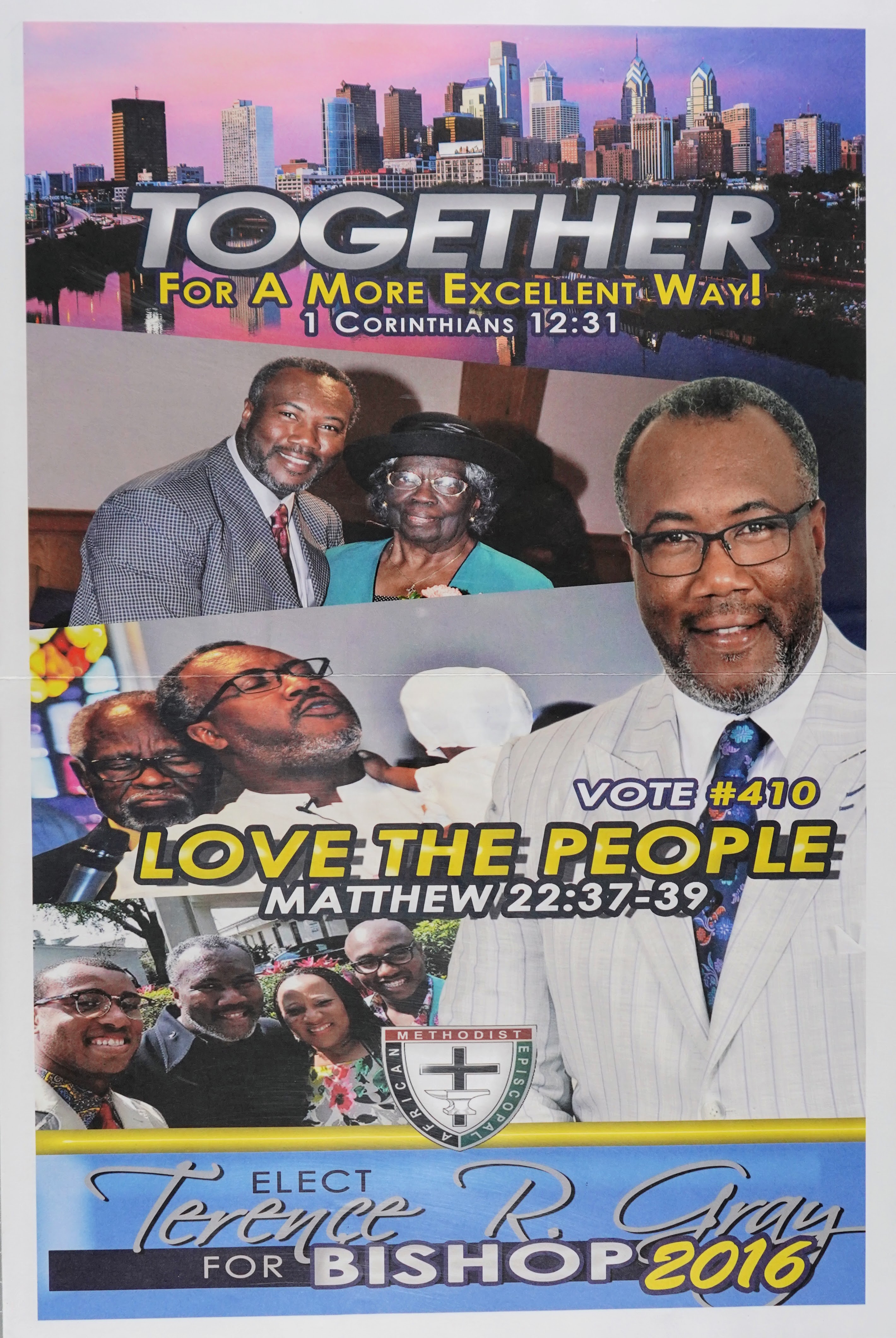
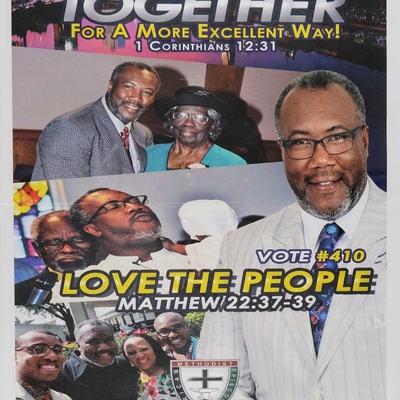
Ad: Vote #410: Terence R. .:
Gray for BiShOP .......ssssss000 Wheneventie onportiint®y
presents itself, | speak with
great pride about my many
former students over 48 years
of teaching in five HBCU’s—
four of my denomination, the
African Methodist Episcopal
(A.M.E.) Church, the oldest
African American denomination
..continued on p3
me at once when this session
is over.
That out of the way, let me
do what | know is proper: Dr.
Counter, Other Distinguished
Harvard Professors, Dedicated
Students, and others from this
educational community and
elsewhere. There is an old
As | look out at you Harvard |
scholars | cannot resist making
my usual recruitment com-
mercial: “If you have not
already committed yourselves
to a career in academe, please
do so. It really, surely, ‘sure
enough’ needs you.” Please
don’t everyone crowd around
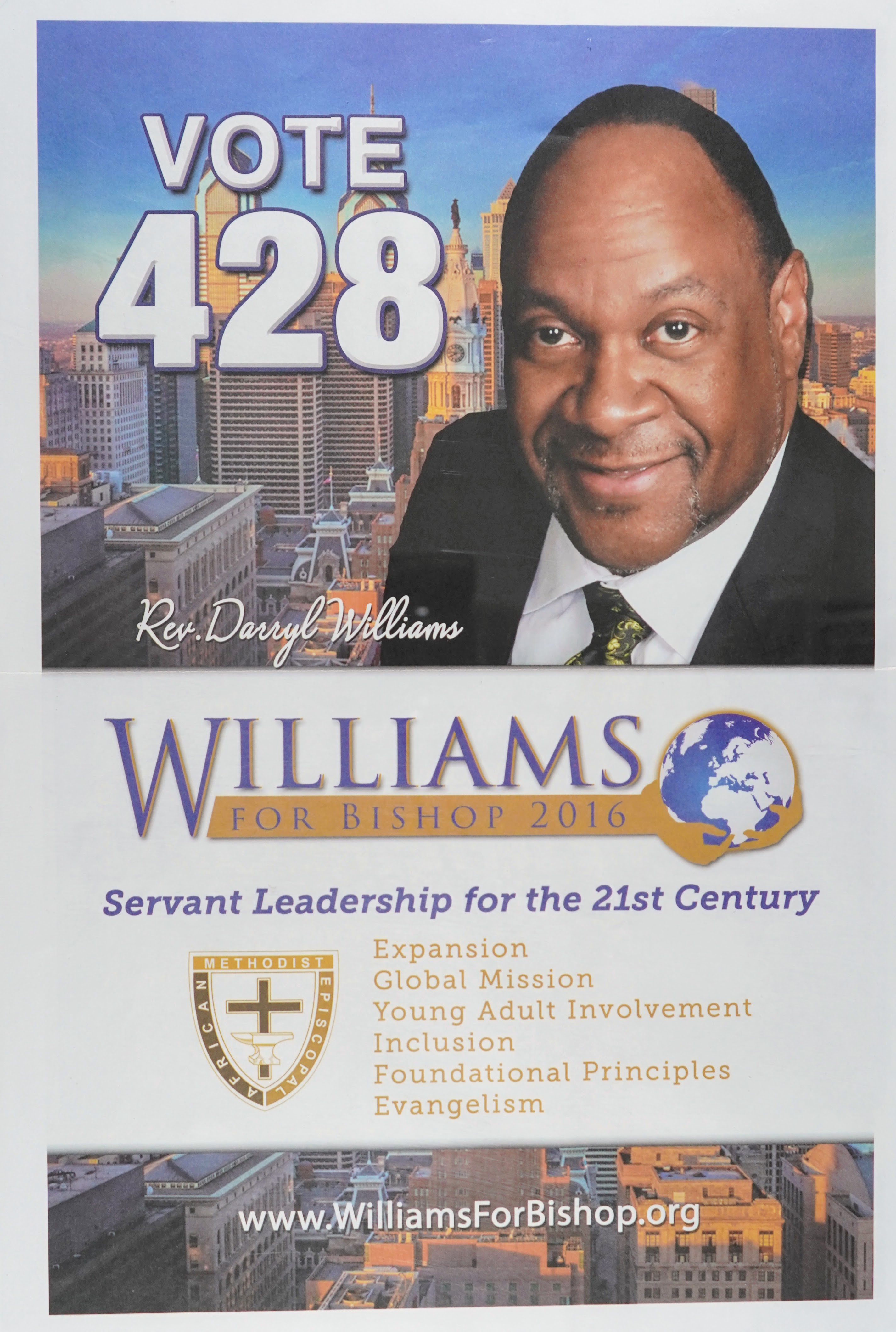
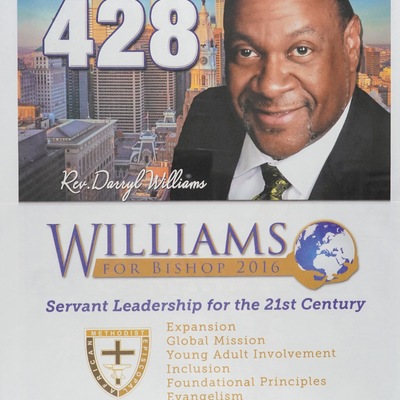
Ad: Vote #428: Rev. Darryl
Williams for Bishop ...... sl
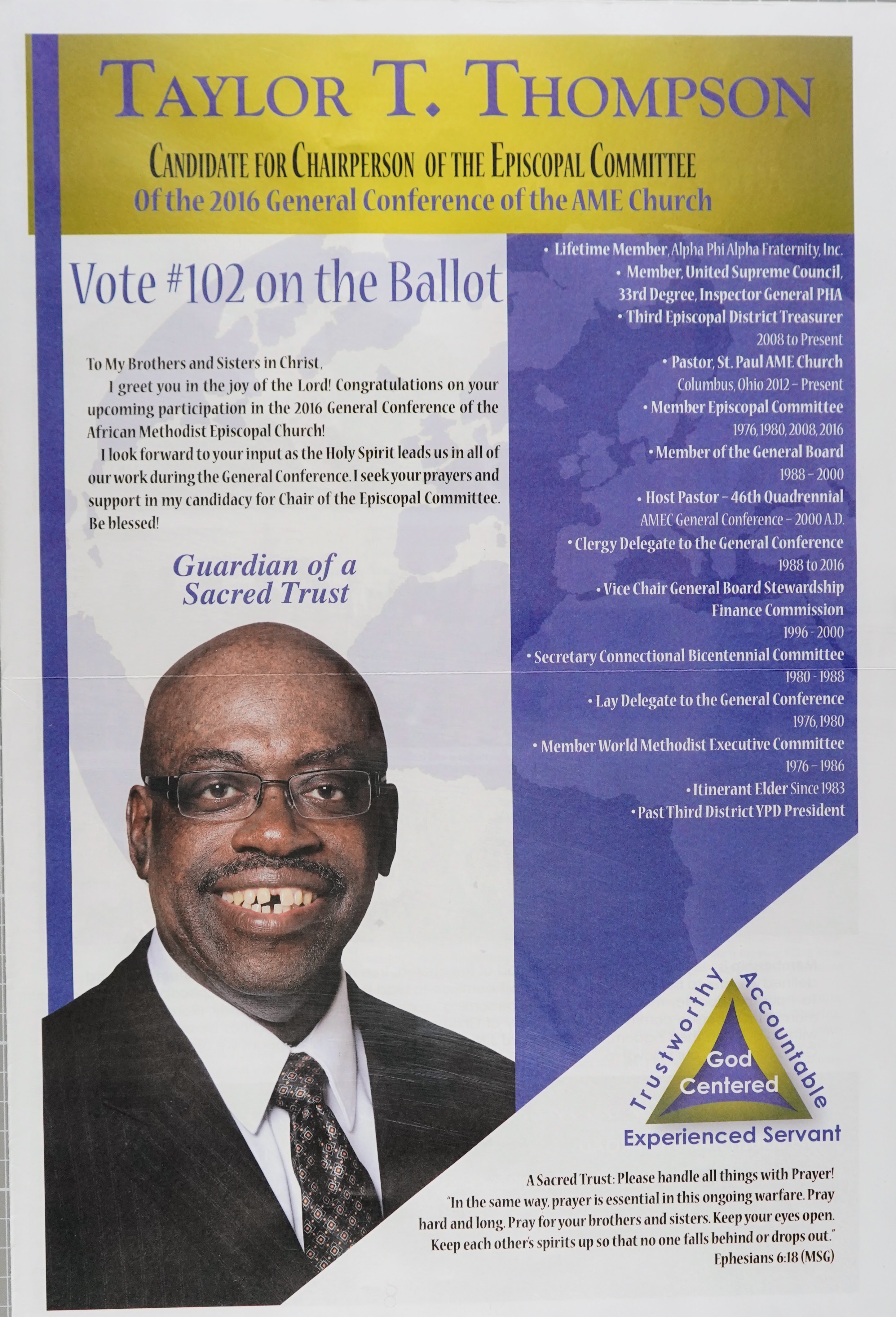
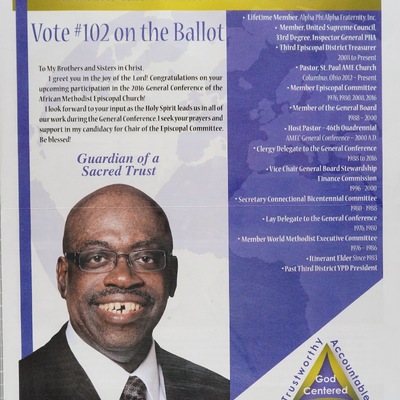
Ad: Vote #102: Taylor T.
Thompson for
Chairperson .........ssssseeesee ip
WE HAVE THE POWER
By Shirley A. Waters White, Ph.D., Big Bethel AME.
Church, Atlanta
IS)
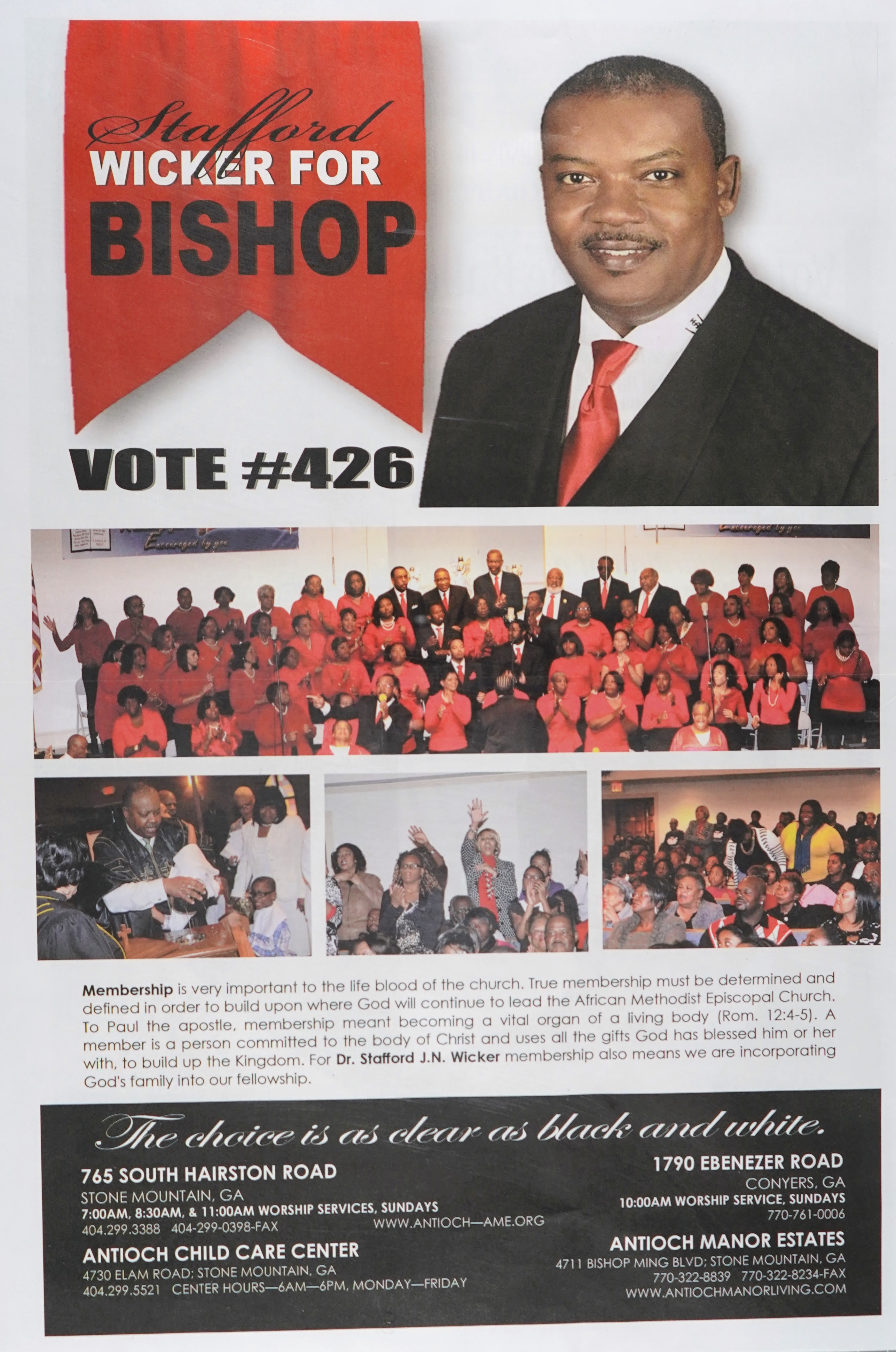
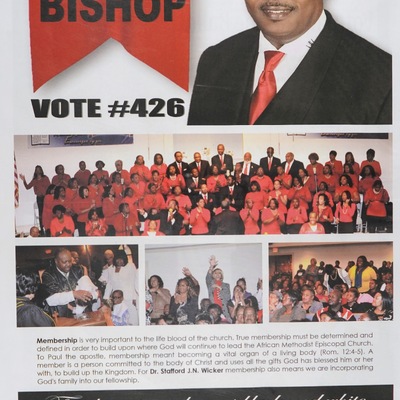
Ad: Vote #426: Stafford
Wicker for Bishop.........
do not reflect the will of the people. The voters selected
Obama and his vision over Romney and his, Schlesinger
wrote, and they did it decisively. Here are some key
statistics about President Obama’s victory cited in the
article: Barack Obama got 51.1 percent of the popular
vote to Mitt Romney’s 47.2 percent, the first president
to exceed 51 percent two elections in a row since
Dwight D. Eisenhower. Obama won 26 states and the
District of Columbia, 332 electoral votes. No state
won by Obama would have swung the election to
Romney had Romney won it. There were only four
especially close states in the 2012 election; Florida,
North Carolina, Ohio and Virginia were decided by
less than 5 percentage points, the...continued on p10
It is understandable that we are perplexed, confused
and repelled by what we see. Our political system may
be flawed, but that may be all the more reason we
; ; : need to stay engaged and make every effort to make
As the primary elections continue across America, | 4 difference. |
‘some voters may be repelled by the negative and often | tn January 2013, just a few weeks before President
‘hostile and violent scenes enacted each night on the | Obama was sworn in for his second term, columnist
‘national news. It is my prayer that these disagreeable Robert Schlesinger wrote an article titled: “Conservatives
antics will not result in the avoidance of the entire | Can’t Win at the Negotiating Table What They Lost at
| political process by many Americans, who might avoid | the Ballot Box.” Schlesinger was referring to the con-
‘going to the polls completely either in the primaries | tinuing efforts by Republicans to block the President
lor the national election in November. The danger that at every turn, no matter what the cost to the country.
\this attitude may well lead to disengagement when it | He reminded them —- and us —- that despite having |
/comes time to vote in the national election is very real. | control of the Congress through numbers, their efforts
===== DSC04342.JPG =====
In 2010, I decided that I was going to learn to play the guitar; it was something I
had always wanted to do, but had not gotten around to doing.
As a matter of fact, way back in 1997, I even bought a cheap guitar and a parishioner
offered to teach me how to play the guitar, but I didn’t follow up and the cheap guitar
stayed in my closet for years.
DR. CALVIN H. SYDNOR III
The 20th Editor of
The Christian Recorder
In 2009, a dear friend sent me a new expensive guitar with the encouragement to
learn to play it.
No movement on my part until he emailed and wrote, “I am going to try to get to
Nashville and we can strum together.” | got nervous because I didn’t want to embarrass myself by accepting a
gift and not using it. I quickly decided I needed to find a guitar teacher so I could learn to play something. I found
a good teacher and his studio was not far from home.
Before accepting me as a student, the guitar instructor asked, “Are you willing to practice?” | responded affir-
matively. The rest is history, but there were some learning curves along the way.
As an aside, I have been playing the piano since I was a teenager and played for choirs, but I always wanted
to play the guitar. The guitar is such a mobile instrument and I dreamed of playing the guitar and singing along
as I played; so I chose to learn to play the acoustic guitar.
I quickly discovered that playing the guitar was not an extension of playing the piano. My fingers took a beat-
ing and those six strings seemed at times to be 12 strings. My big hands and long fingers didn’t seem big enough
to maneuver my fingers to play even the simplest chords. I struggled.
About six months into my lessons, I had an epiphany. My teacher explained to me what some call the Nashville
Numbering System.
He explained that if you went to the various studios around Nashville, you will see guitarists and pianists excit-
edly numbering their musical score. He numbered a rock and roll song and a hymn and | was on my way to
learning to play the guitar.
I always knew that I learn best when I understand how things work and my guitar lessons reinforced it. I learn
best when I can make an application to something concrete; I do not learn well in a vacuum. I don’t learn well
from ethereal concepts.
Over time in my life and ministry, I discovered worship became more meaningful as | gained a greater knowl-
edge about worship and liturgy and came to understand that the order of worship was not something that was
“kind of thrown together.”
Recently, a young man doing some work in our home
came into my office and saw all of my guitars and two
ukuleles and we got into a discussion about playing
the guitar. I mentioned the Nashville Numbering
System to him and he had a quizzical look. After
explaining it to him, I pulled out some music and
showed him how I had numbered several musical
selections. He said, “I understand the 1-4-5 notations,
but I don’t know anything about all of the minor, sev-
I know that | play
|
}
DR. JOHNNY BARBOUR, JR., Publisher
DR. CALVIN H. SYDNOR III, The 20" Editor
! The Christian Recorder of the African Methodist Episcopal Church (USPS }
016880) is published bi-weekly by the AMEC Sunday School Union, 500
Eighth Avenue South, Nashville, Tennessee. Periodicals postage paid at
| Nashville, Tennessee. Postmaster, send address changes to The Christian |
| Recorder, 500 Eighth Avenue South, Nashville, TN 37203-4119. |
The Christian Recorder was established in 1852.
| Executive and Editorial Office: 500 Eighth Avenue South, Nashville,
Tennessee 37203-4119. Advertising rates are available on request
Subscription rate-$36.00 per annum. Please make all money orders and
cashiers checks payable to The Christian Recorder
BISHOP T. LARRY KIRKLAND, Chair of Publications’ Commission
Office: 615-714-0986 / chsydnor@bellsouth.net / Fax: 615-658-5552
www.the-christian-recorder.org
The Christian Recorder welcomes letters from its readers on matters of
general interest. Letters must be exclusive to The Christian Recorder and must
be signed, including the writer's home address and business telephone number.
No defamatory, libelous, or slanderous letters will be printed; and The Christian
Recorder reserves the right to reject or edit any letter or artic le to conform to good
taste, style, and space requirements Although we are unable to acknowledge
those letters we cannot publish, we appreciate the interest and value the views
of those who take the time to send us their comments. Letters intended for
publication should be addressed to The Christian Recorder/Letters to the Editor,
512 Eighth Avenue South, Nashville, TN 37203-4119 All photograph submissions
\ are the property of The Christian Recorder and will not be returned.
them, but | don’t know them like that.”
I suspect there some parishioners like the young man
working on our home; they know about church, but
they are unaware of the power of worship.
I suspect there are parishioners, and maybe some
clergy too, who attend worship and “meet the require-
ments for having attended church on Sunday.” They
are familiar with the order of worship, love the singing,
like to hear the preaching, tolerate preaching and meet
the requirement of having gone to church
$36.00 Per Year
Send Check or
Name
SUBSCRIBE!
to The Christian Recorder
Keep yourself informed
about your church fo
Money Order Payable to:
The Christian Recorder
500 Eighth Avenue South
Nashville, TN 37203-4119
Please PRINT, Fayment must
accompany order. Allow 4 weeks for delivery.
JUNE 6, 2016
© Cf -2f.
CDANLD
AUTHENTIC WORSHIP ALLOWS PARISHIONERS TO DEAL
WITH THE “WOWS" AND THE “WHYS" OF LIFE
They love the “Wow” moments of church; the great
music, dynamic sermons, the good job, the new car,
the great medical results, etc.
They often have difficulty with the “Why” moments
of faith. Why things don’t go right, why the children
are rebellious, why the troublesome medical issues,
why the conflicts in marriage, why the financial
burdens.
I believe worship would be more meaningful if we
understood the various parts of worship. I think if we
understand worship, we can more effectively deal with
the “Wow” and “Why” moments of life.
A.M.E. worship is kind of like A.M.E. protocol; we
always acknowledge God first.
A synopsis of A.M.E. worship
The prelude and introit help parishioners prepare
their hearts and minds for worship. Parishioners should
rid themselves of non-spiritual distractions.
The Doxology is an affirmation at the beginning of
worship that affirms the authority of God in our lives
and in the worship event. The Doxology is the assembled
parishioners’ praise to God.
The Doxology always requires an “Amen.” A doxo-
logical statement sung or spoken requires an “Amen”
from Christians. A shout or a holy dance is appropriate
after the Doxology!
A call to worship is just that, a call of the people to
congregational worship and an opportunity for parish-
ioners to affirm their love and commitment to be in
the house of the Lord, in the presence of the Holy God
and their commitment to share in joyful worship.
If a pastor uses another call to worship, that call to
worship should express the same intentions of the joy
of being in the house of the Lord and a commitment
for joyful worship.
The opening hymn, which should be taken from the
AMEC Hymnal, should always be a hymn of praise to
God! The opening hymn gives honor and acknowledges
the awesomeness and power of God. If..continued on p11
Order online at
amecpublishing-
house.com
===== DSC04343.JPG =====
QUALIFICATION REQUIREMENTS TO RUN FOR THE OFFICE OF THE BISHOP
By the Rev. Dimpho Alpheus Gaobepe, 19th Episcopal District (South Africa) *
| have deemed it appropriate and orderly for me to write this article in order to attempt to share with members |
of the A.M.E. Church around the globe my own understanding of the requirements for pastors of Episcopal dis-
tricts 14 - 20 to run for the office of a bishop as enshrined in The Doctrine and Discipline of the African Methodist
Episcopal Church - 2012.
This article is motivated by recent developments that have arisen due to non-certification of candidates who
were educated in seminaries and universities outside of the Continental United States and particular candidates
coming from South Africa and Namibia.
| would wish to first place on record issues that | believe are common cause attendant to the foregoing subject:
Page 116, Paragraph 4 of The Doctrine and Discipline of the African Methodist Episcopal Church- 2012, provides
that the candidates for the office of the bishop must register their credentials with the AMEC General Secretary/
ClO at least 180 days prior to the opening day of the General Conference. It further provides that, they must pos-
sess an earned seminary degree from an Association of Theological Schools (ATS) accredited seminary or, if outside
the United States, an accredited seminary as determined by the country in which he or she is educated.
Consistent with this part of the cited provision in The
Doctrine and Discipline of the African Methodist Episcopal
Church - 2012, candidates who acquired their seminary
degree in the U.S.A. are required by law to have obtained
a seminary degree from an ATS accredited seminary.
What does this mean? It means that the seminaries
from which they obtained their theological degree would
have complied with ATS requirements for
accreditation.
It is my considered submission that, reference to
“seminary degree” in the provision under view, cannot
reasonably and rationally have a common definition in
all the jurisdictions that affiliate to the church. This
provision does not even require candidates from outside
the United States to have an equivalent seminary degree.
The provision simply states, “If outside the United States,
an accredited seminary as determined by the country
in which he or she is educated.”
Acknowledging and appreciating the fact that in terms
_of the internal arrangements in the U.S.A. reference of _! —approved and accredited in terms of a particular NOF-
...From The Way p1 in our nation which will in this year of
2016 celebrate its Bicentennial. We will return to
Philadelphia, where when in 1787 the fathers of our
country were drafting the U.S. Constitution, a few blocks
away Richard Allen, a former slave, and others, were
establishing the A.M.E. Church.
It was a most unexpected surprise to receive a letter
from Doni Lehman, an intern at the Harvard Foundation,
inviting me to come to Harvard for this occasion. Doni’s
mother, Ellen Lehman, is the President of the thriving
Community Foundation of Middle TN, which was orga-
nized in 1991. | was pleased to be a member of the first
Board of Trustees, and I have continued to be a supporter
through the years. It is a case of connecting the dots,
according to Doni’s mother, that Doni would become
an intern at the Harvard Foundation, where Dr. Allen
Counter is the distinguished President and just happened
to have been one of my students at Tennessee State
University. Is this a coincidence or something else?
You have no idea how much pride | take in having
been a part of their educational experience. But there
is one more—a more recent addition to Harvard—a
graduate of Wilberforce University, my alma mater—in
the person of Dr. William Julius Wilson, distinguished
professor in the John F. Kennedy School of Government.
Now, all that being said, you can perhaps understand
my opening commercial. A teacher's life is so enriched
by the achievements of the students who have passed
her way. | am blessed also that not only was | invited
to your institution but that | was able to respond in the
affirmative. But let me hasten to tell you that | could
not be here today if my husband of 72 years, 2 months
and 3 days had not been able to accompany me—and
neither one of us could have come had our daughter
not traveled with us. Please stand up—Dr. McDonald
Williams and Donna Williams. They mistakenly think
I'm too old to travel alone.
Having just celebrated Black History Month we have
the seminary in the provision in question would be
interpreted as making reference to a Master’s degree,
commonly called Master of Divinity or any seminary
Master’s degree offered by an ATS accredited seminary,
which would not, as a matter of fact, be consistent with
the internal arrangements in other jurisdictions; South
Africa is a classic example.
| feel inclined to indicate that, in the case of South
African Qualifications Authority (SAQA)’s determination
of what would constitute the seminary degree, SAQA
employs NQF credits as a barometer; which in this
instance, 360 NQF credits would constitute NQF level 6
(degree), and on the other hand, 480 NQF credits would
constitute NQF level 7 (degree). When obtained, these
are considered seminary degrees in our context.
Accreditation does not begin at a Master’s degree,
unlike in the U.S.A., as it is determined by the Association
of Theological Schools in the U.S.A. and Canada.
In South Africa the following seminary degrees are
today—not only as it concerns race relations but also the
multiplicity of other problems that confront our nation
and the world. It is indeed relevant that you want to look
back on a major event in our democracy—the Civil Rights
Movement—and look ahead to your participation as a
new generation of thinkers who must also want the best
for America.
As a background to my discussion of the 1960’s, let
me take you back with me to the year 1956. From 1942
to 1956 our family lived in the quiet and peace of an
Ohio community, the home of Wilberforce University,
founded in 1856, the oldest private coeducational institu-
tion of higher education owned and controlled by African
Americans. Of interest to you, perhaps, is the fact that
one of the early teachers at Wilberforce University was
W.E.B. DuBois, the first African American to be awarded
the Ph.D. from Harvard University. Living in Ohio and
rearing our young daughter in relative freedom was all |
could ask for. Then my husband, with his recently granted -
Ph.D., was offered a position as Head of the Department
of English at Morris Brown College. This was 1956. The
place was Atlanta, GA, where segregation, despite Brown
v. Board of Education, was the de facto law of many
southern states. That then was the beginning of my
involvement in civil rights.
Atlanta was the home of 5 HBCU’s—Spelman, Clark,
Morehouse, Atlanta University and Morris Brown. |
became active with the NAACP, and worked with the
youth councils of the colleges. | became a member of
the Executive Committee of the NAACP and had the
opportunity on more than one occasion to volunteer
to pick up Atty. Thurgood Marshall at the airport when
he was coming to speak. Now the reason for my vol-
unteering was that | was in the process of writing my
doctoral dissertation on “A Rhetorical Analysis of
Thurgood Marshall’s Arguments Before the Supreme
Court in the Public School Segregation Controversy.”
(Brown v. Board of Education)
heard many discussions about the state of America Other involvement included attending the court
AMECPUBLISHINGHOUSE.COM
neal i
credits threshold:
Diploma in Theology (360 credits) NQF Level 6
| (Degree)
Systematic Diploma in Theology (480 Credits) NQF
Level 7 (BA or B.Th)
B.A. or B.Th (with honors) (120 Credits) NOF LEVEL 8
Master’s Degree (120 Credits) NOF level 9
Doctoral Degree NQF Level 10
My point is that The Doctrine and Discipline of the
African Methodist Episcopal Church- 2012 states that
candidates should have a seminary degree and in so far
as | am concerned, all of the above are considered
seminary degrees as determined by the country in which
clergy members are educated.
Let me also bring to the attention of the readers in the
U.S.A., the majority of certified candidates have Masters
of Divinity, which is a three year program. The seminary
degree (M.Div.) in South Africa is only offered by three
universities: Stellenbosch University in Cape Town,
University of North West and University of Pretoria.
Note that though the degree is called a Master of
Divinity in South Africa it is not at the level of a profes-
sional Master’s degree which is NOF Level 9; it is at NOF
Level 8, which is B.A. with Honors.
| invite the readers to visit all these prestigious uni-
versities online and confirm my facts. Furthermore note
that the reason for the non-certification is based on
the idea that such candidates do not possess a profes-
sional Master’s degree in terms of (ATS) U.S.A. standards
and requirements.
Using (ATS) U.S.A. approved requirements and (SAQA)
| south African standards-on equal —~22tinued on p6_
presided over by Judge Durwood Pye, where Atty. Donald
Hollowell, who secured Martin Luther King, Jr’s, release
from Reidsville Prison, would represent the NAACP, which
was under fire because of the failure of the President,
John C. Calhoun, to register the organization with the
Secretary of State. | recall another dramatic case when
Judge Pye cross-examined Mrs. Eunice Cooper, the
NAACP Secretary, concerning her refusal to turn over
the membership roll of the Atlanta Branch. To do so
would have endangered the jobs of many of its members.
When the trial ended Judge Pye, a diehard segregationist,
fined the Atlanta Branch $25,000. Interestingly, the state’s
highest bench ruled in support of the NAACP, which
resulted in the NAACP not having to pay the fine nor
surrender its membership roll.
Fast forward to 1958 when my husband and | were
invited to join the faculty of Tennessee A & | State College,
as it was then called. Because | had just been granted
a Danforth Fellowship to complete my dissertation at
The Ohio State University, | was given a year’s leave of
absence.
When | returned to Nashville in 1959 it was on the
eve of the 1960 Civil Rights Movement. Actually the
Nashville Movement had its inception in December,
1959, when after training in nonviolent techniques by
James Lawson, the students of Fisk, TN A&, Meharry
and American Baptist College quietly tested the status
quo by sitting-in at Harvey and Cain Sloan Department
Stores, the Greyhound and Trailway Bus Stations, and
Woolworth and McClellan Ten Cent Stores. This action
took the community by surprise; so there was no violence.
The decision was made to continue the demonstrations
upon returning from the Christmas holidays.
Meanwhile in Greensboro, NC, four freshman students
on February 1, 1960, staged a sit-down at the lunch
counters at the Woolworth Store. The students in
Nashville then on February 6 staged a sympathy sit-in.
The major players in the Nashville Movement were Diane
Nash, Marion Barry (Fisk), Fred Leonard, Leo Lillard
..continued on p4
===== DSC04344.JPG =====
THE CHRISTIAN RECORDER
From The Way p3 Lucretia
Catherine Burke, William Barbee
John Lewis, Bernard Lafayette
Bevel (ABC). James Lawson, a graduate
student at Vanderbilt Divinity School
with Rev. Kelly Miller Smith, Sr., Pastor of
First Baptist Church and Associate Dean
at Vanderbilt Divinity School, Rev. C.T.
Vivian, Rev. Andrew White, Rev. Joseph
ES Lowery, were mentors and supporters,
They represented the Southern Christian
Leadership Conference (SCLC), the NAACP
and local churches.
We as adult activists in the community
attended weekly mass meetings, held at
various churches where we sang freedom
songs, prayed and contributed funds for
bail for the jailed students, provided trans-
portation and were a part of the civil rights
marches. | will mention one example of
an event that solidified the community.
On April 19, 1960, at 5:30 a.m., the home
of the leading lawyer for the movement—
Z. Alexander Looby—was bombed. One
Collins
TN A&l
and James
along
hundred and forty windows at nearby |
Meharry Medical College were broken. |
Our family, living several miles away, was
awakened by the blast.
This cowardly act mobilized the black |
community. A massive march of some
1500 persons left the TN A&! community,
joined by others from the Fisk and Meharry
communities until there were more than
3000 marchers who reached the court-
house to confront Mayor Ben West. Let
me add that there had been no plan to
demonstrations, but on this day some
college students when marching past Pearl
High School barged in and called them
out. Mr. John Hull, the Principal, stood
at the door and, according to our daughter
Donna, asked her what her parents would
say, and she assured him they would
expect her to be in the march.
Upon reaching the capitol, Rev. C.T.
Vivian read a statement setting forth the
position of the demonstrators. Diane Nash,
the real leader of the group, spoke up and
asked the Mayor to use the prestige of his
office to end segregation and then asked
the pointed question: “Do you recommend
that the lunch counters be desegregated?”
To his credit and to our amazement he
said, “Yes.” These courageous student
leaders included John Lewis, now a mem-
ber of Congress; Dr. Gloria Powell Johnson,
first black female to become a tenured full
professor at Harvard Medical School; Dr.
Rodney Powell, a doctor in Hawaii; Curtis
Murphy, an educator in Chicago; and Dr.
Bernard Lafayette, a former President of
American Baptist College. The bombing,
| the massive march, the Mayor's response
|
|
struck a death knell to the continued white
opposition to the desegregation of public
accommodations. In addition, the
Movement used a selective buying tech-
nique—couldn’t call it a boycott—just
before Easter, urging African Americans
to stay out of town. Dr. Vivian Henderson,
a noted economist at Fisk, announced that
in the month of March downtown stores
purchasing power of the black community
was $40 million.
But the
hat caught my
sit-ins were not the only activity
attention. Nashville
vad two other movements requiring citizen
nvolvement. In April, 1967, Dr. Martin
uther King, Jr, Stokely Carmichael and
Senator Strom Thurmond were invited to
speak at Vanderbilt University’s Annual
mpact Symposium. Stokely Carmichael
delivered a speech that stressed the signifi-
cance of the Movement but was not con-
troversial. Interestingly, the Nashville Banner
had tried to prevent his appearance, claiming
he would incite violence. By contrast,
several days later he spoke at Fisk University
and TN State—reluctantly agreed to by the
administrations—and his inflamed rhetoric
generated such a response that it ignited
also
_ trouble in the North Nashville Community.
A riot broke out between students and the
police, resulting in Governor Buford |
Ellington dispatching National Guardsmen
with tanks and firearms to the intersection |
of the street at the main entrance of the
TSU campus. Students, in turn, assembled,
kept running toward the troops and taunting
them. The TSU administration arranged for
a conference with Governor Buford Ellington
at his mansion. Dr. W.N. Jackson, Vice
| President of Academic Affairs; Dr. Joseph
A. Payne, Vice President of Student Affairs;
James Montgomery, SGA President; and |,
as Chairperson of the Student Faculty |
Advisory Committee, met with the Governor
and apprised him of the gravity of the situ-
JUNE 6, 2016
The Governor listened and promised to
withdraw the troops if we could persuade
the students to stop demonstrating, Relative
peace ensued as a result
The Nashville Community faced other
challenges. On one occasion the KKK
announced that it planned to march in
the streets of Nashville. The Nashville
Panel, an integrated group of which | was
a member, sought to work across racial
lines. We decided on a course of action
to stop the march. On April 10, 1980,
Rabbi Marc Tannenbaum of New York,
a leading ecumenist and Human Rights
Rabbi of America, accepted our invitation
to speak at a mass meeting. Three panel-
ists were to react to his strong supportive
statements for justice—I was the woman
on the reaction panel. As a result of this
event, the Klan did not march!
That is a snapshot of some of the dramatic
events of the 1960’s movement. But the
times demanded citizen participation in
other ways to help America become of the
people, by the people and for the people.
Political activity was another area in which
we chose to be involved. We continued our
| activity with the Nashville Branch, NAACP,
40 years as members of the Executive
Committee; my husband was a first Vice
President. | for some 20 years served as
Chair of the Life Membership Committee.
Then there was the Tennessee Voters
Council (TVC), a state-wide political orga-
nization, chaired by Senator Avon Williams,
first black elected to the Tennessee Senate,
include high school students in the | lost $250,000 and noted that the overall '_ation with students taunting armed troops. |_and for which | served as_...continued on p7
Do You Feel Like God is Calling You
To Help pansion ane World?
RORELESSWESS
SOLU BUSY:
Dr. Terence L. Mayes,
Presiding Elder, East Tennessee
13th Episcopal District
DIRECTOR OF EVANGELISM
tmayes5116@aol.com
Turner Theological Seminary at ITC &
is your answer to become
equipped and empowered to do it!
Enroll today at itc.edu
404-527-7792
Ls tS
pha ie
Ma " AN sy et; 1 \
Admissions@itc.edu a) ENA
f
it
ife
orev
TRANSFORMING! Lives. Communities. The World.
===== DSC04345.JPG =====
wane i if
ery of Light
i
sek;
LVL. LEARN, F
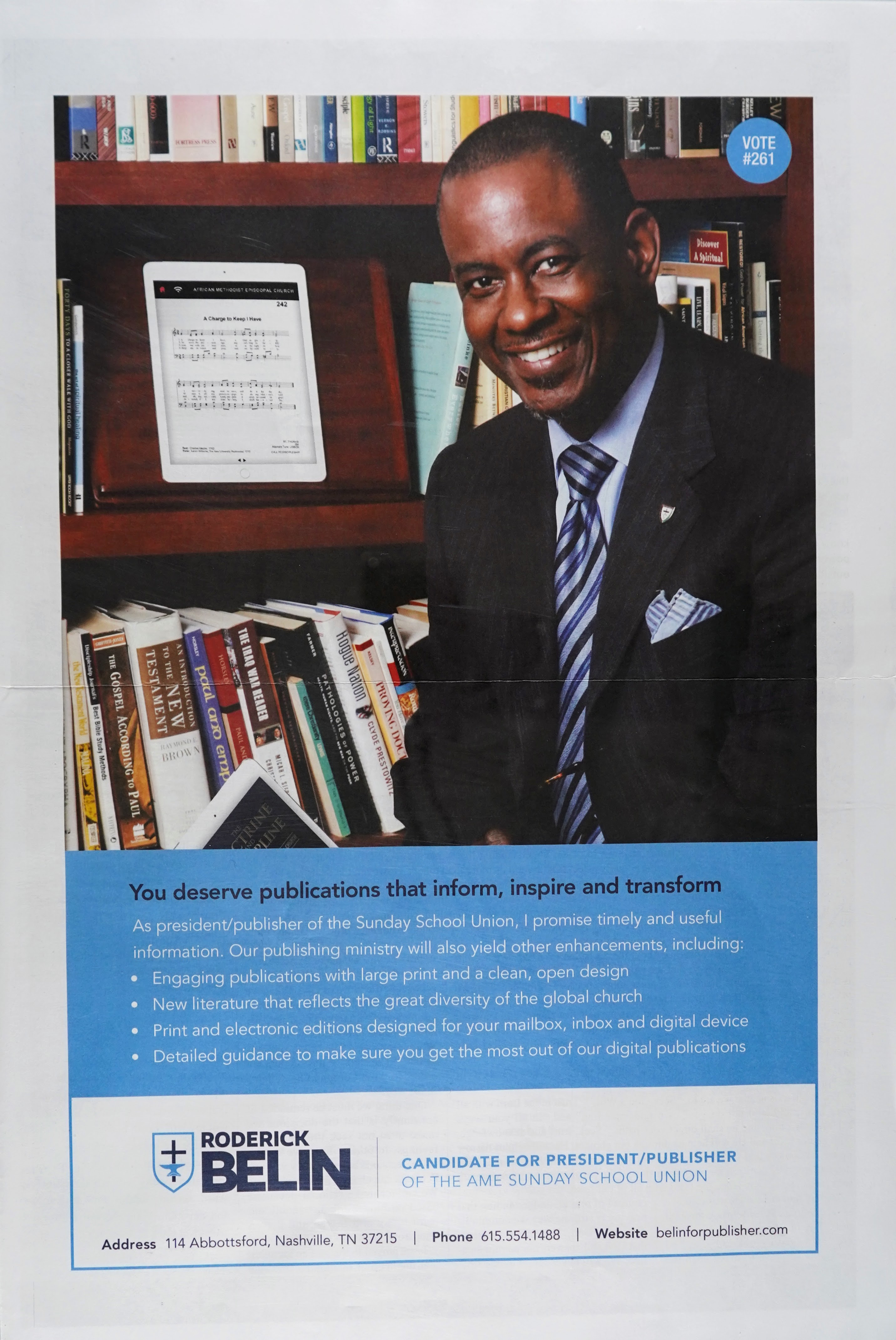
tions that inform, inspire and transform
ica
RODERICK
BELIN
Address 114 Abbottsford, Nashville, TN 37215
safe
You deserve publ
Website belinforpublisher.com
Phone 615.554.1488 |
===== DSC04346.JPG =====
THE CHRISTIAN RECORDER
JUNE 6, 2016
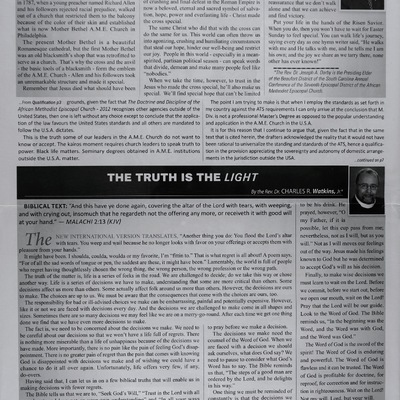
MEDITATION BASED ON PHILIPPIANS 2:1-10
By the Rev. Dr. Joseph A. Darby’
OF THE AFRICAN METHODIS1
EPISCOPAL CHURCH. The denomination was
incorporated in 1816, but the church was really born
in 1787, when a young preacher named Richard Allen
and his followers rejected racial prejudice, walked
out of a church that restricted them to the balcony
because of the color of their skin and established
what is now Mother Bethel A.M.E. Church in
Philadelphia.
The present Mother Bethel is a beautiful
Romanesque cathedral, but the first Mother Bethel
was an old blacksmith’s shop that was retrofitted to
serve as a church. That’s why the cross and the anvil
- the basic tools of a blacksmith - form the emblem
of the A.M.E. Church - Allen and his followers took
an unremarkable structure and made it special.
Remember that Jesus died what should have been
...From Qualification p3
a humiliating and disgraceful death on a cross - an
instrument of cruel torture reserved by the Roman
government for vile criminals and enemies of the state.
Because of Christ, however, what was a symbol
of crushing and final defeat in the Roman Empire is
now a beloved, eternal and sacred symbol of salva-
tion, hope, power and everlasting life - Christ made
the cross special.
The same Christ who did that with the cross can
do the same for us. This world can often throw us
into agonizing, crushing and humiliating circumstances
that steal our hope, hinder our well-being and restrict
our joy. People in this world - especially in a mean-
spirited, partisan political season - can speak words
that divide, demean and make many people feel like
“nobodies.”
When we take the time, however, to trust in the |
Jesus who made the cross special, he’ll also make us _|
special. We’ll find special hope that can’t be limited |
grounds, given the fact that The Doctrine and Discipline of the |
by this world, special blessings
that can’t be restricted by rude
and crude politicians and their
angry followers and special
reassurance that we don’t walk
alone and that we can achieve
and find victory.
Put your life in the hands of the Risen Savior,
When you do, then you won’t have to wait for Easter
Sunday to feel special. You can walk life’s journey,
saying every day as one hymn writer said, “He walks
with me and He talks with me, and he tells me I am
his own; and the joy we share as we tarry there, none
other has ever known!”
*The Rev. Dr. Joseph A. Darby is the Presiding Elder
of the Beaufort District of the South Carolina Annual
Conference of the Seventh Episcopal District of the African
Methodist Episcopal Church.
The point | am trying to make is that when | employ the standards as set forth in
African Methodist Episcopal Church - 2012 recognizes other agencies outside of the
United States, then one is left without any choice except to conclude that the applica-
tion of the law favours the United States standards and all others are mandated to |
follow the U.S.A. dictates.
This is the truth some of our leaders in the A.M.E. Church do not want to
know or accept. The kairos moment requires church leaders to speak truth to
power. Black life matters. Seminary degrees obtained in A.M.E. institutions
outside the U.S.A. matter.
THE TRUTH IS THE L/GHT
my country against the ATS requirements | can only arrive at the conclusion that M.
| Div. is not a professional Master’s Degree as opposed to the popular understanding
and application in the A.M.E. Church in the U.S.A.
It is for this reason that | continue to argue that, given the fact that in the same
text that is cited herein, the drafters acknowledged the reality that it would not have
been rational to universalize the standing and standards of the ATS, hence a qualifica-
tion in the provision appreciating the sovereignty and autonomy of domestic arrange-
| ments in the jurisdiction outside the USA.
..continued on p7
By the Rev. Dr. CHARLES R. Watkins, Jr.*
BIBLICAL TEXT: “And this have ye done again, covering the altar of the Lord with tears, with weeping,
and with crying out, insomuch that he regardeth not the offering any more, or receiveth it with good will
at your hand.” — MALACHI 2:13 (KJV)
The
pleasure from your hands.”
NEW INTERNATIONAL VERSION TRANSLATES, “Another thing you do: You flood the Lord’s altar
with tears. You weep and wail because he no longer looks with favor on your offerings or accepts them with
It might have been. I shoulda, coulda, woulda or my favorite, I’m “fittin to.” That is what regret is all about! A poem says,
“For of all the sad words of tongue or pen, the saddest are these, it might have been.” Lamentably, the world is full of people
who regret having thoughtlessly chosen the wrong thing, the wrong person, the wrong profession or the wrong path.
The truth of the matter is, life is a series of forks in the road. We are challenged to decide; do we take this way or chose
another way. Life is a series of decisions we have to make, understanding that some are more critical than others. Some
decisions affect us more than others. Some actually affect folk around us more than others. However, the decisions are ours
to make. The choices are up to us. We must be aware that the consequences that come with the choices are ours, too.
The responsibility for bad or ill-advised choices we make can be embarrassing, painful and potentially expensive. However,
like it or not we are faced with decisions every day. And the decisions we are challenged to make come in all shapes and
sizes. Sometimes there are so many decisions we may feel like we are on a merry-go-round. After each time we get one thing
done we find that we have even more decisions to make.
The fact is, we need to be concerned about the decisions we make. We need to
be careful about our decisions so that we won’t have a life full of regrets. There
is nothing more miserable than a life of unhappiness because of the decisions we
have made. More importantly, there is no pain like the pain of feeling God’s disap-
pointment. There is no greater pain of regret than the pain that comes with knowing
God is disappointed with decisions we make and of wishing we could have a
chance to do it all over again. Unfortunately, life offers very few, if any,
do-overs.
Having said that, I can let us in on a few biblical truths that will enable us in
making decisions with fewer regrets.
The Bible tells us that we are to, “Seek God’s Will,” “Trust in the Lord with all
your heart, and lean not on your own understanding” and “In all your ways
acknowledge him, and he shall direct your paths.” Seek, trust and acknowledge,
with all our heart and He will help us through our choices. He will help us narrow
down the choices that will work best in our situation. He will help us make the
most appropriate decision for our circumstance. We are admonished, however, to
seek, trust and acknowledge the Lord with all of our heart.
We will find that the greatest resource , counsel of prayer, understanding that
available to us as we journey through | praying is still the way we communi-
the valley of decision is the Lord! We | cate with God. The Bible promises
are challenged to look to hgim. The | that God still answers our communica-
decisions we have to make need the ! tion. We will never regret taking time
to pray before we make a decision.
The decisions we make need the
counsel of the Word of God. When we
are faced with a decision we should
ask ourselves, what does God say? We
need to pause to consider what God’s
Word has to say. The Bible reminds
us that, “The steps of a good man are
ordered by the Lord, and he delights
in his way.”
One thing we must be reminded of
constantly is that the decisions we
make must not seek the counsel of
feelings. In other words, we cannot
make decisions based on how we feel.
Feelings can change from day to day.
We cannot make rational decisions
based on how we feel, tranquil and
calm today and tossed and driven
tomorrow.
Jesus prayed in the garden knowing
that the “cup of mankind’s sin” was
to be his drink. He
prayed, however, “O )
my Father, if it is
possible, let this cup pass from me;
nevertheless, not as I will, but as you
will.” Not as I will moves our feelings
out of the way. Jesus made his feelings
known to God but he was determined
to accept God’s will as his decision.
Finally, to make wise decisions we
must learn to wait on the Lord. Before
we commit, before we start out, before
we open our mouth, wait on the Lord!
Pray that the Lord will be our guide.
Look to the Word of God. The Bible
reminds us, “In the beginning was the
Word, and the Word was with God,
and the Word was God.”
The Word of God is the sword of the
spirit! The Word of God is enduring
and powerful. The Word of God is
flawless and it can be trusted. The Word
of God is profitable for doctrine, for
reproof, for correction and for instruc-
tion in righteousness. Wait on the Lord!
Not my will, Lord, but your will.
Before we make a decision we are
cautioned to wait, pray seeking quality
time alone with God. Wait, read the
Word, seeking quality time in study
and devotion. Wait, put our feelings
aside! Not my will, Lord, but your will.
ae!
*The Rev. Dr. Charles R. Watkins, Jr. is the Pastor
of Morris Brown A.M.E. Church in Charleston, SC.
===== DSC04347.JPG =====
|-From Qualifications p6 = Most importantly, in my considered view, the operative
word that constitutes an overbearing prerequisite to the latter part of the provi-
| sion, being reference to as “a degree,” which in my view, had the drafters intended
_ to qualify the level of such a degree, such a clarity would have been expressly
provided in The Doctrine and Discipline of the African Methodist Episcopal Church
- 2012 like they have done on Pages 113-114 on requirements when running for
Office of Connectional WMS and including Pages 84 and 85 of The Doctrine and
Discipline of the African Methodist Episcopal Church- 2012 on appointment of
members to the Board of Examiners. The Doctrine and Discipline of the African
Methodist Episcopal Church - 2012 is clear!
For example, Page 125 Section Ill, The Doctrine and Discipline of the African
Methodist Episcopal Church - 2012 as it relates to General Officers states, “Persons
elected General Officers by the General Conference shall be blameless in character
and possess the necessary qualifications.”
Dealing only with this first part of the provision as enshrined in The Doctrine and
Discipline of the African Methodist Episcopal Church - 2012, one wonders what is
meant by “necessary qualifications.” Are we going to be told the definition of this |
requirement at the time some of the potential candidates outside the U.S.A. declare
interest to run for office?
To me, this requirement of “necessary requirements” is the same as “Seminary
Degree” because it is not specific as to what degree threshold is required.
Reverting to my subject, acknowledging and appreciating the role that the ATS
plays in the context of the U.S.A. and Canada, it is equally of paramount importance
to proffer that various accrediting agencies in respective jurisdictions outside the
purview of ATS, based on the autonomous determination of their educational
programmes, may not accredit the degrees at the same levels as ATS. This competence
is unambiguously given life and acknowledged in the scheme of the above cited |
provision, which affords those members outside the U.S.A. such a competency.
| want to reiterate that my understanding without giving interpretation of the lan-
guage in The Doctrine and Discipline of the African Methodist Episcopal Church - 2012,
candidates that went to seminaries in the U.S.A. and Canada would need a seminary
..From The Way p4 Secretary for 19 years. One of the main functions of the TVC was
to interview candidates for state-wide and national office and give our endorsement.
Interestingly, legislative as well as presidential candidates sought our endorsement.
That was the way it was. It was truly a gratifying moment when on April 19,
1995, exactly 35 years after Diane Nash posed that crucial question to Mayor West
-on the morality of segregation another Mayor—Philip Bredesen—on the same spot
in front of the courthouse in the presence of civil rights activists, including an older
Diane Nash, dedicated a plaque commemorating that historic day with the words
from the Old Testament prophet Joshua: “And the people shouted with a great
shout so that the walls fell down.”
All that having been said, what can | say to you? As future leaders of the 21st
Century, as individuals who are more privileged than many others who are denied
access to education and a better life, you have the responsibility to do what you
can, where you can, to erase the last vestige of racism which negates the words of
the Declaration of Independence being a creed to live by: We hold these truths to
be self-evident that we are endowed by our creator with certain inalienable rights
and among these are life, liberty and the pursuit of happiness.
What | want you to keep in your remembrance is a simple message. It is simply
this, “It’s Up to You.” It truly is. It really is! It “sure enough” is!! You, the millennial
generation, with more advantages than many in prior centuries. You who live in a
highly sophisticated, technological, advanced society with far more advantages than
many of your ancestors. | urge you to take seriously all of the crucial problems of a
degree at a Master's Level because of the ATS requirement, while candidates from the
country in which | was educated would need to have a seminary degree at any thresh-
old to be certified as candidates so long as they possess a seminary degree not a
Master's degree, but a seminary degree earned from an accredited seminary,
Why? Because it is common cause that the domestic arrangements in a particular
member country, which are being acknowledged and given effect by the enabling
provision in The Doctrine and Discipline of the African Methodist Episcopal Church,
would not be bound by the autonomous arrangements in the ATS regulated jurisdic-
tions in the form of U.S.A. and Canada on determination of a level of a degree con-
cerned, It is thus compellingly evident that the interpretation and application of this
provision by the A.M.E. Church is currently favorably lopsided towards the ATS
standards, which paradoxically are not explicitly enshrined in any official document
of the A.M.E. Church as such; let alone in The Doctrine and Discipline of the African
Methodist Episcopal Church - 2012, as assuming such principal point of reference by
other jurisdictions.
Let us remember that while a Master of Divinity is a professional degree in the
U.S.A., in South Africa, a Master of Divinity Degree, in terms of our NQF level is at
level 8, not NQF level 9, which is considered a professional Master’s degree.
Finally, The Doctrine and Discipline of the African Methodist Episcopal Church - 2012
does not mention the requirement as a professional Master’s degree but it says a
| seminary degree. Had it been the intention of the drafters of The Doctrine and
Discipline of the African Methodist Episcopal Church to set the level of the seminary
degree at the professional Master’s degree level as per the argument tendered by
some individuals in the U.S.A., either a definition would have been included in The
Doctrine and Discipline of the African Methodist Episcopal Church - 2012 to provide
certainty on this, or the body of this provision would have explicitly made reference
to “a Professional Master’s Degree.”
Like all other A.M.E.s around the world - | love my Church and | am proud to be an A.M.E.
*The Rev. Dimpho Alpheus Gaobepe, M.A., International Relations, BSC Math and Political Science;
Diploma Systematic Theology (NOF Level 7, a Seminary Degree), Current M.Th. degree; Senior Pastor
at H.J. Bryant Temple, West Conference, 19th Episcopal District- South Africa.
hurting world. Look at them carefully.
The writer of Ecclesiastes reminds us that
“for everything there is a season, and a
time for every matter under heaven.” This
is a time to evaluate with an unprejudiced,
objective eye; and-act in the best of inter-
est of everybody. It’s up to you.
The Southern Poverty Law Center urges
us to “fight against the far-right extremists
who want to divide our country; seek
justice in the courts for victims of racism
and discrimination, whether it is ethnic,
cultural, religious or class; be examples
for children with lessons of tolerance and
understanding before the seeds of hate
can take root in their lives.” Somebody
should have reached Dylann Roof, the
misguided young man, who on June 17,
2015, murdered nine Christian women
and men in Bible Study at Mother Emanuel A.M.E. Church in Charleston—because
he wanted to start a race war.
| was able to attend the funeral of the Pastor of Mother Emanuel, the | pontinued on p11
ANNUAL CONFERENCE
SCHEDULE
SIXTH EPISCOPAL DISTRICT
A.M.E. CHURCH
BISHOP PRESTON WARREN WILLIAMS II
JUNE 8-10, 2016
PLANNING MEETING
Macon Marriott Centreplex
240 Coliseum Drive
Macon, GA 31217
Site Phone: (478) 621-5300
..From Concerns p1 you to proceed forward. Please
keep in mind “that if a parent loves his child, he will
correct him when he is out of line.” A loving parent
will guide and teach their children. The Bible adds that
“if you neglect to train and teach your child, you don’t
love your child (Proverbs 13:24).”
If our youth are too uncomfortable to seek help from
family, the community, or the church--our future is in
trouble. As a minister of the youth, it troubled my heart
when I learned from a few high schoolers; first, that the
bathrooms and various sections within the schools smell
of marijuana on a daily basis. Since the smell of this
drug is blatant, both students and teachers detect and
are aware of the activities that transpire; however, it
appears none of the school administration has said or
has done anything to stop such activity to occur on/
within school grounds.
Second, several students are faced with bullying on
a daily basis. Although reported to teachers and/or vice
principals/principals with the requested written bullying
reports, it appears none of the school administration has
body or faculty. Unfortunately, it also seems no school
administrative action is in place to discipline the young
people who are doing the bullying. Furthermore, it was
revealed that some if not most of the teachers are too
in fear to speak up about/or speak to those who are the
“bullies”--for fear of becoming threatened or the ones
included as the victims of bullying.
No more shall children go to school and remain in
doubt, threatened and/or feel that that if truly faced
with a problem, no one will listen. It is important that
our youth know that their lives are significant and of
value wherever they go and with whoever is in their
company. No longer should suicide or homicide be
an option as a solution. If a child feels in danger, a
child should have confidence within those who vow
to cultivate, encourage, teach and aspire to excellence-
-would also serve as those same persons make sure
each child knows they are valuable, and treatment
unto them and from one another SHOULD be in
excellence.
If we do not consider them as valuable rather than
collectively addressed this issue to either the student
AMECPUBLISHINGHOUSE.COM
anything glamorized negatively, the legacy of our
people and our church will die. It is time to take back
our youth; from depression, thoughts/attempts of
suicide, drugs, unprotected/underage/unmarried Sex,
insecurity, mom’s and dad’s mess, the wrong crowds,
neglect and manipulation. It is time, to make the
change to preserve our future as black people, restore
our community as one in Christ; not as enemies and
not as thieves but as brothers and sisters in Christ
making investments into the younger brothers and
sisters in need.
When asked by a younger person, “Where is God?”,
make sure that each of them knows God is wherever
they are because Christ lives within them and they
are never alone or apart from a reliable provider of
comfort, power, love and safety--Jesus Christ.
Assignment: Be the church and minister unto our
youth-- Young lives matter!
LE i eR
The Reverend Miesha Osborne, Minister of the
Youth at Mount Calvary A.M.E. Church in Tow-
son, Maryland. 900
===== DSC04348.JPG =====
Continuing sa
A Legacy of ais
dist Century 3
UDIIShing Am
VOTE #262
REV. HENRY E.
GREEN, JR.
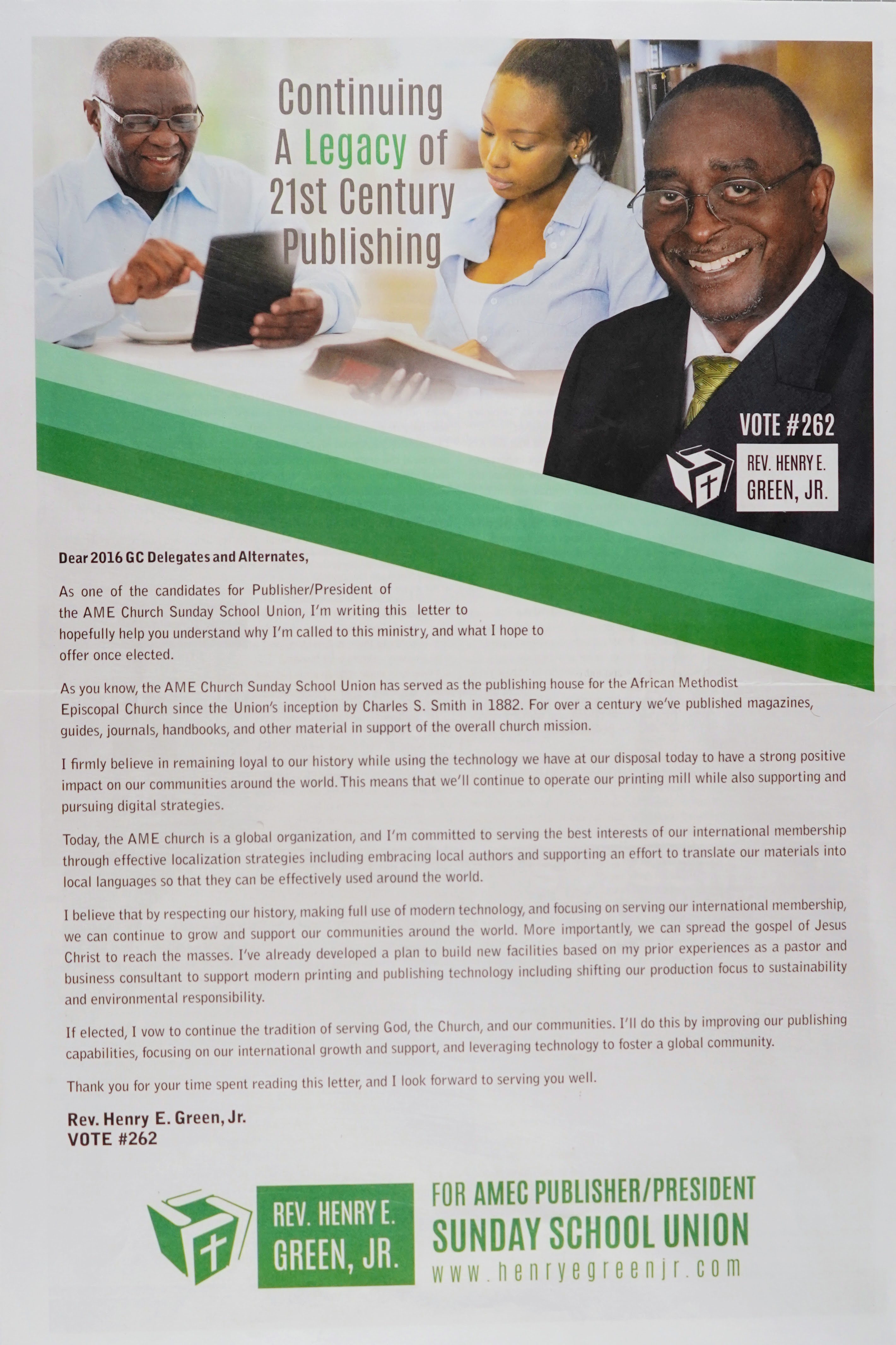
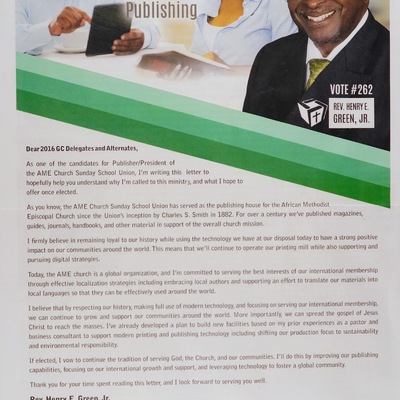
Dear 2016 GC Delegates and Alternates,
As one of the candidates for Publisher/President of
the AME Church Sunday School Union, I’m writing this letter to
hopefully help you understand why I’m called to this ministry, and what I hope to
offer once elected.
As you know, the AME Church Sunday School Union has served as the publishing house for the African Methodist
Episcopal Church since the Union’s inception by Charles S. Smith in 1882. For over a century we’ve published magazines,
guides, journals, handbooks, and other material in support of the overall church mission.
I firmly believe in remaining loyal to our history while using the technology we have at our disposal today to have a strong positive
impact on our communities around the world. This means that we’ll continue to operate our printing mill while also supporting and
pursuing digital strategies.
Today, the AME church is a global organization, and I’m committed to serving the best interests of our international membership
through effective localization strategies including embracing local authors and supporting an effort to translate our materials into
local languages so that they can be effectively used around the world.
I believe that by respecting our history, making full use of modern technology, and focusing on serving our international membership,
we can continue to grow and support our communities around the world. More importantly, we can spread the gospel of Jesus
Christ to reach the masses. I’ve already developed a plan to build new facilities based on my prior experiences as a pastor and
business consultant to support modern printing and publishing technology including shifting our production focus to sustainability
and environmental responsibility.
If elected, I vow to continue the tradition of serving God, the Church, and our communities. I'll do this by improving our publishing
capabilities, focusing on our international growth and support, and leveraging technology to foster a global community.
Thank you for your time spent reading this letter, and I look forward to serving you well.
Rev. Henry E. Green, Jr.
VOTE #262
FOR AMEC PUBLISHER/PRESIDENT
pra SUNDAY SCHOOL UNION
REV. HENRY E.
===== DSC04349.JPG =====
rer rane
|
WHY PASTORS SHOULDN'T WORK MORE THAN 40 HOURS A WEEK — AND WHY MOST DO
“If you want to see me on my day off, you will have to die.”
peepee pastor shared this line with me that he uses to protect his day off. He sets the boundary that the only work he is willing
to make exceptions for, on his day off, is imminent death or funerals.
i]
Managing work time and hours as a professional in ministry is a constant struggle. | don’t know many pastors who work less than a
45 hour a week, with many working 50 or 60 hours. Being “busy” and over-worked is the norm for most in ministry (as it is for many in
our busy-ness focused society).
After 7 years of being in ordained ministry, | still have difficulty understanding just why so many pastors feel the need to work more
than full time. While I have never heard anyone articulate it this way, | suspect many pastors have a sense that the first 40 hours are for
the salary, and the rest are for Jesus. | am sure there are a few church folks who may agree, but I think this is a sentiment that originates
with pastors themselves.
Many pastors are running around going to every church event, dropping everything for every hospital call or shut-in visit, answering
every phone call, arriving before every church meeting and staying for the meeting after the meeting in the parking lot. It seems like
many pastors and the churches they serve are completely content with the idea that the pastor is omni-present in body... while never
being able to focus well — in mind and soul — on anything in particular.
| once attended a retirement party for a pastor leaving a long time call to institutional ministry. While it was a celebratory event, there
was a certain awkwardness about the whole thing. The community he served thanked him for his tremendous service, while his family
made jokes about their husband and father that was never home. And when he was home, he was bringing work with him. The community
that this pastor served basically thanked this pastor’s family for sacrificing quality time with their husband and father... for Jesus?
I don’t think this is a healthy way to do ministry, nor do I think that Jesus calls pastors to be work-a-holics.
A few weeks ago, I came across an article by Eugene Peterson called, “The Un-busy Pastor.” It is an article that has resonated with
me, even though it was written the year before I was born.
The idea of an “un-busy” pastor seems like a rarity: A pastor who takes the time to contemplatively read scripture so that she is drenched
in the word. A pastor who prays often enough and in such a way that she exudes calmness and wisdom. A pastor who is isn’t so busy
running around from function to function, that she has time to listen when real listening is needed.
I don’t know what the cultural value of being busy in 1981 was
when Eugene Peterson wrote about the unbusy pastor, but certainly
being busy in 2016 is a sign of importance. Now pastors have no
exclusive claim to being busy in today’s world, but like so many
other professions and jobs out there, being busy seems to be the
way pastors show we are doing our job and worth our keep.
I can’t help but think of the contrast between the omni-present,
omni-doing pastor with the idea of the unbusy pastor who, accord-
ing to Peterson, focuses on prayer, reading scripture and unhur-
riedly listening. oy
Decades ago, as the church in North America became heavily
prescribed and institutionalized post-WWII, the role of pastor
shifted from leader, expert and resident theologian of a community
to the chief doer of ministry for a community. This means the
culture now is one where instead of leading communities that do
ministry, pastors do ministry on behalf of churches.
However, in the past 10 or so years this has started shifting
back. As churches contend with the big “change” happening
around them (rapid technological advancement changing the way
communities organize and interact coupled with decline of insti-
tutional Christianity), many are realizing that communities need
to be a part of ministry again. It can’t all sit on the shoulders of
the pastor. As that shift takes place and pastors start doing less
so that they can provide leadership and expertise, pastors will
have to better understand how to prioritize their time.
In Eugene Peterson’s article “The Un-busy Pastor,” he suggests
that being a busy pastor (as many pastors are) is actually a sign
of laziness:
“The other reason I become busy is that I am lazy. I indolently
let other people decide what I will do instead of resolutely decid-
ing myself. I let people who do not understand the work of the
pastor write the agenda for my day’s work because I am too
slipshod to write it myself. But these people don’t know what a
pastor is supposed to do. The pastor is a shadow figure in their
‘minds, a marginal person vaguely connected with matters of God
and good will. Anything remotely religious or somehow well-
intentioned can be properly assigned to the pastor.”
Taking control of our own schedules and prioritizing is essential
as pastors shift from chief doers to expert leaders, but so is under-
standing how a pastor’s time is valuable to a faith community.
To that end, I think there are three competing ways in which a
pastor’s time is valuable to congregations. Balancing these three
will be essential for healthy ministry in the future.
1) Quantity
Society, at least legislatively speaking, thinks that about 40
hours of work a week is enough for most full time jobs. Yet, as
responsibilities meant more time. And as pastors worked to prove
their value to their congregations, they worked more and more
and more.
But when quantity of ministry
is the highest value, it neces-
sitates a decline of quality. You
cannot write a good sermon if
they are all Saturday night spe-
cials. You cannot plan for the
future, if it takes all your energy
to get through the day. You
cannot attend to the needs of
the community as a whole, if
you are running from individual
to individual like a nursemaid.
You cannot take the time for
prayer, reading scripture or to
really listen, if your calendar
is full of the appointments made
by others.
2) Flexibility
Churches tend to hold their
functions when most people are
not working, which means pas-
tors work when most people
are off. Evening and weekends.
Standard eight hour work days
wouldn’t work for ministry.
This means that usually a pas-
tor’s day(s) off are a weekday,
and that often pastors might
find themselves without some-
thing scheduled on a weekday
morning or afternoon. This
flexibility works well for pas-
tors and is a benefit to congre-
gations, as churches wouldn’t
be very good places for com-
munity if they operated on bank
hours.
But when pastors start to
work bank hours AND evenings
and weekends, the boundaries
around work-life balance disap-
pear. Pastors set an expectation
that they can be anywhere,
anytime. Congregations then
embrace that behaviour. Then
when pastors do try to have
boundaries, they have to say
things like, “If you want to see
me on my day off, you have to
die.” Flexibility is important
for ministry, but not at the cost
of a balance of personal time
and space. Nor at the cost of a
healthy relationship between
pastor and congregation, but
that is for another article.
3) Expertise
Seminary training gives pas-
tors tools and knowledge that
simply cannot be found in other
ways. The training and educa-
tion shapes and forms a pastor
into a person who should be a
scholar of the Bible, a compe-
tent provider of pastoral care,
a theologian and liturgist, an
administrator and leader of
systems, and an educator and
teacher among other things. Of
course not all gifts and skills
are equal among pastors, but
there is a certain expertise that
is brought to the table with a
pastor. I know that I have stud-
ied the Bible in ways that my
parishioners have not. I know
that I have been trained to care
for emotional and spiritual
needs in ways that most of my
parishioners have not. I know
that my understanding of theol-
ogy and liturgy is a resource
that my congregation wouldn’t
have access to without me.
|
|
But expertise takes time to
keep up and maintain. It takes
a sharp, well-rested mind to dig
back to readings and lectures
buried in the recesses of the
brain. It takes time to keep up
on current articles and books
about ministry or theology or
administration. It takes inten-
tionality to leave the mind time
to ponder and reflect on the
bigger picture of ministry in
the parish. The expertise a pas-
tor provides is like that of a
doctor or lawyer or other pro-
fessional. It should be seen as
something that church people
cannot receive elsewhere or on
their own. Just like Dr. Google
is not a substitute for a real
doctor, nor is Pastor Google a
substitute (says the pastor).
The balance between quan-
tity, flexibility and expertise
has long been weighted towards
quantity. The sacrifice has been
quality expertise. Too many
pastors boast about not reading
any books since seminary, nor
having the time to do continuing
education.
The church for the future
needs less of a chief doer of
ministry and more of an expert
leader. Pastors need to re-bal-
ance. Lots of ministry can hap-
pen in 60 hours a week, but
good ministry should only take
40. After that you are not likely
helping your congregation in
their ministry, nor providing
the leadership and expertise
that the church has been longing
for, for some time now.
As congregations and the
church contend with a changing
world, Christians need pastors
who can help prioritize the
mission of the gospel. A pastor
cannot help people grow in
relationship with Jesus if that
pastor is too busy filling his or
her days with un-prioritized
busy work.
Ultimately, the proof will be
in the pudding. Thriving,
healthy, mission and Jesus-
minded congregations will be
led and served by unbusy
pastors.
Are you a pastor who works
more than 40 hours a week?
Why? How much do you think
pastors should work and why?
Share on the Facebook Page:
The Millennial Pastor or on
Twitter: @ParkerErik.
pb fps ims ena ie aS
Read more: http://millennialpastor.net/20 1 6/03/03/why-
pastors-shouldnt-work-more-than-40-hours-a-week-and-
why-most-do/.
pastors became the chief doers of ministry decades ago, added
AMECPUBLISHINGHOUSE.COM
===== DSC04350.JPG =====
THE CHRISTIAN RECORDER
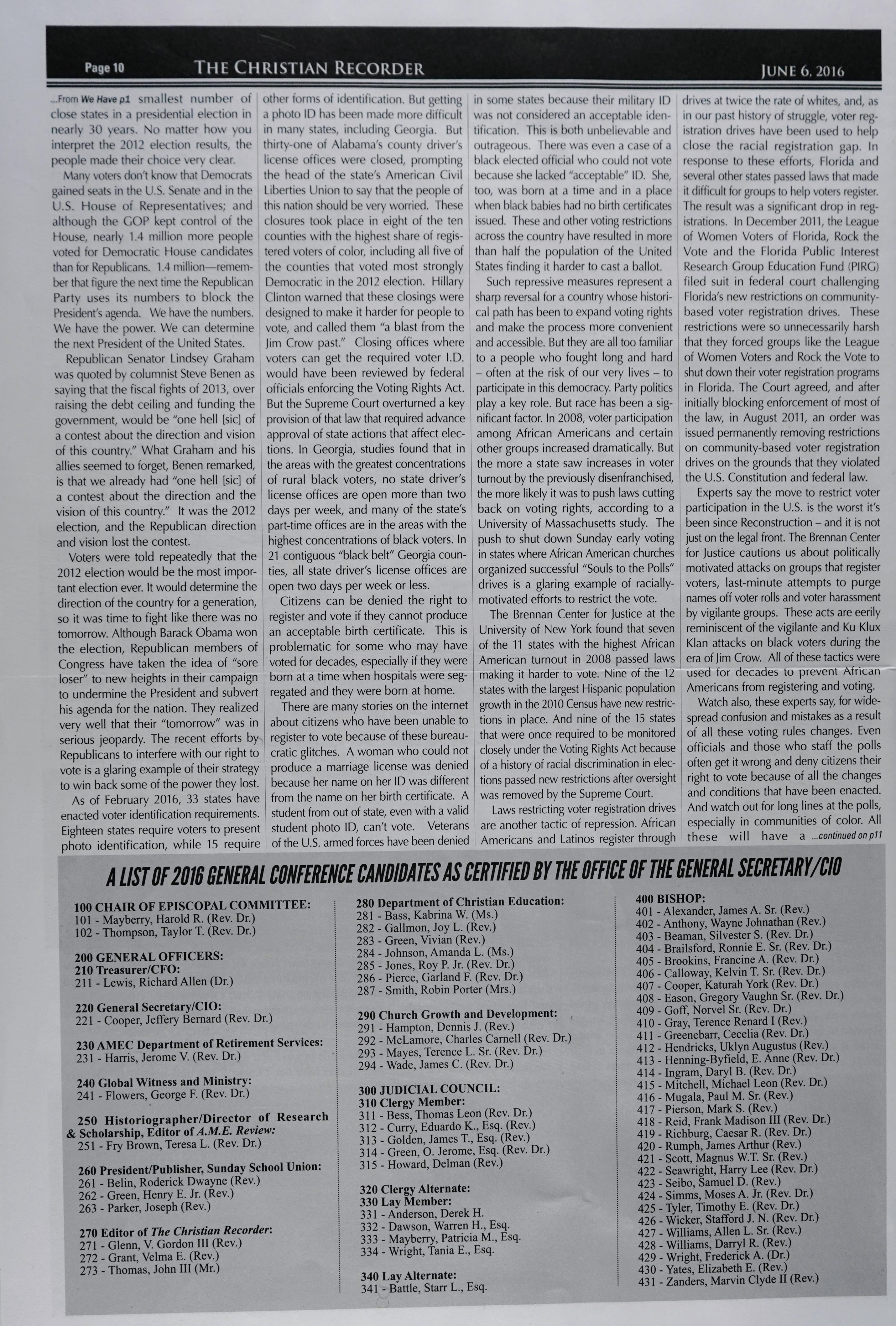
..From We Have p1 smallest number of
close states in a presidential election in
nearly 30 years. No matter how you
interpret the 2012 election results, the
people made their choice very clear.
Many voters don’t know that Democrats
gained seats in the U.S. Senate and in the
U.S. House of Representatives; and
although the GOP kept control of the
House, nearly 1.4 million more people
voted for Democratic House candidates
than for Republicans. 1.4 million—remem-
ber that figure the next time the Republican
Party uses its numbers to block the
President's agenda. We have the numbers.
We have the power. We can determine
the next President of the United States.
Republican Senator Lindsey Graham
was quoted by columnist Steve Benen as
saying that the fiscal fights of 2013, over
raising the debt ceiling and funding the
government, would be “one hell [sic] of
a contest about the direction and vision
of this country.” What Graham and his
allies seemed to forget, Benen remarked,
is that we already had “one hell [sic] of
a contest about the direction and the
vision of this country.” It was the 2012
election, and the Republican direction |
and vision lost the contest.
_ highest concentrations of black voters. In|
Voters were told repeatedly that the |
2012 election would be the most impor-
tant election ever. It would determine the |
direction of the country for a generation, |
so it was time to fight like there was no |
tomorrow. Although Barack Obama won
the election, Republican members of
Congress have taken the idea of “sore
other forms of identification. But getting
a photo ID has been made more difficult
in many states, including Georgia. But
thirty-one of Alabama’s county driver's
license offices were closed, prompting
the head of the state’s American Civil
Liberties Union to say that the people of
this nation should be very worried. These
closures took place in eight of the ten
counties with the highest share of regis-
tered voters of color, including all five of
the counties that voted most strongly
Democratic in the 2012 election. Hillary
Clinton warned that these closings were
designed to make it harder for people to
vote, and called them “a blast from the
Jim Crow past.” Closing offices where
voters can get the required voter |.D.
would have been reviewed by federal
officials enforcing the Voting Rights Act.
But the Supreme Court overturned a key
provision of that law that required advance
approval of state actions that affect elec-
tions. In Georgia, studies found that in
the areas with the greatest concentrations |
of rural black voters, no state driver's
license offices are open more than two
days per week, and many of the state's
part-time offices are in the areas with the
21 contiguous “black belt” Georgia coun-
ties, all state driver's license offices are
open two days per week or less.
Citizens can be denied the right to |
register and vote if they cannot produce
an acceptable birth certificate. This is |
problematic for some who may have |
| voted for decades, especially if they were
loser” to new heights in their campaign |
to undermine the President and subvert
his agenda for the nation. They realized
very well that their “tomorrow” was in |
serious jeopardy. The recent efforts by
Republicans to interfere with our right to
born at a time when hospitals were seg-
regated and they were born at home.
There are many stories on the internet
about citizens who have been unable to
register to vote because of these bureau-
cratic glitches. A woman who could not
vote is a glaring example of their strategy |_ produce a marriage license was denied
to win back some of the power they lost. | because her name on her ID was different
As of February 2016, 33 states have
| from the name on her birth certificate. A |
enacted voter identification requirements. | student from out of state, even with a valid
‘ | ;
Eighteen states require voters to present | student photo ID, can’t vote. Veterans
photo identification, while 15 require | of the U.S. armed forces have been denied
A LIST OF 2016 GENERAL CONFERENCE
100 CHAIR OF EPISCOPAL COMMITTEE:
101 - Mayberry, Harold R. (Rev. Dr.)
102 - Thompson, Taylor T. (Rev. Dr.)
200 GENERAL OFFICERS:
210 Treasurer/CFO:
211 - Lewis, Richard Allen (Dr.)
220 General Secretary/CIO:
221 - Cooper, Jeffery Bernard (Rev. Dr.)
CANDIDATES AS CERTIFIED BY THE OFFICE
280 Department of Christian Education:
281 - Bass, Kabrina W. (Ms.)
282 - Gallmon, Joy L. (Rev.)
283 - Green, Vivian (Rev.)
284 - Johnson, Amanda L. (Ms.)
285 - Jones, Roy P. Jr. (Rev. Dr.)
286 - Pierce, Garland F. (Rev. Dr.)
287 - Smith, Robin Porter (Mrs.)
290 Church Growth and Development:
291 - Hampton, Dennis J. (Rev.)
292 - McLamore, Charles Carnell (Rev. Dr.)
in some states because their military 1D
was not considered an acceptable iden
tification. This is both unbelievable and
outrageous. There was even a case of a
black elected official who could not vote
because she lacked “acceptable” ID. She,
too, was born at a time and in a place
when black babies had no birth certificates
issued. These and other voting restrictions
across the country have resulted in more
than half the population of the United
States finding it harder to cast a ballot.
Such repressive measures represent a
sharp reversal for a country whose histori-
cal path has been to expand voting rights
and make the process more convenient
and accessible. But they are all too familiar
to a people who fought long and hard
— often at the risk of our very lives — to
participate in this democracy. Party politics
play a key role. But race has been a sig-
nificant factor. In 2008, voter participation
among African Americans and certain
_ other groups increased dramatically. But
the more a state saw increases in voter
turnout by the previously disenfranchised,
| the more likely it was to push laws cutting
back on voting rights, according to a
push to shut down Sunday early voting
in states where African American churches
_ organized successful “Souls to the Polls”
drives is a glaring example of racially-
motivated efforts to restrict the vote.
The Brennan Center for Justice at the
University of New York found that seven
of the 11 states with the highest African
| American turnout in 2008 passed laws
states with the largest Hispanic population
growth in the 2010 Census have new restric-
closely under the Voting Rights Act because
| of a history of racial discrimination in elec-
tions passed new restrictions after oversight
was removed by the Supreme Court.
Laws restricting voter registration drives
are another tactic of repression. African
_ Americans and Latinos register through
tions in place. And nine of the 15 states |
that were once required to be monitored |
JUNE 6, 2016
drives at twice the rate of whites, and, as
in our past history of struggle, voter reg-
istration drives have been used to help
close the racial registration gap. In
response to these efforts, Florida and
several other states passed laws that made
it difficult for groups to help voters register.
The result was a significant drop in reg-
istrations. In December 2011, the League
of Women Voters of Florida, Rock the
Vote and the Florida Public Interest
Research Group Education Fund (PIRG)
filed suit in federal court challenging
Florida’s new restrictions on community-
based voter registration drives. These
restrictions were so unnecessarily harsh
that they forced groups like the League
of Women Voters and Rock the Vote to
shut down their voter registration programs
in Florida. The Court agreed, and after
initially blocking enforcement of most of
the law, in August 2011, an order was
issued permanently removing restrictions
on community-based voter registration
drives on the grounds that they violated
| the U.S. Constitution and federal law.
University of Massachusetts study. The |
Experts say the move to restrict voter
participation in the U.S. is the worst it’s
been since Reconstruction — and it is not
just on the legal front. The Brennan Center
for Justice cautions us about politically
| motivated attacks on groups that register
| voters, last-minute attempts to purge
names off voter rolls and voter harassment
by vigilante groups. These acts are eerily
reminiscent of the vigilante and Ku Klux
Klan attacks on black voters during the
| era of Jim Crow. All of these tactics were
making it harder to vote. Nine of the 12 |
| Americans from registering and voting.
used for decades to prevent African
Watch also, these experts say, for wide-
spread confusion and mistakes as a result
of all these voting rules changes. Even
officials and those who staff the polls
often get it wrong and deny citizens their
right to vote because of all the changes
and conditions that have been enacted.
| And watch out for long lines at the polls,
especially in communities of color. All
these will have a. ...continued on pil
OF THE GENERAL SECRETARY/CIO
400 BISHOP:
401 - Alexander, James A. Sr. (Rev.)
402 - Anthony, Wayne Johnathan (Rev.)
403 - Beaman, Silvester S. (Rev. Dr.)
404 - Brailsford, Ronnie E. Sr. (Rev. Dr.)
405 - Brookins, Francine A. (Rev. Dr.)
406 - Calloway, Kelvin T. Sr. (Rev. Dr.)
407 - Cooper, Katurah York (Rev. Dr.)
408 - Eason, Gregory Vaughn Sr. (Rev. Dr.)
409 - Goff, Norvel Sr. (Rev. Dr.)
410 - Gray, Terence Renard I (Rev.)
411 - Greenebarr, Cecelia (Rev. Dr.)
230 AMEC Department of Retirement Services: :
231 - Harris, Jerome V. (Rev. Dr.) 412 - Hendricks, Uklyn Augustus (Rev.)
413 - Henning-Byfield, E. Anne (Rev. Dr.)
414 - Ingram, Daryl B. (Rev. Dr.)
415 - Mitchell, Michael Leon (Rev. Dr.)
416 - Mugala, Paul M. Sr. (Rev.)
417 - Pierson, Mark S. (Rev.)
418 - Reid, Frank Madison III (Rev. Dr.)
419 - Richburg, Caesar R. (Rev. Dr.)
420 - Rumph, James Arthur (Rev.)
421 - Scott, Magnus W.T. Sr. (Rev.)
422 - Seawright, Harry Lee (Rev. Dr.)
423 - Seibo, Samuel D. (Rev.)
424 - Simms, Moses A. Jr. (Rev. Dr.)
425 - Tyler, Timothy E. (Rev. Dr.)
426 - Wicker, Stafford J. N. (Rev. Dr.)
427 - Williams, Allen L. Sr. (Rev.)
428 - Williams, Darryl R. (Rev.)
429 - Wright, Frederick A. (Dr.)
430 - Yates, Elizabeth E. (Rev.)
431 - Zanders, Marvin Clyde II (Rev.)
293 - Mayes, Terence L. Sr. (Rev. Dr.)
294 - Wade, James C. (Rev. Dr.)
240 Global Witness and Ministry:
241 - Flowers, George F. (Rev. Dr.) 300 JUDICIAL COUNCIL:
310 Clergy Member:
311 - Bess, Thomas Leon (Rev. Dr.)
312 - Curry, Eduardo K., Esq. (Rev.)
313 - Golden, James T., Esq. (Rev.)
314 - Green, O. Jerome, Esq. (Rev. Dr.)
315 - Howard, Delman (Rev.)
250 Historiographer/Director of Research
& Scholarship, Editor of A.M.E. Review: i
251 - Fry Brown, Teresa L. (Rev. Dr.)
260 President/Publisher, Sunday School Union:
261 - Belin, Roderick Dwayne (Rev.)
262 - Green, Henry E. Jr. (Rev.)
263 - Parker, Joseph (Rev.)
320 Clergy Alternate:
330 Lay Member:
331 - Anderson, Derek H.
332 - Dawson, Warren H., Esq.
333 - Mayberry, Patricia M., Esq.
334 - Wright, Tania E., Esq.
270 Editor of The Christian Recorder:
271 - Glenn, V. Gordon III (Rev.)
272 - Grant, Velma E. (Rev.)
- John II] (Mr.
ee al) 340 Lay Alternate:
341 - Battle, Starr L., Esq.
===== DSC04352.JPG =====
..From Authentic p2. a pastor does not use an opening
hymn out of the AMEC Hymnal, the opening hymn
should express the awesomeness and power of God.
The opening hymn should not focus upon the issues and
struggles. The opening hymn is about God, nothing else!
The worship prayer is congregational or a shared
petition; it’s not a personal prayer. A pastor or parishioner
who prays should not use personal pronouns, i.e., “Lord,
bless my family...”
Corporate prayer is about “us” and “we,” never “I”
or “my.” “I” or “my” are used in personal prayer.
We kneel to pray and if a person is unable to kneel,
it might be more appropriate to ask someone who can
kneel to lead in the prayer. We do not stand when peti-
tioning God, we kneel or bow.
An outline for prayer that has been around for a while
is ACTS: Adoration, which should praise / adore God;
Confession - a general confession type statement(s);
Thanksgiving as in expressing our thanks to God for the
blessings of the congregation, the church, the commu-
nity; and Supplication, which expresses the collective
needs of the congregation or issues facing the congrega-
tion. In many A.M.E. churches, those offering prayers
end their prayers with an eschatological appeal.
In congregational prayer the use of “us” and “we”
are most appropriate. In personal prayer “I” and “my”
are appropriate and the ACTS might be a helpful outline
to follow.
In churches that use the term “invocation,” it simply
means invoking God’s presence, not necessarily in the
worship space, but in our lives and in our hearts as we
join in corporate worship.
We pray before reading the scripture because we seek
God’s presence before reading the Word.
or whoever prays remains Kneeling until the end of the
prayer response.
A prayer response should be an appropriate ending
of the prayer, “Go tell it on the mountain” is not a prayer
response. Choirs should not use a prayer response as a
special selection, A prayer response should not take five
minutes, not even four minutes, and probably not three
minutes, unless the Spirit is high,
The Decalogue allows us to affirm that we will follow
God’s law. If a pastor uses a responsive reading, the
responsive reading should give the congregants an
opportunity to affirm that they will follow God’s laws.
The Gloria Patri provides a Trinitarian conclusion of
the Decalogue and a statement of Jesus Christ’s fulfill-
ment of the law,
The offering gives parishioners an opportunity to
support the ministry of the church and to give to God a
portion of what God has provided for us.
Up to this point in worship, everything should be |
moving to a climax in preparation for the delivery of
the sermon.
The music and the announcements and other acts of _ I respond, “Yes” and if they ask me how I know, then
worship are all good, but the sermon is the supreme act —
of worship.
The coordination of the opening hymn, prayers,
scripture lessons, the Decalogue or responsive readings,
announcements should all be done as liturgical move-
ment to the sermon. The sermon is the supreme act of
~ worship.
The hymn of preparation should be just that, a hymn
of preparation for the people to listen to the Word of
God. In some areas of the country, people sit for the
_ hymn of preparation.
If a choir gives a musical selection in place of the
for the sermon that will follow,
“All roads” of the liturgy should lead to the sermon,
The delivery of the sermon is given from the pulpit and
should be delivered with power and authority, because
the sermon represents the Word of God. The sermon
should “cut to the soul” of the congregation. Sermons
should be well prepared and it should be evident to all
that the sermon is well prepared.
There should not be a lot of activities after the sermon;
and on Communion Sundays no activities after the
Lord’s Supper.
The invitation to discipleship gives parishioners and
guests the opportunity to recommit or make a decision
for Christ. The invitation should be given with power
and with care. The invitation should not be rushed.
People should be allowed to respond to the Word of
God. It takes some people longer to make a decision
and a decision for Christ is an important decision!
The Affirmation of Faith gives parishioners an oppor-
_ tunity to reaffirm what they believe.
If someone on the street asks me if I am a Christian,
I know I have got them; I respond, “I believe in God
_ the Father Almighty, maker of heaven and earth, and in
Jesus Christ...” and go on to recite the entire Apostles’
Creed, which usually ends the inquiry.
The closing Doxology gives parishioners another
opportunity to praise and proclaim the greatness of God.
The benediction is simply the closing blessing and
worship does not end before the benediction is
pronounced.
The recessional is an orderly way for the clergy and
choir to exit.
Worship is movement and worship allows us to effec-.
The prayer ends with the prayer response. The preacher
..From We Have p10 significant effect on
the numbers of voters in these
communities.
We are and always have been a strong,
resilient people; we survived the worst |
that could be done to us — from the Middle
Passage and enslavement, to Black Code |
and Jim Crow laws, to deadly attacks on
our people from lynching by mobs, to |
attacks by law enforcement for exercising
our rights, unequal sentencing and impris-
onment, and recently the widely publi-
cized killings by law enforcement. We >
have survived the Klan, brutal attempts —
at voter suppression by both white suprem-
acists and the government sworn to
represent and protect us, and modern-day
hate crimes. With God as our help, surely
we will not allow this latest attempt to |
undermine our rights as citizens to
succeed. Psalms 91:1, 2 reads: “He who |
‘dwells in the shelter of the Most High will
_ abide in the shadow of the Almighty. |.
will say of the Lord, my refuge and my |
We can remember that we enjoy both the |
full and inalienable rights of citizens of the -
United States of America, and the protec- |
tion and blessings of Almighty God. But |
while we pray, and wait upon God, we -
have work to do. We know the right of |
these states. Millions are staying home
fortress, my God, in whom | trust.”
Just as our forefathers did when they
resisted enslavement-- from Gabriel Prosser |
to Denmark Vesey; just as we have fought
to call attention to and defeat the purposes _
of the murder, mayhem and indignity —
heaped upon our people -- from Ida B.
Wells to Rosa Parks; just as we continued
to fight to gain the full rights of citizenship
over decades -- from W.E.B. DuBois to |
the Rev. Martin Luther King, Jr., we will
meet this challenge as well.
We will continue to pray that those who
have malice in their hearts, and are trying
to harm us through their actions, will turn
from their wicked ways. But in the
hymn of preparation, the selection should be appropriate —
meantime, while we continue to pray, we
have work to do. We can remember that
we have the power, no matter what others
may say, no matter what others may do.
it, and we know the wrong. | believe God
would expect that while we are praying,
we put our shoulders to the wheel and |
work to right this wrong that is being com- _
mitted against us.
What can we do about a Republican- |
dominated Congress that threatens to stall
any nomination the President makes to
fill the Supreme Court vacancy? Let our
voices be heard! Let elected officials know
tively deal with the “Wows” and the “Whys” of life. : :
they will be held accountable for their
Obstruction and delaying tactics. Get out
and vote, and elect representatives that
will do what is best for you and what is
best for the nation! What can we do about
a hate-filled, negative primary campaign?
Speak up! Remember that the loud, angry
and violent crowds you see on the nightly
news at these rallies actually represent
only a fraction of the eligible voters in
out of disgust and disappointment. We
need to encourage those voters to become
active, to vote, to make their voices heard.
The primaries are just the first phase.
We must not grow weary of doing good
and continue to fight for what is right and
good for all people. We can campaign,
work for a candidate, and most impor-
tantly, vote in every election.
_.From The Wayp7 Reverend
Clementa Pinckney. There were
in fact two funerals—the A.M.E.
Church’s at 11:00 o'clock, and the
second at 1:00, at which President
Obama gave a moving eulogy, |
concluding by singing “Amazing _
Grace,” with the large audience |
joining in. What was a source of
inspiration was the presence
through both services of the Mayor
of Charleston; the Governor;
Senator Graham; and former
Secretary of State, Hillary Clinton;
and Congressman James Clyburn.
| would also remind you not
to be overly concerned with the
pursuit of things. We should not
live with only the concern for
that which brings us pleasure,
comfort, and security. Being
products of a materialistic culture,
we find ourselves primarily
interested in things. We even |
measure success in terms of what
| can, where you can.
a person has—houses, land and
money. We are often too con- |
cerned with power, prestige and
portfolios.
Mahatma Gandhi, the great
Indian humanitarian who was
born into privilege, died with —
| tion not only for the vitriolic
fewer than ten possessions includ-
ing a watch, spectacles, sandals,
eating bowl and plate, and a few —
clothes. Gandhi said, “You may
have occasion to possess or use
material things, but the secret of
life lies in never missing them.”
Your generation is confronted
with a multiplicity of crucial prob-
lems and issues. Tentacles of
racism still permeate every facet
of our society. Benign neglect
and insensitivity still exist in high
places. Obstacles to parity are
in many aspects of American life.
It’s up to you to do what you
Edmund Burke in the 19th
Century reminded us that evil
prevails because men of goodwill
are silent. Martin Luther King,
Jr, in our day, declared that we
may have to repent in this genera-
words and acts of the bad people
but also for the appalling silence
of the good people.
Let me close as | began with —
a plug for my introductory com- —
mercial. Do please consider a
career in academe! If you do,
you will have my heartwarming
experience of having my life so
enriched by so many of my stu-
dents. In addition to the three
distinguished ones whose names
I’ve already called (Allen, David
and Julius), there are others: the
late Wilma Rudolph, winner of
three gold medals in the Rome
Olympics; Oprah Winfrey, the
television personality; Dr. Bobby
Jones, renowned Grammy Award
gospel singer; Dr. Karen Dunlap,
first female and first African
American to be President of
Poynter Institute of Journalism;
Dr. Glenda Baskin Glover,
President of Tennessee State
University; the late Dr. Hazo
Carter, President of West Virginia
State University for 25 years—all
TSU students. From Wilberforce,
eight young men became bishops
in the A.M.E. Church; two
became President of Payne
Theological Seminary; two
became college presidents— _
Kittrell and Allen, and Leontyne
Price, the operatic diva, whose
~ Lincoln
paving stones
York...
But am one
| cannot do everything
But | can do something
And what I can do,
! ought to do
And what | out to do,
By the grace of God, | will do.
May God bless each of you.
————
“Dr. Jamye Coleman Williams is a
retired General Officer of the African
Methodist Episcopal Church.
===== DSC04353.JPG =====
VOTE ||#403
BEAMAN,
"BEAMAN BELIEVERS’
0006
A BELIEVABLE PLAN
SPIRITUAL REVIVAL: An outpouring of the Holy Spirit in the worship, witness
and Kingdom work of African Methodism.
RENEWAL: A reclaiming of African Methodism’s commitment to social
justice for Black People around the world.
RENAISSANCE: That African Methodism is spiritually, socially, economically
and politically relevant in the countries where we have ministry and witness.
CHURCH GROWTH AND DEVELOPMENT: That as a denomination we
focus on worship and ministries that will advance the Kingdom of God and
grow our churches.
ECONOMIC EMPOWERMENT: Financing the Connectional Budget
through endowments and economic development to relieve the local church
of the burden of heavy assessments.
YOUNG ADULT ENTERPRISE: The AME Church must create relevant
ministries and initiatives that will engage young adults beyond the YPD age.
MEN‘S MINISTRY MISSIONS: A reclamation of fathers and adult men within
the life of African Methodism.
REV. DR. SILVESTER BEAMAN
BETHELAME CHURCH
604 N. Walnut Street ¢ Wilmington, Delaware
WWW.BEAMAN FORBISHOP.COM
===== DSC04354.JPG =====
WAN More EXCELLENT: Way!
"em OL \C ORINTHIANS 12:31...
> ou)
LOVE THE PEOPLE
ee MATTHEW! 22: 737: 239,
===== DSC04355.JPG =====
=
-
I
-
-
*
«=
-
.)
a
*
Servant Leade
| METHODIST
rship for the 21st Century
Expansion
Global Mission
Young Adult Involvement
Inclusion
Foundational Principles
Evangelism
===== DSC04356.JPG =====
AYLOR |. LHOMPSON
Of the 2016 General Conference of the AME Church
| To My Brothers and Sisters in Christ,
| | greet you in the joy of the Lord! Congratulations on your |
| upcoming participation in the 2016 General Conference of the |
African Methodist Episcopal Church! | 80, 2008, 2016
| look forward to your input as the Holy Spirit leads us in all of | *Men eneral F
¥ = ourwork during the General Conference.I seekyour prayers and | 988 - 200
support in my candidacy for Chair of the Episcopal Committee. | astor- 46th Quadrennial —
A Sacred Trust: Please handle all things with Prayer!
‘In the same way, prayer is essential in this ongoing warfare. Pray
hard and long, Pray foryour brothers and sisters. Keep your eyes open.
Keep each other's spirits up so that no one falls behind or drops out.’
Ephesians 6:18 (MSG)
===== DSC04357.JPG =====
WICKER FOR
BISHOP
Membership is very important to the life blood of the church. True membership must be determined and
defined in order to build upon where God will continue to lead the African Methodist Episcopal Church.
To Paul the apostle, membership meant becoming a vital organ of a living body (Rom. 12:4-5). A
member is a person committed to the body of Christ and uses all the gifts God has blessed him or her
with, to build up the Kingdom. For Dr. Stafford J.N. Wicker membership also means we are incorporating
God's family into our fellowship
¢ Spe RotCC C5 05 CCAK C5 Mette cored. Une.
765 SOUTH HAIRSTON ROAD 1790 EBENEZER ROAD
STONE MOUNTAIN, GA CONYERS, GA
7:00AM, 8:30AM, & 11:00AM WORSHIP SERVICES, SUNDAYS 10:00AM WORSHIP SERVICE, SUNDAYS
404.299.3388 404-299-0398-FAX WWW.ANTIOCH—AME.ORG 770-761-0006
ANTIOCH CHILD CARE CENTER ANTIOCH MANOR ESTATES
4730 ELAM ROAD; STONE MOUNTAIN, GA 4711 BISHOP MING BLVD; STONE MOUNTAIN, GA
404.299.5521 CENTER HOURS—6AM—6PM, MONDAY—FRIDAY 770-322-8839 770-322-8234-FAX
WWW.ANTIOCHMANORLIVING.COM
-
Date
-
2016-6-6