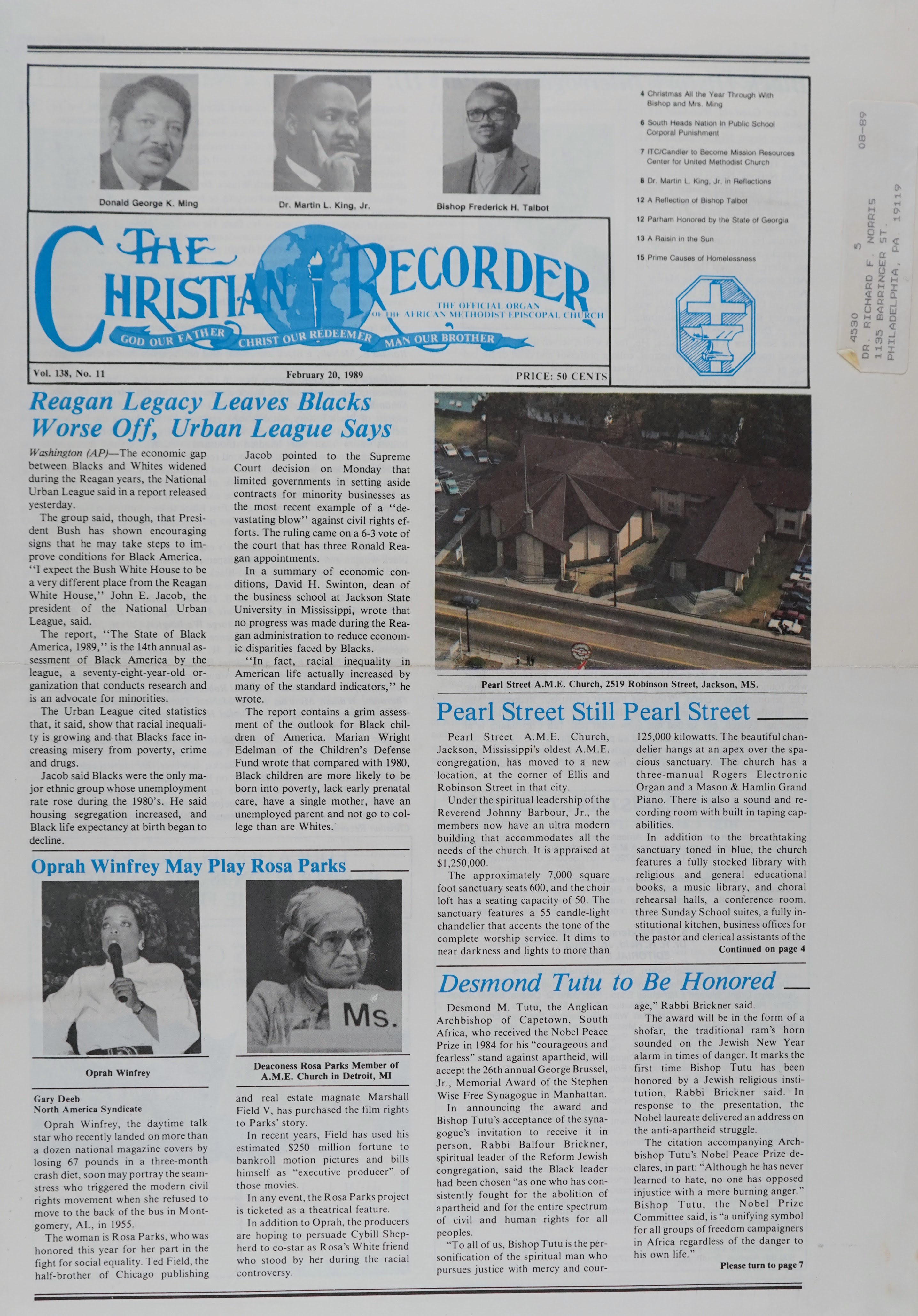
-
Title
-
February 20, 1989
-
Description
-
===== DSC05733.JPG =====
Donald George K. Ming
Vol. 138, No. 11
OF Lith AFRICAN METHODIST EPISCOPAL CHL
February 20, 1989
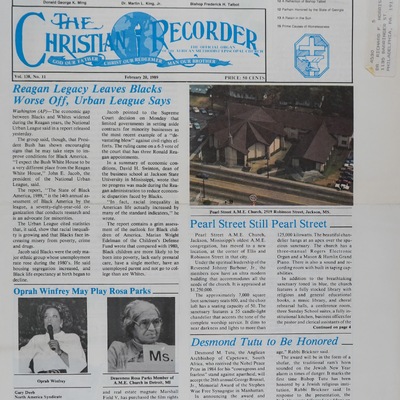
Reagan Legacy Leaves Blacks
Worse Off, Urban League Says
Washington (AP)—The economic gap
between Blacks and Whites widened
during the Reagan years, the National
Urban League said in a report released
yesterday.
The group said, though, that Presi-
dent Bush has shown encouraging
signs that he may take steps to im-
prove conditions for Black America.
“*T expect the Bush White House to be
a very different place from the Reagan
White House,’’ John E. Jacob, the
president of the National Urban
League, said.
The report, ‘‘The State of Black
America, 1989,’’ is the 14th annual as-
sessment of Black America by the
league, a seventy-eight-year-old or-
ganization that conducts research and
is an advocate for minorities.
The Urban League cited statistics
that, it said, show that racial inequali-
ty is growing and. that Blacks face in-
creasing misery from poverty, crime
and drugs.
Jacob said Blacks were the only ma-
jor ethnic group whose unemployment
rate rose during the 1980’s. He said
housing segregation increased, and
Black life expectancy at birth began to
decline.
Jacob pointed to the Supreme
Court decision on Monday that
limited governments in setting aside
contracts for minority businesses as
the most recent example of a ‘‘de-
vastating blow’’ against civil rights ef-
forts. The ruling came on a 6-3 vote of
the court that has three Ronald Rea-
gan appointments.
In a summary of economic con-
ditions, David H. Swinton, dean of
the business school at Jackson State
University in Mississippi, wrote that
no progress was made during the Rea-
gan administration to reduce econom-
ic disparities faced by Blacks.
“In fact, racial inequality in
American life actually increased by
many of the standard indicators,’’ he
wrote.
The report contains a grim assess-
ment of the outlook for Black chil-
dren of America. Marian Wright
Edelman of the Children’s Defense
Fund wrote that compared with 1980,
Black children are more likely to be
born into poverty, lack early prenatal
care, have a single mother, have an
unemployed parent and not go to col-
lege than are Whites.
Oprah Winfrey May Play Rosa Parks —___
Oprah Winfrey
Gary Deeb
North America Syndicate
Oprah Winfrey, the daytime talk
star who recently landed on more than
a dozen national magazine covers by
losing 67 pounds in a three-month
crash diet, soon may portray the seam-
stress who triggered the modern civil
rights movement when she refused to
move to the back of the bus in Mont-
gomery, AL, in 1955.
The woman is Rosa Parks, who was
honored this year for her part in the
fight for social equality. Ted Field, the
half-brother of Chicago publishing
Deaconess Rosa Parks Member of
A.M.E. Church in Detroit, MI
and real estate magnate Marshall
Field V, has purchased the film rights
to Parks’ story.
In recent years, Field has used his
estimated $250 million fortune to
bankroll motion pictures and bills
himself as “executive producer” of
those movies.
In any event, the Rosa Parks project
is ticketed as a theatrical feature.
In addition to Oprah, the producers
are hoping to persuade Cybill Shep-
herd to co-star as Rosa’s White friend
who stood by her during the racial
controversy.
CH
“~
PRICE: 50 CE
4 Christmas All the Year Through With
Bishop and Mrs. Ming
6 South Heads Nation in Public School
Corporal Punishment
7 ITC/Candier to Become Mission Resources
Center for United Methodist Church
8 Dr, Martin L. King, Jr, in Reflections
12 A Reflection of Bishop Talbot
12 Parham Honored by the State of Georgia
13 A Raisin in the Sun
15 Prime Causes of Homelessness
Pearl Street A.M.E. Church, 2519 Robinson Street, Jackson, MS.
Pearl Street Still Pearl Street
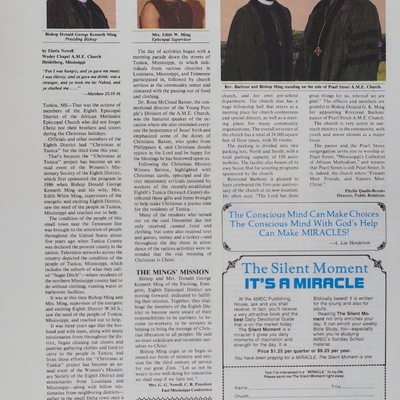
Pearl Street A.M.E. Church,
Jackson, Mississippi’s oldest A.M.E.
congregation, has moved to a new
location, at the corner of Ellis and
Robinson Street in that city.
Under the spiritual leadership of the
Reverend Johnny Barbour, Jr., the
members now have an ultra modern
building that accommodates all the
needs of the church. It is appraised at
$1,250,000.
The approximately 7,000 square
foot sanctuary seats 600, and the choir
loft has a seating capacity of 50. The
sanctuary features a 55 candle-light
chandelier that accents the tone of the
complete worship service. It dims to
near darkness and lights to more than
125,000 kilowatts. The beautiful chan-
delier hangs at an apex over the spa-
cious sanctuary. The church has a
three-manual Rogers Electronic
Organ and a Mason & Hamlin Grand
Piano. There is also a sound and re-
cording room with built in taping cap-
abilities.
In addition to the breathtaking
sanctuary toned in blue, the church
features a fully stocked library with
religious and general educational
books, a music library, and choral
rehearsal halls, a conference room,
three Sunday School suites, a fully in-
stitutional kitchen, business offices for
the pastor and clerical assistants of the
Continued on page 4
Desmond Tutu to Be Honored __
Desmond M. Tutu, the Anglican
Archbishop of Capetown, South
Africa, who received the Nobel Peace
Prize in 1984 for his “courageous and
fearless” stand against apartheid, will
accept the 26th annual George Brussel,
Jr., Memorial Award of the Stephen
Wise Free Synagogue in Manhattan.
In announcing the award and
Bishop Tutu’s acceptance of the syna-
gogue’s invitation to receive it in
person, Rabbi Balfour Brickner,
spiritual leader of the Reform Jewish
congregation, said the Black leader
had been chosen “as one who has con-
sistently fought for the abolition of
apartheid and for the entire spectrum
of civil and human rights for all
peoples.
“To all of us, Bishop Tutu is the per-
sonification of the spiritual man who
pursues justice with mercy and cour-
age,” Rabbi Brickner said.
The award will be in the form of a
shofar, the traditional ram’s horn
sounded on the Jewish New Year
alarm in times of danger. It marks the
first time Bishop Tutu has been
honored by a Jewish religious insti-
tution, Rabbi Brickner said. In
response to the presentation, the
Nobel laureate delivered an address on
the anti-apartheid struggle.
The citation accompanying Arch-
bishop Tutu’s Nobel Peace Prize de-
clares, in part: “Although he has never
learned to hate, no one has opposed
injustice with a more burning anger.”
Bishop Tutu, the Nobel Prize
Committee said, is “a unifying symbol
for all groups of freedom campaigners
in Africa regardless of the danger to
his own life.”
Please turn to page 7
—e———— SSS.
/
A# 4530
NORRIS
ST
PA
F
RICHARD
DR
BARRINGER
1135
PHILADELPHIA
===== DSC05734.JPG =====
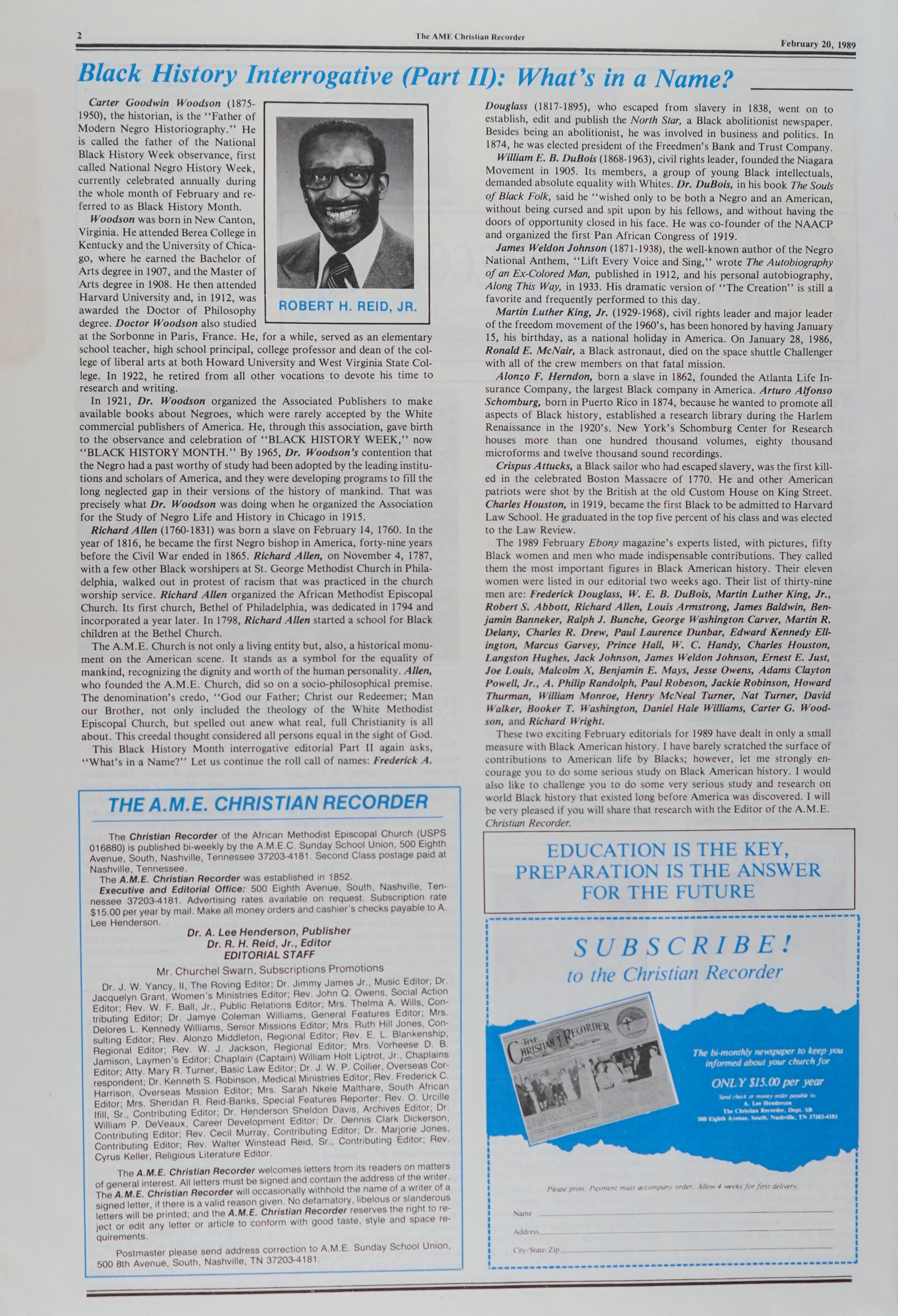
| The AME Christian Recorder
February 20, 1989
Black History Interrogative (Part I): What’s in a Name?
Carter Goodwin Woodson (1875-
1950), the historian, is the ‘‘Father of
Modern Negro Historiography.’’ He
is called the father of the National
Black History Week observance, first
called National Negro History Week,
currently celebrated annually during
the whole month of February and re-
ferred to as Black History Month.
Woodson was born in New Canton,
Virginia. He attended Berea College in
Kentucky and the University of Chica-
go, where he earned the Bachelor of
Arts degree in 1907, and the Master of
Arts degree in 1908. He then attended
Harvard University and, in 1912, was
awarded the Doctor of Philosophy
degree. Doctor Woodson also studied
at the Sorbonne in Paris, France. He, for a while, served as an elementary
school teacher, high school principal, college professor and dean of the col-
lege of liberal arts at both Howard University and West Virginia State Col-
lege. In 1922, he retired from all other vocations to devote his time to
research and writing.
In 1921, Dr. Woodson organized the Associated Publishers to make
available books about Negroes, which were rarely accepted by the White
commercial publishers of America. He, through this association, gave birth
to the observance and celebration of ‘‘BLACK HISTORY WEEK,”’’ now
“BLACK HISTORY MONTH.”’’ By 1965, Dr. Woodson’s contention that
the Negro had a past worthy of study had been adopted by the leading institu-
tions and scholars of America, and they were developing programs to fill the
long neglected gap in their versions of the history of mankind. That was
precisely what Dr. Woodson was doing when he organized the Association
for the Study of Negro Life and History in Chicago in 1915.
Richard Allen (1760-1831) was born a slave on February 14, 1760. In the
year of 1816, he became the first Negro bishop in America, forty-nine years
before the Civil War ended in 1865. Richard Allen, on November 4, 1787,
with a few other Black worshipers at St. George Methodist Church in Phila-
delphia, walked out in protest of racism that was practiced in the church
worship service. Richard Allen organized the African Methodist Episcopal
Church. Its first church, Bethel of Philadelphia, was dedicated in 1794 and
incorporated a year later. In 1798, Richard Allen started a school for Black
children at the Bethel Church.
The A.M.E. Church is not only a living entity but, also, a historical monu-
ment on the American scene. It stands as a symbol for the equality of
mankind, recognizing the dignity and worth of the human personality. Allen,
who founded the A.M.E. Church, did so on a socio-philosophical premise.
The denomination’s credo, ‘‘God our Father; Christ our Redeemer; Man
our Brother, not only included the theology of the White Methodist
Episcopal Church, but spelled out anew what real, full Christianity is all
about. This creedal thought considered all persons equal in the sight of God.
This Black History Month interrogative editorial Part II again asks,
“‘What’s in a Name?’’ Let us continue the roll call of names: Frederick A.
ROBERT H. REID, JR.
THE A.M.E. CHRISTIAN RECORDER
The Christian Recorder of the African Methodist Episcopal Church (USPS
016880) is published bi-weekly by the A.M.E.C. Sunday School Union, 500 Eighth
Avenue, South, Nashville, Tennessee 37203-4181. Second Class postage paid at
Nashville, Tennessee.
The A.M.E. Christian Recorder was established in 1852.
Executive and Editorial Office: 500 Eighth Avenue, South, Nashville, Ten-
nessee 37203-4181. Advertising rates available on request. Subscription rate
$15.00 per year by mail. Make all money orders and cashier's checks payable to A.
Lee Henderson.
Dr. A. Lee Henderson, Publisher
Dr. R. H. Reid, Jr., Editor
EDITORIAL STAFF
Mr. Churchel Swarn, Subscriptions Promotions
Dr. J. W. Yancy, Il, The Roving Editor; Dr. Jimmy James Jr., Music Editor; Dr.
Jacquelyn Grant, Women’s Ministries Editor; Rev. John Q. Owens, Social Action
Editor; Rev. W. F. Ball, Jr., Public Relations Editor; Mrs. Thelma A. Wills, Con-
tributing Editor; Dr. Jamye Coleman Williams, General Features Editor; Mrs.
Delores L. Kennedy Williams, Senior Missions Editor; Mrs. Ruth Hill Jones, Con-
sulting Editor; Rev. Alonzo Middleton, Regional Editor; Rev. E. L. Blankenship,
Regional Editor; Rev. W. J. Jackson, Regional Editor; Mrs. Vorheese dD. B
Jamison, Laymen's Editor; Chaplain (Captain) William Holt Liptrot, Jr., Chaplains
Editor; Atty. Mary R. Turner, Basic Law Editor; Dr. J. W. P. Collier, Overseas Cor-
respondent; Dr. Kenneth S. Robinson, Medical Ministries Editor; Rev. Frederick C
Harrison, Overseas Mission Editor; Mrs. Sarah Nkele Malthare, South African
Editor; Mrs. Sheridan R. Reid-Banks, Special Features Reporter, Rev. O. Urcille
Ifill, Sr., Contributing Editor; Dr, Henderson Sheldon Davis, Archives Editor; Dr.
William P. DeVeaux, Career Development Editor; Dr. Dennis Clark Dickerson,
Contributing Editor; Rev. Cecil Murray, Contributing Editor; Dr. Marjorie Jones,
Contributing Editor; Rev. Walter Winstead Reid, Sr., Contributing Editor; Rev.
Cyrus Keller, Religious Literature Editor.
_M.E. Christian Recorder welcomes letters from Its readers on matters
of cera itaree All letters must be signed and contain the address of the app
The A.M.E. Christian Recorder will occasionally withhold the name of a writer of a
signed letter, if there is a valid reason given. No defamatory, libelous or rel ler
letters will be printed; and the A.M.E. Christian Recorder reserves the right to re-
ject or edit any letter or article to conform with good taste, style and space re-
quirements.
Postmaster please send address correction to A.M.E. Sunday School Union,
500 8th Avenue, South, Nashville, TN 37203-4181
Douglass (1817-1895), who escaped from slavery in 1838, went on to
establish, edit and publish the North Star, a Black abolitionist newspaper.
Besides being an abolitionist, he was involved in business and politics. In
1874, he was elected president of the Freedmen’s Bank and Trust Company.
William E. B. DuBois (1868-1963), civil rights leader, founded the Niagara
Movement in 1905. Its members, a group of young Black intellectuals,
demanded absolute equality with Whites. Dr. DuBois, in his book The Souls
of Black Folk, said he ‘‘wished only to be both a Negro and an American,
without being cursed and spit upon by his fellows, and without having the
doors of opportunity closed in his face. He was co-founder of the NAACP
and organized the first Pan African Congress of 1919.
James Weldon Johnson (1871-1938), the well-known author of the Negro
National Anthem, ‘‘Lift Every Voice and Sing,’”? wrote The Autobiography
of an Ex-Colored Man, published in 1912, and his personal autobiography,
Along This Way, in 1933. His dramatic version of ‘‘The Creation’’ is still a
favorite and frequently performed to this day.
Martin Luther King, Jr. (1929-1968), civil rights leader and major leader
of the freedom movement of the 1960’s, has been honored by having January
15, his birthday, as a national holiday in America. On January 28, 1986,
Ronald E. McNair, a Black astronaut, died on the space shuttle Challenger
with all of the crew members on that fatal mission.
Alonzo F. Herndon, born a slave in 1862, founded the Atlanta Life In-
surance Company, the largest Black company in America. Arturo Alfonso
Schomburg, born in Puerto Rico in 1874, because he wanted to promote all
aspects of Black history, established a research library during the Harlem
Renaissance in the 1920’s. New York’s Schomburg Center for Research
houses more than one hundred thousand volumes, eighty thousand
microforms and twelve thousand sound recordings.
Crispus Attucks, a Black sailor who had escaped slavery, was the first kill-
ed in the celebrated Boston Massacre of 1770. He and other American
patriots were shot by the British at the old Custom House on King Street.
Charles Houston, in 1919, became the first Black to be admitted to Harvard
Law School. He graduated in the top five percent of his class and was elected
to the Law Review.
The 1989 February Ebony magazine’s experts listed, with pictures, fifty
Black women and men who made indispensable contributions. They called
them the most important figures in Black American history. Their eleven
women were listed in our editorial two weeks ago. Their list of thirty-nine
men are: Frederick Douglass, W. E. B. DuBois, Martin Luther King, Jr.,
Robert S. Abbott, Richard Allen, Louis Armstrong, James Baldwin, Ben-
jamin Banneker, Ralph J. Bunche, George Washington Carver, Martin R.
Delany, Charles R. Drew, Paul Laurence Dunbar, Edward Kennedy Ell-
ington, Marcus Garvey, Prince Hall, W. C. Handy, Charles Houston,
Langston Hughes, Jack Johnson, James Weldon Johnson, Ernest E. Just,
Joe Louis, Malcolm X, Benjamin E. Mays, Jesse Owens, Adams Clayton
Powell, Jr., A. Philip Randolph, Paul Robeson, Jackie Robinson, Howard
Thurman, William Monroe, Henry McNeal Turner, Nat Turner, David
Walker, Booker T. Washington, Daniel Hale Williams, Carter G. Wood-
son, and Richard Wright.
These two exciting February editorials for 1989 have dealt in only a small
measure with Black American history. I have barely scratched the surface of
contributions to American life by Blacks; however, let me strongly en-
courage you to do some serious study on Black American history. I would
also like to challenge you to do some very serious study and research on
world Black history that existed long before America was discovered. I will
be very pleased if you will share that research with the Editor of the A.M.E.
Christian Recorder.
EDUCATION IS THE KEY,
PREPARATION IS THE ANSWER
FOR THE FUTURE
SUBSCRIBE?
to the Christian Recorder
The bi-monthly newspaper to keep you
informed about your church for
ONLY $15.00 per year
Send check or more
A. Lee Henderson
The Christian Recorder, Dept. SB
$00 Eighth Avenue, South, Nashville, TN 3720}-4181
der purwatvie
Name as
Address.
City/State: Zip ae
heme eee eee mee eee
eS
===== DSC05735.JPG =====
February 20, 1989
The AME. Christian Recorder
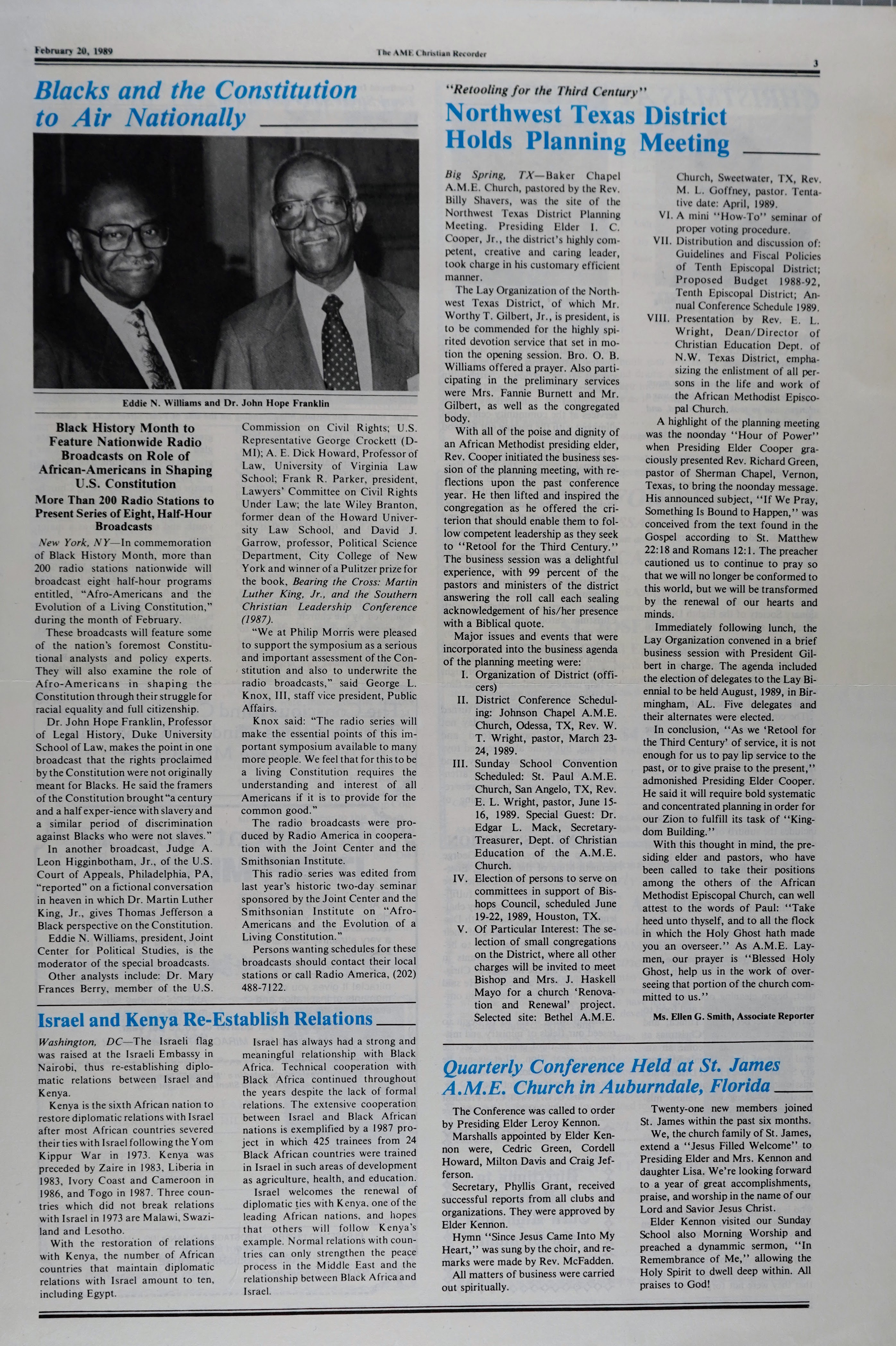
Blacks and the Constitution
to Air Nationally
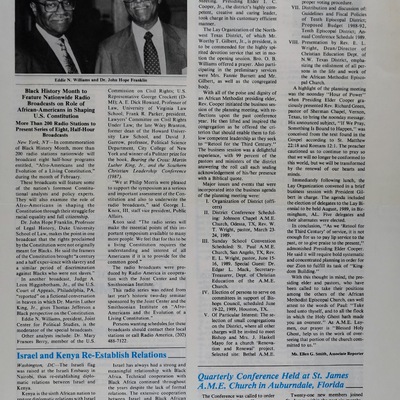
Eddie N. Williams and Dr. John Hope Franklin
Black History Month to
Feature Nationwide Radio
Broadcasts on Role of
African-Americans in Shaping
U.S. Constitution
More Than 200 Radio Stations to
Present Series of Eight, Half-Hour
Broadcasts
New York, NY—In commemoration
of Black History Month, more than
200 radio stations nationwide will
broadcast eight half-hour programs
entitled, “Afro-Americans and the
Evolution of a Living Constitution,”
during the month of February.
These broadcasts will feature some
of the nation’s foremost Constitu-
tional analysts and policy experts.
They will also examine the role of
Afro-Americans in shaping the
Constitution through their struggle for
racial equality and full citizenship.
Dr. John Hope Franklin, Professor
of Legal History, Duke University
School of Law, makes the point in one
broadcast that the rights proclaimed
by the Constitution were not originally
meant for Blacks. He said the framers
of the Constitution brought “a century
and a half exper-ience with slavery and
a similar period of discrimination
against Blacks who were not slaves.”
In another broadcast, Judge A.
Leon Higginbotham, Jr., of the U.S.
Court of Appeals, Philadelphia, PA,
“reported” on a fictional conversation
in heaven in which Dr. Martin Luther
King, Jr., gives Thomas Jefferson a
Black perspective on the Constitution.
Eddie N. Williams, president, Joint
Center for Political Studies, is the
moderator of the special broadcasts.
Other analysts include: Dr. Mary
Frances Berry, member of the U.S.
Commission on Civil Rights; U.S.
Representative George Crockett (D-
MI); A. E. Dick Howard, Professor of
Law, University of Virginia Law
School; Frank R. Parker, president,
Lawyers’ Committee on Civil Rights
Under Law; the late Wiley Branton,
former dean of the Howard Univer-
sity Law School, and David J.
Garrow, professor, Political Science
Department, City College of New
York and winner ofa Pulitzer prize for
the book, Bearing the Cross: Martin
Luther King, Jr., and the Southern
Christian Leadership Conference
(1987).
“We at Philip Morris were pleased
to support the symposium as a serious
and important assessment of the Con-
stitution and also to underwrite the
radio broadcasts,” said George L.
Knox, III, staff vice president, Public
Affairs.
Knox said: “The radio series will
make the essential points of this im-
portant symposium available to many
more people. We feel that for this to be
a living Constitution requires the
understanding and interest of all
Americans if it is to provide for the
common good.”
The radio broadcasts were pro-
duced by Radio America in coopera-
tion with the Joint Center and the
Smithsonian Institute.
This radio series was edited from
last year’s historic two-day seminar
sponsored by the Joint Center and the
Smithsonian Institute on “Afro-
Americans and the Evolution of a
Living Constitution.”
Persons wanting schedules for these
broadcasts should contact their local
stations or call Radio America, (202)
488-7122.
Israel and Kenya Re-Establish Relations ___
Washington, DC—The Israeli flag
was raised at the Israeli Embassy in
Nairobi, thus re-establishing diplo-
matic relations between Israel and
Kenya.
Kenya is the sixth African nation to
restore diplomatic relations with Israel
after most African countries severed
their ties with Israel following the Yom
Kippur War in 1973. Kenya was
preceded by Zaire in 1983, Liberia in
1983, Ivory Coast and Cameroon in
1986, and Togo in 1987. Three coun-
tries which did not break relations
with Israel in 1973 are Malawi, Swazi-
land and Lesotho.
With the restoration of relations
with Kenya, the number of African
countries that maintain diplomatic
relations with Israel amount to ten,
including Egypt.
Israel has always had a strong and
meaningful relationship with Black
Africa. Technical cooperation with
Black Africa continued throughout
the years despite the lack of formal
relations. The extensive cooperation
between Israel and Black African
nations is exemplified by a 1987 pro-
ject in which 425 trainees from 24
Black African countries were trained
in Israel in such areas of development
as agriculture, health, and education.
Israel welcomes the renewal of
diplomatic ties with Kenya, one of the
leading African nations, and hopes
that others will follow Kenya’s
example. Normal relations with coun-
tries can only strengthen the peace
process in the Middle East and the
relationship between Black Africa and
Israel.
“Retooling for the Third Century”
Northwest Texas District
Holds Planning Meeting ____
Big Spring, TX—Baker Chapel
A.M.E. Church, pastored by the Rey.
Billy Shavers, was the site of the
Northwest Texas District Planning
Meeting. Presiding Elder I, C.
Cooper, Jr,, the district’s highly com-
petent, creative and caring leader,
took charge in his customary efficient
manner,
The Lay Organization of the North-
west Texas District, of which Mr.
Worthy T. Gilbert, Jr., is president, is
to be commended for the highly spi-
rited devotion service that set in mo-
tion the opening session. Bro. O. B.
Williams offered a prayer. Also parti-
cipating in the preliminary services
were Mrs. Fannie Burnett and Mr.
Gilbert, as well as the congregated
body.
With all of the poise and dignity of
an African Methodist presiding elder,
Rev. Cooper initiated the business ses-
sion of the planning meeting, with re-
flections upon the past conference
year. He then lifted and inspired the
congregation as he offered the cri-
terion that should enable them to fol-
low competent leadership as they seek
to ‘‘Retool for the Third Century.’
The business session was a delightful
experience, with 99 percent of the
pastors and ministers of the district
answering the roll call each sealing
acknowledgement of his/her presence
with a Biblical quote.
Major issues and events that were
incorporated into the business agenda
of the planning meeting were:
I. Organization of District (offi-
cers)
II. District Conference Schedul-
ing: Johnson Chapel A.M.E.
Church, Odessa, TX, Rev. W.
T. Wright, pastor, March 23-
24, 1989.
III. Sunday School Convention
Scheduled: St. Paul A.M.E.
Church, San Angelo, TX, Rev.
E. L. Wright, pastor, June 15-
16, 1989. Special Guest: Dr.
Edgar L. Mack, Secretary-
Treasurer, Dept. of Christian
Education of the A.M.E.
Church.
IV. Election of persons to serve on
committees in support of Bis-
hops Council, scheduled June
19-22, 1989, Houston, TX.
V. Of Particular Interest: The se-
lection of small congregations
on the District, where all other
charges will be invited to meet
Bishop and Mrs. J. Haskell
Mayo for a church ‘Renova-
tion and Renewal’ project.
Selected site: Bethel A.M.E.
Church, Sweetwater, TX, Rev.
M. L, Goffney, pastor. Tenta-
tive date; April, 1989,
.A mini ‘‘How-To”’ seminar of
proper voting procedure.
VII. Distribution and discussion of:
Guidelines and Fiscal Policies
of Tenth Episcopal District;
Proposed Budget 1988-92,
Tenth Episcopal District; An-
nual Conference Schedule 1989,
VIII. Presentation by Rev. E. L,
Wright, Dean/Director of
Christian Education Dept. of
N.W. Texas District, empha-
sizing the enlistment of all per-
sons in the life and work of
the African Methodist Episco-
pal Church.
A highlight of the planning meeting
was the noonday ‘‘Hour of Power’’
when Presiding Elder Cooper gra-
ciously presented Rev. Richard Green,
pastor of Sherman Chapel, Vernon,
Texas, to bring the noonday message.
His announced subject, ‘‘If We Pray,
Something Is Bound to Happen,’’ was
conceived from the text found in the
Gospel according to St. Matthew
22:18 and Romans 12:1. The preacher
cautioned us to continue to pray so
that we will no longer be conformed to
this world, but we will be transformed
by the renewal of our hearts and
minds.
Immediately following lunch, the
Lay Organization convened in a brief
business session with President Gil-
bert in charge. The agenda included
the election of delegates to the Lay Bi-
ennial to be held August, 1989, in Bir-
mingham, AL. Five delegates and
their alternates were elected.
In conclusion, ‘‘As we ‘Retool for
the Third Century’ of service, it is not
enough for us to pay lip service to the
past, or to give praise to the present,’”
admonished Presiding Elder Cooper.
He said it will require bold systematic
and concentrated planning in order for
our Zion to fulfill its task of ‘‘King-
dom Building.’’
With this thought in mind, the pre-
siding elder and pastors, who have
been called to take their positions
among the others of the African
Methodist Episcopal Church, can well
attest to the words of Paul: ‘‘Take
heed unto thyself, and to all the flock
in which the Holy Ghost hath made
you an overseer.’’ As A.M.E. Lay-
men, our prayer is ‘‘Blessed Holy
Ghost, help us in the work of over-
seeing that portion of the church com-
mitted to us.”
Vv
Ms. Ellen G. Smith, Associate Reporter
Quarterly Conference Held at St. James
A.M.E. Church in Auburndale, Florida ___
The Conference was called to order
by Presiding Elder Leroy Kennon.
Marshalls appointed by Elder Ken-
non were, Cedric Green, Cordell
Howard, Milton Davis and Craig Jef-
ferson.
Secretary, Phyllis Grant, received
successful reports from all clubs and
organizations. They were approved by
Elder Kennon.
Hymn ‘‘Since Jesus Came Into My
Heart,’’ was sung by the choir, and re-
marks were made by Rev. McFadden.
All matters of business were carried
out spiritually.
Twenty-one new members joined
St. James within the past six months.
We, the church family of St. James,
extend a ‘‘Jesus Filled Welcome’’ to
Presiding Elder and Mrs. Kennon and
daughter Lisa. We’re looking forward
to a year of great accomplishments,
praise, and worship in the name of our
Lord and Savior Jesus Christ.
Elder Kennon visited our Sunday
School also Morning Worship and
preached a dynammic sermon, “In
Remembrance of Me,”’’ allowing the
Holy Spirit to dwell deep within. All
praises to God!
———EEEE
===== DSC05736.JPG =====
The AME Christian Recorder
February 20, 1989
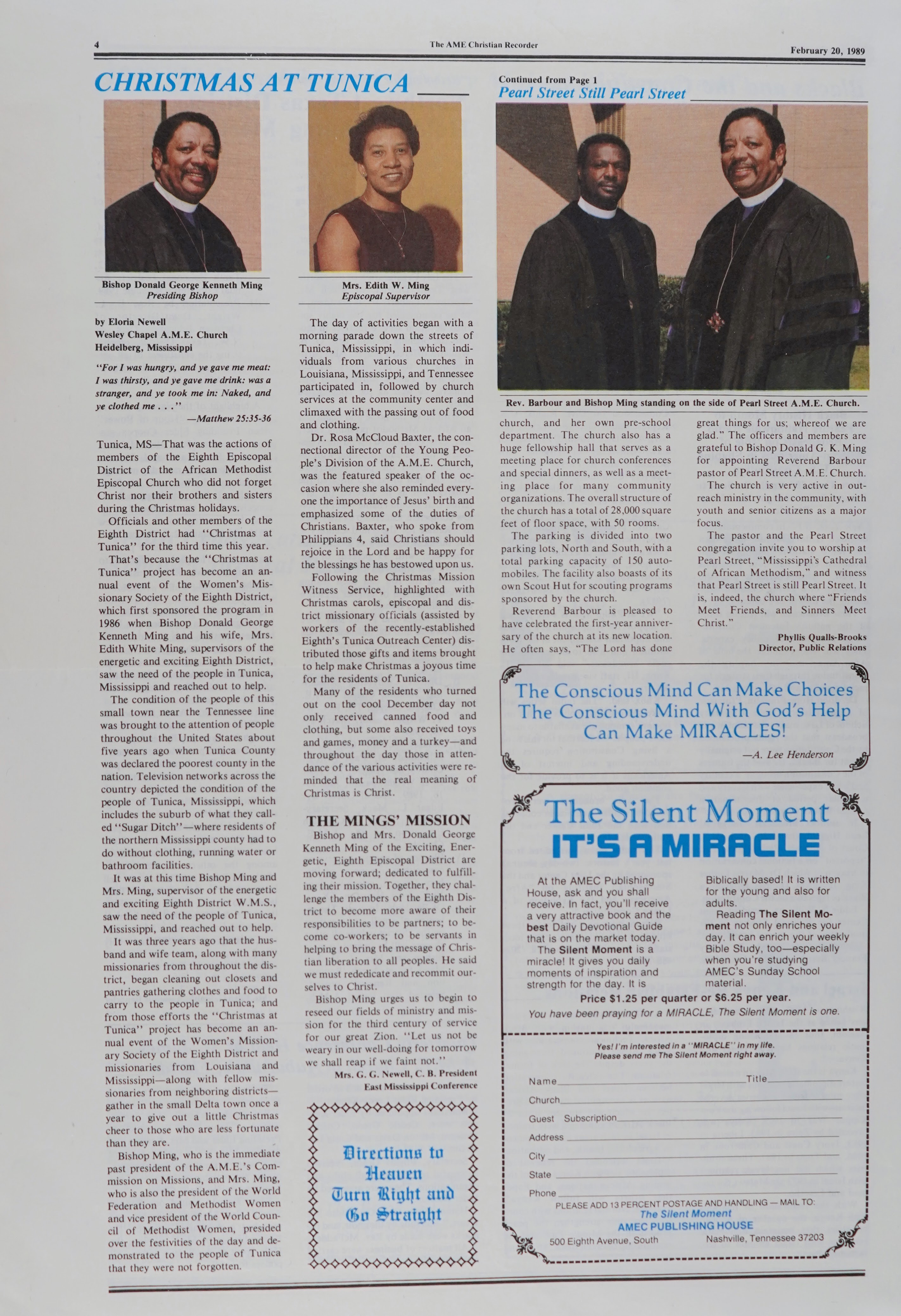
CHRISTMAS AT TUNICA
Wig
Bishop Donald George Kenneth Ming
Presiding Bishop
Mrs. Edith W. Ming
Episcopal Supervisor
by Eloria Newell
Wesley Chapel A.M.E. Church
Heidelberg, Mississippi
“For I was hungry, and ye gave me meat:
I was thirsty, and ye gave me drink: was a
stranger, and ye took me in: Naked, and
ye clothed me...”’
—Matthew 25:35-36
Tunica, MS—That was the actions of
members of the Eighth Episcopal
District of the African Methodist
Episcopal Church who did not forget
Christ nor their brothers and sisters
during the Christmas holidays.
Officials and other members of the
Eighth District had ‘‘Christmas at
Tunica’’ for the third time this year.
That’s because the ‘‘Christmas at
Tunica’ project has become an an-
nual event of the Women’s Mis-
sionary Society of the Eighth District,
which first sponsored the program in
1986 when Bishop Donald George
Kenneth Ming and his wife, Mrs.
Edith White Ming, supervisors of the
energetic and exciting Eighth District,
saw the need of the people in Tunica,
Mississippi and reached out to help.
The condition of the people of this
small town near the Tennessee line
was brought to the attention of people
throughout the United States about
five years ago when Tunica County
was declared the poorest county in the
nation. Television networks across the
country depicted the condition of the
people of Tunica, Mississippi, which
includes the suburb of what they call-
ed ‘‘Sugar Ditch’’—where residents of
the northern Mississippi county had to
do without clothing, running water or
bathroom facilities.
It was at this time Bishop Ming and
Mrs. Ming, supervisor of the energetic
and exciting Eighth District W.M.S.,
saw the need of the people of Tunica,
Mississippi, and reached out to help.
It was three years ago that the hus-
band and wife team, along with many
missionaries from throughout the dis-
trict, began cleaning out closets and
pantries gathering clothes and food to
carry to the people in Tunica; and
from those efforts the ‘‘Christmas at
Tunica’ project has become an an-
nual event of the Women’s Mission-
ary Society of the Eighth District and
missionaries from Louisiana and
Mississippi—along with fellow mis-
sionaries from neighboring districts—
gather in the small Delta town once a
year to give out a little Christmas
cheer to those who are less fortunate
than they are.
Bishop Ming, who is the immediate
past president of the A.M.E.’s Com-
mission on Missions, and Mrs. Ming,
who is also the president of the World
Federation and Methodist Women
and vice president of the World Coun-
cil of Methodist Women, presided
over the festivities of the day and de-
monstrated to the people of Tunica
that they were not forgotten.
The day of activities began with a
morning parade down the streets of
Tunica, Mississippi, in which indi-
viduals from various churches in
Louisiana, Mississippi, and Tennessee
participated in, followed by church
services at the community center and
climaxed with the passing out of food
and clothing.
Dr. Rosa McCloud Baxter, the con-
nectional director of the Young Peo-
ple’s Division of the A.M.E. Church,
was the featured speaker of the oc-
casion where she also reminded every-
one the importance of Jesus’ birth and
emphasized some of the duties of
Christians. Baxter, who spoke from
Philippians 4, said Christians should
rejoice in the Lord and be happy for
the blessings he has bestowed upon us.
Following the Christmas Mission
Witness Service, highlighted with
Christmas carols, episcopal and dis-
trict missionary officials (assisted by
workers of the recently-established
Eighth’s Tunica Outreach Center) dis-
tributed those gifts and items brought
to help make Christmas a joyous time
for the residents of Tunica.
Many of the residents who turned
out on the cool December day not
only received canned food and
clothing, but some also received toys
and games, money and a turkey—and
throughout the day those in atten-
dance of the various activities were re-
minded that the real meaning of
Christmas is Christ.
THE MINGS’ MISSION
Bishop and Mrs. Donald George
Kenneth Ming of the Exciting, Ener-
getic, Eighth Episcopal District are
moving forward; dedicated to fulfill-
ing their mission. Together, they chal-
lenge the members of the Eighth Dis-
trict to become more aware of their
responsibilities to be partners; to be-
come co-workers; to be servants in
helping to bring the message of Chris-
tian liberation to all peoples. He said
we must rededicate and recommit our-
selves to Christ.
Bishop Ming urges us to begin to
reseed our fields of ministry and mis-
sion for the third century of service
for our great Zion. ‘*Let us not be
weary in our well-doing for tomorrow
we shall reap if we faint not.’”
Mrs. G. G. Newell, C. B. President
East Mississippi Conference
Directions to
Heaven
Gurn Right and
@o Straight
Continued from Page 1
Pearl Street Still Pearl Street
Rey. Barbour and Bishop Ming standing on the side of Pearl Street A.M.E. Church.
church, and her own _ pre-school
department. The church also has a
huge fellowship hall that serves as a
meeting place for church conferences
and special dinners, as well as a meet-
ing place for many community
organizations. The overall structure of
the church has a total of 28,000 square
feet of floor space, with 50 rooms.
The parking is divided into two
parking lots, North and South, witha
total parking capacity of 150 auto-
mobiles. The facility also boasts of its
own Scout Hut for scouting programs
sponsored by the church.
Reverend Barbour is pleased to
have celebrated the first-year anniver-
sary of the church at its new location.
He often says, “The Lord has done
At the AMEC Publishing
House, ask and you shall
receive. In fact, you'll receive
a very attractive book and the
best Daily Devotional Guide
that is on the market today.
The Silent Moment is a
miracle! It gives you daily
moments of inspiration and
strength for the day. It is
Name
Church
Guest Subscription
Address
City
State
Phone
He 500 Eighth Avenue, South
~ a
The Conscious Mind Can Make Choices
The Conscious Mind With God’s Help
Can Make MIRACLES!
The Silent Moment
IT’S A MIRACLE
Price $1.25 per quarter or $6.25 per year.
You have been praying for a MIRACLE, The Silent Moment is one.
Yes! |'m interested in a ‘‘MIRACLE"’ in my life.
Please send me The Silent Moment right away.
PLEASE ADD 13 PERCENT POSTAGE AND HANDLING — MAIL TO
The Silent Moment
AMEC PUBLISHING HOUSE
Nashville, Tennessee ay.
great things for us; whereof we are
glad.” The officers and members are
grateful to Bishop Donald G. K. Ming
for appointing Reverend Barbour
pastor of Pearl Street A.M.E. Church.
The church is very active in out-
reach ministry in the community, with
youth and senior citizens as a major
focus.
The pastor and the Pearl Street
congregation invite you to worship at
Pearl Street, “Mississippi’s Cathedral
of African Methodism,” and witness
that Pearl Street is still Pearl Street. It
is, indeed, the church where “Friends
Meet Friends, and Sinners Meet
Christ.”
Phyllis Qualls-Brooks
Director, Public Relations
—A. Lee Henderson
Biblically based! It is written
for the young and also for
adults.
Reading The Silent Mo-
ment not only enriches your
day. It can enrich your weekly
Bible Study, too—especially
when you're studying
AMEC’s Sunday School
material.
yf)
ae ne
===== DSC05737.JPG =====
February 20, 1989
The AME Christian Recorder
Florida-Lakeland District of the A.M.E. Church
HOLDS PLANNING COUNCIL
Pastors, Ministers, Evangelists,
District Stewards, Missionaries, Sun-
day School Superintendents, and
many Laypersons yielded to the call of
newly appointed Presiding Elder
Leroy Kennon to attend the first Plan-
ning Council Saturday, November 26,
1988, at Mt. Zion A.M.E. Church,
Mulberry, Florida, where Rev. J. L.
Gay is pastor. It was a spirit-filled,
action-packed meeting. Presiding El-
der Kennon provided a well-organized
agenda that was challenging, spiritual
and intellectually stimulating.
The Lakeland District theme is:
‘Finding, Folding, and Feeding’’
complementing the Episcopal theme:
“‘Winning, Teaching, and Keeping.’’
The meeting began with Worship
Service at 9:45 AM with Rev. Jimmy
Thompson, Bethel A.M.E. Church,
Lakeland, Florida, presiding. The
host church choir provided music.
Other participants were Reverends J.
L. Gay, R. Heastie, C. Wilcher, M.
Bouie, J. Crews and V. Fayson. Rev.
John N. Butler, Allen Chapel A.M.E.
Church, Plant City, Florida, pre-
sented Presiding Elder Kennon who
presented the speaker of the hour,
Rev. T. P. King, pastor of Mt. Plea-
sant A.M.E. Church, Lakeland,
Florida. The Holy Ghost descended
upon the meeting as Rev. King pro-
claimed God’s word from I Cor.
13:1-5, 9-13 vs. Subject: ‘‘Calm
Words For A Hurting Church.’”’ A
wave of spiritual fervor swept
throughout the crowd as he delivered a
soul-stirring message.
The Reverends J. Thompson, L.
Kerney, C. Rawls, J. Rosier, N.
McFadden, J. C. Gordon, A. Oliver,
and A. Trudell presided over council
obligations and gifts.
The business session began with roll
call of Pastors, Ministers, Evange-
lists, District Stewards, and Sunday
School Superintendents. Organization
of the district followed with Presiding
Elder Kennon presiding. Those elected
and appointed to serve were as fol-
lows:
Rev. Jimmy L. Thompson
Dean of Institute
Rev. Michael Bouie
Assistant Dean and District Sec-
Mr. James Honors
President Lay Organization
Mrs. Luci Longworth
YPD
Mrs. EmmaRhaye Mitchell
Director Youth Activities
Mrs. Esther Snowden
Musician
Mrs. Jonnye Charlow
District Reporter
Rev. James Rosier
District Evangelist
Areas on the agenda for discussion
included: Episcopal and Connectional
Obligations; District Concerns, which
included immediate and long-range
goals; Church Growth—Evangelism,
covering Seminars, Workshops, Cru-
sades for Christ, Church Planting (ex-
pansion), membership and Recruiting;
Stewardship—Tithing, Offerings;
EWC; and District Banquet, Mrs.
Peggy Cooper, Chairperson.
After a palatable lunch, catered by
host church, the work session began.
Committees were informed involving
all council participants. After de-
liberating, reports were given, re-
ceived and adopted by the body. The
receptive and cooperative spirit of the
group reflected a sense of confidence,
commitment, and readiness, for wit-
ness and service to the church on the
local, district, and Episcopal levels.
Presiding Elder Kennon emphasized
the importance and necessity of total
involvement of ministers and layper-
sons alike in order to make the
Lakeland District second to none. He
further stated that he expects total
commitment and accountability, and
will aggressively pursue these endea-
vors aS we move onward and upward.
Plans were made for the District
Conference to be held February 22-24,
1989, in Plant City, (Bealsville) at Mt.
Olive, Rev. C. Wilcher, pastor.
The Lakeland District takes great
pride in the innovative leadership ex-
emplified by Presiding Elder Kennon
and his lovely wife and first lady, Mrs.
Vida Kennon, and thanks Bishop Cou-
sin for sending them to this district.
At the wrap-up and closing, several
ministers and laypersons stood up to
say that this was one of the best Dis-
trict Councils ever held.
\LLOF THE
WOMEN
OFTHE
BIBLE
Please send me copies
of All the Women of the Bible, En-
closed is paymment in the amount of
ey» plus 13% postage
and handling.
Name __
Church _
Address
City
State Zip
Phone
AMEC Publishing House
500 Eighth Avenue, South
Nashville, Tennessee 37203-4181
This is the first comprehensive book ever written on all the women of
the Bible, flavored with the color and drama of the original stories. Mrs.
Deen’s comments on these women, their influence, and their times, gives the
book a quality that is as constructive as it is entertaining.
RA-601000 (Paperback)
(Please add 13% postage and handling).
REASON F OR BEIN. G
AND OTHER MESSAGES OF FAITH
From an
AFRO-AMERICAN MINISTER
by
WILLIAM WEBSTER EASLEY, JR. PASTOR
Historic
ST. JOSEPH’S
African Methodist Episcopal Church
Durham, North Carolina
(A participant in the struggles for human dignity during the 60’s, now speaks at age 42
through messages delivered in pulpits across the nation after 25 years of experience as
an aie) clergyman).
Only $4.95
Please Add 13% Postage & Handling
Address.
City
State. Zip.
No.
REASON FOR BEING
AMEC PUBLISHING HOUSE, 500 Eighth Avenue, South, Nashville, TN 37203
FOE AA AE A A A EK AE A EK CE KK KK KK KKK KK
retary Everyone departed with an uplifted % Be Properly In formed! *
Mr. Jack Johnson spirit and a sincere feeling that the *
Sunday School Superintendent best is yet to come! 8 BECOMING A MINISTER
Mrs. Wilemena Spires x
President ACE Fellowship ee ee in the African Methodist Episcopal Church
s JOHN HURST ADAMS, Presiding Bishop
* Second Episcopal District Board of Examiners
ey Walter Hildebrand, Chairman — Maurice Wilson, Editor
4% All persons entering our ministry need to know
% what they should do. Assumptions have left large
%€ gaps in the training, support, and development of
aspiring young clergypersons.
ty) E This book addresses the concerns by making
FOLLOWED clear the standards, expectations, process, mutual
DIS responsibility, and resources on becoming an Or-
errr % dained Minister in the African Methodist Episcopal
% Church; it also deals with the concern of how the
%€ African Methodist Episcopal Church relates to and
He Followed
His Star
A Pen Portrait of the Life, Personality
and Chief Exploits
RRR KA
of
WILLIAM ALFRED FOUNTAIN, SR.
RIK OC
. works with the candidates for ordained ministry, as
LEANDER HILL well as evaluating the candidatens
By CHARLES * LY $4. 50
Sermiiie: A eeee copies foi nebee au deee ae
of HE FOLLOWED HIS STAR & Rush your order to: %
$4.95 x A.M.E.C. SUNDAY SCHOOL UNION %
Only é ‘4 500 8th Avenue, South Nashville, TN 37203-4181 cd
* PLEASE SEND BOOKS ON BECOMING A MINISTER “i
Name * Hi
% NAME Hi
Address % (1
ADDRESS
City State ¥
Send to: A.M. E. C. SUNDAY SCHOOL UNION % CITY/STATE/ZIP ¥
er Sis evetite, Outs os ah ne -iblinsepebaie See Amount enclosed Please add 13 Percent Postage & Handling Ps
ee a esctes RR I I IIIA AAR AAA A A AR
===== DSC05738.JPG =====
6
The AME Christian Recorder
February 20, 1989
1989 “McDonald’s Black History M
Oak Brook, IL—The McDonald's
Corporation held a leadership confer-
ence for ten high school students
named 1989 “McDonald's Black
History Makers of Tomorrow.” The
students were selected last February
from a national pool of 1,400 juniors
on the basis of character, leadership,
scholarship, and through their partici-
pation in an essay contest. One of the
conference activities was meeting with
Acting Chicago Mayor Eugene
Sawyer. He was presented with a
Plaque and a copy of Barbara
Reynold’s book, And Still We Rise.
Ms. Reynolds is the Inquiry page
editor of USA Today. She was one of
several conference speakers.
The present met with the future
when some of the country’s top Black
leaders—current history makers—
joined ten Black high school stu-
dents—future history makers—for a
McDonald’s Leadership Conference,
which fostered discussion on the
future of America and the role these
young leaders will play.
The students, named 1989
“McDonald’s Black History Makers
of Tomorrow,” as part of the com-
pany’s observance of Black History
Month last February. The Leadership
Conference, at McDonald's
Hamburger University in Oak Brook,
IL, was the concluding event in the
1989 “McDonald’s Black History
Makers of Tomorrow” program, and
provided the ten students the chance to
interact with some of the country’s
current Black business and political
leaders,
The ten students chosen as
“McDonald's Black History Makers
of Tomorrow” offered keen perspec-
tives and vision into some of the prob-
lems facing our country as well as a
personal commitment to help cure
them,” said Edward H. Rensi,
McDonald’s president and chief
operating officer. “Fortunately, if
these students are a reflection of their
generation, many of the challenges
ahead will be met and conquered.”
Participants in the conference in-
cluded Vernon Jordan, former
president of the National Urban
League; Barbara Reynolds, USA
Today editor and author of the book,
And Still We Rise; nationally known
motivational speaker Patricia Russell-
McCloud; Thomas Burrell, chairman
and founder of Burrell Advertising,
the country’s largest minority-owned
advertising agency; and Robert
South Leads Nation in Public
School Corporal Punishment
Southern states lead the nation in
corporal punishment of public school
students, according to a report pre-
pared by the National Coalition of Ad-
vocates for Students (NCAS).
The ten states where corporal pun-
ishment is most often used in public
schools are: Arkansas (1), Mississippi
(2), Alabama (3), Tennessee (4), Okla-
homa (5), Georgia (6), Texas (7),
Florida (8), South Carolina (9), and
Louisiana (10).
Corporal punishment in public
school is prohibited in ten states:
Hawaii, Maine, Massachusetss,
Nebraska, New Jersey, New York,
Rhode Island, Vermont, Wisconsin,
Washington, and the District of
Columbia. Legislation to prohibit cor-
poral punishment is pending in seven
states: Arkansas, Illinois, Indiana,
Michigan, Minnesota, Ohio, and
Washington.
The NCAS report is based on data
collected by the U.S. Department of
Education’s Office for Civil Rights
(OCR). OCR conducts a bi-annual
survey of public secondary schools on
school discipline and special educa-
tion referrals.
“Corporal punishment has no place
in school,” said NCAS Executive
Director Joan First. “It blames the
student without considering how the
behavior of teachers and staff may be
contributing to classroom disruptions
and it is not administered equitably.”
“Physical punishment may tem-
porarily interrupt undesirable be-
havior.” First continued, “but there
is no research indicating any perma-
nent positive effect. It doesn’t help
students develop self-discipline and it
discourages teachers from closely
examining their own behavior. When
corporal punishment is administered
by an adult who lacks an affectionate
bond with the child,” First continued,
“it can result in injury. If parents
punished children to the same degree
as some schools do, they would be
charged with child abuse.”
The report finds that Black public
school students suffer more than twice
the corporal punishment as do their
White counterparts. Blacks account
for 16% of the U.S. public school
population while receiving 31% of
corporal punishment. White students
make up 70% of the school
population, but receive 60% of
corporal punishment. Because male
students account for 80% of corporal
punishment incidents and 70% of
school suspensions, Black male
students are most at risk for disci-
plinary action.
NCAS suggests that schools wishing
to lower overall corporal punishment
rates while lowering racial disparity in
these rates can try the following:
(a) the school principal, in the role
of instructional leader, should share
current research with teachers which
concludes that corporal punishment is
not an effective way to discipline
students;
(b) the school principal should make
it clear to teachers that all corporal
punishment will be delivered in the
presence of another adult and will be
reported to the school administrator;
similar approaches are already re-
quired by law in many states where
corporal punishment is allowed;
(c) datashould be collected at both
district and school site levels by race,
ethnicity, gender, and handicapping
conditions; data should be disaggre-
gated to offer a clear picture of the use
of corporal punishment at each school
site; data should be publicized to par-
ents and the community;
(d) incidents of corporal punish-
ment should be noted in the records of
both teachers and students; a review of
this information should be part of a
teacher’s evaluation; teachers should
be provided with training to strength-
en their classroom management skills
so that they will not have to resort to
the raw use of authority.
The Bread of Life
Is Never Stale
akers of Tomorrow”
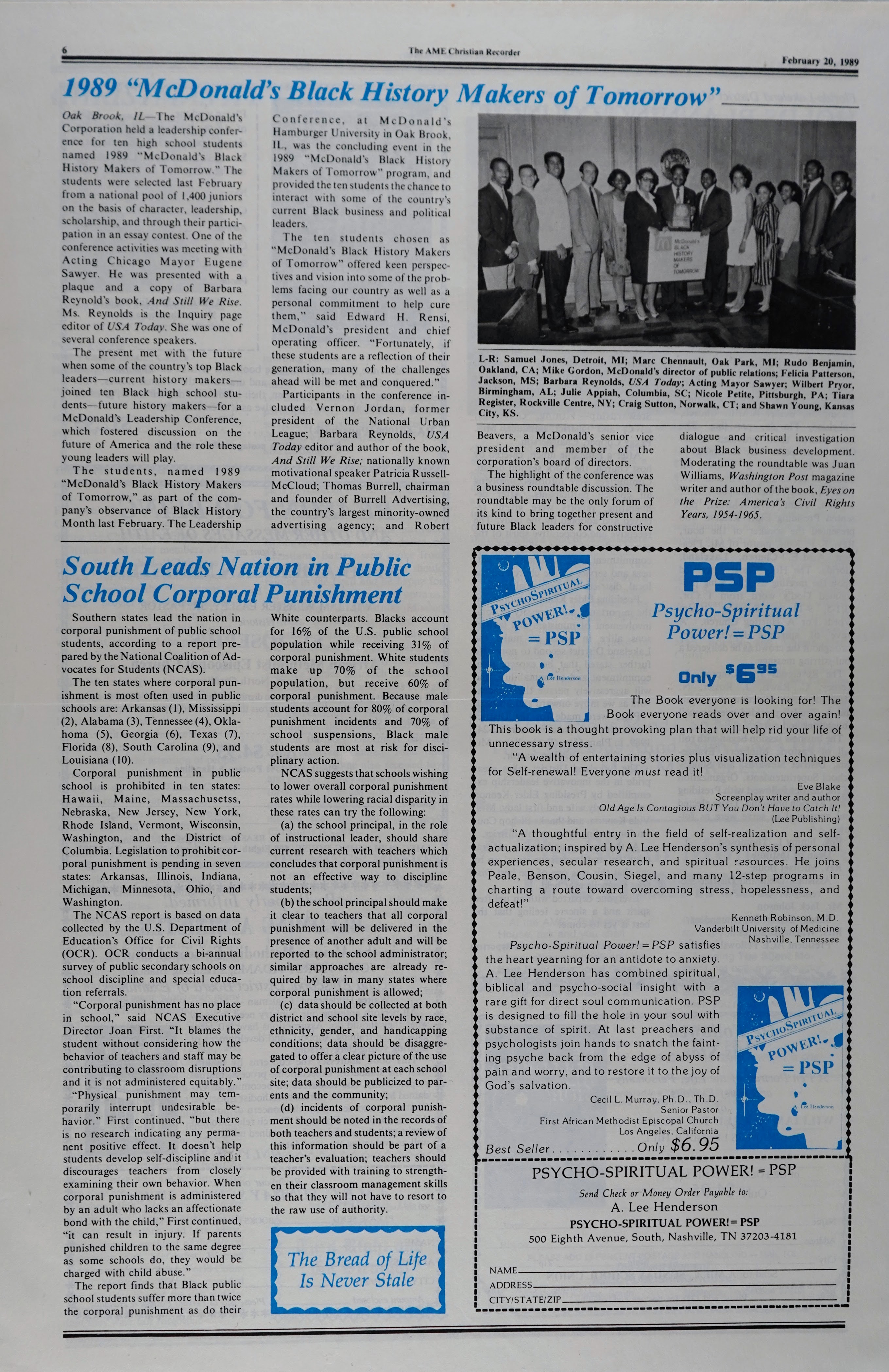
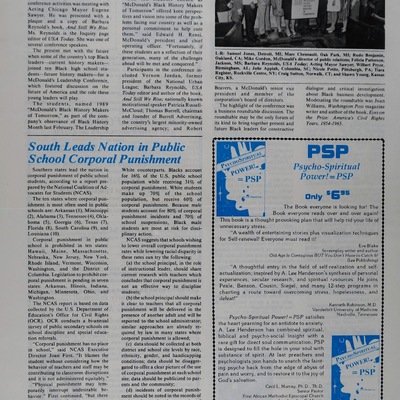
L-R: Samuel Jones, Detroit, MI; Marc Chennault, Oak Park, MI; Rudo Benjamin,
Oakland, CA; Mike Gordon, McDonald’s director of public relations; Felicia Patterson,
Jackson, MS; Barbara Reynolds, USA Today; Acting Mayor Sawyer; Wilbert Pryor,
Birmingham, AL; Julie Appiah, Columbia, SC; Nicole Petite, Pittsburgh, PA; Tiara
Register, Rockville Centre, NY; Craig Sutton, Norwalk, CT; and Shawn Young, Kansas
City, KS.
Beavers, a McDonald’s senior vice
president and member of the
corporation’s board of directors.
The highlight of the conference was
a business roundtable discussion. The
roundtable may be the only forum of
its kind to bring together present and
future Black leaders for constructive
ry (Re Henderson
This book is at
unnecessary stress.
defeat!”
God’s salvation.
Psycho-Spiritual
Power! =PSP
Only *G**
The Book everyone is looking for! The
gj Book everyone reads over and over again!
hought provoking plan that will help rid your life of
“A wealth of entertaining stories plus visualization techniques
for Self-renewal! Everyone must read it!
Old Age Is Contagious BUT You Don't Have to Catch It!
“A thoughtful entry in the field of self-realization and self-
actualization; inspired by A. Lee Henderson’s synthesis of personal
experiences, secular research, and spiritual resources. He joins
Peale, Benson, Cousin, Siegel, and many 12-step programs in
charting a route toward overcoming stress, hopelessness, and
Psycho-Spiritual Power! = PSP satisfies
the heart yearning for an antidote to anxiety.
A. Lee Henderson has combined spiritual,
biblical and psycho-social insight with a
rare gift for direct soul communication. PSP
is designed to fill the hole in your soul with
substance of spirit. At last preachers and
psychologists join hands to snatch the faint-
ing psyche back from the edge of abyss of
pain and worry, and to restore it to the joy of
Cecil L. Murray, Ph.D., Th.D.
Senior Pastor
First African Methodist Episcopal Church
Los Angeles. California
Best Sellen vera Only $6. 95
dialogue and critical investigation
about Black business development.
Moderating the roundtable was Juan
Williams, Washington Post magazine
writer and author of the book, Eyes on
the Prize: America’s Civil Rights
Years, 1954-1965.
Eve Blake
Screenplay writer and author
(Lee Publishing)
Kenneth Robinson, M.D.
Vanderbilt University of Medicine
Nashville, Tennessee
i PSYCHO-SPIRITUAL POWER! = PSP 1
H Send Check or Money Order Payable to: H
H A. Lee Henderson H
t PSYCHO-SPIRITUAL POWER!= PSP '
H 500 Eighth Avenue, South, Nashville, TN 37203-4181 H
1 NAME i
i ADDRESS i
§ CITY/STATE/ZIP eee i
——— ee 8885858588660 Ee
===== DSC05739.JPG =====
February 20, 1989
The AME Christian Recorder
‘‘T Just Ran Scared... It Was
Fear of the Unknown’’
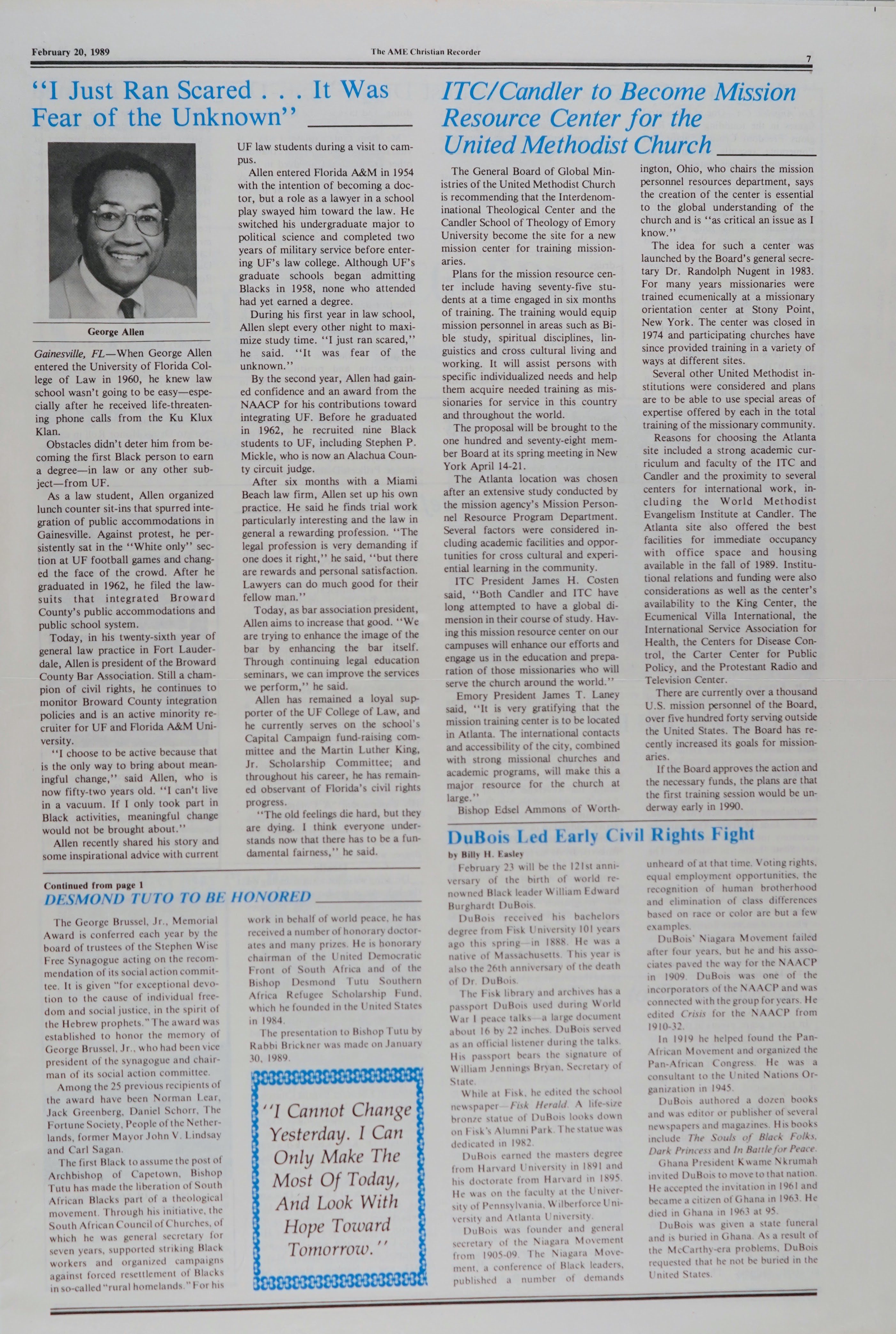
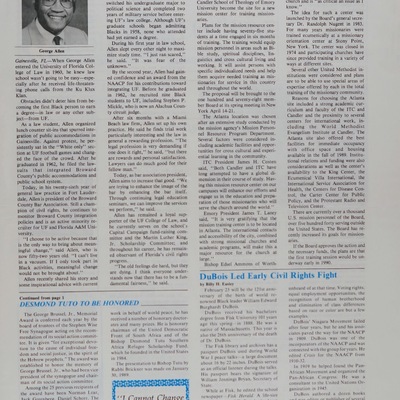
George Allen
Gainesville, FL—When George Allen
entered the University of Florida Col-
lege of Law in 1960, he knew law
school wasn’t going to be easy—espe-
cially after he received life-threaten-
ing phone calls from the Ku Klux
Klan.
Obstacles didn’t deter him from be-
coming the first Black person to earn
a degree—in law or any other sub-
ject—from UF.
As a law student, Allen organized
lunch counter sit-ins that spurred inte-
gration of public accommodations in
Gainesville. Against protest, he per-
sistently sat in the ‘‘White only’’ sec-
tion at UF football games and chang-
ed the face of the crowd. After he
graduated in 1962, he filed the law-
suits that integrated Broward
County’s public accommodations and
public school system.
Today, in his twenty-sixth year of
general law practice in Fort Lauder-
dale, Allen is president of the Broward
County Bar Association. Still a cham-
pion of civil rights, he continues to
monitor Broward County integration
policies and is an active minority re-
cruiter for UF and Florida A&M Uni-
versity.
“I choose to be active because that
is the only way to bring about mean-
ingful change,’ said Allen, who is
now fifty-two years old. ‘‘I can’t live
in a vacuum. If I only took part in
Black activities, meaningful change
would not be brought about.’”
Allen recently shared his story and
some inspirational advice with current
UF law students during a visit to cam-
pus.
Allen entered Florida A&M in 1954
with the intention of becoming a doc-
tor, but a role as a lawyer in a school
play swayed him toward the law. He
switched his undergraduate major to
political science and completed two
years of military service before enter-
ing UF’s law college. Although UF’s
graduate schools began admitting
Blacks in 1958, none who attended
had yet earned a degree.
During his first year in law school,
Allen slept every other night to maxi-
mize study time. ‘‘I just ran scared,”’
he said. ‘‘It was fear of the
unknown.’
By the second year, Allen had gain-
ed confidence and an award from the
NAACP for his contributions toward
integrating UF. Before he graduated
in 1962, he recruited nine Black
students to UF, including Stephen P.
Mickle, who is now an Alachua Coun-
ty circuit judge.
After six months with a Miami
Beach law firm, Allen set up his own
practice. He said he finds trial work
particularly interesting and the law in
general a rewarding profession. ‘‘The
legal profession is very demanding if
one does it right,’’ he said, ‘‘but there
are rewards and personal satisfaction.
Lawyers can do much good for their
fellow man.”’
Today, as bar association president,
Allen aims to increase that good. ‘‘We
are trying to enhance the image of the
bar by enhancing the bar itself.
Through continuing legal education
seminars, we can improve the services
we perform,”’ he said.
Allen has remained a loyal sup-
porter of the UF College of Law, and
he currently serves on the school’s
Capital Campaign fund-raising com-
mittee and the Martin Luther King,
Jr. Scholarship Committee; and
throughout his career, he has remain-
ed observant of Florida’s civil rights
progress.
‘The old feelings die hard, but they
are dying. I think everyone under-
stands now that there has to be a fun-
damental fairness,’’ he said.
i
Continued from page 1
DESMOND TUTO TO BE HONORED
The George Brussel, Jr., Memorial
Award is conferred each year by the
board of trustees of the Stephen Wise
Free Synagogue acting on the recom-
mendation of its social action commit-
tee. It is given “for exceptional devo-
tion to the cause of individual free-
dom and social justice, in the spirit of
the Hebrew prophets.” The award was
established to honor the memory of
George Brussel, Jr., who had been vice
president of the synagogue and chair-
man of its social action committee,
Among the 25 previous recipients of
the award have been Norman Lear,
Jack Greenberg, Daniel Schorr, The
Fortune Society, People of the Nether-
lands, former Mayor John V. Lindsay
and Carl Sagan.
The first Black to assume the post of
Archbishop of Capetown, Bishop
Tutu has made the liberation of South
African Blacks part of a theological
movement. Through his initiative, the
South African Council of Churches, of
which he was general secretary lor
seven years, supported striking Black
workers and organized campaigns
against forced resettlement ot Blacks
in so-called “rural homelands.” For his
work in behalf of world peace, he has
received a number of honorary doctor-
ates and many prizes. He is honorary
chairman of the United Democratic
Front of South Africa and of the
Bishop Desmond Tutu Southern
Africa Refugee Scholarship Fund,
which he founded in the United States
in 1984
The presentation to Bishop Tutu by
Rabbi Brickner was made on January
30, 1989
‘I Cannot Change §
Yesterday. I Can
Only Make The
Most Of Today,
And Look With
Hope Toward
Tomorrow. ’’
ITC/Candler to Become Mission
Resource Center for the
United Methodist Church
The General Board of Global Min-
istries of the United Methodist Church
is recommending that the Interdenom-
inational Theological Center and the
Candler School of Theology of Emory
University become the site for a new
mission center for training mission-
aries.
Plans for the mission resource cen-
ter include having seventy-five stu-
dents at a time engaged in six months
of training. The training would equip
mission personnel in areas such as Bi-
ble study, spiritual disciplines, lin-
guistics and cross cultural living and
working. It will assist persons with
specific individualized needs and help
them acquire needed training as mis-
sionaries for service in this country
and throughout the world.
The proposal will be brought to the
one hundred and seventy-eight mem-
ber Board at its spring meeting in New
York April 14-21.
The Atlanta location was chosen
after an extensive study conducted by
the mission agency’s Mission Person-
nel Resource Program Department.
Several factors were considered in-
cluding academic facilities and oppor-
tunities for cross cultural and experi-
ential learning in the community.
ITC President James H. Costen
said, ‘‘Both Candler and ITC have
long attempted to have a global di-
mension in their course of study. Hav-
ing this mission resource center on our
campuses will enhance our efforts and
engage us in the education and prepa-
ration of those missionaries who will
serve the church around the world.’”
Emory President James T. Laney
said, ‘‘It is very gratifying that the
mission training center is to be located
in Atlanta. The international contacts
and accessibility of the city, combined
with strong missional churches and
academic programs, will make this a
major resource for the church at
large.”’
Bishop Edsel Ammons of Worth-
ington, Ohio, who chairs the mission
personnel resources department, says
the creation of the center is essential
to the global understanding of the
church and is ‘‘as critical an issue as I
know.”’
The idea for such a center was
launched by the Board’s general secre-
tary Dr. Randolph Nugent in 1983.
For many years missionaries were
trained ecumenically at a missionary
orientation center at Stony Point,
New York. The center was closed in
1974 and participating churches have
since provided training in a variety of
ways at different sites.
Several other United Methodist in-
stitutions were considered and plans
are to be able to use special areas of
expertise offered by each in the total
training of the missionary community.
Reasons for choosing the Atlanta
site included a strong academic cur-
riculum and faculty of the ITC and
Candler and the proximity to several
centers for international work, in-
cluding the World Methodist
Evangelism Institute at Candler. The
Atlanta site also offered the best
facilities for immediate occupancy
with office space and housing
available in the fall of 1989. Institu-
tional relations and funding were also
considerations as well as the center’s
availability to the King Center, the
Ecumenical Villa International, the
International Service Association for
Health, the Centers for Disease Con-
trol, the Carter Center for Public
Policy, and the Protestant Radio and
Television Center.
There are currently over a thousand
U.S. mission personnel of the Board,
over five hundred forty serving outside
the United States. The Board has re-
cently increased its goals for mission-
aries.
If the Board approves the action and
the necessary funds, the plans are that
the first training session would be un-
derway early in 1990.
DuBois Led Early Civil Rights Fight
by Billy H. Easley
February 23 will be the 121st anni-
versary of the birth of world re-
nowned Black leader William Edward
Burghardt DuBois
DuBois received his bachelors
degree from Fisk University 101 years
ago this spring—in 1888 He was a
native of Massachusetts. This year ts
also the 26th anniversary of the death
of Dr, DuBois
The Fisk library and archives has a
passport DuBois used during World
War | peace talks—a large document
about 16 by 22 inches. DuBois served
as an official listener during the talks
His passport bears the signature of
William Jennings Bryan, Secretary of
State
While at Fisk, he edited the school
newspaper— Fisk Herald, A lite-size
bronze statue of DuBois looks down
on Fisk’s Alumni Park, The statue was
dedicated in 1982
DuBois earned the masters degree
from Harvard University in 1891 and
his doctorate from Harvard in 1895
He was on the faculty at the Univer-
sity of Pennsylvania, Wilberforce Unt
versity and Atlanta University
DuBois was founder and general
secretary of the Niagara Movement
from 1905-09. The Niagara Move-
ment, a conference of Black leaders,
published a number of demands
unheard of at that time, Voting rights,
equal employment opportunities, the
recognition of human brotherhood
and elimination of class differences
based on race or color are but a few
examples
DuBois’ Niagara Movement failed
after four years, but he and his asso-
ciates paved the way for the NAACP
in 1909. DuBois was one of the
incorporators of the NAACP and was
connected with the group for years. He
edited Crisis for the NAACP from
1910-32.
In 1919 he helped found the Pan-
African Movement and organized the
Pan-African Congress. He was a
consultant to the United Nations Or-
ganization in 1945
DuBois authored a dozen books
and was editor or publisher of several
newspapers and magazines, His books
include The Souls of Black Folks,
Dark Princess and In Battle for Peace.
Ghana President Kwame Nkrumah
invited DuBois to move to that nation,
He accepted the invitation in [96] and
became a citizen of Ghana in 1963, He
died in Ghana in 1963 at 95
DuBois was given a state funeral
and is buried in Ghana, As a result of
the MeCarthy-era problems, DuBois
requested that he not be buried in the
United States
—————
===== DSC05740.JPG =====
The AME Christian Recorder
February 20, 1989
‘“Clergy and Congregations Against Drugs
Los Angeles, CA—One of the central
figures in the founding of the Reli-
gious Freedom Crusade, actor Jeff
Pomerantz, recently announced the
formation of a new, interdenomina-
tional anti-drug group, Clergy and
Congregations Against Drugs.
Joining him in the formation of the
organization was a well-respected reli-
gious leader who has fought the drug
problem in America, the Reverend
Jim Nicholls, a member of the Reli-
gious Freedom Crusade’s Advisory
Board.
In exclusive interviews with The
Crusader for its January issue, both
Mr. Pomerantz and Mr. Nicholls dis-
cussed their reasons for working
against drug abuse.
Mr. Pomerantz, a_ scientologist
since 1971, is founder of the Holly-
wood Says “No” to Drugs Honor Roll
and Hollywood Kids Say “No” to
Drugs.
Those two groups have successfully
used celebrity influence to combat the
drug problem in the United States and
abroad. Hundreds of celebrities, as
well as many thousands of other
people, private citizens and leaders
alike, have shown their support for
this anti-drug effort by signing a
pledge to help in the fight against
drugs
Mr. Nicholls, a Pentecostal Baptist
minister, is executive director of The
Voice of Freedom, a radio and
television ministry which reaches all 50
states and Canada and which has
featured broadcasts that have
informed audiences of the dangers of
drugs.
The “Honor Roll” concept began as
a means to get leaders directly in-
volved in helping to combat the de-
structive influence of drugs.
All who sign the Honor Roll pledge
“to be intolerant of the glorification of
drug use, and to use my influence and
power to help create a drug-free
society and to personally take a stand
and say ‘No’ to drugs.”
“My original intention was to gal-
vanize the entertainment industry and
get its leaders to stand up and say ‘No’
to drugs,” Mr. Pomerantz told The
Crusader. “The idea was that young
people will do what their heroes are
doing, and take a stand against drugs
as well,”
Mr. Pomerantz explained why it is
vital for clergy, perhaps more than any
other group, to get involved in help-
ing others say “No” to drugs. “Clergy
are often the first ones that people
come to for help,” he said, “especially
if they have a drug problem or are in
some way affected by drugs. | think it
is important for ministers, rabbis and
priests to be able to take a stand and
express their opposition to drugs.”
Mr. Nicholls said, “Drugs have
taken a toll that is hard to estimate.
The true damage that is done includes
many people going to premature
graves, leaving their families and their
loves ones. Drugs have forced many
innocent youths into lives of crime,
degradation and prostitution. The
more people you can get to say ‘No’ to
drugs, the better.”
Former President and Mrs. Reagan,
California Governor George Deuk-
mejian, and Los Angeles Mayor Tom
Bradley have all signed the Holly-
wood Says “No” to Drugs Honor Roll
pledge. Princess Diana of England and
’’ Anti- Drug Group Formed
Princess Christina of Sweden also
pledged their support in the fight
against drugs, The prime minister of
Sweden, Ingvar Carlsson, and even-
tually all the prime ministers of Sean-
dinavia added their names to the
Hollywood Says “No” to Drugs
Honor Roll.
Others who have signed that Honor
Roll include a host of the entertain-
ment industry's top stars, such as Sir
Laurence Olivier, Tom Selleck, Patty
Duke, Henry Mancini, Charley Pride,
Burt Bacharach, Dudley Moore, and
John Travolta, as well as such sports
personalities as Charles Lakes,
America’s top-rated gymnast. The list
grows constantly,
Signers of the Clergy and Congrega-
tions Say “No” to Drugs Honor Roll
will receive a certificate of recognition
from Clergy and Congregations
Against Drugs.
Those who wish to sign may write to
the Clergy and Congregations Say
“No” to Drugs Honor Roll in care of
The Crusader, 4810 Fountain Ave-
nue, Box 50, Los Angeles, CA 90029,
(213) 661-4178.
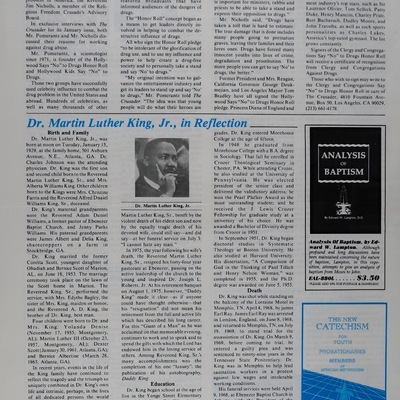
Dr. Martin Luther King, Jr., in Reflection
Birth and Family
Dr. Martin Luther King, Jr., was
born at noon on Tuesday, January 15,
1929, at the family home, 501 Auburn
Avenue, N.E., Atlanta, GA. Dr.
Charles Johnson was the attending
physician. Dr. King was the first son
and second child born to the Reverend
Martin Luther King, Sr., and Mrs.
Alberta Williams King. Other children
born to the Kings were Mrs. Christine
Farris and the Reverend Alfred Dnaiel
Williams King, Sr., deceased.
Dr. King’s maternal grandparents
were the Reverend Adam Daniel
Williams, a former pastor of Ebenezer
Baptist Church, and Jenny Parks
Williams. His paternal grandparents
were James Albert and Delia King,
sharecroppers on a farm in
Stockbridge, GA.
Dr. King married the former
Coretta Scott, youngest daughter of
Obadiah and Bernice Scott of Marion,
AL, on June 18, 1953. The marriage
ceremony took place on the lawn of
the Scott home in Marion. The
Reverend King, Sr., performed the
service, with Mrs. Edythe Bagley, the
sister of Mrs. King, maiden or honor,
and the Reverend A. D. King, the
brother of Dr. King, best man.
Four children were born to Dr. and
Mrs. King: Yolanda Denise
(November 17, 1955, Montgomery,
AL); Martin Luther III (October 23,
1957, Montgomery, AL); Dexter
Scott (January 30, 1961, Atlanta, GA);
and Bernice Albertine (March 28,
1963, Atlanta, GA).
In recent years, events in the life of
the King family have continued to
reflect the tragedy and the triumph so
uniquely combined in Dr. King’s own
life and intrinsic, perhaps, in the lives
of all dedicated persons the world
over.
On June 30, 1974, Mrs. Alberta
Williams King, the Mother of Dr.
Martin Luther King, Jr., was shot and
killed as she sat at the organ in the
Ebenezer Baptist Church in Atlanta.
Again, through an act of violence,
there ended a life that was totally
nonviolent, a life that was thoroughly
Christian, a life that reflected love for
all persons and unselfish service to
humankind. Again, the indomitable
faith of the King family was put to the
test, and again love prevailed amid the
greatest sadness. The Reverend
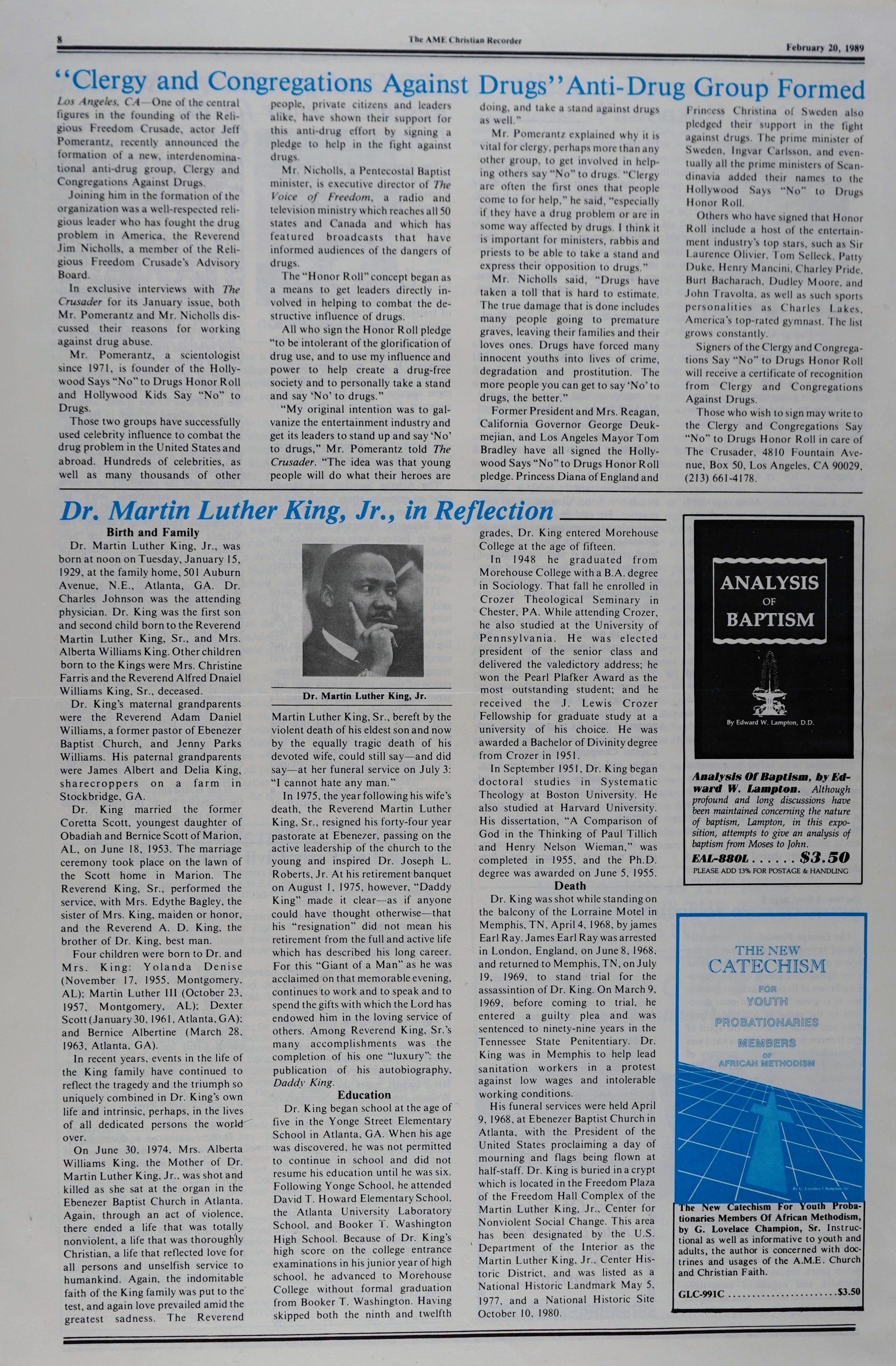
Dr. Martin Luther King, Jr.
Martin Luther King, Sr., bereft by the
violent death of his eldest son and now
by the equally tragic death of his
devoted wife, could still say—and did
say—at her funeral service on July 3:
“T cannot hate any man.”
In 1975, the year following his wife’s
death, the Reverend Martin Luther
King, Sr., resigned his forty-four year
pastorate at Ebenezer, passing on the
active leadership of the church to the
young and inspired Dr. Joseph L.
Roberts, Jr. At his retirement banquet
on August I, 1975, however, “Daddy
King” made it clear—as if anyone
could have thought otherwise—that
his “resignation” did not mean his
retirement from the full and active life
which has described his long career.
For this “Giant of a Man” as he was
acclaimed on that memorable evening,
continues to work and to speak and to
spend the gifts with which the Lord has
endowed him in the loving service of
others. Among Reverend King, Sr.’s
many accomplishments was the
completion of his one “luxury”: the
publication of his autobiography,
Daddy King.
Education
Dr. King began school at the age of
five in the Yonge Street Elementary
School in Atlanta, GA. When his age
was discovered, he was not permitted
to continue in school and did not
resume his education until he was six.
Following Yonge School, he attended
David T. Howard Elementary School,
the Atlanta University Laboratory
School, and Booker Y. Washington
High School. Because of Dr. King’s
high score on the college entrance
examinations in his junior year of high
school, he advanced to Morehouse
College without formal graduation
from Booker T. Washington. Having
skipped both the ninth and twelfth
grades, Dr. King entered Morehouse
College at the age of fifteen.
In 1948 he graduated from
Morehouse College witha B.A. degree
in Sociology. That fall he enrolled in
Crozer Theological Seminary in
Chester, PA. While attending Crozer,
he also studied at the University of
Pennsylvania. He was elected
president of the senior class and
delivered the valedictory address; he
won the Pearl Plafker Award as the
most outstanding student; and he
received the J. Lewis Crozer
Fellowship for graduate study at a
university of his choice. He was
awarded a Bachelor of Divinity degree
from Crozer in 1951.
In September 1951, Dr. King began
doctoral studies in Systematic
Theology at Boston University. He
also studied at Harvard University.
His dissertation, “A Comparison of
God in the Thinking of Paul Tillich
and Henry Nelson Wieman,” was
completed in 1955, and the Ph.D.
degree was awarded on June 5, 1955.
Death
Dr. King was shot while standing on
the balcony of the Lorraine Motel in
Memphis, TN, April 4, 1968, by james
Earl Ray. James Earl Ray was arrested
in London, England, on June 8, 1968,
and returned to Memphis, TN, on July
19, 1969, to stand trial for the
assassintion of Dr. King. On March 9,
1969, before coming to trial, he
entered a guilty plea and was
sentenced to ninety-nine years in the
Tennessee State Penitentiary. Dr.
King was in Memphis to help lead
sanitation workers in a_ protest
against low wages and intolerable
working conditions.
His funeral services were held April
9, 1968, at Ebenezer Baptist Church in
Atlanta, with the President of the
United States proclaiming a day of
mourning and flags being flown at
half-staff. Dr. King is buried ina crypt
which is located in the Freedom Plaza
of the Freedom Hall Complex of the
Martin Luther King, Jr., Center for
Nonviolent Social Change. This area
has been designated by the U.S.
‘ Department of the Interior as the
Martin Luther King, Jr., Center His-
toric District, and was listed as a
National Historic Landmark May 5,
1977, and a National Historic Site
October 10, 1980.
By Edward W. Lampton, D.D
Analysis Of Baptism, by Ed-
ward W. Lampton. Although
profound and long discussions have
been maintained concerning the nature
of baptism, Lampton, in this expo-
sition, attempts to give an analysis of
baptism from Moses to John.
EAL-880L...... $3.50
PLEASE ADD 13% FOR POSTAGE & HANDLING
THE NEW
CATECHISM
FOR
YOUTH
PROBATIONARIES
MEMBERS
oF
AFRICAN METHODISM
tionaries Members Of African Methodism,
by G. Lovelace Champion, Sr. Instruc-
tional as well as informative to youth and
adults, the author is concerned with doc-
trines and usages of the A.M.E. Church
and Christian Faith.
GLC-991C
ne
===== DSC05741.JPG =====
February 20, 1989
The AME Christian Recorder
Royce E. McClanahan is First
Black to Win $10,000 Durfee
Foundation Awar
Royce E. McClanahan
San Diego, CA—Royce E. McClana-
han has won one of eight $10,000
awards in the 1988 Durfee Awards
program.
McClanahan, president of the Mon-
roe County Branch of the National
Association for the Advancement of
Colored People, Stroudsburg, PA, is
the first Black recipient of a Durfee
Award. The Durfee Awards program
recognizes individuals who have signi-
ficantly enhanced the human dignity
of others through the law or legal in-
struments. The program, instituted in
1982 by the Los Angeles-based Durfee
Foundation, a self-directed, non-pro-
fit organization, is held every two
years. Durfee Award winners are se-
lected from national and international
program finalists.
McClanahan, a resident of Strouds-
burg, was selected for initiating an ag-
gressive civil rights movement in the
early 1980's and for his vigorous pur-
suit of first-time civil rights redress
for racial and religious minority group
members in Northeastern Pennsyl-
vania.
McClanahan’s work included repre-
senting Black, White, Oriental and
Jewish individuals who were discrimi-
nated against in housing, employment
and education and the U.S. armed ser-
vices. He was instrumental in helping
others find redress for violations of
their civil rights, ushering in major
d
rights challenges and a civil rights
renaissance in a suburban rural area.
McClanahan has been a self-em-
ployed tax and personnel consultant in
Monroe County for the past five
years. His work experience also in-
cluded a variety of administrative
posts in social work and human ser-
vices, as well as employment as a
watchman and on loading docks as a
dockworker in the trucking industry.
Over the years, McClanahan has
been extremely active with community
service organizations. He has served
as an advisory board member of
Northampton Area Community Col-
lege and has worked as a governing
board member with the Easton Citi-
zens Coalition, the Northampton
County Bureau of Aging, the Easton
Branch of the NAACP, and was a
founding director of the Lehigh Valley
Legal Services, Inc., all located in the
Allentown, Bethlehem and Easton
area of Pennsylvania.
He has been a member of the Mon-
roe County Branch NAACP and has
held a variety of leadership posts in
the organization for the past eight
years.
A native midwesterner, McClana-
han was born in Kansas City, MO,
and attended elementary and secon-
dary schools in Leavenworth, KS.
He is a graduate of Emporia State
University, Emporia, KS, where he re-
ceived a bachelor of arts degree in
social science and psychology. He has
done graduate work in education, so-
ciology and social science at Emporia
State, Wichita State University,
Wichita, KS, and Long Island Univer-
sity in Brooklyn, NY
Editor’s Note
Readers wishing information
about the 1990 Durfee Awards
Program may contact; Durfee
Awards Program, Suite 288,
1288 Camino Del Ric North,
San Diego, CA 92108
Out of the creative union of the late
Reverend Waymon Dixon and Mary
Collins Dixon, Charles Delano Dixon
was born December 22, 1911, in Quin-
cy Florida.
He grew up in Piant City, Florida,
and received his formal education in
the Hillsborough County Public
Schools. Later on, he matriculated at
Edward Waters College, B. F. Semi
nary, and also did further study at the
Interdenominational Theological Cen
ter of Atlanta University
He was called to preach ai an early
age. He later met and married Mary
Lee Collins, a teacher of Tampa, Plo
rida. Out of this dynamic umon
(preacher/teacher) seven children
were born
The late Reverend Charles Delano
Dixon, Sr. enjoyed forty-nine years of
ministry which criss-crossed the Flori
da Peninsula in the African Methodist
Episcopal Church. He was a true ser
vani of God, winning souls to Christ
Twice elected delegaic to the A.M.I
General Conference, the legacy he
leaves as a preacher, builder, civil
rights activiet, husband, father and
Christian, serves as a pattern of excel
lence for a new generation of Black
preachers in the third century of Afri
can Methodism. At the time of his de
mise, Rev. Divon was the pastor ot
Mi. Zion A.M.E. Church, Arcadia,
OBITUARY
Florida, He was former pastor of St
Luke A.M.E., Tampa, Florida
He passed away peacefully ai 6:00
A.M., on September 29, in a local
hospital, to dwell with the saints of
God
He leaves to cherish his homegoung,
wife Mary Collins Dixon, Tampa, FL;
four sens, Charles D. Dixon and wife
Gaynelle, Tampa, PL, Theodore L
Dixon and wife Beverly, Atlanta, GA,
Gerald D. Dixon and wife Sharon,
Tampa, FL, and Rev. Waymon T
Dixon and wife Deborah, &. Peters
burg, PL; three daughters, Atty, Al
berta H. Johnson and husband Wil
liam, Houston, TX, Theadora D
Bingham and husband Fimo, Atlanta,
GA, and Laverne A. Mason and hus
band Clem, Miami, FL, several
grandchildren; one brother, Tom Dix
on and wife Neta, Plant City, PL; five
sisters, Dola Patterson, Tampa, PL,
Maeola Forte and husband Mitchell,
Milwaukee, Wi, Annie Low Griffin
and husband Jasper, Bernice MoGhee,
Lottie M. Dixon, all of Plant City,
FL; sisters-in-law, Edith L.. Collis,
Tampa, FL, Renee Dixon, New Jer
sey, Nita Dixon; cousins, Rev. and
Mrs. J. B. Blaine, Starke, PL, and a
hest of mieoes and nephews
The comoling eulogy was given by
Bishop Philip KR. Cousin, Presiding
Prelate of the 11th Ppiscopal District
: LMichael (cg) Green and Derek M. Wilson
College Student, 19, Wins $50,000
Greensboro, NC—Derek M. Wilson,
a 19-year-old student at North Caro-
lina Agricultural and Technical State
University (NC A&T), took the top
prize of $50,000 in the Pepsi Cola
Company’s “New Generation Dream
Sweepstakes Giveaway,” here
recently
A marketing major from New
Castle, DE, Wilson promptly gave the
money to his parents. His father,
Samuel, told a huncheon sponsored by
Dr. Edward B. Fort, the university's
chancellor, that “the money will be
mvested in a very safe, high-imterest-
bearing account.”
“We promised to pay for Derek's
first four years of college,” said
Samuel Wilson, Derek's father, “and
we will keep that promise. His carn-
ings will be invested for his future.”
Derek's father is a jumior high
school principal and his mother teach-
es business subjects
Before accepting the $50,000 check
from L Michael (cg) Green, Durector of
Black Marketing for Pepsi-Cola
Derek Wilson had earlier harvested a
windfall of prizes as one of the four-
teen finalists im the national sweep-
stakes He had already recerved a new
1988 Oldsmobile Cutlass Suerra, a trip
for two to Sea World m Orlando, FL
and $1000 im cash as “spending
money.”
Addressing the luacheon guests
Derek related how he “almost host the
first prize ”
Each of the fourteen finalists in the
promotion won an Oldsmobile Sierra.
They were told that a notice was
placed in the glove compartment of
one of the cars announcing that its
owner would also win the top prize of
$50,000
“| was going to choose number five
but a friend, Henry Stephens, suggest-
ed I take number eight,” Wilson said
“I picked number eight and | won.”
Green told the gathering that the
competition had been run in fourteen
markets and that Derek, who heard of
the contest over radio station WDAS.
had been the winner from the Philadel-
phia, PA, area
“Derek truly represents today’s new
generation,” Green said, “and as a
marketing major, believes like Pepsi-
Cola, that excellence in marketing is
the true formula for business suc-
cess.”
Green expressed great pleasure in
the fact that the top winner was also a
student at NC AAT. “Pepsi Cola and
A&T have enjoyed a dear and close
fnendship over the years.”
He mentioned the university's par-
ticepation im both the Excellence im
Marketing Seminar for Historically
Black Colleges and the Minority
Summer lotern Program
Wilson, who normally works during
the sumumer vacation, sad be would
apply for the Pepsi-Cola summer
intern program
Service of Triumph and Thanksgiving
for the Late
SISTER ETHER HUNTER TURNER
Held at (he
Si. Joha’s Church
Atricae Meithodhiot b pin apa
Wet Port Mississigpt
Wednesday, December 21, 1983, 1.00 PM
Paster J. L. Moore, Jr. Officiating
On November 7, 1919, the sixth
seedling from the tree of Ezekiel and
Mary Hunter, named Ether B.
Hunter, sprouted and began to grow
This little tree grew and took coverage
with Hunter Chapel A.M.E. Church
at the age of eleven. The learning pro
cess continued at West Poimt High
Scheel and Mary Holmes College im
West Point
The tree continued to grow and
joined in Holy Matrimony to the late
Robert Turner. This union settled im
“Smith Bottom. ~
This tree found time to spread and
share het Branches throughout the em
tire CoHRUtty As an active member
ef St. John’s A.M_E. Churoh, this tree
supported and becatae a mertber of
the Board of Trustees, the Board of
Stewards, the Senior Choir and served
as a member and treasurer of the Wo-
men’s Missionary Society till her pass-
img. She served Bryan Foods for thér-
ty-onme years. This tree was a long-time
member of the Lily of the Valley
Order of Bastern Stars Chapter #79
and was Worthy Matron for many
years
Om December 16, 198%, the life of
the maim seed im the tree came to rest
at Madison General Hospital im Can-
tea, (South) Mississappe
To cherish her memories are: five
children, Willie J. Turner of West
Point, MS; Jeff E. Turner (Patricia
Smith Turner) and Adama C. Turner of
Buffalo, NY; Bettye J. Nichol
(Richard L. Nichols, Sr.) of Canton,
MS; and Attoraey Beanie L. Turner
(Edema Walker Turner) of West Poins,
MS: two sisters, Anaie H. Garth and
Bertha H. Hill of West Pott, MS;
one sister-te-law, Ane M. Hunter of
West Point, MS; thirteen grandechil
dren, five great-grandchiidren, and
rhany other Rieces, Rephews, relatives
and friends
4. C, Clarke, Reporting
===== DSC05742.JPG =====
10
The AME Christian Recorder
February 20, 1989
Chaplain’s Notebook
COTTONBALER SUICIDE
As a Chaplain in the United States
Army, one of my tasks is to perform a
suicide briefing to my soldiers, twice a
year. That is the purpose of this arti-
cle.
I am aware that this article is being
addressed primarily to civilians and
adults. As you care for and nurture
each family member, I ask that you
look for the following signs that could
show suicidal tendencies. This article
is designed to pre-test you on your
knowledge of the subject, inform you
of suicide signals, and finally, to tell
of preventive action. Let’s begin!
Answer the following, True or
False:
a. Mental illness is the largest sin-
gle cause of suicide.
b. New stress added to existing
stress pushes many people
‘“over the edge.’’
c. Suicide is a permanent solution
to what is normally a tempo-
rary problem.
d. Most suicidal people do not
really want to die.
e. A small percentage of suicidal
persons are mentally ill.
f. People who talk about commit-
ting suicide do not normally do
so.
g. Suicide happens normally with-
out warning.
h. The most important person in
preventing suicide is the Bat-
talion Chaplain.
i. If a person talks about suicide,
it is best to challenge and at-
tempt to shame him out of that
kind of thinking.
j. Talking with a suicidal person
about the details of his plan
could motivate the person to act
upon the plan.
The answers are at the bottom of
this article.
Suicide signals can be obvious. Se-
vere depression is an early sign of a
possible problem. Signs of depression
are trouble sleeping, eating signifi-
cantly more or less, increased drug use
(alcohol, legal/illegal drugs), or slow-
ing down of body movements and
speech. Dramatic drop in job perfor-
mance is a suicide signal. Severe per-
sonality changes may precede suicide.
A person may have a history of sui-
cide attempts, or may indicate that
they have done some unforgiveable
act. Remember that a person talking
about suicide should be taken serious-
ly. People seldom talk about it unless
they are considering it. It is interesting
that suicidal people normally ‘‘get
their house in order.’? They may pay
final bills, say goodbyes, turn in credit
cards, or apologize to friends for past
problems, or make out their wills.
Hopelessness, helplessness, and
worthlessness are three feelings that
usually accompany suicide.
If your family gives any suicide sig-
nals, they may be a suicide risk. Con-
tact your minister when suicide is even
suspected. Talk with the individual to
determine the seriousness of the prob-
lem. If they reflect several suicide sig-
nals, then ask them, ‘‘Have you ever
thought about injuring yourself or
anyone else?’’ If so, ask if they have a
plan. Ask then, ‘‘If you were to kill
yourself, how would you do it?’
(Gunshot, drug overdose, etc.) Is their
plan lethal? If yes to these three, then
immediate action must be taken to
separate them from the means. (Take
away the gun, pills, etc.) DO NOT
LEAVE THE PERSON ALONE!!!
This is not a pleasant subject, yet it
is a part of our human existence and
our Christian duty to attack it. Note
the above data. Please remember that
you are not alone. Most importantly,
remember Matthew 28:20 tells us that
“‘Lo, I am with you, even until the
ends of the earth.’’
ANSWERS
1. True. 98% of suicides suffer from
psychiatric disorders.
False
True
True
. False
. False. When people tell you, LIS-
TEN.
7. False. When people tell you, LIS-
TEN.
8. False; it’s YOU
9. False. Shame adds to the problem.
Understanding and sympathy heals.
10. False. You can remove their wea-
pon while you seek immediate help.
avr
Leading Alzheimer
Researchers Receive
Prestigious NIA
Award
The National Institute on Aging
(NIA) has awarded multi-million dol-
lar grants for Alzheimer’s disease re-
search to three outstanding scientists:
Dr, Carl W. Cotman, professor of
psychobiology in the School of Bio-
logical Sciences at the University of
California at Irvine, Dr. Caleb E.
Finch, professor of gerontology and
neurobiology at the University of Sou-
thern California’s Andrus Geronto-
logy Center, and Dr, Donald L. Price,
professor of pathology in the School
of Medicine, The Johns Hopkins Uni
versity. The Leadership and Excel
lence of Alzheimer’s Disease (LEAD)
award, authorized by Congress in
1986, provides up to $7 million of sup.
port over a seven-year period to dis
tinguished senior investigators and
their colleagues to further their con
tributions to biomedical research on
Alzheimer’s and related dementias
Bethel Rincon Will
Celebrate Their
94th Anniversary
Rincon, GA—Bethel A.M.E. Church
will celebrate their 94th Church An-
niversary, beginning February 16th,
The Rev. R, L. Thomas and his
congregation of Goodwill Baptist
Church Rincon, GA will be in charge
of the services Thursday night, Febru-
ary 16th
The Rev, Joseph L. Napier and his
congregation of Abercorn Baptist
Church, Rincon, GA, will be in charge
of the services Friday night, February
17th, These services will begin at 7:30
p.m. nightly
Sunday morning at 11:30 a.m will
be the regular communion services,
with Pastor Joseph Ward in charge
Sunday afternoon at 2:30 p.m, Rev
Jack Bradshaw and his congregation
of Townsley Chapel A.M.B, Church
Savannah, GA, will bring the Anniver
sary to a close
Pastor Joseph Ward is extending an
invitation to all to join us in these ser
vices, Dinner will be served after the
services on Sunday afternoon
Humility
Chaplain William Holt Liptrot, Jr.
(Cpt.) USA
Humility is housed in your mind,
and it is seen through your actions. It is
important because without it, self-
centeredness will set in and you will
find it difficult to reach your goals.
This paper briefly explains how we
acquire humility by examining its
biblical origin; looks at famous
exemplifiers of humility, and suggests
ways of discovering it. Read it, and
better learn who you are.
Humility originates during our for-
mulative years. It is a product of our
socialization, because at age ten our
mind is like a sponge and soaks in new
knowledge. If during the formulative
years our mind absorbs selfish and
egocentric behavior, we will come to
have an adolescent and adult with self-
ish and egocentric behavior. Unless a
Christian resocialization occurs, the
soldier will remain driven by pride,
envy and anger.
God made humility for the purpose
of empowering us to remain free from
pride. Ultimately, the goal was to
allow humans to stay on the path of
God and not fall victim to self-glorifi-
cation. The goal is to realize that there
is a greater law than man’s law; that
God’s way of justice and daily exis-
tence is the best way and, in fact, the
only way for survival.
In the US Army, humility is a way of
life, and usually this is healthy. To ex-
perience condescension on the battle-
field puts lives in jeopardy. The art of
taking an order is humility.
For the Christian humility is not an
option, but is mandatory. Although
the Greeks considered humility to be
weak, Jesus made it the cornerstone of
character (Matt. 5:3, 5; 18:4; Luke
14:11). Jesus, in His humility, drew
men to Himself. By His example, He
commanded us to be humble toward
one another. He spoke of Himself as
the ultimate standard. Through Him,
we see that humility is the action of
God. Abraham and Jacob in Genesis,
Moses in Exodus, Davis in 1
Chronicles, Hezekiah in 2 Chronicles,
Job in the Book of Job, John the
Baptist, the Centurian, and the woman
of Canaan in Matthew, all shows us
the importance and value of this form
of servitude.
In the church, we must continue to
wash each others feet by inspiring the
weakest member of our group. We
must continue to take on the challenge
set forth by Christ, of associating with
the dispaired. Humility is not weak-
ness,, it is strength. Humility is a
mental phenomenon that should
continue to affect every action.
Wm. Holt Liptrot, Jr.
Chaplain (CPT) USA
Battalion Chaplain
THE MEASURE OF A MAN
“The ultimate measure of a man is not where he stands in
moments of comfort and convenience, but where he stands at times
of challenge and controversy.’
Martin Luther King, ]r., 1929-1968
Basic Sunday School
Growth In Black
Methodist Churches
by
A, LEE and BOBBYE J. HENDERSON
Superintendent, C
day School.
PRACTICAL!
Send me
Name
Address
Oity
Send to: /
$00 8th Avenue, South
————————
Does your Sunday School have purpose and
direction, well-trained teachers, and enthusi-
astic students who are practicing the biblical principles they have been
It is
CHALLENGING!
This Book is an excellent resource for teacher training.
taught? In this latest book Dr. A. Lee Henderson and wife Bobbye tells
how to achieve these characteristics of a growing, thriving Sunday
School, This book contains topics that are on the heart of every Bishop,
Christian Education Director, Pastor, and Teacher.
Topics like Finding Prospects for Growth, Enlisting Workers for '
Growth, Training Workers for Growth, and Bible Teaching for Growth. |
This is a must for these who are administering or feac hing today’s Sun-
AUTHORITATIVE!
copies of BASIC SUNDAY SCHOOL GROWTH B
Only $4.95
State Zip
A.M.E.C, SUNDAY SC ‘HOOL U NION
|
=
Nashville, TN —
Please add 13% for postage and handling
\Insoesc | cegeser) (Cesmesc) “creessc) “Sassen. se
===== DSC05743.JPG =====
February 20, 1989
The AME Christian Recorder
STRONG’S
EXHAUSTIVE
CONCORDANCE
OF THE BIBLE
With Greek
and
Hebrew
Dictionaries
Beautiful Hardbound
a Black with Gold Trim
$18.00
Please add 13% for postage and handling
besides being one of the
greatest communication
packages ever
developed. . .
it can
*be given to friends
ebe divided up
ecarried from room to room
eclipped
eread at leisure
and
after it has been given to a friend,
divided, carried, clipped and read, it
can still be used to line garbage can or
bird cage, start a fire, pack a box, as
a drop cloth, and sometimes even as
an umbrella
it also can
*bring inspiration
*keep you informed
*connect you with others
espeak for you
because
tomorrow a newer, more modern,
improved edition will be available
The newspaper for the Connectional
Church
To subscribe, clip insert and mail to-
day:
AME Christian Recorder
A. Lee Henderson, Publisher
500 Eighth Avenue South
Nashville, TN 37203-4181
FIRST EPISCOPAL DISTRICT
AME CHURCH
ANNUAL CONFERENCE
BISHOP FRANK C, CUMMINGS
BERMUDA
ANNUAL CONFERENCE
March 9-12, 1989
WMS Annual Day
March 8, 1989
Heard Chapel A.M.E. Church
Glebe Road
Pembroke East, Bermuda
Church Telephone (809) 292-3949
Pastor’s Telephone (809) 292-3949
The Rev. Reginald McRae, Host Pastor
The Rev. Conway Simmons, Host P.E.
NEW JERSEY
ANNUAL CONFERENCE
April 5-9, 1989
WMS Annual Day
April 4, 1989
Bethel A.M.E. Church
512 N. Church Street
Moorestown, NJ 08057
Church Telephone: (609) 235-3152
Pastor’s Telephone: (609) 234-7624
The Rey. Vernal Simms, Host Pastor
he Rev. John H. Johnson Jr., Host P.E.
DELAWARE
ANNUAL CONFERENCE
April 13-16, 1989
WMS Annual Day
April 12, 1989
Dickerson Chapel A.M.E. Church
South Dupont Highway
Millsboro, DE 19966
Church Telephone: (302) 934-6360
Pastor’s Telephone: (302) 398-4437
The Rev. Joseph Brame, Host Pastor
The Rev. Joseph D. Tull, Host P.E.
NEW YORK
ANNUAL CONFERENCE
April 26-30, 1989
WMS Annual Day
April 25, 1989
Emmanuel A.M.E. Church
37-41 West 119th Street
New York City, NY 10026
Church Phone: (212) 722-3969
Pastor’s Phone: (914) 636-6334
The Rev. Millard D. Birt, Host Pastor
The Rev. W. Lee Freeman, Host P.E.
NEW ENGLAND
ANNUAL CONFERENCE
May 18-21, 1989
WMS Annual Day
May 17, 1989
Bethel A.M.E. Church
110 Grove Street
Bridgeport, CT 06606
Church Telephone: (203) 384-9200
Pastor’s Telephone: (203) 371-0214
The Rev. Ellis B. Louden, Host Pastor
The Rey. Herbert L. Eddy, Host P.E.
PHILADELPHIA
ANNUAL CONFERENCE
May 24-28, 1989
WMS Annual Day
May 23, 1989
Trinity A.M.E. Church
27th and Cumberland Streets
Philadelphia, PA 19132
Church Telephone: (215) 229-1652
Pastor’s Telephone: (215) 276-1360
The Rev. E. W. Saunders, Host Pastor
The Rey. Harry J. White, Host P.E.
THE FIRST DISTRICT
PLANNING MEETING
June 8-9, 1989
Mt. Zion A.M.E. Church
Corner of New and Neilson Streets
New Brunswick, NJ 08901
Church Phone: (201) 749-8476
Pastor’s Telephone: (201) 545-3638
The Rev. H. A. Hildebrand, Host Pastor
The Rev. C. E. Martin, Host P.E.
Attend Your
Annual Conference
ANNUAL CONFERENCE SCHEDULE
SIXTH EPISCOPAL DISTRICT
AME CHURCH
ANNUAL CONFERENCE
BISHOP JOHN HURST ADAMS
SOUTH GEORGIA
ANNUAL CONFERENCE
March 27-31, 1989
Grant Chapel A.M.E, Church
316 West Central Avenue
Moultrie, Georgia 31768
Church Telephone: (912) 985-2553
Pastor’s Telephone: (912) 985-2553
The Rev. J. A, Alexander, Host Pastor
SOUTHWEST GEORGIA
ANNUAL CONFERENCE
April 3-7, 1989
St. Paul A.M.E, Church
308 Rowe Street
Dublin, GA 31021
Pastor’s Telephone: (912) 745-9125
The Rev. J. E. Curry, Pastor
GEORGIA
ANNUAL CONFERENCE
April 17-21, 1989
St. Paul A.M.E. Church
1526 Wolf Street
Brunswick, Georgia 31520
Church Telephone: (912) 264-2734
Pastor’s Telephone: (912) 264-0897
The Rev. Richard Q. Ward, Pastor
AUGUSTA GEORGIA
ANNUAL CONFERENCE
May 1-5, 1989
St. Paul A.M.E. Church
306 Third Avenue
Vidalia, GA 30474
Church Telephone: (912) 537-4872
Pastor’s Telephone: (912) 537-0782
The Rev. C. O. Adams, Jr., Pastor
MACON GEORGIA
ANNUAL CONFERENCE
May 15-19, 1989
Steward Chapel A.M.E. Church
887 Forsyth Street
Macon, GA 31208
Church Telephone: (912) 742-4922
Pastor’s Telephone: (912) 745-2351
The Rev. David H. Jackson, Pastor
ATLANTA-NORTH GEORGIA
ANNUAL CONFERENCE
May 29 - June 2, 1989
St. Phillips A.M.E. Church
242 Candler Road
Atlanta, GA 30317
Church Telephone: (404) 371-0749
Pastor’s Telephone: (404) 349-5081
The Rev. George Moore, Sr., Pastor
POST CONFERENCE
PLANNING MEETING
June 15 - 17, 1989
Sixth Episcopal District
African Methodist Episcopal Church
FOURTEENTH DISTRICT
AME CHURCH
ANNUAL CONFERENCE
BISHOP JOHN R. BRYANT
LIBERIA
ANNUAL CONFERENCE
AND W.M.S. CONVENTION
February 5-12,1989
Eliza Turner A.M.E. Church
Camp Johnson Road
Monrovia, Liberia
The Rev. J. E. January, Host Pastor
The Rev. Thomas Z. Clark, Host P.E.
SIERRA LEONE
ANNUAL CONFERENCE
AND W.M.S. CONVENTION
February 20-26, 1989
New Zion A.M.E. Church
Pademba Road
Freetown, Sierra Leone
The Rev. P. V. A. Waterson-Coker, H. P.
The Rev. P. A. King, Host Presiding Elder
The Rev, J. A, Fadehan, H. Pastor & PE,
NIGERIA
ANNUAL CONFERENCE
AND W.M.S. CONVENTION
March 6-12, 1989
Christ A.M.E, Church
Oyo State, Nigeria
GHANA
ANNUAL CONFERENCE
AND W.M.S. CONVENTION
March 13-March 19, 1989
Lord Healing A.M.E. Church
Essikado, Sekondi
Ghana
The Rev, Anthony Ainoo, Host Pastor
Rev. Dr, B. M. Forson, Host P.E.
SIXTEENTH EPISCOPAL DISTRICT
AME CHURCH
ANNUAL CONFERENCE
BISHOP V. R. BYRD
JAMAICA ANNUAL CONFERENCE
April 12-16, 1989
Chapel of Christ Redeemer Church
15 Swallowfield Road
Kingston, Jamaica, West Indies
Church Phone: 92-93824
The Rev. S. Lawrence, Host Pastor
The Rev. J. E. Micklejohn, Host P.E.
GUYANA-SURINAME
ANNUAL CONFERENCE
April 20-23, 1989
Bethel A.M.E. Church
Kaiser Straat 140
Paramaribo, Surinam
The Rev. Pearline E. Chaser, Host Pastor
The Rev. Dr. H. E. Hinds, Sr., Host P.E.
U.S. VIRGIN ISLANDS
ANNUAL CONFERENCE
April 27-30, 1989
Bethel A.M.E. Church
12th & Queen Street
U.S. Virgin Islands, St. Croix
Church Phone: 1-809-773-6892
Pastor’s Phone: 1-809-778-9403
The Rev. V. H. A. Gordon, Host Pastor
The Rev. Louis C. Davis, Host P.E.
HAITI ANNUAL CONFERENCE
May 4-7, 1989
A.M.E. Church
Rue de Centre #320
Port-au-Prince, Haiti
The Rev. Saul Louis, Host Pastor
DOMINICAN REPUBLIC
ANNUAL CONFERENCE
May 11-14, 1989
Bethel A.M.E. Church
Santo Domingo, Dominican Republic
The Rey. J. Green, Host Pastor & P.E.
TRINIDAD—GRENADA—
BARBADOS
ANNUAL CONFERENCE
July 19-24, 1989
Nazareth A.M.E. Church
Sunshine Avenue
San Juan, Trinidad
The Rev. Anderson Burkett, Host Pastor
The Rey. Dr. Fleming Joseph, Host P.E.
LONDON ENGLAND
ANNUAL CONFERENCE
August 17-20, 1989
Mt. Zion A.M.E. Church
Bay 624 Malton Road
North Kensington
London W. 10 6110
The Rev. B. K. Tweed, Host Pastor
*Date and Place to be announced
a
There Are Tears
Of The Heart
That Never
Reach The Eye
===== DSC05744.JPG =====
12
The AME Christian Recorder
February 20, 1989
Remembering Bishop William Reid Wilkes, Sr.
A REFLECTION
Frederick Hilborn Talbot
Bishop and Ecumenical Officer
In the Old Testament, the Deuter-
onomist was the “remembrancer.” |
found myself in that role recently
when, as I was clearing my files, I dis-
covered a telegram | had kept for ten
years. It was the telegram sent by our
treasurer announcing the sudden pass-
ing of my beloved mentor, Bishop Wil-
liam Wilkes, who had expired shortly
after preaching the morning service at
Cosmopolitan A.M.E. Church,
Atlanta, GA, on January 10, 1979.
Remembering is as vital as the air we
breathe. As a people, as a church, we
have a rich legacy. It would, there-
fore, be well for us to cultivate the
habit of remembering those who have
brought us to this hour. It is precisely
for this reason that I want to
remember Bishop Wilkes; what he has
meant to me and the lessons we can all
learn from his model of ministry.
Bishop Wilkes was a “pastoral bish-
op.” In some sense he preempted the
Lima convergence on ministry by em-
bodying the style of “representative
pastoral minister of oversight.” He
always saw himself as a “pastor pastor-
um,” (pastor of pastors) and indeed a
shepherd of the entire flock of Christ.
He was a big man, both in stature and
spirit, and shunned pettiness like the
plague.
He was a princely man—a man who
typified dignity without being pomp-
ous; a purist; meticulous without
being overbearing. He sought avidly
after righteousness without being self-
righteous.
Bishop Wilkes was a teacher at
heart, and studious to the core. He
succeeded in instructing his flock with-
out being condescending. For him,
preaching was the preeminent skill for
the pastor. He often said to his pastors,
“I can help you if you have a serious
problem in your congregation, but I
cannot help you if your congregation
has concluded that you cannot
preach!” Bishop Wilkes had carefully
honed his preaching skills. Indeed, he
was known as a “preachers’ preach-
er!” Had he been named one of the best
preachers of his time, no one’s cred-
ulity would have been strained.
Bishop Wilkes loved music and was
a precentor and liturgist who com-
posed both tune and verse. Several of
his compositions have been included
in the new Bicentennial Hymnal. He
often delighted to hear the singing of
what he often called “the great hymns
of the Church,” and he sang them lust-
ily as well.
It is good to remember that it was
under Bishop Wilkes’ leadership in
Georgia that the courageous decision
was made to include Turner Theologi-
cal Seminary as a constituent semi-
nary at the Interdenominational Theo-
logical Center. This certainly was nota
popular decision, but Wilkes was a
man ahead of his time—a thespian
who walked across the stage before the
curtain was raised. History has
already affirmed the wisdom of his
action, and appropriately, a memo-
rial window has been placed in the
Bishops’ Chapel in the new Turner
Seminary Building so that “those who
run may read.”
One of his unforgettable statements
was, “my death does not mean your re-
surrection.”
For those who knew him well, it is
not possible to sing the beautiful
hymn, “For All the Saints” without
remembering Bishop Wilkes because,
although it never appeared in our
hymnal until recently, that was one of
his very favorites.
O may Thy soldiers, faithful, true and
bold, Fight as the saints who nobly
fought of old, And win with them the
victor’s crown of gold. Alleluia,
Alleluia!
REVEREND C. L. PARHAM HONORED
BY THE STATE OF GEORGIA
Barnesville, FL—The Griffin District
is proud of the Reverend C. L.
Parham, pastor of Bethel A.M.E.
Church. Rev. Parham was chosen by
Thomaston Mills, Thomaston, Geor-
gia, where he is employed, as their
nominee for the Georgia Textile Citi-
zen of the Year for 1988. He received
an award from Governor Joe Frank
Harris as one of the finalists. Rev.
Parham placed third in the entire State
of Georgia.
Rev. Parham has pastored the
Musella Circuit, Fountain Temple
A.M.E. Church, Macon, GA, and the
Neal and Bethel Circuit, Concord and
Woodbury, Georgia. He has worked
with the Mothers of Missing and
Murdered Soldiers, is a member of
Boy Scout Troop 133, was appointed
to The Council of the Aging, and is ac-
tive in the African Methodist Episco-
pal Church, helping the needy in
Roberta and surrounding counties,
with clothes, food, toys and other
needs. He is also a veteran of the
United States Army.
Rev. Parham was recommended for
the award of Textile Citizen of the
Year by Thomaston Mills based on his
job knowledge, performance, perfect
attendance and dedication. He is
highly respected by both Black and
White members of the community as
a leader.
In addition to his other activities
and duties, Rev. Parham is a devoted
husband and father to three children.
The Griffin District, the Macon,
Georgia Annual Conference, and the
entire Sixth Episcopal District, of
which the Rt. Reverend John H.
Adams is bishop, are proud of Rev.
Parham, not only because of this
great achievement, but because he is
one of our own, representing a grow-
ing number of ministers who are
reaching out to help someone above
and beyond the call of duty.
Rev. L. C. Dixon, Reporter
f+
Hesus First
@thers Second
Pou Last
c4$
layale
Berets
+
“Come As You Are”’ Sunday A
Great Worship Experience
New Smyrna Beach, FL—On a recent
Sunday, the members of Allen Chapel
A.M.E, Church were involved in an
unusual, but meaningful, worship ser-
vice. Pastor Nolan T. Pitts designated
this day a ‘‘Come As You Are’’ Sun-
day. Members came attired in clothing
appropriate to their daily routines.
Nurses, construction workers, profes-
sionals, dishwashers, students and
housewives could be easily identified
amidst the crowd.
The major thrust of the day was to
de-emphasize elaborate attire as a pre-
requisite for attending church, and to
emphasize that God accepts us as we
are. The responsive reading, which in-
cluded passages from I Samuel 16:7
and Matthew 6:31, gave credibility to
the purpose of this day.
After the singing of the sermonic
hymn, Bradbury’s version of ‘‘Just As
I Am,’’ Pastor Pitts delivered a
dynamic sermon entitled ‘‘What’s
Your Excuse?’’ Using St. Luke
14;18-19 as the basis for his discourse,
he admonished the audience to place
less emphasis on formality. Instead,
they were urged to ‘‘get an inside
job,’’ for the Lord looketh at the
heart. Pastor Pitts alluded to many
Biblical accounts of persons who gave
trivial excuses to avoid doing the will
of God,
How typical of those of us who
worship today! We render every
imaginable excuse, ineluding the claim
that we have nothing to wear, and tend
to lose sight of what church really
means. Nevertheless, NO EXCUSE
WILL STOP GOD’S PROGRAM.
There will come a time when ex-
cuses will not suffice, for when we
stand before the judgment seat of
Christ, we must have that ‘‘SOME-
THING WITHIN.”’
The following words composed by
Pastor Pitts were repeated in unison,
I am what I am.
Clothed, or unclothed—
It is not so much how I look,
But what I look for when I come to
church.
It is not so much what is without,
But what is within.
For if my heart is right,
I will feel right, think right,
I look right and do right.
Truly, ‘‘Come As You Are’’ Sun-
day was an inspirational day in Allen
Chapel A.M.E. Church.
Lydia Griffiths, Reporter
New Zion A.M.E. Church
Celebrates Steward’s Day
New Zion A.M.E. Church of
Wisacky, South Carolina, Rev.
Charles J: Graves, pastor, celebrated
its annual Steward’s Day, Sunday,
January 22, 1989, with great enthusi-
asm and participation. The highlight
of Steward’s Day, was the presence of
our Presiding Bishop, the Rt. Rev. F.
C. James, Seventh Episcopal District,
of the African Methodist Episcopal
Church.
Indeed, it is very encouraging to
have our bishop take time out from
his active schedule to share with us
our hope and dream on this special
Steward’s Day.
Bishop James and New Zion was
supported by the presence of our
District Presiding Elder, the Rev. L.
J. Hyman, also, we are indebted to
the consideration and honor given to
our Bishop James by Rev. T. J.
Slater, pastor of Mt. Olive A.M.E.
Church, Sumter District, and his
members. Dwelling with us on this
day, really was a spirit of Christianity
and good fellowship for a good cause.
In the midst of the services Mrs.
Rosella Toney, P.M.E. Director of
the Seventh Episcopal District, in her
most uplifting form, presented Mrs.
Odessa Graves, wife of our pastor,
with a corsage who then presented our
special guests, Mrs. Teressa James,
wife of our Presiding Bishop, the Rt.
Rev. F. C. James and Mrs. O. R.
Hyman, wife of our Presiding Elder,
Elder L. J. Hyman with beautiful cor-
sages that brought radiant smiles of
pleasure and appreciation.
Under the leadership of Bishop F.
Cc. James, “THE SAY NO TO
DRUGS CLUB” of New Zion
A.M.E. Church presented him with a
plaque. Bishop James accepted the
plaque with joy and faith. Joy and
faith that hope is here and faith will
take us to achieve more, and more will
help others to say no to drugs.
With soul reviving and uplifting
music from the Adult Choir, our
Elder, the Rev. L. J. Hyman present-
ed the Rt. Rev. F. C. James. Bishop
James preached a soul stirring sermon
taken from the 8th chapter of St. Mat-
thew, using as his theme— ‘4 SEC-
OND TOUCH.” Much to the delight
of his followers, we were indeed
touched with the spirit of going forth
and doing something that meant the
touch of the Lord.
Mr. C. D. Bradley chairman of ste-
wards presented Mr. Eddie L. Fortune
to call the roll of the Junior and
Senior Stewards. Each senior steward
complied to the request of one hun-
dred dollars ($100.00) and each junior
steward complied to their share of fif-
ty dollars ($50.00) each. Our grand
total for the day was three thousand
nine hundred twenty-four dollars and
eighty-seven cents ($3,924.87). This
success was truly the touch of a glori-
ous and well spent day.
The Quarterly Conference was im-
mediately called in session. The Pre-
siding Elder, Rev. L. J. Hyman had a
successful report with all clubs and or-
ganizations, fulfilling their duties fi-
nancially and leaving still happy with
touch to continue serving the Lord.
Rev. and Mrs. Charles J. Graves ex-
tended an invitation to Bishop and
Mrs. F. C. James, Elder and Mrs. L.
J. Hyman and other special guests toa
dinner prepared by the church.
The day was fully enjoyed. Our
hearts were made to burn and we live
with the expectation of more success
because it’s so much happiness just to
serve the Lord.
Sister Sadie C. McDowell, Reporter
Rev. Charles J. Graves, Pastor
Rev. L. J. Hyman, Presiding Elder
MEER OS
IE You Cannot
Hind God
Guess Who Is
Lost! .
PAOD
OPV LDV IV IVP PVP LPP ODO”
===== DSC05745.JPG =====
February 20, 1089
News and Views of the
Tine AME. C hetstian Recorder
Connectional Debutant-Master
Dedication Commission
Dr. Julma B. Crawford, Administrator
Chicago, IL—At each Quadrennial
Presentation of the Connectional
Debutante-Master Dedication Cere-
mony, the audience participation of
delegates and dignitaries is more
widely acclaimed. The roll call in-
cludes numerous bishops and their
wives, former episcopal supervisors,
general and connectional officers, pre-
siding elders, pastors and General
Conference delegates. The Com-
mission sincerely appreciates the
support given to this dedicatory serv-
ice witnessing young people com-
mitting their lives to greater Christian
service.
Of the nearly $750.00 representing
the offertory, the following contribu-
tors listed their names on the offering
envelopes. To them and others of the
vast audience who did not identify
their contributions, our deep
appreciation is extended.
Juanita Johnson Abel, Olivia A. V.
Adewusi, Rev. Theodore Anchene,
Harriett Barnes, Portia T. Bailey-
Beal, Kay Bell, Rev. Dr. Artilla E.
Bettis, Mrs. Lorraine Bridin, Mrs.
Carrie L. Braswell, Cecelia J. Bridges,
Addie D. Brown, Eloise Brown,
Canetha L. Bryant, Bettie M.
Calhoun, Johnnie Carswell, Mr. and
Mrs. Ovie Carter, Blanche Ceasar,
Mrs. Clotie Coates, Sarah Council,
Robert B. Crecy, Jerry and Ruth E.
Davis, Emma F. Dawkins, Leroy
Deckard, Jr., Earlston DeSilva, Edna
N. Dorsey, Rev. and Mrs. O. L.
Duncan, Mrs. Bessie Durgan, Muriel
Johnson-Eckert, Denise Edwards,
Mrs. Ruby Edwards, Eva Esther,
Evelyn Farris, Louise Fedrick;
Estella Gaiter, Gladys F. Gamble,
Mary G. Gant, Sarah E. Garmony, K.
Grady, Laura S. Grady, Ella M.
Grant, Evang. Mary J. Green, Minnie
Hardison, Mary L. Hayes, Mrs. Katie
J. Henderson, Emma L. Ike, C.
Jackson, Dr. and Mrs. Edward W.
Jackson, Khristal Jackson, Mrs. Katie
Goff-Jeter, J. S. Jewel, Archie
Johnson, Betty Johnson, Mrs. Irma
Johnson, Kirbie R. Johnson, Mrs.
Peggy Johnson, Allene Jones, Vilet C.
Jones, Rev. Florence L. Kelley, Ella
Lackey, C. Jean Lang, James F.
Leath, Marie F. Lewis, John F. Little,
Mrs. Helen H. Luckey, Lester
McClendon, Mr. and Mrs. Lewis B.
McClendon, Ruth E. McDonald,
Mrs. Laura L. McMillan, Margaret
Meeks, James D. Miller, Rev. and
Mrs. S. Miller, Mr. and Rev. James E.
Mitchell, Rev. James N. Moody, Jr.;
Mrs. Eloise Nichols, Miss Jessie
Nicklson, Ella E. Parker, Mr. and
Mrs. E. Patterson, Frances Paul, Er-
sie McClendon Payton, Ardella
Poindexter, Francine C. Presley.
Mrs Grace Pullum, Jane Rhodes,
Geralene Robinson, Mrs. Betty
Rock, Rev. Mildred Rodgers, Ka-
therine B. Ross, Mary Ross, Emma
Seay, Margaret H. Shumpert, Lula
Smith, Rev, Mozie L. Smith, Rev. and
Mrs. Neal Smith, Mrs. Bluma B
Stewart, Mary Strong, Hazel G
Stubbs, Bernice Sumlin, J. W
Swafford, Lavinia Swafford, Lillie
Swanson, Rev. H. D. Swenson, Mrs
C. B. Tate, Florence B. Tatum,
Margaret E. Taylor, Jessie N. Davis
Thompson, Eddie L. Thorton, Lucille
Thrower, Michael Tyobeka, Mary
Walker, L. Walls, Viona Webb. Ms
Washington and E. Williams, Celeste
Washington, Melissa Washington,
Mrs. Cleantha Williams, Mrs. Delores
L. Williams, Rev. and Mrs, D. C,
Williams, Rev. Deborah Williams,
Mary A. Williams, Mrs. Rose Marie
Williams, Wilmer Willis, Esther L.
Hicks Wilson, Lastitia Wilson, Gladis
Wright, Willy F. Wright and Emily
Wynne.
10th Episcopal District News
St. Paul Holds First
Quarterly Conference
Dallas, Texas—The first quarterly
conference began at St. Paul with the
morning worship service. Having just
come out of an eight night revival, the
members were filled with a spirit of
warmth, thanksgiving and renewal.
The atmosphere was tuned toward
commitment and the melodious sing-
ing of the Sanctuary and Gospel choirs
endorsed their sense of commission.
Presiding Elder H. F. Dodson (South
Dallas District) reminded the congre-
gation of who God is as he prayerfully
expounded his theme ‘‘Be Still And
Know That I Am God’’ (Psalm 46:10)
Dr. H. F. Dodson
Dr. Drinkard Timms, Jr.
The business session of the first
quarter showed the Boards and Aux-
iliaries actively engaged in kingdom
building, ar increase in membership,
financial stability and a desire to fur-
ther endeavors in Outreach and Youth
Ministries. Presiding Elder Dodson
commended Pastor Timms and the
members for their tender love for he
and Mrs. Dodson and bestowed God’s
choicest blessings upon us.
Rev. H. F. Dodson, Presiding Elder
Rev. Drinkard Timms, Jr., Minister
Mrs. Matty Johnigan, Reporter
Boston University’s Howard Thurman Center
World-renowned preacher and
social philosopher Howard Thurman
served as dean of Marsh Chapel at
Boston University from 1953 to 1965
and then as dean emeritus until the
time of his death in 1981. He was the
first Black man in the country to serve
as an administrative dean in a pre
dominantly White university, He had
previously served as dean of the chapel
at Howard University and as director
of religious life at Morehouse College
and Spelman College. He was co
founder of the Church for the Fellow-
ship of All Peoples in San Francisco,
the first interracial church in the
United States. Poet, educator and
social philosopher, Thurman
authored more than twenty books
Thurman had a dream of unity,
breaking down the barriers that
separate individuals and races. Boston
University’s continued commitment to
this purpose led to the establishment
of the Howard Thurman Center in
1986. The Center conducts Thurman-
related programs at Boston University
while serving as a liaison with the
Thurman Educational Trust in San
Francisco. In addition to conducting
‘*A RAISIN IN
by Benjamin F. Chavis, Jr.
New York—African American His-
tory Month will begin on February 1,
1989, with a historic world premiere
PBS-TV broadcast of Lorraine Hans-
berry’s famous play, ‘‘A Raisin in the
Sun.’’ The American Playhouse will
produce this new, uncut version of
Hansberry’s award-winning drama.
We encourage all Americans to
view this television special not only for
its educational value but also its po-
tential to help serve as a cultural anti-
dote to the continuing rising tide of
racism across the nation. Robert
Nemiroff, executive producer, is to be
congratulated for selecting such ac-
claimed actors as Danny Glover and
Esther Rolle to star in the film.
Lorraine Hansberry celebrated Af-
rican American history by making
history thirty years ago. ‘‘Raisin’’
was the first play written by an Af-
rican American woman to reach
Broadway, and it became the first
commercially successful, serious
Black drama. Moreover, Lorraine
Hansberry, who died at age thirty-
four, was the youngest American, at
age twenty-nine, the fifth woman, and
the only African American to win the
prestigious New York Drama Critics
“Best Play’? Award.
Concerning the impact of ‘‘Raisin
in the Sun,’’ James Baldwin once
wrote, ‘‘Never before in the entire his-
tory of the American theater had so
much of the truth of Black people’s
conlerences, seminars and off-campus
retreats for students, faculty and
members of the community at large,
the Center sponsors cooperative
programs at the Crittenton-Hastings
House for unwed teenage mothers
MCI-Norfolk prison, the Hillside Pre
Release Center in Roxbury, and the
Hospice of the Good Shepherd in
Newton-Wellesley
The Howard Thurman Archive,
located in Boston University’s Mugar
Memorial Library, contains
Thurman's papers and 500 original
tapes of his lectures, sermons and
meditations, The university provides
two Howard Thurman Rooms for
listening, reading and meditation, one
in Marsh Chapel and the other in the
King Center. Both rooms contain a
library of Thurman books and audio
cassettes. His sermons are regularly
broadcast over WBUR-FM, a
National Public Radio affiliate at
Boston University. The Howard
Thurman Center's Fellowship
presents programs each spring and fall
to commemorate the life and thoughts
of Howard Thurman.
THE SUN”’
lives been seen on stage. Now millions
more will have the opportunity to view
this historic portrait of the plight of
African American family life.
We believe the timing of this new
production is quite appropriate. First,
because it is African American His-
tory month. Secondly, this drama re-
veals that the struggle of African
Americans to overcome the vestiges of
slavery, segregation and economic ex-
ploitation is on-going. What Hansber-
ry portrayed in 1959 is still true today
in 1989. Yes, there has been progress,
but there has also been regression. Ra-
cism is just as much a reality today as
it was thirty years ago.
It is our hope that the viewing of
“A Raisin in the Sun’’ will stimulate
the kind of response across the nation
that will enhance the struggle for
racial justice. Especially among young
people there is a great need for an in-
crease in awareness concerning the
issues arising from the play, such as
poverty and discrimination, and ethnic
pride and consciousness.
We need a new generation of Lor-
raine Hansberrys. We have a new
generation of gifted and talented
youth. The question remains whether
or not this generation will be inspired
to achieve the heights of Hansberry.
“‘A Raisin in the Sun’’ reminds all of
us of our mutual responsibilities to
each other and to never accept in-
justice.
St. Paul Gets Stamp
of Approval at
Quarterly Conference
Blountstown, FL—AI\l boards and
auxiliaries made their written and fi-
nancial reports at the Second Quarter-
ly Conference recently presided over
by Rev. T. L. Nealy, Presiding Elder
of the Panama City District, reflect-
ing the status of St. Paul A.M.E.
Church under the leadership of the
pastor, the Rev. B. O. Cawthon.
At the Sunday morning eleven
o’clock worship service, the presiding
elder delivered an inspiring and chal-
lenging sermon, to the enjoyment of
all in attendance.
Mrs. Mary Cawthon, Reporter
DEATH NOTICES
Mrs. Inez Bust, mother of Bishop
Donald George Kenneth Ming, died
December 29, 1988. She was funeral-
ized Monday, January 2, 1989, in De-
vonshire, Bermuda.
Dr. Luna I. Mishoe died January 16,
1989. A special wake was held at Mt.
Zion A.M.E. Church, Dover, Dela-
ware, January 19, 1989. Funeral ser-
vices were held January 20, Delaware
State College, at the Humanities
Building. A second funeral was held
Saturday, January 21, at St. John
A.M.E. Church in Baltimore, Mary-
land, with burial in the State of South
Carolina.
A
===== DSC05746.JPG =====
14
The AME Christian Recorder Feb 20
eee a as
A BRIEF HISTORY
by Rev. A. C. Griffin
As stated in the dictionary, history
is a narrative of events; a story;
chronicle, a chronological record of
events as of life or development of a
people, country or institution,
The study of Tennessee history was
required by the Hamilton County
Schools when I was in the Seventh and
Eighth Grades at the Booker T. Wash-
ington School. If the American Heri-
tage Dictionary is correct, I feel it so
to be, or, until I learn different, then
the past History writer did a disservice
to the students of our schools. I real-
ize a person can’t write everything,
but what can be more important to a
young Black is to know some of the
beginning of Black churches in the
Tennessee history.
They took time to tell us about the
time that Kington had to be used for
the capital of Tennessee for one day.
Can we forgive those writers for leav-
ing out part of the great sacrifices the
people of color made to give us a place
of worship. After all, was not this one
of the main reasons many came to this
country from the beginning, (Though
we didn’t). History must be upgraded
so all will know about the Black of
yesteryears living the impossible
dream. Doing so in spite of the poor
living conditions, bigotry, and some-
times in the shadow of the KKK and
other hate groups.
What they did, and the way they did
it should make our hearts burn, but,
yet shameful. How could they do it?
The last A.M.E. Church to be organ-
ized in the East Tennessee Confer-
ence, was done so by the late Rev.
Maude Lowery, and less than five
years after her death, as a memorial
to her, the Church split up.
Yes we should hang our head in
shame. How can the A.M.E. Church
count on the present age to hold on to
our Zion? I know that we have closed
more than six churches since I joined
the Conference over twenty years ago.
Why? My feelings are, if a Congre-
gation roll shows less than two mem-
bers for each year since the church
entered into the Conference, some-
thing is wrong.
I give you the chronological outline
of the churches in the East Tennessee
Conference. Some of the dates are not
available to me as requested.
Saint Paul, Fayetteville, Tennessee,
June 11, 1824
Warren Chapel, Chattanooga, Ten-
nessee, 1867-'70
Saint John Winchester, Tennessee
(Also known as Russes Chapel),
1871
Shorter Chapel, Tullahoma, Tennes-
see, 1877
Lilburn Chapel, Giles County, Ten-
nessee, 1882
Bethel, Chattanooga,
1887-88
Saint Paul, Chattanooga, Tennessee,
1889
Powelle Chapel, Giles County, Ten-
nessee, 1890
Saint Paul, Eugene, Tennessee, 1891
Berry Chapel. Lynchburg, Tennessee,
August 29, 1891
Bethel, Knoxville, Tennessee, 1895
Quinn Chapel, (Also known as
Division Chapel), Chattanooga,
Tennessee 1897
Saint James, Chattanooga, Tennessee
1897-98
Allen Temple, Chattanooga, Tennes-
see, 1905
Saint Joseph Chapel, Chattanooga,
Tennessee, 1921, (Worshiped in a
Tent until 1923)
Clayborn Temple, Knoxville, Ten-
nessee 1949
Tennessee,
Other Churches of the Conference
Saint Paul, Alcoa, Tennessee
Rayborn Temple, Cowan, Tennessee
Mount View, Decherd, Tennessee
Saint John, Mulberry, Tennessee
Mary’s Chapel, Fayetteville,
nessee
Solomon Chapel, Petersburg, Ten-
nessee
Brown Chapel, Giles County,
nessee
Brown’s Temple, Fayetteville, Ten-
nessee
Campbell Chapel, Pulaski, Tennessee
Saint Paul, Aspen Hill, Tennessee
Bethel, South Pittsburgh, Tennessee
Phoenix Chapel, Prospect, Tennessee
Suggs Chapel, Mcburg, Tennessee
Friendship, Giles County, Tennessee
Roundhill, Lynnville, Tennessee
A. C. Griffin, Pastor
Ten-
Ten-
First Quarterly Conference Convened at Mt.
Pleasant, Waldo Circuit, Magnolia District
The first quarterly Conference at
Mt. Pleasant, the Waldo Circuit Con-
vened with Presiding Elder Eddie
McDonald presiding. He commented
on the wonderful work that had been
accomplished over the previous years
on the Magnolia district, and he em-
phasized that it could not have been
done without spiritual team work. He
also commented on God’s watchful
care over us and continued by saying
that no earthly person could have done
for us the things that God has done.
Again he emphasized our responsi-
bility to give God honor and praise for
his great blessings.
Presiding Elder McDonald, con-
tinued the session by calling for re-
ports from auxillaries, and inquiries
It Is One of the Most Beautiful
Compensations of This Life That No
Man Can Sincerely Try to Help Another
Without Helping Himself.
were made concerning various proce-
dures and activities.
The churches of the Magnolia dis-
trict sponsored a program this quar-
ter, which was a tremendous success.
A banquet with tasty foods, refreshing
drinks, the mixing and mingling of
friendly voices all contributed to a
wonderful occasion. It scattered a joy-
ous feeling over all who attended.
Our church program this quarter
has been filled with enthusiasm and
spiritual growth. We are grateful for
the dedicated leadership of our pastor,
Rev. Eddie McDonald. We feel that
by trusting in God our Christian at-
tainment will be much greater and ful-
filled in the future.
Flossie Mae King, Reporter
— Emerson
VA Seeks Volunteers for Stroke
Prevention Study
Washington, DC—Veterans Admin-
istration researchers are seeking
volunteers for an innovative study to
determine if anticoagulant drug thera-
py can lower the risk of strokes in pa-
tients with heart disease,
The study will examine whether low
doses of the drug warfarin can provide
protection from stroke-causing blood
clots, but with minimal risk of inter-
nal bleeding. The nationwide project
involves fifteen VA medical centers
and is named the Stroke Prevention in
Nonvalvular Atrial Fibrillation
(SPINAF) study after a heart ailment
that often leads to stroke.
Co-chaired by Sammuel L. Brid-
gers, M.D. and Michael Ezekowitz,
M.D. of the VA medical center in
West Haven, Conn., the study is the
first large-scale American warfarin
study with a double-blind structure.
“Double-blind’’ means that neither
the patient nor the doctor knows who
receives the warfarin and who receives
a look-alike pill without the drug.
Persons with nonvalvular atrial fi-
brillation, usually caused by coronary
artery disease and hypertension, face
a thirty percent lifetime chance of
stroke. Also, while traditional re-
search follows illnesses that have be-
gun, the SPINAF Study will include
patients who have never suffered a
stroke,
Recent medical journal articles have
Suggested aspirin’s value in preventing
cardiovascular problems; however,
aspirin acts primarily in the artery
system, Bridgers said that warfarin
may prevent stroke-causing blood
clots in the veins,
The study is part of the VA’s larger
Cooperative Studies Program, which
allows many VA medical centers to
work together on a large-scale health
problem. While providing high quality
health care to the nation’s veterans,
the VA also conducts an array of re-
search activities concentrating on
some of today’s most difficult medi-
cal science challenges. Among the
agency’s high-priority research efforts
the studies relating to AIDS,- spinal-
cord injury, alcoholism, and health
problems of the aging including Alz-
heimer’s disease.
The VA medical centers looking
for volunteers for its stroke-
prevention study are in Baltimore;
Boston; Cincinnati; Hines, IL; Little
Rock; Long Beach, California; Min-
neapolis; Newington, CT; Northport,
NY; Roseburg, OR; San Diego; Seat-
tle; Tampa; Washington, DC and
West Haven, CT.
Give a Friend a GIFT SUBSCRIPTION
to
The Christian Recorder
Fe SSS SRSA SF UTS BTS TS VSSVS BWV AWSTT
So, You Want To Be A Christian! by Edith Hol-
land Bryant. We are living in a period of revolution
where there is a broad feeling of rejection to some
of our most cherished ideals. Among these the
teachings of the Church have not escaped and this
points to the real necessity of emphasizing conver-
sion through the means of the ministry of evangel-
ism for our young people.
RA1-200121
Please add 13% postage and handling.
PASTOR’S
MANUAL
A.M.E. CHURCH
G. Lovelace Champion Eantor
The Pastor’s Manual, Volume I & II by G. L.
Champion provides helpful, “how-to”? methods
and techniques to be employed in the pastorate of a
church, large or small.
RA1-46880 (Vol. I)
RA1-46881 (Vol. ID)
Please add 13% postage and handling.
Black Methodism Basic Beliefs, by G. Lovelace
Champion, Sr. The book, in catechismic form,
serves as an instructional instrument for all youth,
probationaries, laypersons and clergy of the church-
es of Black Methodism and Methodist everywhere.
AN INTERMEDIATE RELIGIOUS
READER AND STUDY GUIDE
a we
BLACK
METHODISM
BASIC
BELIEFS
By @. Lovelace Champion, Sr.
C.0.8.M.
es one”
With festure Article—"The Future: A Congress Of Black
Methodism”
===== DSC05747.JPG =====
|
|
February 20, 1989
The AME Christian Recorder
Prime Causes of Homelessness:
RENT, GROWTH CONTROLS
Washington—Cities could dramati-
cally reduce homelessness if they
would eliminate controls on housing
rents and construction, which are ma-
jor causes of homelessness in Ameri-
ca, according to new research publish-
ed today by The Heritage Foundation.
““Housing is . .. one of the most
highly regulated industries in the
country,’’ writes William Tucker, au-
thor of the study. ‘‘These regulations
are . .. imposed . . . at the local le-
vel, where the narrow interests of
local residents often block the
market’s ability to provide housing.”’
Tucker conducted a statistical sur-
vey in which he attempted to find cor-
relations between the homeless rate,
as reported by the Department of
Housing and Urban Development,
and a variety of factors: population,
unemployment, poverty, availability
of public housing, population growth,
climate (average temperature and
average rainfall), the percentage of va-
cant housing units, and the presence
or absence of rent control. Only rent
control and the vacancy rate produced
strong correlations with homelessness,
he found, with rent control accounting
for about twenty-seven percent of the
variations between cities, and when
the two factors were combined, the
vacancy rate disappeared altogether as
a significant factor, because rent con-
trol results in fewer vacancies.
In cities without rent control,
Tucker explains, the availability of
federal housing vouchers and Section
8 rent subsidy certificates has led to an
increased supply of low-income hous-
ing. ‘‘In a normal market, the increas-
-ed buying power in the hands of the
poor pushes up the market price of
rental housing and encourages sup-
pliers to bring forth more low-income
housing,’’ he writes. ‘‘But in cities
with rent control, price regulations
have so disrupted the market that
many poor people cannot even spend
their vouchers.’’ In rent-controlled
New York and Boston, for example,
between thirty and sixty percent of
housing vouchers are returned unspent
to housing authorities, while in Chi-
cago, which has no rent control, news-
paper listings for apartments read,
“Section 8 housing vouchers wel-
come!”’
Also contributing to the problem,
Tucker contends, are zoning laws that
restrict development, particularly in
suburban areas, where homeowners
want to keep their property values up.
One study found that these restric-
tions have raised the price of a new
home in California by sixty percent.
““As a result, young couples who
could once purchase a home are now
forced to seek rental accommodations
in the city. This in turn puts pressure
on rents and forces prices up for the
poor. The market would respond to
this by building more apartments, but
many cities block growth and instead
impose rent control, protecting in-
cumbent tenants but leaving others—
literally—out in the cold.’’
Tucker suggests several steps to
remedy the situation:
—The federal government, he says,
should deny community development
funds to cities with rent control, and
should challenge local rent control or-
dinances in court as ‘‘an unconstitu-
tional interference with the federal
government’s housing voucher pro-
gram.”’
—Suburban communities should be
required to pay for their use of zoning
restrictions to increase the value of
property. In New Jersey, for example,
each community is assigned an allot-
ment of low-income housing. A com-
munity may still use zoning to prevent
the construction of low-income hous-
ing, but it must then reimburse other
communities that allow more than
their allotment of such housing.
—Cities should be encouraged to
allow the construction of single-room
occupancy hotels and efficiency apart-
ments. San Diego, for example, has
encouraged the construction of such
dwellings, and its homeless rate per
capita is only one-quarter that of Los
Angeles.
“‘To solve the housing shortage,
America’s poor must be given an op-
portunity, as consumers, to take part
in the housing market,’’ writes
Tucker. ‘‘This means that suburban
homeowners and rent-controlled
tenants cannot continue to maintain
the privileges they have conferred
upon themselves at the expense of the
poor.”’
The Courage of Martin Luther
e
King, Jr.
by Benjamin F, Chavis, Jr.
“But | want you to know tonight,
that, as a people we will get to the
Promised Land. I'm not worried about
anything. I’m not fearing any man,
Mine eyes have seen the glory of the
coming of the Lord.” These were some
of the last public statements made by
Rey. Dr. Martin Luther King, Jr. It
was on April 3, 1968, at the Masonic
Temple in Memphis, TN, that Dr.
King gave this famous and last speech.
Dr. King affirmed that he had been to
“the mountaintop” and he encour-
aged the huge crowd present to con-
tinue to make a stand for justice. On
April 4, 1968, an assassin’s bullet
attempted to silence the dream and the
dreamer. Dr. King’s tragic murder has
had a continuous impact on the civil
rights movement during the last
twenty years. Weare still in need of the
kind of leadership that Dr. King exem-
plified with his ministry and life.
As 1989 begins and as the nation
focuses on the birthday celebrations of
Dr. King, we believe that it is impor-
tant to re-emphasize what we believe
to be one of the essential qualities of
Dr. King’s leadership—the courage to
struggle. Dr. King’s courage to wage
struggle on behalf of the downtrod-
den was based on his faith and the God
of liberation. Dr. King’s religion did
not prevent him from being an activist
and an outspoken articulator of the
interest of the oppressed. In fact, it was
Dr. King’s religious beliefs and faith
that enabled him to take
unprecedented risks in behalf of the
cause of justice, freedom and peace.
Within the African-American
community across the nation, as well
as in other racial and ethnic communi-
ties, there is a deep void in the kind of
leadership that is present. At a time
when our communities are facing a
multifaceted resurgence in racism, we
are in need of bold and courageous
leadership in the tradition of Martin
Luther King, Jr.
How will a new generation of lead-
ers emerge to take up the torch of Dr.
King? This will only be possible if a
serious effort is organized by the major
civil rights organizations to recruit,
train, network and nurture thousands
of youth who are out there searching
for a meaningful future. If the freedom
Dr. Martin Luther King, Jr.
movement remains reluctant to put a
priority on youth leadership develop-
ment, then the possibilities of future
victories for racial justice will be
severely limited.
The courage of Dr. King to mobilize
the powerless in order to effectively
challenge the powerful was one of Dr.
King’s remarkable characteristics. Dr.
King was not interested in just getting
his name in the newspaper or his face
on television. Dr. King used the media
strategically to heighten the national
consciousness not only about the
extent of racial discrimination, but
also about the determination of
African-Americans and others to fight
against racial injustice.
Unfortunately, today there are too
many leaders who allow the media and
the systems of oppression to use them
against the interest of the poor and the
downtrodden. We will not engage in
name calling but suffice it to say if Dr.
King were alive, he would denounce
some of the cowardly, bumbling
baffoons who are just pretending to be
civil rights leaders loyal to Dr. King’s
dream.
We believe if Dr. King were alive, he
would be courageously struggling to
lead a national movement against the
racial bigotry that has been enhanced
as a result of the Reagan-Bush years.
Dr. King would simply not
compromise the truth about injustice
of current domestic and foreign
policies. It is our prayer, in the advent
and wake of the national celebrations
in tribute to Dr. King’s legacy, that
more of us will be inspired to shoulder
more of the leadership responsibilities
toward an effective socio-economic
transformation of this society. We all
should contemplate and take up the
courage of Dr. King’s leadership.
The Rev. W. R. Greenfield, Sr.
“Servant of God, well done, Rest from
thy loved employ; The battle fought, the
victory won, Enter thy Master ’s Joy.”’
The Reverend William Russell
Greenfield was one of nine children
born to the union of the late George
and Jane Greenfield. He was born on
December 12, 1888, in Williamsport,
Tennessee. He departed this life Sun-
day, November 13, 1988, in Phoenix,
Arizona.
Young Greenfield received his early
education in the public schools of
Tennessee and graduated from Ten-
nessee State College. At age twenty-
one, he married the late Clara Mae
Blackburn. From this blessed union,
six children were born, three sons and
three daughters. In 1927, Reverend
Greenfield married Roberta Bridge-
forth; she also preceded him in death.
He accepted the call to the ministry
at an early age, and served fifty-five
years as an active minister and pastor
in the Thirteenth Episcopal District of
the African Methodist Episcopal
Church. Rev. Greenfield was Prin-
cipal of Clark High School for ten
years, pastor of Jones Chapel A.M.E.
Church for ten years, pastor of Sandy
-OBITUARY
Hook A.M.E. Church for seven
years, and pastor in East Tennessee
for one year. He served as pastor of
Bethel A.M.E. Church in Columbia
for six years, accepted other pas-
torates and returned to pastor Bethel
for the last eighteen years of his active
ministry retiring in 1977.
This devoted family patriarch,
A.M.E. preacher, and civic leader
received many community honors re-
sulting from his service and contribu-
tions in education, civic affairs,
religion and family life in his native
Tennessee community.
In 1981, Reverend Greenfield and
his pet ‘‘Fuzzy’’? moved to Phoenix,
Arizona, and he became an honorary
associate minister at Tanner Chapel
A.M.E. Church now pastored by the
Reverend John L. Shaw, Sr. The Tan-
ner Family cherished his person and
his membership.
In December 1986, Governor Bruce
Babbitt inducted Reverend Greenfield
into Arizona’s Century Club which
honors Arizona’s oldest citizens. He
received birthday messages from Pre-
sident and Mrs. Ronald Reagan on his
98th and 99th birthdays.
Reverend Greenfield is survived by
a devoted family and many friends.
His beautiful memories will be che-
rished by four children, Dr. Curtis O.
Greenfield and Mrs. Cleo Moorehead
of Phoenix, Arizona, Lt. Col. Gerald
Greenfield, Sr., of Columbia,
Maryland, and Mrs. Evelyn McClain
of Columbia, Tennessee, (two chil-
dren preceded him in death); eight
grandchildren, Damon Greenfield,
Dr. Gerald Greenfield, Jr., William
Russell Greenfield, III, William Ward
Greenfield, Dolores Strawbridge,
William H. Pillow, Ronald Pillow
and (Judy) Mary Greenfield Cason;
one sister, Mrs. Maude E. Huff; seven
great grandchildren, Lisa and Jason
Greenfield, Steve and Tiffany Straw-
bridge, Christopher and Michael
Pillow and Ronnie Pillow; one great-
great grandchild, Jessica Greenfield.
Nee
===== DSC05748.JPG =====
16
The AME Christian Recorder
February 20, 1989
Rev. R. L. Williams, born on June 29,
1933, and died on March 4, 1988. At
the time of death, he was serving as
Presiding Elder of the Greensburg
District, Louisiana Conference, of the
Eighth Episcopal District, He served
faithfully under the leadership of Bis-
hop Donald George Kenneth Ming,
Presiding Prelate of the Exciting,
Energetic Eighth Episcopal District.
Rev. Williams preached his last ser-
mon on February 14, 1988, at
Leonard Chapel A.M.E. Church when
he held his last quarterly conference.
This was a meaningful day, because it
was Founder’s Day.
His sermon was entitled: ‘‘For
Zion’s Sake Will I Not Rest, Until the
Righteousness Thereof Go Forth As A
Lamp That Burneth.’’ Isaiah 62:1.
Excerpts from that sermon follow:
“‘The words or our text are taken
from a passage of the Isaiah Prophecy
in which its writer is speaking of the
Restoration and Re-establishment of
the Holy City Jerusalem...
Many nations believed that the end
of the people of the covenant had
come. . . But God, to show that the
destiny of history was in His hands,
had allowed a remnant of His people
to return to the land of their inheri-
tance just as He promises. So the pro-
phet in our text was speaking words of
comfort and encouragement to the
people . . . Reassuring them that re-
gardless of the present condition. . .
in spite of the desecration that had oc-
curred .. . the Lord was going to re-
store the city of Jerusalem once again
to its former position of Glory and
prominence . . . It would no more be
considered an unhabited and desolate
region. .. But it would be called,
Sought Out, A City not forsaken.
That’s why the Prophet was moved to
say ... For Zion’s Sake Will I Not
Rest... Until the Righteousness
Thereof Go Forth As Brightness and
the Salvation Thereof As A Lamp
That Burneth. For he understood the
significance of Jerusalem, the Holy
City of the people who were to be the
Light unto the Gentiles . . . Like the
Israelites, we Black people know what
it is to have been treated with injus-
tices . . . Our ancestors knew what it
was to have been in slavery and bon-
dage ... The only thing that could
not be taken from us was our faith in
God, and in spite of our social posi-
tion... like the Israelites... we
knew within ourselves that the Lord,
God Almighty had used just as much
intelligence, care, and love, when He
made us, as He did when he made any-
body else . . . When prejudice and ra-
cism put the church of God itself into
enslavement, God smiled, one cold
February 14, 1760, on a little Black
slave baby on a Pennsylvania Planta-
tion...and...Up from an en-
vironment of human bondage the
Lord brought forth Richard Allen
...who... would one day emerge
as a new Isaiah...an... Isaiah
whose mission was not to the old Is-
rael. .. but to the new Israel...
the church of God . . . Richard Allen
grew up among his people and was ex-
posed to those conditions which he
would one day fight against . . . One
Sunday morning in St. George’s Meth-
odist Church, in Philadelphia, where
bowed with fifteen other Blacks at
prayer... a White group attempted
to pull them from their knees...
saying to them get up... you can’t
pray here . . . you are not in the pro-
per place . . . if you want to worship,
then you must go to another section of
the church... The Civil Rights
IN MEMORIAM
Struggle did not begin in 1954 in
Montgomery, AL, but it began some
two hundred years ago when Black
people refused to accept second class
citizenship in the Church of God. . .
it began in the city of brotherly love
. When some eighteen Blacks boy-
cotted a Sunday morning worship ser-
vice . . . they didn’t know everything
about the organization and structure
of the church . . . but they did know
that one day out on Calvary’s brow
... Christ suffered, bled, and died
for their sins .. .When they walked
out of St. George’s Methodist Church
on that historic Sunday, they were let-
ting them know that although their
bodies and labor had been bought
with money . . . their lives and their
souls had been ransomed by the blood
of Christ... although they were
slaves on the farm . . . they were free
men in God’s house... They saw
and understood the significance of the
church in the Christian faith.’’
Rev. R. L. Williams impressed many
persons with whom he worked in the
African Methodist Episcopal Church.
One former member, Mrs. Elmira R.
Wilkerson, Kentwood, LA, wrote the
following tribute to him upon his
death:
“WE WALKED WITH YOU”’
A Tribute to Rev. R. L. Williams
You came, you saw, you conquered
the hearts of those who allowed you.
Being a chosen one of God, you gene-
rated love and compassion to all. This
love was depicted through so many en-
actments as you trod miles and miles
to keep your promise to God.
For you... ‘‘Life ain’t been no
crystal stair. It’s had tacks in it,
and—splinters, and the boards torn
up, and places with no carpet on the
floor—Bare.”’
Yet you took up the cross and learn-
ed of Him.
You loved PEOPLE. The unlearned
as well as the learned could hold your
attention for hours, as you conversed
with them in a manner that was equal.
Why? Why now? We have not the an-
swer. We shall endeavor to take ‘‘One
Day At A Time’’ in accepting God’s
will. For we know that ‘‘We’ll Under-
stand It Better By and By.”’
So sleep on our friend. We take
note of thy departure. You ran faster
than we. But one day we shall meet
again. For yet a few days, and we too,
shall mount the wings of an eagle and
fly away to be at rest with God.
Your friend of Kentwood,
Elmira R. Wilkerson
Sadly missed by his wife,
Gloria A. Williams, relatives, and friends
CAN MY
CREED BE
RECOGNIZED
BY DEEDS?
2 ‘‘The Greatest
Of Faults Is 5
To Be 5
Conscious
soctoctas’ectoctoctes’e:
.. Home
Mrs. Regina Sylvia Morrison
Mrs. Regina Sylvia Morrison was
born in New York City on May 14,
1920, to the late Joseph Garnett and
Marie Antoinette McClean, the third
of five children. She went home to be
with the Lord on Sunday morning,
November 13, 1988.
Mrs. Morrison received her early
education in the New York City public
schools. She committed her life to
Christ at an early age and was a very
active member of Grace Gospel
Chapel, New York City. She attended
Shelton College for four and one half
years (a biblical school), where she met
and had several classes with the late
Reverend Paul J. Morrison. They
graduated together and were married
in July 1951. Together they worked as
a team for the Lord for thirty-four and
one half years. To this union came one
son, Lieutenant Commander John
Wesley Morrison, Chaplain Corps,
United States Navy.
A true Christian lady, Mrs.
Morrison’s key words for her family
and friends were love, respect, con-
sideration, and sacrifice for each
other. She knew and loved the Lord.
Many can recall her always ready
words of counsel, “Just tell God about
it,” “And all things, whatever ye shall
ask in prayer believing, ye shall receive
it.” (Matthew 21:22)
Since 1952, when Rev. Morrison
was ordained an elder in the African
Methodist Episcopal Church, Mrs.
Morrison was very active in the church
and community. She served faithfully
with Rev. Morrison at his various
charges in the New York Conference:
Lincoln Memorial; Trinity, New York
City; and Bethel, Setauket.
A licensed evangelist, Mrs.
Morrison loved to preach whenever
asked, striving to make her life and the
lives of others more meaningful. She
worked diligently with the young
people of the church wherever she
went and served as organist-director
for numerous choirs--she loved to
sing! At the time of her passing, she
was the president of the Mary Eato
Missionary Society, organist for the
Senior Choir, and Sunday School
teacher at Bethel, Setauket
A very active member of the New
York Conference Branch Missionary
Society, Mrs, Morrison served as Area
Chairwoman of the Eastern Long
Island Area for eight years, Treasurer
and Worship Director, and was a
delegate to the Missionary
Quadrennium three times. She also
held several other positions: president
of the Ministers’ Wives and Ministers’
Widows; area chairwoman for Church
Women United of North Suffolk;
president of Church Women United;
area chairwoman for Suffolk County
World Federation of Methodist
Women.
Mrs. Morrison was also the past
president for the New York State
Ministers’ Wives and Ministers’
Widows and had been the Director of
Music for the National Association of
Ministers’ Wives and Ministers’
Widows for five years.
Mrs. Morrison’s favorite hymns
were: “How Great Thou Art,”
“Without God, I Could Do Nothing,”
and “There Is No Secret, What God
Can Do.”
She outran us, leaving to mourn a
devoted sister, Vivien McClean; a
brother, Garnett McClean; five sons,
one daughter, three daughters-in-law,
two sisters-in-law, one brother-in-law,
grandchildren, nieces, cousins, church
families, and a host of friends. A
Going Home Celebration was held at
Grace Gospel Chapel, New York City,
on the evening of November 17, 1988.
A Service of victory was held the next
day at Bethel, Setauket, presided over
by the Reverend Melvin Rayner,
pastor. The eulogy was given bya long
time friend of the family, Reverend
Leroy Judge, pastor of St. John’s New
York City.
She left the thought of loveliness
With those who knew her voice,
And through some magic all her own
Made others hearts rejoice.
She walked in paths of unselfed calm,
Untouched by hate or strife;
She put the robe of love on all
Throughout her gracious life.
Her vision always seemed above
The things whereon we gaze;
And we who loved her can well try
To emulate her ways. (B. W. Rose)
The Family
23 603 603 £03 £03 £23 £03 £03 03 £03 £03 £03 £03 £03 £03 £03 £03 £3 43 43 3 OB OB EB ES ES OS ES BS
Every True A.M.E. should have the Book of
Worship to accompany your Bible, Hymnal Book,
and a Sunday School Quarterly
African
Reduced
Only $5.00
Methodist
Episcopal
Church
Reduced
Only $5.00
BOOK
OF
WORSHIP]
&.
The Book of Worship is a new book with a new name, offered in the hope that it will serve a
new age in our church. The change within is symbolic of the attempt to help Christians and those
who may become Christians to hear God’s word, and worship Him, in the language of their needs
and aspirations today.
BOW-815
PLEASE INCLUDE 13% POSTAGE AND HANDLING $5.00
Send to: A.M.E.C. Sunday School Union, 500 8th Avenue, South, Nashville, TN 37203-4181
SA SAS Se
-
Date
-
1989-2-20