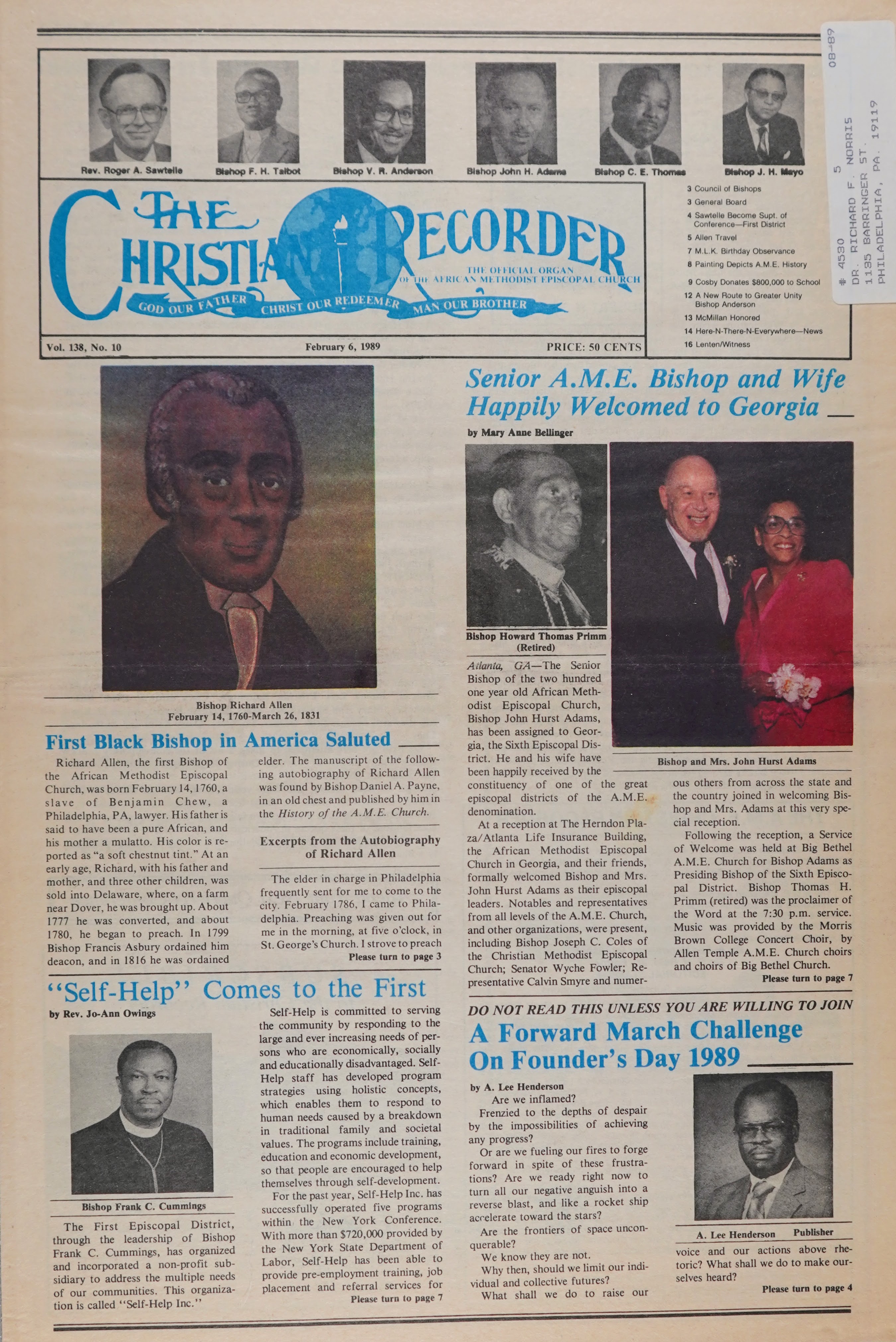
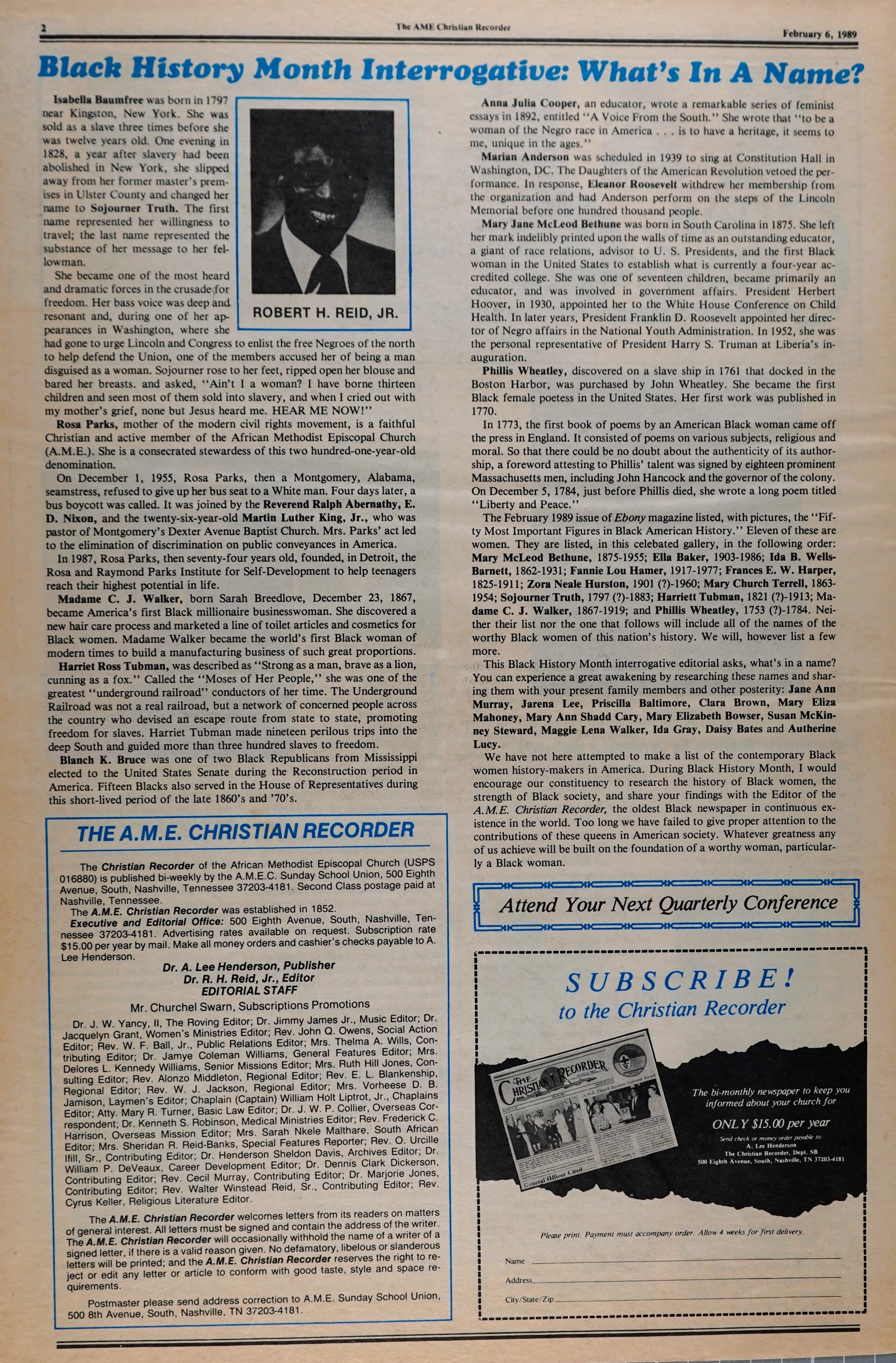
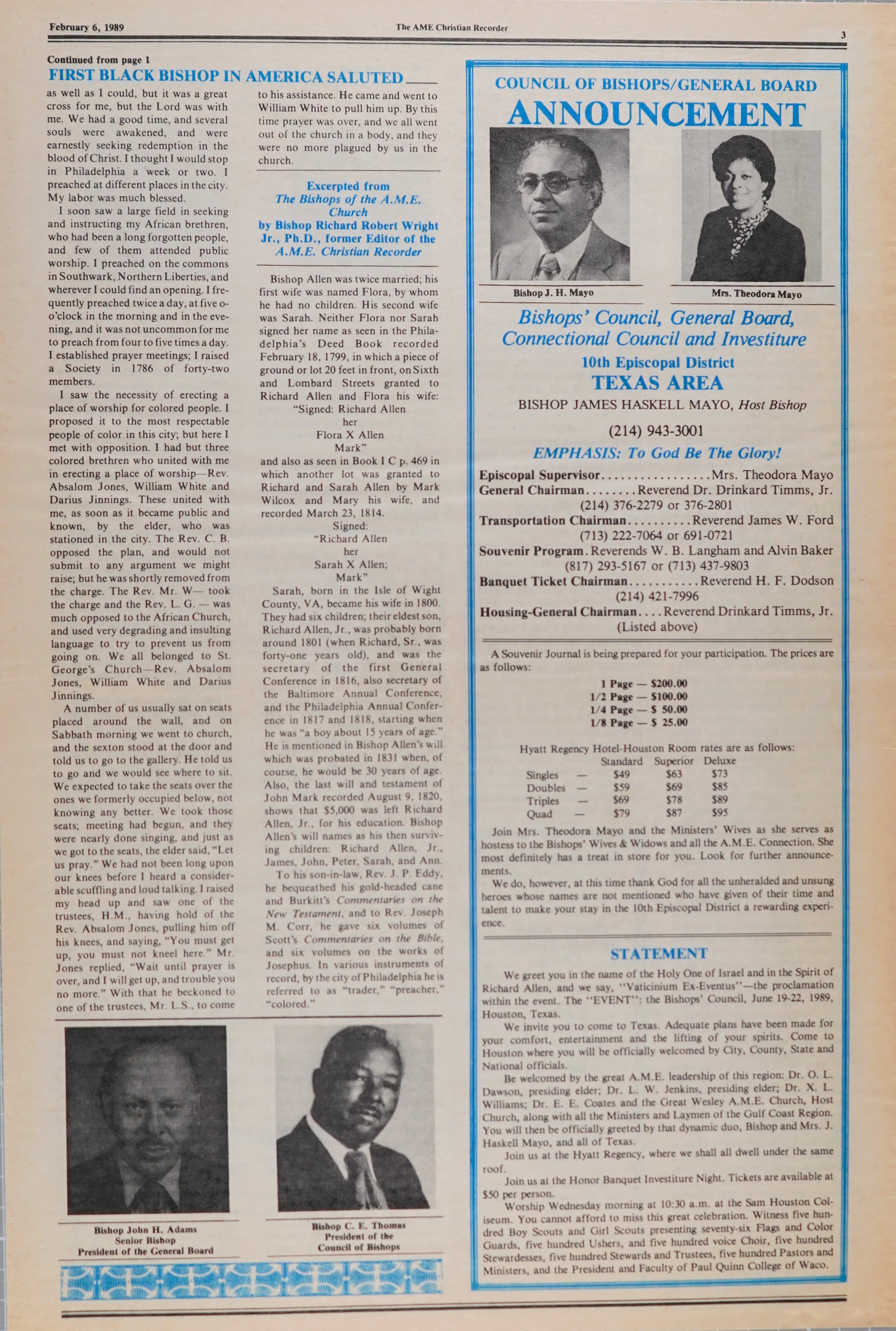
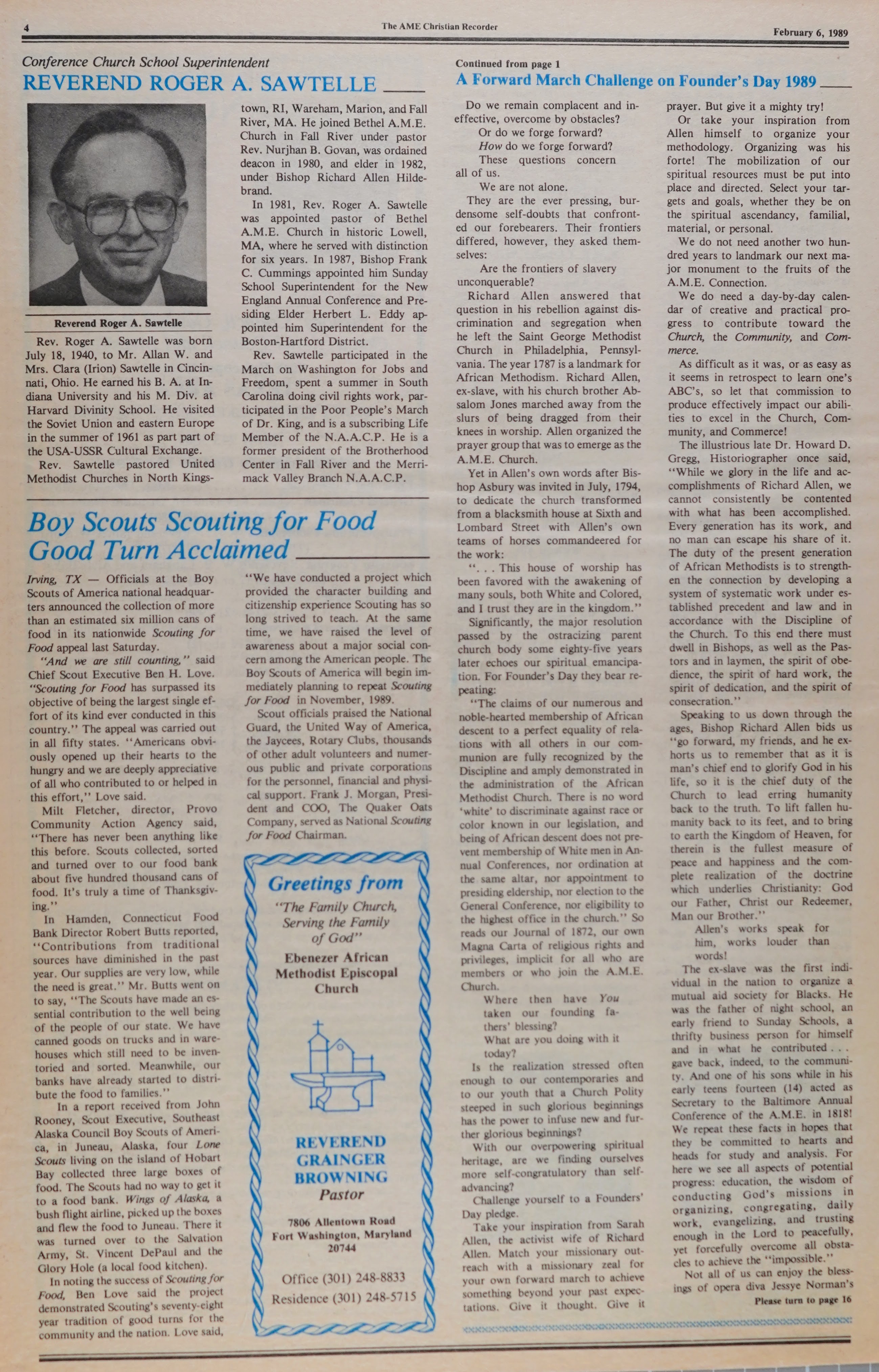
-
Title
-
February 6, 1989
-
Description
-
===== DSC05717.JPG =====
Vol. 138, No. 10
Bishop F. H. Talbot
February 6, 1989
Bishop V. R. Anderson
PRICE: 50 CENTS
Bishop John H. Adame Bishop C. E. Thomes Bishop J. H. Meyo
3 Council of Bishops
3 General Board
4 Sawtelle Become Supt. of
Conference—First District
5 Allen Travel
7 M.L.K. Birthday Observance
8 Painting Depicts A.M.E, History
9 Cosby Donates $800,000 to School
12 A New Route to Greater Unity
Bishop Anderson
13 McMillan Honored
14 Here-N-There-N-Everywhere—News
16 Lenten/Witness
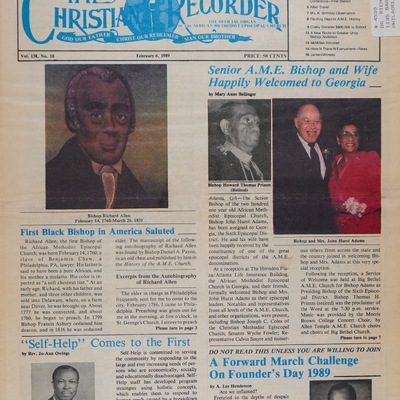
Bishop Richard Allen
February 14, 1760-March 26, 1831
Richard Allen, the first Bishop of
the African Methodist Episcopal
Church, was born February 14, 1760, a
slave of Benjamin Chew, a
Philadelphia, PA, lawyer. His father is
said to have been a pure African, and
his mother a mulatto. His color is re-
ported as “a soft chestnut tint.” At an
early age, Richard, with his father and
mother, and three other children, was
sold into Delaware, where, on a farm
near Dover, he was brought up. About
1777 he was converted, and about
1780, he began to preach. In 1799
Bishop Francis Asbury ordained him
deacon, and in 1816 he was ordained
elder. The manuscript of the follow-
ing autobiography of Richard Allen
was found by Bishop Daniel A. Payne,
in an old chest and published by him in
the History of the A.M.E. Church.
Excerpts from the Autobiography
of Richard Allen
The elder in charge in Philadelphia
frequently sent for me to come to the
city. February 1786, I came to Phila-
delphia. Preaching was given out for
me in the morning, at five o’clock, in
St. George’s Church. I strove to preach
Please turn to page 3
by Rev. Jo-Ann Owings
Bishop Frank C. Cummings
The First Episcopal District,
through the leadership of Bishop
Frank C. Cummings, has organized
and incorporated a non-profit sub-
sidiary to address the multiple needs
of our communities. This organiza-
tion is called ‘‘Self-Help Inc.””
Self-Help is committed to serving
the community by responding to the
large and ever increasing needs of per-
sons who are economically, socially
and educationally disadvantaged. Self-
Help staff has developed program
strategies using holistic concepts,
which enables them to respond to
human needs caused by a breakdown
in traditional family and_ societal
values. The programs include training,
education and economic development,
so that people are encouraged to help
themselves through self-development.
For the past year, Self-Help Inc. has
successfully operated five programs
within, the New York Conference.
With more than $720,000 provided by
the New York State Department of
Labor, Self-Help has been able to
provide pre-employment training, job
placement and referral services for
Please turn to page 7
Bishop Howard Thomas Primm
(Retired)
Ailania, GA—The Senior
Bishop of the two hundred
one year old African Meth-
odist Episcopal Church,
Bishop John Hurst Adams,
has been assigned to Geor-
gia, the Sixth Episcopal Dis-
trict. He and his wife have
Bishop and Mrs. John Hurst Adams
been happily received by the
constituency of one of the great
episcopal districts of the A.M.E. +
denomination. x
At a reception at The Herndon Pla-
za/Atlanta Life Insurance Building,
the African Methodist Episcopal
Church in Georgia, and their friends,
formally welcomed Bishop and Mrs.
John Hurst Adams as their episcopal
leaders. Notables and representatives
from all levels of the A.M.E. Church,
and other organizations, were present,
including Bishop Joseph C. Coles of
the Christian Methodist Episcopal
Church; Senator Wyche Fowler; Re-
presentative Calvin Smyre and numer-
ous others from across the state and
the country joined in welcoming Bis-
hop and Mrs. Adams at this very spe-
cial reception.
Following the reception, a Service
of Welcome was held at Big Bethel
A.M.E. Church for Bishop Adams as
Presiding Bishop of the Sixth Episco-
pal District. Bishop Thomas H.
Primm (retired) was the proclaimer of
the Word at the 7:30 p.m. service.
Music was provided by the Morris
Brown College Concert Choir, by
Allen Temple A.M.E. Church choirs
and choirs of Big Bethel Church.
Please turn to page 7
DO NOT READ THIS UNLESS YOU ARE WILLING TO JOIN
by A. Lee Henderson
Are we inflamed?
Frenzied to the depths of despair
by the impossibilities of achieving
any progress?
Or are we fueling our fires to forge
forward in spite of these frustra-
tions? Are we ready right now to
turn all our negative anguish into a
reverse blast, and like a rocket ship
accelerate toward the stars?
Are the frontiers of space uncon-
querable?
We know they are not.
Why then, should we limit our indi-
vidual and collective futures?
What shall we do to raise our
Publisher
A. Lee Henderson
voice and our actions above rhe-
toric? What shall we do to make our-
selves heard?
Please turn to page 4
SSS
===== DSC05718.JPG =====
2 The AME Christian Recorder .
February 6, 1989
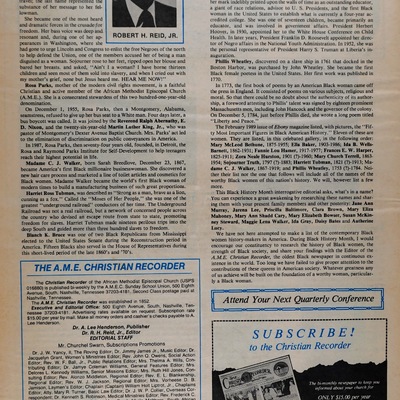
Black History Month Interrogative: What’s In A Name?
Isabella Baumfree was born in 1797
near Kingston, New York. She was
sold as a slave three times before she
was twelve years old. One evening in
1828, a year after slavery had been
abolished in New York, she slipped
away from her former master’s prem-
ises in Ulster County and changed her
name to Sojourner Truth, The first
name represented her willingness to
travel; the last name represented the
substance of her message to her fel-
lowman.
She became one of the most heard
and dramatic forces in the crusade:for
freedom. Her bass voice was deep and
resonant and, during one of her ap-
pearances in Washington, where she
had gone to urge Lincoln and Congress to enlist the free Negroes of the north
to help defend the Union, one of the members accused her of being a man
disguised as a woman. Sojourner rose to her feet, ripped open her blouse and
bared her breasts. and asked, ‘‘Ain’t 1 a woman? I have borne thirteen
children and seen most of them sold into slavery, and when I cried out with
my mother’s grief, none but Jesus heard me. HEAR ME NOW!”’
Rosa Parks, mother of the modern civil rights movement, is a faithful
Christian and active member of the African Methodist Episcopal Church
(A.M.E.). She is a consecrated stewardess of this two hundred-one-year-old
denomination.
On December 1, 1955, Rosa Parks, then a Montgomery, Alabama,
seamstress, refused to give up her bus seat to a White man. Four days later, a
bus boycott was called. It was joined by the Reverend Ralph Abernathy, E.
D. Nixon, and the twenty-six-year-old Martin Luther King, Jr., who was
pastor of Montgomery’s Dexter Avenue Baptist Church. Mrs. Parks’ act led
to the elimination of discrimination on public conveyances in America.
In 1987, Rosa Parks, then seventy-four years old, founded, in Detroit, the
Rosa and Raymond Parks Institute for Self-Development to help teenagers
reach their highest potential in life.
Madame C. J. Walker, born Sarah Breedlove, December 23, 1867,
became America’s first Black millionaire businesswoman. She discovered a
new hair care process and marketed a line of toilet articles and cosmetics for
Black women. Madame Walker became the world’s first Black woman of
modern times to build a manufacturing business of such great proportions.
Harriet Ross Tubman, was described as ‘‘Strong as a man, brave as a lion,
cunning as a fox.’’ Called the ‘“‘Moses of Her People,’’ she was one of the
greatest “‘underground railroad’’ conductors of her time. The Underground
Railroad was not a real railroad, but a network of concerned people across
the country who devised an escape route from state to state, promoting
freedom for slaves. Harriet Tubman made nineteen perilous trips into the
deep South and guided more than three hundred slaves to freedom.
Blanch K. Bruce was one of two Black Republicans from Mississippi
elected to the United States Senate during the Reconstruction period in
America. Fifteen Blacks also served in the House of Representatives during
this short-lived period of the late 1860’s and ’70’s.
THE A.M.E. CHRISTIAN RECORDER
ROBERT H. REID, JR.
Nashville, Tennessee. j
The A.M.E. Christian Recorder was established in 1852.
Lee Henderson.
Dr. A. Lee Henderson, Publisher
Dr. R. H. Reid, Jr., Editor
EDITORIAL STAFF
Mr. Churchel Swarn, Subscriptions Promotions
Cyrus Keller, Religious Literature Editor.
quirements.
500 8th Avenue, South, Nashville, TN 37203-4181.
The Christian Recorder of the African Methodist Episcopal Church (USPS
016880) is published bi-weekly by the A.M.E.C. Sunday School Union, 500 Eighth
Avenue, South, Nashville, Tennessee 37203-4181. Second Class postage paid at
Executive and Editorial Office: 500 Eighth Avenue, South, Nashville, Ten-
nessee 37203-4181. Advertising rates available on request. Subscription rate
$15.00 per year by mail. Make all money orders and cashier’s checks payable to A.
Dr. J. W. Yancy, Il, The Roving Editor; Dr. Jimmy James Jr., Music Editor; Dr.
Jacquelyn Grant, Women’s Ministries Editor; Rev. John Q. Owens, Social Action
Editor; Rev. W. F. Ball, Jr., Public Relations Editor; Mrs. Thelma A. Wills, Con-
tributing Editor; Dr. Jamye Coleman Williams, General Features Editor; Mrs.
Delores L. Kennedy Williams, Senior Missions Editor; Mrs. Ruth Hill Jones, Con-
sulting Editor; Rev. Alonzo Middleton, Regional Editor; Rev. E. L. Blankenship,
Regional Editor; Rev. W. J. Jackson, Regional Editor; Mrs. Vorheese D. B.
Jamison, Laymen’s Editor; Chaplain (Captain) William Holt Liptrot, Jr., Chaplains
Editor; Atty. Mary R. Turner, Basic Law Editor; Dr. J. W. Pe Collier, Overseas Cor-
respondent; Dr. Kenneth S. Robinson, Medical Ministries Editor; Rev. Frederick Cc.
Harrison, Overseas Mission Editor; Mrs. Sarah Nkele Malthare, South African
Editor; Mrs. Sheridan R. Reid-Banks, Special Features Reporter; Rev. O. Urcille
Ifill, Sr., Contributing Editor; Dr. Henderson Sheldon Davis, Archives Editor; Dr.
William P. DeVeaux, Career Development Editor; Dr. Dennis Clark Dickerson,
Contributing Editor; Rev. Cecil Murray, Contributing Editor; Dr. Marjorie Jones,
Contributing Editor; Rev. Walter Winstead Reid, Sr., Contributing Editor; Rev.
The A.M.E. Christian Recorder welcomes letters from its readers on matters
of general interest. All letters must be signed and contain the address of the writer.
The A.M.E. Christian Recorder will occasionally withhold the name of awriter of a
signed letter, if there is a valid reason given. No defamatory, libelous or slanderous
letters will be printed; and the A.M.E. Christian Recorder reserves the right to re-
ject or edit any letter or article to conform with good taste, style and space re-
Postmaster please send address correction to A.M.E. Sunday Schoo! Union,
Anna Julia Cooper, an educator, wrote a remarkable series of feminist
essays in 1892, entitled ‘‘A Voice From the South,’’ She wrote that ‘‘to be a
woman of the Negro race in America . . . is to have a heritage, it seems to
me, unique in the ages.”’
Marian Anderson was scheduled in 1939 to sing at Constitution Hall in
Washington, DC, The Daughters of the American Revolution vetoed the per-
formance, In response, Eleanor Roosevelt withdrew her membership from
the organization and had Anderson perform on the steps of the Lincoln
Memorial before one hundred thousand people.
Mary Jane McLeod Bethune was born in South Carolina in 1875, She left
her mark indelibly printed upon the walls of time as an outstanding educator,
a giant of race relations, advisor to U. S. Presidents, and the first Black
woman in the United States to establish what is currently a four-year ac-
credited college. She was one of seventeen children, became primarily an
educator, and was involved in government affairs. President Herbert
Hoover, in 1930, appointed her to the White House Conference on Child
Health, In later years, President Franklin D, Roosevelt appointed her direc-
tor of Negro affairs in the National Youth Administration. In 1952, she was
the personal representative of President Harry S. Truman at Liberia’s in-
auguration.
Phillis Wheatley, discovered on a slave ship in 1761 that docked in the
Boston Harbor, was purchased by John Wheatley. She became the first
Black female poetess in the United States. Her first work was published in
1770.
In 1773, the first book of poems by an American Black woman came off
the press in England. It consisted of poems on various subjects, religious and
moral. So that there could be no doubt about the authenticity of its author-
ship, a foreword attesting to Phillis’ talent was signed by eighteen prominent
Massachusetts men, including John Hancock and the governor of the colony.
On December 5, 1784, just before Phillis died, she wrote a long poem titled
“Liberty and Peace.’’
The February 1989 issue of Ebony magazine listed, with pictures, the ‘‘Fif-
ty Most Important Figures in Black American History.’’ Eleven of these are
women. They are listed, in this celebated gallery, in the following order:
Mary McLeod Bethune, 1875-1955; Ella Baker, 1903-1986; Ida B. Wells-
Barnett, 1862-1931; Fannie Lou Hamer, 1917-1977; Frances E. W. Harper,
1825-1911; Zora Neale Hurston, 1901 (?)-1960; Mary Church Terrell, 1863-
1954; Sojourner Truth, 1797 (?)-1883; Harriett Tubman, 1821 (?)-1913; Ma-
dame C. J. Walker, 1867-1919; and Phillis Wheatley, 1753 (?)-1784. Nei-
ther their list nor the one that follows will include all of the names of the
worthy Black women of this nation’s history. We will, however list a few
more.
., This Black History Month interrogative editorial asks, what’s in a name?
You can experience a great awakening by researching these names and shar-
ing them with your present family members and other posterity: Jane Ann
Murray, Jarena Lee, Priscilla Baltimore, Clara Brown, Mary Eliza
Mahoney, Mary Ann Shadd Cary, Mary Elizabeth Bowser, Susan McKin-
ney Steward, Maggie Lena Walker, Ida Gray, Daisy Bates and Autherine
Lucy.
We have not here attempted to make a list of the contemporary Black
women history-makers in America. During Black History Month, I would
encourage our constituency to research the history of Black women, the
strength of Black society, and share your findings with the Editor of the
A.M.E. Christian Recorder, the oldest Black newspaper in continuous ex-
istence in the world. Too long we have failed to give proper attention to the
contributions of these queens in American society. Whatever greatness any
of us achieve will be built on the foundation of a worthy woman, particular-
ly a Black woman.
SSS FT —————eESS EES EE
SUBSCRIBE!
to the Christian Recorder
The bi-monthly newspaper to keep you
informed about your church for
ONLY $15.00 per year
Send check or money order payable to.
A. Lee Henderson
The Christian Recorder, Dept. SB
500 Eighth Avenue, South, Nashville, TN 37203-4181
Please print. Payment must accompany order. Allow 4 weeks for first delivery.
Name
Address__
City/State/Zip
maaan nas asa senasen=
Ty ttend Your Next Quarterly Conference |
===== DSC05719.JPG =====
j
4
February 6, 1989
The AME Christian Recorder
Continued from page 1
FIRST BLACK BISHOP IN AMERICA SALUTED
as well as I could, but it was a great
cross for me, but the Lord was with
me. We had a good time, and several
souls were awakened, and were
earnestly seeking redemption in the
blood of Christ. I thought I would stop
in Philadelphia a week or two. I
preached at different places in the city.
My labor was much blessed.
I soon saw a large field in seeking
and instructing my African brethren,
who had been a long forgotten people,
and few of them attended public
worship. I preached on the commons
in Southwark, Northern Liberties, and
wherever I could find an opening. I fre-
quently preached twice a day, at five o-
o’clock in the morning and in the eve-
ning, and it was not uncommon for me
to preach from four to five times a day.
I established prayer meetings; I raised
a Society in 1786 of forty-two
members.
I saw the necessity of erecting a
place of worship for colored people. I
proposed it to the most respectable
people of color in this city; but here I
met with opposition. I had but three
colored brethren who united with me
in erecting a place of worship—Rev.
Absalom Jones, William White and
Darius Jinnings. These united with
me, as soon as it became public and
known, by the elder, who was
stationed in the city. The Rev. C. B.
opposed the plan, and would not
submit to any argument we might
raise; but he was shortly removed from
the charge. The Rev. Mr. W— took
the charge and the Rev. L. G. — was
much opposed to the African Church,
and used very degrading and insulting
language to try to prevent us from
going on. We all belonged to St.
George’s Church—Rey. Absalom
Jones, William White and Darius
Jinnings.
A number of us usually sat on seats
placed around the wall, and on
Sabbath morning we went to church,
and the sexton stood at the door and
told us to go to the gallery. He told us
to go and we would see where to sit.
We expected to take the seats over the
ones we formerly occupied below, not
knowing any better. We took those
seats; meeting had begun, and they
were nearly done singing, and just as
we got to the seats, the elder said, “Let
us pray.” We had not been long upon
our knees before I heard a consider-
able scuffling and loud talking. | raised
my head up and saw one of the
trustees, H.M., having hold of the
Rev. Absalom Jones, pulling him off
his knees, and saying, “You must get
up, you must not kneel here.” Mr
Jones replied, “Wait until prayer is
over, and I will get up, and trouble you
no more.” With that he beckoned to
one of the trustees, Mr. L.S., to come
to his assistance. He came and went to
William White to pull him up. By this
time prayer was over, and we all went
out of the church in a body, and they
were no more plagued by us in the
church.
Excerpted from
The Bishops of the A.M.E.
Church
by Bishop Richard Robert Wright
Jr., Ph.D., former Editor of the
A.M.E. Christian Recorder
Bishop Allen was twice married; his
first wife was named Flora, by whom
he had no children. His second wife
was Sarah. Neither Flora nor Sarah
signed her name as seen in the Phila-
delphia’s Deed Book recorded
February 18, 1799, in which a piece of
ground or lot 20 feet in front, on Sixth
and Lombard Streets granted to
Richard Allen and Flora his wife:
“Signed: Richard Allen
her
Flora X Allen
Mark”
and also as seen in Book I C p. 469 in
which another lot was granted to
Richard and Sarah Allen by Mark
Wilcox and Mary his wife, and
recorded March 23, 1814.
Signed:
“Richard Allen
her
Sarah X Allen;
Mark”
Sarah, born in the Isle of Wight
County, VA, became his wife in 1800.
They had six children; their eldest son,
Richard Allen, Jr., was probably born
around 1801 (when Richard, Sr., was
forty-one years old), and was the
secretary of the first General
Conference in 1816, also secretary of
the Baltimore Annual! Conference,
and the Philadelphia Annual Confer-
ence in 1817 and 1818, starting when
he was “a boy about 15 years of age.”
He is mentioned in Bishop Allen’s will
which was probated in 1831 when, of
course, he would be 30 years of age
Also, the last will and testament of
John Mark recorded August 9, 1820,
shows that $5,000 was left Richard
Allen, Jr., for his education. Bishop
Allen’s will names as his then surviv-
ing children: Richard Allen, Jr.,
James, John, Peter, Sarah, and Ann
To his son-in-law, Rev. J. P. Eddy,
he bequeathed his gold-headed cane
and Burkitt’s Commentaries on the
New Testament, and to Rev. Joseph
M. Corr, he gave six volumes of
Scott’s Commentaries on the Bible,
and six volumes on the works of
Josephus. In various instruments of
record, by the city of Philadelphia he is
referred to as “trader,” “preacher,”
“colored.”
ae
’
i
1
i]
1
:
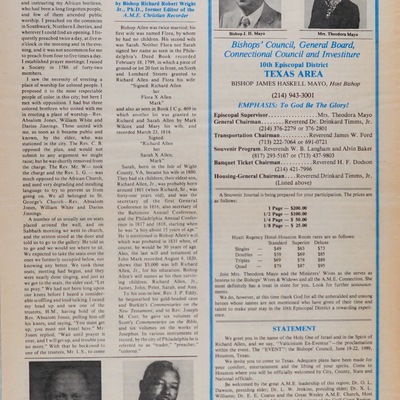
Bishop John H, Adams
Senior Bishop
President of the General Board —
el ig TD
Bishop C. E. Thomas
President of the
Counell of Bishops —
Seb She ae
COUNCIL OF BISHOPS/GENERAL BOARD
ANNOUNCEMENT
Bishop J. H. Mayo
Mrs. Theodora Mayo
Bishops’ Council, General Board,
Connectional Council and Investiture
10th Episcopal District
TEXAS AREA
BISHOP JAMES HASKELL MAYO, Host Bishop
(214) 943-3001
EMPHASIS: To God Be The Glory!
| Episcopal Supervisor................. Mrs. Theodora Mayo
General Chairman........Reverend Dr. Drinkard Timms, Jr.
(214) 376-2279 or 376-2801
| Transportation Chairman.......... Reverend James W. Ford
(713) 222-7064 or 691-0721
Souvenir Program. Reverends W. B. Langham and Alvin Baker
(817) 293-5167 or (713) 437-9803
Banquet Ticket Chairman......... . .Reverend H. F. Dodson
(214) 421-7996
Housing-General Chairman. . . . Reverend Drinkard Timms, Jr.
(Listed above)
A Souvenir Journal is being prepared for your participation. The prices are
as follows:
1 Page — $200.00
1/2 Page — $100.00
1/4 Page — $ 50.00
1/8 Page — $ 25.00
Hyatt Regency Hotel-Houston Room rates are as follows:
Standard Superior Deluxe
Singles — $49 $63 $73
Doubles — $59 $69 $85
Triples — $69 $78 $89
Quad = $79 $87 $95
Join Mrs. Theodora Mayo and the Ministers’ Wives as she serves as
hostess to the Bishops’ Wives & Widows and all the A.M.E. Connection, She
most definitely has a treat in store for you. Look for further announce-
ments,
We do, however, at this time thank God for all the unheralded and unsung
heroes whose names are not mentioned who have given of their time and
talent to make your stay in the 10th Episcopal District a rewarding experi-
STATEMENT
We greet you in the name of the Holy One of Israel and in the Spirit of
Richard Allen, and we say, ‘‘Vaticinium Ex-Eventus’’—the proclamation
within the event. The ‘‘EVENT”’: the Bishops’ Council, June 19-22, 1989,
Houston, Texas.
We invite you to come to Texas. Adequate plans have been made for
your comfort, entertainment and the lifting of your spirits. Come to
Houston where you will be officially welcomed by City, County, State and
Nationa! officials.
Be welcomed by the great A.M.E. leadership of this region: Dr, O. L.
Dawson, presiding elder; Dr. L, W. Jenkins, presiding elder; Dr. X, L.
Williams; Dr. E. E. Coates and the Great Wesley A.M.E. Church, Host
Church, along with all the Ministers and Laymen of the Gulf Coast Region.
You will then be officially greeted by that dynamic duo, Bishop and Mrs. J.
Haskell Mayo, and all of Texas.
Join us at the Hyatt Regency, where we shall all dwell under the same
roof,
Join us at the Honor Banquet Investiture Night. Tickets are available at
$50 per person,
Worship Wednesday morning at 10:30 a.m. at the Sam Houston Col-
iseum. You cannot afford to miss this great celebration, Witness five hun-
dred Boy Scouts and Girl Scouts presenting seventy-six Flags and Color
| Guards, five hundred Ushers, and five hundred voice Choir, five hundred
Stewardesses, five hundred Stewards and Trustees, five hundred Pastors and
Ministers, and the President and Faculty of Paul Quinn College of Waco.
===== DSC05720.JPG =====
4
The AME Christian Recorder
ssn TY 6) 1989
Conference Church School Superintendent
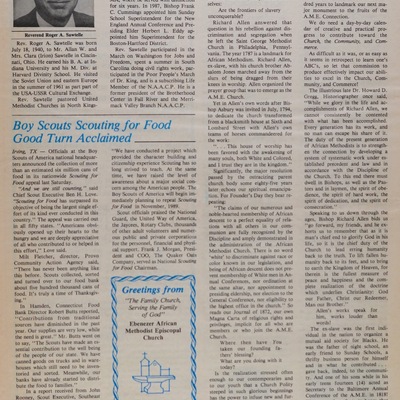
REVEREND ROGER A. SAWTELLE ___
Reverend Roger A. Sawtelle
Rev. Roger A. Sawtelle was born
July 18, 1940, to Mr. Allan W. and
Mrs. Clara (Irion) Sawtelle in Cincin-
nati, Ohio. He earned his B. A. at In-
diana University and his M. Div. at
Harvard Divinity School. He visited
the Soviet Union and eastern Europe
in the summer of 1961 as part part of
the USA-USSR Cultural Exchange.
Rev. Sawtelle pastored United
Methodist Churches in North Kings-
town, RI, Wareham, Marion, and Fall
River, MA. He joined Bethel A.M.E.
Church in Fall River under pastor
Rey. Nurjhan B. Govan, was ordained
deacon in 1980, and elder in 1982,
under Bishop Richard Allen Hilde-
brand.
In 1981, Rev. Roger A. Sawtelle
was appointed pastor of Bethel
A.M.E. Church in historic Lowell,
MA, where he served with distinction
for six years. In 1987, Bishop Frank
C. Cummings appointed him Sunday
School Superintendent for the New
England Annual Conference and Pre-
siding Elder Herbert L. Eddy ap-
pointed him Superintendent for the
Boston-Hartford District.
Rev. Sawtelle participated in the
March on Washington for Jobs and
Freedom, spent a summer in South
Carolina doing civil rights work, par-
ticipated in the Poor People’s March
of Dr. King, and is a subscribing Life
Member of the N.A.A.C.P. He is a
former president of the Brotherhood
Center in Fall River and the Merri-
mack Valley Branch N.A.A.C.P.
Boy Scouts Scouting for Food
Good Turn Acclaimed
Irving, TX — Officials at the Boy
Scouts of America national headquar-
ters announced the collection of more
than an estimated six million cans of
food in its nationwide Scouting for
Food appeal last Saturday.
“And we are still counting,’’ said
Chief Scout Executive Ben H. Love.
“Scouting for Food has surpassed its
objective of being the largest single ef-
fort of its kind ever conducted in this
country.’’ The appeal was carried out
in all fifty states. ‘‘Americans obvi-
ously opened up their hearts to the
hungry and we are deeply appreciative
of all who contributed to or helped in
this effort,’’ Love said.
Milt Fletcher, director, Provo
Community Action Agency said,
“There has never been anything like
this before. Scouts collected, sorted
and turned over to our food bank
about five hundred thousand cans of
food. It’s truly a time of Thanksgiv-
In Hamden, Connecticut Food
Bank Director Robert Butts reported,
“Contributions from traditional
sources have diminished in the past
year. Our supplies are very low, while
the need is great.’’ Mr, Butts went on
to say, ‘*The Scouts have made an es-
sential contribution to the well being
of the people of our state. We have
canned goods on trucks and in ware-
houses which still need to be inven-
toried and sorted. Meanwhile, our
banks have already started to distri-
bute the food to families.’’
In a report received from John
Rooney, Scout Executive, Southeast
Alaska Council Boy Scouts of Ameri-
ca, in Juneau, Alaska, four Lone
Scouts living on the island of Hobart
Bay collected three large boxes of
food. The Scouts had no way to get it
to a food bank. Wings of Alaska, a
bush flight airline, picked up the boxes
and flew the food to Juneau. There it
was turned over to the Salvation
Army, St. Vincent DePaul and the
Glory Hole (a local food kitchen).
In noting the success of Scouting for
Food, Ben Love said the project
demonstrated Scouting’s seventy-eight
year tradition of good turns for the
community and the nation. Love said,
“‘We have conducted a project which
provided the character building and
citizenship experience Scouting has so
long strived to teach. At the same
time, we have raised the level of
awareness about a major social con-
cern among the American people. The
Boy Scouts of America will begin im-
mediately planning to repeat Scouting
for Food in November, 1989.
Scout officials praised the National
Guard, the United Way of America,
the Jaycees, Rotary Clubs, thousands
of other adult volunteers and numer-
ous public and private corporations
for the personnel, financial and physi-
cal support. Frank J. Morgan, Presi-
dent and COO, The Quaker Oats
Company, served as National Scouting
for Food Chairman.
“The Family Church,
Serving the Family
of God”
Ebenezer African
Methodist Episcopal
REVEREND
GRAINGER
BROWNING
Pastor
7806 Allentown Road
Fort Washington, Maryland
20744
Office (301) 248-8833
Residence (301) 248-5715
Continued from page 1
A Forward March Challenge on Founder’s Day 1989 ___
Do we remain complacent and in-
effective, overcome by obstacles?
Or do we forge forward?
How do we forge forward?
These questions concern
all of us.
We are not alone.
They are the ever pressing, bur-
densome self-doubts that confront-
ed our forebearers. Their frontiers
differed, however, they asked them-
selves:
Are the frontiers of slavery
unconquerable?
Richard Allen answered that
question in his rebellion against dis-
crimination and segregation when
he left the Saint George Methodist
Church in Philadelphia, Pennsyl-
vania. The year 1787 is a landmark for
African Methodism. Richard Allen,
ex-slave, with his church brother Ab-
salom Jones marched away from the
slurs of being dragged from their
knees in worship. Allen organized the
prayer group that was to emerge as the
A.M.E. Church.
Yet in Allen’s own words after Bis-
hop Asbury was invited in July, 1794,
to dedicate the church transformed
from a blacksmith house at Sixth and
Lombard Street with Allen’s own
teams of horses commandeered for
the work:
‘|. . This house of worship has
been favored with the awakening of
many souls, both White and Colored,
and I trust they are in the kingdom.””
Significantly, the major resolution
passed by the ostracizing parent
church body some eighty-five years
later echoes our spiritual emancipa-
tion. For Founder’s Day they bear re-
peating:
“The claims of our numerous and
noble-hearted membership of African
descent to a perfect equality of rela-
tions with all others in our com-
munion are fully recognized by the
Discipline and amply demonstrated in
the administration of the African
Methodist Church, There is no word
‘white’ to discriminate against race or
color known in our legislation, and
being of African descent does not pre-
vent membership of White men in An-
nual Conferences, nor ordination at
the same altar, nor appointment to
presiding eldership, nor election to the
General Conference, nor eligibility to
the highest office in the church,’’ So
reads our Journal of 1872, our own
Magna Carta of religious rights and
privileges, implicit for all who are
members or who join the A.M.E.
Church.
Where then have You
taken our founding fa-
thers’ blessing?
What are you doing with it
today?
Is the realization stressed often
enough to our contemporaries and
to our youth that a Church Polity
steeped in such glorious beginnings
has the power to infuse new and fur-
ther glorious beginnings?
With our overpowering spiritual
heritage, are we finding ourselves
more self-congratulatory than self-
advancing?
Challenge yourself to a Founders’
Day pledge.
Take your inspiration from Sarah
Allen, the activist wife of Richard
Allen. Match your missionary out-
reach with a missionary zeal for
your own forward march to achieve
something beyond your past expec-
tations. Give it thought. Give it
MeN MRNENLM NS RNRRN
prayer. But give it a mighty try!
Or take your inspiration from
Allen himself to organize your
methodology. Organizing was his
forte! The mobilization of our
spiritual resources must be put into
place and directed. Select your tar-
gets and goals, whether they be on
the spiritual ascendancy, familial,
material, or personal.
We do not need another two hun-
dred years to landmark our next ma-
jor monument to the fruits of the
A.M.E. Connection.
We do need a day-by-day calen-
dar of creative and practical pro-
gress to contribute toward the
Church, the Community, and Com-
merce.
As difficult as it was, or as easy as
it seems in retrospect to learn one’s
ABC’s, so let that commission to
produce effectively impact our abili-
ties to excel in the Church, Com-
munity, and Commerce!
The illustrious late Dr. Howard D.
Gregg, Historiographer once said,
“While we glory in the life and ac-
complishments of Richard Allen, we
cannot consistently be contented
with what has been accomplished.
Every generation has its work, and
no man can escape his share of it.
The duty of the present generation
of African Methodists is to strength-
en the connection by developing a
system of systematic work under es-
tablished precedent and law and in
accordance with the Discipline of
the Church. To this end there must
dwell in Bishops, as well as the Pas-
tors and in laymen, the spirit of obe-
dience, the spirit of hard work, the
spirit of dedication, and the spirit of
consecration.’”
Speaking to us down through the
ages, Bishop Richard Allen bids us
“*go forward, my friends, and he ex-
horts us to remember that as it is
man’s chief end to glorify God in his
life, so it is the chief duty of the
Church to lead erring humanity
back to the truth. To lift fallen hu-
manity back to its feet, and to bring
to earth the Kingdom of Heaven, for
therein is the fullest measure of
peace and happiness and the com-
plete realization of the doctrine
which underlies Christianity: God
our Father, Christ our Redeemer,
Man our Brother.”
Allen's works speak for
him, works louder than
words!
The ex-slave was the first indi-
vidual in the nation to organize a
mutual aid society for Blacks. He
was the father of night school, an
early friend to Sunday Schools, a
thrifty business person for himself
and in what he contributed...
gave back, indeed, to the communi-
ty. And one of his sons while in his
early teens fourteen (14) acted as
Secretary to the Baltimore Annual
Conference of the A.M.E, in 1818!
We repeat these facts in hopes that
they be committed to hearts and
heads for study and analysis, For
here we see all aspects of potential
progress: education, the wisdom of
conducting God's missions in
organizing, congregating, daily
work, evangelizing, and trusting
enough in the Lord to peacefully,
yet forcefully overcome all obsta-
cles to achieve the ‘timpossible.””
Not all of us can enjoy the bless-
ings of opera diva Jessye Norman's
Please turn to page 16
* SRRXNAENANARRANNARANARAAARNAAA Ae eas
0
===== DSC05721.JPG =====
February 6, 1989
The AME Christian Recorder
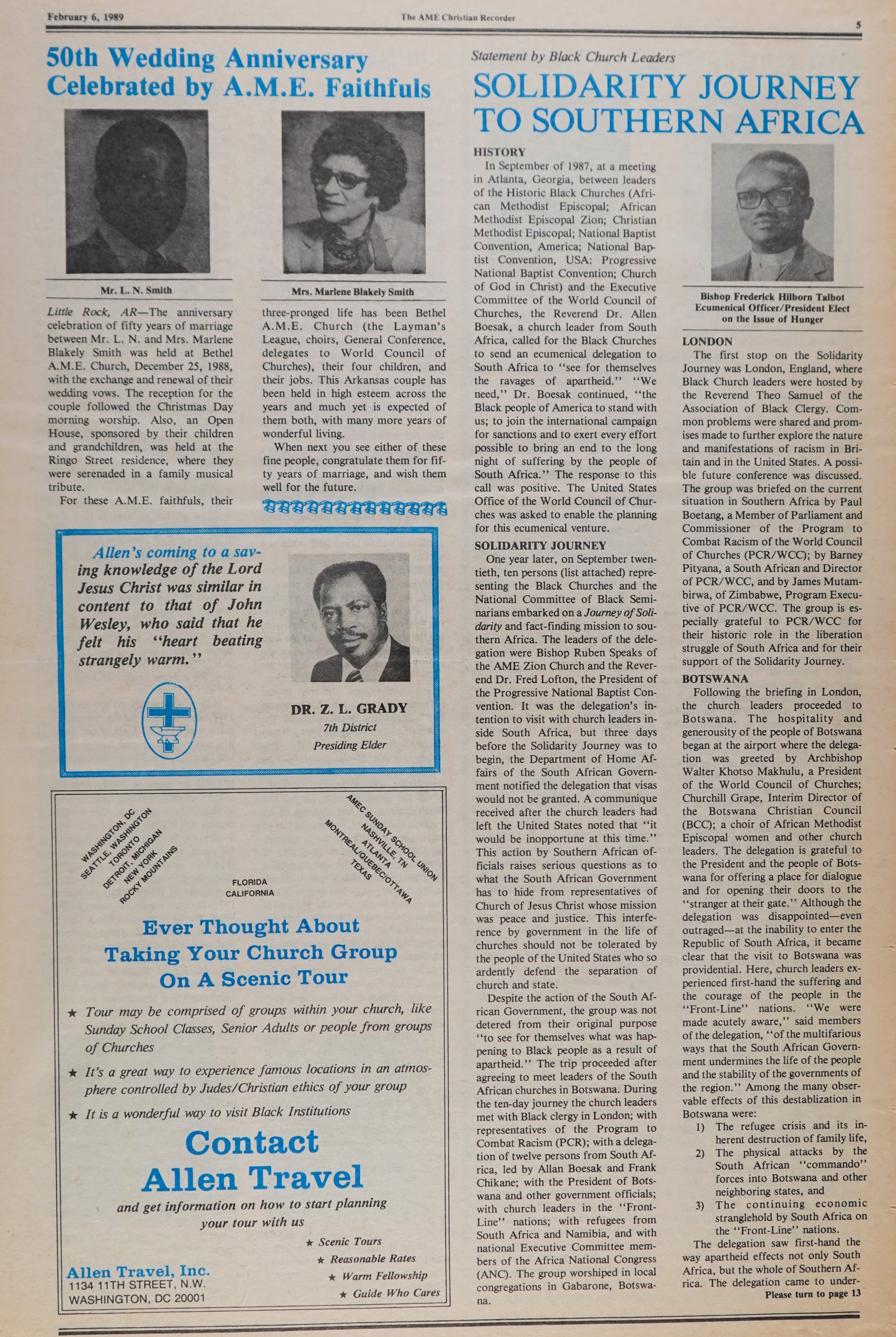
50th Wedding Anniversary
Celebrated by A.M.E. Faithfuls
Mr. L. N. Smith
Mrs. Marlene Blakely Smith
Little Rock, AR—The anniversary
celebration of fifty years of marriage
between Mr. L. N. and Mrs. Marlene
Blakely Smith was held at Bethel
A.M.E. Church, December 25, 1988,
with the exchange and renewal of their
wedding vows. The reception for the
couple followed the Christmas Day
morning worship. Also, an Open
House, sponsored by their children
and grandchildren, was held at the
Ringo Street residence, where they
were serenaded in a family musical
tribute.
For these A.M.E. faithfuls, their
three-pronged life has been Bethel
A.M.E. Church (the Layman’s
League, choirs, General Conference,
delegates to World Council of
Churches), their four children, and
their jobs. This Arkansas couple has
been held in high esteem across the
years and much yet is expected of
them both, with many more years of
wonderful living.
When next you see either of these
fine people, congratulate them for fif-
ty years of marriage, and wish them
well for the future.
te
@
‘eo
an
le
iy
Allen’s coming to a sav-
ing knowledge of the Lord
Jesus Christ was similar in
content to that of John
Wesley, who said that he
felt his ‘“‘heart beating
strangely warm.’”’
DR. Z. L. GRADY
7th District
Presiding Elder
FLORIDA
CALIFORNIA
Ever Thought About
Taking Your Church Group
On A Scenic Tour
* Tour may be comprised of groups within your church, like
Sunday School Classes, Senior Adults or people from groups
of Churches
* It’s a great way to experience famous locations in an atmos-
phere controlled by Judes/Christian ethics of your group
* It is a wonderful way to visit Black Institutions
Contact
Allen Travel
and get information on how to start planning
your tour with us
% Scenic Tours
+ Reasonable Rates
* Warm Fellowship
* Guide Who Cares |
Allen Travel, Inc.
1134 11TH STREET, N.W.
WASHINGTON, DC 20001
Statement by Black Church Leaders
SOLIDARITY JOURNEY
TO SOUTHERN AFRICA
HISTORY
In September of 1987, at a meeting
in Atlanta, Georgia, between leaders
of the Historic Black Churches (Afri-
can Methodist Episcopal; African
Methodist Episcopal Zion; Christian
Methodist Episcopal; National Baptist
Convention, America; National Bap-
tist Convention, USA: Progressive
National Baptist Convention; Church
of God in Christ) and the Executive
Committee of the World Council of
Churches, the Reverend Dr. Allen
Boesak, a church leader from South
Africa, called for the Black Churches
to send an ecumenical delegation to
South Africa to ‘‘see for themselves
the ravages of apartheid.’’ ‘We
need,’’ Dr. Boesak continued, ‘‘the
Black people of America to stand with
us; to join the international campaign
for sanctions and to exert every effort
possible to bring an end to the long
night of suffering by the people of
South Africa.’’ The response to this
call was positive. The United States
Office of the World Council of Chur-
ches was asked to enable the planning
for this ecumenical venture.
SOLIDARITY JOURNEY
One year later, on September twen-
tieth, ten persons (list attached) repre-
senting the Black Churches and the
National Committee of Black Semi-
narians embarked on a Journey of Soli-
darity and fact-finding mission to sou-
thern Africa. The leaders of the dele-
gation were Bishop Ruben Speaks of
the AME Zion Church and the Rever-
end Dr. Fred Lofton, the President of
the Progressive National Baptist Con-
vention. It was the delegation’s in-
tention to visit with church leaders in-
side South Africa, but three days
before the Solidarity Journey was to
begin, the Department of Home Af-
fairs of the South African Govern-
ment notified the delegation that visas
would not be granted. A communique
received after the church leaders had
left the United States noted that ‘‘it
would be inopportune at this time.”’
This action by Southern African of-
ficials raises serious questions as to
what the South African Government
has to hide from representatives of
Church of Jesus Christ whose mission
was peace and justice. This interfe-
rence by government in the life of
churches should not be tolerated by
the people of the United States who so
ardently defend the separation of
church and state.
Despite the action of the South Af-
rican Government, the group was not
detered from their original purpose
“to see for themselves what was hap-
pening to Black people as a result of
apartheid.’’ The trip proceeded after
agreeing to meet leaders of the South
African churches in Botswana. During
the ten-day journey the church leaders
met with Black clergy in London; with
representatives of the Program to
Combat Racism (PCR); with a delega-
tion of twelve persons from South Af-
rica, led by Allan Boesak and Frank
Chikane; with the President of Bots-
wana and other government officials;
with church leaders in the ‘‘Front-
Line’ nations; with refugees from
South Africa and Namibia, and with
national Executive Committee mem-
bers of the Africa National Congress
(ANC). The group worshiped in local
congregations in Gabarone, Botswa-
na.
Bishop Frederick Hilborn Talbot
Ecumenical Officer/President Elect
on the Issue of Hunger
LONDON
The first stop on the Solidarity
Journey was London, England, where
Black Church leaders were hosted by
the Reverend Theo Samuel of the
Association of Black Clergy. Com-
mon problems were shared and prom-
ises made to further explore the nature
and manifestations of racism in Bri-
tain and in the United States. A possi-
ble future conference was discussed.
The group was briefed on the current
situation in Southern Africa by Paul
Boetang, a Member of Parliament and
Commissioner of the Program to
Combat Racism of the World Council
of Churches (PCR/WCC); by Barney
Pityana, a South African and Director
of PCR/WCC, and by James Mutam-
birwa, of Zimbabwe, Program Execu-
tive of PCR/WCC. The group is es-
pecially grateful to PCR/WCC for
their historic role in the liberation
struggle of South Africa and for their
support of the Solidarity Journey.
BOTSWANA
Following the briefing in London,
the church leaders proceeded to
Botswana. The hospitality and
generousity of the people of Botswana
began at the airport where the delega-
tion was greeted by Archbishop
Walter Khotso Makhulu, a President
of the World Council of Churches;
Churchill Grape, Interim Director of
the Botswana Christian Council
(BCQ); a choir of African Methodist
Episcopal women and other church
leaders. The delegation is grateful to
the President and the people of Bots-
wana for offering a place for dialogue
and for opening their doors to the
“stranger at their gate.’’ Although the
delegation was disappointed—even
outraged—at the inability to enter the
Republic of South Africa, it became
clear that the visit to Botswana was
providential. Here, church leaders ex-
perienced first-hand the suffering and
the courage of the people in the
“‘Front-Line’’ nations. ‘‘We were
made acutely aware,’’ said members
of the delegation, ‘‘of the multifarious
ways that the South African Govern-
ment undermines the life of the people
and the stability of the governments of
the region.’’ Among the many obser-
vable effects of this destablization in
Botswana were:
1) The refugee crisis and its in-
herent destruction of family life,
2) The physical attacks by the
South African ‘‘commando’’
forces into Botswana and other
neighboring states, and
3) The continuing economic
stranglehold by South Africa on
the ‘‘Front-Line’’ nations.
The delegation saw first-hand the
way apartheid effects not only South
Africa, but the whole of Southern Af-
rica. The delegation came to under-_
Please turn to page 13
pee
===== DSC05722.JPG =====
The AME Christian Recorder
February 6, 1989
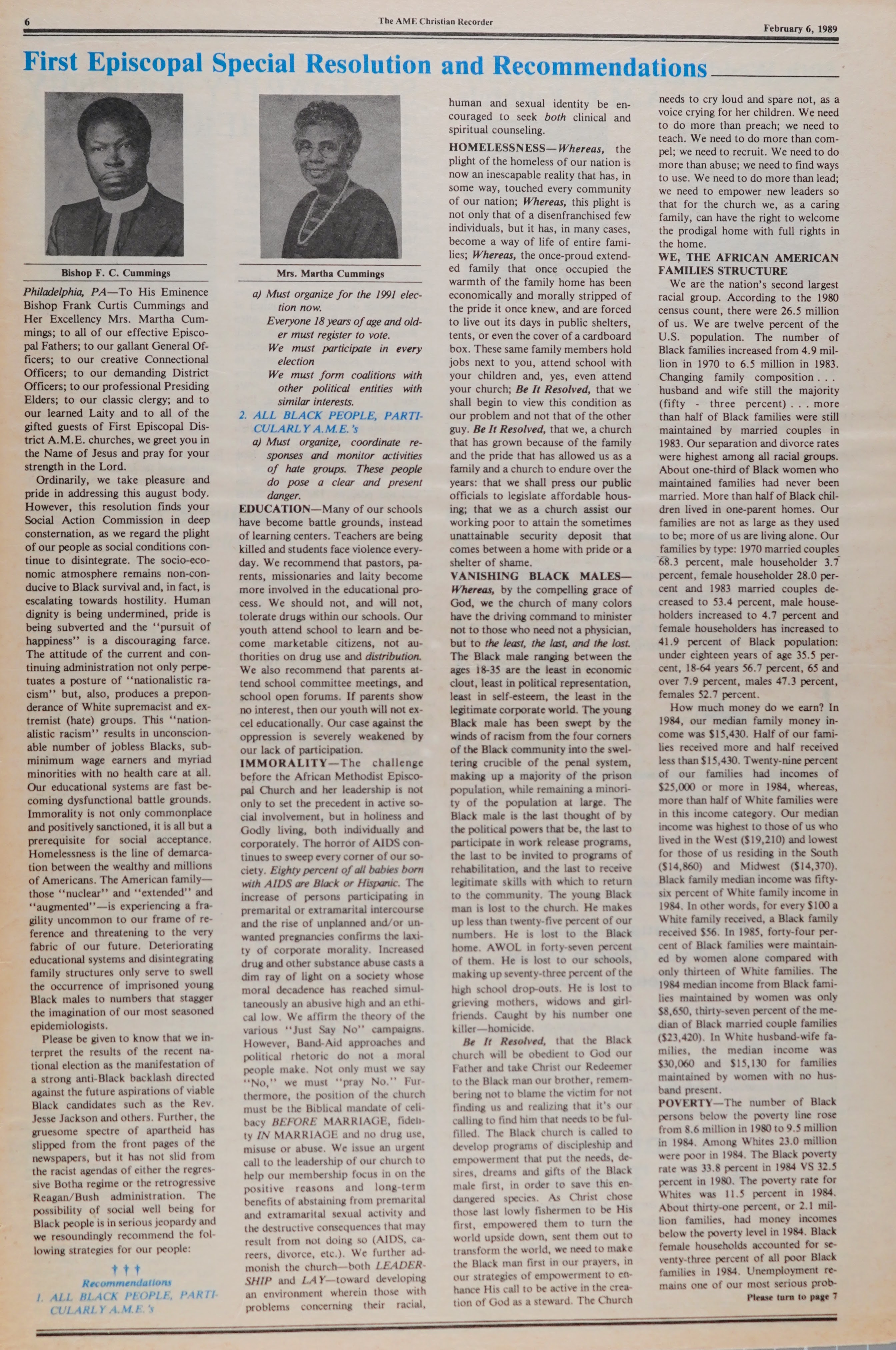
First Episcopal Special Resolution and Recommendations
Bishop F. C. Cummings
Mrs. Martha Cummings
Philadelphia, PA—To His Eminence
Bishop Frank Curtis Cummings and
Her Excellency Mrs. Martha Cum-
mings; to all of our effective Episco-
pal Fathers; to our gallant General Of-
ficers; to our creative Connectional
Officers; to our demanding District
Officers; to our professional Presiding
Elders; to our classic clergy; and to
our learned Laity and to all of the
gifted guests of First Episcopal Dis-
trict A.M.E. churches, we greet you in
the Name of Jesus and pray for your
strength in the Lord.
Ordinarily, we take pleasure and
pride in addressing this august body.
However, this resolution finds your
Social Action Commission in deep
consternation, as we regard the plight
of our people as social conditions con-
tinue to disintegrate. The socio-eco-
nomic atmosphere remains non-con-
ducive to Black survival and, in fact, is
escalating towards hostility. Human
dignity is being undermined, pride is
being subverted and the ‘‘pursuit of
happiness’ is a discouraging farce.
The attitude of the current and con-
tinuing administration not only perpe-
tuates a posture of ‘nationalistic ra-
cism’’ but, also, produces a prepon-
derance of White supremacist and ex-
tremist (hate) groups. This ‘‘nation-
alistic racism’’ results in unconscion-
able number of jobless Blacks, sub-
minimum wage earners and myriad
minorities with no health care at all.
Our educational systems are fast be-
coming dysfunctional battle grounds.
Immorality is not only commonplace
and positively sanctioned, it is all but a
prerequisite for social acceptance.
Homelessness is the line of demarca-
tion between the wealthy and millions
of Americans. The American family—
those ‘‘nuclear’’ and ‘‘extended’’ and
“augmented’’—is experiencing a fra-
gility uncommon to our frame of re-
ference and threatening to the very
fabric of our future. Deteriorating
educational systems and disintegrating
family structures only serve to swell
the occurrence of imprisoned young
Black males to numbers that stagger
the imagination of our most seasoned
epidemiologists.
Please be given to know that we in-
terpret the results of the recent na-
tional election as the manifestation of
a strong anti-Black backlash directed
against the future aspirations of viable
Black candidates such as the Rev.
Jesse Jackson and others. Further, the
gruesome spectre of apartheid has
slipped from the front pages of the
newspapers, but it has not slid from
the racist agendas of either the regres-
sive Botha regime or the retrogressive
Reagan/Bush administration, The
possibility of social well being for
Black people is in serious jeopardy and
we resoundingly recommend the fol-
lowing strategies for our people:
ie
Recommendations
1. ALL BLACK PEOPLE, PARTI
CULARLY A.M.E.’s
—————————————————_
a) Must organize for the 1991 elec-
tion now.
Everyone 18 years of age and old-
er must register to vote.
We must participate in every
election
We must form coalitions with
other political entities with
similar interests.
2. ALL BLACK PEOPLE, PARTI-
CULARLY A.M.E.’s
a) Must organize, coordinate re-
sponses and monitor activities
of hate groups. These people
do pose a clear and present
danger.
EDUCATION—Many of our schools
have become battle grounds, instead
of learning centers. Teachers are being
killed and students face violence every-
day. We recommend that pastors, pa-
rents, missionaries and laity become
more involved in the educational pro-
cess. We should not, and will not,
tolerate drugs within our schools. Our
youth attend school to learn and be-
come marketable citizens, not au-
thorities on drug use and distribution.
We also recommend that parents at-
tend school committee meetings, and
school open forums. If parents show
no interest, then our youth will not ex-
cel educationally. Our case against the
oppression is severely weakened by
our lack of participation.
IMMORALITY—The challenge
before the African Methodist Episco-
pal Church and her leadership is not
only to set the precedent in active so-
cial involvement, but in holiness and
Godly living, both individually and
corporately. The horror of AIDS con-
tinues to sweep every corner of our so-
ciety. Eighty percent of all babies born
with AIDS are Black or Hispanic. The
increase of persons participating in
premarital or extramarital intercourse
and the rise of unplanned and/or un-
wanted pregnancies confirms the laxi-
ty of corporate morality, Increased
drug and other substance abuse casts a
dim ray of light on a society whose
moral decadence has reached simul-
taneously an abusive high and an ethi-
cal low. We affirm the theory of the
various ‘‘Just Say No’’ campaigns.
However, Band-Aid approaches and
political rhetoric do not a moral
people make. Not only must we say
‘No,’ we must ‘pray No,’’ Fur-
thermore, the position of the church
must be the Biblical mandate of celi
bacy BEFORE MARRIAGE, fidel-
ty IN MARRIAGE and no drug use,
misuse or abuse. We issue an urgent
call to the leadership of our church to
help our membership focus in on the
positive reasons and long-term
benefits of abstaining from premarital
and extramarital sexual activity and
the destructive consequences that may
result from not doing so (AIDS, ca
reers, divorce, etc.). We further ad-
monish the church—both LEADER-
SHIP and LAY—toward developing
an environment wherein those with
problems concerning their racial,
human and sexual identity be en-
couraged to seek both clinical and
spiritual counseling.
HOMELESSNESS— Whereas, the
plight of the homeless of our nation is
now an inescapable reality that has, in
some way, touched every community
of our nation; Whereas, this plight is
not only that of a disenfranchised few
individuals, but it has, in many cases,
become a way of life of entire fami-
lies; Whereas, the once-proud extend-
ed family that once occupied the
warmth of the family home has been
economically and morally stripped of
the pride it once knew, and are forced
to live out its days in public shelters,
tents, or even the cover of a cardboard
box. These same family members hold
jobs next to you, attend school with
your children and, yes, even attend
your church; Be It Resolved, that we
shall begin to view this condition as
our problem and not that of the other
guy. Be It Resolved, that we, a church
that has grown because of the family
and the pride that has allowed us as a
family and a church to endure over the
years: that we shall press our public
officials to legislate affordable hous-
ing; that we as a church assist our
working poor to attain the sometimes
unattainable security deposit that
comes between a home with pride or a
shelter of shame.
VANISHING BLACK MALES—
Whereas, by the compelling grace of
God, we the church of many colors
have the driving command to minister
not to those who need not a physician,
but to the least, the last, and the lost.
The Black male ranging between the
ages 18-35 are the least in economic
clout, least in political representation,
least in self-esteem, the least in the
legitimate corporate world. The young
Black male has been swept by the
winds of racism from the four corners
of the Black community into the swel-
tering crucible of the penal system,
making up a majority of the prison
population, while remaining a minori-
ty of the population at large. The
Black male is the last thought of by
the political powers that be, the last to
participate in work release programs,
the last to be invited to programs of
rehabilitation, and the last to receive
legitimate skills with which to return
to the community. The young Black
man is lost to the church. He makes
up less than twenty-five percent of our
numbers. He is lost to the Black
home. AWOL in forty-seven percent
of them. He is lost to our schools,
making up seventy-three percent of the
high school drop-outs. He is lost to
grieving mothers, widows and girl-
friends. Caught by his number one
killer—homicide.
Be It Resolved, that the Black
church will be obedient to God our
Father and take Christ our Redeemer
to the Black man our brother, remem-
bering not to blame the victim for not
finding us and realizing that it's our
calling to find him that needs to be ful-
filled. The Black church is called to
develop programs of discipleship and
empowerment that put the needs, de-
sires, dreams and gifts of the Black
male first, in order to save this en-
dangered species. As Christ chose
those last lowly fishermen to be His
first, empowered them to turn the
world upside down, sent them out to
transform the world, we need to make
the Black man first in our prayers, in
our strategies of empowerment to en-
hance His call to be active in the crea-
tion of God as a steward. The Church
needs to cry loud and spare not, as a
voice crying for her children. We need
to do more than preach; we need to
teach. We need to do more than com-
pel; we need to recruit. We need to do
more than abuse; we need to find ways
to use. We need to do more than lead;
we need to empower new leaders so
that for the church we, as a caring
family, can have the right to welcome
the prodigal home with full rights in
the home.
WE, THE AFRICAN AMERICAN
FAMILIES STRUCTURE
We are the nation’s second largest
racial group. According to the 1980
census count, there were 26.5 million
of us. We are twelve percent of the
U.S. population. The number of
Black families increased from 4.9 mil-
lion in 1970 to 6.5 million in 1983.
Changing family composition...
husband and wife still the majority
(fifty - three percent)... more
than half of Black families were still
maintained by married couples in
1983. Our separation and divorce rates
were highest among all racial groups.
About one-third of Black women who
maintained families had never been
married. More than half of Black chil-
dren lived in one-parent homes. Our
families are not as large as they used
to be; more of us are living alone. Our
families by type: 1970 married couples
68.3 percent, male householder 3.7
percent, female householder 28.0 per-
cent and 1983 married couples de-
creased to 53.4 percent, male house-
holders increased to 4.7 percent and
female householders has increased to
41.9 percent of Black population:
under eighteen years of age 35.5 per-
cent, 18-64 years 56.7 percent, 65 and
over 7.9 percent, males 47.3 percent,
females 52.7 percent.
How much money do we earn? In
1984, our median family money in-
come was $15,430. Half of our fami-
lies received more and half received
less than $15,430. Twenty-nine percent
of our families had incomes of
$25,000 or more in 1984, whereas,
more than half of White families were
in this income category. Our median
income was highest to those of us who
lived in the West ($19,210) and lowest
for those of us residing in the South
($14,860) and Midwest ($14,370).
Black family median income was fifty-
six percent of White family income in
1984. In other words, for every $100 a
White family received, a Black family
received $56. In 1985, forty-four per-
cent of Black families were maintain-
ed by women alone compared with
only thirteen of White families. The
1984 median income from Black fami-
lies maintained by women was only
$8,650, thirty-seven percent of the me-
dian of Black married couple families
($23,420). In White husband-wife fa-
milies, the median income was
$30,060 and $15,130 for families
maintained by women with no hus-
band present.
POVERTY—The number of Black
persons below the poverty line rose
from 8.6 million in 1980 to 9.5 million
in 1984. Among Whites 23.0 million
were poor in 1984, The Black poverty
rate was 33.8 percent in 1984 VS 32.5
percent in 1980, The poverty rate for
Whites was 11.5 percent in 1984.
About thirty-one percent, or 2.1 mil-
lion families, had money incomes
below the poverty level in 1984, Black
female households accounted for se-
venty-three percent of all poor Black
families in 1984. Unemployment re-
mains one of our most serious prob-
Please turn to page 7
===== DSC05723.JPG =====
February 6, 1989
nee
The AME Christian Recorder
Continued from page 6
FIRST EPISCOPAL DISTRICT SPECIAL
RESOLUTIONS AND COMMENDATIONS __
2000.
First, our parents must take control
of their children, teach their children
love, respect, moral values; their his-
tory and culture. Take their children
to church and teach them about God.
Second, we must have a strategy of
raising our economic well-being. We
need to keep the land we own and pur-
chase additional land. As a nation, we
have to create our own jobs.
A. Start small businesses
B. Hire our family members and
neighbors
C. Support our own businesses
D. Patronize Black professionals,
technicians, vocational and ser-
vice industries
E. Create new businesses for the
Third Century
We must continue our political par-
ticipation, increase our political
power, influence legislation being
made. We must help each other to
grow.
Finally, unlike any other report that
this commission has issued, this one
merits an organized response. FIRST,
there must be a social action commis-
sion in every local church. In cases
where the Missionary Society, Social
Action Committee or the Lay
Organization Social Action Commit-
tee are functioning, they can serve as
the liaison to the First District Social
Action Committee. SECONDLY, we
are expecting every church to respond
to the issues contained in this report
and report those responses to either
the Conference Director of Social Ac-
tion or to the First District Social Ac-
tion Commission by February 11,
1989. LASTLY, we will be encourag-
ing every local church to complete
your social action survey and return it
to the First District Social Action
Commission. We are in_ perilous
times. Our commitment to Jesus
Christ and to God’s people, to the op-
pressed and to the poor indicates that
we rise up and meet the challenges of
our day.
IEMMNMNEMNE NY
We must rescue the perishing, care
for the dying, snatch them in pity from
sin and the grave. Weep o’er the erring
one, lift up the fallen, tell them of Jesus
the Mighty to save.
IMNEERMNMMEEES
Rey. Dr. Alvan N. Johnson, Jr.
Chairperson
1st District Social Action Commission
Continued from page 1
Senior A.M.E. Bishop and
Wife Happily Welcomed
to Georgia
Wherever Bishop John Hurst
Adams and Dr. Dolly D. Adams have
served, they have made a difference to
the glory of God. We happily look
forward to that difference during the
1988-1992 quadrennium and beyond.
God bless our new episcopal team.
Attend Annual
Conference
Continued from page 1
“<Self-Help’’ Comes to the
First Episcopal District __
more than three hundred youths and
adults.
Recently, Self-Help Inc. rearranged
its structure by establishing a new ex-
ecutive board of directors and organi-
zing local boards of directors in New
York, New Jersey, New England,
Philadelphia and Delaware Confer-
ences to investigate and develop suit-
able funding sources for local pro-
grams in that area.
Self-Help is bound to its Motto:
“We Meet People Where They Are
And Help Them To Help Them-
selves. ”’
*< A SINGING STREAM” IS GOSPEL
ACCORDING TO LANDIS FAMILY ___—
For eighty-eight-year old Mrs. Ber-
tha Landis, one of the best things
about A Singing Stream: A Black Fa-
mily Chronicle, is the film’s title. It
came from her comments.
“T taught them how to sing—my
boys,’’ she said. ‘‘My father was a
music teacher, and he had a brother
who taught music, and my mother had
two brothers who taught music. So
that’s why it’s called the singing
steam—it comes from a long way.”
Broadcast at 10 p.m., Sunday, Feb.
12, over national PBS stations (check
local airtime), the hour-long docu-
mentary is the first film to trace 20th-
century Black history through the
musical and cultural traditions of one
Southern Black family. Through inter-
views and scenes from daily routines,
family reunions, gospel concerts and
church services, the film chronicles the
history of the Creedmoor, NC, Landis
family, as it happened during the life-
time of the family’s matriarch and
oldest surviving member.
A Singing Stream documents how
Mrs. Landis used her family’s musical
gifts, along with a deep religious faith
and strong cultural traditions, to
unite, discipline and motivate her chil-
dren, equipping them to rise above
barriers faced by Blacks in the South
during the last half-century. Musical
performances in the film span nearly a
century of Black religious song styles,
from unaccompanied shape-note sing-
ing to contemporary gospel. A Singing
Stream features rehearsals and con-
certs by The Golden Echoes, a male
gospel quartet that includes,three Lan-
dis men, and The Echoes of Heaven, a
female quartet also made up of family
members.
The historic strength of the extend-
ed Black family seems to be a vital
component of Black progress in
America. A Singing Stream solidly un-
derscores such strength both in voices
that are heavenly music to the ears and
in spirits of indomitable faith. In Mrs.
Landis’ words, ‘‘The singing stream—
it comes from a long way.”
A Singing Stream: A Black Family
Chronicle is a production of Daven-
port Films and Curriculum in Folk-
lore at The University of North Caro-
lina at Chapel Hill. Independent film-
maker Tom Davenport is the director.
Associate directors are Daniel Patter-
son, chairman of curriculum in folk-
lore at UNC-CH, and Allen Tullos,
Emory University professor. North
Carolina Public Television, the pro-
gram service of The University of
North Carolina Center for Public
Television, is presenting the film for
PBS national broadcast.
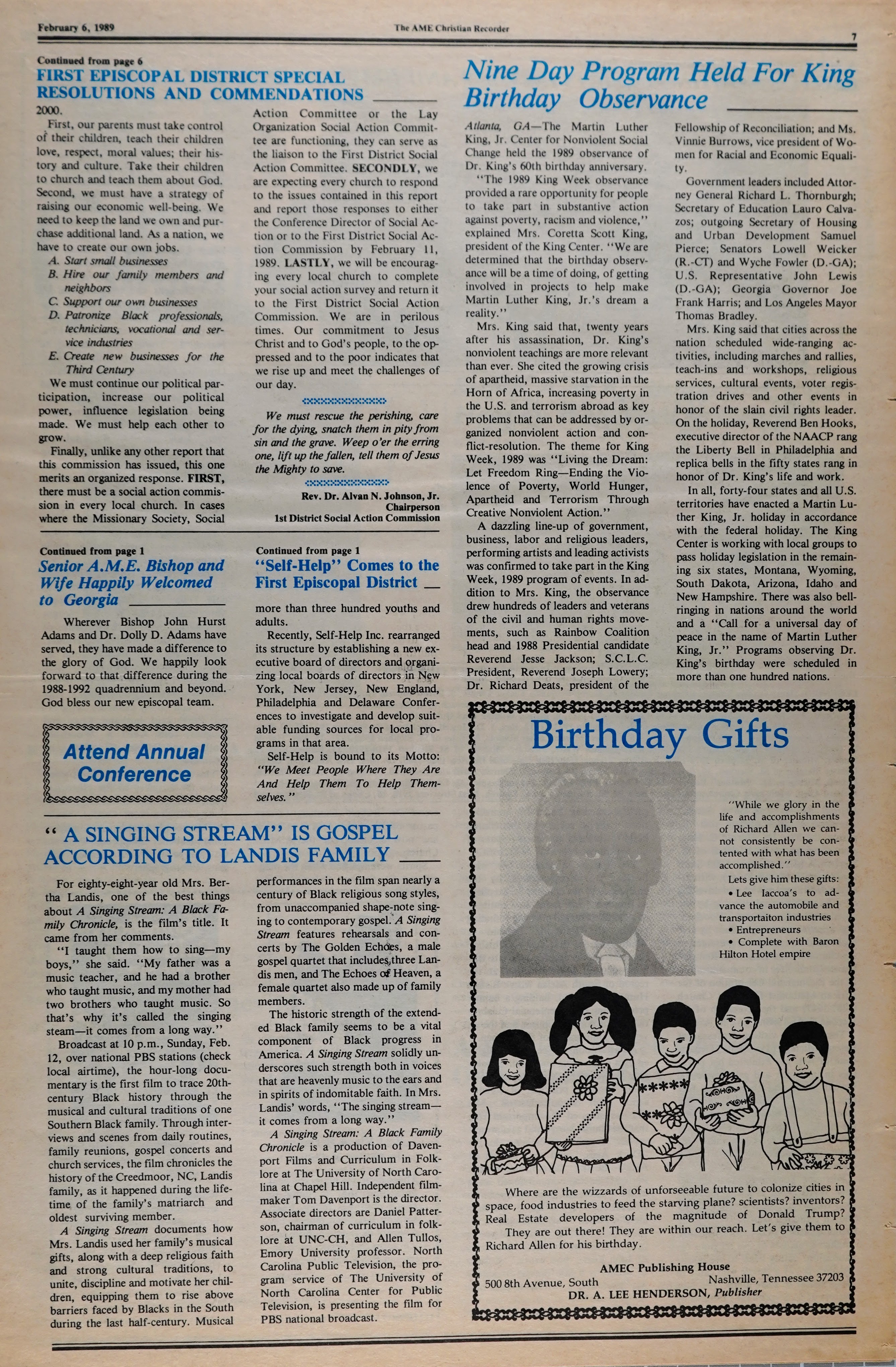
Nine Day Program Held For King
Birthday Observance
Atlanta, GA—The Martin Luther
King, Jr, Center for Nonviolent Social
Change held the 1989 observance of
Dr. King’s 60th birthday anniversary,
“The 1989 King Week observance
provided a rare opportunity for people
to take part in substantive action
against poverty, racism and violence,’’
explained Mrs. Coretta Scott King,
president of the King Center. ‘‘We are
determined that the birthday observ-
ance will be a time of doing, of getting
involved in projects to help make
Martin Luther King, Jr.’s dream a
reality.’’
Mrs. King said that, twenty years
after his assassination, Dr. King’s
nonviolent teachings are more relevant
than ever. She cited the growing crisis
of apartheid, massive starvation in the
Horn of Africa, increasing poverty in
the U.S. and terrorism abroad as key
problems that can be addressed by or-
ganized nonviolent action and con-
flict-resolution. The theme for King
Week, 1989 was ‘‘Living the Dream:
Let Freedom Ring—Ending the Vio-
lence of Poverty, World Hunger,
Apartheid and Terrorism Through
Creative Nonviolent Action.”’
A dazzling line-up of government,
business, labor and religious leaders,
performing artists and leading activists
was confirmed to take part in the King
Week, 1989 program of events. In ad-
dition to Mrs. King, the observance
drew hundreds of leaders and veterans
of the civil and human rights move-
ments, such as Rainbow Coalition
head and 1988 Presidential candidate
Reverend Jesse Jackson; S.C.L.C.
President, Reverend Joseph Lowery;
Dr. Richard Deats, president of the
Richard Allen for his birthday.
‘ 500 8th Avenue, South
D
Where are the wizzards of unforseeable future to colonize cities in ,
» space, food industries to feed the starving plane? scientists? inventors? §
Real Estate developers of the magnitude of Donald Trump?
They are out there! They are within our reach. Let’s give them to §
AMEC Publishing House
DR. A. LEE HENDERSON, Publisher
De OD oD ED 2 OD o F0 5 +92 6-0 «
Fellowship of Reconciliation; and Ms.
Vinnie Burrows, vice president of Wo-
men for Racial and Economic Equali-
ty.
Government leaders included Attor-
ney General Richard L. Thornburgh;
Secretary of Education Lauro Calva-
zos; Outgoing Secretary of Housing
and Urban Development Samuel
Pierce; Senators Lowell Weicker
(R.-CT) and Wyche Fowler (D.-GA);
U.S. Representative John Lewis
(D.-GA); Georgia Governor Joe
Frank Harris; and Los Angeles Mayor
Thomas Bradley.
Mrs. King said that cities across the
nation scheduled wide-ranging ac-
tivities, including marches and rallies,
teach-ins and workshops, religious
services, cultural events, voter regis-
tration drives and other events in
honor of the slain civil rights leader.
On the holiday, Reverend Ben Hooks,
executive director of the NAACP rang
the Liberty Bell in Philadelphia and
replica bells in the fifty states rang in
honor of Dr. King’s life and work.
In all, forty-four states and all U.S.
territories have enacted a Martin Lu-
ther King, Jr. holiday in accordance
with the federal holiday. The King
Center is working with local groups to
pass holiday legislation in the remain-
ing six states, Montana, Wyoming,
South Dakota, Arizona, Idaho and
New Hampshire. There was also bell-
ringing in nations around the world
and a ‘‘Call for a universal day of
peace in the name of Martin Luther
King, Jr.’ Programs observing Dr.
King’s birthday were scheduled in
more than one hundred nations.
SP OP Or COI OO oe FOR oe Oh oa Oh a Ope te pe teeta tee
Birthday Gifts
“While we glory in the
life and accomplishments
of Richard Allen we can-
not consistently be con-
tented with what has been
accomplished.’
Lets give him these gifts:
eLee Iaccoa’s to ad-
vance the automobile and
transportaiton industries
e Entrepreneurs
¢ Complete with Baron
Hilton Hotel empire
‘
Nashville, Tennessee 37203 ¢
===== DSC05724.JPG =====
The AME Christian Recorder
February 6, 1989
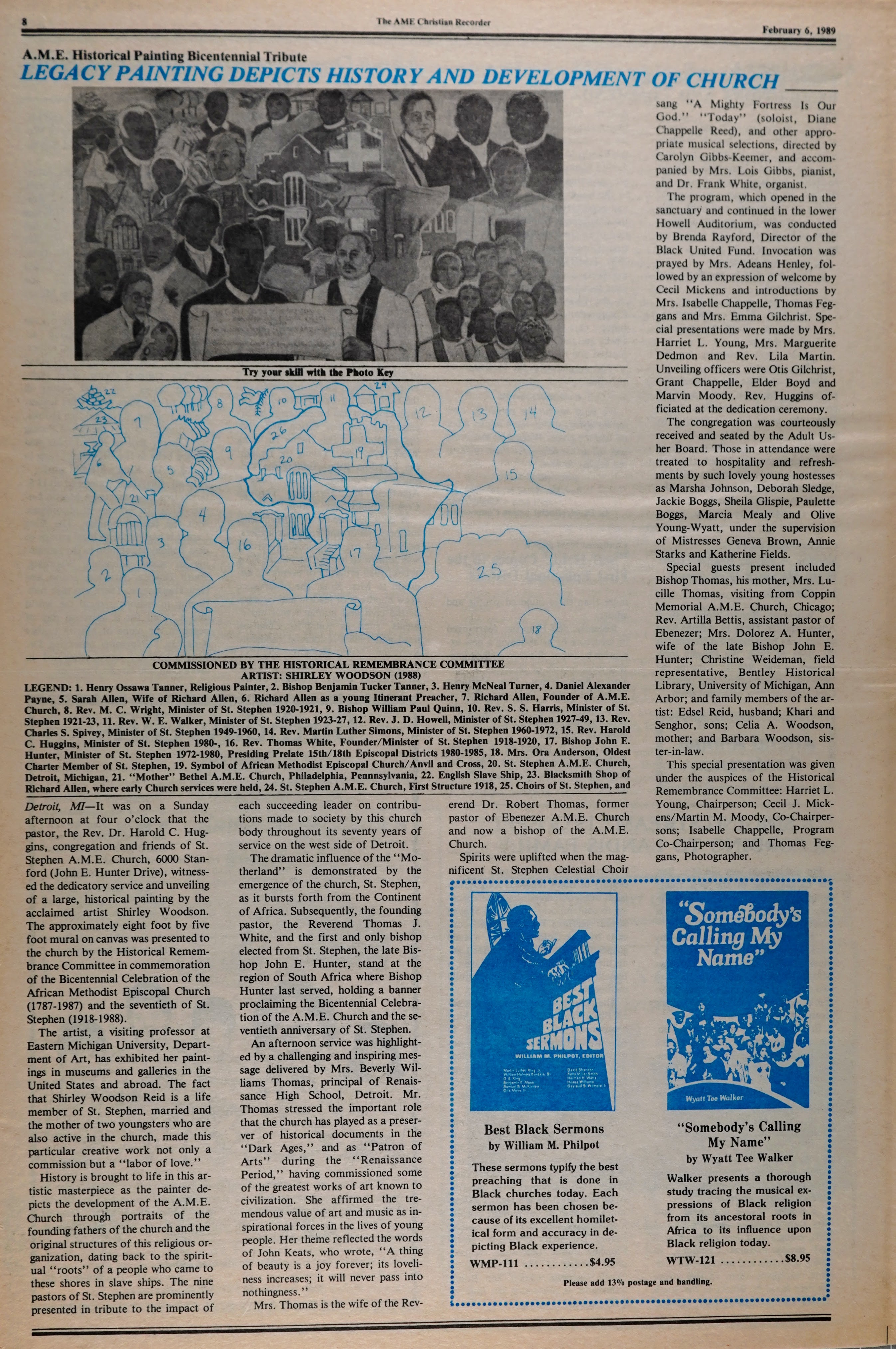
A.M.E. Historical Painting Bicentennial Tribute
LEGACY
W
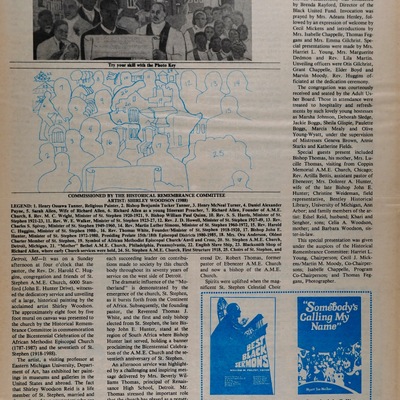
PAIN TING DEPICTS HIS TORY AND DEVELOPMENT OF CHURCH
COMMISSIONED BY THE HISTORICAL REMEMBRANCE COMMITTEE
ARTIST: SHIRLEY WOODSON (1988)
LEGEND: 1. Henry Ossawa Tanner, Religious Painter, 2. Bishop Benjamin Tucker Tanner, 3. Henry McNeal Turner, 4. Daniel Alexander
Payne, 5. Sarah Allen, Wife of Richard Allen, 6. Richard Allen as a young Itinerant Preacher, 7. Richard Allen, Founder of A.M.E.
Church, 8. Rev. M. C. Wright, Minister of St. Stephen 1920-1921, 9. Bishop William Paul Quinn, 10. Rev. S. S. Harris, Minister of St.
Stephen 1921-23, 11. Rev. W. E. Walker, Minister of St. Stephen 1923-27, 12. Rev. J. D. Howell, Minister of St. Stephen 1927-49, 13. Rev.
Charles S. Spivey, Minister of St. Stephen 1949-1960, 14. Rev. Martin Luther Simons, Minister of St. Stephen 1960-1972, 15. Rev. Harold
C. Huggins, Minister of St. Stephen 1980-, 16. Rev. Thomas White, Founder/Minister of St. Stephen 1918-1920, 17. Bishop John E.
Hunter, Minister of St. Stephen 1972-1980, Presiding Prelate 15th/18th Episcopal Districts 1980-1985, 18. Mrs. Ora Anderson, Oldest
Charter Member of St. Stephen, 19. Symbol of African Methodist Episcopal Church/Anvil and Cross, 20. St. Stephen A.M.E. Church,
Detroit, Michigan, 21. ‘‘Mother” Bethel A.M.E. Church, Philadelphia, Pennsylvania, 22. English Slave Ship, 23. Blacksmith Shop of
Richard Allen, where early Church services were held, 24. St. Stephen A.M.E. Church, First Structure 1918, 25. Choirs of St. Stephen, and
Detroit, MI—It was on a Sunday
afternoon at four o’clock that the
pastor, the Rev. Dr. Harold C. Hug-
gins, congregation and friends of St.
Stephen A.M.E. Church, 6000 Stan-
ford (John E. Hunter Drive), witness-
ed the dedicatory service and unveiling
of a large, historical painting by the
acclaimed artist Shirley Woodson.
The approximately eight foot by five
foot mural on canvas was presented to
the church by the Historical Remem-
brance Committee in commemoration
of the Bicentennial Celebration of the
African Methodist Episcopal Church
(1787-1987) and the seventieth of St.
Stephen (1918-1988).
The artist, a visiting professor at
Eastern Michigan University, Depart-
ment of Art, has exhibited her paint-
ings in museums and galleries in the
United States and abroad. The fact
that Shirley Woodson Reid is a life
member of St. Stephen, married and
the mother of two youngsters who are
also active in the church, made this
particular creative work not only a
commission but a “‘labor of love.’’
History is brought to life in this ar-
tistic masterpiece as the painter de-
picts the development of the A.M.E.
Church through portraits of the
founding fathers of the church and the
original structures of this religious or-
ganization, dating back to the spirit-
ual ‘‘roots’’ of a people who came to
these shores in slave ships. The nine
pastors of St. Stephen are prominently
presented in tribute to the impact of
each succeeding leader on contribu-
tions made to society by this church
body throughout its seventy years of
service on the west side of Detroit.
The dramatic influence of the ‘‘Mo-
therland’’ is demonstrated by the
emergence of the church, St. Stephen,
as it bursts forth from the Continent
of Africa. Subsequently, the founding
pastor, the Reverend Thomas J.
White, and the first and only bishop
elected from St. Stephen, the late Bis-
hop John E. Hunter, stand at the
region of South Africa where Bishop
Hunter last served, holding a banner
proclaiming the Bicentennial Celebra-
tion of the A.M.E. Church and the se-
ventieth anniversary of St. Stephen.
An afternoon service was highlight-
ed by a challenging and inspiring mes-
sage delivered by Mrs. Beverly Wil-
liams Thomas, principal of Renais-
sance High School, Detroit. Mr.
Thomas stressed the important role
that the church has played as a preser-
ver of historical documents in the
“Dark Ages,’ and as ‘‘Patron of
Arts’? during the ‘‘Renaissance
Period,’’ having commissioned some
of the greatest works of art known to
civilization. She affirmed the tre-
mendous value of art and music as in-
spirational forces in the lives of young
people. Her theme reflected the words
of John Keats, who wrote, ‘‘A thing
of beauty is a joy forever; its loveli-
ness increases; it will never pass into
nothingness.”’
Mrs. Thomas is the wife of the Rev-
erend Dr. Robert Thomas, former
pastor of Ebenezer A.M.E. Church
and now a bishop of the A.M.E.
Church.
Spirits were uplifted when the mag-
nificent St. Stephen Celestial Choir
PST)
e
WILLIAM M. PHILPOT, EDITOR
Best Black Sermons
by William M. Philpot
These sermons typify the best
preaching that is done in
Black churches today. Each
sermon has been chosen be-
cause of its excellent homilet-
ical form and accuracy in de-
picting Black experience.
WMP-111 .......-.-.- $4.95
POOSSOEHLO OOOO HOSS OOOHSSOH OOOOH OSHS TOSSHSGGOHT SOOO HO OSES OHS SHHOOSOSOOLOSOOSOOSOD
Please add 13% postage and handling.
sang ‘‘A Mighty Fortress Is Our
God."’ ‘*Today’’ (soloist, Diane
Chappelle Reed), and other appro-
priate musical selections, directed by
Carolyn Gibbs-Keemer, and accom-
panied by Mrs. Lois Gibbs, pianist,
and Dr, Frank White, organist,
The program, which opened in the
sanctuary and continued in the lower
Howell Auditorium, was conducted
by Brenda Rayford, Director of the
Black United Fund. Invocation was
prayed by Mrs. Adeans Henley, fol-
lowed by an expression of welcome by
Cecil Mickens and introductions by
Mrs. Isabelle Chappelle, Thomas Feg-
gans and Mrs. Emma Gilchrist. Spe-
cial presentations were made by Mrs.
Harriet L. Young, Mrs. Marguerite
Dedmon and Rev. Lila Martin.
Unveiling officers were Otis Gilchrist,
Grant Chappelle, Elder Boyd and
Marvin Moody. Rev. Huggins of-
ficiated at the dedication ceremony.
The congregation was courteously
received and seated by the Adult Us-
her Board. Those in attendance were
treated to hospitality and refresh-
ments by such lovely young hostesses
as Marsha Johnson, Deborah Sledge,
Jackie Boggs, Sheila Glispie, Paulette
Boggs, Marcia Mealy and Olive
Young-Wyatt, under the supervision
of Mistresses Geneva Brown, Annie
Starks and Katherine Fields.
Special guests present included
Bishop Thomas, his mother, Mrs. Lu-
cille Thomas, visiting from Coppin
Memorial A.M.E. Church, Chicago;
Rev. Artilla Bettis, assistant pastor of
Ebenezer; Mrs. Dolorez A. Hunter,
wife of the late Bishop John E.
Hunter; Christine Weideman, field
representative, Bentley Historical
Library, University of Michigan, Ann
Arbor; and family members of the ar-
tist: Edsel Reid, husband; Khari and
Senghor, sons; Celia A. Woodson,
mother; and Barbara Woodson, sis-
ter-in-law.
This special presentation was given
under the auspices of the Historical
Remembrance Committee: Harriet L.
Young, Chairperson; Cecil J. Mick-
ens/Martin M. Moody, Co-Chairper-
sons; Isabelle Chappelle, Program
Co-Chairperson; and Thomas Feg-
gans, Photographer.
oy
““Somebody’s Calling
My Name”
by Wyatt Tee Walker
Walker presents a thorough
study tracing the musical ex-
pressions of Black religion
from its ancestoral roots in
Africa to its influence upon
Black religion today.
WTW-121 .......-+-+- $8.95
0000000000000 00000000090 0009900000000000000000000000005000000000000 0000008000
===== DSC05725.JPG =====
eS
a a a ee ee ee eee
SS Se Se Mele ON SECIS CONE MAMNeNaes Lames CRMNEENS Be
The AME Christian Recorder
UHW SCHOLARSHIP WINNER—Pictured above at presentation of United Handicap-
ped Workers Scholarship award to UT at Knoxville are (L-R: Luke Pogue, UHW district
manager; Dorothy Bryson, chairwoman of university scholarship committee, and Pete
Crouse, recipient of UHW 1988-89 scholarship
United Handicapped Workers Awards
Scholarship to Disabled Student
Knoxville, TN—United Handicapped
Workers (UHW), a Nashville-based
company, has awarded a $1,600
scholarship to Peter Crouse, a disabl-
ed student at the University of Tennes-
see (UT) at Knoxville. The UHW
scholarship is for the 1988-89 aca-
demic year.
Crouse, who suffers from retinal
degeneration, is a native of Sevierville,
TN. An education major, he is ex-
pected to earn a B.S. in Earth and
general Science in May 1989. The
thirty-three-year-old Crouse maintains
a 3.55 grade point average.
According to the university’s Gen-
eral Scholarship Committee, forty stu-
dents were nominated for the scholar-
ship. Final selection was based on aca-
demic merit, financial need and certi-
fied physical handicap of the recipient.
“The UHW scholarship is one of
this school’s most meaningful,’’ said
Dorothy Bryson, the university’s as-
sistant director of financial aid. ‘*The
students who benefit from this special
scholarship have much more than
financial hardship to overcome.”’
Crouse is receiving the second an-
nual UHW scholarship awarded to UT
at Knoxville. ‘‘United Handicapped
Workers is extremely pleased to once
again fund this tuition scholarship as
part of our ongoing commitment to
the community,’’ said UHW Presi-
dent Fil Martocci. ‘‘From our ex-
perience, we know that disabled indi-
viduals set high goals and we hope this
scholarship will help Pete in attaining
his.’’
UHW awards similar scholarships
to outstanding disabled students at UT
at Chattanooga, Georgia Tech, Uni-
versity of South Florida, University of
Missouri-St. Louis and University of
Oklahoma.
UHW employs disabled individuals
in the telephone marketing of long-
life lightbulbs and other quality pro-
ducts throughout Tennessee, Florida,
Georgia, Kansas, Oklahoma and Mis-
souri. UHW is a member of the
American Handicapped Employers
Association (AHEA), whose ten mem-
ber companies have established simi-
lar scholarship funds at colleges and
universities across the country. The
members of AHEA currently employ
more than 1,800 disabled workers na-
tionwide.
Martin Luther King Had The
Dream...Do We Have The Will?
by Harold Williams
A lot of celebration that’s going
on this past week is honoring a great
man, Dr. Martin Luther King, Jr. We
talked about his contribution to socie-
ty, his desire for unity among all peo-
ple. We talked about the past and sac-
rifices that he and others have made.
From the mid 1950’s to the late '60’s a
lot of marches, a lot of sit-in’s, a lot
of pray-in’s, were going on to help us
obtain true freedom, A lot of people
died that we would have opportunities
in this generation and generations to
come, Was their sacrifice in vain? It
appears that we have sat on our
laurels expounding on the sacrifices of
Dr. King and others on our behalf.
But we have not been willing to pick
up the baton and move forward, for
we are still looking for someone to do
it for us. The question now is, do we
have the will to do it for ourselves?
We have to come together and rebuild
the solid structure around the family,
give more positive attention to our
children and their needs, We must
plant a seed in their minds that the
dream that Martin Luther King had
for all of us was for us to move to 4
higher level spiritually and intellectu-
ally, that will give us the opportunity
within ourselves, that will allow us to
determine our own destiny. We have
the economic wherewithal to remove
unemployment from our community
if we would buy and trade with one
another who are in business, By keep-
ing our dollars in our community, our
people would move from employees
to employers. Do we have the will to
trust ourselves or do we still have
more faith in someone else than we
have in ourselves? The dream is about
self pride, the ability to overcome all
obstacles and achieve in spite of, No
one promised us a rose garden, for the
rose garden, with all its beautiful col-
ors and fragrances, has thorns. Do we
have the will to make the dream a
reality? Or will we relegate ourselves
to talk of the past victories and make
no efforts to have future ones? Do we
have the will?
From the Portland Observer
(Used by Permission)
PUBLISHER'S NOTE:
Herold Williams is a member of Bethel
A.M.E. Church, Portland, Oregon,
and « staff writer for the Observer.
Meharry Medical
College Names New
Vice President
Nashville, TN—Dr. Rickard B. Scott
has assumed the position of vice presi-
dent for institutional advancement at
Meharry Medical College. Scott will
be responsible for the college’s de-
velopment effort, public relations and
alumni affairs.
Prior to coming to Meharry, Scott
served as vice president for develop-
ment and public affairs at Agnes Scott
College in Decatur, GA. During his
tenure at the all women’s college he
brought donations to the school to
record highs. He also led an award
winning publications department at
the school.
Scott, a Florida native, has been in
both classroom and administrative
settings during his professional career.
He served on both the faculty and in
administrative positions at Bethany
College, Lindsborg, KS, and Linden-
wood College, St. Charles, MO. He
earned his Bachelor’s degree from
Eckard College in St. Petersburg.
Subsequently, he received both his
Master’s and Ph.D. from Florida
State University in Tallahassee.
Dr. Scott and his wife have two
sons,
Meharry is the nation’s oldest, free-
standing, historically Black medical
school. Founded in 1876, the college
offers courses through its four com-
ponent schools: the School of Medi-
cine, the School of Dentistry, the
School of Graduate Studies and the
School of Allied Health professions.
Meharry has graduated over forty per-
cent of the Black physicians and den-
tists practicing in the United States to-
day. Some seventy-five percent of the
graduates remained true to the col-
lege’s mission of ‘‘Service to the un-
derserved,’’ by establishing practice in
inner city and rural areas, traditionally
medically underserved areas.
Cosby Donates
$800,000 to Meharry
Medical College
Nashville, TN—Dr. David Satcher,
president of Meharry Medical College,
announced today that Camille and Bill
Cosby have donated $800,000 to the
college. The money is earmarked for
the J Have a Future and cancer screen-
ing programs at the four-year, inde-
pendent, historically Black medical
school. Mrs. Cosby has a special in-
terest in and concern for the health
status of women, and targeted the two
Meharry programs because of their
focus on women’s health.
According to Satcher, $600,000 of
the gift will be used for the J Have a
Future program, a unique, teen preg-
nancy intervention program. The pro-
gram works on a one-on-one basis
within housing projects to break the
cycle of teen pregnancies by offering
lifestyle and self image alternatives.
The remaining $200,000 will be
used for the college’s community
cancer screening effort. This unique
program, under the guidance of Dr.
Linda Clayton, reaches out to the
community through churches and
other civic organizations to provide
screening for cancer and other major
health problems.
“We are certainly grateful to
Camille and Bill Cosby for this
generous gift to these two very signifi-
cant and important programs,’’ Sat-
cher said. ‘“‘Such a donation demon-
strates the Cosby’s understanding of
and concern for a traditionally under-
served population. Their generosity
will insure the continuance of these
two programs, which are important
components of Meharry’s work.”
Cosby was the commencement
speaker at Meharry in May, 1986.
SS OOe
Our Old Ship of Zion Keeps Rolling Along
THE WATCHMAN
by Dr. Charles C. Epps, Jr.
Memphis, TN—I love the Body of
Christ—especially our “Old Ship of
Zion”—the African Methodist
Episcopal Church. Established in
1787, upon the solid Rock of Jesus
Christ, by Richard Allen and others, it
is one of the few institutions totally
controlled by Black people. For over
two hundred years the A.M.E. Church
has been, and is still, a refuge for many
Blacks seeking spiritual nourishment,
self-determination and security
Furthermore, thoughtout Ameri-
can history, the A.M.E. Church con-
tinues to be a voice crying in the
wilderness for the civil, economic and
political rights of Black people, here
and in Africa. To attain these un-
alienable rights, dynamic church
leaders have risen to meet the occa-
sion. They urged Black people to pool
their meager resources, buy property,
and build churches for freedom of
religious worship, For self-deter-
mination and economic independence,
Blacks were entreated to start their
own businesses; consequently, not
only has our “Old Ship of Zion” pro-
vided numerous members with boot-
straps to pull up by, but it has elevated
some from the bottom to the
bishopric; and boosted others from
hellish to heavenly conditions,
I love the A.M.E. Church because it
has proven to be worthy by standing
the test of time, During its longevity,
the “Old Ship of Zion” has not always
had smooth sailing. Though besieged
by troubled waters, it has maintained a
steady course. There was a time when
various turbulent storms faced by our
church were exerted from the outside.
Even when its legal status was bat-
tered by White Methodists, “Old
Zion” was never inundated, nor did it
capsize. Threatened by rampant
racism and blatant attacks from the
Ku Klux Klan, “Old Zion” reeled and
rocked, but, like ‘Old Man River,” it
just keeps rolling along.
Whereas in the past, formidable foes
were mostly external, something much
more insidious and sinister now hovers
over “Old Zion,” Imminent
demolition appears to emanate from
internal strife, “I have met the enemy
and he is us.” Selfish ambition and
misconduct of some members have led
to muckraked lawsuits against the
Church. Moreover, disgruntled and
misguided souls attempt to gain relief
from secular rather than spiritual
means
Someone has said that if certain un-
regenerate members could tear up the
church they would. But because “Old
Zion” is moored to the eternal anchor
of Jesus Christ, it remains undaunted
by devastating waves of upheaval. So,
by sailing the crest of God our Father,
Christ our Redeemer, and Man our
Brother, our Church will survive and
continue to launch out into the deep
waters of liberation and reconcilia~
hon, « 2 E
===== DSC05726.JPG =====
ee ee ee ee eo ee) ok Abe eae SO §
5
$
4
-
10
The AME Christian Recorder
February 6, 1989
ANNUAL CONFERENCE SCHEDULE
FIRST EPISCOPAL DISTRICT
AME CHURCH
ANNUAL CONFERENCE
BISHOP FRANK C. CUMMINGS
BERMUDA
ANNUAL CONFERENCE
March 9-12, 1989
WMS Annual Day
March 8, 1989
Heard Chapel A.M.E. Church
Glebe Road
Pembroke East, Bermuda
Church Telephone (809) 292-3949
Pastor’s Telephone (809) 292-3949
The Rey. Reginald McRae, Host Pastor
The Rev. Conway Simmons, Host P.E.
NEW JERSEY
ANNUAL CONFERENCE
April 5-9, 1989
WMS Annual Day
April 4, 1989
Bethel A.M.E. Church
512 N. Church Street
Moorestown, NJ 08057
Church Telephone: (609) 235-3152
Pastor’s Telephone: (609) 234-7624
The Rev. Vernal Simms, Host Pastor
The Rev. John H. Johnson Jr., Host P.E.
DELAWARE
ANNUAL CONFERENCE
April 13-16, 1989
WMS Annual Day
April 12, 1989
Dickerson Chapel A.M.E. Church
South Dupont Highway
Millsboro, DE 19966
Church Telephone: (302) 934-6360
Pastor’s Telephone: (302) 398-4437
The Rev. Joseph Brame, Host Pastor
The Rev. Joseph D. Tull, Host P.E.
NEW YORK
ANNUAL CONFERENCE
April 26-30, 1989
WMS Annual Day
April 25, 1989
Emmanuel A.M.E. Church
37-41 West 119th Street
New York City, NY 10026
Church Phone; (212) 722-3969
Pastor’s Phone: (914) 636-6334
The Rev. Millard D. Birt, Hast Pastor
The Rev, W. Lee Freeman, Host P.E.
NEW ENGLAND
ANNUAL CONFERENCE
May 18-21, 1989
WMS Annual Day
May 17, 1989
Bethel A.M.E. Church
110 Grove Street
Bridgeport, CT 06606
Church Telephone; (203) 384-9200
Pastor’s Telephone: (203) 371-0214
The Rev, Ellis B, Louden, Host Pastor
The Rev. Herbert L. Eddy, Host P.E.
PHILADELPHIA
ANNUAL CONFERENCE
May 24-28, 1989
WMS Annual Day
May 23, 1989
Trinity A.M.E, Church
27th and Cumberland Streets
Philadelphia, PA 19132
Church Telephone: (215) 229-1652
Pastor’s Telephone: (215) 276-1360
The Rev. E. W. Saunders, Host Pastor
The Rey, Harry J. White, Host P_E.
THE FIRST DISTRICT
PLANNING MEETING
June 8-9, 1989
Mt. Zion A.M.E, Church
Corner of New and Neilson Streets
New Brunswick, NJ 08901
Church Phone: (201) 749-8476
Pastor’s Phone; (201) 545-3638)
The Rey. H, A, Hildebrand, Host Pastor
The Rev, C. E. Martin, Host PE
FOURTEENTH EPISCOPAL DISTRICT
AME CHURCH
ANNUAL CONFERENCE
BISHOP JOHN R. BRYANT
LIBERIA
ANNUAL CONFERENCE
AND W.M.S. CONVENTION
February 5-12,1989
Eliza Turner A.M.E. Church
Camp Johnson Road
Monrovia, Liberia
The Rev. J. E. January, Host Pastor
The Rev. Thomas Z. Clark, Host P.E.
SIERRA LEONE
ANNUAL CONFERENCE
AND W.M.S. CONVENTION
February 20-26, 1989
New Zion A.M.E, Church
Pademba Road
Freetown, Sierra Leone
The Rev. P. V. A. Waterson-Coker, Host P.
The Rev. P. A. King, Host Presiding Elder
NIGERIA
ANNUAL CONFERENCE
AND W.M.S. CONVENTION
March 6-12, 1989
Christ A.M.E. Church
Oyo State, Nigeria
The Rev. J. A. Fadehan, Host Pastor & P.E.
GHANA
ANNUAL CONFERENCE
AND W.M.S. CONVENTION
March 13-19, 1989
Lord Healing A.M.E. Church
Essikado, Sekondi
Ghana
The Rev. Anthony Ainoo, Host Pastor
Rev. Dr. B. M. Forson, Host P.E.
SIXTEENTH EPISCOPAL DISTRICT
AME CHURCH
ANNUAL CONFERENCE
BISHOP Y. R. BYRD
JAMAICA ANNUAL CONFERENCE
April 12-16, 1989
Chapel of Christ Redeemer Church
15 Swallowfield Road
Kingston, Jamaica, West Indies
Church Phone: 92-93824
The Rev. S. Lawrence, Host Pastor
The Rev. J. E. Micklejohn, Host P.E
GUYANA-SURINAME
ANNUAL CONFERENCE
April 20-23, 1989
Bethel A.M.E. Church
Kaiser Straat 140
Paramaribo, Surinam
The Rev. Pearline E. Chaser, Host Pastor
The Rev, Dr. H. E. Hinds, Sr., Host PLE
U.S. VIRGIN ISLANDS
ANNUAL CONFERENCE
April 27.30, 1989
Bethel AME. Church
12th & Queen Street
U.S. Virgin Islands, St. Croix
Church Phone; 1-809-773-6892
Pastor's Phone: |-809- 778-9003
The Rev. V. H. A. Gordon, Hast Paster
The Rev. Louis C. Davis, Host PE
SERVANT OF GOD WELL DONE
Reverend A. J. Mattison, Sr.
The Reverend Alexander Joseph
Mattison, Sr., son of the late Rever-
end and Mrs. N. L. Mattison, the fifth
of eleven children, was born in Wil-
liamston, South Carolina.
He received his early education in
the public schools of Williamston,
South Carolina, and High Point,
North Carolina. He furthered his
educational aspirations by attending
Wilberforce University and Payne
Theological Seminary, where he
received his B.S. and B.D. degrees.
In 1936, he united in holy matri-
mony with Pauline Tate, who became
not only his wife but his friend, com-
panion and help-mate, for they
labored together for fifty-three years.
This union was blessed with one son,
Alexander Mattison, Jr.
Rev. Mattison was converted at an
early age and received his early Chris-
tian education and guidance from his
parents and New Prospect Baptist
Church. At a later date he accepted the
call to the ministry.
While attending Wilberforce Uni-
versity in Wilberforce, Ohio, he be-
came seriously ill. A.M.E. Mission-
aries were so kind, caring and compas-
sionate toward him that he united with
the A.M.E. Church.
Prior to graduating from Wilber-
force University, he was ordained
Itinerant Deacon by the late Bishop
Reverdy C. Ransom. Upon graduation
he transferred from the Ohio Confer-
ence to the North Carolina Con-
ference. He was ordained Itinerant
Elder at the Annual Conference in
Wilmington, North Carolina, by the
late Bishop Monroe H. Davis.
Reverend Mattison’s itinerancy
spanned more than a half-century.
During his period of ministry he serv-
ed six pastorates: St. John A.M.E.C.,
Goldsboro, NC; Nashville Circuit,
Nashville, NC; St. James A.M.E.C.,
Kinston, NC; Method Circuit, Me-
thod, NC; Bethel A.M.B.C., Char-
lotte, NC and Brown Memorial
A.M.E.C., DC, where he pastored
thirty-two years
HAITI ANNUAL CONFERENCE
May 4-7, 1989
A.M.E. Church
Rue de Centre #320
Port-au-Prince, Haitt
The Rev. Saul Louis, Host Pastor
DOMINICAN REPUBLIC
ANNUAL CONFERENCE
May 11-14, 1989
Bethel A.MLE. Church
Santo Domingo, Dominican Republic
The Rev. J. Green, Hast Pastor & PE
TRINIDAD—GRENADA-—
BARBADOS
ANNUAL CONFERENCE
July 19-24, 1989
Nezareth AME, Church
Sunshine A venue
San Juan, Trinidad
The Rev. Anderson Burkett, Hast Pastor
During Rev. Mattison’s pastorate at
Brown Memorial, he had a vision of a
bigger and better congregation. In
consultation with the officers and
members they expressed a desire to
share in his vision. To this end a build-
ing fund was set up and the congrega-
tion demonstrated in a tangible way
their desire to make the vision a reali-
ty.
On June 3, 1960, the congregation
entered the New Brown Memorial
A.M.E. Church. Nine and one-half
years later, June 1970, the mortgage
was burned by the late Bishop George
W. Baber.
Not being content to rest on prior
achievements, Rev. Mattison envi-
sioned an educational building and
sought with the wholehearted support
of the congregation to strive toward
this new goal. Funds were raised; but
before this dream became a reality,
Bishop John Hurst Adams, needing a
Presiding Elder, appointed Rev. Matt-
ison to serve the Potomac District,
Washington Conference, in June 1983,
a position he served with dignity, hu-
mility and compassion, until his health
began to decline. He retired from ac-
tive pastorate at the Washington An-
nual Conference April, 1988.
Rev. Mattison’s greatest desire in
life was his relationship with God and
to people. God made him an instru-
ment of His peace, and it was through
his peace that Rev. Mattison’s Chris-
tian character touched and influenced
the lives of many, both children and
adults.
He leaves to mourn his passing and
cherish his memories a loving and de-
voted companion, Pauline T. Matti-
son; one son, Alexander Joseph Matti-
son, Jr.; five grandchildren, Kevin and
Gwendolyn Mattison, Alexis M.
Washington, Alexander Joseph Matti-
son, II] and Melanie Mattison; three
great-grandchildren, Craig, Anaise
and Antoine Washington; two bro-
thers, Rochelle Mattison of SC, and
Joel Mattison of DC; three sisters,
Pearlena Simon, Anna Mae Anderson
and Lillian Fowler of SC; five sisters-
in-law; one brother-in-law; one daugh-
ter-in-law; nieces, nephews, other re-
latives and a host of friends.
Lovingly and Humbly Submitted
The Family
Well Done
Faithful Servant
Well Done
AMEN
LONDON ENGLAND
ANNUAL CONFERENCE
August 17-20, 1989
Mt, Zion A.MLE. Church
Bay 624 Malton Road
North Kensington
London W. 10 6110
The Rev. B. K. Tweed, Hast Pastor
Annual df lonferance The Rev. Dr. Fleming Joseph, Host PE
¢ Attend Your «
a
So Interwoven Are The Threads OF Human Life That No Single Contact 3s Trivial.
aed ee
SS.
===== DSC05727.JPG =====
February 6, 1989
The AME Christian Recorder
Highlight of the Year for the Chicago Conference Lay Organization
Annual Music Extravaganza and Harvest Fest
One of the highlights of the year for
the Chicago Conference Lay Organi-
zation is the Annual Music Extrava-
ganza and Harvest Fest.
It was held recently in the beautiful
Sanctuary of Greater Institutional
A.M.E. Church in Chicago, IL, where
Ms. Maryida Horn is the local presi-
dent and Rev. Lyman S. Parks is the
pastor.
The Indian Summer like weather
provided the perfect atmosphere for
an evening of Praise, Thanksgiving
and Fellowship.
Music for the occasion was render-
ed by musicians, choirs and soloists
from area Conference churches. They
were the Gospel Choir from Ebenezer
A.M.E., Evanston; Ms. Carolyn Bost,
directress/musician, Ward Chapel
Gospel Choir, Chicago; Mr. Freddie
Jackson, director of both the Sanc-
tuary and Young Adult choirs of Insti-
tutional whose directors/musicians
are Mr. Mark Jordan and Mrs. Bever-
ly Armstead respectively. Soloists
were Mrs. Glenda Hildreth of Allen
Chapel, Rockford; and Rev. J. C.
Brown, pastor of Ward Chapel.
They absolutely thrilled the audi-
ence with their renditions.
The program was well attended by
Lay persons from all denominations
as well as a large number of the Con-
ference pastors.
Both Presiding Elder Roy L. Miller
of the North District and Presiding
Elder David C. Coleman of the South
District gave greetings and words of
commendations to the organization
for an exciting and inspiring program.
Those same sentiments were echoed in
Pastor Parks’ remarks. Presiding
Elder William D. Davis who was un-
able to attend sent regrets and best
‘‘Taughter Is The Sensation of Feeling
Good All Over and Show It Principally
In One Place.”’
wishes for a successful program.
After the program, the audience
was invited to the Harvest Table in the
Undercroft. It was heavily laden with
delectable food prepared for their im-
mediate enjoyment and a wide variety
of harvest produce. They were urged
to take the produce home for their
Own use or to share with friends.
Conference members donated all of
the food. Coordinator for the solici-
tation and arrangement was chaired by
Mrs. Carolyn DeRamus. She was
assisted by Mrs. Rita Williams, Jac-
quelyn Ford, Effie Lee, Maryida
Horn and Robin Jordan.
Mr. Jerry Davis, first vice president
served as general chairperson and both
he and President Willie Thompson ex-
pressed their appreciation to the
members, the program participants
and to the audience.
Mr. Morris Link Williams, presi-
dent of the Fourth District Lay Or-
ganization and past president of the
Chicago Conference was on hand to
join in the festivities. He congratu-
lated President Thompson and the
Conference on the program as well as
the other activities of the Conference.
Mistress of Ceremonies was Mrs.
Mary E. Jackson, veteran Lay Person
aka as Mrs. A.M.E. Other program
participants were: Mr. Luster Jack-
son, Mrs. Evelyn Farris, Mrs. Sylbil
Hunley, Mrs. Christeen Long, Mrs.
Wayman Byrd, Mr. Roland Ingram,
and Mrs. Stella Harden. Chief Usher
was Mrs. Willa Dawson assisted by
Mrs. Mary Jackson (from Cassion),
Mrs. Janice Barker and members of
Institutional.
Ruth E. Anderson
Director of Public Relations
Chicago Conference Lay Organization
M.L.K. Day Set to Highlight
Evils of Apartheid
Dr. Martin Luther King, Jr.
“*The Hogan Family’’ Exposes the
Tragedy of Apartheid on
Martin Luther King, Jr.’s Birthday,
January 16th
TONY AWARD-WINNING SOUTH
AFRICAN ACTOR ZAKES MOKAE
GUEST STARS
Culver City, CA—The award-winning
television series ‘‘The Hogan
Family,’’ acclaimed for its sensitive
portrayal of such socially critical is-
sues as teenage sexual responsibility,
the dangers of drinking and driving,
fire safety and the health hazards of
cigarette smoking, commemorates
Martin Luther King, Jr.’s birthday
with an enlightening episode on the in-
justices of the South African policy of
Apartheid, scheduled for broadcast on
King’s birthday, Monday, January 16
(8:30-9:00 PM, PT) on the NBC Tele-
vision Network.
The episode, entitled ‘‘Three Stran-
gers on a Train,’’ features Tony
Award-winner Zakes Mokae (Best
Dramatic Actor for his role in the
1982 production of ‘‘Master Harold
. . . and the Boys’’) as Thomas Mam-
bukwe, a former college professor of
Sandy Hogan’s (series star Sandy Dun-
can) who is in town to deliver an anti-
Apartheid speech during a candlelight
vigil at the South African consulate in-
nearby Chicago. While dining at the
tragedy of the injustice and stirs the
sensitivities of impressionable, six-
teen-year-old Willie Hogan (series star
Danny Ponce), Searching for a way to
act upon his feelings, Willie defies his
father and sneaks out of the house
with his brother Mark (series star
Jeremy Licht) to risk the dangers of
riding the El train into the city for the
midnight rally,
The South African policy of Apart-
heid, officially sanctioned in 1948,
firmly established the existence of cul-
turally distinct and mutually antago-
nistic ‘‘Peoples’’ or ‘‘nations’’ within
South Africa. The White nation,
which represents only 4.3 million peo-
ple, or sixteen percent of the entire
population, controls all aspects of the
government. The 18.6 million Black
Africans (seventy-one percent of the
nation) are denied even the most basic
human rights: they are not allowed to
vote and are relegated to living on
“homelands,’’ thirteen percent of
South Africa’s land, which is eroded,
barren, overpopulated wasteland. The
atrocities of this system of denial are
appalling, with Black Africans living
under the fear of the South African
law which permits detention of any
person considered to be engaging in
activities which could endanger the
security of the state. In short, anyone
disputing the racist system can be
“‘banned,’’ a status preventing them
from leaving designated areas, speak-
ing publicly or even gathering with
more than two people at a time.
For the millions of Africans who
suffer under the cruel, oppressive
regime of the South African govern-
ment, Martin Luther King, Jr., was
and is a spiritual leader, a symbol of
hope against the terrible system of
Apartheid. The anniversary of his
birth gives pause for all human beings
to consider the tragedy of racism in
South Africa and throughout the
Hogan home, Mambukwe relates the world. E
(DSOODOOSOOS OLOGY
‘‘Bachelors have an un-alter-able view.’
RRR RRR ARR ARIA AAA AAA RRRRRRRRRRRRRRRRRRRRRRFFRFFFFFSS
Hud Announces $3.6 million for Permanent Housing for Handicapped Homeless
FUNDS MADE AVAILABLE
FOR HANDICAPPED HOMELESS
two applications totaling $5,117,439, @
Washington, DC—The Department of
Housing and Urban Development is
awarding $3.6 million in grants to non-
profit organizations and states to
assist the development of forty-one
projects in the Permanent Housing
Program for Handicapped Homeless,
it was announced today by HUD Sec-
retary Samuel R. Pierce, Jr.
A component of the Supportive
Housing Demonstration Program, the
program was authorized by the Mc-
Kinney Homeless Assistance Act to
provide assistance in developing com-
munity-based, long-term housing and
supportive services for handicapped
homeless persons, including the chro-
nically mentally ill.
Secretary Pierce said: ‘‘I am parti-
cularly pleased to announce these
awards for Permanent Housing for
Handicapped Homeless. They target
assistance to people with the greatest
need, those who are both handicapped
and without shelter.’’ be enhanced by a stable living situa- you involve :
Applicants are limited to states, tion. us, the faster :
which are required to supplement you get the :
HUD funding with an equal amount HAKAAAK AEA EA KEKE finished ;
of state of local matching funds. ° ¥ 7
Funding received is passed on to Good Fi r iends x
private non-profit organization which zt A re R are (A |
serve as project sponsors. Hy % ;
Funds are awarded through a na- %
tionwide competitive process. For this = And F ew * :
funding round, HUD received sixty- HK KK KK KEE
and forty-one are being funded in a
total amount of $3,594,239, having
met the program requirements.
The assistance provided may in-
clude: advances for the cost of ac-
quisition and/or rehabilitation of ex-
isting structures, grants for moderate
rehabilitation, and technical assistance
in establishing and operating the hous-
ing and providing support services.
Selected project sites are to house no
more than eight handicapped homeless
persons.
For purposes of the program, the
definition of homelessness is expanded
to include handicapped persons who
are currently not homeless but are at
risk of becoming homeless. As defined
by the program, handicapped persons
are those with longstanding physical or
mental impairments which impede
their ability to live independently, but
that ability to live independently could
The BIG NEWS Breaking Tomorrow
is growth...
We should know. We are writing the lead story on it today! :
All with the help of a qualified staff, a prominent editor and an effi-
cient publisher/manager. A publisher who knows what it means to to
meet a deadline. A seasoned professional who knows his business.
We are ready to supply all of your printing and publishing
needs—brochures, calendars, labels, church programs, cards a
tificates: Baptismal, Stewardess, Steward, Trustees, Class Leaders, E ee
tion, Appointment, Dedication, License to Preach, Ordination, an
ant == of our unique experience in this area that we under-
stand fully the complex nature of the challenge of growth. When you are
ready to start thinking about tomorrow, we would like to share in your
thoughts today. Write us at:
A.M.E. Sunday School Union
500 Eighth Avenue, South
Nashville, Tennessee 37203-4181
Or better yet, call us at:
(615) 256-5882
The sooner
;
j
‘
4
4
4
3
Z
:
3
§
a eh) ee ae
PPA BF ee i
===== DSC05728.JPG =====
2
The AME Christian Recorder
A NEW ROUTE TO GREATER UNITY
COVENANT COMMUNION
New Orleans—A new route to greater
unity in witness, sacraments and ser-
vice for more than twenty-two million
U.S. Christians was called for Dec. 9,
here by representatives of nine major
religious bodies.
In a unanimous vote, the Consulta-
tion on Church Union sent to the top
legislative assemblies of its members
the formulation developed here. The
churches are asked to approve it ‘‘as
the definitive agreement for joining
with other participating churches in
covenant communion.’’
Action by the nine churches is not
expected to be completed before the
mid-1990’s, at the earliest.
The covenanting proposal is the cul-
mination of more than twenty-five
years of study, debate and agreement
in the Consultation. The plan is de-
scribed by one of its principal archi-
tects as ‘‘a biblical format to bring
Christians together sociologically and
theologically to meet today’s needs
and those of the future.’’
A preliminary draft was issued in
1984 for study and response. The text
adopted here was revised in light of
comments received.
Under the proposal, the nine
churches will recognize each other’s
baptism, membership and ordained
clergy. Congregations in a given com-
munity will celebrate Holy Commu-
nion together regularly, and will plan
joint mission and service.
Each of the nine churches can retain
its own name, form of church govern-
ment, worship, and patterns of minis-
terial training and placement.
“Church of Christ Uniting’’ will be
added to the present name of covenant
churches.
“The aim of this covenant commu-
nion will be to make visible and practi-
cable in the places where we live, what
we already say with our lips,’’ Consul-
tation officials said. ‘‘Some will be
surprised to learn that consultation
churches are not already one in these
ways, but the painful fact is that they
are not.”’
The Rev. David W. A. Taylor,
Princeton, NJ, the Consultation’s
General Secretary, said that ‘‘we be-
lieve we are being led by God in a new
way that has implications far beyond
these nine churches—the unity of the
holy catholic church.’’
Preaching is the opening eucharistic
celebration, the Rev. George H. Pike,
Louisville, KY, Consultation presi-
dent, said that ‘‘what we have been
seeking since the beginning is unity,
not uniformity, in things that really
matter, like membership and ministry
and mission. We are not, and never
have been, seeking a monolithic insti-
tution.”’
The Rev. Gerald F. Moede, now a
pastor in Wisconsin, and for fourteen
years the Consultation’s General Sec-
retary, said ‘‘This is the time we have
been working and praying for—it is
time to act.’’ Dr. Moede was a princi-
pal developer of the covenanting con-
cept.
The Consultation on Church Union
grew out of a sermon preached in 1960
in San Francisco by the late Rev. Eu-
gene Carson Blake, a top Presbyterian
official who later headed the World
Council of Churches. In that sermon,
which attracted wide attention, Dr.
Blake called for his church and several
other mainline denominations to join
forces in a unique demonstration of
oneness in Christ.
In 1970, a plan of structural union
of the participating churches was ap-
Bishop Vinton R. Anderson
February 6, 1989
proved by delegates to the Plenary,
but it became apparent quickly that
the proposal was not going to receive
the necessary approval by the parent
bodies. At that point, the Consulta-
tion began seeking ways in which the
developing agreements on theology,
sharing of the Lord’s Supper, and
recognition of membership among the
churches could lead to greater visible
unity.
The covenanting proposal adopted
here by the ten voting delegates from
each of the nine denominations is
grounded in a consensus on theology
reached at the Consultation’s 1984
Plenary in Baltimore. Since that time
six of the nine churches have accepted
the theological agreement as the basis
for the next step.
The Christian Church (Disciples of
Christ) and the United Church of
Christ will vote on the Consensus
statement in the summer of 1989. The
1988 General Convention of the
Episcopal Church commended por-
tions of the statement, but said that
additional work was needed before it
could be accepted as a sufficient basis
for covenanting acts.
Bishop Edward W. Jones of India-
napolis, who headed the Episcopal
delegation here, told the Plenary parti-
cipants that ‘‘an uncertainty about
covenanting hung over’’ his church’s
consideration of the theology consen-
sus. ‘‘We have a commitment to con-
tinue,’’ he said.
Representatives of all nine Consul-
tation churches offered numerous sug-
gestions here for changing the cove-
nanting proposal. The Rev. Paul A.
Crow, Jr., Indianapolis, who chaired
the drafting committee, said that more
than one hundred and fifty suggestions
of ‘‘high import’’ reflecting ‘‘a lot of
passion and a lot of substance’ were
received, and ‘‘about eighty percent’’
were accepted.
When the vote was taken, each dele-
gation stood and a spokesperson re-
ported support for the covenanting
proposal. One called it ‘ta moment of
immense consequence for the entire
church and the ecumenical move-
ment;’’ another said that ‘‘as one of
the many who have shared the
C.O.C.U. journey for more than eigh-
teen years, I celebrate the fact that I
can be here to share this historic
movement.’’
Dr. Pike announced at 8:58 a.m.
that the vote by the nine delegations
had been unanimous. ‘I’m over-
whelmed by this movement,”’ he told
the delegates and observers. ‘‘It is a
historic moment in the Christian
movement.’’
The delegates sang one verse of
““Now Thank We All Our God’’ and
spent the next five minutes embracing
each other.
An extensive set of liturgies will ac-
company the consensus statement to
the member churches. The rites have
been developed during the past fifteen
years by a committee headed by Bis-
hop Vinton R. Anderson of the
A.M.E. Church,
In the covenanting statement, the
Consultation ‘‘calls upon its member
churches to confess our complicity in
the sin of the church’s division, and to
do all that can be done to exhibit that
unity.”’
Dr. Taylor underscored that theme
in his address to the Plenary saying
that ‘‘If we can’t do all things, and it is
clear we cannot, then in God’s name,
let us do what we can.,”’
The importance of a ‘‘truly inclu-
sive’ church is emphasized repeatedly
throughout the convenanting state-
ment. ‘‘Special concern’ is expressed
“for those whom the world mistreats
or overlooks: the poor, the weak, the
disabled, the oppressed, those exclud-
ed from full participation in
society... .”’
“Racism and sexism still live at
idolatries in churches,’’ the text as-
serts, ‘‘continuing to divide and
destroy. Handicapism marginalizes
people with disabilities as the institu-
tions of both church and society con-
tinue to value physical wholeness in
divisive and destructive ways. Rich
and poor seldom worship God toge-
ther.’’
Continuing support for councils of
churches and world families of
churches is pledged.
The proposal provides for what are
called ‘‘convenanting councils’’ at na-
tional, regional and local levels.
«« . . church unity will be neither visi-
ble nor organic if it is not embodies in
some tangible form,”’ the text asserts.
All the churches that are together in
the covenant would be represented in
ordinations so that new ministers
would have a common acceptability
by all churches in the covenant. All,
therefore, could serve in any of the
congregations of these churches.
Major efforts to interpret the cove-
nanting proposal to the member
churches are planned, Consultation
officials said. The complete text of the
proposal, including the accompanying
liturgies, will be available from
C.O.C.U. headquarters in Princeton,
NJ, early in 1989.
Dr. Vivian U. Robinson, Augusta,
GA, a member of the Christian Meth-
odist Church and a professor of Eng-
lish at Paine College, was elected pre-
sident of the Consultation during the
sessions in New Orleans. She is the
second woman, and the first lay per-
son, to head C.O.C.U. in its history.
She will serve until the next Plenary,
probably in four to five years.
Other officers elected here were:
vice-presidents—African Methodist
Episcopal Bishop Vinton R. Ander-
son, St. Louis; and Dr. Alice Cowan,
Kansas City, MO, a theological pro-
fessor and member of the Episcopal
Church; secretary—the Rev. Clyde H.
Miller, Denver, a regional executive of
the United Church of Christ.
Churches in the Consultation, and
their approximate membership, are:
African Methodist Episcopal, 2.2
million; African Methodist Episcopal
Zion, 1.2 million; Christian Church
(Disciples of Christ), 1.1 million;
Christian Methodist Episcopal, seven
hundred and twenty thousand; Episco-
pal Church, 2.5 million; International
Council of Community Churches, two
hundred thousand; Presbyterian
Church (U.S.A.), 3 million; United
Church of Christ, 1.7 million; and
United Methodist Church, 9.1
million. Some of the churches have
regional units and congregations in
other parts of the world.
Department
of
Worship
and
Evangelism
2758 Major Boulevard
Orlando, FL
DR. Y. BENJAMIN BRUCE
Director
MOTHER BETHEL
-A.M.E. CHURCH
Philadelphia, PA
===== DSC05729.JPG =====
February 6, 1989
The AME Christian Recorder
13
A Legend Honored at
Appreciation Celebration
Dr. and Mrs. J. T. McMillan
Winston-Salem, NC—Statewide repre-
sentatives of Ecumenical Laypersons,
human and civil rights activists, politi-
cal leaders and friends, sponsored a
mammoth appreciation celebration
for Dr. Joseph T. McMillan, Sr., at
St. James A.M.E. Church, following
his superannuation after nearly fifty
busy years in the active ministry in the
African Methodist Episcopal Church.
The Rev. J. T. McMillan trans-
ferred from the Eleventh Episcopal
District (comprised of the State of
Florida and the Bahamas) to the Sec-
ond Episcopal District when the late
Bishop S. L. Greene, Sr., was appoint-
ed here in 1962, following the death of
the late Bishop Frank Madison Reid,
Sr. He had served for five successful
years at Historic Grant Memorial
A.M.E. Church in the metropolis of
Jacksonville, FL, when his bishop—
with whom he had served for more
than twelve years in the Fourth
Episcopal District as Secretary, Ad-
ministrative Assistant, Confidante,
and Trusted Friend—made the expect-
ed call for ‘‘Mac’’ to come to St.
James A.M.E. Church, Winston-
Salem, NC., at once.
This move began a new, miraculous
ministry for the versatile, militant
leader. Immediately, his broad, fear-
less and effective roles caught new fire
in Winston-Salem, and the State of
North Carolina, and, for twenty-five
years, he has been a major instrument
in helping to produce desirable
changes in the Winston-Salem/
Greensboro/High Point Triad Area
and throughout North Carolina.
In May 1988, at the closing of the
annual conference presided over by
Bishop John Hurst Adams, this veter-
an pastor requested superannuation
because of his lack of mobility. How-
ever, he assured the annual conference
that, while he was retiring from the ac-
tive pastoral ministry, the truth is that
he was broadening his parish with so-
cio-religious concerns throughout the
connection. The Western NC Annual
Conference, under the leadership of
Bishop Adams, the presiding elders,
pastors and laity, gave the most mag-
nanimous tribute to a retiring preach-
er that has ever been given in the his-
tory of the conference. The occasion
netted a most liberal purse for him.
The spectacular celebration, featur-
ing ‘‘THIS IS YOUR LIFE,’’ under
the theme ‘‘Winner of the Goal,”’ por-
trayed timely expressions of appreci-
ation by prominent representatives of
the community and state, including
the Governor’s, Mayor’s, and Con-
gressman’s offices, political and civic
statesmen, top educational and in-
dustrial leaders, community action
persons, civil rights activists, Out-
standing interdenominational minis-
ters and youths.
The occasion was climaxed by the
spectacular, honorable appearance
and stimulating message of the Rt.
Rev. H. Hartford Brookins, Presiding
Prelate of the Second Episcopal Dis-
trict, who made this his first official
appearance on the scene of the West-
ern NC Annual Conference to give
honor and respect to a humble veteran
minister and friend who had given fifty
years in Christian ministries.
The best in music was rendered by
the Mass Choir of St. James A.M.E.
Church and the Gospel Choir of the
Union Chapel Baptist Church, both of
Winston-Salem, NC, and three uplift-
ing solos that were rendered by three
prominent artists: Ms. Mona Rey-
nolds of Mt. Pleasant Baptist Church,
Winston-Salem; Mrs. Bert Brown of
Mt. Zion A.M.E. Church and Mrs.
Thelma S. Robinson, representing
Bethel A.M.E. Church, both of
Greensboro, NC.
Mrs. Frances Enzlow, Lay Activi-
ties Director, et al, Bethel A.M.E.
Church, Greensboro, dramatically
thrilled the jubilant audience with
“This Is Your Life, Dr. Mac.”’ She
pointed out many of the daring ex-
periences in the versatile life of this
senior soldier from birth to superannu-
ation (with the pledge to continue to
fight for equality). This presentation
had a climactic ending by twenty-six
outstanding participating ministers
and laypersons, who worked vigorous-
ly with Dr. Mac during the revolution
of Blacks in the ’60’s—’70’s and ’80’s,
as they paraded to shake hands with
their friend and leader.
Dr. McMillan and the committee
prepared and edited a journal relating
his life story, which will serve as a
keepsake for all who attended. The
booklet contains sincere tributes by
some of the most distinguished leaders
in the church and nation, who have
known and have been associated with
him during the past half century
throughout the connection where he
has served. These tributes were offer-
ed by political statesmen, active and
retired bishops, general officers,
higher education institutions and edu-
cators, connectional and conference
women’s Missionaries and YPD lead-
ers, presiding elders, prominent pas-
tors, young ministers coming into the
ministry, significant lay leaders, dis-
tinguished civil rights leaders, youth
and senior citizens who had been
helped by the honoree, as well as in-
dustries and businesses and numerous
friends. This masterpiece will be pub-
lished in book form later.
(Excerpts from a news article pub-
lished from the front page of The
Winston-Salem Chronicle, September
29, 1988)
Ms. Mattie S. Smith, Member, Reporter
The Coordinating Committee
Continued from page 5
Solidarity Journey to Southern Africa
stand that the struggle for liberation is
in fact a regional struggle.
While in Botswana, the church lead-
ers met with a delegation from South
Africa led by the Reverend Dr. Allan
Boesak, South African church leader,
Patron of the United Democratic
Front (UDF), President of the World
Alliance of Reformed Churches, and
the Reverend Frank Chikane, General
Secretary of the South African Coun-
cil of Churches. For one day and a half
they painted a vivid word picture of
the situation inside South Africa. We
heard of children in detention, fami-
lies scattered, leaders underground
and in prison, church leaders vilified,
poverty and need, limitations on
speech and movement of persons, and
of congregations tear-gassed during
prayer. We heard of a government
that has become increasingly milita-
ristic and punitive toward the majority
of the population. We heard these
representatives of South African
church people call for a campaign to
tell the world the truth about South
Africa, regardless of the conse-
quences, and of intensive efforts to
boycott the October 26 elections, that
would further serve to legitimize the
system of apartheid. In the midst of
the storm of suffering, we saw in the
South African representatives, a de-
termination and a courage that speaks
of a deep and abiding faith in the God
of history who frees and liberates His
people from oppression. Their faith-
fulness and their spirituality in the
midst of the struggle is a model for
Christian people everywhere.
They spoke of an acute situation in
which they must deal daily with life
and death issues. We heard their call
to the Western world to support com-
prehensive economic sanctions, espe-
cially the United States. We heard
again and again that although Black
people would no doubt suffer from
the effects of sanctions, this was their
choice. It was their opinion that they
could suffer no worse with sanctions
than their present oppression at the
hands of the apartheid regime. In the
words of Frank Chikane, ‘‘Better to
have short-term suffering than long-
term oppression. If our suffering
brings a better tomorrow, so be it.”’
All that was seen and heard convinced
the delegation that the eradication of
apartheid is more than a South Afri-
can problem—it is a challenge to
humanity. Apartheid is the most bla-
tant repudiation of natural law and of
our Judeo-Christian heritage. Chris-
tians believe that there is a more com-
pelling ground for human rights than
natural law... . it is the relevation of
God in Jesus Christ. Apartheid is the
Achilles’ heel of the Western world. It
is the most crucial problem, the most
malignant disease and the most press-
ing issue on the agenda of the civilized
world. The outcome will decide what
ideology will capture the minds of
humankind. South Africa is unique
among the nations of the world. Other
nations may commit gross human
rights violations, which we deplore,
but South Africa is the only regime in
the world that constitutionally and
legally enshrines racism by denying
over four-fifths of its population the
right to participate in the life of the na-
tion . . . solely on the basis of race. In
a statement made to the delegation
from South Africa, church leaders
from the United States stated:
1, We express our solidarity with
the churches of South Africa
and all of those who are engaged
in the struggle against the demon
of apartheid. We identify with
the South African people who
live under a terrorist government
and deplore the South African
government’s persecution of the
people of God who dare to be
Christian by opposing apartheid.
We pray for the White citizens
of South Africa, that their
hearts and minds might be open
to movement of the Holy Spirit;
for they too are hurt by the
maintenance of the system of
apartheid.
2. We express our support and soli-
darity with the refugees, who are
forced to live in settlements, and
with the governments of the
“Front-Line’’ nations who use
their meager resources to care
for the refugees and who in of-
fering asylum risk the wrath of
the South African police. We do
not see that the offering of
asylum is a hostile act. We are in
solidarity with the families of re-
fugees whose tragic disruption is
caused by the apartheid system.
3. We stand in solidarity with the
members of the African Na-
tional Congress (ANC) both in-
side South Africa and in the
“‘Front-Line’’ nations. Their
role in bringing freedom to the
region cannot be questioned.
MEETING WITH THE AFRICAN
NATIONAL CONGRESS
The delegation proceeded from
Botswana to Lusaka where a day and
a half was spent in meetings with Na-
tional Executive Committee members
and representatives of the Department
of Religious Affairs of the African
National Congress (ANC). This was
the first time an ecumenical delegation
from the historic Black Churches had
met with representatives of the ANC.
The meeting was most informative.
The ANC representatives spoke of the
importance of the United States in re-
solving the problems of the region and
of the need to build up constituency in
the United States—especially in the
Black community. As Thabu Mbeki
said, ‘‘We count you as our own,
therefore we can put burdens on
you.’’ They spoke of the growing
recognition of the ANC in the region.
There are, in fact, two centers of
power in South Africa—Pretoria and
Lusaka. This fact has been recognized
by the Eminent Persons Group from
the Commonwealth and, in fact, by
informal actions of the U.S. govern-
ment. Deputy Ambassador to Bots-
wana John Carson, stated, ‘‘The ANC
are a reasoned people and not in any
way a communist or terrorist organi-
zation. In fact, the U.S. government
carries on regular dialogue with the
ANC.”’ The newly appointed U.S.
Ambassador to Zambia asked for an
informal meeting with the ANC,
before he left Washington, and then a
formal meeting with Oliver Thambo
where he would present his creden-
tials. The ANC pointed to many signs
of hope in the South African situation
—the resistance to conscription by
Whites within South Africa; White in-
tellectuals drifting toward support of
the ANC and its ideals as witnessed by
an up-coming meeting with eight pro-
minent professors from Stellenbosch
University; the formal objection on
the cancellation of an anti-apartheid
conference scheduled for Cape Town
by executives of U.S. corporations,
and a request by an outstanding rugby
Please turn to page 14
SS 00 ee
===== DSC05730.JPG =====
4
The AME Christian Recorder
February 6, 1989
End-of-the-Year World Council of Churches Note___
Written by the Rev. Joan B. Campbell
Executive Director
United States Office, WCC
New York, NY—Dietrich Bonhoeffer,
in despair over Hitler's inhuman poli-
cies and practices, asked of the chur-
ches are we still of any use?” That
haunting question could be ours today
as we are faced with increasing poverty
here in the United States, war and fa-
mine abroad, continued and increas-
ingly brutal bigotry in South Africa,
and a growing lack of passion about
the ecumenical movement in the
United States.
What the World Council of Chur-
ches has done in its forty years has
neither banished sin and death nor
created the unity of the Holy Catholic
Church! Disillusionment and distress
have been more evident than con-
fidence and joy. Yet there are many
who have given themselves to those
tasks which were at hand and in so do-
ing . . . set up signs!
Now in 1988, in all their imbiguity
and incompleteness, here are some of
the signs that point to the unity of the
church and the renewal of human
community...
1. Responses to the BEM (Bap-
tism, Eucharist and Ministry)
document are being studied
and compiled, Despite continu-
ing differences there is a defi-
nite convergence that points to
an increased understanding be-
tween the churches and gives
reason to hope for the day
when we will all be one.
2. The Ecumenical Decade of
Churches in Solidarity with
Women is rooting itself in the
life of the churches, and on
every continent churches are
being challenged to take seri-
ously the role of women in
church and society. The fact
that everywhere women are the
poorest of the poor points to
the need for the church to be a
sign of a more excellent way.
3. The witness of the world
church vis a vis Southern Afri-
ca has not been all it could be
but within South Africa the
courageous witness of Chris-
tians has earned them the title
—dangerous—‘‘thou who
come turning the world upside
down’’ (Acts 17:6), The sup-
port of these persons by the
WCC is a sign that apartheid
days are numbered.
4. The CWME (Commission on
World Mission and Evange-
lism) has chosen the United
States as the venue for their
World Conference to be held in
1989. This is a first for the
U.S.A., and a sign that ‘‘Mis-
sion in Christ’s Way’’ points to
a partnership between churches
in the north and the south, the
east and the west—where each
learns from the other and re-
sources are gladly shared.
5. A spectrum of national church
bodies, national church coun-
cils, individual congregations
and grass-roots issue groups
have enthusiastically accepted
the call for Justice, Peace and
the Integrity of Creation, the
Council’s current program em-
phasis mandated by the World
Assembly in 1983. From all
regions, bold approaches for
critical action are emerging to
inform the 1990 world convo-
cation on JPIC in Seoul, Ko-
rea,
6. The family of the WCC, now
much more internally diverse
than in its early days, prepares
to come together at the 7th As-
sembly in Canberra, Australia,
As churches around the world
choose their participants in glo-
bal dialogue, we will pray toge-
ther, ‘‘Come Holy Spirit—Re-
new the Whole Creation.”’
Are we still of any use/Yes, I think
so. There are signs that point to our
ability to respond to God’s eternal call
to faithfulness and to unity. The WCC
has been such a sign and as such de-
serves and needs our generous and on-
going support.
In this time in history, when our
world so badly needs a sign of hope,
could you once again share out of
your abundance and out of your love,
a substantial material gift with the
WCC? We are bold to challenge you
to give so that the WCC might con-
tinue to set up signs that point to the
day when the power of the beast will
be overcome by the victory of the
lamb.
Continued from page 13
Solidarity Journey to Southern Africa
ream in South Africa to discuss with
the ANC ways in which they might
become non-racial, and thus be able
to compete in international competi-
tion. The rugby ream was feeling
deeply the isolation of the world com-
munity. Other signs of hope, accord-
ing to ANC leaders, are. the larger
numbers of young people committed
to ending the long day of suffering,
and the growth of the ANC inside
South Africa and within the region. It
was pointed out that there are at least
four thousand members of the ANC
in Zambia. The ANC believes that
much of this is evidence that sanctions
are working and beginning to bite.
It became clear to members of the
delegation that no journey which at-
tempts to learn the truth about South
Africa would be complete without
listening to members of the African
Dear Bishops, General
and
Connectional Officers:
Those Nomads,
Gypsies!
We have moved again.
Who knows, this may be it.
Then to think of it, the
LADY may say, “‘Let’s do it
again. ”’
those
DPODO DODD" LD
OUR NEW MEMPHIS
RESIDENCE
5565 Crepe Myrtle Drive
Memphis, TN 38115
Phone: 901/794-2024
DODD? DOD DID
Until you are notified again,
this is it. (Maybe, hope so).
Sincerely,
Alonzo W. Holman
National Congress. The delegation
was challenged by the ANC to give full
support to comprehensive sanctions,
and has pledged to do so. The church
leaders were challenged to form a net-
work for information. We were made
aware that there has truly been a dis-
information campaign about the ANC
within the United States. The delega-
tion has committed themselves to an
information campaign within the
Black churches to help church mem-
bers understand the ANC’s leadership
role in Southern Africa, and the seri-
ousness with which their work is
taken. Their courage and determina-
tion to bring peace to a region riddled
with racism and destablized by the in-
creasing militarism of South Africa is
to be lauded, and deserving of our
support.
As a response to all that was seen
and heard on this Journey of Soli-
darity, the representatives of the his-
toric Black churches committed them-
selves to:
1. Vigorously support the people
of South Africa, the church lead-
ers, and the peoples and govern-
ments of the ‘‘Front-Line’’ na-
tions in their freedom struggle.
2. Support economic sanctions by
the U.S. government, the Del-
lums-Cranston Bill in particular,
and to campaign within the
Black churches for support of
this legislation currently before
the House.
3. A dialogue with Black church
representatives who are mem-
bers of the Coalition on Sou-
thern Africa (COSA). The dele-
gation expressed deep regret in a
recent statement by some chur-
ches that opposed sanctions
without listening to the govern-
mental leadership of the ‘‘Front-
Line’ nations as well as to
church leaders of South Africa
and the surrounding area.
4. Call for economic aid for the
““Front<Line’’ nations to help
free them from the economic
strangle-hold of the South Afri-
can government, and to off-set
some of the effects caused by the
sanctions too necessary to end
apartheid.
5. To provide information to the
Black churches on the struggle in
South Africa, and increase the
knowledge about the African
National Congress and provide
opportunities for interpretation
__.. of the struggle through Black
church conferences and conven-
tions.
6. To provide material as well as
financial support for the relief of
the suffering people, particularly
the refugees in the region.
7. To keep the South African strug-
gle before the United States poli-
tical leaders. To utilize this pre-
election period and to call upon
the soon to be elected President
of the United States to make a
broader commitment to this re-
gion.
8. To create within Black churches
a network of solidarity that is
prepared to act quickly to sup-
port the peoples and church
leaders in Southern Africa.
9. To urge cooperation with all
ecumenical efforts in both Black
and White churches committed
to ending apartheid.
10. To pray without ceasing for all
the peoples of the region of Sou-
thern Africa that they might be
released from the bondage of
hatred and racism
As people who have lived our daily
lives in the presence of racism, as a
people who have known the ravages of
slavery and bondage, we can do no less
than commit ourselves—our time and
our energy—to ending of the pain and
suffering of our sisters and brothers in
Southern Africa. We do not work
against racism because we are Black
people who are directly affected, but
because Jesus Christ is Lord and all
people are called to a life abundant,
full and free.
The Reverend Dr. Donald G.
Jacobs—denomination: African
Methodist Episcopal Church, Execu-
tive Director Emeritus, Partners in
Ecumenism (PIE), the Black Church
Program of the National Council of
the Churches of Christ, USA; Pastor,
Community African Methodist Epis-
copal Church, Cleveland, Ohio.
The Reverend Robert J. N. Jones,
Sr.—denomination: National Baptist
Church, America; Pastor, Mt.
Calvary Baptist Church, DeWitt, Vir-
ginia; Moderator, Bethany Baptist As-
sociation.
The Reverend Mac Charles
Jones—denomination: National Bap-
tist Church, America; Pastor, St.
Stephen’s Baptist Church, Kansas,
City, Missouri; International Affairs
Committee of National Council of
Churches.
The Reverend Dr. Fred C. Lofton
—denomination: Progressive National
Baptist Convention; President, Pro-
gressive National Baptist Convention;
Pastor, Metropolitan Missionary Bap-
tist Church, Memphis, Tennessee.
Mr. Harold Pierre—denomination:
Student at Graduate Theological
Union, Berkeley, California; Co-
Chairperson, National Association of
Black Seminarians.
The Reverend Dr. Albert P. Rowe
—denomination: Progressive National
Baptist Convention; Pastor, Calvary
Baptist Church, Paterson, New Jer-
sey; City Councilman at Large, Pater-
son, New Jersey.
Mrs. Carolyn E. Scavella—de-
nomination: African Methodist Epis-
copal Church; Director of Publica-
tions, United States Office, World
Council of Churches; Representing the
President of A.M.E. Women.
The Reverend Dr. William D.
Watley—denomination: African
Methodist Episcopal Church; Pastor,
St. James African Methodist Episco-
pal Church; Pastor, St. James African
Methodist Episcopal Church, New-
ark, New Jersey; Former Associate
Director of COCU (Council on
Church Union); Author.
Bishop Ruben Speaks—denomina-
tion: African Methodist Episcopal
Zion Church; Senior Bishop, Sixth
Episcopal District, AMEZion Church.
The Reverend Joan B. Campbell—
denomination: Christian Church (Dis-
ciples of Christ); Executive Director
of United States Office, World Coun-
cil of Churches; Pastor, Christian
Church (Disciples) and American Bap-
tist Churches.
===== DSC05731.JPG =====
February 6, 1989 The AME Christian Recorder
HERE-N-THERE AND EVERYWHERE—NEWS —
Bethel A.M.E. Celebrates Ninety-fourth
Church Anniversary
Rincon, GA—Bethel A.M.E. Church
will hold their ninety-fourth Church
Anniversary celebration on February
19, during Black History Month. ;
Giving thanks to God for helping
them to hold out thus far, the church
membership asked for His help as
they seek to continue their journey
into TOMORROW.
A special anniversary dinner will be
served in the Fellowship Hall follow-
ing the joyous celebration. The Rev,
Joseph Ward is pastor at Bethel,
Sister Deborah E, Miller, Reporter
Black College Satellite Network Telecast
*““THE STATE OF BLACK AMERICA”’
PRESS CONFERENCE
The Black College Satellite Net-
work telecast live the press conference
on the release of THE STATE OF
BLACK AMERICA 1989 from the
National Press Club in Washington,
pc.
The press conference, led by John
E. Jacob, President and Chief Execu-
tive Officer of the National Urban
League, was also received by other
satellite networks, cable stations, as
well as homes with private satellites
with receive capabilities.
THE STATE OF BLACK AMERI-
CA is the most authoritative annual
document examining the current sta-
tus and conditions of Blacks in Ameri-
ca. THE STATE OF BLACK AME-
RICA is a publication of the National
Urban League, Inc.
Black History Comes Alive for
Children Through New Product
of Underground Railroad
Too often Black history and the
period of slavery is thought of in the
most stereo-typical terms at the exclu-
sion of accounts of immense human
courage and resourcefulness, accord-
ing to publisher Janus Adams of
BackPax International. This problem
is the motivation behind The Under-
ground Railroad: Escape to Freedom,
an innovative book/ cassette product
that brings the experience of the run-
away slaves to a tangible level for
young people aged nine and above.
“The Underground Railroad is an
exciting and instructional topic on
many levels,” stated Ms. Adams, who
has seen the impact of the subject on
children of all backgrounds at schools
across the country. “It is an oppor-
tunity to celebrate the depth of human
resourcefulness and accomplishment
against tremendous odds. At the same
time, it also gives insight into a type of
injustice and inhumanity that
unfortunately still exists to this pres-
ent day.”
Through its non-traditional use of
the book/cassette format, BackPax
titles have been lauded by educators
and parents across the country for its
ability to translate history, learning
skills and multi-cultural understand-
ing into an entertaining and challeng-
ing medium. For The Underground
Railroad, BackPax traveled the actual
route taken in the years leading up to
the Civil War, BackPax recording its
audio portion on locations such as
Harper’s Ferry, Colonial Williams-
burg, Jamestown (site of the first doc-
umented landing of Blacks), and
Canada, among many others. The
voices, music, personal accounts and
environmental sounds help transport
the child through their imagination to
that place in history. Teamed with a
colorful and richly detailed non-read-
along book, BackPax tells a story of
courage, daring, hope and determina-
tion—a powerful portrait of people in
a precarious time.
BackPax was created by Adams asa
response to an outcry by educators for
increased multi-cultural materials. In
addition to its use in schools across the
country, Underground and five other
BackPax titles including Traveling
Mark Twain’s America, Journey to
the Moon and Beyond and Trailblaz-
ing Yellowstone can be found in book-
stores and museum gift shops
nationally. For more information,
contact BackPax International, Box
603, Wilton, CT 06897.
“It is important to us that we depart
from the stereotype of the Afro-
American slave as the downtrodden
object of pity and embarrassment,”
Adams concludes. “It took immense
courage to achieve freedom over seem-
ingly insurmountable odds.”
UNCEF Gets $483,900 from McDonald’s __
TO TEAM! (Left to right) Marv Roberts, representing McDonald’s Los Angeles, United
Negro College Fund spokesperson Lou Rawls, and McDonald’s Licensee Leighton Hull
teamed up recently to present McDonald’s system wide contribution of $483,900 to UNCF
during its annual telethon. McDonald’s restaurants have supported UNCF since 1970 rais-
ing over $6.5 million.
A New and Expanded Church Ministry
at Trinity African Methodist Episcopal Church
Salt Lake City, Utah—Historical
Trinity A.M.E. Church began its new
conference year with a new and ex-
panded ministry.
On the Saturday prior to Thanks-
giving Day, the Trinity Church hosted
a full traditional Thanksgiving dinner
for the homeless and hungry of the
city. Almost six hundred people were
fed. This was only the beginning of a
special outreach undertaking by the
church this conference year. The last
Monday of November, 1988, marked
the day that the ‘‘Share the Food Pan-
try’’ opened at the church.
Since the Pantry’s opening, between
ninety to one hundred and fifty peo-
ele,
4:
AR
setaiet
ee
oe
+354
ele
oe
friendships as you “Sh
support. ¢Insurance 1
language skills as you and
ah
Watcome a teenager from Japan, Spain,
tries into your home, community and schoo
ple, primarily families, have been as-
sisted weekly, not only with food, but
with clothing and toys at Christmas.
God has touched individuals and or-
ganizations from around the city in
keeping the Pantry well stocked. The
church’s mission of feeding the hungry
and clothing the naked is, indeed, be-
ing carried out by Trinity A.M.E.
Church in Salt Lake City, where the
Reverend Curtis F. Sewell, Sr., is pas-
tor.
God continues to bless those who
undertake His work!
Annetta Wilson
Church Secretary
SPRORPADAS
Pear itha thd tae ates
e.ee
terse
eye's gels ele, ele sla) eie
+ Pa ett hat eve
ost family?
AMERICAN INSTITUTE FOR FO
Dept. WG, 140 Greenwich Avenue,
The American Institute For Foreign
Call us Toll Free or write today for infos
mation on how you can become a Host Family
Germany and many other coun-
1.¢ Develop wonderful global
are America with the World.” ¢ Full local coordinator
s provided for all students ¢Improve your foreign
your children learn about other cultures®
Don’t pass up this community-based international opportunity.
© gsle ele ele cle ere ole ere sie ele cle ere ore ole oie ve!
@ WH THE WORLD®
ye
REIGN STUDY SCHOLARSHIP FOUNDATION
Greenwich, Connecticut 06830 Tel: 800-322-HOST
Study Scholarship Foundation is a non-profit organization.
===== DSC05732.JPG =====
16
The AME Christian Recorder
February 6, 1989
Fourteenth Episcopal District
Launches Comprehensive
LENTEN / WITNESS
CLAY STREET HEADQUARTERS — FOURTEENTH EPISCOPAL DISTRICT
Bishop John R. Bryant from his
Clay Street Headquarters in Monrovia
will be coordinating a massive effort
to unify the ministries of the A.M.E.
Church in LIBERIA, NIGERIA,
GHANA and SIERRA LEONE. Pas-
tors, evangelists, missionaries and lai-
ty for forty days will witness under the
banner of ‘‘JESUS CHRIST—The
Promise, The Passion, The Pre-
sence.”’
Bishop Bryant and his wife Rev.
Cecelia Williams-Bryant have pre-
pared a prayer and scripture study
guide to be used during Lenten Season
89. The first Annual Conference in
the fourteenth will open in LIBERIA
on February 8, Ash Wednesday. The
concluding Annual Conference in
Ghana will end on March 19, Palm
Sunday.
_ Prayers for the Lord to raise up
ministers; resources—natural and spi-
ritual; transform governments; defeat
witchcraft; build churches will be of-
fered daily. In each country evidence
will be presented that neither the Lord
nor African Methodism has forgotten
West Africa.
The fourteenth is a district of many
dialects: Bassa, Kru, Krio, Khran,
Mende, Timi, Youroba, Hausa, Fan-
ti, Ashanti, to name a few. It will be
necessary for the Articles of Religion,
History and Polity of the A.M.E.
Church to be made available in the
languages of our people.
In his pre-conference visitations to
each country—Ghana (November),
Sierra Leone (December) and Nigeria
(January), Bishop Bryant was able to
SSS
PMANNAADAAAAAAN AANA AAA AAA
y>
*
REV. W. J. BAXTER
St. Peter A.M.E. Church
Cameron, SC
ee iit niin a si ean aia a aia aay
Z
Slavery is the execrable sum
——— Of all villianies.
SNA NAANAANANANA NANA AAA AANA ATT 4
assess the strengths and weaknesses of
the District. As residents of Liberia he
and his family are daily involved in the
life of the Church. The LENTEN wit-
ness will bring Spiritual encourage-
ment and strength to an area of the
world greatly in need of HOPE.
The Lenten witness will conclude on
Easter Sunday morning when a minis-
try team led by Rev. Cecelia Williams
Bryant conducts Worship in the Ivory
Coast. This will represent our first
presence in the Francophone Coun-
tries of West Africa. The Abijan
Commission of the Fourteenth Epis-
copal District has been actively en-
gaged in intercession for this effort.
French Language Bibles and Christian
Education materials have been se-
cured for this purpose. Funds were
donated for this purpose by the
missionaries of Kansas City. Prior to
her departure for West Africa, Rev.
Cecelia Williams-Bryant attended the
meeting of the Kansas City Con-
ference Branch hosted by Mrs. Dora
Reid and Supervisor Vivienne Ander-
son. She received significant support
for the Fourteenth. One thousand
dollars ($1,000) was raised by the
Missionaries in solidarity with the Vi-
sion of a French-language ministry.
This support is also making it possible
for members of the W.M.S. in Liberia
to study French.
Bishop Bryant continues to mobi-
lize West Africa utilizing a three point
approach—Evangelism, Self Help and
Stewardship. This Lenten Witness 789
will signal a major thrust in African
Methodism’s presence in West Africa.
%
SS
—John Wesley
WAM MAMA ADA A WoW Aw Ay
SSS NSS
AS
Continued from page 4
A Forward March on Founder’s Day 1989
divine gifts that mark her at forty-
three ‘The reigning wonder of the
operatic world,’’ In spite of her inter-
national acclaim, singing in as many
languages as there are operas,
Jessye Norman is loyal to her birth-
right as a native of Georgia and the
great spirituals which she has
woven into the theater piece with
Robert Wilson, her friend. Her
father in Augusta, Georgia, manag-
ed the office of The North Carolina
Mutual Life Insurance Company,
one of the largest Black-owned cor-
porations in the nation. At six years
old she won a contest in her Baptist
church singing ‘‘God Will Take Care
Of You.’’ He has, and the rest is his-
tory with the legendary Jessye Nor-
man enjoying her unrivaled posi-
tion, comparable to Maria Callas, as
the reigning royalty of the opera
world. Norman has moved from
Augusta, Georgia, of course, to live
in London and New York.
Triumphs in the field of entertain-
ment and sports are all too visible
...from the phenomenon of
Michael Jackson to that of Olympic
gold medallist Florence (Flo-Jo)
Joiner. The all-Black revue which
took Paris by storm is due to open
on Broadway, New York boasting
Fayard Nicholas as a_choreogra-
pher who opened at the Cotton Club
in 1932 at the tender age of four-
teen!
But where are our Lee Iaccoca’s to
advance the automobile or trans-
portation industries? Where are our
entrepreneur computer wizards and
engineers? The dynamic woman to
emerge as a first A.M.E. spawned
candidate to compete with Baron
Hilton’s hotel empire? Where are the
wizards of the unforeseeable future to
colonize cities in space, food in-
dustries to feed the starving plants?
Scientists, inventors? Real Estate
developers of the magnitude of
Donald Trump?
They are out there!
They are within our reach, our
touch, and we must inspire them to
take a giant step forward in our col-
lective A.M.E. Church!
Perhaps we can be more pragmatic
than we have in the past.
Perhaps we can form those Profes-
sional Aspiration Clubs, Career Clubs
to foster the youth for their future.
Such bread upon the waters may in-
deed be the open door they need to en-
courage them back into the
Church... A Caring Home Under
One Roof Come Home! That is our
Church!
The California Business magazine
in its 1988 year-end issue ran a tan-
talizing headline: “the Next Billion
Dollar Sure Thing’? on it’s cover.
What could that be? Is it something
we have overlooked in our quest for
building a better and bigger
mousetrap?
The Billion Dollar Sure Thing is on-
ly for California, but what is it, we
wondered. ‘‘The countdown is start-
ing for the launch of a massive new in-
dustry in California. Will you be part
of it?’’? They asked.
We found out.
It’s Garbage.
Garbage, pure and simple!
People are going to make millions
in garbage, but surely not just in
California! Because there is a crisis
with billions of dollars in revenue
available for corporations who are
able to handle waste and its overflow.
Imagine being able to turn all that gar-
bage into gold!
What’s more only a few companies
are now ready to cash in on the grow-
ing need to get rid of refuse. Garbage
is actually the ‘*future of fast corpor-
ate growth in California,’’ and waste
disposal is big business not only there
but in other cities and States, too!
It is incredible, isn’t it, when we
can magnify our negative realities into
commerical blessings wherever possi-
ble. :
Such a situation exists within the
African Methodist Episcopal Connec-
tion within our colleges and educa-
tional institutions, They are in need,
dire economic need,
How can we establish a Think
Tank, modeled perhaps after the fa-
mous Rand Institute to sit down and
explore the infinite fund-raising enter-
prises that might put money back into
our struggling colleges?
A Think Tank is a collection of
human beings willing to pool their col-
lective heads with their experiential
expertise to solve a given problem.
The solution is often a viable, ongoing
succession of enterprising enterprises!
Let us create these!
What a testimonial to Founder’s
Day to move forward with spirited
success born of the spiritual zeal of
the A.M.E. constituencies!
As we are truly inspired by our
Founder’s Day legacies. We can chal-
lenge ourselves to a Forward March!
Let us continue to ‘‘feed the
flock,’’ preparing ourselves vigilantly
to use all our resources, material,
spiritual, and human, to expand and
fortify the Kingdom.
For only in the abundance of riches,
material as well as spiritual, can we
pour out full benevolence upon our
flocks.
Our mandate is to heed the
challenge.
Our mandate is to Forward
March.
As Peter counsels us we are not
lords over God’s heritage, but we
must act as examples to the flock.
‘“And when the chief Shepherd shall
appear, ye shall receive a crown of
glory that fadeth not away.’’
I Peter 5:4
FOUNDER’S DAY 1989
ALLENITES
ATTACKING AND
CHALLENGING
THE FUTURE
Rev. Leslie White, Pastor
St. James A.M.E. Church
St. Louis, MO
-
Date
-
1989-2-6