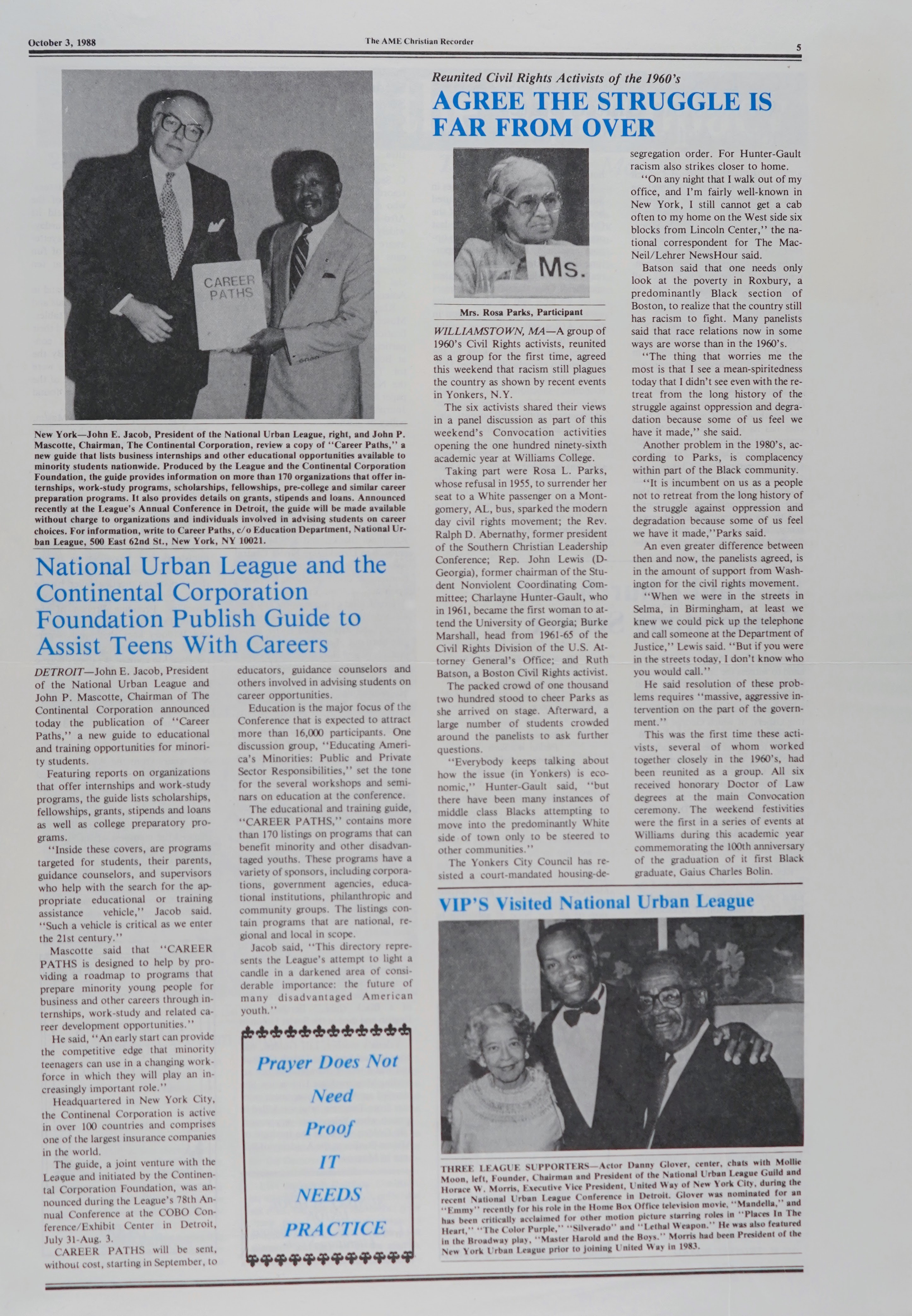
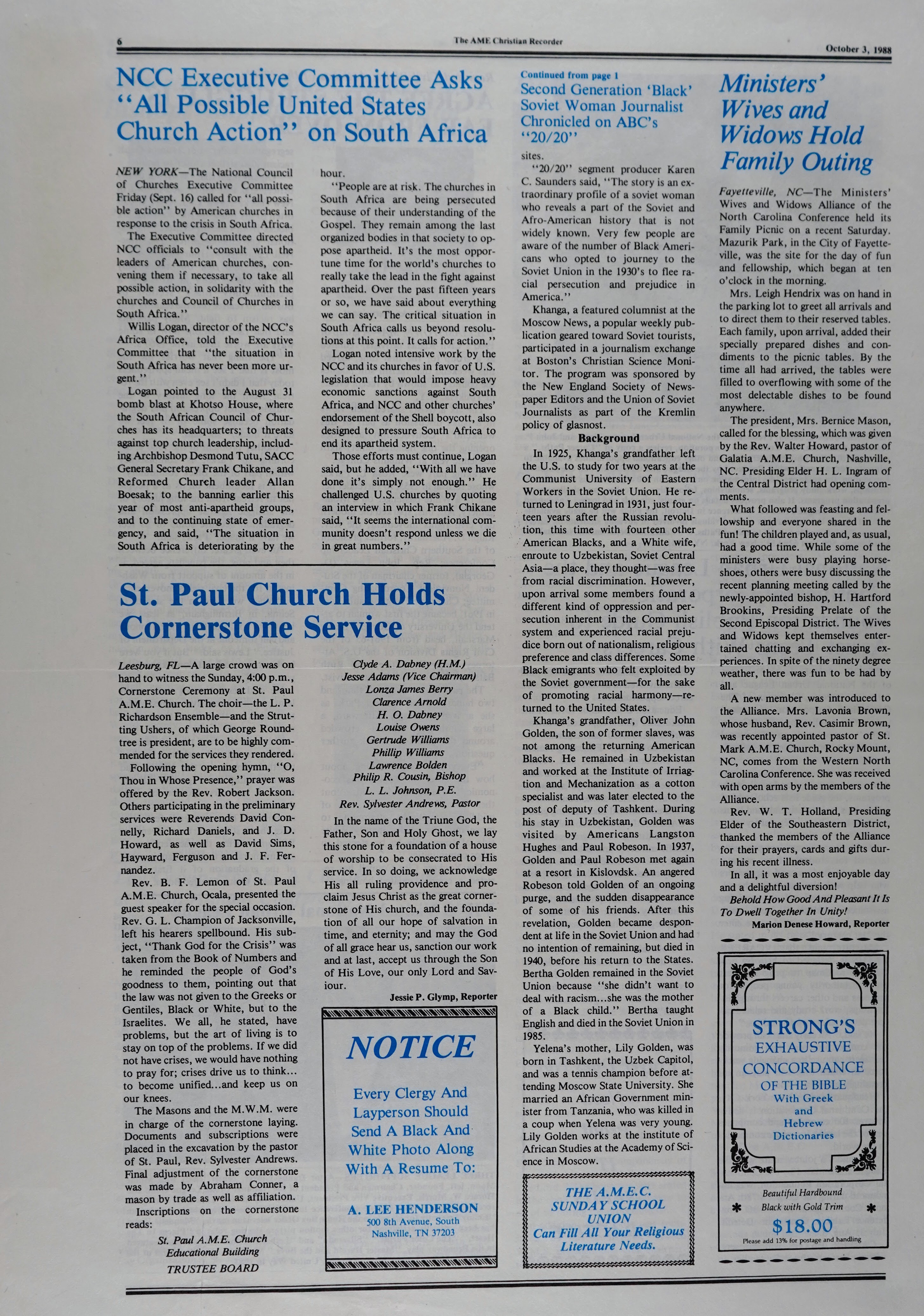
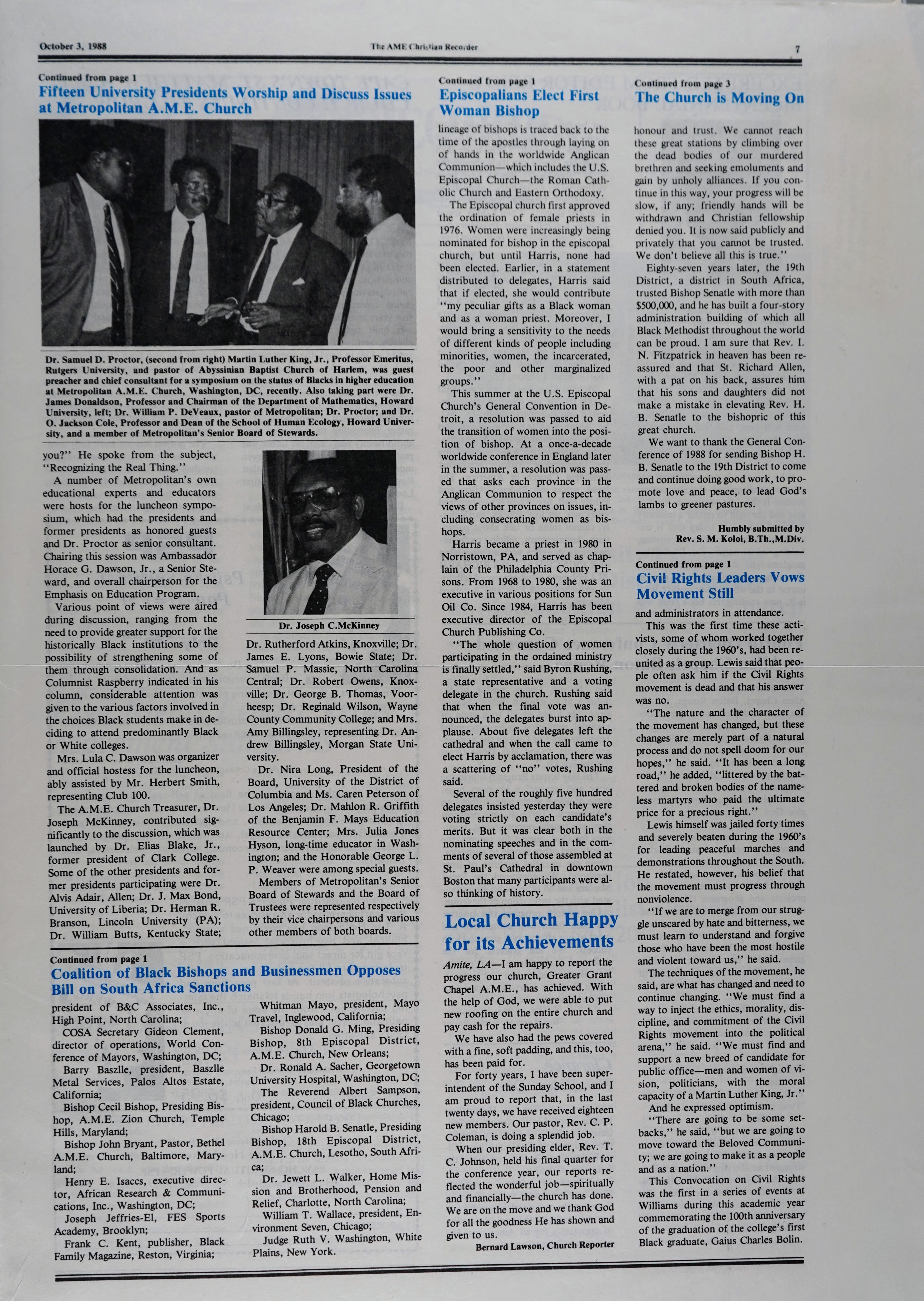
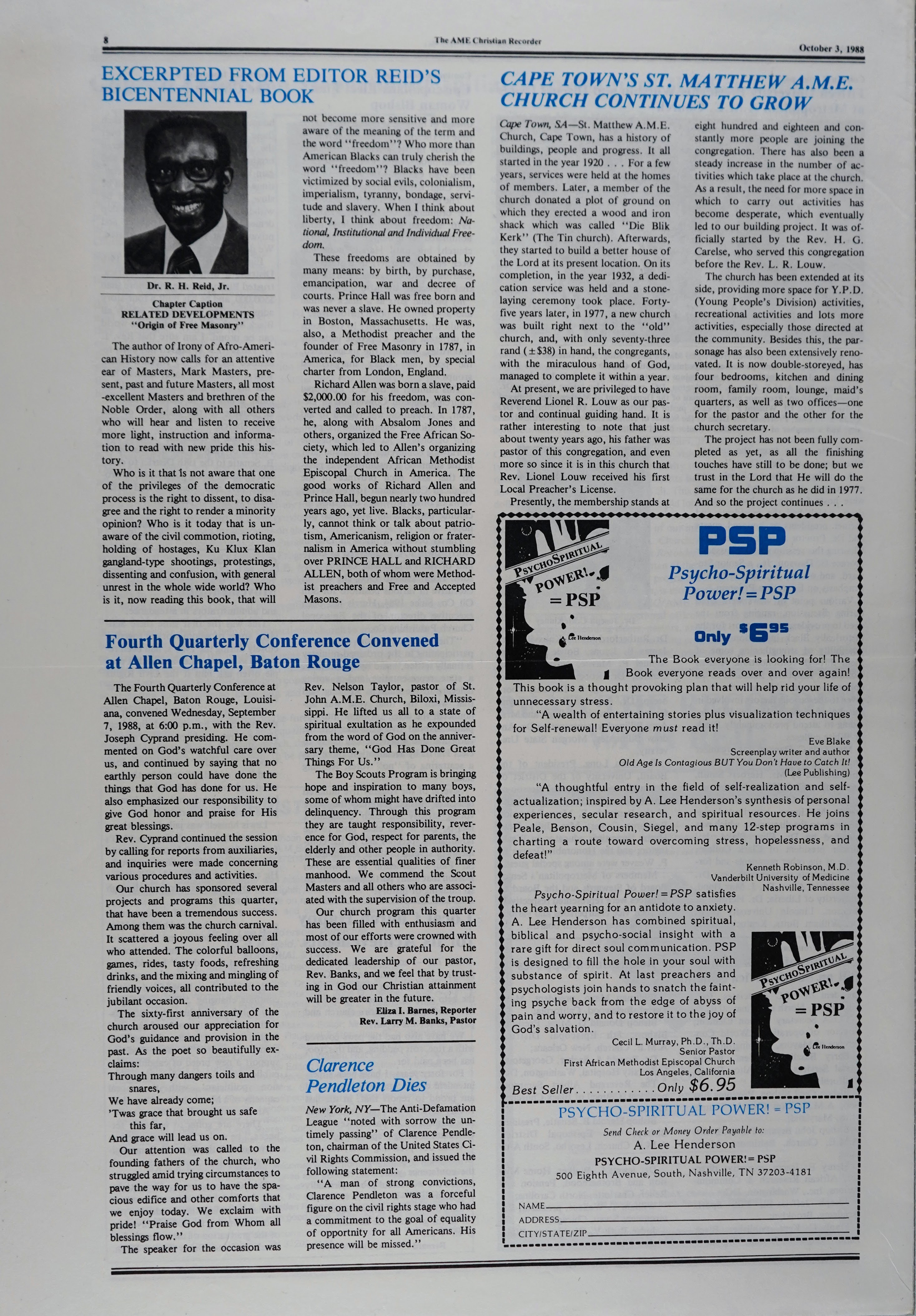
-
Title
-
October 3, 1988
-
Description
-
===== DSC05697.JPG =====
The AME Christian Recorder
Th OFFICIAL ORGAN
Hit AFRICAN METHODIST EPISCOPAL CHURCH
a
Vol. 138, No. 1
October 3, 1988
Coalition of Black Bishops and
Businessmen Opposes Bill
on South Africa Sanctions
WASHINGTON, DC—The following
statement was issued by Bishop
Richard L. Fisher, president of the
Coalition on Southern Africa (COSA),
an organization of businessmen, bis-
hops and ministers representing 7.5
million Black church members. Bis-
hop Fisher is Presiding Bishop, 11th
Episcopal District, A.M.E. Zion
Church, St. Louis.
“The Coalition on South Africa
(COSA), committed to the absolute
elimination of apartheid in South
Africa, calls on the people, President
and Congress of the United States to
encourage a re-examination of our na-
tional position on South Africa. We
are concerned with the evil of the
apartheid system and the rightful an-
ger that system engenders has often
obscured the need to focus on the
source of our major concern—the
Black people of South Africa.
*‘In our eagerness to dispense solu-
tions from afar, we have not often
listened to the voices of the Black
workers, teachers, farmers and busi-
nessmen who have been hurt by in-
creased unemployment, disinvestment
and sanctions. COSA reaffirms its
belief that both the private and public
sectors must be encouraged to maxi-
mize all opportunities throughout
South Africa to improve the quality of
life and secure political equality for
Black South Africans. It has become
obvious that if this is to be done, we
need a continued and vigorous Ameri-
can church, corporate, university,
government presence in South Africa.
To that end, we encourage Congress
not to place obstacles to the role
which the corporate and private sec-
tors are playing to bring about real
change in South Africa. We encourage
innovative legislation to open up
South Africa to greater American in-
fluence designed to bring about
peaceful movement toward a non-ra-
cial democracy in South Africa.”’
In addition to Bishop Fisher, COSA
board members are:
COSA Chairman Robert J. Brown,
Please turn to page 7
Civil Rights Leader Vows
Movement Still Lives
WILLIAMSTOWN, MA—Rep. John
Lewis (D-Georgia) claimed today that
the Civil Rights movement has merely
changed, not died.
‘““We have lost some of our finest
leaders, but we are still very much in-
volved in that same movement for
liberation,’’ Lewis said in an address
at the Convocation officially opening
the 196th academic year at Williams
College. ‘‘Our struggle is not for one
day, or one week, or one year, but for
a lifetime, if that is what it takes.’
Lewis, former chairman of the Stu-
dent Non-violent Coordinating Com-
mittee, received the honorary degree
of Doctor of Laws at the ceremony
along with Rosa L. Parks, whose re-
fusal in 1955 to surrender her seat toa
White passenger on a Montgomery,
AL, bus earned her the unofficial title
of ‘‘Mother of the Modern Day Civil
Rights Movement;’’ the Rev. Ralph
D. Abernathy, former president of the
Southern Christian Leadership Con-
ference; Charlayne Hunter-Gault, the
first Black woman to enroll at the
University of Georgia; Burke Mar-
shall, former head of the Civil Rights
Division of the U.S. Attorney
General’s Office; and Ruth M. Bat-
son, a Boston Civil Rights activist.
Parks received her honorary degree
to a standing ovation from the one
thousand students, faculty members,
Please turn to page 7
EPISCOPALIANS ELECT
FIRST WOMAN BISHOP
by John Diamond
BOSTON—Members of the nation’s
largest Episcopal diocese elected the
first woman bishop in the history of
the church yesterday.
Barbara C. Harris, fifty-eight, a
Black priest at Philadelphia’s Church
of the Advocate, was elected suffra-
gan, or assistant, bishop for the
eastern Massachusetts diocese, the
largest in the country with one hun-
dred ninety-two missions and parishes
and more than one hundred fifty thou-
sand members. After eight ballots,
Harris defeated the Rev. Marshall
Hunt, two hundred seventy-six to two
hundred twenty-four. When balloting
started, there were six candidates, in-
cluding two women.
Reached at her home in Philadel-
phia, Harris declined to comment im-
mediately. Later, a spokeswoman said
Harris would respond after her ser-
mon at the Church of the Advocate.
The election marks the first time a
woman has been brought into the his-
toric line of apostolic succession. The
Please turn to page 7
PRICE: 50 CENTS
African
Methodist
Episcopal
Church
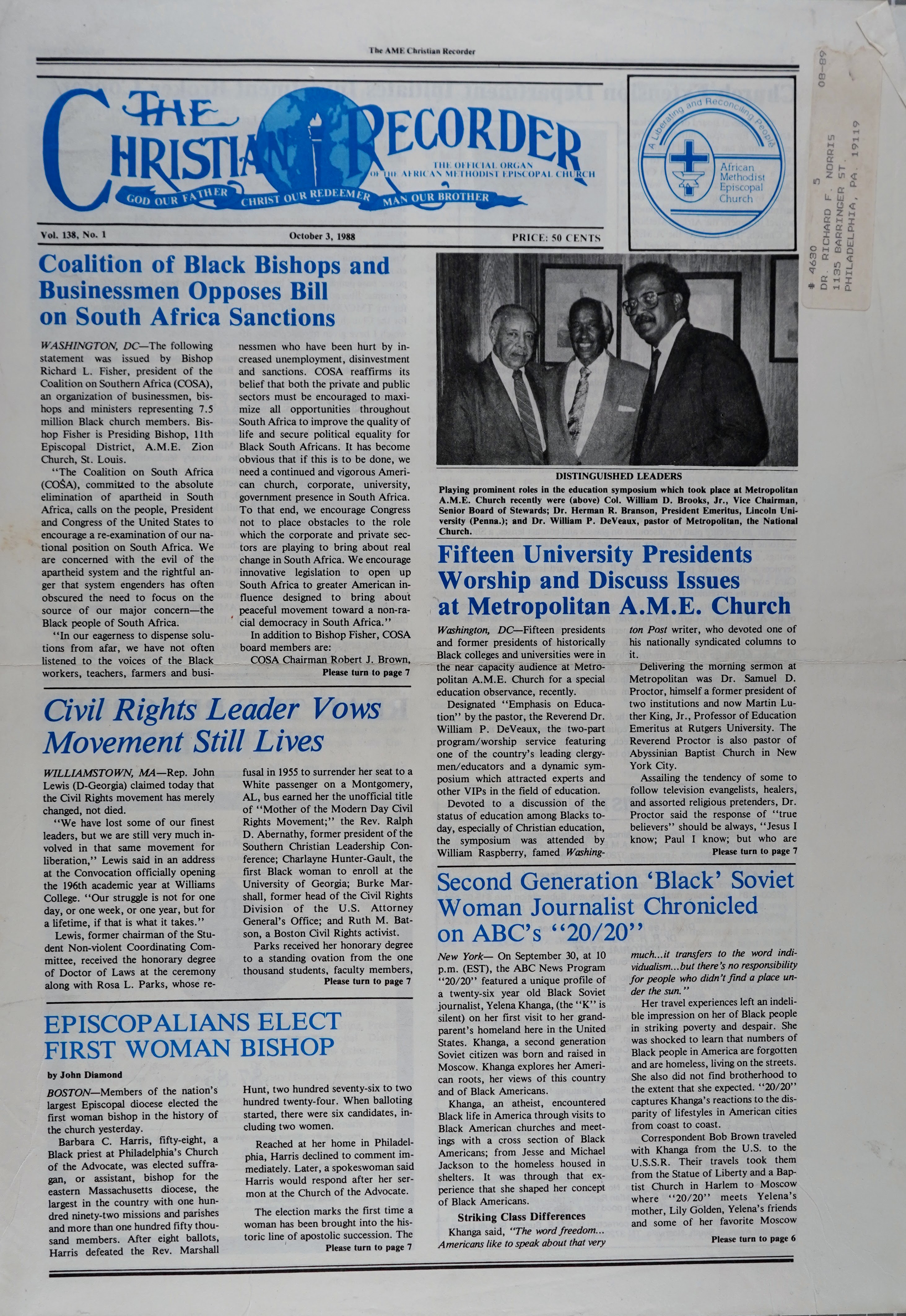
DISTINGUISHED LEADERS
Playing prominent roles in the education symposium which took place at Metropolitan
A.M.E. Church recently were (above) Col. William D. Brooks, Jr., Vice Chairman,
Senior Board of Stewards; Dr. Herman R. Branson, President Emeritus, Lincoln Uni-
versity (Penna.); and Dr. William P. DeVeaux, pastor of Metropolitan, the National
Church.
Fifteen University Presidents
Worship and Discuss Issues
at Metropolitan A.M.E. Church
Washington, DC—Fifteen presidents
and former presidents of historically
Black colleges and universities were in
the near capacity audience at Metro-
politan A.M.E. Church for a special
education observance, recently.
Designated ‘‘Emphasis on Educa-
tion’’ by the pastor, the Reverend Dr.
William P. DeVeaux, the two-part
program/worship service featuring
one of the country’s leading clergy-
men/educators and a dynamic sym-
posium which attracted experts and
other VIPs in the field of education.
Devoted to a discussion of the
status of education among Blacks to-
day, especially of Christian education,
the symposium was attended by
William Raspberry, famed Washing-
ton Post writer, who devoted one of
his nationally syndicated columns to
it.
Delivering the morning sermon at
Metropolitan was Dr. Samuel D.
Proctor, himself a former president of
two institutions and now Martin Lu-
ther King, Jr., Professor of Education
Emeritus at Rutgers University. The
Reverend Proctor is also pastor of
Abyssinian Baptist Church in New
York City.
Assailing the tendency of some to
follow television evangelists, healers,
and assorted religious pretenders, Dr.
Proctor said the response of ‘“‘true
believers’’ should be always, ‘‘Jesus I
know; Paul I know; but who are
Please turn to page 7
Second Generation ‘Black’ Soviet
Woman Journalist Chronicled
on ABC’s ‘‘20/20’’
New York— On September 30, at 10
p.m. (EST), the ABC News Program
“20/20”? featured a unique profile of
a twenty-six year old Black Soviet
journalist, Yelena Khanga, (the ‘‘K’’ is
silent) on her first visit to her grand-
parent’s homeland here in the United
States. Khanga, a second generation
Soviet citizen was born and raised in
Moscow. Khanga explores her Ameri-
can roots, her views of this country
and of Black Americans.
Khanga, an atheist, encountered
Black life in America through visits to
Black American churches and meet-
ings with a cross section of Black
Americans; from Jesse and Michael
Jackson to the homeless housed in
shelters. It was through that ex-
perience that she shaped her concept
of Black Americans.
Striking Class Differences
Khanga said, “The word freedom...
Americans like to speak about that very
much...it transfers to the word indi-
vidualism...but there’s no responsibility
for people who didn’t find a place un-
der the sun.”
Her travel experiences left an indeli-
ble impression on her of Black people
in striking poverty and despair. She
was shocked to learn that numbers of
Black people in America are forgotten
and are homeless, living on the streets.
She also did not find brotherhood to
the extent that she expected. ‘‘20/20”’
captures Khanga’s reactions to the dis-
parity of lifestyles in American cities
from coast to coast.
Correspondent Bob Brown traveled
with Khanga from the U.S. to the
U.S.S.R. Their travels took them
from the Statue of Liberty and a Bap-
tist Church in Harlem to Moscow
where ‘‘20/20’? meets Yelena’s
mother, Lily Golden, Yelena’s friends
and some of her favorite Moscow
Please turn to page 6
SS S50 Oeoeowom—__—_—o
08-Rf9
NORRIS
S
vw
PA
RICHARD F
# 4630
1135 BARRINGER
PHILADELPHIA
DR
19119
=
===== DSC05698.JPG =====
: ihe AME. Christian Recorder
October 3, 1988
Church Extension Department Initiates Investment Broker Concept
The General Board of the African
Methodist Episcopal Church, in its re-
cent meeting, has approved Innovative
Consumer Services, Inc, (ICS) to pro-
vide a special A.M.E. Church Credit
Card. This program concept was in-
itiated by the Church Extension De-
partment as an economic development
project to benefit the African Method-
ist Church. The project, the A.M.E,
Church Credit Card, is designed to
generate several millions of dollars
that will help fund many denomina-
tional needs.
The basic idea is that each time
the A.M.E. Church Credit Card is
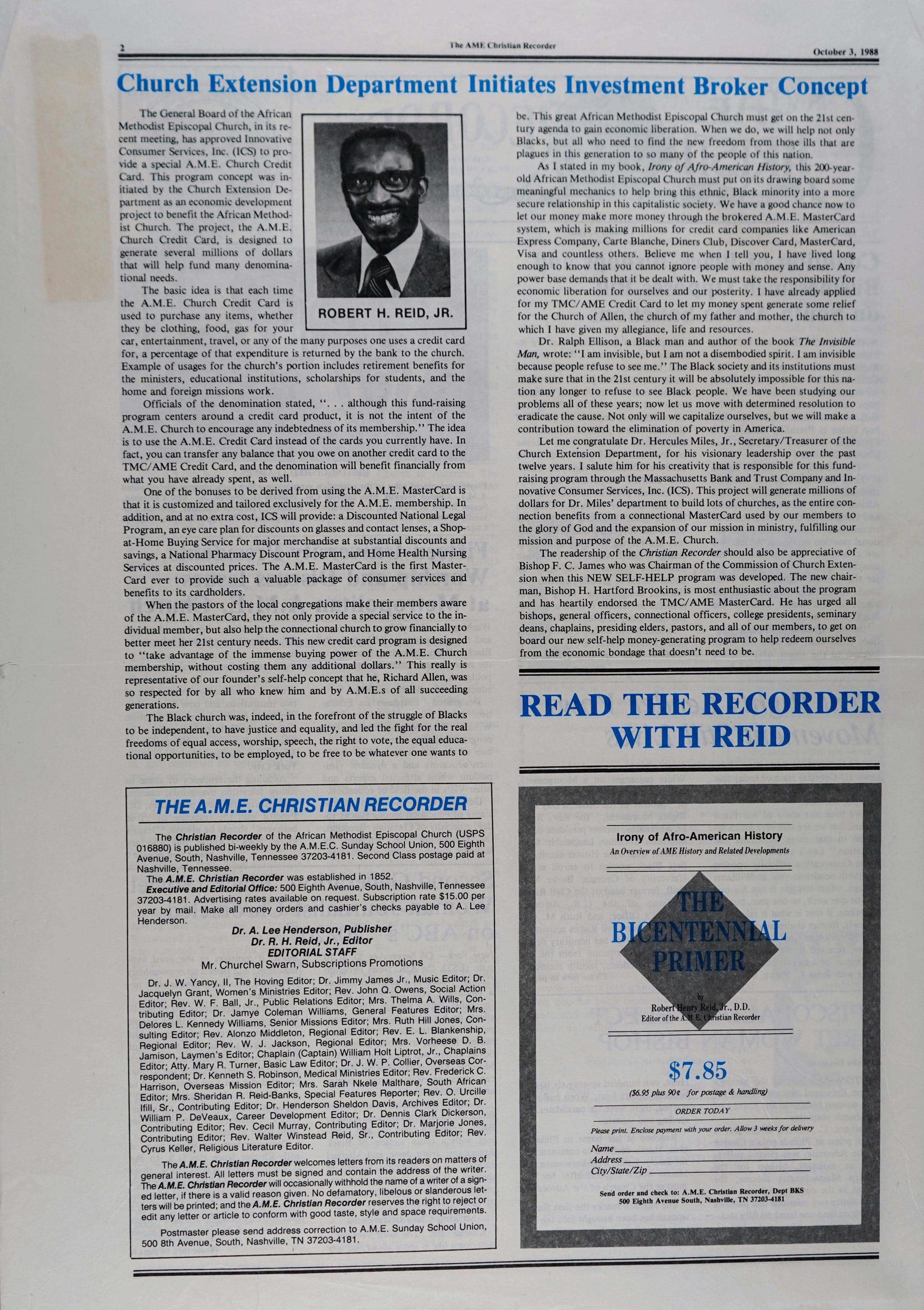
used to purchase any items, whether ROBERT H. REID, JR.
they be clothing, food, gas for your
car, entertainment, travel, or any of the many purposes one uses a credit card
for, a percentage of that expenditure is returned by the bank to the church.
Example of usages for the church’s portion includes retirement benefits for
the ministers, educational institutions, scholarships for students, and the
home and foreign missions work.
Officials of the denomination stated, ‘‘. . . although this fund-raising
program centers around a credit card product, it is not the intent of the
A.M.E. Church to encourage any indebtedness of its membership.’’ The idea
is to use the A.M.E. Credit Card instead of the cards you currently have. In
fact, you can transfer any balance that you owe on another credit card to the
TMC/AME Credit Card, and the denomination will benefit financially from
what you have already spent, as well.
One of the bonuses to be derived from using the A.M.E. MasterCard is
that it is customized and tailored exclusively for the A.M.E. membership. In
addition, and at no extra cost, ICS will provide: a Discounted National Legal
Program, an eye care plan for discounts on glasses and contact lenses, a Shop-
at-Home Buying Service for major merchandise at substantial discounts and
savings, a National Pharmacy Discount Program, and Home Health Nursing
Services at discounted prices. The A.M.E. MasterCard is the first Master-
Card ever to provide such a valuable package of consumer services and
benefits to its cardholders.
When the pastors of the local congregations make their members aware
of the A.M.E. MasterCard, they not only provide a special service to the in-
dividual member, but also help the connectional church to grow financially to
better meet her 21st century needs. This new credit card program is designed
to ‘take advantage of the immense buying power of the A.M.E. Church
membership, without costing them any additional dollars.” This really is
representative of our founder’s self-help concept that he, Richard Allen, was
so respected for by all who knew him and by A.M.E.s of all succeeding
generations.
The Black church was, indeed, in the forefront of the struggle of Blacks
to be independent, to have justice and equality, and led the fight for the real
freedoms of equal access, worship, speech, the right to vote, the equal educa-
tional opportunities, to be employed, to be free to be whatever one wants to
THE A.M.E. CHRISTIAN RECORDER
be. This great African Methodist Episcopal Church must get on the 21st cen-
tury agenda to gain economic liberation, When we do, we will help not only
Blacks, but all who need to find the new freedom from those ills that are
plagues in this generation to so many of the people of this nation.
As I stated in my book, /rony of Afro-American History, this 200-year-
old African Methodist Episcopal Church must put on its drawing board some
meaningful mechanics to help bring this ethnic, Black minority into a more
secure relationship in this capitalistic society. We have a good chance now to
let our money make more money through the brokered A.M.E. MasterCard
system, which is making millions for credit card companies like American
Express Company, Carte Blanche, Diners Club, Discover Card, MasterCard,
Visa and countless others, Believe me when I tell you, I have lived long
enough to know that you cannot ignore people with money and sense, Any
power base demands that it be dealt with. We must take the responsibility for
economic liberation for ourselves and our posterity, I have already applied
for my TMC/AME Credit Card to let my money spent generate some relief
for the Church of Allen, the church of my father and mother, the church to
which I have given my allegiance, life and resources.
Dr. Ralph Ellison, a Black man and author of the book The Invisible
Man, wrote: ‘‘I am invisible, but I am not a disembodied spirit. I am invisible
because people refuse to see me.’’ The Black society and its institutions must
make sure that in the 21st century it will be absolutely impossible for this na-
tion any longer to refuse to see Black people. We have been studying our
problems all of these years; now let us move with determined resolution to
eradicate the cause. Not only will we capitalize ourselves, but we will make a
contribution toward the elimination of poverty in America.
Let me congratulate Dr. Hercules Miles, Jr., Secretary/Treasurer of the
Church Extension Department, for his visionary leadership over the past
twelve years. I salute him for his creativity that is responsible for this fund-
raising program through the Massachusetts Bank and Trust Company and In-
novative Consumer Services, Inc. (ICS). This project will generate millions of
dollars for Dr. Miles’ department to build lots of churches, as the entire con-
nection benefits from a connectional MasterCard used by our members to
the glory of God and the expansion of our mission in ministry, fulfilling our
mission and purpose of the A.M.E. Church.
The readership of the Christian Recorder should also be appreciative of
Bishop F. C. James who was Chairman of the Commission of Church Exten-
sion when this NEW SELF-HELP program was developed. The new chair-
man, Bishop H. Hartford Brookins, is most enthusiastic about the program
and has heartily endorsed the TMC/AME MasterCard. He has urged all
bishops, general officers, connectional officers, college presidents, seminary
deans, chaplains, presiding elders, pastors, and all of our members, to get on
board our new self-help money-generating program to help redeem ourselves
from the economic bondage that doesn’t need to be.
READ THE RECORDER
WITH REID
The Christian Recorder of the African Methodist Episcopal Church (USPS
016880) is published bi-weekly by the A.M.E.C. Sunday School Union, 500 Eighth
Avenue, South, Nashville, Tennessee 37203-4181. Second Class postage paid at
Nashville, Tennessee.
The A.M.E. Christian Recorder was established in 1852.
Executive and Editorial Office: 500 Eighth Avenue, South, Nashville, Tennessee
37203-4181. Advertising rates available on request. Subscription rate $15.00 per
year by mail. Make all money orders and cashier’s checks payable to A.. Lee
Henderson.
Irony of Afro-American History
An Overview of AME History and Related Developments
Dr. A. Lee Henderson, Publisher
Dr. R. H. Reid, Jr., Editor
EDITORIAL STAFF
Mr. Churchel Swarn, Subscriptions Promotions
Dr. J. W. Yancy, Il, The Roving Editor; Dr. Jimmy James Jr., Music Editor; Dr.
Jacquelyn Grant, Women’s Ministries Editor; Rev. John Q. Owens, Social Action
Editor; Rev. W. F. Ball, Jr., Public Relations Editor; Mrs. Thelma A. Wills, Con-
tributing Editor; Dr. Jamye Coleman Williams, General Features Editor; Mrs.
Delores L. Kennedy Williams, Senior Missions Editor; Mrs. Ruth Hill Jones, Con-
sulting Editor; Rev. Alonzo Middleton, Regional Editor; Rev. E. L. Blankenship,
Regional Editor; Rev. W. J. Jackson, Regional Editor; Mrs. Vorheese D. B.
Jamison, Laymen’s Editor; Chaplain (Captain) William Holt Liptrot, Jr., Chaplains
Editor; Atty. Mary R. Turner, Basic Law Editor; Dr. J. W. P. Collier, Overseas Cor-
respondent; Dr. Kenneth S. Robinson, Medical Ministries Editor; Rev. Frederick C.
Harrison, Overseas Mission Editor; Mrs. Sarah Nkele Malthare, South African
Editor; Mrs. Sheridan R. Reid-Banks, Special Features Reporter; Rev. O. Urcille
Ifill, Sr., Contributing Editor; Dr. Henderson Sheldon Davis, Archives Editor, Dr.
William P. DeVeaux, Career Development Editor; Dr. Dennis Clark Dickerson,
Contributing Editor; Rev. Cecil Murray, Contributing Editor; Dr. Marjorie Jones,
Contributing Editor; Rev. Walter Winstead Reid, Sr., Contributing Editor; Rev.
Cyrus Keller, Religious Literature Editor.
The A.M.E. Christian Recorder welcomes letters from its readers on matters of
general interest. All letters must be signed and contain the address of the writer.
The A.M.E. Christian Recorder will occasionally withhold the name of a writer of a sign-
ed letter, if there is a valid reason given. No defamatory, libelous or slanderous let-
ters will be printed; and the A.M.E. Christian Recorder reserves the right to reject or
edit any letter or article to conform with good taste, style and space requirements.
Robe
Editor of the AY
(36.95 plus 90¢ for postage & handling)
ORDER TODAY
Please print. Enclose payment with your order. Allow 3 weeks for delivery
Ob/State/Zip._ —$_$_—__$_—5_
Send order and check to: A.M.E, Christian Recorder, Dept BKS
500 Eighth Avenue South, Nashville, TN 37203-4181
Postmaster please send address correction to A.M.E. Sunday School Union,
500 8th Avenue, South, Nashville, TN 37203-4181.
===== DSC05699.JPG =====
October 3, 1988
)
The AME Christian Recorder
The Voice of the Episcopac
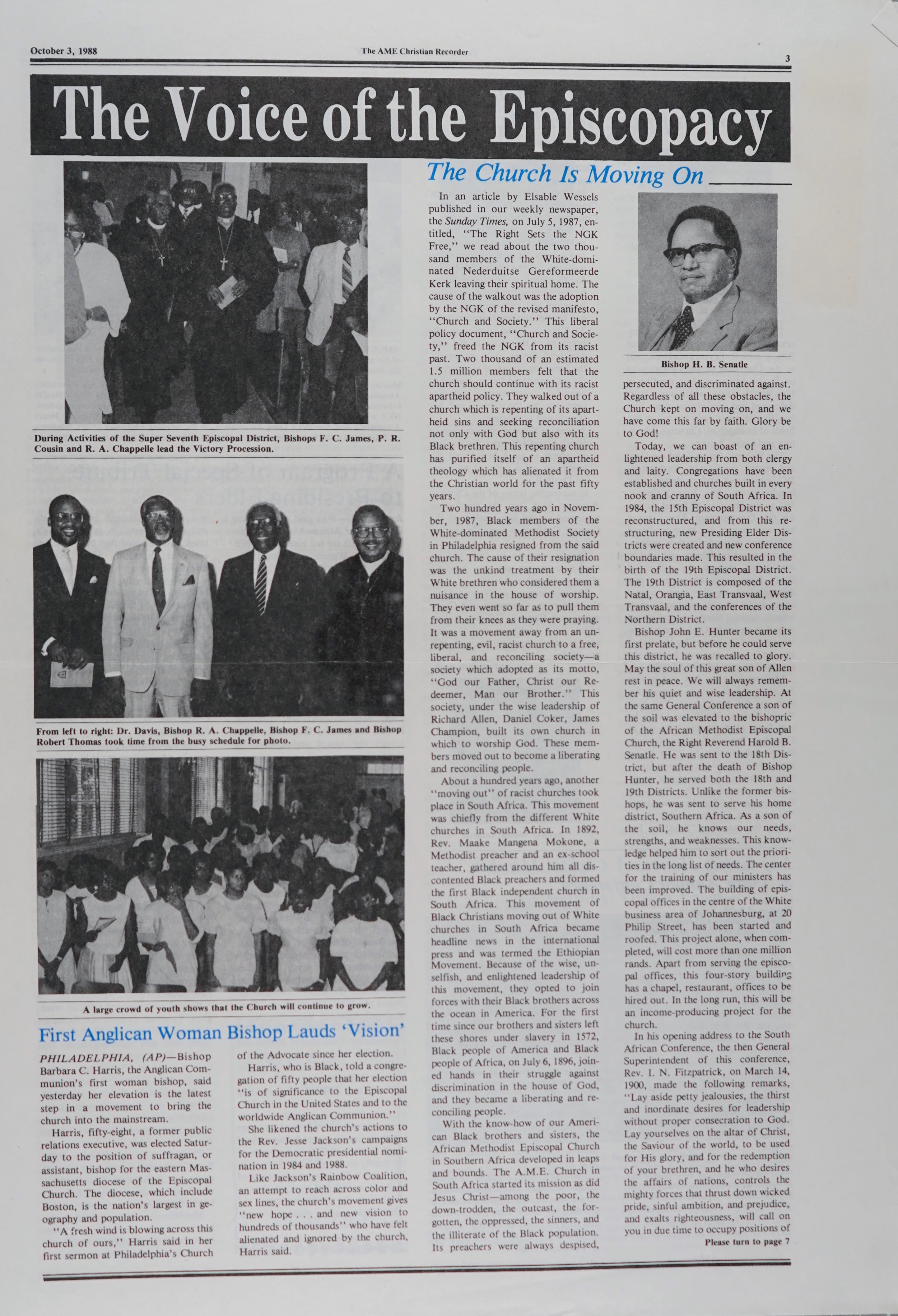
During Activities of the Super Seventh Episcopal District, Bishops F. C. James, P. R.
Cousin and R. A. Chappelle lead the Victory Procession.
From left to right: Dr. Davis, Bishop R. A. Chappelle, Bishop F. C. James and Bishop
Robert Thomas took time from the busy schedule for photo.
A large crowd of youth shows that the Church will continue to grow.
First Anglican Woman Bishop Lauds ‘Vision’
PHILADELPHIA, (AP)—Bishop
Barbara C. Harris, the Anglican Com-
munion’s first woman bishop, said
yesterday her elevation is the latest
step in a movement to bring the
church into the mainstream.
Harris, fifty-eight, a former public
relations executive, was elected Satur-
day to the position of suffragan, or
assistant, bishop for the eastern Mas-
sachusetts diocese of the Episcopal
Church, The diocese, which include
Boston, is the nation’s largest in ge-
ography and population.
“A fresh wind is blowing across this
church of ours,’’ Harris said in her
first sermon at Philadelphia’s Church
of the Advocate since her election.
Harris, who is Black, told a congre-
gation of fifty people that her election
“is of significance to the Episcopal
Church in the United States and to the
worldwide Anglican Communion,””
She likened the church’s actions to
the Rev. Jesse Jackson’s campaigns
for the Democratic presidential nomi-
nation in 1984 and 1988.
Like Jackson’s Rainbow Coalition,
an attempt to reach across color and
sex lines, the church’s movement gives
“new hope... and new vision to
hundreds of thousands’’ who have felt
alienated and ignored by the church,
Harris said.
The Church Is Moving O
In an article by Elsable Wessels
published in our weekly newspaper,
the Sunday Times, on July 5, 1987, en-
titled, ‘‘The Right Sets the NGK
Free,’’ we read about the two thou-
sand members of the White-domi-
nated Nederduitse Gereformeerde
Kerk leaving their spiritual home. The
cause of the walkout was the adoption
by the NGK of the revised manifesto,
“Church and Society.’’ This liberal
policy document, ‘‘Church and Socie-
ty,’’ freed the NGK from its racist
past. Two thousand of an estimated
1.5 million members felt that the
church should continue with its racist
apartheid policy. They walked out of a
church which is repenting of its apart-
heid sins and seeking reconciliation
not only with God but also with its
Black brethren. This repenting church
has purified itself of an apartheid
theology which has alienated it from
the Christian world for the past fifty
years.
Two hundred years ago in Novem-
ber, 1987, Black members of the
White-dominated Methodist Society
in Philadelphia resigned from the said
church. The cause of their resignation
was the unkind treatment by their
White brethren who considered them a
nuisance in the house of worship.
They even went so far as to pull them
from their knees as they were praying.
It was a movement away from an un-
repenting, evil, racist church to a free,
liberal, and reconciling society—a
society which adopted as its motto,
“God our Father, Christ our Re-
deemer, Man our Brother.’’ This
society, under the wise leadership of
Richard Allen, Daniel Coker, James
Champion, built its own church in
which to worship God. These mem-
bers moved out to become a liberating
and reconciling people.
About a hundred years ago, another
‘‘moving out’’ of racist churches took
place in South Africa, This movement
was chiefly from the different White
churches in South Africa. In 1892,
Rev. Maake Mangena Mokone, a
Methodist preacher and an ex-school
teacher, gathered around him all dis-
contented Black preachers and formed
the first Black independent church in
South Africa. This movement of
Black Christians moving out of White
churches in South Africa became
headline news in the international
press and was termed the Ethiopian
Movement, Because of the wise, un-
selfish, and enlightened leadership of
this movement, they opted to join
forces with their Black brothers across
the ocean in America. For the first
time since our brothers and sisters left
these shores under slavery in 1572,
Black people of America and Black
people of Africa, on July 6, 1896, join
ed hands in their struggle against
discrimination in the house of God,
and they became a liberating and re-
conciling people.
With the know-how of our Ameri-
can Black brothers and sisters, the
African Methodist Episcopal Church
in Southern Africa developed in leaps
and bounds. The A.M.E. Church in
South Africa started its mission as did
Jesus Christ—among the poor, the
down-trodden, the outcast, the for
gotten, the oppressed, the sinners, and
the illiterate of the Black population
Its preachers were always despised,
LG
Bishop H. B. Senatle
persecuted, and discriminated against.
Regardless of all these obstacles, the
Church kept on moving on, and we
have come this far by faith. Glory be
to God!
Today, we can boast of an en-
lightened leadership from both clergy
and laity. Congregations have been
established and churches built in every
nook and cranny of South Africa. In
1984, the 15th Episcopal District was
reconstructured, and from this re-
structuring, new Presiding Elder Dis-
tricts were created and new conference
boundaries made. This resulted in the
birth of the 19th Episcopal District.
The 19th District is composed of the
Natal, Orangia, East Transvaal, West
Transvaal, and the conferences of the
Northern District.
Bishop John E. Hunter became its
first prelate, but before he could serve
this district, he was recalled to glory.
May the soul of this great son of Allen
rest in peace. We will always remem-
ber his quiet and wise leadership. At
the same General Conference a son of
the soil was elevated to the bishopric
of the African Methodist Episcopal
Church, the Right Reverend Harold B.
Senatle. He was sent to the 18th Dis-
trict, but after the death of Bishop
Hunter, he served both the 18th and
19th Districts. Unlike the former bis-
hops, he was sent to serve his home
district, Southern Africa. As a son of
the soil, he knows our needs,
strengths, and weaknesses. This know-
ledge helped him to sort out the priori-
ties in the long list of needs. The center
for the training of our ministers has
been improved. The building of epis-
copal offices in the centre of the White
business area of Johannesburg, at 20
Philip Street, has been started and
roofed. This project alone, when com-
pleted, will cost more than one million
rands. Apart from serving the episco-
pal offices, this four-story building
has a chapel, restaurant, offices to be
hired out. In the long run, this will be
an income-producing project for the
church,
In his opening address to the South
African Conference, the then General
Superintendent of this conference,
Rev. I. N. Fitzpatrick, on March 14,
1900, made the following remarks,
‘Lay aside petty jealousies, the thirst
and inordinate desires for leadership
without proper consecration to God.
Lay yourselves on the altar of Christ,
the Saviour of the world, to be used
for His glory, and for the redemption
of your brethren, and he who desires
the affairs of nations, controls the
mighty forces that thrust down wicked
pride, sinful ambition, and prejudice,
and exalts righteousness, will call on
you in due time to occupy positions of
Please turn to page 7
===== DSC05700.JPG =====
The AME Christian Recorder
October 3, 1988
General Board and Council of
Bishops Support Social Action
Bishop John R. Bryant
The Bishops’ Council and the Gen-
eral Board nominated and elected
Bishop John R. Bryant (newly-elected)
as the Chairman of the Commission
on Social Action at their meeting in
Fort Worth, Texas, which was a most
welcomed and wise choice, since Bis-
hop Bryant has a long history in the
fields of Evangelism, Christian Educa-
tion and Social Action.
The Bishops’ Council and the Gen-
eral Board meeting in Washington,
DC, nominated and re-elected your
humble servant, Rev. John Q. Owens,
Jr., as the Director of Social Action
for this Quadrennium. May I pause
here and express my most profound
and sincere gratitude for their actions,
which express confidence and trust in
my ability, through the offices of
God’s Holy Spirit, to represent our
denomination in the many arenas
where social inaction need to be chal-
lenged. Again, I thank you and pledge
myself to be led by God, by my Com-
mission and its leader, by the Board
and the Council, as we try to serve the
present age, our calling to fulfill.
Mail reaching my desk and waiting
for my response include requests for
help and for funds from: The New
World Society; The Rural Crisis Is-
sues Team of the National Council of
Churches; Project Equality; Impact;
Renew Subscription to ‘‘The Wing-
spread Journal’’ of the Johnson Foun-
dation; Invitation to pertinent work-
shops sponsored by the Oklahoma
Conference of Churches; newsletter
“Lights, on Christian-Jewish Rela-
tion’’; the magazine ‘‘Southern Ex-
posure,’’ Unsettling Images, A Por-
trait of American Agriculture; ‘‘One
World’ of the World Council of
Churches; and many individual letters
requesting information and support,
The General Board and the Bishops’
Council adopted the Social Action
Committee’s recommendations to:
1, Seek the support of each Episco-
pal Prelate, Presiding Elder, Pastor
and Layperson as it pertains to in-
volvement in the upcoming election
for President of the United States,
by committing to voting, voter reg-
istration and providing education
and transportation where needed,
2. Take a stand deploring the
bombing of the office of the anti-
apartheid forces and, conversely,
the bombing or use of violence by
the anti-apartheid forces, instead of
peaceful negotiations, including
sanctions by the Group and her
friends and supporters.
3. Seeking the stay of execution of
South Africa’s Sharpesville Six (one
of whom is an A.M.E.) and the
twenty-six other political prisoners
on Death Row.
In succeeding issues of the Christian
Recorder look for the resolutions
presented to the last session of the
General Conference pertaining to So-
cial Action.
There’s much to be done and we
need your prayers and your support;
please be liberal with both.
The past support of Bishops Mor-
ris, Anderson, Cummings and Chap-
pelle, and General Officers Keller,
Miles, Reid, McKinney and Hender-
son is much appreciated and still
prayed for.
GOD BLESS OUR ZION
John Q. Owens, Director
Lay Group Honors A Charter Member
at 150th Annual Conference
by Jasper C. Wilder
Director of Public Relations
Indiana Conference Lay Organization
African Methodist Episcopal Church
The 150th Session of the Indiana
Annual Conference was held August
18-21, 1988, at Bethel A.M.E. Church,
Richmond, Indiana, with Rev. Larry
Bell, Host Pastor, Rev. William
Sampson Nelson, Host Presiding El-
der, the Rt. Rev. Samuel Soloman
Morris, Presiding Bishop. Bethel
Church is one of the oldest A.M.E.
Churches in the Indiana Conference.
One of the most memorable high-
lights of the conference was the Lay
Organization Banquet held on Satur-
day night, August 20, 1988, at the
Radisson Hotel in Richmond. Mr. Ar-
thur D. Dodson, ninety, a charter
member of the forty-six-year old Lay
Organization of the Indiana Confer-
ence was honored for his many years
of untiring service to the organization.
He has been a loyal member of St.
John A.M.E. Church, Indianapolis
since 1926. In 1942, he organized the
Lay Organization at St. John, and sub-
Arthur D. Dodson
Charter Member of Indiana
Conference Lay Organization
ty three years. Mr. Dodson helped or-
ganize the Indiana Conference Lay Or-
ganization and sixteen local church or-
ganizations. In 1983, he received the
Indiana Conference Layman of the
Year award.
The eighty-five member Indiana
Conference Male Chorus performed a
mini-concert to highlight the occasion
attended by more than one hundred
and fifty members of the fourth Epis-
copal District of The African Method-
ist Episcopal Church.
21st Century Kick Off Campaig
Hen me
4
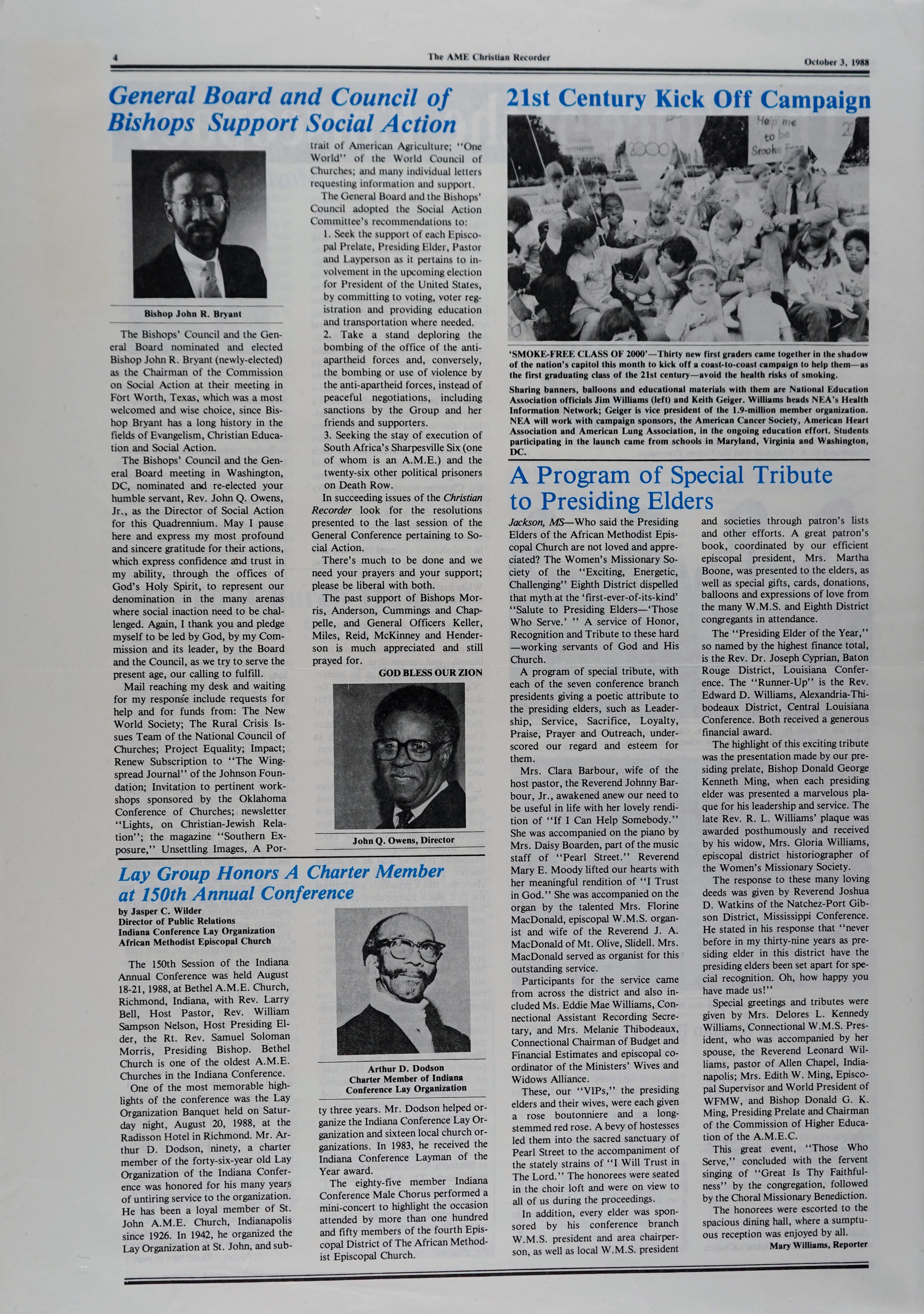
‘SMOKE-FREE CLASS OF 2000’—Thirty new first graders came together in the shadow
of the nation’s capitol this month to kick off a coast-to-coast campaign to help them—as
the first graduating class of the 21st century—avoid the health risks of smoking.
Sharing banners, balloons and educational materials with them are National Education
Association officials Jim Williams (left) and Keith Geiger. Williams heads NEA’s Health
Information Network; Geiger is vice president of the 1.9-million member organization.
NEA will work with campaign sponsors, the American Cancer Society, American Heart
Association and American Lung Association, in the ongoing education effort. Students
participating in the launch came from schools in Maryland, Virginia and Washington,
DC.
A Program of Special Tribute
to Presiding Elders
Jackson, MS—Who said the Presiding
Elders of the African Methodist Epis-
copal Church are not loved and appre-
ciated? The Women’s Missionary So-
ciety of the ‘‘Exciting, Energetic,
Challenging’ Eighth District dispelled
that myth at the ‘first-ever-of-its-kind’
“Salute to Presiding Elders—‘Those
Who Serve.’ ’’ A service of Honor,
Recognition and Tribute to these hard
—working servants of God and His
Church.
A program of special tribute, with
each of the seven conference branch
presidents giving a poetic attribute to
the presiding elders, such as Leader-
ship, Service, Sacrifice, Loyalty,
Praise, Prayer and Outreach, under-
scored our regard and esteem for
them.
Mrs. Clara Barbour, wife of the
host pastor, the Reverend Johnny Bar-
bour, Jr., awakened anew our need to
be useful in life with her lovely rendi-
tion of ‘‘If I Can Help Somebody.”’
She was accompanied on the piano by
Mrs. Daisy Boarden, part of the music
staff of ‘‘Pearl Street.’’ Reverend
Mary E. Moody lifted our hearts with
her meaningful rendition of ‘‘I Trust
in God.’’ She was accompanied on the
organ by the talented Mrs. Florine
MacDonald, episcopal W.M.S. organ-
ist and wife of the Reverend J. A.
MacDonald of Mt. Olive, Slidell. Mrs.
MacDonald served as organist for this
outstanding service.
Participants for the service came
from across the district and also in-
cluded Ms. Eddie Mae Williams, Con-
nectional Assistant Recording Secre-
tary, and Mrs. Melanie Thibodeaux,
Connectional Chairman of Budget and
Financial Estimates and episcopal co-
ordinator of the Ministers’ Wives and
Widows Alliance.
These, our ‘‘VIPs,’’ the presiding
elders and their wives, were each given
a rose boutonniere and a_long-
stemmed red rose. A bevy of hostesses
led them into the sacred sanctuary of
Pearl Street to the accompaniment of
the stately strains of ‘‘I Will Trust in
The Lord.’’ The honorees were seated
in the choir loft and were on view to
all of us during the proceedings.
In addition, every elder was spon-
sored by his conference branch
W.M.S. president and area chairper-
son, as well as local W.M.S. president
and societies through patron’s lists
and other efforts. A great patron’s
book, coordinated by our efficient
episcopal president, Mrs. Martha
Boone, was presented to the elders, as
well as special gifts, cards, donations,
balloons and expressions of love from
the many W.M.S. and Eighth District
congregants in attendance.
The ‘‘Presiding Elder of the Year,’’
so named by the highest finance total,
is the Rev. Dr. Joseph Cyprian, Baton
Rouge District, Louisiana Confer-
ence. The ‘‘Runner-Up’’ is the Rev.
Edward D. Williams, Alexandria-Thi-
bodeaux District, Central Louisiana
Conference. Both received a generous
financial award.
The highlight of this exciting tribute
was the presentation made by our pre-
siding prelate, Bishop Donald George
Kenneth Ming, when each presiding
elder was presented a marvelous pla-
que for his leadership and service. The
late Rev. R. L. Williams’ plaque was
awarded posthumously and received
by his widow, Mrs. Gloria Williams,
episcopal district historiographer of
the Women’s Missionary Society.
The response to these many loving
deeds was given by Reverend Joshua
D. Watkins of the Natchez-Port Gib-
son District, Mississippi Conference.
He stated in his response that ‘‘never
before in my thirty-nine years as pre-
siding elder in this district have the
presiding elders been set apart for spe-
cial recognition. Oh, how happy you
have made us!”’
Special greetings and tributes were
given by Mrs. Delores L. Kennedy
Williams, Connectional W.M.S. Pres-
ident, who was accompanied by her
spouse, the Reverend Leonard Wil-
liams, pastor of Allen Chapel, India-
napolis; Mrs. Edith W. Ming, Episco-
pal Supervisor and World President of
WFMW, and Bishop Donald G. K.
Ming, Presiding Prelate and Chairman
of the Commission of Higher Educa-
tion of the A.M.E.C.
This great event, ‘‘Those Who
Serve,’’ concluded with the fervent
singing of ‘‘Great Is Thy Faithful-
ness’? by the congregation, followed
by the Choral Missionary Benediction.
The honorees were escorted to the
spacious dining hall, where a sumptu-
ous reception was enjoyed by all.
Mary Williams, Reporter
SSS SSS
===== DSC05701.JPG =====
October 3, 1988
The AME Christian Recorder
New York—John E. Jacob, President of the National Urban League, right, and John P.
Mascotte, Chairman, The Continental Corporation, review a copy of ‘‘Career Paths,’’ a
new guide that lists business internships and other educational opportunities available to
minority students nationwide. Produced by the League and the Continental Corporation
Foundation, the guide provides information on more than 170 organizations that offer in-
ternships, work-study programs, scholarships, fellowships, pre-college and similar career
preparation programs. It also provides details on grants, stipends and loans. Announced
recently at the League’s Annual Conference in Detroit, the guide will be made available
without charge to organizations and individuals involved in advising students on career
choices. For information, write to Career Paths, c/o Education Department, National Ur-
ban League, 500 East 62nd St., New York, NY 10021.
National Urban League and the
Continental Corporation
Foundation Publish Guide to
Assist Teens With Careers
DETROIT—John E. Jacob, President
of the National Urban League and
John P. Mascotte, Chairman of The
Continental Corporation announced
today the publication of ‘‘Career
Paths,’’ a new guide to educational
and training opportunities for minori-
ty students.
Featuring reports on organizations
that offer internships and work-study
programs, the guide lists scholarships,
fellowships, grants, stipends and loans
as well as college preparatory pro-
grams,
“Inside these covers, are programs
targeted for students, their parents,
guidance counselors, and supervisors
who help with the search for the ap-
propriate educational or training
assistance vehicle,’ Jacob said.
“Such a vehicle is critical as we enter
the 21st century.”’
Mascotte said that ‘‘CAREER
PATHS is designed to help by pro-
viding a roadmap to programs that
prepare minority young people for
business and other careers through in-
ternships, work-study and related ca-
reer development opportunities.’’
He said, ‘‘An early start can provide
the competitive edge that minority
teenagers can use in a changing work-
force in which they will play an in-
creasingly important role.”’
Headquartered in New York City,
the Continenal Corporation is active
in over 100 countries and comprises
one of the largest insurance companies
in the world.
The guide, a joint venture with the
League and initiated by the Continen-
tal Corporation Foundation, was an-
nounced during the League’s 78th An-
nual Conference at the COBO Con-
ference/Exhibit Center in Detroit,
July 31-Aug. 3.
CAREER PATHS will be sent,
without cost, starting in September, to
educators, guidance counselors and
others involved in advising students on
career opportunities.
Education is the major focus of the
Conference that is expected to attract
more than 16,000 participants. One
discussion group, ‘‘Educating Ameri-
ca’s Minorities: Public and Private
Sector Responsibilities,’’ set the tone
for the several workshops and semi-
nars on education at the conference.
The educational and training guide,
“CAREER PATHS,”’ contains more
than 170 listings on programs that can
benefit minority and other disadvan-
taged youths. These programs have a
variety of sponsors, including corpora-
tions, government agencies, educa-
tional institutions, philanthropic and
community groups. The listings con-
tain programs that are national, re-
gional and local in scope.
Jacob said, ‘*This directory repre-
sents the League’s atternpt to light a
candle in a darkened area of consi-
derable importance: the future of
many disadvantaged American
youth.”’
bbhbohteted
Prayer Does Not
Need
Proof
IT
NEEDS
PRACTICE
PPEPPEPFFF
Reunited Civil Rights Activists of the 1960’s
AGREE THE STRUGGLE IS
FAR FROM OVER
Mrs. Rosa Parks, Participant
WILLIAMSTOWN, MA—A group of
1960’s Civil Rights activists, reunited
as a group for the first time, agreed
this weekend that racism still plagues
the country as shown by recent events
in Yonkers, N.Y.
The six activists shared their views
in a panel discussion as part of this
weekend’s Convocation activities
opening the one hundred ninety-sixth
academic year at Williams College.
Taking part were Rosa L. Parks,
whose refusal in 1955, to surrender her
seat to a White passenger on a Mont-
gomery, AL, bus, sparked the modern
day civil rights movement; the Rev.
Ralph D. Abernathy, former president
of the Southern Christian Leadership
Conference; Rep. John Lewis (D-
Georgia), former chairman of the Stu-
dent Nonviolent Coordinating Com-
mittee; Charlayne Hunter-Gault, who
in 1961, became the first woman to at-
tend the University of Georgia; Burke
Marshall, head from 1961-65 of the
Civil Rights Division of the U.S. At-
torney General’s Office; and Ruth
Batson, a Boston Civil Rights activist.
The packed crowd of one thousand
two hundred stood to cheer Parks as
she arrived on stage. Afterward, a
large number of students crowded
around the panelists to ask further
questions.
“Everybody keeps talking about
how the issue (in Yonkers) is eco-
nomic,’’ Hunter-Gault said, ‘‘but
there have been many instances of
middle class Blacks attempting to
move into the predominantly White
side of town only to be steered to
other communities.”’
The Yonkers City Council has re-
sisted a court-mandated housing-de-
segregation order. For Hunter-Gault
racism also strikes closer to home.
“‘On any night that I walk out of my
office, and I’m fairly well-known in
New York, I still cannot get a cab
often to my home on the West side six
blocks from Lincoln Center,’’ the na-
tional correspondent for The Mac-
Neil/Lehrer NewsHour said.
Batson said that one needs only
look at the poverty in Roxbury, a
predominantly Black section of
Boston, to realize that the country still
has racism to fight. Many panelists
said that race relations now in some
ways are worse than in the 1960’s.
“The thing that worries me the
most is that I see a mean-spiritedness
today that I didn’t see even with the re-
treat from the long history of the
struggle against oppression and degra-
dation because some of us feel we
have it made,”’ she said.
Another problem in the 1980’s, ac-
cording to Parks, is complacency
within part of the Black community.
“It is incumbent on us as a people
not to retreat from the long history of
the struggle against oppression and
degradation because some of us feel
we have it made,’’Parks said.
An even greater difference between
then and now, the panelists agreed, is
in the amount of support from Wash-
ington for the civil rights movement.
‘“‘When we were in the streets in
Selma, in Birmingham, at least we
knew we could pick up the telephone
and call someone at the Department of
Justice,’’ Lewis said. ‘But if you were
in the streets today, | don’t know who
you would call.”
He said resolution of these prob-
lems requires ‘‘massive, aggressive in-
tervention on the part of the govern-
ment.””
This was the first time these acti-
vists, several of whom worked
together closely in the 1960's, had
been reunited as a group. All six
received honorary Doctor of Law
degrees at the main Convocation
ceremony. The weekend festivities
were the first in a series of events at
Williams during this academic year
commemorating the 100th anniversary
of the graduation of it first Black
graduate, Gaius Charles Bolin.
VIP’S Visited National Urban League
THREE LEAGUE SUPPORTERS— Actor Danny Glover, center, chats with Mollie
Moon, left, Founder, Chairman and President of the National Urban League Guild and
Horace W. Morris, Executive Vice President, United Way of New York City, during the
recent National Urban League Conference in Detroit. Glover was nominated for an
“Emmy” recently for his role in the Home Box Office television movie, “‘Mandella,”’ and
has been critically acclaimed for other motion picture starring roles in ‘‘Places In The
Heart,’ “The Color Purple,”’ ‘*Silverado” and ‘Lethal Weapon.”’ He was also featured
in the Broadway play, ‘Master Harold and the Boys.’’ Morris had been President of the
New York Urban League prior to joining United Way in 1983.
===== DSC05702.JPG =====
6
The AME. Christian Recorder
ee October 3, 1988
NCC Executive Committee Asks
**All Possible United States
Church Action’’ on South Africa
NEW YORK—The National Council
of Churches Executive Committee
Friday (Sept. 16) called for ‘‘all possi-
ble action’’ by American churches in
response to the crisis in South Africa.
The Executive Committee directed
NCC officials to ‘‘consult with the
leaders of American churches, con-
vening them if necessary, to take all
possible action, in solidarity with the
churches and Council of Churches in
South Africa.’’
Willis Logan, director of the NCC’s
Africa Office, told the Executive
Committee that ‘‘the situation in
South Africa has never been more ur-
gent.’’
Logan pointed to the August 31
bomb blast at Khotso House, where
the South African Council of Chur-
ches has its headquarters; to threats
against top church leadership, includ-
ing Archbishop Desmond Tutu, SACC
General Secretary Frank Chikane, and
Reformed Chureh leader Allan
Boesak; to the banning earlier this
year of most anti-apartheid groups,
and to the continuing state of emer-
gency, and said, ‘‘The situation in
South Africa is deteriorating by the
hour.
‘*People are at risk. The churches in
South Africa are being persecuted
because of their understanding of the
Gospel. They remain among the last
organized bodies in that society to op-
pose apartheid. It’s the most oppor-
tune time for the world’s churches to
really take the lead in the fight against
apartheid. Over the past fifteen years
or so, we have said about everything
we can say. The critical situation in
South Africa calls us beyond resolu-
tions at this point. It calls for action.’’
Logan noted intensive work by the
NCC and its churches in favor of U.S.
legislation that would impose heavy
economic sanctions against South
Africa, and NCC and other churches’
endorsement of the Shell boycott, also
designed to pressure South Africa to
end its apartheid system.
Those efforts must continue, Logan
said, but he added, ‘‘With all we have
done it’s simply not enough.’’ He
challenged U.S. churches by quoting
an interview in which Frank Chikane
said, ‘‘It seems the international com-
munity doesn’t respond unless we die
in great numbers.”’
St. Paul Church Holds
Cornerstone Service
Leesburg, FL—A large crowd was on
hand to witness the Sunday, 4:00 p.m.,
Cornerstone Ceremony at St. Paul
A.M.E. Church. The choir—the L. P.
Richardson Ensemble—and the Strut-
ting Ushers, of which George Round-
tree is president, are to be highly com-
mended for the services they rendered.
Following the opening hymn, ‘‘O,
Thou in Whose Presence,’’ prayer was
offered by the Rev. Robert Jackson.
Others participating in the preliminary
services were Reverends David Con-
nelly, Richard Daniels, and J. D.
Howard, as well as David Sims,
Hayward, Ferguson and J. F. Fer-
nandez.
Rev. B. F. Lemon of St. Paul
A.M.E. Church, Ocala, presented the
guest speaker for the special occasion.
Rev. G. L. Champion of Jacksonville,
left his hearers spellbound. His sub-
ject, ‘‘Thank God for the Crisis’’ was
taken from the Book of Numbers and
he reminded the people of God’s
goodness to them, pointing out that
the law was not given to the Greeks or
Gentiles, Black or White, but to the
Israelites. We all, he stated, have
problems, but the art of living is to
stay on top of the problems. If we did
not have crises, we would have nothing
to pray for; crises drive us to think...
to become unified...and keep us on
our knees.
The Masons and the M.W.M. were
in charge of the cornerstone laying.
Documents and subscriptions were
placed in the excavation by the pastor
of St. Paul, Rev. Sylvester Andrews.
Final adjustment of the cornerstone
was made by Abraham Conner, a
mason by trade as well as affiliation.
Inscriptions on the cornerstone
reads:
St. Paul A.M.E. Church
Educational Building
TRUSTEE BOARD
Clyde A. Dabney (H.M.)
Jesse Adams (Vice Chairman)
Lonza James Berry
Clarence Arnold
H. O. Dabney
Louise Owens
Gertrude Williams
Phillip Williams
Lawrence Bolden
Philip R. Cousin, Bishop
L. L. Johnson, P.E.
Rey. Sylvester Andrews, Pastor
In the name of the Triune God, the
Father, Son and Holy Ghost, we lay
this stone for a foundation of a house
of worship to be consecrated to His
service. In so doing, we acknowledge
His all ruling providence and pro-
claim Jesus Christ as the great corner-
stone of His church, and the founda-
tion of all our hope of salvation in
time, and eternity; and may the God
of all grace hear us, sanction our work
and at last, accept us through the Son
of His Love, our only Lord and Sav-
iour.
Jessie P. Glymp, Reporter
NOTICE
Every Clergy And
Layperson Should
Send A Black And:
White Photo Along
With A Resume To:
A. LEE HENDERSON
500 8th Avenue, South
Nashville, TN 37203
SANNA AANA ANA
Continued from page 1
Second Generation ‘Black’
Soviet Woman Journalist
Chronicled on ABC’s
**20/20”’
sites,
**20/20"’ segment producer Karen
C. Saunders said, ‘‘The story is an ex-
traordinary profile of a soviet woman
who reveals a part of the Soviet and
Afro-American history that is not
widely known, Very few people are
aware of the number of Black Ameri-
cans who opted to journey to the
Soviet Union in the 1930’s to flee ra-
cial persecution and prejudice in
America.’’
Khanga, a featured columnist at the
Moscow News, a popular weekly pub-
lication geared toward Soviet tourists,
participated in a journalism exchange
at Boston’s Christian Science Moni-
tor. The program was sponsored by
the New England Society of News-
paper Editors and the Union of Soviet
Journalists as part of the Kremlin
policy of glasnost.
Background
In 1925, Khanga’s grandfather left
the U.S. to study for two years at the
Communist University of Eastern
Workers in the Soviet Union. He re-
turned to Leningrad in 1931, just four-
teen years after the Russian revolu-
tion, this time with fourteen other
- American Blacks, and a White wife,
enroute to Uzbekistan, Soviet Central
Asia—a place, they thought—was free
from racial discrimination. However,
upon arrival some members found a
different kind of oppression and per-
secution inherent in the Communist
system and experienced racial preju-
dice born out of nationalism, religious
preference and class differences. Some
Black emigrants who felt exploited by
the Soviet government—for the sake
of promoting racial harmony—re-
turned to the United States.
Khanga’s grandfather, Oliver John
Golden, the son of former slaves, was
not among the returning American
Blacks. He remained in Uzbekistan
and worked at the Institute of Irriag-
tion and Mechanization as a cotton
specialist and was later elected to the
post of deputy of Tashkent. During
his stay in Uzbekistan, Golden was
visited by Americans Langston
Hughes and Paul Robeson. In 1937,
Golden and Paul Robeson met again
at a resort in Kislovdsk. An angered
Robeson told Golden of an ongoing
purge, and the sudden disappearance
of some of his friends. After this
revelation, Golden became despon-
dent at life in the Soviet Union and had
no intention of remaining, but died in
1940, before his return to the States.
Bertha Golden remained in the Soviet
Union because ‘‘she didn’t want to
deal with racism...she was the mother
of a Black child.’? Bertha taught
English and died in the Soviet Union in
1985.
Yelena’s mother, Lily Golden, was
born in Tashkent, the Uzbek Capitol,
and was a tennis champion before at-
tending Moscow State University. She
married an African Government min-
ister from Tanzania, who was killed in
a coup when Yelena was very young.
Lily Golden works at the institute of
African Studies at the Academy of Sci-
ence in Moscow.
THE A.M.E.C.
SUNDAY SCHOOL
UNION
Can Fill All Your Religious
Literature Needs.
Ministers’
Wives and
Widows Hold
Family Outing
Fayetteville, NC—The Ministers’
Wives and Widows Alliance of the
North Carolina Conference held its
Family Picnic on a recent Saturday.
Mazurik Park, in the City of Fayette-
ville, was the site for the day of fun
and fellowship, which began at ten
o’clock in the morning,
Mrs. Leigh Hendrix was on hand in
the parking lot to greet all arrivals and
to direct them to their reserved tables.
Each family, upon arrival, added their
specially prepared dishes and con-
diments to the picnic tables. By the
time all had arrived, the tables were
filled to overflowing with some of the
most delectable dishes to be found
anywhere.
The president, Mrs. Bernice Mason,
called for the blessing, which was given
by the Rev. Walter Howard, pastor of
Galatia A.M.E. Church, Nashville,
NC. Presiding Elder H. L. Ingram of
the Central District had opening com-
ments.
What followed was feasting and fel-
lowship and everyone shared in the
fun! The children played and, as usual,
had a good time. While some of the
ministers were busy playing horse-
shoes, others were busy discussing the
recent planning meeting called by the
newly-appointed bishop, H. Hartford
Brookins, Presiding Prelate of the
Second Episcopal District. The Wives
and Widows kept themselves enter-
tained chatting and exchanging ex-
periences. In spite of the ninety degree
weather, there was fun to be had by
all.
A new member was introduced to
the Alliance. Mrs. Lavonia Brown,
whose husband, Rev. Casimir Brown,
was recently appointed pastor of St.
Mark A.M.E. Church, Rocky Mount,
NC, comes from the Western North
Carolina Conference. She was received
with open arms by the members of the
Alliance.
Rev. W. T. Holland, Presiding
Elder of the Southeastern District,
thanked the members of the Alliance
for their prayers, cards and gifts dur-
ing his recent illness.
In all, it was a most enjoyable day
and a delightful diversion!
Behold How Good And Pleasant It Is
To Dwell Together In Unity!
Marion Denese Howard, Reporter
STRONG’S
EXHAUSTIVE
CONCORDANCE
OF THE BIBLE
With Greek
and
Hebrew
Dictionaries
Beautiful Hardbound
Black with Gold Trim
$18.00
Please add 13% for postage and handling,
-_ oe ow ow awe ae as ae
===== DSC05703.JPG =====
October 3, 1988
The AME Christian Recorder
Continued from page |
Fifteen University Presidents Worship and Discuss Issues
at Metropolitan A.M.E. Church
Dr. Samuel D. Proctor, (second from right) Martin Luther King, Jr., Professor Emeritus,
Rutgers University, and pastor of Abyssinian Baptist Church of Harlem, was guest
preacher and chief consultant for a symposium on the status of Blacks in higher education
at Metropolitan A.M.E. Church, Washington, DC, recently. Also taking part were Dr.
James Donaldson, Professor and Chairman of the Department of Mathematics, Howard
University, left; Dr. William P. DeVeaux, pastor of Metropolitan; Dr. Proctor; and Dr.
O. Jackson Cole, Professor and Dean of the School of Human Ecology, Howard Univer-
sity, and a member of Metropolitan’s Senior Board of Stewards.
you?”’? He spoke from the subject,
“Recognizing the Real Thing.’’
A number of Metropolitan’s own
educational experts and educators
were hosts for the luncheon sympo-
sium, which had the presidents and
former presidents as honored guests
and Dr. Proctor as senior consultant.
Chairing this session was Ambassador
Horace G. Dawson, Jr., a Senior Ste-
ward, and overall chairperson for the
Emphasis on Education Program.
Various point of views were aired
during discussion, ranging from the
need to provide greater support for the
historically Black institutions to the
possibility of strengthening some of
them through consolidation. And as
Columnist Raspberry indicated in his
column, considerable attention was
given to the various factors involved in
the choices Black students make in de-
ciding to attend predominantly Black
or White colleges.
Mrs. Lula C. Dawson was organizer
and official hostess for the luncheon,
ably assisted by Mr. Herbert Smith,
representing Club 100.
The A.M.E. Church Treasurer, Dr.
Joseph McKinney, contributed sig-
nificantly to the discussion, which was
launched by Dr. Elias Blake, Jr.,
former president of Clark College.
Some of the other presidents and for-
mer presidents participating were Dr.
Alvis Adair, Allen; Dr. J. Max Bond,
University of Liberia; Dr. Herman R.
Branson, Lincoln University (PA);
Dr. William Butts, Kentucky State;
Dr. Joseph C.McKinney
Dr. Rutherford Atkins, Knoxville; Dr.
James E. Lyons, Bowie State; Dr.
Samuel P. Massie, North Carolina
Central; Dr. Robert Owens, Knox-
ville; Dr. George B. Thomas, Voor-
heesp; Dr. Reginald Wilson, Wayne
County Community College; and Mrs.
Amy Billingsley, representing Dr. An-
drew Billingsley, Morgan State Uni-
versity.
Dr. Nira Long, President of the
Board, University of the District of
Columbia and Ms. Caren Peterson of
Los Angeles; Dr. Mahlon R. Griffith
of the Benjamin F. Mays Education
Resource Center; Mrs. Julia Jones
Hyson, long-time educator in Wash-
ington; and the Honorable George L.
P. Weaver were among special guests.
Members of Metropolitan’s Senior
Board of Stewards and the Board of
Trustees were represented respectively
by their vice chairpersons and various
other members of both boards.
ee ee
Continued from page 1
Coalition of Black Bishops and Businessmen Opposes
Bill on South Africa Sanctions
president of B&C Associates, Inc.,
High Point, North Carolina;
COSA Secretary Gideon Clement,
director of operations, World Con-
ference of Mayors, Washington, DC;
Barry Baszlle, president, Baszlle
Metal Services, Palos Altos Estate,
California;
Bishop Cecil Bishop, Presiding Bis-
hop, A.M.E. Zion Church, Temple
Hills, Maryland;
Bishop John Bryant, Pastor, Bethel
A.M.E. Church, Baltimore, Mary-
land;
Henry E. Isaccs, executive direc-
tor, African Research & Communi-
cations, Inc., Washington, DC;
Joseph Jeffries-El, FES Sports
Academy, Brooklyn;
Frank C. Kent, publisher, Black
Family Magazine, Reston, Virginia;
Whitman Mayo, president, Mayo
Travel, Inglewood, California;
Bishop Donald G. Ming, Presiding
Bishop, 8th Episcopal District,
A.M.E. Church, New Orleans;
Dr. Ronald A. Sacher, Georgetown
University Hospital, Washington, DC;
The Reverend Albert Sampson,
president, Council of Black Churches,
Chicago;
Bishop Harold B. Senatle, Presiding
Bishop, 18th Episcopal District,
A.M.E. Church, Lesotho, South Afri-
ca;
Dr. Jewett L. Walker, Home Mis-
sion and Brotherhood, Pension and
Relief, Charlotte, North Carolina;
William T. Wallace, president, En-
vironment Seven, Chicago;
Judge Ruth V. Washington, White
Plains, New York.
Continued from page |
Episcopalians Elect First
Woman Bishop
lineage of bishops is traced back to the
time of the apostles through laying on
of hands in the worldwide Anglican
Communion—which includes the U.S,
Episcopal Church—the Roman Cath-
olic Church and Eastern Orthodoxy.
The Episcopal church first approved
the ordination of female priests in
1976. Women were increasingly being
nominated for bishop in the episcopal
church, but until Harris, none had
been elected. Earlier, in a statement
distributed to delegates, Harris said
that if elected, she would contribute
“‘my peculiar gifts as a Black woman
and as a woman priest. Moreover, I
would bring a sensitivity to the needs
of different kinds of people including
minorities, women, the incarcerated,
the poor and other marginalized
groups.”’
This summer at the U.S. Episcopal
Church’s General Convention in De-
troit, a resolution was passed to aid
the transition of women into the posi-
tion of bishop. At a once-a-decade
worldwide conference in England later
in the summer, a resolution was pass-
ed that asks each province in the
Anglican Communion to respect the
views of other provinces on issues, in-
cluding consecrating women as bis-
hops.
Harris became a priest in 1980 in
Norristown, PA, and served as chap-
lain of the Philadelphia County Pri-
sons. From 1968 to 1980, she was an
executive in various positions for Sun
Oil Co. Since 1984, Harris has been
executive director of the Episcopal
Church Publishing Co.
“The whole question of women
participating in the ordained ministry
is finally settled,’ said Byron Rushing,
a state representative and a voting
delegate in the church. Rushing said
that when the final vote was an-
nounced, the delegates burst into ap-
plause. About five delegates left the
cathedral and when the call came to
elect Harris by acclamation, there was
a scattering of ‘‘no’’ votes, Rushing
said.
Several of the roughly five hundred
delegates insisted yesterday they were
voting strictly on each candidate’s
merits. But it was clear both in the
nominating speeches and in the com-
ments of several of those assembled at
St. Paul’s Cathedral in downtown
Boston that many participants were al-
so thinking of history.
Local Church Happy
for its Achievements
Amite, LA—I am happy to report the
progress our church, Greater Grant
Chapel A.M.E., has achieved. With
the help of God, we were able to put
new roofing on the entire church and
pay cash for the repairs.
We have also had the pews covered
with a fine, soft padding, and this, too,
has been paid for.
For forty years, I have been super-
intendent of the Sunday School, and I
am proud to report that, in the last
twenty days, we have received eighteen
new members. Our pastor, Rev. C. P.
Coleman, is doing a splendid job.
When our presiding elder, Rev. T.
C. Johnson, held his final quarter for
the conference year, our reports re-
flected the wonderful job—spiritually
and financially—the church has done.
We are on the move and we thank God
for all the goodness He has shown and
given to us.
Bernard Lawson, Church Reporter
Continued from page 3
The Church is Moving On
honour and trust. We cannot reach
these great stations by climbing over
the dead bodies of our murdered
brethren and seeking emoluments and
gain by unholy alliances. If you con-
tinue in this way, your progress will be
slow, if any; friendly hands will be
withdrawn and Christian fellowship
denied you. It is now said publicly and
privately that you cannot be trusted,
We don’t believe all this is true.’’
Eighty-seven years later, the 19th
District, a district in South Africa,
trusted Bishop Senatle with more than
$500,000, and he has built a four-story
administration building of which all
Black Methodist throughout the world
can be proud. I am sure that Rev. I.
N. Fitzpatrick in heaven has been re-
assured and that St. Richard Allen,
with a pat on his back, assures him
that his sons and daughters did not
make a mistake in elevating Rev. H.
B. Senatle to the bishopric of this
great church.
We want to thank the General Con-
ference of 1988 for sending Bishop H.
B. Senatle to the 19th District to come
and continue doing good work, to pro-
mote love and peace, to lead God’s
lambs to greener pastures.
Humbly submitted by
Rev. S. M. Koloi, B.Th.,M.Div.
Continued from page 1
Civil Rights Leaders Vows
Movement Still
and administrators in attendance.
This was the first time these acti-
vists, some of whom worked together
closely during the 1960’s, had been re-
united as a group. Lewis said that peo-
ple often ask him if the Civil Rights
movement is dead and that his answer
was no.
“The nature and the character of
the movement has changed, but these
changes are merely part of a natural
process and do not spell doom for our
hopes,’’ he said. ‘‘It has been a long
road,’’ he added, ‘‘littered by the bat-
tered and broken bodies of the name-
less martyrs who paid the ultimate
price for a precious right.’’
Lewis himself was jailed forty times
and severely beaten during the 1960’s
for leading peaceful marches and
demonstrations throughout the South.
He restated, however, his belief that
the movement must progress through
nonviolence.
“If we are to merge from our strug-
gle unscared by hate and bitterness, we
must learn to understand and forgive
those who have been the most hostile
and violent toward us,’’ he said.
The techniques of the movement, he
said, are what has changed and need to
continue changing. ‘‘We must find a
way to inject the ethics, morality, dis-
cipline, and commitment of the Civil
Rights movement into the political
arena,”’ he said. ‘‘We must find and
support a new breed of candidate for
public office—men and women of vi-
sion, politicians, with the moral
capacity of a Martin Luther King, Jr. i
And he expressed optimism.
“There are going to be some set-
backs,’”’ he said, ‘‘but we are going to
move toward the Beloved Communi-
ty; we are going to make it as a people
and as a nation.”’
This Convocation on Civil Rights
was the first in a series of events at
Williams during this academic year
commemorating the 100th anniversary
of the graduation of the college’s first
Black graduate, Gaius Charles Bolin.
EE
===== DSC05704.JPG =====
The AME Christian Recorder
EXCERPTED FROM EDITOR REID’S
BICENTENNIAL BOOK
Dr. R. H. Reid, Jr.
Chapter Caption
RELATED DEVELOPMENTS
“Origin of Free Masonry”’
The author of Irony of Afro-Ameri-
can History now calls for an attentive
ear of Masters, Mark Masters, pre-
sent, past and future Masters, all most
-excellent Masters and brethren of the
Noble Order, along with all others
who will hear and listen to receive
more light, instruction and informa-
tion to read with new pride this his-
tory.
Who is it that is not aware that one
of the privileges of the democratic
process is the right to dissent, to disa-
gree and the right to render a minority
opinion? Who is it today that is un-
aware of the civil commotion, rioting,
holding of hostages, Ku Klux Klan
gangland-type shootings, protestings,
dissenting and confusion, with general
unrest in the whole wide world? Who
is it, now reading this book, that will
not become more sensitive and more
aware of the meaning of the term and
the word ‘‘freedom’’? Who more than
American Blacks can truly cherish the
word ‘‘freedom’’? Blacks have been
victimized by social evils, colonialism,
imperialism, tyranny, bondage, servi-
tude and slavery. When I think about
liberty, I think about freedom: Na-
tional, Institutional and Individual Free-
dom.
These freedoms are obtained by
many means: by birth, by purchase,
emancipation, war and decree of
courts. Prince Hall was free born and
was never a slave. He owned property
in Boston, Massachusetts. He was,
also, a Methodist preacher and the
founder of Free Masonry in 1787, in
America, for Black men, by special
charter from London, England.
Richard Allen was born a slave, paid
$2,000.00 for his freedom, was con-
verted and called to preach. In 1787,
he, along with Absalom Jones and
others, organized the Free African So-
ciety, which led to Allen’s organizing
the independent African Methodist
Episcopal Church in America. The
good works of Richard Allen and
Prince Hall, begun nearly two hundred
years ago, yet live. Blacks, particular-
ly, cannot think or talk about patrio-
tism, Americanism, religion or frater-
nalism in America without stumbling
over PRINCE HALL and RICHARD
ALLEN, both of whom were Method-
ist preachers and Free and Accepted
Masons.
Fourth Quarterly Conference Convened
at Allen Chapel, Baton Rouge
The Fourth Quarterly Conference at
Allen Chapel, Baton Rouge, Louisi-
ana, convened Wednesday, September
7, 1988, at 6:00 p.m., with the Rev.
Joseph Cyprand presiding. He com-
mented on God’s watchful care over
us, and continued by saying that no
earthly person could have done the
things that God has done for us. He
also emphasized our responsibility to
give God honor and praise for His
great blessings.
Rev. Cyprand continued the session
by calling for reports from auxiliaries,
and inquiries were made concerning
various procedures and activities.
Our church has sponsored several
projects and programs this quarter,
that have been a tremendous success.
Among them was the church carnival.
It scattered a joyous feeling over all
who attended. The colorful balloons,
games, rides, tasty foods, refreshing
drinks, and the mixing and mingling of
friendly voices, all contributed to the
jubilant occasion.
The sixty-first anniversary of the
church aroused our appreciation for
God’s guidance and provision in the
past. As the poet so beautifully ex-
claims:
Through many dangers toils and
snares,
We have already come;
’Twas grace that brought us safe
this far,
And grace will lead us on.
Our attention was called to the
founding fathers of the church, who
struggled amid trying circumstances to
pave the way for us to have the spa-
cious edifice and other comforts that
we enjoy today. We exclaim with
pride! ‘‘Praise God from Whom all
blessings flow.’’ :
The speaker for the occasion was
Rev. Nelson Taylor, pastor of St.
John A.M.E. Church, Biloxi, Missis-
sippi. He lifted us all to a state of
spiritual exultation as he expounded
from the word of God on the anniver-
sary theme, ‘‘God Has Done Great
Things For Us.”’
The Boy Scouts Program is bringing
hope and inspiration to many boys,
some of whom might have drifted into
delinquency. Through this program
they are taught responsibility, rever-
ence for God, respect for parents, the
elderly and other people in authority.
These are essential qualities of finer
manhood. We commend the Scout
Masters and all others who are associ-
ated with the supervision of the troup.
Our church program this quarter
has been filled with enthusiasm and
most of our efforts were crowned with
success. We are grateful for the
dedicated leadership of our pastor,
Rev. Banks, and we feel that by trust-
ing in God our Christian attainment
will be greater in the future.
Eliza I. Barnes, Reporter
Rev. Larry M. Banks, Pastor
Clarence
Pendleton Dies
New York, NY—The Anti-Defamation
League ‘‘noted with sorrow the un-
timely passing’? of Clarence Pendle-
ton, chairman of the United States Ci-
vil Rights Commission, and issued the
following statement:
“A man of strong convictions,
Clarence Pendleton was a forceful
figure on the civil rights stage who had
a commitment to the goal of equality
of opportnity for all Americans. His
presence will be missed.”
October 3, 1988
CAPE TOWN’S ST. MATTHEW A.M.E.
CHURCH CONTINUES TO GROW
Cape Town, SA—St, Matthew A.M.E.
Church, Cape Town, has a history of
buildings, people and progress. It all
started in the year 1920. . . For a few
years, services were held at the homes
of members. Later, a member of the
church donated a plot of ground on
which they erected a wood and iron
shack which was called ‘‘Die Blik
Kerk’’ (The Tin church). Afterwards,
they started to build a better house of
the Lord at its present location, On its
completion, in the year 1932, a dedi-
cation service was held and a stone-
laying ceremony took place. Forty-
five years later, in 1977, a new church
was built right next to the ‘‘old’’
church, and, with only seventy-three
rand (+ $38) in hand, the congregants,
with the miraculous hand of God,
managed to complete it within a year.
At present, we are privileged to have
Reverend Lionel R. Louw as our pas-
tor and continual guiding hand. It is
rather interesting to note that just
about twenty years ago, his father was
pastor of this congregation, and even
more so since it is in this church that
Rev. Lionel Louw received his first
Local Preacher’s License.
Presently, the membership stands at
unnecessary stress.
defeat!”
God’s salvation.
CITY/STATE/ZIP
Psycho-Spiritual
Power! =PSP
The Book everyone is looking for! The
Book everyone reads over and over again!
This book is a thought provoking plan that will help rid your life of
“A wealth of entertaining stories plus visualization techniques
for Self-renewal! Everyone must read it!
Old Age Is Contagious BUT You Don’t Have to Catch It!
“A thoughtful entry in the field of self-realization and self-
actualization; inspired by A. Lee Henderson’s synthesis of personal
experiences, secular research, and spiritual resources. He joins
Peale, Benson, Cousin, Siegel, and many 12-step programs in
charting a route toward overcoming stress, hopelessness, and
Psycho-Spiritual Power! =PSP satisfies
the heart yearning for an antidote to anxiety.
A. Lee Henderson has combined spiritual,
biblical and psycho-social insight with a
rare gift for direct soul communication. PSP
is designed to fill the hole in your soul with
substance of spirit. At last preachers and
psychologists join hands to snatch the faint-
ing psyche back from the edge of abyss of
pain and worry, and to restore it to the joy of
Cecil L. Murray, Ph.D., Th.D.
Senior Pastor
First African Methodist Episcopal Church
Los Angeles, California
Best Seller... a: ascae Only $6. 95
PSYCHO-SPIRITUAL POWER! = PSP
Send Check or Money Order Payable to:
A. Lee Henderson
PSYCHO-SPIRITUAL POWER!= PSP
500 Eighth Avenue, South, Nashville, TN 37203-4181
NAME ————_—___— ee ———— ee
ADDRESS ————__$_$ ———— — — — — — — — — — ——————
eight hundred and eighteen and con-
stantly more people are joining the
congregation. There has also been a
steady increase in the number of ac-
tivities which take place at the church,
As a result, the need for more space in
which to carry out activities has
become desperate, which eventually
led to our building project. It was of-
ficially started by the Rev. H. G,
Carelse, who served this congregation
before the Rev. L. R, Louw,
The church has been extended at its
side, providing more space for Y.P.D.
(Young People’s Division) activities,
recreational activities and lots more
activities, especially those directed at
the community. Besides this, the par-
sonage has also been extensively reno-
vated. It is now double-storeyed, has
four bedrooms, kitchen and dining
room, family room, lounge, maid’s
quarters, as well as two offices—one
for the pastor and the other for the
church secretary.
The project has not been fully com-
pleted as yet, as all the finishing
touches have still to be done; but we
trust in the Lord that He will do the
same for the church as he did in 1977.
And so the project continues . . .
only *G**
Eve Blake
Screenplay writer and author
(Lee Publishing)
Kenneth Robinson, M.D.
Vanderbilt University of Medicine
Nashville, Tennessee
a SSSSSSS—morn—_o_o—mov
-
Date
-
1988-10-3