-
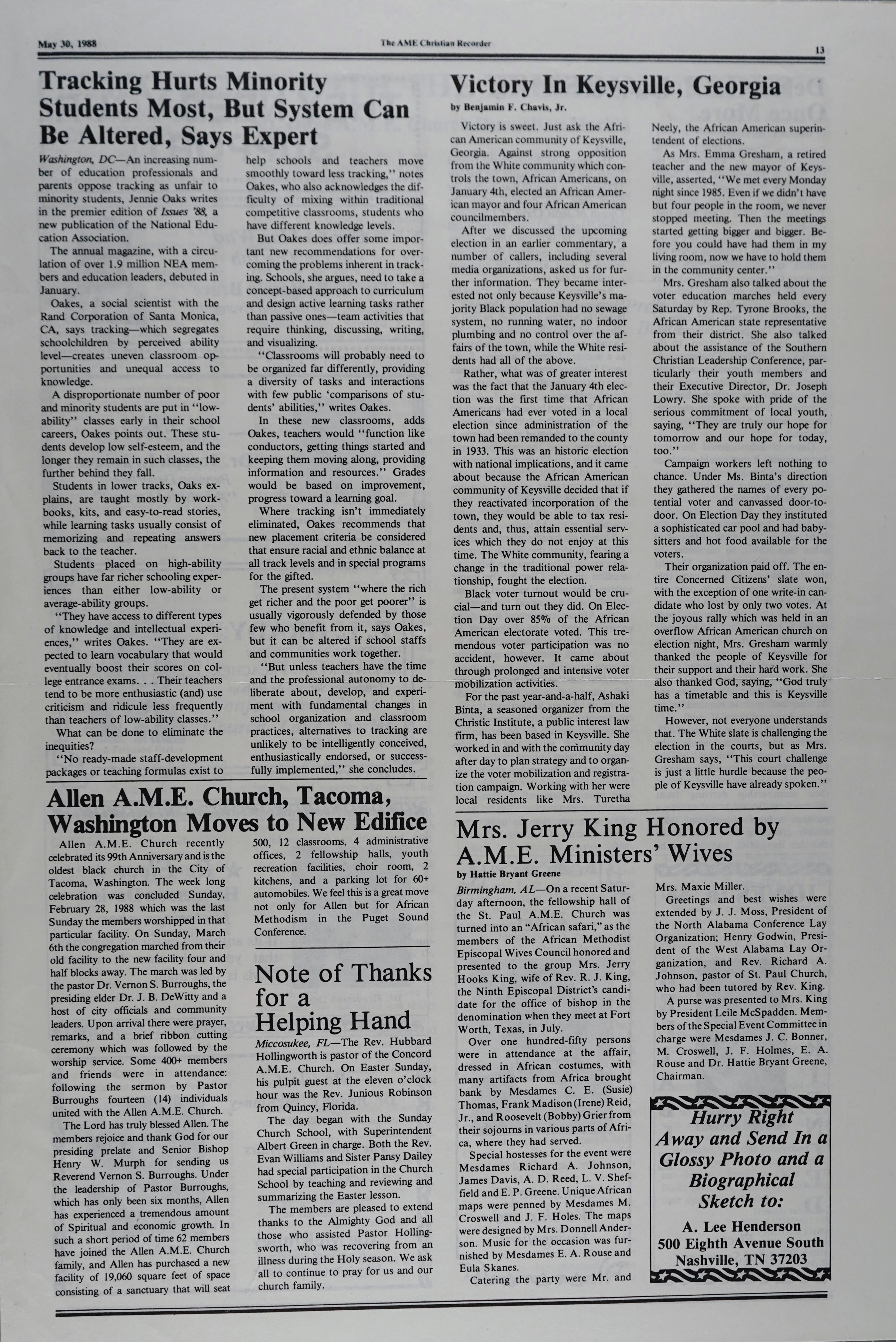
Title
-
May 30, 1988
-
Description
-
===== DSC05526.JPG =====
Vol. 137, No. 18
May 30, 1988
Senior Bishop of Methodism
Fea
¥
A sume
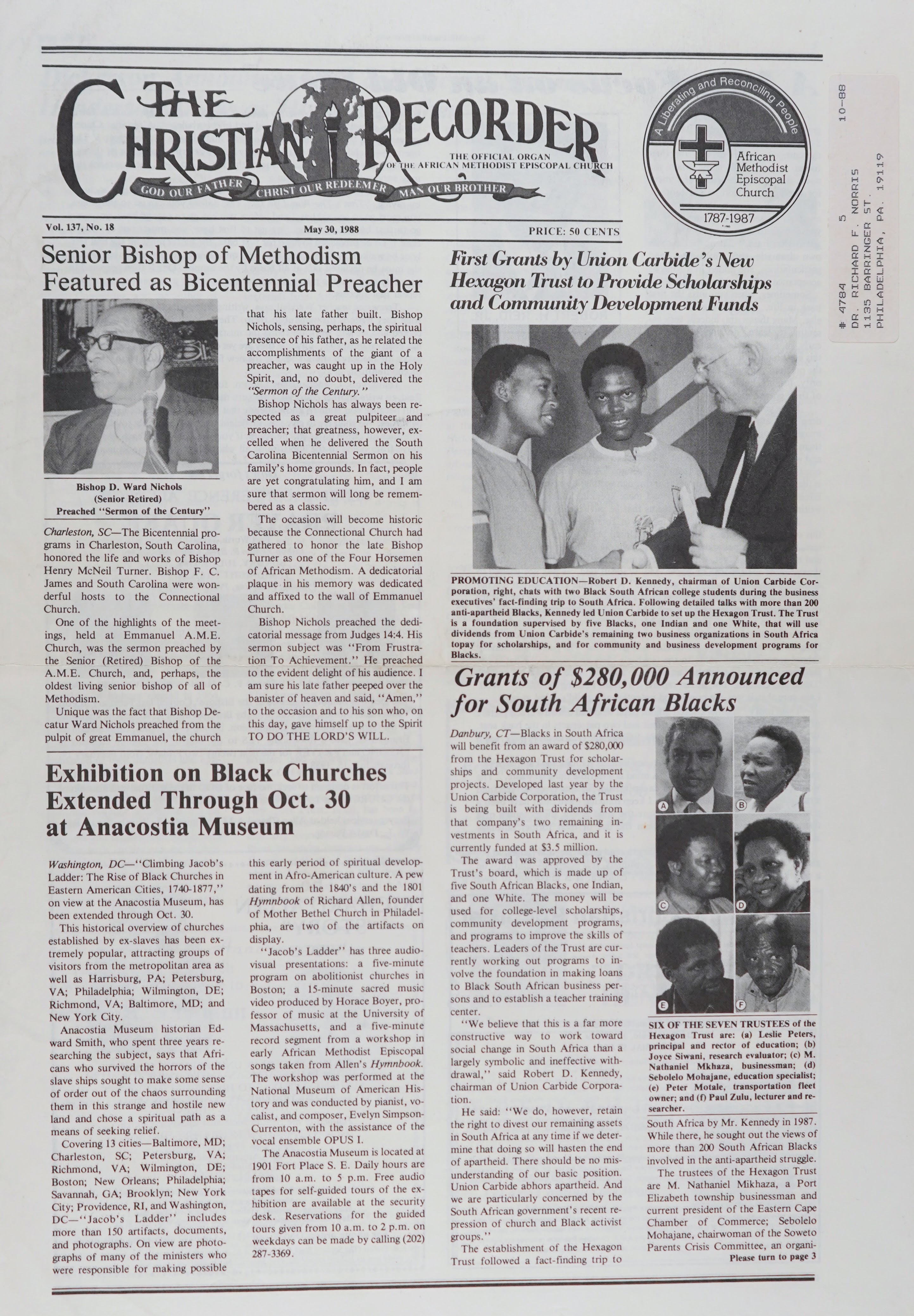
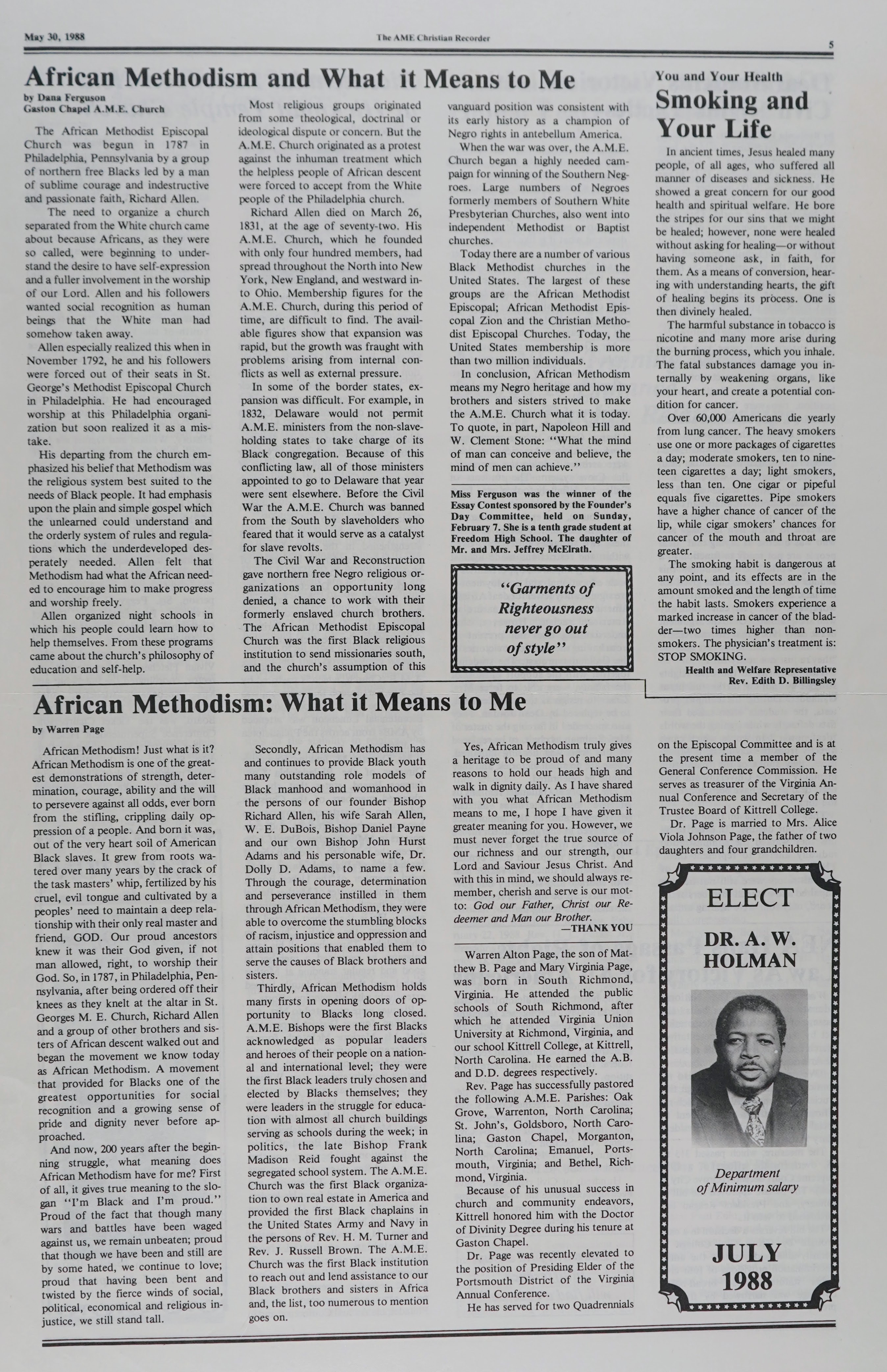
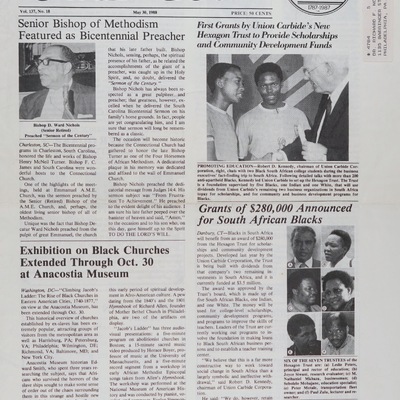
Bishop D. Ward Nichols
(Senior Retired)
Preached ‘‘Sermon of the Century”’
Charleston, SC—The Bicentennial pro-
grams in Charleston, South Carolina,
honored the life and works of Bishop
Henry McNeil Turner. Bishop F. C.
James and South Carolina were won-
derful hosts to the Connectional
Church.
One of the highlights of the meet-
ings, held at Emmanuel A.M.E.
Church, was the sermon preached by
the Senior (Retired) Bishop of the
A.M.E. Church, and, perhaps, the
oldest living senior bishop of all of
Methodism.
Unique was the fact that Bishop De-
catur Ward Nichols preached from the
pulpit of great Emmanuel, the church
tured as Bicentennial Preacher
that his late father built. Bishop
Nichols, sensing, perhaps, the spiritual
presence of his father, as he related the
accomplishments of the giant of a
preacher, was caught up in the Holy
Spirit, and, no doubt, delivered the
“Sermon of the Century.”
Bishop Nichols has always been re-
spected as a great pulpiteer. and
preacher; that greatness, however, ex-
celled when he delivered the South
Carolina Bicentennial Sermon on his
family’s home grounds. In fact, people
are yet congratulating him, and I am
sure that sermon will long be remem-
bered as a classic.
The occasion will become historic
because the Connectional Church had
gathered to honor the late Bishop
Turner as one of the Four Horsemen
of African Methodism. A dedicatorial
plaque in his memory was dedicated
and affixed to the wall of Emmanuel
Church.
Bishop Nichols preached the dedi-
catorial message from Judges 14:4. His
sermon subject was ‘‘From Frustra-
tion To Achievement.’’ He preached
to the evident delight of his audience. I
am sure his late father peeped over the
banister of heaven and said, ‘‘Amen,’’
to the occasion and to his son who, on
this day, gave himself up to the Spirit
TO DO THE LORD’S WILL.
Exhibition on Black Churches
Extended Through Oct. 30
at Anacostia Museum
Washington, DC—‘‘Climbing Jacob’s
Ladder: The Rise of Black Churches in
Eastern American Cities, 1740-1877,”’
on view at the Anacostia Museum, has
been extended through Oct. 30.
This historical overview of churches
established by ex-slaves has been ex-
tremely popular, attracting groups of
visitors from the metropolitan area as
well as Harrisburg, PA; Petersburg,
VA; Philadelphia; Wilmington, DE;
Richmond, VA; Baltimore, MD; and
New York City.
Anacostia Museum historian Ed-
ward Smith, who spent three years re-
searching the subject, says that Afri-
cans who survived the horrors of the
slave ships sought to make some sense
of order out of the chaos surrounding
them in this strange and hostile new
land and chose a spiritual path as a
means of seeking relief.
Covering 13 cities—Baltimore, MD;
Charleston, SC; Petersburg, VA;
Richmond, VA; Wilmington, DE;
Boston; New Orleans; Philadelphia;
Savannah, GA; Brooklyn; New York
City; Providence, RI, and Washington,
DC—‘‘Jacob’s Ladder’’ includes
more than 150 artifacts, documents,
and photographs. On view are photo-
graphs of many of the ministers who
were responsible for making possible
this early period of spiritual develop-
ment in Afro-American culture. A pew
dating from the 1840’s and the 1801
Hymnbook of Richard Allen, founder
of Mother Bethel Church in Philadel-
phia, are two of the artifacts on
display.
‘“Jacob’s Ladder’’ has three audio-
visual presentations: a five-minute
program on abolitionist churches in
Boston; a 15-minute sacred music
video produced by Horace Boyer, pro-
fessor of music at the University of
Massachusetts, and a five-minute
record segment from a workshop in
early African Methodist Episcopal
songs taken from Allen’s Hymnbook.
The workshop was performed at the
National Museum of American His-
tory and was conducted by pianist, vo-
calist, and composer, Evelyn Simpson-
Currenton, with the assistance of the
vocal ensemble OPUS I.
The Anacostia Museum is located at
1901 Fort Place S. E. Daily hours are
from 10 a.m. to 5 p.m. Free audio
tapes for self-guided tours of the ex-
hibition are available at the security
desk. Reservations for the guided
tours given from 10 a.m. to 2 p.m. on
weekdays can be made by calling (202)
287-3369.
Methodist
Episcopal
Church
“«
1787-1987
PRICE: 50 CENTS
First Grants by Union Carbide’s New
Hexagon Trust to Provide Scholarships
and Community Development Funds
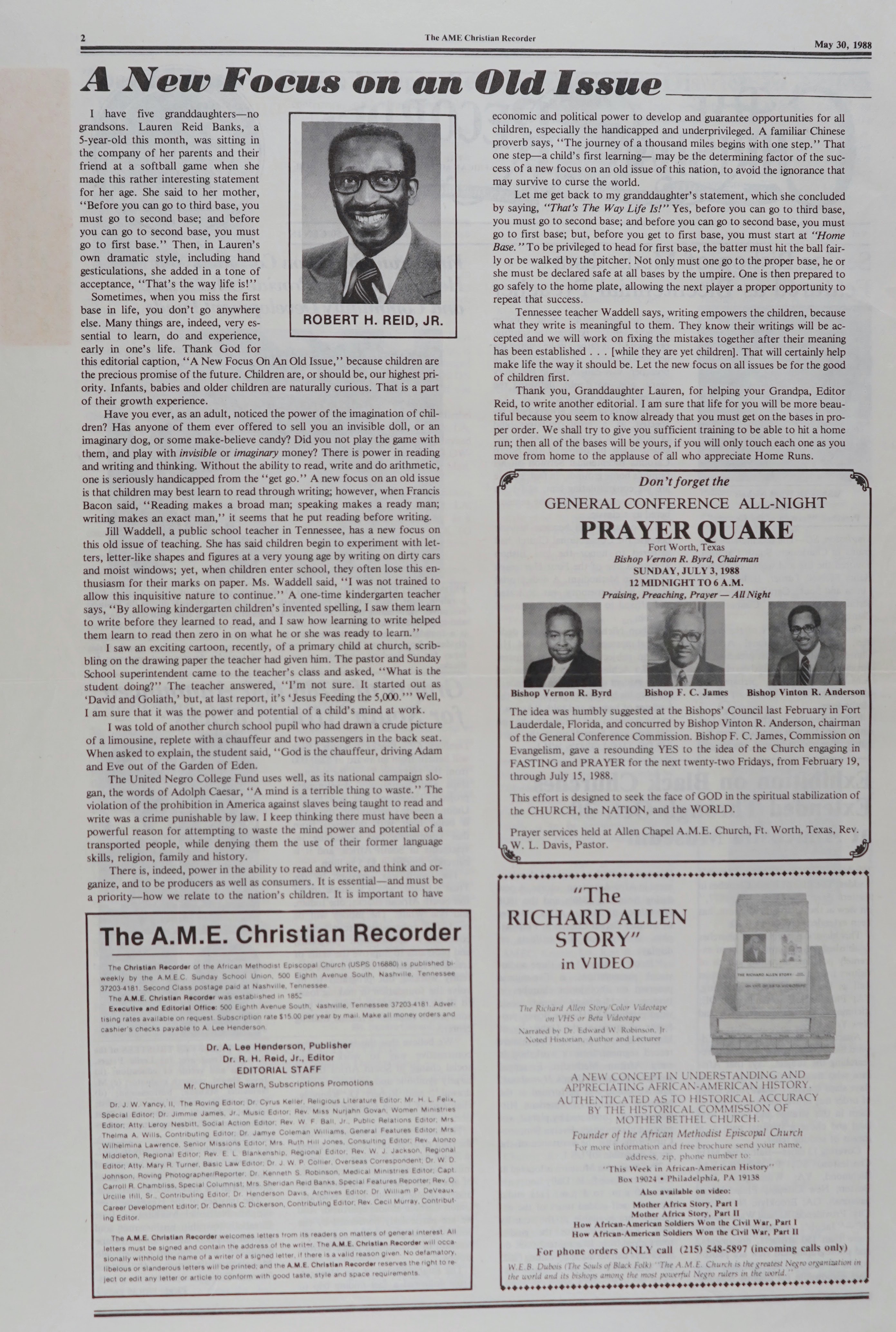
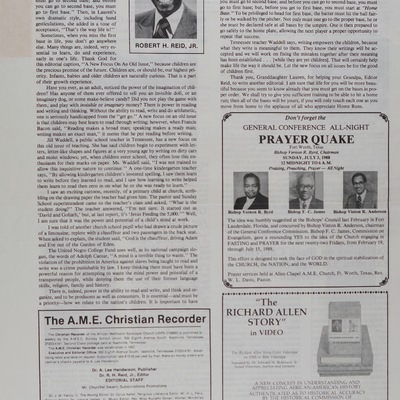
PROMOTING EDUCATION—Robert D. Kennedy, chairman of Union Carbide Cor-
poration, right, chats with two Black South African college students during the business
executives’ fact-finding trip to South Africa. Following detailed talks with more than 200
anti-apartheid Blacks, Kennedy led Union Carbide to set up the Hexagon Trust. The Trust
is a foundation supervised by five Blacks, one Indian and one White, that will use
dividends from Union Carbide’s remaining two business organizations in South Africa
topay for scholarships, and for community and business development programs for
Blacks.
Grants of $280,000 Announced
for South African Blacks
Danbury, CT—Blacks in South Africa
will benefit from an award of $280,000
from the Hexagon Trust for scholar-
ships and community development
projects. Developed last year by the
Union Carbide Corporation, the Trust
is being built with dividends from
that company’s two remaining in-
vestments in South Africa, and it is
currently funded at $3.5 million.
The award was approved by the
Trust’s board, which is made up of
five South African Blacks, one Indian,
and one White. The money will be
used for college-level scholarships,
community development programs,
and programs to improve the skills of
teachers. Leaders of the Trust are cur-
rently working out programs to in-
volve the foundation in making loans
to Black South African business per-
sons and to establish a teacher training
center.
“‘We believe that this is a far more
constructive way to work toward
social change in South Africa than a
largely symbolic and ineffective with-
drawal,’’ said Robert D. Kennedy,
chairman of Union Carbide Corpora-
tion.
He said: ‘‘We do, however, retain
the right to divest our remaining assets
in South Africa at any time if we deter-
mine that doing so will hasten the end
of apartheid. There should be no mis-
understanding of our basic position.
Union Carbide abhors apartheid. And
we are particularly concerned by the
South African government's recent re-
pression of church and Black activist
groups.”’
The establishment of the Hexagon
Trust followed a fact-finding trip to
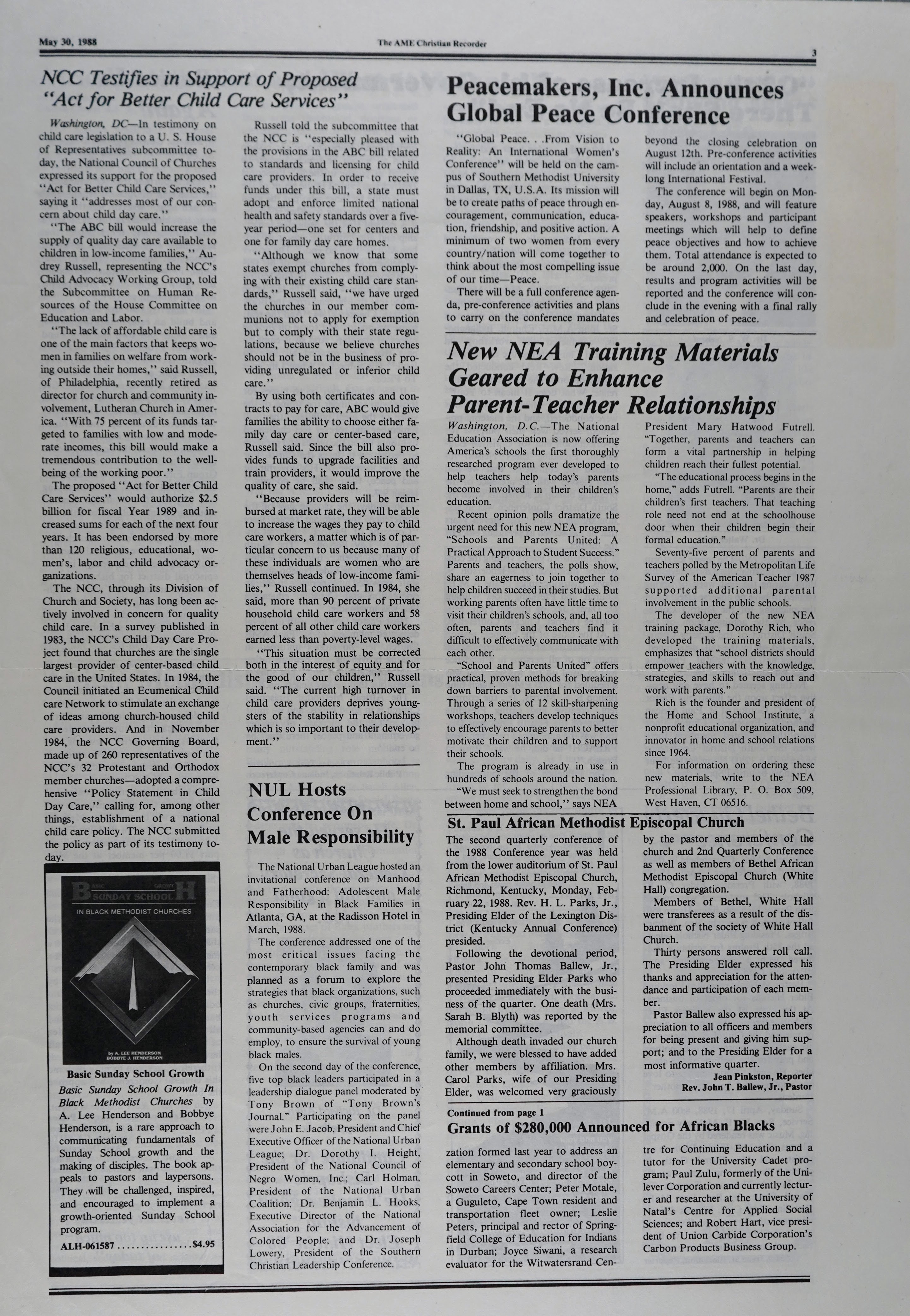
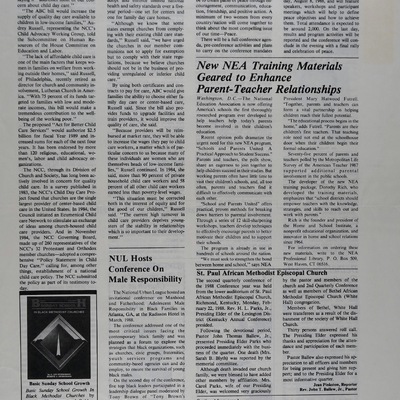
SIX OF THE SEVEN TRUSTEES of the
Hexagon Trust are: (a) Leslie Peters,
principal and rector of education; (b)
Joyce Siwani, research evaluator; (c) M.
Nathaniel Mkhaza, businessman; (d)
Sebolelo Mohajane, education specialist;
(e) Peter Motale, transportation fleet
owner; and (f) Paul Zulu, lecturer and re-
searcher.
South Africa by Mr. Kennedy in 1987.
While there, he sought out the views of
more than 200 South African Blacks
involved in the anti-apartheid struggle.
The trustees of the Hexagon Trust
are M. Nathaniel Mikhaza, a Port
Elizabeth township businessman and
current president of the Eastern Cape
Chamber of Commerce; Sebolelo
Mohajane, chairwoman of the Soweto
Parents Crisis Committee, an organi-
Please turn to page 3
10-88
it 4784
DR.
NORRIS
RICHARD F.
BARRINGER ST.
1135
L929
PA.
PHILADELPHIA,
===== DSC05527.JPG =====
2 The AME Christian Recorder
May 30, 1988
A New Focus on an Old Issue
I have five granddaughters—no
grandsons. Lauren Reid Banks, a
5-year-old this month, was sitting in
the company of her parents and their
friend at a softball game when she
made this rather interesting statement
for her age. She said to her mother,
““Before you can go to third base, you
must go to second base; and before
you can go to second base, you must
go to first base.’’ Then, in Lauren’s
own dramatic style, including hand
gesticulations, she added in a tone of
acceptance, ‘‘That’s the way life is!’’
Sometimes, when you miss the first
base in life, you don’t go anywhere
else. Many things are, indeed, very es-
sential to learn, do and experience,
early in one’s life. Thank God for
this editorial caption, ‘‘A New Focus On An Old Issue,’’ because children are
the precious promise of the future. Children are, or should be, our highest pri-
ority. Infants, babies and older children are naturally curious. That is a part
of their growth experience.
Have you ever, as an adult, noticed the power of the imagination of chil-
dren? Has anyone of them ever offered to sell you an invisible doll, or an
imaginary dog, or some make-believe candy? Did you not play the game with
them, and play with invisible or imaginary money? There is power in reading
and writing and thinking. Without the ability to read, write and do arithmetic,
one is seriously handicapped from the ‘‘get go.’’ A new focus on an old issue
is that children may best learn to read through writing; however, when Francis
Bacon said, ‘‘Reading makes a broad man; speaking makes a ready man;
writing makes an exact man,”’ it seems that he put reading before writing.
Jill Waddell, a public school teacher in Tennessee, has a new focus on
this old issue of teaching. She has said children begin to experiment with let-
ters, letter-like shapes and figures at a very young age by writing on dirty cars
and moist windows; yet, when children enter school, they often lose this en-
thusiasm for their marks on paper. Ms. Waddell said, ‘‘I was not trained to
allow this inquisitive nature to continue.’’ A one-time kindergarten teacher
says, ‘‘By allowing kindergarten children’s invented spelling, I saw them learn
to write before they learned to read, and I saw how learning to write helped
them learn to read then zero in on what he or she was ready to learn.”’
I saw an exciting cartoon, recently, of a primary child at church, scrib-
bling on the drawing paper the teacher had given him. The pastor and Sunday
School superintendent came to the teacher’s class and asked, ‘*What is the
student doing?’’ The teacher answered, ‘‘I’m not sure. It started out as
‘David and Goliath,’ but, at last report, it’s ‘Jesus Feeding the 5,000,’’’ Well,
I am sure that it was the power and potential of a child’s mind at work.
I was told of another church school pupil who had drawn a crude picture
of a limousine, replete with a chauffeur and two passengers in the back seat.
When asked to explain, the student said, ‘‘God is the chauffeur, driving Adam
and Eve out of the Garden of Eden.
The United Negro College Fund uses well, as its national campaign slo-
gan, the words of Adolph Caesar, ‘‘A mind is a terrible thing to waste.’’ The
violation of the prohibition in America against slaves being taught to read and
write was a crime punishable by law. I keep thinking there must have been a
powerful reason for attempting to waste the mind power and potential of a
transported people, while denying them the use of their former language
skills, religion, family and history.
There is, indeed, power in the ability to read and write, and think and or-
ganize, and to be producers as well as consumers. It is essential—and must be
a priority—how we relate to the nation’s children. It is important to have
The A.M.E. Christian Recorder
The Christian Recorder of the African Methodist Episcopal Church (USPS 016880) is published bi
weekly by the AME C. Sunday Schoo! Union, 500 Eighth Avenue South, Nashville, Tennessee
37203-4181. Second Class postage paid at Nashville, Tennessee
The A.M.E, Christian Recorder was esiablisned in 185-
Executive and Editorial Office: 500 Eighth Avenue South, vasnviile Tennessee 37203-4181 Adver
tising rates available on request Subscription rate $15.00 per year by mai! Make ali money orders and
cashier's checks payable to A Lee Henderson
ROBERT H. REID, JR.
Or. A. Lee Henderson, Publisher
Dr. R. H. Reid, Jr., Editor
EDITORIAL STAFF
Mr. Churchel Swarn, Subscriptions Promotions
Dr. J. W. Yancy, |, The Roving Editor, Or Cyrus Keller Religious Literature Editor, Mr MH. L. Felix
Special Editor; Dr. Jimmie James Jr. Music Editor, Rev. Miss Nurjann Govan, Women Ministries
Editor; Atty. Leroy Nesbitt, Social Action Editor, Rev. W F. Ball, Jr, Public Relations Editor, Mrs
Theima A. Wills, Contributing Editor; Or, Jamye Coleman Williams, General Features Editor, Mrs
Wilhelmina Lawrence, Senior Missions Editor, Mrs. Ruth Hill Jones Consyiting Editor, Rev Alonzo
Middleton, Regional Editor, Rev EL Blankenship Regional Editor, Rev, W. J. Jackson, Regional
Editor; Atty. Mary R. Turner Basic Law Editor, Dr J. W. P. Collier, Overseas Correspondent, Or WD
Jonnson, Roving Photographer/Reporter, Or Kenneth § Robinson, Medical Ministries Editor, Capt
Carroll A. Chambliss, Special Columnist, Mrs. Sheridan Reid Banks, Special Features Reporter, Rev, O
Urcille Ifill, Sr, Contributing Editor, Dr Henderson Davis, Archives Editor. Or William P DeVeaux
Career Development editor, Dr. Dennis C Dickerson, Contributing Editor, Rev. Cecil Murray, C ontribut
ing Editor
The A.M.E. Christian Recorder welcomes letters trom its readers on matters of general interest, All
letlers must be signed and contain the address of the writer The A.M.E, Christian Recorder will occa
sionally withhold the name of a writer of a signed letter, if there is a valid reason given
serves the right to re
No defamatory
libelous or slanderous letters wil! be printed and the A.M.E. Christian Recorder 1e
ject or edit any letter or article to conform with good taste style and space requirements
economic and political power to develop and guarantee opportunities for all
children, especially the handicapped and underprivileged. A familiar Chinese
proverb says, ‘‘The journey of a thousand miles begins with one step.”’ That
one step—a child’s first learning— may be the determining factor of the suc-
cess of a new focus on an old issue of this nation, to avoid the ignorance that
may survive to curse the world.
Let me get back to my granddaughter’s statement, which she concluded
by saying, “‘That’s The Way Life Is!’’ Yes, before you can go to third base,
you must go to second base; and before you can go to second base, you must
go to first base; but, before you get to first base, you must start at “Home
Base.’’ To be privileged to head for first base, the batter must hit the ball fair-
ly or be walked by the pitcher. Not only must one go to the proper base, he or
she must be declared safe at all bases by the umpire. One is then prepared to
go safely to the home plate, allowing the next player a proper opportunity to
repeat that success.
Tennessee teacher Waddell says, writing empowers the children, because
what they write is meaningful to them. They know their writings will be ac-
cepted and we will work on fixing the mistakes together after their meaning
has been established . . . [while they are yet children]. That will certainly help
make life the way it should be. Let the new focus on all issues be for the good
of children first.
Thank you, Granddaughter Lauren, for helping your Grandpa, Editor
Reid, to write another editorial. I am sure that life for you will be more beau-
tiful because you seem to know already that you must get on the bases in pro-
per order. We shall try to give you sufficient training to be able to hit a home
run; then all of the bases will be yours, if you will only touch each one as you
move from home to the applause of all who appreciate Home Runs.
Don’t forget the
GENERAL CONFERENCE ALL-NIGHT
PRAYER QUAKE
Fort Worth, Texas
Bishop Vernon R. Byrd, Chairman
SUNDAY, JULY 3, 1988
12 MIDNIGHT TO 6 A.M.
Praising, Preaching, Prayer — All Night
ah
Bishop Vernon R. Byrd Bishop F. C. James Bishop Vinton R. Anderson
The idea was humbly suggested at the Bishops’ Council last February in Fort
Lauderdale, Florida, and concurred by Bishop Vinton R. Anderson, chairman
of the General Conference Commission. Bishop F. C. James, Commission on
Evangelism, gave a resounding YES to the idea of the Church engaging in
FASTING and PRAYER for the next twenty-two Fridays, from February 19,
through July 15, 1988.
This effort is designed to seek the face of GOD in the spiritual stabilization of
the CHURCH, the NATION, and the WORLD.
Prayer services held at Allen Chapel A.M.EB. Church, Ft. Worth, Texas, Rev.
9 W. L. Davis, Pastor. e
s
FOOSE OEE ES ESE SE SESE SES ES ESE SESE Se Se Se Se See Se Ge Se Ge Ge Ge Heese
“The
RICHARD ALLEN
STORY”
in VIDEO
The Richard Allen Story’Color Videotape
n VHS or Beta Videotape
Narrated by Dr. Edward W. Robinson. Jr
Noted Historian, Author and Lecturer
A NEW CONCEPT IN UNDERSTANDING AND
APPRECIATING AFRICAN-AMERICAN HISTORY.
AUTHENTICATED AS TO HISTORICAL ACC URACY
BY THE HISTORICAL COMMISSION OF
MOTHER BETHEL CHURCH
Founder of the African Methodist Episcopal Church
For more information and free brochure send your name
address, zip, phone number to
‘This Week in African-American History
Box 19024 ¢ Philadelphia, PA 19138
Also available on video:
Mother Africa Story, Part I
Mother Africa Story, Part I
How African-American Soldiers Won the Civil War, Part I
How African-American Soldiers Won the Civil War, Part u
For phone orders ONLY call (215) $48-5897 (incoming calls only)
Th
W.E.B. Di ts ef Black Folk) “The A.M.E. Church is the greatest Negro organization in
the wor be powerful Negro rulers in the world
prewererererertr ert st tt ist tr tt ae
===== DSC05528.JPG =====
May 30, 1988
The AME Christian Recorder
a eEeEeeeEeEeEeQuaeaReeooeeeeeeeeeeeee
NCC Testifies in Support of Proposed
“Act for Better Child Care Services”’
Washington, DC—In testimony on
child care legislation to a U. S. House
of Representatives subcommittee to-
day, the National Council of Churches
expressed its support for the proposed
“Act for Better Child Care Services,”’
Saying it ‘‘addresses most of our con-
cern about child day care.’’
“The ABC bill would increase the
supply of quality day care available to
children in low-income families,’’ Au-
drey Russell, representing the NCC’s
Child Advocacy Working Group, told
the Subcommittee on Human Re-
sources of the House Committee on
Education and Labor.
““The lack of affordable child care is
one of the main factors that keeps wo-
men in families on welfare from work-
ing outside their homes,’’ said Russell,
of Philadelphia, recently retired as
director for church and community in-
volvement, Lutheran Church in Amer-
ica. ‘‘With 75 percent of its funds tar-
geted to families with low and mode-
rate incomes, this bill would make a
tremendous contribution to the well-
being of the working poor.”’
The proposed ‘‘Act for Better Child
Care Services’? would authorize $2.5
billion for fiscal Year 1989 and in-
creased sums for each of the next four
years. It has been endorsed by more
than 120 religious, educational, wo-
men’s, labor and child advocacy or-
ganizations.
The NCC, through its Division of
Church and Society, has long been ac-
tively involved in concern for quality
child care. In a survey published in
1983, the NCC’s Child Day Care Pro-
ject found that churches are the single
largest provider of center-based child
care in the United States. In 1984, the
Council initiated an Ecumenical Child
care Network to stimulate an exchange
of ideas among church-housed child
care providers. And in November
1984, the NCC Governing Board,
made up of 260 representatives of the
NCC’s 32 Protestant and Orthodox
member churches—adopted a compre-
hensive ‘‘Policy Statement in Child
Day Care,”’ calling for, among other
things, establishment of a national
child care policy. The NCC submitted
the policy as part of its testimony to-
day.
iN BLACK METHODIST CHURCHES
by A. LEE HENDERSON
BOBBYE J. HENDERSON
Basic Sunday School Growth
Basic Sunday School Growth In
Black Methodist Churches by
A. Lee Henderson and Bobbye
Henderson, is a rare approach to
communicating fundamentals of
Sunday School growth and the
making of disciples. The book ap-
peals to pastors and laypersons.
They will be challenged, inspired,
and encouraged to implement a
growth-oriented Sunday School
program.
ALH-061587 .......----0005+
Russell told the subcommittee that
the NCC is ‘especially pleased with
the provisions in the ABC bill related
to standards and licensing for child
care providers. In order to receive
funds under this bill, a state must
adopt and enforce limited national
health and safety standards over a five-
year period—one set for centers and
one for family day care homes,
“Although we know that some
states exempt churches from comply-
ing with their existing child care stan-
dards,”’ Russell said, ‘‘we have urged
the churches in our member com-
munions not to apply for exemption
but to comply with their state regu-
lations, because we believe churches
should not be in the business of pro-
viding unregulated or inferior child
care.””
By using both certificates and con-
tracts to pay for care, ABC would give
families the ability to choose either fa-
mily day care or center-based care,
Russell said. Since the bill also pro-
vides funds to upgrade facilities and
train providers, it would improve the
quality of care, she said.
“*Because providers will be reim-
bursed at market rate, they will be able
to increase the wages they pay to child
care workers, a matter which is of par-
ticular concern to us because many of
these individuals are women who are
themselves heads of low-income fami-
lies,’’ Russell continued. In 1984, she
said, more than 90 percent of private
household child care workers and 58
percent of all other child care workers
earned less than poverty-level wages.
“This situation must be corrected
both in the interest of equity and for
the good of our children,’’ Russell
said. ‘‘The current high turnover in
child care providers deprives young-
sters of the stability in relationships
which is so important to their develop-
ment.””
NUL Hosts
Conference On
Male Responsibility
The National Urban League hosted an
invitational conference on Manhood
and Fatherhood: Adolescent Male
Responsibility in Black Families in
Atlanta, GA, at the Radisson Hotel in
March, 1988.
The conference addressed one of the
most critical issues facing the
contemporary black family and was
planned as a forum to explore the
strategies that black organizations, such
as churches, civic groups, fraternities,
youth services programs and
community-based agencies can and do
employ, to ensure the survival of young
black males.
On the second day of the conference,
five top black leaders participated in a
leadership dialogue panel moderated by
Tony Brown of “Tony Brown’s
Journal.” Participating on the panel
were John E. Jacob, President and Chief
Executive Officer of the National Urban
League; Dr. Dorothy I. Height,
President of the National Council of
Negro Women, Inc.; Carl Holman,
President of the National Urban
Coalition; Dr. Benjamin L. Hooks,
Executive Director of the National
Association for the Advancement of
Colored People; and Dr. Joseph
Lowery, President of the Southern
Christian Leadership Conference.
Peacemakers, Inc. Announces
Global Peace Conference
‘Global Peace. . .From Vision to
Reality: An International Women’s
Conference’’ will be held on the cam-
pus of Southern Methodist University
in Dallas, TX, U.S.A. Its mission will
be to create paths of peace through en-
couragement, communication, educa-
tion, friendship, and positive action. A
minimum of two women from every
country/nation will come together to
think about the most compelling issue
of our time—Peace.
There will be a full conference agen-
da, pre-conference activities and plans
to carry on the conference mandates
beyond the closing celebration on
August 12th. Pre-conference activities
will include an orientation and a week-
long International Festival.
The conference will begin on Mon-
day, August 8, 1988, and will feature
speakers, workshops and participant
meetings which will help to define
peace objectives and how to achieve
them, Total attendance is expected to
be around 2,000. On the last day,
results and program activities will be
reported and the conference will con-
clude in the evening with a final rally
and celebration of peace.
New NEA Training Materials
Geared to Enhance
Parent-Teacher Relationships
Washington, D.C.—The National
Education Association is now offering
America’s schools the first thoroughly
researched program ever developed to
help teachers help today’s parents
become involved in their children’s
education.
Recent opinion polls dramatize the
urgent need for this new NEA program,
“Schools and Parents United: A
Practical Approach to Student Success.”
Parents and teachers, the polls show,
share an eagerness to join together to
help children succeed in their studies. But
working parents often have little time to
visit their children’s schools, and, all too
often, parents and teachers find it
difficult to effectively communicate with
each other.
“School and Parents United” offers
practical, proven methods for breaking
down barriers to parental involvement.
Through a series of 12 skill-sharpening
workshops, teachers develop techniques
to effectively encourage parents to better
motivate their children and to support
their schools.
The program is already in use in
hundreds of schools around the nation.
“We must seek to strengthen the bond
between home and school,’’ says NEA
President Mary Hatwood Futrell.
“Together, parents and teachers can
form a vital partnership in helping
children reach their fullest potential.
“The educational process begins in the
home,” adds Futrell. “Parents are their
children’s first teachers. That teaching
role need not end at the schoolhouse
door when their children begin their
formal education.”
Seventy-five percent of parents and
teachers polled by the Metropolitan Life
Survey of the American Teacher 1987
supported additional parental
involvement in the public schools.
The developer of the new NEA
training package, Dorothy Rich, who
developed the training materials,
emphasizes that “school districts should
empower teachers with the knowledge,
strategies, and skills to reach out and
work with parents.”
Rich is the founder and president of
the Home and School Institute, a
nonprofit educational organization, and
innovator in home and school relations
since 1964.
For information on ordering these
new materials, write to the NEA
Professional Library, P. O. Box 509,
West Haven, CT 06516.
St. Paul African Methodist Episcopal Church
The second quarterly conference of
the 1988 Conference year was held
from the lower auditorium of St. Paul
African Methodist Episcopal Church,
Richmond, Kentucky, Monday, Feb-
ruary 22, 1988. Rev. H. L. Parks, Jr.,
Presiding Elder of the Lexington Dis-
trict (Kentucky Annual Conference)
presided.
Following the devotional period,
Pastor John Thomas Ballew, Jr.,
presented Presiding Elder Parks who
proceeded immediately with the busi-
ness of the quarter. One death (Mrs.
Sarah B. Blyth) was reported by the
memorial committee.
Although death invaded our church
family, we were blessed to have added
other members by affiliation. Mrs.
Carol Parks, wife of our Presiding
Elder, was welcomed very graciously
Continued from page 1
by the pastor and members of the
church and 2nd Quarterly Conference
as well as members of Bethel African
Methodist Episcopal Church (White
Hall) congregation.
Members of Bethel, White Hall
were transferees as a result of the dis-
banment of the society of White Hall
Church.
Thirty persons answered roll call.
The Presiding Elder expressed his
thanks and appreciation for the atten-
dance and participation of each mem-
ber.
Pastor Ballew also expressed his ap-
preciation to all officers and members
for being present and giving him sup-
port; and to the Presiding Elder for a
most informative quarter.
Jean Pinkston, Reporter
Rev. John T. Ballew, Jr., Pastor
Grants of $280,000 Announced for African Blacks
zation formed last year to address an
elementary and secondary school boy-
cott in Soweto, and director of the
Soweto Careers Center; Peter Motale,
a Guguleto, Cape Town resident and
transportation fleet owner; Leslie
Peters, principal and rector of Spring-
field College of Education for Indians
in Durban; Joyce Siwani, a research
evaluator for the Witwatersrand Cen-
tre for Continuing Education and a
tutor for the University Cadet pro-
gram; Paul Zulu, formerly of the Uni-
lever Corporation and currently lectur-
er and researcher at the University of
Natal’s Centre for Applied Social
Sciences; and Robert Hart, vice presi-
dent of Union Carbide Corporation’s
Carbon Products Business Group.
===== DSC05529.JPG =====
The AME Christian Recorder
May 30, 1988
“OF the Increase of his Government,
There Shall Be No End”’
Dr. Walter Reid
Indianapolis, IN—The severe ice storm
that gave Indianapolis a most devasting
blow during the first week of Spring
seemed to have no adverse effect upon
the planning for the District Confe-
rence by the administration of the
South District of the Indiana Confe-
rence, led on by the tall, determined,
unrelenting and faithful Presiding
Elder William Sampson Nelson.
Nothing seemed to have any nega-
tive effect upon the illustrious Pastor
Wesley C. Gordon of St. Paul African
Methodist Episcopal Church, nor
upon the dedicated members there
when the South District Conference
began with a 12:00 Noon coffee hour
on a most beautiful Spring day.
After the coffee hour and fellow-
ship, registration and worship led by
Pastor Leroy White of Bethel A.M.E.
Church, Seymour, Indiana, the sereni-
ty of the flowing chain of events, under
the direction of Pastor Walter W.
Reid, Sr. (Program Chairman), of
Bethel, Indianapolis, so overwhelmed
the delegation with joy that no ap-
pearance of a desire for an ending was
present.
“Back To Basic African Method-
ism’’ was the theme of the conference.
The Reverend Wendell Abel, pastor at
St. John A.M.E. Church, Indianapo-
lis, conducted the workshop on
“Local Church Structure and Organi-
zation.’? Rev. Reid conducted the
workshop on ‘‘The Quarterly Confe-
rence; What does It mean to You?’’
The manner in which the workshops
were conducted, and the material pre-
sented, served well their purpose for
re-orientation and for Christian Edu-
cation. Presiding Elder Nelson re-
minded the conference that we had
been blessed with the presence of the
presiding bishop at sometime when the
South District Conference was in ses-
sion during each of the eleven years
that he has served as presiding elder of
the district.
Distinguished guests visiting the con-
ference included Dr. Henderson S.
Davis, Historiographer of the A.M.E.
Church, and Presiding Elder William
D. Davis, Jr., of the St. Paul, Mil-
waukee District, Chicago Conference.
At the close of the business session
of the first day of the conference, the
attention of all persons in attendance
was focused on the worship that was
scheduled for 7:00 PM, at which time
Bishop S. S. Morris, Jr., the compe-
tent, creative and caring Presiding
Bishop of the Fourth Episcopal Dis-
trict was the announced preacher. And
PREACH! he did; he was ‘‘Born to
Preach.’’
The influence of the outstanding
and dynamic leadership of the bishop
upon all whom he touched when he
served as pastor in the 4th Episcopal
District was evident in the result of the
work done by those who put the ideal
District Conference together. Clearly,
it is evident that the dedicated leader-
ship and administrative power of Bis-
hop Morris ‘‘has no end.’’ The power
of delivery and the impact of his ser-
mon gave proof of that. Bishop Morris
lifted his subject out of the last verse
of the text that he read from the Book
of Acts, Chapter 27:44 ‘‘And the rest,
some on boards and some on broken
pieces of the ship, And so it came to
pass that they escaped all safe to
land.’’ His subject: ‘‘When Life goes
To Pieces.’’
If life should ever go to pieces for
those who sat under the sound of the
voice of the great pulpiteer, they will
remember and forever feel challenged
to mount up on the pieces and press on
to perfection in Jesus the Christ. For
“of the increase of His government
and peace, there shall be no end.”’
Isaiah 9:7.
On Friday, the closing day of the
conference, the seminar topics were
“Concerns of Pastors,’’ and ‘‘Con-
cerns of Lay Persons.’’ The South
District Conference, under the leader-
ship of Presiding Elder Nelson and his
staff, provided an experience in church
orientation and Christian education
that was invaluable.
Host Pastor Gordon, with the loyal
dedicated members of St. Paul AME
Church, left no stones unturned in
making provisions and demonstrating
royal hospitality for all. ‘‘The song is
ended, but the melody lingers on.’’
The African Methodist Episcopal
Church is in good hands, and we must
pray, ‘‘Of the increase of his/her
government and peace, there shall be
no end.”’
Thomas Turner, Director
Public Relations, Indiana Conference
Bethel Quarterly
Conference
Bethel A.M.E. Church held its third
quarterly conference April 15-17,
1988, with Presiding Elder C. E.
Nichols. The conference was opened
with Pastor McNealy lining Hymn #50,
followed with prayer by Bro. Wilmer
Briggs. Presiding Elder Nichols select-
ed the 25th Psalms for scripture, fol-
lowed with a congregational song
“Precious Lord.”’
Pastor McNealy presented Presiding
Elder Nichols for order of business.
At the close of the business Elder
Nichols expressed his concern about
people and the Churches. He encour-
age each of us to pray for one another,
and pray for the welfare of the chur-
ches. He said, ‘‘Christians are to love
one another, and bear one another’s
burdens.
Sunday, April 17, 1988, 8:00 A.M.
Service, Rev. W. E. McNealy presid-
ing. Music was rendered by the Gospel
Chorus, with Mrs. Eunice Davis as or-
ganist, and Mr. Darrel Gettis as
pianist. The morning hymn was #1,
“© For A Thousand Tongues To
Sing.”’ Prayer by Bro. Sam Huff.
Presiding Elder C. E. Nichols deliver-
ed a soul stirring message. Five people
accepted Christ, four came for Bap-
tism and one Christian experience.
Mrs. Irene M. Blackmon, Reporter
0 everything there is a season,
and a time to every purpose under
heaven. A time to be born and
a time to die. A time to plant, and a
time to pluck up that which is planted.
A time to kill, and a time to heal. A
time to break down and time
to build up. A time to
weep, and a time to
laugh. A time to
mourn and a time
to dance...
Ecclesiastes:3
_saedehtl
Take time
to consider
ou and Piel
lamily's future.
Join the Pension Fund
today: Discuss your plans
now with a member of the AME
Pension Fund. We take the Tension
out of Pension.
AME Pension Department
500 Eighth Avenue
Nashville, Tennessee
PNORC eee ONE ONS ONS
He served the
Church as
General Secretary
and did a good
job.
Dr. Richard Allen
Chappelle, Sr.
Candidate for the
Bishopric
He’ll make a good
bishop
Elect Him in ’88
LIN BIN IN IY EY REY.
Revive Us
Again!
Bishops, General Officers, Delegates
and A.M.E, members, Greetings!
It is important that we re-examine
the concepts of Richard Allen—such
as ‘‘self-help,’’ wherein was the bridge
over troubled waters for us in some
very troublesome times. From that
idea there were established religious,
economical and educational founda-
tions, in which African Methodists
have grown to become a great people
in this twentieth century.
Let us revive that idea of “self-help”
and build an economical foundation
and finance our own Building Fund
Programs. From this Fund, local con-
gregations could borrow money to re-
build, repair or build new structures.
Each loan is to be repaid within five
years with five percent interest to cover
operational expenses. The money
would never be used up, and the funds
would continuously increase.
From this base, the next step would
be to establish an African Methodist
Group Fire Insurance. With approxi-
mately 2000 A.M.E. churches paying
into a group fire insurance fund, it
would grow into millions of dollars in
a few years. The replacement cost will
not be that great for our churches.
From the above financial base, we
could build retirement centers in each
episcopal district for bishops, minis-
ters’ wives and ministers’ widows with-
out a home during the time of their re-
tirement. We could also help local
churches build pre-schools and day
care centers, where the environment
would be safe and secure, with a Chris-
tian atmosphere. We could also build
educational centers in each episcopal
district to train A.M.E. ministers,
teaching the A.M.E. doctrines.
Additionally, we could train Chris-
tian educators, superintendents,
teachers, missionaries, stewards, ste-
wardesses, trustees, etc. We need uni-
formed knowledge to build this gene-
ration of A.M.E. Christians.
Pray that this General Conference
will approve this new legislation:
1. There will be an African Method-
ist Episcopal Church Building Fund.
2. Each local congregation will re-
port $1.00 per member at the Mid-
Year and at the Annual Conference for
the next four years.
3. The General Board (or a Special
Committee) approves all applications
and directs the treasurer to pay the
same: To any local A.M.E. Church
that needs to repair, build, etc., witha
maximum interest rate of five per-
cent, repaying the loan in five years.
Using this procedure, I believe by
the turn of the century, African Meth-
odists would have built a financial
base of more than $50,000,000.00, and
all we are doing is reviving the old idea
of Richard Allen. All great revivals
have praying people who see the need.
I, therefore, ask you to pray with me
this General Conference will approve
the bill.
Your Brother in Christ,
Reverend Earl Anderson, Pastor
1916 East San Antonio Street
San Jose, CA 95116
And Delegate To
43rd General Conference of the
African Methodist Episcopal
Fort Worth, Texas
July 6-14, 1988
‘‘Never let yesterday
use up too much
of today”’
===== DSC05530.JPG =====
May 30, 1988
The AME. Christian Recorder
African Methodism and What it Means to Me
by Dana Ferguson
Gaston Chapel A.M.E. Church
The African Methodist Episcopal
Church was begun in 1787 in
Philadelphia, Pennsylvania by a group
of northern free Blacks led by a man
of sublime courage and indestructive
and passionate faith, Richard Allen.
The need to organize a church
separated from the White church came
about because Africans, as they were
so called, were beginning to under-
stand the desire to have self-expression
and a fuller involvement in the worship
of our Lord. Allen and his followers
wanted social recognition as human
beings that the White man _ had
somehow taken away.
Allen especially realized this when in
November 1792, he and his followers
were forced out of their seats in St.
George’s Methodist Episcopal Church
in Philadelphia. He had encouraged
worship at this Philadelphia organi-
zation but soon realized it as a mis-
take.
His departing from the church em-
phasized his belief that Methodism was
the religious system best suited to the
needs of Black people. It had emphasis
upon the plain and simple gospel which
the unlearned could understand and
the orderly system of rules and regula-
tions which the underdeveloped des-
perately needed. Allen felt that
Methodism had what the African need-
ed to encourage him to make progress
and worship freely.
Allen organized night schools in
which his people could learn how to
help themselves. From these programs
came about the church’s philosophy of
education and self-help.
Most religious groups originated
from some theological, doctrinal or
ideological dispute or concern, But the
A.M.E. Church originated as a protest
against the inhuman treatment which
the helpless people of African descent
were forced to accept from the White
people of the Philadelphia church.
Richard Allen died on March 26,
1831, at the age of seventy-two. His
A.M.E. Church, which he founded
with only four hundred members, had
spread throughout the North into New
York, New England, and westward in-
to Ohio. Membership figures for the
A.M.E. Church, during this period of
time, are difficult to find. The avail-
able figures show that expansion was
rapid, but the growth was fraught with
problems arising from internal con-
flicts as well as external pressure.
In some of the border states, ex-
pansion was difficult. For example, in
1832, Delaware would not permit
A.M.E. ministers from the non-slave-
holding states to take charge of its
Black congregation. Because of this
conflicting law, all of those ministers
appointed to go to Delaware that year
were sent elsewhere. Before the Civil
War the A.M.E. Church was banned
from the South by slaveholders who
feared that it would serve as a catalyst
for slave revolts.
The Civil War and Reconstruction
gave northern free Negro religious or-
ganizations an opportunity long
denied, a chance to work with their
formerly enslaved church brothers.
The African Methodist Episcopal
Church was the first Black religious
institution to send missionaries south,
and the church’s assumption of this
vanguard position was consistent with
its early history as a champion of
Negro rights in antebellum America,
When the war was over, the A.M.E.
Church began a highly needed cam-
paign for winning of the Southern Neg-
roes, Large numbers of Negroes
formerly members of Southern White
Presbyterian Churches, also went into
independent Methodist or Baptist
churches.
Today there are a number of various
Black Methodist churches in the
United States. The largest of these
groups are the African Methodist
Episcopal; African Methodist Epis-
copal Zion and the Christian Metho-
dist Episcopal Churches. Today, the
United States membership is more
than two million individuals.
In conclusion, African Methodism
means my Negro heritage and how my
brothers and sisters strived to make
the A.M.E. Church what it is today.
To quote, in part, Napoleon Hill and
W. Clement Stone: ‘‘What the mind
of man can conceive and believe, the
mind of men can achieve.”’
Miss Ferguson was the winner of the
Essay Contest sponsored by the Founder’s
Day Committee, held on Sunday,
February 7. She is a tenth grade student at
Freedom High School. The daughter of
Mr. and Mrs. Jeffrey McElrath.
St i 8 ttt
“‘Garments of
Righteousness
never go out
of style’’
You and Your Health
Smoking and
Your Life
In ancient times, Jesus healed many
people, of all ages, who suffered all
manner of diseases and sickness. He
showed a great concern for our good
health and spiritual welfare. He bore
the stripes for our sins that we might
be healed; however, none were healed
without asking for healing—or without
having someone ask, in faith, for
them. As a means of conversion, hear-
ing with understanding hearts, the gift
of healing begins its process. One is
then divinely healed.
The harmful substance in tobacco is
nicotine and many more arise during
the burning process, which you inhale.
The fatal substances damage you in-
ternally by weakening organs, like
your heart, and create a potential con-
dition for cancer.
Over 60,000 Americans die yearly
from lung cancer. The heavy smokers
use One or more packages of cigarettes
a day; moderate smokers, ten to nine-
teen cigarettes a day; light smokers,
less than ten. One cigar or pipeful
equals five cigarettes. Pipe smokers
have a higher chance of cancer of the
lip, while cigar smokers’ chances for
cancer of the mouth and throat are
greater.
The smoking habit is dangerous at
any point, and its effects are in the
amount smoked and the length of time
the habit lasts. Smokers experience a
marked increase in cancer of the blad-
der—two times higher than non-
smokers. The physician’s treatment is:
STOP SMOKING.
Health and Welfare Representative
African Methodism: What it Means to Me
by Warren Page
African Methodism! Just what is it?
African Methodism is one of the great-
est demonstrations of strength, deter-
mination, courage, ability and the will
to persevere against all odds, ever born
from the stifling, crippling daily op-
pression of a people. And born it was,
out of the very heart soil of American
Black slaves. It grew from roots wa-
tered over many years by the crack of
the task masters’ whip, fertilized by his
cruel, evil tongue and cultivated by a
peoples’ need to maintain a deep rela-
tionship with their only real master and
friend, GOD. Our proud ancestors
knew it was their God given, if not
man allowed, right, to worship their
God. So, in 1787, in Philadelphia, Pen-
nsylvania, after being ordered off their
knees as they knelt at the altar in St.
Georges M. E. Church, Richard Allen
and a group of other brothers and sis-
ters of African descent walked out and
began the movement we know today
as African Methodism. A movement
that provided for Blacks one of the
greatest opportunities for social
recognition and a growing sense of
pride and dignity never before ap-
proached.
And now, 200 years after the begin-
ning struggle, what meaning does
African Methodism have for me? First
of all, it gives true meaning to the slo-
gan “I’m Black and I’m proud.”’
Proud of the fact that though many
wars and battles have been waged
against us, we remain unbeaten; proud
that though we have been and still are
by some hated, we continue to love;
proud that having been bent and
twisted by the fierce winds of social,
political, economical and religious in-
ustice, we still stand tall.
Secondly, African Methodism has
and continues to provide Black youth
many outstanding role models of
Black manhood and womanhood in
the persons of our founder Bishop
Richard Allen, his wife Sarah Allen,
W. E. DuBois, Bishop Daniel Payne
and our own Bishop John Hurst
Adams and his personable wife, Dr.
Dolly D. Adams, to name a few.
Through the courage, determination
and perseverance instilled in them
through African Methodism, they were
able to overcome the stumbling blocks
of racism, injustice and oppression and
attain positions that enabled them to
serve the causes of Black brothers and
sisters.
Thirdly, African Methodism holds
many firsts in opening doors of op-
portunity to Blacks long closed.
A.M.E. Bishops were the first Blacks
acknowledged as popular leaders
and heroes of their people on a nation-
al and international level; they were
the first Black leaders truly chosen and
elected by Blacks themselves; they
were leaders in the struggle for educa-
tion with almost all church buildings
serving as schools during the week; in
politics, the late Bishop Frank
Madison Reid fought against the
segregated school system. The A.M.E.
Church was the first Black organiza-
tion to own real estate in America and
provided the first Black chaplains in
the United States Army and Navy in
the persons of Rev. H. M. Turner and
Rev. J. Russell Brown. The A.M.E.
Church was the first Black institution
to reach out and lend assistance to our
Black brothers and sisters in Africa
and, the list, too numerous to mention
goes on.
Yes, African Methodism truly gives
a heritage to be proud of and many
reasons to hold our heads high and
walk in dignity daily. As I have shared
with you what African Methodism
means to me, I hope I have given it
greater meaning for you. However, we
must never forget the true source of
our richness and our strength, our
Lord and Saviour Jesus Christ. And
with this in mind, we should always re-
member, cherish and serve is our mot-
to: God our Father, Christ our Re-
deemer and Man our Brother.
—THANK YOU
Warren Alton Page, the son of Mat-
thew B. Page and Mary Virginia Page,
was born in South Richmond,
Virginia. He attended the public
schools of South Richmond, after
which he attended Virginia Union
University at Richmond, Virginia, and
our school Kittrell College, at Kittrell,
North Carolina. He earned the A.B.
and D.D. degrees respectively.
Rey. Page has successfully pastored
the following A.M.E. Parishes: Oak
Grove, Warrenton, North Carolina;
St. John’s, Goldsboro, North Caro-
lina; Gaston Chapel, Morganton,
North Carolina; Emanuel, Ports-
mouth, Virginia; and Bethel, Rich-
mond, Virginia.
Because of his unusual success in
church and community endeavors,
Kittrell honored him with the Doctor
of Divinity Degree during his tenure at
Gaston Chapel.
Dr. Page was recently elevated to
the position of Presiding Elder of the
Portsmouth District of the Virginia
Annual Conference.
He has served for two Quadrennials
on the Episcopal Committee and is at
the present time a member of the
General Conference Commission. He
serves as treasurer of the Virginia An-
nual Conference and Secretary of the
Trustee Board of Kittrell College.
Dr. Page is married to Mrs. Alice
Viola Johnson Page, the father of two
daughters and four grandchildren.
| ttt eee ee te tt ee \
EVECE
DR. A. W.
HOLMAN
~
Department
of Minimum salary
JULY
1988
MMMM MMMM MMMM KKK KKKKHK \
CZAR ROLE REE REEELEELELELELELELLE ee
2s
===== DSC05531.JPG =====
6
The AME Christian Recorder
Deaf Students Victorious with
Civil Rights Tactics
by Benjamin F. Chavis, Jr.
“This is our Selma,”’ said the hear-
ing impaired students of Gallaudet
University in Washington, D.C. In ear-
ly March the 2,100-member student
body took over this foremost college
for the deaf in the world. They were
protesting the appointment of a presi-
dent who—unlike the entire student
body—was not hearing impaired. The
strategies, the rhetoric, and the ratio-
nale of that protest were constant re
minders of the long-lasting effect of
the Civil Rights movement on the pro-
gressive movements of today.
The university, during its entire 124-
year history, had never had a deaf
president. The time had certainly come
for a change and expectations were
high. For, of the three finalists for the
position, two were hearing-impaired,
including I. King Jordan, the school’s
popular Dean of the School of Arts
and Sciences. The students were,
therefore, outraged when neither hear-
ing-impaired candidate was chosen.
Making matters worse was Mrs.
Jane Bassett Spilman, chairman of the
board of directors, who had never
bothered to learn sign language and
who was quoted as saying that “deaf
people are not ready to function in a
hearing world.” How familiar this
sounds to the lame excuses given for
the lack of African Americans in the
workplace: “We just can’t find any
who are qualified.” Or to the argument
of the early 1960’s that African Ameri-
cans should be denied the vote because
“they’re just not ready for it.”
This similarity to the Civil Rights
struggle was not lost on the students at
Gallaudet. During the campus pro-
tests, the students often raised their
fists defiantly while signing the words
“deaf power.” In words which came
directly from the Civil Rights Move-
ment, they spoke of the “plantation
mentality” of the University and said
that “deaf people have been oppressed
too long.”
They also spoke of their need to
“control our destiny.” In order to do
this they wanted the administration
radically altered to represent them.
The overwhelming majority of
administrators were still not hearing
impaired and of the 21 members of the
board, only four were hearing impair-
ed.
The importance of a_ hearing
impaired administration was not lost
on the students. As R. G. Gentry, a
senior at Gallaudet, wrote in a major
op-ed piece in the Washington Post,
“A hearing person cannot possibly un-
derstand what it is like to be deaf, any
more than a white person can under-
stand what it is like to be black, or a
man understand what it is like to be a
woman. Lacking that understanding,
they cannot possibly make logical de-
cisions in our best interests.” You can’t
get any clearer than that.
Mr. Gentry also noted that “The
students are the shock troops of this
deaf protest...If any student is arrest-
ed, another will step forward and take
his or her place.” How much his words
remind us of the student protests of
Nashville, Atlanta, Birmingham, or
Albany, Georgia, where wave upon
wave of African-American students
were arrested fighting the oppressive
Jim Crow system. The students of
Gallaudet definitely took a page from
that victorious book.
Of course, the endemic nature of
racism in this society forces us to see
these two struggles differently. Even
within the restrictions made against
the hearing impaired, opportunities—
both educational and employment—
are significantly fewer for deaf African
Americans. Such is the nature of
American racism. However, that
understanding does not prevent us
from hailing the significant victories of
the Gallaudet protest. The students,
together with the support of most of
the faculty, were able to force Mrs.
Zinser to resign as the new president,
to be replaced by Dean Jordan. They
also succeeded in forcing the ouster of
Mrs. Spilman as chair, to be replaced
by one who was hearing impaired.
These are no small victories, and they
should be celebrated.
The victory at Gallaudet reminds us
of the many victories of the
Movement, and of the importance
they played in energizing us for future
struggles. As Mr. Gentry reminded us,
“We hope all people, in these cynical
and despairing times, will realize that
with courage and solidarity our gov-
ernments can be made to respond to
the challenges facing us.”
NEA Hails Passage of Rights
Law As Victory for All Americans
Washington, DC—The National
Education Association hails the
passage of the Civil Rights Restoration
Act by the House of Representatives
March 2 as a victory for the rights of
all Americans.
“‘We urge President Reagan to re-
consider his veto threat and sign this
crucial bipartisan legislation which re-
affirms the nation’s commitment to
social justice,’’ said NEA President
Mary Hatwood Futrell.
The measure, which passed 315 to
98, overturns the effects of a 1984
Supreme Court decision (Grove City v.
Bell). The Senate approved the bill in
January, and President Reagan has
threatened to veto it.
The bill reverses a decision in a case
brought by Grove City College in
Pennslyvania and restores the anti--
discrimination provisions of four civil
rights statutes whose broad-based
coverage was narrowed by the Su-
The high tribunal ruled in 1984 that
a federal law barring sex discrimi-
nation at schools receiving federal aid
applied only to the ‘‘specific program
or activity’ at the college that received
federal funds, not to the entire insti-
tution.
Later, the Justice Department de-
clared that the Supreme Court’s nar-
row interpretation would be applied to
other laws: Title VI of the 1964 Civil
Rights Act, Section 504 of the Reha-
bilitation Act of 1973, and the Age
Discrimination Act of 1975.
Hundreds of Civil rights cases have
been dropped since the 1984 Supreme
Court decision, including several in-
volving NEA members.
‘Love will find a way,
Indifference
will find an excuse”’
May 30, 1988
Bicentennial Luncheon Held
at Hickman Temple Church
by Peggy E. Pinder
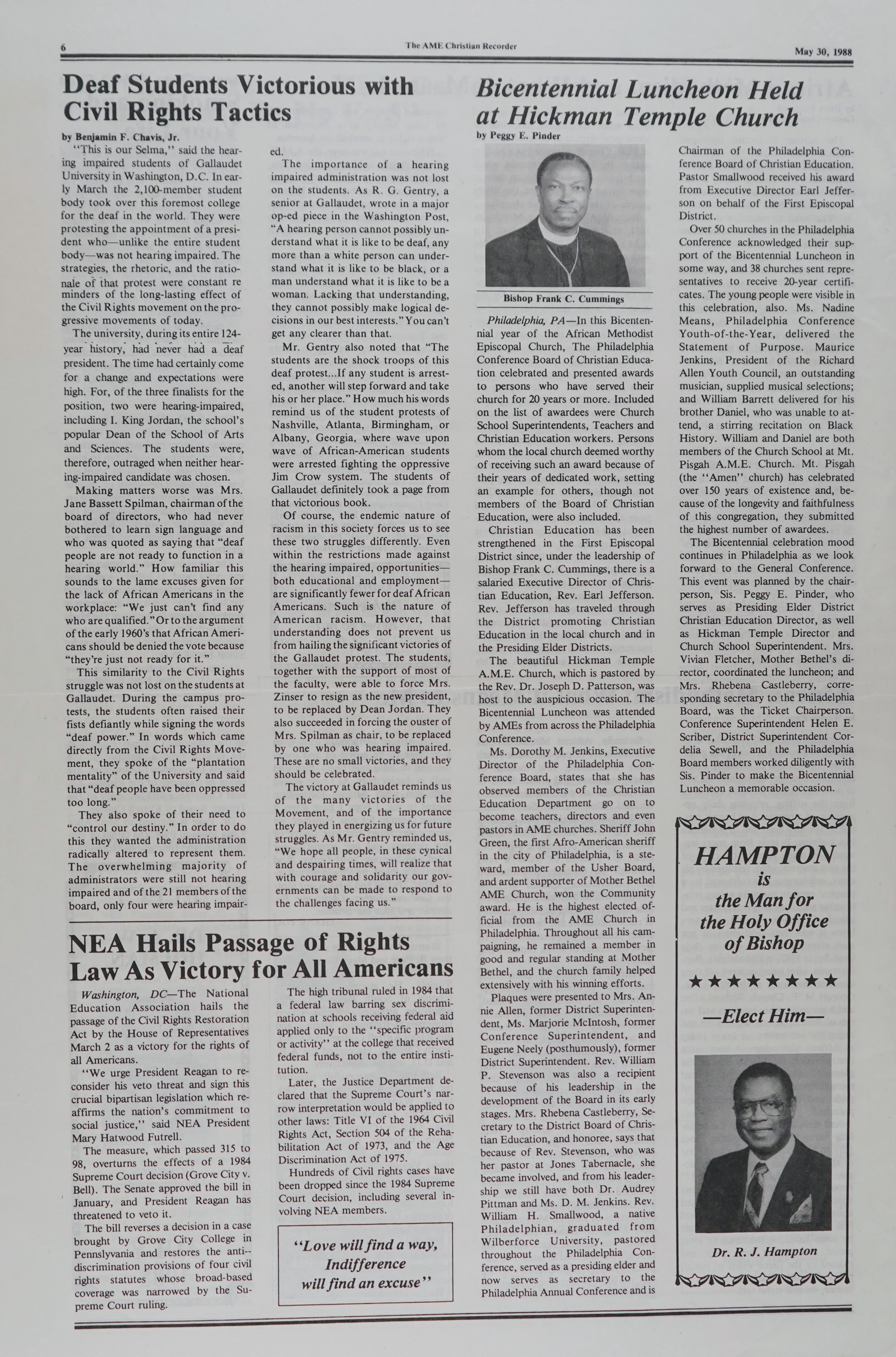
Bishop Frank C. Cummings
Philadelphia, PA—In this Bicenten-
nial year of the African Methodist
Episcopal Church, The Philadelphia
Conference Board of Christian Educa-
tion celebrated and presented awards
to persons who have served their
church for 20 years or more. Included
on the list of awardees were Church
School Superintendents, Teachers and
Christian Education workers. Persons
whom the local church deemed worthy
of receiving such an award because of
their years of dedicated work, setting
an example for others, though not
members of the Board of Christian
Education, were also included.
Christian Education has been
strengthened in the First Episcopal
District since, under the leadership of
Bishop Frank C. Cummings, there is a
salaried Executive Director of Chris-
tian Education, Rev. Earl Jefferson.
Rev. Jefferson has traveled through
the District promoting Christian
Education in the local church and in
the Presiding Elder Districts.
The beautiful Hickman Temple
A.M.E. Church, which is pastored by
the Rev. Dr. Joseph D. Patterson, was
host to the auspicious occasion. The
Bicentennial Luncheon was attended
by AMEs from across the Philadelphia
Conference.
Ms. Dorothy M. Jenkins, Executive
Director of the Philadelphia Con-
ference Board, states that she has
observed members of the Christian
Education Department go on to
become teachers, directors and even
pastors in AME churches. Sheriff John
Green, the first Afro-American sheriff
in the city of Philadelphia, is a ste-
ward, member of the Usher Board,
and ardent supporter of Mother Bethel
AME Church, won the Community
award. He is the highest elected of-
ficial from the AME Church in
Philadelphia. Throughout all his cam-
paigning, he remained a member in
good and regular standing at Mother
Bethel, and the church family helped
extensively with his winning efforts.
Plaques were presented to Mrs. An-
nie Allen, former District Superinten-
dent, Ms. Marjorie McIntosh, former
Conference Superintendent, and
Eugene Neely (posthumously), former
District Superintendent. Rev. William
P. Stevenson was also a recipient
because of his leadership in the
development of the Board in its early
stages. Mrs. Rhebena Castleberry, Se-
cretary to the District Board of Chris-
tian Education, and honoree, says that
because of Rev. Stevenson, who was
her pastor at Jones Tabernacle, she
became involved, and from his leader-
ship we still have both Dr. Audrey
Pittman and Ms. D. M. Jenkins. Rev.
William H. Smallwood, a_ native
Philadelphian, graduated from
Wilberforce University, pastored
throughout the Philadelphia Con-
ference, served as a presiding elder and
now serves as secretary to the
Philadelphia Annual Conference and is
Chairman of the Philadelphia Con-
ference Board of Christian Education,
Pastor Smallwood received his award
from Executive Director Earl Jeffer-
son on behalf of the First Episcopal
District.
Over 50 churches in the Philadelphia
Conference acknowledged their sup-
port of the Bicentennial Luncheon in
some way, and 38 churches sent repre-
sentatives to receive 20-year certifi-
cates. The young people were visible in
this celebration, also. Ms. Nadine
Means, Philadelphia Conference
Youth-of-the-Year, delivered the
Statement of Purpose. Maurice
Jenkins, President of the Richard
Allen Youth Council, an outstanding
musician, supplied musical selections;
and William Barrett delivered for his
brother Daniel, who was unable to at-
tend, a stirring recitation on Black
History. William and Daniel are both
members of the Church School at Mt.
Pisgah A.M.E. Church. Mt. Pisgah
(the ‘‘Amen’’ church) has celebrated
over 150 years of existence and, be-
cause of the longevity and faithfulness
of this congregation, they submitted
the highest number of awardees.
The Bicentennial celebration mood
continues in Philadelphia as we look
forward to the General Conference.
This event was planned by the chair-
person, Sis. Peggy E. Pinder, who
serves as Presiding Elder District
Christian Education Director, as well
as Hickman Temple Director and
Church School Superintendent. Mrs.
Vivian Fletcher, Mother Bethel’s di-
rector, coordinated the luncheon; and
Mrs. Rhebena Castleberry, corre-
sponding secretary to the Philadelphia
Board, was the Ticket Chairperson.
Conference Superintendent Helen E.
Scriber, District Superintendent Cor-
delia Sewell, and the Philadelphia
Board members worked diligently with
Sis. Pinder to make the Bicentennial
Luncheon a memorable occasion.
HAMPTON
is
the Man for
the Holy Office
of Bishop
KKK KKKKK
—Elect Him—
Dr. R. J. Hampton
YANN
ee
===== DSC05532.JPG =====
Saal
te mR «
te tetiint Oe tacit
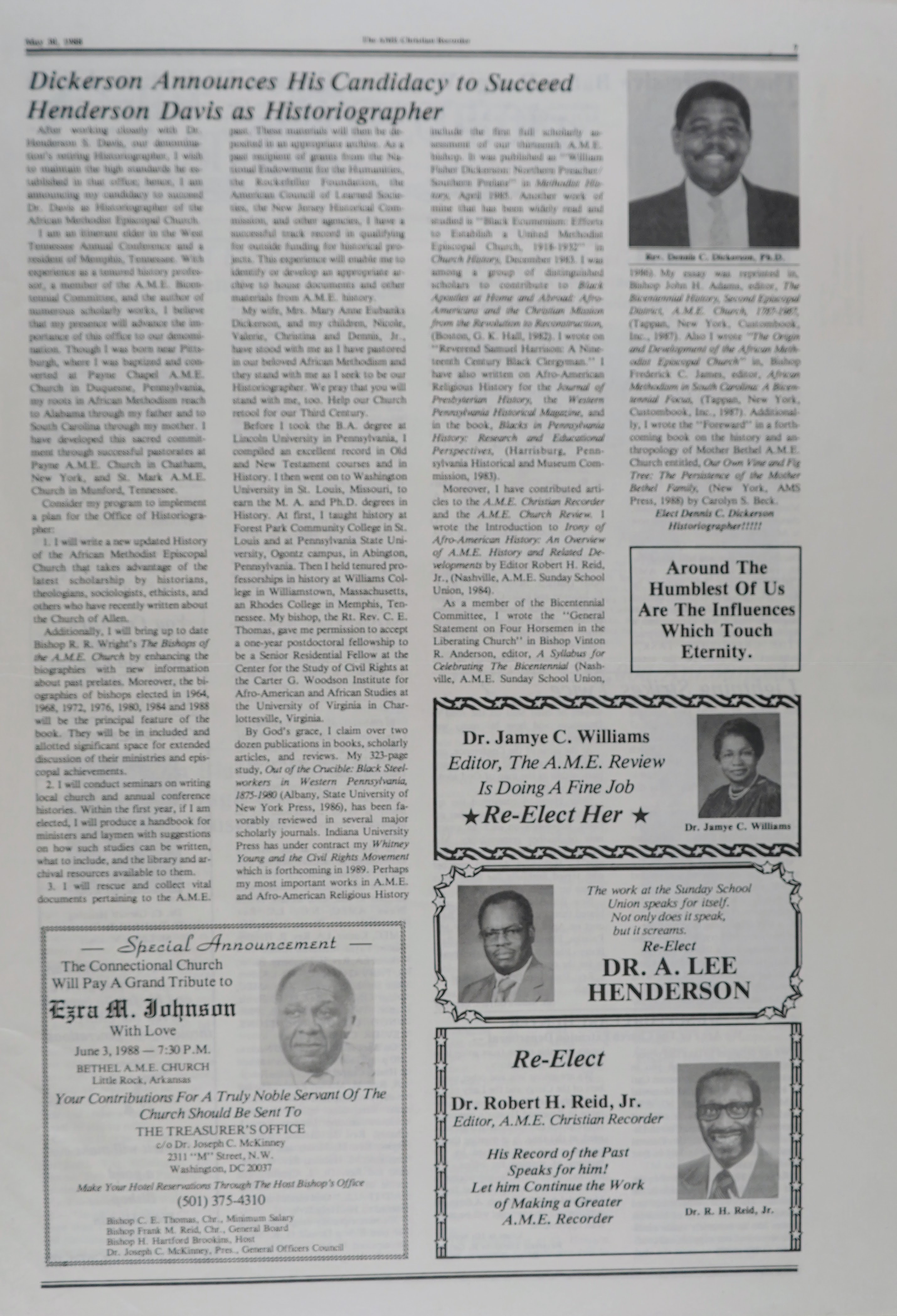
Dickerson Announces His Candidacy to Succeed
Henderson Davis as Historiographer
ate «weg dieiy with fy
Se
toe > ernie Miiecretoggeapites: ) wisi:
ee
whined w cw offue, tewe, | aw
araeniig oe) Cepndtedauy Ko saduiiieennd!
te Dive & Mibkortingeeaguien of tte
Pew Mechessiin Eyaciopay ¢ huis
1 em ae Dee cide we dhe Wan
Yetmwenee Aum Comets gid &
nemadionn col Missengukun Teaaence Wut
ORION HS | Kermerese tuscan pHceley
a, * ember of Ce AME Biam
tera! Commie and ote Maituw ol
mutes athoialhy worlka | tiles
Us ay prenmnoe wal advance he aan
potamus cf hue office to cnet Aeon
aaticon. Thomgt | wes turn oma Pate
‘reergih. witeme | wa hagmund and cow
vec’ «# Paese Chal AME
Chest a Deqguese Roomy hve,
ay toca am Athos: Mentodiiem mat
to Alatamae Ubromglt oe fakes amd ho
South Caveiina through my mother. |
New York, and & Mark AME,
Oierot an Neeaford, Tomucsne
Commadict thy pragract to anpikemaen
0 plan far the Ofiice of Hisorlogse
1. 2 will wrte a new updated History
of the Africas Methods: Epacopal
what to inchade, and the Library and ar-
cheval resources available to them.
3. 1 wil rescue and collect vital
documents pertaining to the A.M_E.
With Love
June 3, 1988 — 7:30 P.M.
BETHEL A M_E. CHURCH
Little Rock, Arkansas
— Sei tat Oi A 5 ok Ps ~enat
The Connectional Church
& Will Pay A Grand Tribute to
Dhaene srcgeetiadie well) hat tos de
ate Ue WP Apps apads rittais Ag
Pee oRARMENL oth gpemie Goon Ol Mle
Gira Bradley fon Cle FO uraatcse
Wie Gicuteetkeilien Froratadianuicn oe
Aamo Conmuil off | sated Shou
toe, Ute Naw Anew Pipeoriual Clown
mbnion, aid cube agence. | hae o
wacched Gra eeuiomd an qasifaany
fon ctyasiadte Pgsaadhang fow Miicatiig pros
jock, Tite eonypantinncie will omaddite ang bo
wamtiats on dieweiop an appropriate a
site ke Monine Glow emote ged cnr
mucetiah throm AME hetory
fy wiete, RO Mary Am Buches
Dixcheron, amd aey chilidben, Nicwile,
Velo, Chirvntew ond Doma, b.
taewe shod with ong ae | hae pentose
am cat tethowend Adtacam Net tadline amd
they stand wih one ae 1 sewik tro te cme
Himtonagraptuy We prey thad you will
stand wah ee, 100. Help oer Church
mio for oar Thed Ceatery
Before | took the B.A. degree aw
Liwooks Univority @ Pommytvenia, |
complied an cuceliom noord m Old
aad New Testament cours and in
History. | then went on io Washington
Usiversity in Si. Lows, Missouri, to
earn the ML A. and PAD. dogecs in
History. Ai first, | taugia history at
Forest Park Community College in Si
Louis and af Pennsylvania State Uni-
versity, Ogontz campus, in Abington,
Ponmylvania. Then | beid tenured pro-
fexsorhips in history at Williams Col-
lege in Williamstown, Massachusetts,
an Rhodes College in Memphis, Ten-
nessoe. My bishop, the Ri. Rev. C. E.
Thomas, gave me permission to accep!
a one-year postdoctoral fellowship to
be a Senior Residential Fellow at the
Cemter for the Study of Civil Rights at
the Carter G, Woodson Institute for
Afro-American and African Studies at
the University of Virginia in Char-
lotiesville, Virginia.
By God's grace, | claim over two
dozen publications in books, scholarly
articles, and reviews. My 323-page
study, Out of the Crucible: Black Steel-
workers in Western Pennsylvania,
1875-1980 (Albany, State University of
New York Press, 1986), has been fa-
worably reviewed in several major
scholarly journals. Indiana University
Press has under contract my Whimey
Young and the Civil Rights Movernent
which is forthcoming in 1989. Perhaps
my most important works in A.M.E.
and Afro-American Religious History
mii Oh fie Sul wholly a
hia AWE
iihioy, BH wie pratbileiasd ae ~ Williaa
UM dopracen Maori Pergiga thane
hou Posie ap Aiea Fil
ws Ap) TO Asotler work of
ite Chat a dee widely cod gd
ids Blick Perea Fe fonts
Eotedinh @ LUlthed Wheto
Eigptnccped = CMe th, ois PRK
Chars byaery, Dcomibun (RHR | wae
amoeyg + poep of Getegeniaed
whole to <¢onitiiete (0 Biwh
Agunilies a theme gud Abeoud Ape
Awneracams aud She Christan Miwsiore
Secreta Regaictestaore it Regs ores tea: acie,
(Bontom, GK. bail, 1902). | woote on
“Reverend Sasewe Hartnom A Niue
weh Comey Black Clergy” |
tue alo wiiter on Alto Amercian
Retgiow: Himory for the Jord of
Prestyieran Hoesory, the Wesmere
Penmaytuaia Hiesworwd Nhagasiee, aad
i the book, Blacks oe Pemylwmas
Haesory Reseach aad Extucutomal
Perspectives, (Hartiburg, Peas
theme Hetoncal and Museum Com-
chines, 1963)
Moreover, | have contributed art)
ches to the A.ALE, Christign Recorder
and the AME. Church Review |
wrote the Introduction to Irony of
Afro-American History: An Querview
of AME. History end Related De-
velopment by Editor Robert H. Read,
Jr., (Nashville, A.MLE. Sunday School
Union, 1984)
As a member of the Bicentennial
Commitiee, 1 wrote the “‘Goneral
Statement on Four Horsemen in the
Liberating Church’’ in Bishop Vinton
R. Anderson, editor, A Syllabus for
Celebrating The Bicentennial (Nash-
ville, A.M.E, Sunday School Union,
St) en
Piisten
he wot Beko, POD
hh), Wy ey wee Copied mm,
Sriep bots MN Adee. etoor, Pie
Bia erences Feats Ses omd tipim oped
Dem, AME Onur, > eae
(Tappan, New You. Comomibock.
ic. 1997). Also | weote “Tie Crag
and Die-uciygrmne of Bae AN «are lige
ott tpmepd COuek &, Gabo
Prederuck C. Jom, oder, Afuwe
telie cthasttcsiee 9% Saige Clapoileeag A Bia go
umd Fou, (Tapas, New Vor,
Custombook, inc, 1997) Additional
by, | wrote the ““Poreward™ a @ forth
coming book om the bntory aad ae
twopology of Mother Bethe! A.M FE
Tree: The Persmmeowe of thee Mother
Hethel Faedy, (New Yor, AMS
Prous, 1988) by Carolyn S. Bock
Hlext Demnis C. Dickerson
Histortogrepher!!!!!
Around The
Humblest Of Us
Are The Influences
Which Touch
Dr. Jamye C. Williams
Editor, The A.M.E. Review
Is Doing A Fine Job
* Re-Elect Her «
Union speaks for itself.
Not only does it speak,
but it screams.
Re-Elect
DR. A. LEE
HEN DERSON
Re-Elect
t Your Contributions For A Truly Noble Servant Of The
Dr. Robert H. Reid, Jr.
+ *+—_ 4+ —_ *—_ 8
Church Should Be Sent To :
THE TREASURER’S OFFICE z Editor, A.M.E. Christian Recorder
. Et ne Suet. ) His Record of the Past
nee a Speaks for him!
Make Your Hotel Reservations Through The Host Bishop's Office : MI Let him Continue the Work
(901) 375-4310 i i! of Making a Greater
Bishop C. B. Thowras, Chr, Mimenam Salary 4 A.M.E. Recorder
Bistep Frank M. Reid, Chr, Gouna Board y l
De. hough Chie. Pre e al Of froers Comancn § i
SLES SE SLELECULE ESTEE AAAI Vous 4
===== DSC05533.JPG =====
The AME Christian Recorder May 30
lay 30, 1988
The Progressive Baton Rouge-West New Orleans District: In Action
By Delores Thomas Geder
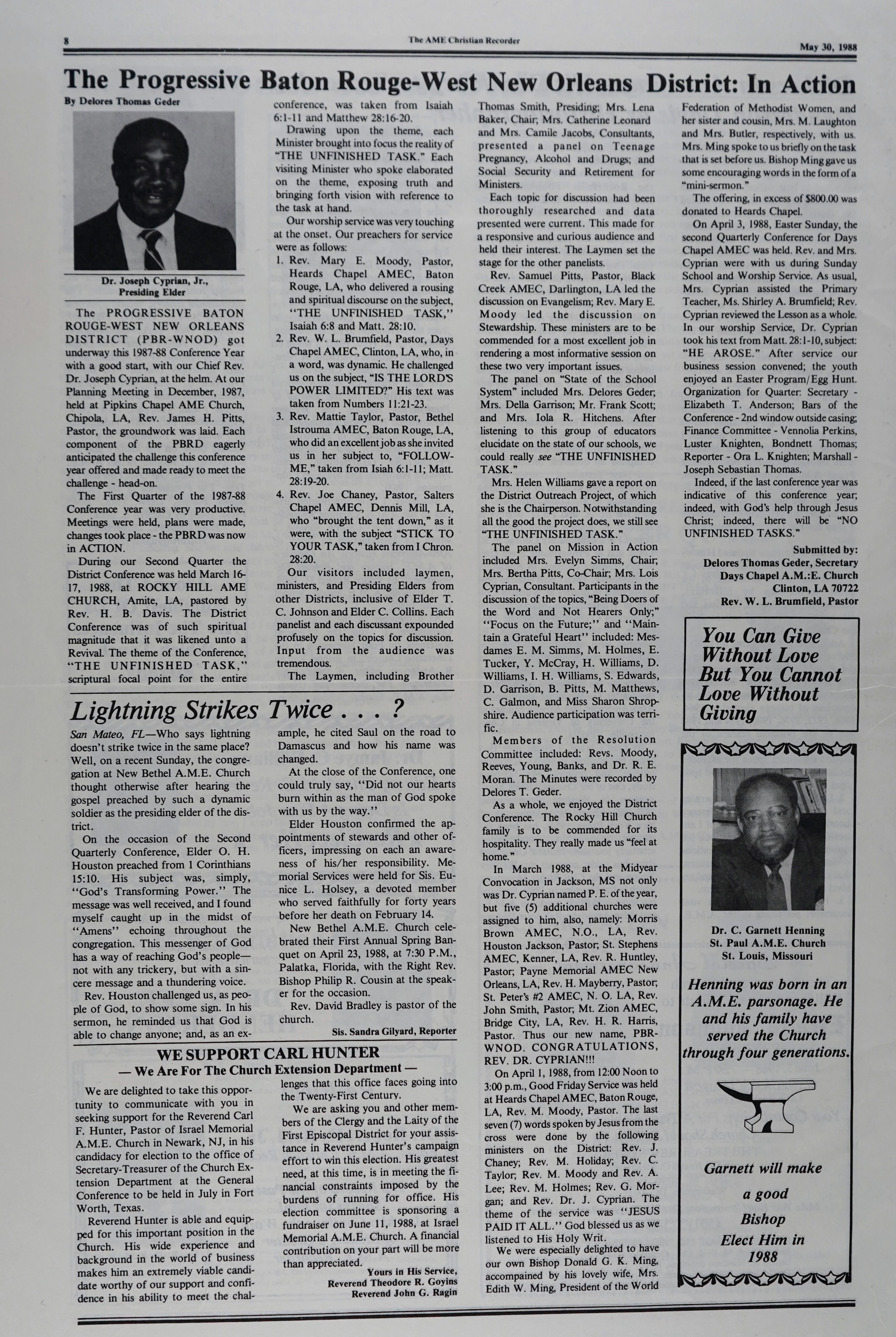
Dr. Joseph Cyprian, Jr.,
Presiding Elder
The PROGRESSIVE BATON
ROUGE-WEST NEW ORLEANS
DISTRICT (PBR-WNOD) got
underway this 1987-88 Conference Year
with a good start, with our Chief Rev.
Dr. Joseph Cyprian, at the helm. At our
Planning Meeting in December, 1987,
held at Pipkins Chapel AME Church,
Chipola, LA, Rev. James H. Pitts,
Pastor, the groundwork was laid. Each
component of the PBRD _ eagerly
anticipated the challenge this conference
year offered and made ready to meet the
challenge - head-on.
The First Quarter of the 1987-88
Conference year was very productive.
Meetings were held, plans were made,
changes took place - the PBRD was now
in ACTION.
During our Second Quarter the
District Conference was held March 16-
17, 1988, at ROCKY HILL AME
CHURCH, Amite, LA, pastored by
Rev. H. B. Davis. The District
Conference was of such spiritual
Magnitude that it was likened unto a
Revival. The theme of the Conference,
“THE UNFINISHED TASK,”
scriptural focal point for the entire
conference, was taken from Isaiah
6:1-11 and Matthew 28:16-20.
Drawing upon the theme, each
Minister brought into focus the reality of
“THE UNFINISHED TASK.” Each
visiting Minister who spoke elaborated
on the theme, exposing truth and
bringing forth vision with reference to
the task at hand.
Our worship service was very touching
at the onset. Our preachers for service
were as follows:
1. Rev, Mary E. Moody, Pastor,
Heards Chapel AMEC, Baton
Rouge, LA, who delivered a rousing
and spiritual discourse on the subject,
“THE UNFINISHED TASK,’’
Isaiah 6:8 and Matt. 28:10.
2. Rev. W. L. Brumfield, Pastor, Days
Chapel AMEC, Clinton, LA, who, in
a word, was dynamic. He challenged
us on the subject, “IS THE LORD’S
POWER LIMITED?” His text was
taken from Numbers 11:21-23.
3. Rev. Mattie Taylor, Pastor, Bethel
Istrouma AMEC, Baton Rouge, LA,
who did an excellent job as she invited
us in her subject to, “FOLLOW-
ME,” taken from Isiah 6:1-11; Matt.
28:19-20.
4. Rev. Joe Chaney, Pastor, Salters
Chapel AMEC, Dennis Mill, LA,
who “brought the tent down,” as it
were, with the subject “STICK TO
YOUR TASK,” taken from I Chron.
28:20.
Our visitors included laymen,
ministers, and Presiding Elders from
other Districts, inclusive of Elder T.
C. Johnson and Elder C. Collins. Each
panelist and each discussant expounded
profusely on the topics for discussion.
Input from the audience was
tremendous.
The Laymen, including Brother
Lightning Strikes Twice... ?
San Mateo, FL—Who says lightning
doesn’t strike twice in the same place?
Well, on a recent Sunday, the congre-
gation at New Bethel A.M.E. Church
thought otherwise after hearing the
gospel preached by such a dynamic
soldier as the presiding elder of the dis-
trict.
On the occasion of the Second
Quarterly Conference, Elder O. H.
Houston preached from 1 Corinthians
15:10. His subject was, simply,
“‘God’s Transforming Power.’’ The
message was well received, and I found
myself caught up in the midst of
“‘Amens’’? echoing throughout the
congregation. This messenger of God
has a way of reaching God’s people—
not with any trickery, but with a sin-
cere message and a thundering voice.
Rev. Houston challenged us, as peo-
ple of God, to show some sign. In his
sermon, he reminded us that God is
able to change anyone; and, as an ex-
ample, he cited Saul on the road to
Damascus and how his name was
changed.
At the close of the Conference, one
could truly say, ‘‘Did not our hearts
burn within as the man of God spoke
with us by the way.”’
Elder Houston confirmed the ap-
pointments of stewards and other of-
ficers, impressing on each an aware-
ness of his/her responsibility. Me-
morial Services were held for Sis. Eu-
nice L. Holsey, a devoted member
who served faithfully for forty years
before her death on February 14.
New Bethel A.M.E. Church cele-
brated their First Annual Spring Ban-
quet on April 23, 1988, at 7:30 P.M.,
Palatka, Florida, with the Right Rev.
Bishop Philip R. Cousin at the speak-
er for the occasion.
Rev. David Bradley is pastor of the
church.
Sis. Sandra Gilyard, Reporter
WE SUPPORT CARL HUNTER
— We Are For The Church Extension Department —
We are delighted to take this oppor-
tunity to communicate with you in
seeking support for the Reverend Carl
F. Hunter, Pastor of Israel Memorial
A.M.E. Church in Newark, NJ, in his
candidacy for election to the office of
Secretary-Treasurer of the Church Ex-
tension Department at the General
Conference to be held in July in Fort
Worth, Texas.
Reverend Hunter is able and equip-
ped for this important position in the
Church. His wide experience and
background in the world of business
makes him an extremely viable candi-
date worthy of our support and confi-
dence in his ability to meet the chal-
lenges that this office faces going into
the Twenty-First Century.
We are asking you and other mem-
bers of the Clergy and the Laity of the
First Episcopal District for your assis-
tance in Reverend Hunter’s campaign
effort to win this election. His greatest
need, at this time, is in meeting the fi-
nancial constraints imposed by the
burdens of running for office. His
election committee is sponsoring a
fundraiser on June 11, 1988, at Israel
Memorial A.M.E. Church. A financial
contribution on your part will be more
than appreciated.
Yours in His Service,
Reverend Theodore R. Goyins
Reverend John G. Ragin
Thomas Smith, Presiding; Mrs. Lena
Baker, Chair, Mrs, Catherine Leonard
and Mrs. Camile Jacobs, Consultants,
presented a panel on Teenage
Pregnancy, Alcohol and Drugs; and
Social Security and Retirement for
Ministers.
Each topic for discussion had been
thoroughly researched and data
presented were current. This made for
a responsive and curious audience and
held their interest. The Laymen set the
stage for the other panelists.
Rev. Samuel Pitts, Pastor, Black
Creek AMEC, Darlington, LA led the
discussion on Evangelism; Rev. Mary E.
Moody led the discussion on
Stewardship. These ministers are to be
commended for a most excellent job in
rendering a most informative session on
these two very important issues.
The panel on “State of the School
System” included Mrs. Delores Geder,;
Mrs. Della Garrison; Mr. Frank Scott;
and Mrs. Iola R. Hitchens. After
listening to this group of educators
elucidate on the state of our schools, we
could really see “THE UNFINISHED
TASK.”
Mrs. Helen Williams gave a report on
the District Outreach Project, of which
she is the Chairperson. Notwithstanding
all the good the project does, we still see
“THE UNFINISHED TASK.”
The panel on Mission in Action
included Mrs. Evelyn Simms, Chair,
Mrs. Bertha Pitts, Co-Chair; Mrs. Lois
Cyprian, Consultant. Participants in the
discussion of the topics, “Being Doers of
the Word and Not Hearers Only;”
“Focus on the Future;’’ and ‘‘Main-
tain a Grateful Heart’’ included: Mes-
dames E. M. Simms, M. Holmes, E.
Tucker, Y. McCray, H. Williams, D.
Williams, I. H. Williams, S. Edwards,
D. Garrison, B. Pitts, M. Matthews,
C. Galmon, and Miss Sharon Shrop-
shire. Audience participation was terri-
fic.
Members of the Resolution
Committee included: Revs. Moody,
Reeves, Young, Banks, and Dr. R. E.
Moran. The Minutes were recorded by
Delores T. Geder.
As a whole, we enjoyed the District
Conference. The Rocky Hill Church
family is to be commended for its
hospitality. They really made us “feel at
home.”
In March 1988, at the Midyear
Convocation in Jackson, MS not only
was Dr. Cyprian named P. E. of the year,
but five (5) additional churches were
assigned to him, also, namely: Morris
Brown AMEC, N.O., LA, Rev.
Houston Jackson, Pastor; St. Stephens
AMEC, Kenner, LA, Rev. R. Huntley,
Pastor; Payne Memorial AMEC New
Orleans, LA, Rev. H. Mayberry, Pastor,
St. Peter’s #2 AMEC, N. O. LA, Rev.
John Smith, Pastor; Mt. Zion AMEC,
Bridge City, LA, Rev. H. R. Harris,
Pastor. Thus our new name, PBR-
WNOD. CONGRATULATIONS,
REV. DR. CYPRIAN!!!
On April 1, 1988, from 12:00 Noon to
3:00 p.m., Good Friday Service was held
at Heards Chapel AMEC, Baton Rouge,
LA, Rev. M. Moody, Pastor. The last
seven (7) words spoken by Jesus from the
cross were done by the following
ministers on the District: Rev. J.
Chaney; Rev. M. Holiday, Rev. C.
Taylor; Rev. M. Moody and Rev. A.
Lee; Rev. M. Holmes; Rev. G. Mor-
gan; and Rev. Dr. J. Cyprian. The
theme of the service was ‘‘JESUS
PAID IT ALL.”’ God blessed us as we
listened to His Holy Writ.
We were especially delighted to have
our own Bishop Donald G. K. Ming,
accompained by his lovely wife, Mrs.
Edith W. Ming, President of the World
Federation of Methodist Women, and
her sister and cousin, Mrs. M. Laughton
and Mrs. Butler, respectively, with us.
Mrs. Ming spoke to us briefly on the task
that is set before us. Bishop Ming gave us
some encouraging words in the form of a
“mini-sermon.”
The offering, in excess of $800.00 was
donated to Heards Chapel.
On April 3, 1988, Easter Sunday, the
second Quarterly Conference for Days
Chapel AMEC was held. Rev. and Mrs.
Cyprian were with us during Sunday
School and Worship Service. As usual,
Mrs. Cyprian assisted the Primary
Teacher, Ms. Shirley A. Brumfield; Rev.
Cyprian reviewed the Lesson as a whole,
In our worship Service, Dr. Cyprian
took his text from Matt. 28:1-10, subject:
“HE AROSE.” After service our
business session convened; the youth
enjoyed an Easter Program/Egg Hunt.
Organization for Quarter. Secretary -
Elizabeth T. Anderson; Bars of the
Conference - 2nd window outside casing;
Finance Committee - Vennolia Perkins,
Luster Knighten, Bondnett Thomas;
Reporter - Ora L. Knighten; Marshall -
Joseph Sebastian Thomas.
Indeed, if the last conference year was
indicative of this conference year;
indeed, with God’s help through Jesus
Christ; indeed, there will be “NO
UNFINISHED TASKS.”
Submitted by:
Delores Thomas Geder, Secretary
Days Chapel A.M.:E. Church
Clinton, LA 70722
Rev. W. L. Brumfield, Pastor
You Can Give
Without Love
But You Cannot
Love Without
Dr. C. Garnett Henning
St. Paul A.M.E. Church
St. Louis, Missouri
Henning was born in an
A.M.E. parsonage. He
and his family have
served the Church
through four generations.
Garnett will make
a good
Bishop
Elect Him in
===== DSC05534.JPG =====
May 30, 1988
The AME Christian Recorder
Celebrating the Future
by Thomas L. McCray, District Pastor Presiding Elder, Cleveland District
Cleveland, OH—It is always exciting,
and to a great extent exhilarating, to
join in a celebration! Remember the
time you were invited to a birthday
party of your best friend, and how
anxious you became as the day drew
near, while anticipating the fun to be
had by all. Perhaps friends not seen
for a long time would be there, like the
friend who moved a few months ago
into another state, in a city just a few
miles away. It was a good feeling to
think there would be a lot of friends,
and there would also be a lot of fun,
and play. Celebrating a birthday party
was and still is a happy occasion.
But how is one to put into perspec-
tive the birthday celebration of 200
years of active, meaningful service to
people with a redemptive edge? What
kind of party do you throw at a time
like this? And after the celebration,
what then? Where do you go and what
do you do? These are questions laid
before the African Methodist Episco-
pal Church, its leadership, and its peo-
ple, questions laid before us by history
and by challenge. Our foreparents
broke ground that had not been
broken before, and they opened doors
that were closed before, pointing the
way for African Methodism to become
a dynamic stream in the movement of
history, impacting this nation, and the
world in a redemptive manner. So in
the year 1987-88, it is Jubilation! Bi-
centennial! Praise the Lord!
Two hundred years of service to the
nation and the world establishing chur-
ches, building educational institutions,
solidifying families, creating and en-
couraging business enterprises, in-
volvement with social and political
systems, together with engaging in
human services, have been hallmarks
of the A.M.E. Church. Undergriding
all of this has been a vital trust in
God, endeavoring in the footsteps of
Jesus Christ, under the guidance of
Holy Spirit. In a traditional form of
religious ecstasy, just to remember
enables the celebration—and almost
warrants a mood of adoration alone,
rather than insight into the future, but
from the nobility of remembrance, the
religious imperative is for us to act. In
our childhood, after the birthday party
was over, we frequently found our-
selves going back home with friends
and returned to ‘‘shooting marbles,”’
or playing with dolls or some other
play until it came time for the next
party.
On the crest of the Third Century
for African Methodism, the leadership
of the church understands that going
from the party, the celebration, and
back to playing marbles as were being
done before, would be tragic, indeed, a
serious derelict of duty, and utter
failure to people, and, especially, to
Black people who, among others in the
population of this nation, are facing
the severity of timely crisis. In addi-
tion, the leadership also understands
liberation and freedom to be eminent,
without which the dignity of human-
hood is senseless. Therefore, the lead-
ership of the A.M.E. Church, starting
with the top leadership, has already
begun to enhance skills and services to
provide resources to enable people to
the fullest extent of their humanity.
The future directions will be much
like what our forebears bequeathed to
us, and much more, because ours, and
the society of the future, will be
radically different. The A.M.E.
Church has been a wholesome pres-
ence in the turbulence of times (even
voluminous storms were striking
fiercely within the body of our Zion),
and will continue to weather the storm
clouds into the rainbow, built by the
providence of God that will enable the
church to endure.
Salvation from sin is primary, and
the first order of business for the com-
munity of God. However, sin takes
forms, like the yoke of ignorance, and
the power of education is the key to
cut the strap. The family and the
home, the work place and the hospital,
are important roads to salvation. The
theological injunction of personal
salvation and that of the society is not
debatable at this juncture, nor com-
pletely exclusive from the context. In-
deed, dynamic forces flood the syn-
drome of human existence are often
critical in the quality of the shape of
life. It is important to analyze, inter-
rogate, and attempt to correct the drift
of the impact of the system on individ-
ual persons, but also vice-versa. In-
fluencing the system seems to have
been a major role for church leader-
ship, and the A.M.E. Church, as a
voice of the Black community from its
genus has been a ‘‘Drum Major’’ for
Black people in America. It started in
1787, with the beat still going on in
1987.
The turf into the third century of the
African Methodist Episcopal Church is
as arable as were the first and second.
Human needs today are extended
beyond the capacity of the perception
of our forebears, and yet, with their
limited resources, they served ex-
ceedingly well, and laid a strong foun-
dation. In addition, they had a vision,
the dynamics of which continues to
impact people, and the systems that
govern the lives of people. The injunc-
tion, ‘‘God, our Father, Christ our
Redeemer, and Man our Brother,’
when released into action, is sound
theology, and a wholesome road to an
authentic sensible expression of the
Christian Faith. In grateful celebra-
tion at this time, the A.M.E. Church
declares to be ‘‘A Liberating and
Reconciling People.’’ Indeed—for the
world cries out for the need to be
reconciled.
With what credentials should the
leadership of the A.M.E. Church take
the lead for guiding its community to
be that liberating and reconciling peo-
ple? Throughout the history of this na-
tion the church and the leadership have
been an influential factor in the gov-
erning of this nation. Not only has this
been the case on a national scale (the
first Black U. S. Senator was an
A.M.E. clergyman), but, also, in state
and local municipalities. In the cor-
respondingly bicentennial history of
America and the African Methodist
Episcopal Church, leadership of our
church is inextricably entwined with
the development of this nation. So, to
prepare and to issue policy programs
to an unliberating and unreconciling
people and nation. seems to be the
challenge now.
The A.M.E. Church has the po-
tential to become the most viable or-
ganization in the nation to respond to
the crying human conditions in the ur-
ban communities. The urban centers
are noted due to their special challenge
to the Black church today. (The
A.M.E. Church was born in the heart
of the city and flourished in that arena
of service to people). We know the
city, for it is our mission!!
From the resources of our schools
of higher education, the faculty, re-
search persons, and other staff in these
schools can be found the most skill-
ful, highly trained, and keenly talented
people to enable the leadership of our
church to address the crucial and
critical issues confronting the Black
community. It is unfortunate, and em-
barrassing, to witness the leadership of
a religious body with theological roots
in a different culture from our own ad-
dressing issues affecting our people.
The leadership of our church is chal-
lenged and is not moving ahead to re-
ognize the importance of the ‘‘ex-
perts’’ in our own family, and will en-
gage them in the process of designing
programs to truly help us to be ‘‘A Li-
berating and Reconciling People.’’
The A.M.E. Church came into be-
ing with a divine commitment to be a
source of direction and strength to
people in trouble, and who were being
shut out of the main stream in Ameri-
ca. The commitment is commanding
and essential today if the church is to
venture into the third century with
significance and meaning. The idea of
massive leadership change, ‘‘moving
all the bishops’’ fades into irrelevance
as the beats in the hearts of Black peo-
ple cry out for comfort, and minds
stretch forth for new directions as we
move into the third Century.
The A.M.E. Church betrays its his-
tory if it fails to be the advocate for
human rights, improved health condi-
tions, economic stability, excellence in
education, equality of opportunity in
jobs and housing. This church has
championed the banner for civil rights,
justice, and peace with love for all peo-
ple. The signs of the times are a chal-
lenge for the church to remain on the
cutting edge, and as such, to be a
strong voice in communion with and
for the people in the contest against
forces of evil seeking to impede growth
and self-development. There are
within our own connection distinguish-
ed resources that could be called on to
fashion creative programs to enable
the church to its tradition, and to
enhance its mission in the world today.
In his book, The Truly Disadvan-
taged, William J. Wilson, a profes-
sor of Sociology at the University of
Chicago (a Wilberforce University
graduate), provides a key that might
prove helpful to the leaders of the
church and others at work seeking to
enable the quality of life in Urban
America today. He writes, ‘‘Civil
rights leaders whose agendas are domi-
nated by anti-discrimination and affir-
mative action are not reaching the
Black under-class. Their agendas
should be enlarged to include con-
crete service to the ‘‘truly disadvan-
taged.’’
The A.M.E. Church and its leader-
ship could strategically prepare policy
documents, and develop action pro-
grams to enable and strengthen the
Black community. Levels of commu-
nications are already in place that
could carry the message far and wide in
America, and throughout the peri-
meters of African Methodism. The
A.M.E. Church has the ability and the
potential power to make a major dif-
ference on the positive side for Black
people now, and in the future. The
hurdle is the will. The Holy Spirit is
urging the call. I believe, and I pray,
that the church and its leadership will
seek to respond. Our grandchildren,
then, will truly celebrate the communi-
ty on earth, reconciled and liberated.
Candidate for
BISHOP
~
Camden District
Twelfth Episcopal District
Rev. T. B. Lamb
Rev. C. D. Willis
Rev. T. A. Broomfield
Third Century
Leadership
To
The Bishopric
In
July 1988
HE IS A CHRISTIAN
DR. DAVID HARRIS
Tenth Episcopal District
Candidate for the Holy
OFFICE — BISHOP
RRA ene
x Leadership
for the
Third Century
>
ry
>
<
é
f
f
&
&
Dr. Jno. D. Leon Walker
ae
he Candidate
for the
x Bishopric
4,
>
a
PNM URNELUOESY
vee
—————————————————— _.___
===== DSC05535.JPG =====
10
The AME Christian Recorder
May 30, 1988
News From The Northwest Texas District
San Angelo, TX — The Pastor, Rev.
E. L. Wright and Congregation of
Greater St. Paul A.M.E. Church, San
Angelo, Texas, welcomed Presiding
Elders, Ministers, Delegates and Visitors
to the District Conference with a
program of warmth, love and gratitude.
Thursday morning at 10:00 a.m., the
District Conference opened with a
spirited devotion directed by our most
capable District Dean, Rev. E. L.
Wright, pastor of Greater St. Paul,
San Angelo, and newly elected co-lead-
er of the Tenth Episcopal District
Delegation to the Forty Third General
Conference in Fort Worth, Texas.
Rev. Vera Clay, pastor of Bethel,
Sweetwater, Texas, lined the beautiful
hymn, “A Charge To Keep I Have”, Rev.
Ciaphias Cain, pastor, Visitors Chapel,
El Paso, gave words of prayer that
touched our hearts. Rev. S. V. Ferguson,
pastor, Greater St. Luke, Midland, read
the Old Testament Scripture. The New
Testament Scripture was read by Rev.
Mary Lyles, pastor, Smith Chapel,
Eastland. Rev. W. T. Wright, pastor,
Johnson Chapel, Odessa, led the
Decalogue, while Rev. M. L. Goffney,
pastor, Baker Chapel, Big Spring, was in
charge of the benevolent offerings.
Rev. E. L. Wright presented our
distinguished Presiding Elder, Rev. I.
C. Cooper, who delivered the opening
sermon with a dynamic message.
Scripture was taken from St. Luke,
15th Chapter, 24th Verse. His ser-
mon was centered around the Pro-
digal Son, and His Lost Brother. He
stated, “We do not count all Sin as Sins
except depending who committed them.
We get so wrapped up in ourselves we
cannot do the things that should be
done. A very inspiring message.
The Invitation to Christian
Discipleship was extended by Rev.
Albert Dunn, pastor of Bethel,
Lubbock, Texas.
Following the offertory prayer by
Rev. W. T. Wright, Presiding Elder
Cooper and Ministers administered the
Holy Communion.
Briefly following the dismissal of the
opening session, Presiding Elder Cooper
organized the District Conference. Rev.
Ciaphias Cain, District Secretary and
Mrs. Norma Hackman, Assistant
District Secretary. Mrs. Fannie Burnett,
District Musician.
The District Institute, presided over
by Rev. E. L. Wright was very, very
informative and educational.
Rey. S. V. Ferguson, of Greater St.
Luke, Midland, and Rev. Albert Dunn,
pastor of Bethel, Lubbock, presented the
subject: Practicing Christian
Stewardship. This was an interesting
presentation, which involved
participation from the floor. Very
educational.
Rev. Billy Chavers, associate pastor at
Visitors Chapel, El Paso, presented
Evangelism — Who Is Responsible?
This presentation was excellent. It was
informative, interesting and educational.
Thursday Evening at 7:30 p.m., the
Ushers and Laymen of the District were
in charge of the program.
Mr. W. T. Gilbert, Conference Lay
President and Mrs. Ruby Niblett
District President of Ushers, presided.
The inspirational hymns and
congregation selections selected by Mrs.
Fannie Burnett, district Musician along
with Mrs. Carol Faye Johnson at the
organ was a spiritual hour.
Presiding Elder Cooper presented the
Rey. Billy Chavers, associate pastor and
rhember of Visitors Chapel, El Paso,
No One Can Make You Feel Inferior
Without Your Consent.
Texas. Rev. Chavers selected his
Scripture from The Book of Acts First
Chapter and the 4th Verse, which reads
in part: Stay In Jerusalem Theme:
Trusting In God Will Pay Off. Rev.
Chavers said to the Worshippers: “God
did a lot to save us. In his story, he said,
You Tarry in Jerusalem until you are
endowed with power. The spirit of God
does not belong to anyone. If you stay
close to the cross your burdens will be
lighter. This was a touching message.
On Friday, the District Institute
subjects were: Aids/Sources and
Resources. Presenters were: Rev. E. L.
Wright and Mrs. AlPearl Jones.
Making Right Decisions In Life.
Presenters: Rev. W. T. Wright and Mrs.
Ruby Niblett. Both were interesting.
During the high noon devotional
services, Rev. Cain presided with dignity.
Rev. I. C. Cooper presented the
speaker of the hour, Rev. Dr. Jno
DeLeon Walker, Presiding Elder of the
Fort Worth District and Candidate for
Episcopal Honors. His Scripture, First
Chapter - John and the 4th verse.
Subject: Through the Eyes of John, Who
Is This Jesus? This was a dynamic
message. Dr. Walker said, “When we
come to know Jesus we will have an
unforgettable experience.”
Friday afternoon District Institute
Subjects were interesting. Presented
were: Spiritual Gifts and Talents.
Presenters: Rev. D. Edwin Johnson and
Ms. Louise Hardeman.
Role of Local Church Officers.
Presenters: Mr. W. T. Gilbert and Mr.
Carlton Price.
This was a very interesting
presentation. Presiding Elder Cooper
presented: Pastoral Administration.
March 24th, at 7:30 p.m., the Ministers
Wives and Missionaries were in charge
of the program. Mrs. Billye Wright
presided with poise and dignity. A
spirited devotion preceded the sermon.
The Call to Worship, Mrs. Billye
Wright. Responsive Scripture: Mrs.
Norma Hackman, Decalogue: Mrs.
Jacquelyn Chavers.
Introduction of speaker, Presiding
Elder Cooper. Speaker of the evening:
Rev. Clinton Robert, pastor, Lee
Chapel, Brownwood, Texas.
Prior to the introduction of the
speaker, Lee Chapel Choir under the
direction of Mrs. Clinton Robert,
rendered two beautiful selections. The
choir’s harmony was marvelous.
Rev. Robert’s selected Scripture was
taken from The Book of Colossians,
First Chapter, 25th Verse. Subject:
Preaching Christ. Rev. Robert said,
“Christ is the true living bread. He is an
all Christ, and He is a whole Christ.”
This was a well delivered sermon. The
District Coference closed on a high note.
Saturday morning at 9:15 a.m., the
Executive Board of the Northwest Texas
Conference Missionary Society under
the leadership of Mrs. Anna D. Jones
held a business session which was very
informative. Mrs. Jones presided with
dignity.
The societies from Bethel, Sweetwater
and Greater St. Paul, San Angelo,
presented beautiful and informative
discussions to the group.
Mrs. AlPearl Jones, Y.P.D. Director,
gave a brief synopsis of the Y.P.D.
Meeting and their accomplishments.
This was an excellent combined
meeting.
The meeting closed with the singing of
the missionary benediction.
Naomi L. Graham, Reporter
Allen Chapel Quarterly Conference
The second Quarterly Conference of
Allen Chapel, Baton Rouge, Louisi-
ana, convened Sunday, March 27,
1988, at 4:45 p.m., with the Rev. Jo-
seph Cyprian presiding.
After the opening of the conference,
Rev, Cyprian made some very ap-
pealing remarks concerning goals that
Christians should pursue, He pointed
out the fact that God has blessed us
all. Since we are the recipients of his
blessings we should be continuously
about our Father’s business. He con-
tinued his remarks by emphasizing that
we are what we are because of God’s
grace and not by any merits of our
own.
The reports from the pastor were
called for and read. The reports show-
ed that the church had been alert in the
performance of their various duties.
To our regret, one of our members
had been called to his final rest during
the quarter, but we realized that we
must bow in humble submission to
God’s will. The business of soul saving
has been clearly demonstrated in that
twelve members have been added to
the church during the quarter. The
Sunday School has taken on new vitali-
ty, and its attendance has increased
tremendously. We are proud of the
stimulating sessions sponsored by the
Allen Christian Endeavor Fellowship.
These sessions provide the youth with
guidelines for Christian living. The
ACE Fellowship has presented panel
discussions, film showings, lectures,
-and various other activities that have
added new dimensions to the spiritual
growth of our young people.
Our church has sponsored many
unique features that have given variety
to the program. One of them is the
church calendar, that lists the names
and birthdays of the members, This
has been a successful financial project
and the calendar can be used as a
treasured memorabilia, The beautiful
church directories are colorful and
portray the workmanship of inno-
vative minds. These are some of the
ways that the expert productivity of
our members is expressed,
The Out-Reach programs are serv-
ing the community in a very special
way. The Food and Clothing Bank is
supplying some urgent needs among
the destitute of our community. It is
gratifying to be able to administer
assistance to those who are not able to
provide for themselves. One of the
greatest evidences of our Christianity is
our willingness to share of our
substances with others who are less
fortunate.
The Adult Instruction Center is a
fountain of knowledge for adults and
high school students who need
refresher courses. The program pro-
vides an opportunity for individuals to
prepare themselves for higher levels of
study or enables them to perform
more efficiently in their field of ser-
vice. Courses are offered in English,
advanced reading, mathematics, and
piano music. We are hoping that the
people of our community and sur-
rounding areas will take advantage of
the program.
We are deeply grateful for the con-
scientious leadership of our pastor,
Rev. Larry M. Banks, who has con-
tributed greatly to the success of the
church program. Above all, we know
that God has been with us and we trust
that He will lead us on to higher
heights of Christian attainment.
Quarterly Meeting Is Observed
The 4th quarterly meeting for the
conference year was observed March 19
& 20, 1988 at Harrison Chapel African
Methodist Episcopal Church-Richlands,
N.C.
Dr. W. T. Holland, Sr., Presiding
Elder of the Southeastern District -
North Carolina Conference and Rev. T.
Campbell, pastor of the Richlands
circuit presiding.
March 19, 1988 at 7:00 p.m. quarterly
conference was held and the business of
the circuit was conducted.
Auxiliaries of both churches made
their financial reports and were
commended for progress noted.
Sunday 9:45 a.m. Sunday School
opened with Mrs. Joan Southerland,
Superintendent and officers in charge.
Worship service began at 11:00
o’clock with Rev. T. Campbell and Rev.
J. W. Richardson visiting minister of St.
Luke A.M.E. Church conducting the
devotional service.
Mrs. Iris Mack and the senior choir
rendered the music.
Rev. Campbell presented Elder
Holland to deliver the morning message.
Sermonic Spiritual: “Shine On Me”
after which Dr. Holland delivered a soul
stirring sermon. Text: Mark 10:45 —
Theme: “The Work of Christ Before He
Went To The Cross.” The message was
spiritually moving.
Holy Communion was administered
and a spiritual fellowship was
experienced.
Lunch was spread at the close of the
morning service.
The 3:00 o’clock worship service was
rendered by Rev. Willie James Cox,
pastor, choir and members of Greater
Mount Zion Baptist Church, Kinston,
N.C.
Spiritual selection: “I’m Going To See
It Through” — Text: Acts 16:25-26
verses. Subject for thought “Can You
Handle Your Midnight?”
Rev. Cox really preached out of the
depth of his heart.
The quarter was largely attended
and considered successful in every
respect.
Next quarter will be observed June
18 & 19, 1988 at Haw Branch African
Methodist Episcopal Church, Rt. 3,
Richlands, N.C.
Total finance raised during the quar-
ter $984.28.
KKK KKK FOR KKKKKKK
BISHOP 8
Ue
Rev. Louise C. Harris
THIRD EPISCOPAL DISTRICT
A Servant of God
Ready For Service
art Sie Sa en Sl
===== DSC05536.JPG =====
May 30, 1988
The AME Christian Recorder
TRAVELING WITH THE PRESIDING ELDER
Mt. Olive A.M.E. Church Dunnellon Florida
St. Paul A.M.E.
Orlando, Florida
The North Orlando District Con-
ference was one of success. There were
all indications of learning and witness-
ing. It was significant to note that
ministers, laymen, missionaries, and
delegates from every corner in the dis-
trict traveled to St. Paul A.M.E.
Church, Orlando, Florida for this an-
nual occasion. The Rev. Jack Williams
and his dedicated members wasted no
time in being very generous and
gracious hosts and hostesses.
Topic and presenters included:
Preachers For Orders, Rev. Leroy
Kennon; Mission Churches of The
District and Voter Registration, Rev.
David Connelly. Considerable time
was given for each discussion, in-
cluding Laity as well as Ministers.
The mid-day and evening messages
were delivered by the following minis-
ters: Promises of The King, Rev.
James O. Williams: It’s Not Strange,
Rev. K. D. White, Jr., Every Born
Again Christian Ought to Have a New
Song, Rev. Jimmy Howard: Be Not
Dismayed, Rev. James T. Golden. The
Holy Spirit made itself evident in each
session.
Friday night (the last night of the
conference) senior choirs came from
all across the district with represen-
tation from every church on the dis-
trict.
Presiding Elder K. D. White Sr., has
served the district well during the past
seventeen years. He is a peacemaker,
pastor, and a born again Christian. We
cannot praise him enough for the lead-
ership that has been presented by him.
Reporter: Mary Slice Jenkins
Today was a two fold day. It was
Young People’s Day and the 2nd
Quarterly Conference.
The day was beautiful all day, It
started off with Sunday School, and on
through the Quarterly Conference.
The young people sang out of their
souls.
Rev. Al Washington lined hymn
#394 (We are often Tossed and
Driven), and read our scripture. It was
taken from Mark 12:36-44.
Pastor J. E. Reeves presented the
Presiding Elder, Reverend L. L.
Johnson, who gave us some encour-
aging remarks.
The Rev. S. L. Harris, Presiding El-
der brought his daughter along with
him.
After we sang the sermonic hymn,
‘** Amazing Grace,’’ which was lined by
Rev. Al Washington, Rev. S. L. Harris
came before us. She gave a beautiful
meassage. It was taken from the a-
bove read scripture. Her text was
“How Much Is All?’’ She really
preached out of her heart. She was
preaching about a widow who gave all
the money she had to Christ. She said
Christ gave his life for us. She asked
the question: Are we giving our all
to—for Christ? Are we giving our time
and our money for the cause of
Christ? She really gave us food for
thought.
After collection, Presiding Elder
Johnson began his Quarterly Confe-
rence.
Sister Rochelle Montgomery was
named secretary and reporter for the
Second Quarterly Conference Held at
St. Paul A.M.E. Church, Lake Charles, LA
by Mrs. Ruth Ferguson Parker
“Blessed Is the Man Whose Faith
and Hope Are in the Lord,”’ was the
theme of Presiding Elder E. D.
Williams’ message to the congregation
of St. Paul A.M.E. Church, Lake
Charles, LA, in its Second Quarterly
Conference. Rev. Williams chose for a
text, Jeremiah 17:7, and began his ser-
mon by describing the importance of
Faith and Hope—two of the three
great Christian virtues. In emphasizing
his theme, he stated, ‘‘ ‘Blessed’
means to be rewarded; it means great
joy; it is the gift of divine faith: good
wishes approved.’’ The Presiding
Elder added, ‘“‘You must do something
to be blessed.’’ ‘‘Faith,’’ he said,
“means belief, unquestionable belief
in God, complete trust, control and re-
liance. Hope means trust; it is a feeling
of what will happen. Faith and trust
are tied up together.’’ Rev. Williams
cited three faithful patriarchs—Abra-
ham, Job and Jeremiah—whom the
Lord blessed. He reminisced the la-
bors of his own life and expressed the
great joys that he is now experiencing.
He climaxed his message by reciting
the first Psalms and a stanza from the
hymn ‘‘Amazing Grace.” ‘‘The Lord
has promised good to me. . .”
Accompanying Rev. Williams to the
Conference was his queenly wife, Mrs.
Nettie Williams, and Sister Catherine
Gaines. Mrs. Gaines, a member of
Grant Chapel A.M.E. Church, Lena,
LA, and an aspiring local elder of the
A.M.E. Church, assisted the pastor,
Rev. Jesse R. Adams, in the morning
worship. An interesting business ses-
sion followed. The pastor reported
five conversions and accessions, one
baptism, and one death—Sister Rosa
Offitt. Mrs. Offitt was a loving, giving
and faithful member who served her
church well as Program Chairperson
and usher. Though she is sadly missed,
we shall always cherish her memory. A
brief memorial was conducted. Mrs.
Augustine Shorten spoke on her life,
followed by the Presiding Elder who
led in singing ‘‘Rest for the Weary.”’
Presiding Elder Williams lauded
Pastor Adams and members of St.
Paul for the spiritual and financial
progress made during the past Quarter
and commended them for the beauti-
ful work done on the interior of the
church. He also expressed his joy in
coming to St. Paul because of the
warmth and spiritual atmosphere of
peace and love that exists and abides
among the membership and pastor.
This annual relationship seems to bind
pastor and members so closely togeth-
er that every activity, program or pro-
ject that has been planned and carried
out has been so effective that St. Paul
continues to be a beacon for African
Methodism and Christian Mission in
the Lake Charles Community.
THOUGHTS FOR
THINKERS
by Dr. R. J. Hampton
The utmost degree of accuracy
should be pursued in every move or
endeavor in one’s life.
For it is that slight degree of greater
accuracy that distinguishes the
winners in life.
Quarterly Conference,
Evangelist James Griffin and
Evangelist Ponzelle Boone’s licenses
were renewed, Each received their
licenses from Presiding Elder Johnson,
All organizations and Auxiliaries
made their reports. The reports were
adopted as read.
We were dismissed by Rev. S. L.
Harris.
We were happy to have our new
pastor, Rev. J. E. Reeves, and his
family.
His wife, Sister P, Reeves, is work-
ing beautifully with the women of the
church and the young people.
We are always happy to have Pre-
siding Elder Johnson and his queenly
wife.
We are praying for Elder Johnson’s
complete recovery from his accident.
Sister Rochelle Montgomery, Reporter
District Conference Presided Over by
Presiding Elder J. B. Blake
by Reverend I. F. Mitchell
Lake Worth, FL—The West Palm
Beach District Conference, of the
South Florida Conference of the
African Methodist Episcopal Church,
was one of delightful enchantment and
enlightenment, as Presiding Elder J. B.
Blake took charge. It was an occasion
of great spiritual growth and develop-
ment.
Resolution
Grant Chapel A.M.E. Church
Whereas, we have met in another
District Conference of the West Palm
Beach District of the African
Methodist Episcopal Church, answer-
ing the call of our most efficient
leaders in the persons of Presiding
Elder J. B. Blake and Mrs. Dorothy
Blake; and
Whereas, we thank God for putting
it into the mind of our most eloquent
Presiding Elder J. B. Blake is most
challenging and inspiring program in
this great District Conference, one that
has brought much inspiration and
discussion; and
Whereas, we have been blessed with
strong and challenging sermons
delivered by Rev. L. W. Sneed, Sr.,
pastor of Bethel A.M.E. Church,
Deerfield Beach, FL. Text: Luke
5:4—‘‘Launch out into the deep and
let down your nets for a draught. Sub-
ject: ‘‘Reaching Out for New Horizons
of Christian Witnessing in This
Troubled World.”’
Rev. I. F. Mitchell, pastor of St.
Paul A.M.E. Church, West Palm
Beach, FL. Text: Exodus 3:3—‘‘And
Moses said, I will now turn aside, and
see this great sight, why the bush is not
burnt.’’ Subject: ‘‘Turn Aside,
Qualify, Go.”’
Rev. Joseph Berrian, pastor of St.
James A.M.E. Church, Jupiter, FL.
Text: Psalms 66:7—‘‘He ruleth by His
power forever.’’ Subject: ‘‘Power
From On High.’’
Rev. F. S. Fayson, pastor of Hurst
Chapel A.M.E. Church, Riviera
Beach, FL. Text: Daniel 2:25—‘‘I have
found a man of the captives of Judah,
that will make known unto the king
the interpretation.’’ Subject: ‘‘I Have
Found A Man.”’
Whereas, we have been blessed with
the melodious voices from the follow-
ing choirs: (1) Bethel A.M.E. Church
Choir, Deerfield Beach, FL, Rev. L.
W. Sneed, pastor; (2) St. Paul A.M.E.
Church Choir, West Palm Beach, FL,
Rev. I. F. Mitchell, pastor; (3) Hurst
Chapel A.M.E. Church Choir and
Duet, Riviera Beach, FL, Rev. F. S.
Fayson, pastor; and (4) the District
Choir; and
Whereas, we are deeply grateful to
our Presiding Elder Blake for the
topics we have been blessed with for
discussion as they pertained to the
“Local Church’’ led by the following
pastors: 1. Rev. W. J. Jackson—
‘‘What are the procedures for borrow-
ing money for a church?’ 2. Rev. F.
R. Satchel—‘‘What is the procedure
for securing trustees?’’ 3. Rev. I. S.
Jones—‘‘Who authorizes payments of
bills for the church??”’ 4. Rev. I. F.
Mitchell—‘‘What are the respon-
sibilities of the Church Conference and
how often should it meet?’’ 6. Rev. E.
G. Bellamy—‘‘What are the responsi-
bilities of the Board Meetings?’ 7.
Rev. L. W. Sneed, Sr.—‘‘Should a
Steward or Trustee sit behind the
Chancel Rail and why?”’ 8. Rev. Allen
Orr—‘‘What are the rules of an
A.M.E. pastor?’? 9. Articles of
Religion Discussion—Rev. Walter
Harvey, Rev. Joseph Berrian, Bro.
Joseph Baldwin, Bro. Willie
McLemore. 10. Rev. J. H.
Russell—‘‘What are the duties of
A.M.E. members?’ 11. Rev. H. H.
Hall—‘‘Should an infant who has
been baptized be baptized again upon
reaching adulthood?’’ 12. Rev. Rheba
Johnson—‘‘Who makes changes in
scheduled Quarterly Conferences?’’
13. Rev. Theodore A. Barnett—
“What is a Junior Church, its purpose
and whose duty is it to get it organiz-
ed??? 14. Rev. George Gaskin—
“What is the purpose of the proba-
tionary term and how long is its dura-
tion?’’
Whereas, the West Palm Beach Dis-
trict Lay Organization was in session
under the capable leadership of Sister
Marian Bacon White of St. Paul
A.M.E. Church, West Palm Beach,
FL, as president, presented a program
entitled ‘‘A Change—The Old Time
Meeting;’’ and
Whereas, we have been blessed with
the presence of the following
distinguished personalities: Presiding
Elder C. W. Hunt and Mrs. Lelia
Hunt of the Fort Pierce District,
Presiding Elder I. D. Hinson of the
Miami District, Rev. Leroy Wash-
ington, Rev. Thomas Francisco, Rev.
James Watson, Rev. T. E. Roddy,
Rev. Louis Preston; and
Whereas, congratulations are in
order to Pastor E. G. Bellamy and his
lovely wife, Mrs. Judy Bellamy, and
the entire Grant Chapel A.M.E.
Church Family for the splendid enter-
tainment that they have given us. They
left no stones unturned in providing us
with superb hospitality and scrump-
tuous meals.
Resolved, that this Conference now
in session give a rising vote of thanks to
our leaders, Presiding Elder J. B.
Blake and Mrs. Dorothy Blake for
their dynamic leadership.
Humbly submitted,
YOUR COMMITTEE
ON RESOLUTIONS
Rey. Rheba Johnson
Rev. F. R. Satchel
Rev. L. W. Sneed, Sr.
Rev. I. F. Mitchell, Chairman
===== DSC05537.JPG =====
12 The AME Christian Recorder
Cecil W. Howard
vAY
The Choice
For General
Secretary
Dr. U. A, Hughey Rev. Lewis E Grady
“THE BETTER CHOICE’
F—ELECT—*
1 Rev. Lewis E.
Grady, Jr. ,
B.S., M. DIV. *
For
Leadership
for the
THIRD CENTURY
— Elect —
Him Bishop in Candidate
for the
Bishopric
PER RTT TT RRR RA AH TTT TTT IH III HII AAA IIASA SAS SASS SISSISISSSISSCSSISSAWCSC
* Elect x
CANDIDATE :
FOR : * Elect
BISHOPRIC : Dr. Cyrus Keller
DR. ROBERT WEBSTER t Editor
PK KK HTK I IORI HRI TK II II KI IIIA DIA IAAI ASIA SIA SAA SIA AAA SIA A SO : Religious
[2 pe ay een : Literature
The Best Man For x 2
x The JobIsOnThe Job % |:
x a |i
x — Re-Elect — x :
i ° x (i(F Dr. David C. Coleman
x Heres Miles : aia
a” or ot h
x ‘ The Church Extension 3 t mh aes c
% Department x t
INARI ININIRINININY :
— Re-Elect — j 5 » : Peek 27AA
Dr. Edgar L. Mack ‘(= : : “oe :
Executive Secretary Ps x :
The Christian Education >» /; G z :
Department tag STAR Mack : :
SAAC ACACIA KKHKKKKKEAK Gf :
S = -<C OR Ree 1 LO Ne @ ; :
6 : Dr. Fred Harrison :
9) In The Last Issue We Published . . . : :
© Ne Dr. P. Albert aed Picture Under : * E lect * :
© J ~«) Dr. Preston Williams — : $ A Man With ;
S “<P . is easeies rots a ir | 2 food Cause For
© fan & P. Albert Williams agi : Missions :
; ine —A. Lee Henderson, Publisher § t
6 Id oo BP poner i : Dr. Fred Harrison :
© Dr. Preston Williams ; :
: adda
===== DSC05538.JPG =====
May 30, 1988
The AME. Christian Recorder
Tracking Hurts Minority
Students Most, But System Can
Be Altered, Says Expert
Washington, DC—An increasing num-
ber of education professionals and
parents oppose tracking as unfair to
minority students, Jennie Oaks writes
in the premier edition of Issues 88 a
new publication of the National Edu-
cation Association.
The annual magazine, with a circu-
lation of over 1.9 million NEA mem-
bers and education leaders, debuted in
January.
Oakes, a social scientist with the
Rand Corporation of Santa Monica,
CA, says tracking—which segregates
schoolchildren by perceived ability
level—creates uneven classroom op-
portunities and unequal access to
knowledge.
A disproportionate number of poor
and minority students are put in ‘‘low-
ability’? classes early in their school
careers, Oakes points out. These stu-
dents develop low self-esteem, and the
longer they remain in such classes, the
further behind they fall.
Students in lower tracks, Oaks ex-
plains, are taught mostly by work-
books, kits, and easy-to-read stories,
while learning tasks usually consist of
memorizing and repeating answers
back to the teacher.
Students placed on_high-ability
groups have far richer schooling exper-
iences than either low-ability or
average-ability groups.
“They have access to different types
of knowledge and intellectual experi-
ences,’’ writes Oakes. ‘‘They are ex-
pected to learn vocabulary that would
eventually boost their scores on col-
lege entrance exams. . . Their teachers
tend to be more enthusiastic (and) use
criticism and ridicule less frequently
than teachers of low-ability classes.’’
What can be done to eliminate the
inequities?
“‘No ready-made staff-development
packages or teaching formulas exist to
help schools and teachers move
smoothly toward less tracking,’’ notes
Oakes, who also acknowledges the dif-
ficulty of mixing within traditional
competitive classrooms, students who
have different knowledge levels.
But Oakes does offer some impor-
tant new recommendations for over-
coming the problems inherent in track-
ing. Schools, she argues, need to take a
concept-based approach to curriculum
and design active learning tasks rather
than passive ones—team activities that
require thinking, discussing, writing,
and visualizing.
“‘Classrooms will probably need to
be organized far differently, providing
a diversity of tasks and interactions
with few public ‘comparisons of stu-
dents’ abilities,’’ writes Oakes.
In these new classrooms, adds
Oakes, teachers would ‘‘function like
conductors, getting things started and
keeping them moving along, providing
information and resources.’’ Grades
would be based on improvement,
progress toward a learning goal.
Where tracking isn’t immediately
eliminated, Oakes recommends that
new placement criteria be considered
that ensure racial and ethnic balance at
all track levels and in special programs
for the gifted.
The present system ‘‘where the rich
get richer and the poor get poorer’’ is
usually vigorously defended by those
few who benefit from it, says Oakes,
but it can be altered if school staffs
and communities work together.
“But unless teachers have the time
and the professional autonomy to de-
liberate about, develop, and experi-
ment with fundamental changes in
school organization and classroom
practices, alternatives to tracking are
unlikely to be intelligently conceived,
enthusiastically endorsed, or success-
fully implemented,’’ she concludes.
Allen A.M.E. Church, Tacoma,
Washington Moves to New Edifice
Allen A.M.E. Church recently
celebrated its 99th Anniversary and is the
oldest black church in the City of
Tacoma, Washington. The week long
celebration was concluded Sunday,
February 28, 1988 which was the last
Sunday the members worshipped in that
particular facility. On Sunday, March
6th the congregation marched from their
old facility to the new facility four and
half blocks away. The march was led by
the pastor Dr. Vernon S. Burroughs, the
presiding elder Dr. J. B. DeWitty and a
host of city officials and community
leaders. Upon arrival there were prayer,
remarks, and a brief ribbon cutting
ceremony which was followed by the
worship service. Some 400+ members
and friends were in attendance:
following the sermon by Pastor
Burroughs fourteen (14) individuals
united with the Allen A.M.E. Church.
The Lord has truly blessed Allen. The
members rejoice and thank God for our
presiding prelate and Senior Bishop
Henry W. Murph for sending us
Reverend Vernon S. Burroughs. Under
the leadership of Pastor Burroughs,
which has only been six months, Allen
has experienced a tremendous amount
of Spiritual and economic growth. In
such a short period of time 62 members
have joined the Allen A.M.E. Church
family, and Allen has purchased a new
facility of 19,060 square feet of space
consisting of a sanctuary that will seat
500, 12 classrooms, 4 administrative
offices, 2 fellowship halls, youth
recreation facilities, choir room, 2
kitchens, and a parking lot for 60+
automobiles. We feel this is a great move
not only for Allen but for African
Methodism in the Puget Sound
Conference.
Note of Thanks
fora
Helping Hand
Miccosukee, FL—The Rev. Hubbard
Hollingworth is pastor of the Concord
A.M.E. Church. On Easter Sunday,
his pulpit guest at the eleven o’clock
hour was the Rev. Junious Robinson
from Quincy, Florida.
The day began with the Sunday
Church School, with Superintendent
Albert Green in charge. Both the Rev.
Evan Williams and Sister Pansy Dailey
had special participation in the Church
School by teaching and reviewing and
summarizing the Easter lesson.
The members are pleased to extend
thanks to the Almighty God and all
those who assisted Pastor Holling-
sworth, who was recovering from an
illness during the Holy season. We ask
all to continue to pray for us and our
church family.
Victory In Keysville, Georgia
by Benjamin F. Chavis, Jr.
Victory is sweet. Just ask the Afri-
can American community of Keysville,
Georgia, Against strong opposition
from the White community which con-
trols the town, African Americans, on
January 4th, elected an African Amer-
ican mayor and four African American
councilmembers.
After we discussed the upcoming
election in an earlier commentary, a
number of callers, including several
media organizations, asked us for fur-
ther information. They became inter-
ested not only because Keysville’s ma-
jority Black population had no sewage
system, no running water, no indoor
plumbing and no control over the af-
fairs of the town, while the White resi-
dents had all of the above.
Rather, what was of greater interest
was the fact that the January 4th elec-
tion was the first time that African
Americans had ever voted in a local
election since administration of the
town had been remanded to the county
in 1933. This was an historic election
with national implications, and it came
about because the African American
community of Keysville decided that if
they reactivated incorporation of the
town, they would be able to tax resi-
dents and, thus, attain essential serv-
ices which they do not enjoy at this
time. The White community, fearing a
change in the traditional power rela-
tionship, fought the election.
Black voter turnout would be cru-
cial—and turn out they did. On Elec-
tion Day over 85% of the African
American electorate voted. This tre-
mendous voter participation was no
accident, however. It came about
through prolonged and intensive voter
mobilization activities.
For the past year-and-a-half, Ashaki
Binta, a seasoned organizer from the
Christic Institute, a public interest law
firm, has been based in Keysville. She
worked in and with the community day
after day to plan strategy and to organ-
ize the voter mobilization and registra-
tion campaign. Working with her were
local residents like Mrs. Turetha
Neely, the African American superin-
tendent of elections,
As Mrs, Emma Gresham, a retired
teacher and the new mayor of Keys-
ville, asserted, ‘*We met every Monday
night since 1985, Even if we didn’t have
but four people in the room, we never
stopped meeting. Then the meetings
started getting bigger and bigger. Be-
fore you could have had them in my
living room, now we have to hold them
in the community center.’’
Mrs. Gresham also talked about the
voter education marches held every
Saturday by Rep. Tyrone Brooks, the
African American state representative
from their district. She also talked
about the assistance of the Southern
Christian Leadership Conference, par-
ticularly their youth members and
their Executive Director, Dr. Joseph
Lowry. She spoke with pride of the
serious commitment of local youth,
saying, ‘‘They are truly our hope for
tomorrow and our hope for today,
too.”’
Campaign workers left nothing to
chance. Under Ms. Binta’s direction
they gathered the names of every po-
tential voter and canvassed door-to-
door. On Election Day they instituted
a sophisticated car pool and had baby-
sitters and hot food available for the
voters.
Their organization paid off. The en-
tire Concerned Citizens’ slate won,
with the exception of one write-in can-
didate who lost by only two votes. At
the joyous rally which was held in an
overflow African American church on
election night, Mrs. Gresham warmly
thanked the people of Keysville for
their support and their hard work. She
also thanked God, saying, ‘‘God truly
has a timetable and this is Keysville
time.”’
However, not everyone understands
that. The White slate is challenging the
election in the courts, but as Mrs.
Gresham says, ‘‘This court challenge
is just a little hurdle because the peo-
ple of Keysville have already spoken.”
Mrs. Jerry King Honored by
A.M.E. Ministers’ Wives
by Hattie Bryant Greene
Birmingham, AL—On a recent Satur-
day afternoon, the fellowship hall of
the St. Paul A.M.E. Church was
turned into an “African safari,” as the
members of the African Methodist
Episcopal Wives Council honored and
presented to the group Mrs. Jerry
Hooks King, wife of Rev. R. J. King,
the Ninth Episcopal District’s candi-
date for the office of bishop in the
denomination when they meet at Fort
Worth, Texas, in July.
Over one hundred-fifty persons
were in attendance at the affair,
dressed in African costumes, with
many artifacts from Africa brought
bank by Mesdames C. E. (Susie)
Thomas, Frank Madison (Irene) Reid,
Jr., and Roosevelt (Bobby) Grier from
their sojourns in various parts of Afri-
ca, where they had served.
Special hostesses for the event were
Mesdames Richard A. Johnson,
James Davis, A. D. Reed, L. V. Shef-
field and E. P. Greene. Unique African
maps were penned by Mesdames M.
Croswell and J. F. Holes. The maps
were designed by Mrs. Donnell Ander-
son. Music for the occasion was fur-
nished by Mesdames E. A. Rouse and
Eula Skanes.
Catering the party were Mr. and
Mrs. Maxie Miller.
Greetings and best wishes were
extended by J. J. Moss, President of
the North Alabama Conference Lay
Organization; Henry Godwin, Presi-
dent of the West Alabama Lay Or-
ganization, and Rev. Richard A.
Johnson, pastor of St. Paul Church,
who had been tutored by Rev. King.
A purse was presented to Mrs. King
by President Leile McSpadden. Mem-
bers of the Special Event Committee in
charge were Mesdames J. C. Bonner,
M. Croswell, J. F. Holmes, E. A.
Rouse and Dr. Hattie Bryant Greene,
Chairman.
* eS eS
Hurry Right
Away and Send Ina
Glossy Photo and a
Biographical
Sketch to:
A. Lee Henderson
500 Eighth Avenue South
Nashville, TN 37203
©,
wt
a
===== DSC05539.JPG =====
14
The AME Christian Recorder
May 30, 1988
Debate on Polygamy Stirring
Once More
by William F. Silloughby
Canterbury, England (RFC) — The
major churches in Africa, like the
churches in Europe and in America
from which they sprang, have always
taught against multiple marriages.
They used the Bible to set forth their
standards.
However, in London and in Canter-
bury this year, the Christian world will
witness an unusual spectacle. The
Anglican Communion, which numbers
about 67 million adherents, including
Episcopalians in the United States, will
be debating the pros and cons of
polygamy. The people bringing that
debate, long thought settled, to the
prestigious Lamberth Conference of
the Anglican Communion, are none
other than the Anglican bishops of
Africa, most of them shepherding pro-
sperous and fast-growing churches
whose combined membership is 22
million.
Those churches would be even
faster growing if they would acquiesce
to allowing Christians who have more
than one wife enter into the member-
ship with their families.
The African Anglican bishops will
be asking their counterparts in the
West, and in other parts of the world
other than Africa, to reconsider the
case for permitting polygamy. Many of
the churchmen now are saying that
monogamy, or marriage to only one
spouse, was enforced upon them, not
because of a correct interpretation of
the Bible, but because it had become a
part of the culture of the places the
missionaries were sent from. This
standard should not be expected of the
African, they argue, because it has not
been a part of his natural culture, nor
do they believe it is required to be
from a scriptural point of view.
While it likely is a few years off,
once the debate settles down into the
national psyche, churches in the
United States which have African roots
or which have a substantial number of
their membership deriving from
African ancestors, might well take up a
position in favor of polygamy, ulti-
mately producing test cases in the
churches themselves, and then in the
Ld Ld ©,
JONES i
SHOZE=FHUKS
— Elect —
General Secretary
courts.
The polygamy debate in the United
States has not been major for the last
112 years, but prior to that it raged for
more than two decades when the
Church of Jesus Christ of Latter-day
Saints (Mormons) taught and practiced
polygamy. In 1876 the United States
Supreme Court outlawed the practice,
saying it went against the common
morality of the nation.
Remnants of so-called ‘‘jackleg
Mormons,”’ or ‘‘bootleg Mormons,’’
largely in Arizona and Utah, as well as
along the Mexican side of the Rio
Grande, continue to practice polygamy
as a matter of church doctrine. Some
small Holiness groups in West Virginia
also practice plural marriages as a mat-
ter of teaching.
The 70 African bishops who received
the 96-page draft report on polygamy
which will be debated at the Lambeth
Conference read the principal argu-
ment that it was Western missionaries,
influenced by their cultures to retract
their interpretation of the scriptures
pertaining to marriage through their
own cultures, who imposed such
teachings on the Africans.
There is no specific injunction in the
Bible forbidding the man with more
than one wife from being in full com-
munion in the Church, the paper
argues. Monogamy is pictured in terms
not always flattering, as for instance,
in the African experience, it tends to
promote prostitution. Polygamy, on
the other hand, is ‘‘natural’’ with so
many African men and women. Even
women benefit from it, the argument
goes, in that there are fewer who are
left unmarried and thereby left to
scorn, or who are left without the op-
portunity to bear children. It also
keeps more women out of destitution,
particularly with the African
economies being in tight straits.
Surveys have been taken which show
a favorable stance toward polygamy
and some of them indicate that when
an African man receives a job advance-
ment or a pay raise he quite often
thinks in terms of ‘‘purchasing’’ a new
wife.
De) hae an
Dr. James Baldwin
Candidate for
Worship and
Evangelism
FEE III ST TAIT II ISI IIA IAI IISA IIIT IAI III I TI IIA
THEY NEED YOUR
SUPPORT!
Flr danonrnnooniiitiiniitnitiiivetiwenireretaeneees
EKKKKEKKKE EEK ty
kkkkkrkkkkktkKe
AISI III III III III II IITA SAS AOA SASS AAA ASO NAAM HHA
&
Dr. Y. Benjamin Bruce
Labbbbbhhaahhahahhaaananaanaerrrrerr eer
Elect A Man Who
Is On The Job
Dr. Y. Benjamin Bruce
Director, Worship and Evangelism
— Re-Elect —
Dr. Joseph L. Joiner
Pension Department
‘A Faithful Servant’’
ELECT
Z. L. GRADY
The Record Shows That
HE IS ASERVANT PREACHER
Ready For Service As Bishop
In The Third Century
ELECT
* Re-Elect «
Henderson Davis
Historiographer
If its authentic historical materials
that you seek, then Henderson
Davis is your man!
Re-Elect
Dr. Joseph C. McKinney
Treasurer
The Financial Affairs
of the
A.M.E. Church
have always been handled
ina business way.
Joe McKinney
is aman of integrity,
honesty and is accountable.
Dr. Joseph C. McKinney
===== DSC05540.JPG =====
May 30, L988
The AME Christian Recordc,
15
8th District 2nd District
B+8
12th District 10th District
1th District Ist District
Dr. R. J. King
13th District
as
Rev. Elizabeth Scott
3rd District
Dr. Robert Thomas,
4th District
+
+
+
Dr. Robert Webster Dr. G. E. West
11th District 12th District
AMEE AEM EERE N ARMAS ENS EAANEAS EEN EL EL EEN ANSES EEE EE ELEL ELEY ELEM EL PLES EPSP LELEREL ELE LELELELL YELLE RELL ELLE
NOC CI III IIIS IIIS OSI IIIS A ISAS IS ISI ISIS II SISA I ISIS III ISIIISSIIISISSIISIISIIIISISSISSIIISISSIAISIIIISSSSSSISIISISSIS
REV. DENNIS C.
DICKERSON, PH.D.
1111 Houston Street
Preacher, Professor, Author
From 13th District
$50.00.
CANDIDATE
FOR
HISTORIOGRAPHER
Dr. D. C. Coleman Rev. Albert Dunn
4th District 10th District
Dr. R. J. Hampton Dr. David F. Harris
Dr. Ira Hinson Rev. Carrie Hooper
Dr. Robert Keesee Dr. E. E. McAshan
Jr.
$
Dr. Thomas Brown Dr. John R, Bryant Dr. G, L. Champion
14th District
Dr. John H. Gillison
7th District
saa
Rev. Louise Harris
3rd District
Dr. U. A. Hughey
3rd District
Ist District
Dr. A. D. Tyson
Ist District
BS
Dr. Preston Williams
43rd Quadrennial Session
of the
Church
Tarrant County Convention Center
Tenth Episcopal District
6th District
‘General Conference of the
African Methodist Episcopal
FAMILY BANQUET
Tuesday, July 5, 1988 — 7:00 P.M.
Ft. Worth, Texas
Please plan to attend this exciting feature. We're looking
forward to seeing you.
Reservations are already being made. Tickets are in the
hands of each Episcopal District Bishop. Ticket donation
Mrs. Izean F. Davidson, Chairperson
4509 Rolling Hills Dr., Ft. Worth, Texas 76119
Reverend W. D. Turner, Co-Chairperson
Mrs. Nancy P. Stokes, Advisor
The Right Reverend R. E. Stokes, Bishop
SEDO III EEO IE IO ISIS IGIIIEIOIIEGISIISISIO CIOS IOI IOI ISISSISISISIIOISISIOISISISIOISIDIGISISISISISI IDI SIOIOI SSIS SII IIIS ICIS ioi ai iOtO oii ioiotgioietes
* CANDIDATES FOR THE BISHOPRIC 1988 x
RERER KR EH
Dr. Richard Allen Chappelle
General Officer
A
Dr. Z. L. Grady
&th District
Dr. C. G. Henning
Sth District
Dr. Lovell Johnson
4th District
Dr. Robert Phillips
4th District
Dr. Jno. Walker
10th District
Dr. McKinley Young
6th District
eee S CCC COCO SSUCCCSSSSCSTCCESTC CSCC Ce tes ee CC CCC CCC CCC CSCC CCC CSCS CCC CSCS SSS SSS SS SSS SS eee eee eed
to
Fort Worth, Texas
July 1988
OTT I TIT I IH I HHH KH IK
ot
* Elect *
Rev. Helix B. Bancy
Candidate for
Secretary Church
Extension Office
PII II IKI II III III III III SII IIA IAI ISI AISI AI IAI SII SIS IIA SI ASAIN
CET OSSSESSCESSSSCOSTSSOCCOCCSUCTCUCCCTCTCTCTE ST ST
Peeeveresroesocroc£ cs 22 so |
===== DSC05541.JPG =====
16
The AME Christian Recorder
——— May 30, 1988
IRS PROBLEM RESOLUTION
Nashville, TN—The Internal Revenue
Service has a special Problem Reso-
lution Program to assist taxpayers
who have been unsuccessful in solving
their tax problems through normal
IRS channels. Larry Hyatt, Assistant
Director in Tennessee, said the Prob-
lem Resolution Office in Nashville
gives personal attention to taxpayers
when previous contacts with the IRS
have not helped.
“‘Problems that have not been re-
solved through routine methods can
qualify for PRP handling,’’ said
Hyatt. ‘‘Most complaints involve de-
layed refund checks, incorrect social
security numbers, incorrect billings by
IRS or taxpayer errors.’’
Etoile Beller, Problem Resolution
Officer, said, ‘‘One reason our Prob-
lem Resolution Office can operate so
effectively is that it can cut across lines
of authority to assist the taxpayer. The
Problem Resolution Office can deal
directly with any IRS division, any
computer center operator, or whoever
is needed to solve a problem as quickly
as possible.’’
SECOND EPISCOPAL DISTRICT
A.M.E. CHURCH
ANNUAL CONFERENCE SCHEDULE
BISHOP JOHN HURST ADAMS
SECOND EPISCOPAL DISTRICT
PLANNING MEETING
June 16-18, 1988
Bethel A.M.E. Church
Druid Hill & Lanvale Streets
Baltimore, MD 21217
The Rev. John R. Bryant, Host Pastor
Church Telephone: (301) 523-3273
Pastor’s Telephone: (301) 542-2902
FOURTH EPISCOPAL DISTRICT
A.M.E CHURCH
ANNUAL CONFERENCE SCHEDULE
BISHOP S. S. MORRIS
CANADIAN ANNUAL
CONFERENCE
August 11, 1988
WMS Conference
August 12-14, 1988
Tanner A.M.E. Church
727 McDougall Street
Windsor, Ontario, Canada
Pastor’s Phone: (517) 752-0474
The Rev. McKinley F. Tyler, Host Pastor
The Rev. Lloyd O. Jenkins, Host P.E.
INDIANA ANNUAL CONFERENCE
August 16-17, 1988
WMS Conference
August 18-21, 1988
Bethel A.M.E. Church
200 South 6th Street
Richmond, IN 47373
Church Phone: (317) 962-7241
Pastor’s Phone: (317) 962-6763
The Rev. Larry J. Bell, Host Pastor
The Rev. William S. Nelson, Host P.E.
The Rev. Handley A. Hickey, Assoc. P.E.
ILLINOIS ANNUAL CONFERENCE
August 30-31, 1988
WMS Conference
September 1-4, 1988
St. Paul A.M.E. Church
1130 South 16th Street
Springfield, IL 62703
Church Phone: (217) 5224769
Pastor’s Phone: (217) 529-4053
The Rev. J. S. Benn III, Host Pastor
The Rev. Ivan J. Johnson, Host P.E.
The Rev. Richard D. Smith, Assoc. P.E.
/
Annual Conferences Schedules
While Problem Resolution officials
do anything they can to help taxpayers,
there are some things they cannot do.
Appeals of decisions made in tax ex-
aminations, Freedom of Information
Act requests, Privacy Act inquiries,
and complaints about hiring practices
are all beyond the Problem Resolution
Office’s authority.
NOTICE
Do Not
Send Color Pictures
For Our
Black and White
Production
A. Lee Henderson
Publisher
MICHIGAN ANNUAL CONFERENCE
September 6-7, 1988
WMS Conference
September 8-11, 1988
St. John A.M.E. Church
505 Beechwood Street
River Rouge, MI 48218
Church Phone: (313) 386-2288
Pastor’s Phone: (313) 861-0281
The Rev. Armistice R. Polk, Host Pastor
The Rev. Martin L. Simmons, Host P.E.
The Rev. J. Allen Parker, Assoc. P.E.
CHICAGO ANNUAL CONFERENCE
September 20-21, 1988
WMS Conference
September 22-25, 1988
St. John A.M.E. Church
142 South Fourth Street
Aurora, IL 60505
Church Phone: (312) 898-5333
Pastor’s Phone: (312) 896-0696
The Rey. Jesse Hawkins, Host Pastor
The Rev. W. D. Davis, Jr., Host P.E.
The Rev. Roy L. Miller, Assoc. P.E.
The Rev. David C. Coleman, Assoc. P.E.
PLANNING COUNCIL
October 14-15, 1988
Bethel A.M.E. Church
414 West Vermont Street
Indianapolis, IN 46204
Church Phone: (317) 634-7002
Pastor’s Phone: (317) 251-4777
The Rev. W. W. Reid, Sr., Host Pastor
SIXTH EPISCOPAL DISTRICT
AME CHURCH
ANNUAL CONFERENCE SCHEDULE
BISHOP F. H. TALBOT
ATLANTA-NORTH GEORGIA
ANNUAL CONFERENCE
June 1-5, 1988
Big Bethel A.M.E. Church
Atlanta, GA
The Rev. McKinley Young, Host Pastor
The Rev. W. L. Scarbrough, Host P.E.
POST CONFERENCE
CONVOCATION
June 18, 1988
Steward Chapel A.M.E. Church
Macon, GA
10:00 a.m.-3:00 p.m.
The Rev. C. E. Shepherd, Host Pastor
The Rev. R. H. Martin, Host P.E.
C U In Conference
Pensacola District Conference
held at Grant Tabernacle
The call to convene for the District
Conference was answered by all minis-
ters and lay delegates of the Pensacola
District, where the Rev, Charlie EB.
Nichols is the Presiding elder.
Financial reports were made pre-
ceding the opening session at 3 p.m. A
very informative workshop on taxes as
related to ministers was presented by
the team of the Rev. Gregory Colquitt
and his wife the Rev. Linda Colquitt.
Before adjournment the conference
boundaries as well as Assistant Secre-
tary, Marshals, and Reporter to the
paper were nominated and elected to
serve for the duration of the con-
ference.
Wednesday night the host church
had a short welcome program, which
featured the Mayor of Chipley, as well
as members of area churches, welcom-
ing us to their city. The worship service
followed the welcome program. The
services were spirit-filled as they were
handled by the very fine Pastor of Al-
len Chapel A.M.E. Church, Pensa-
cola, Florida, the first church on the
Pensacola District. His congregation
served capably in all areas. The subject
of his message was ‘‘A revival at the
river.’’ Scripture, Mark 1:4.
Thursday morning official opening.
Rev. W. J. Brooks presided for the de-
votional services. Morning institutes
conducted by the Revs. P. Russ, IV,
and James Williams. Their respective
subjects were ‘‘How to witness effec-
tively,’ and from our conference
theme, ‘‘Winning, Teaching, and
Keeping.”’
Thursday noon—Hour of Power.
Sermon delivered by Rev. Gloria Coo-
per of Bethel A.M.E. Church, Pensa-
cola, Florida. Subject: Power in the
blood. Scripture Hebrews 10:14. A dy-
namic delivery. Communion services
held. Ministers visiting from other con-
ferences and districts helped with the
communion services. Twenty-two
ministers as well as 56 laymen received
the sacrament. There were several lay-
men visiting from other districts.
Thursday afternoon. Steward re-
ports read, reports were received by
Bro, H. S, Weatherspoon, all charges
made their respective reports. The W.
M. S. and Ministers, wives, and Spou-
ses each held brief workshops,
Thursday night, Gregg Chapel
A.M.E, Church, Fort Walton Beach,
Florida in charge of services, the very
capable Rev. Calvin Griffin, Sr., Pas-
tor. Souls were stirred by the elevating
sermon, Giants Keep on Coming.
Scripture II Samuel 21:15-22,
Friday morning, Rev. Grady Britt
presided for the devotional services.
Minutes of the previous sessions were
read and approved. Workshops con-
ducted: Bro. James Sawyer, President
of the Lay Organization for the Pensa-
cola District, presented the first work-
shop on organizational structure in our
local church.
Sis. Ermer C. Lewis, Director of
Christian Education, for the Pensacola
District, conducted her workshop on
Bible Facts.
Friday noon—Hour of Power. Rev.
Grady Britt preached the sermon. sub-
ject: If I’m too high Lord, bring me
down. Scripture Leviticus 26:1-9. Very
powerfully presented.
Friday afternoon. Workshops con-
ducted. Sons of Allen—Bro. Charlie
Nichols, and Bro. Samuel Johnson.
ACE Fellowship—Sis. Christine Den-
son.
Friday night. Bethlehem A.M.E.
Church, Milton, Florida, to take
charge of services, due to inclement
weather they were not able to come.
District Conference Choir sang and
members of the local church served as
ushers. Rev. Jerry H. Hand delivered a
soul moving message. ‘‘Make your
own decision.’’ Scripture I Kings
18:17-24. The rains fell without, and
our souls wafted heaven-ward during
all sessions of this conference. The re-
solution committee chaired by the ever
faithful and capable Sis. Lillie James
Frazier, ended this session after the
reading of resolutions submitted for
this meeting of the Pensacola District
Conference, of the West Florida An-
nual Conference.
Mary A. Silva, Reporter
St. Phillips Quarterly
Conference
Wilmington, NC—St. Phillip A.M.E.
Church of the Southeastern District,
held its 3rd Quarterly Conference
Meeting on Saturday, February 27, 1988
at 7:15 p.m., with Dr. W. T. Holland,
Presiding Elder, presiding.
Rev. L. E. Humphrey, host pastor,
extended greetings and led the devoi-
tional services. Dr. W. T. Holland
presiding elder was presented.
Elder Holland extended greetings
and stated that Mrs. Holland had been
very ill but is much improved and
sends love to all.
During the business session all or-
ganizations made written and financial
reports. Elder Holland informed us
the North Carolina Conference will be
hosting a banquet on May 9, 1988, 7
p.m. in Fayetteville, NC, at the Holi-
day Inn. The banquet is in honor of
our beloved Bishop John Hurst
Adams and his lovely wife, Dr. Dolly
Adams. All ministers have tickets for
this grand affair, please see your
pastor for tickets.
Memorial service was held for our
deceased member, sister Mattie
Nelson. Remarks by Pastor Hum-
phrey were made. He thanked God for
another three month’s journey and
eveyone attending the meeting for their
support.
Business meeting was carried out in
a spiritual and professional manner
and was enjoyed by all. Under the
leadership of Dr. W. T. Holland,
presiding elder and Rev. L. E. Hum-
phrey, Pastor we are truly a blessed
church.
Rey. L. E. Humphrey, Pastor
Sister Alberta Lynette Pittman, Reporter
Don’t Let
DOPE
Scratch
You
Out!
JUST
SAY
NO!!!
-
Date
-
1988-5-30