-
Title
-
April 4, 1988
-
Description
-
===== DSC05467.JPG =====
Vol. 137, No. 14
PRICE: 50 CENTS
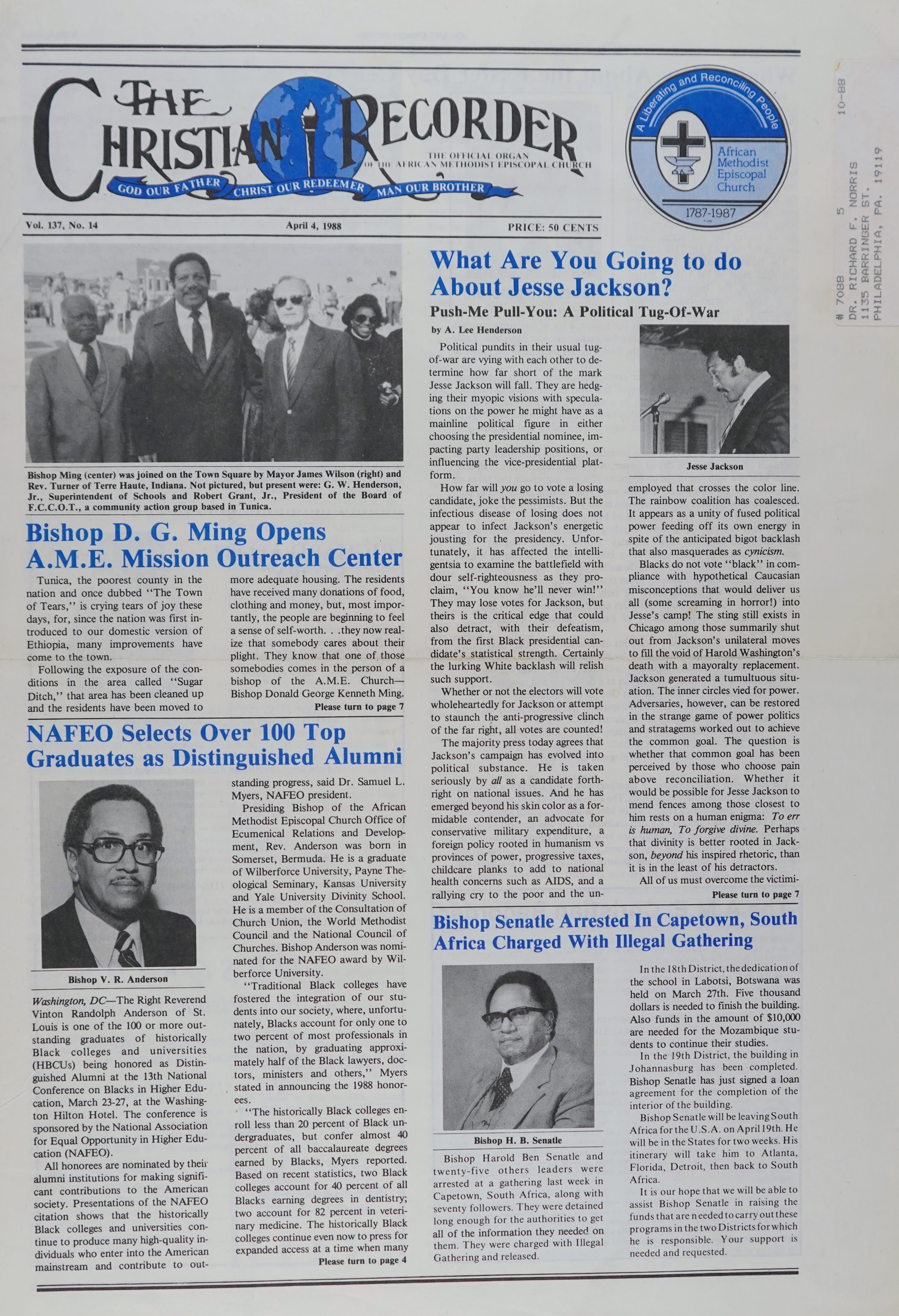
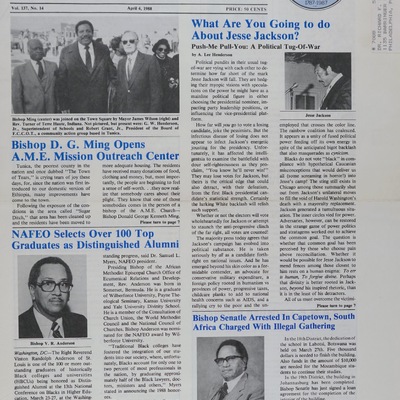
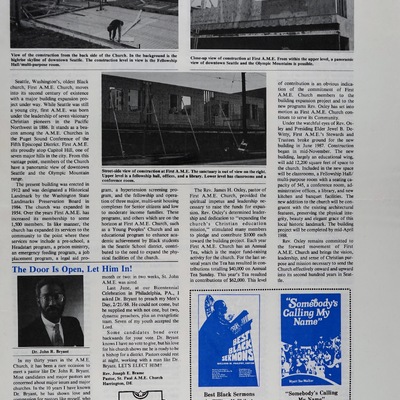
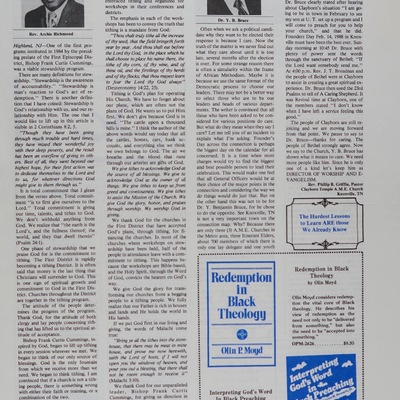
Bishop Ming (center) was joined on the Town Square by Mayor James Wilson (right) and
Rey. Turner of Terre Haute, Indiana. Not pictured, but present were: G. W. Henderson,
Jr., Superintendent of Schools and Robert Grant, Jr., President of the Board of
F.C.C.O.T., a community action group based in Tunica.
Bishop D. G. Ming Opens ,
A.M.E. Mission Outreach Center
Tunica, the poorest county in the
nation and once dubbed ‘‘The Town
of Tears,’’ is crying tears of joy these
days, for, since the nation was first in-
troduced to our domestic version of
Ethiopia, many improvements have
come to the town.
Following the exposure of the con-
ditions in the area called ‘‘Sugar
Ditch,”’ that area has been cleaned up
and the residents have been moved to
more adequate housing. The residents
have received many donations of food,
clothing and money, but, most impor-
tantly, the people are beginning to feel
a sense of self-worth. . .they now real-
ize that somebody cares about their
plight. They know that one of those
somebodies comes in the person of a
bishop of the A.M.E. Church—
Bishop Donald George Kenneth Ming.
Please turn to page 7
NAFEO Selects Over 100 Top
Graduates as Distinguished Alumni
Bishop V. R. Anderson
Washington, DC—The Right Reverend
Vinton Randolph Anderson of St.
Louis is one of the 100 or more out-
standing graduates of historically
Black colleges and universities
(HBCUs) being honored as Distin-
guished Alumni at the 13th National
Conference on Blacks in Higher Edu-
cation, March 23-27, at the Washing-
ton Hilton Hotel. The conference is
sponsored by the National Association
for Equal Opportunity in Higher Edu-
cation (NAFEO).
All honorees are nominated by their
alumni institutions for making signifi-
cant contributions to the American
society. Presentations of the NAFEO
citation shows that the historically
Black colleges and universities con-
tinue to produce many high-quality in-
dividuals who enter into the American
mainstream and contribute to out-
standing progress, said Dr. Samuel L.
Myers, NAFEO president.
Presiding Bishop of the African
Methodist Episcopal Church Office of
Ecumenical Relations and Develop-
ment, Rev. Anderson was born in
Somerset, Bermuda. He is a graduate
of Wilberforce University, Payne The-
ological Seminary, Kansas University
and Yale University Divinity School.
He is a member of the Consultation of
Church Union, the World Methodist
Council and the National Council of
Churches. Bishop Anderson was nomi-
nated for the NAFEO award by Wil-
berforce University.
“Traditional Black colleges have
fostered the integration of our stu-
dents into our society, where, unfortu-
nately, Blacks account for only one to
two percent of most professionals in
the nation, by graduating approxi-
mately half of the Black lawyers, doc-
tors, ministers and others,’’ Myers
_ stated in announcing the 1988 honor-
ees.
» “The historically Black colleges en-
roll less than 20 percent of Black un-
dergraduates, but confer almost 40
percent of all baccalaureate degrees
earned by Blacks, Myers reported.
Based on recent statistics, two Black
colleges account for 40 percent of all
Blacks earning degrees in dentistry;
two account for 82 percent in veteri-
nary medicine. The historically Black
colleges continue even now to press for
expanded access at a time when many
Please turn to page 4
1787-1987
What Are You Going to do
About Jesse Jackson?
Push-Me Pull-You: A Political Dee War
by A. Lee Henderson
Political pundits in their usual tug-
of-war are vying with each other to de-
termine how far short of the mark
Jesse Jackson will fall. They are hedg-
ing their myopic visions with specula-
tions on the power he might have as a
mainline political figure in either
choosing the presidential nominee, im-
pacting party leadership positions, or
influencing the vice-presidential plat-
form.
How far will you go to vote a losing
candidate, joke the pessimists. But the
infectious disease of losing does not
appear to infect Jackson’s energetic
jousting for the presidency. Unfor-
tunately, it has affected the intelli-
gentsia to examine the battlefield with
dour self-righteousness as they pro-
claim, ‘‘You know he’ll never win!’’
They may lose votes for Jackson, but
theirs is the critical edge that could
also detract, with their defeatism,
from the first Black presidential can-
didate’s statistical strength. Certainly
the lurking White backlash will relish
such support.
Whether or not the electors will vote
wholeheartedly for Jackson or attempt
to staunch the anti-progressive clinch
of the far right, all votes are counted!
The majority press today agrees that
Jackson’s campaign has evolved into
political substance. He is taken
seriously by all as a candidate forth-
right on national issues. And he has
emerged beyond his skin color as a for-
midable contender, an advocate for
conservative military expenditure, a
foreign policy rooted in humanism vs
provinces of power, progressive taxes,
childcare planks to add to national
health concerns such as AIDS, and a
rallying cry to the poor and the un-
Jesse Jackson
employed that crosses the color line.
The rainbow coalition has coalesced.
It appears as a unity of fused political
power feeding off its own energy in
spite of the anticipated bigot backlash
that also masquerades as cynicism.
Blacks do not vote ‘‘black’’ in com-
pliance with hypothetical Caucasian
misconceptions that would deliver us
all (some screaming in horror!) into
Jesse’s camp! The sting still exists in
Chicago among those summarily shut
out from Jackson’s unilateral moves
to fill the void of Harold Washington’s
death with a mayoralty replacement.
Jackson generated a tumultuous situ-
ation. The inner circles vied for power.
Adversaries, however, can be restored
in the strange game of power politics
and stratagems worked out to achieve
the common goal. The question is
whether that common goal has been
perceived by those who choose pain
above reconciliation. Whether it
would be possible for Jesse Jackson to
mend fences among those closest to
him rests on a human enigma: To err
is human, To forgive divine. Perhaps
that divinity is better rooted in Jack-
son, beyond his inspired rhetoric, than
it is in the least of his detractors.
All of us must overcome the victimi-
Please turn to page 7
Bishop Senatle Arrested In Capetown, South
Africa Charred With Illegal Gathering
Bishop H. B. Senatle
Bishop Harold Ben Senatle and
twenty-five others leaders were
arrested at a gathering last week in
Capetown, South Africa, along with
seventy followers. They were detained
long enough for the authorities to get
all of the information they needed on
them. They were charged with Illegal
Gathering and released.
In the 18th District, the dedication of
the school in Labotsi, Botswana was
held on March 27th. Five thousand
dollars is needed to finish the building.
Also funds in the amount of $10,000
are needed for the Mozambique stu-
dents to continue their studies.
In the 19th District, the building in
Johannasburg has been completed.
Bishop Senatle has just signed a loan
agreement for the completion of the
interior of the building.
Bishop Senatle will be leaving South
Africa for the U.S.A. on April 19th. He
will be in the States for two weeks. His
itinerary will take him to Atlanta,
Florida, Detroit, then back to South
Africa.
It is our hope that we will be able to
assist Bishop Senatle in raising the
funds that are needed to carry out these
programs in the two Districts for which
he is responsible. Your support is
needed and requested.
eS SS eaermTeroeo
# 7088
DR.
S
NORRI
RICHARD F.
cS
iT.
PA.
1135 BARRINGER
19119
ELPHIA,
PHILADE
===== DSC05468.JPG =====
2 The AME Christian Recorder
What’s New About the Easter Day Celebration?
Easter is the English name for the
ecclesiastical festival commemorating
the resurrection of Jesus Christ. Both
the origin of the word ‘‘Easter’’ and
the time of its observance have long
been subjects of controversy. Easter
has always been considered the high
day in Christianity and, undoubtedly,
the most important of the Christian
year. Many Christians throughout the
world attend Holy Communion serv-
ices on Easter Day and design special
services for the DAY OF THE LORD.
The flower called the Easter lily,
and used most in the United States’
churches, is the Bermuda lily. It
is a long, trumpet-shaped, white-
blossomed flower. Apart from the
deep spiritual and religious meanings for Easter, a lot of intriguing customs
have been associated with it that make for excitement and happiness. Little
children anxiously look forward to the Easter Bunny more than the Easter li-
ly
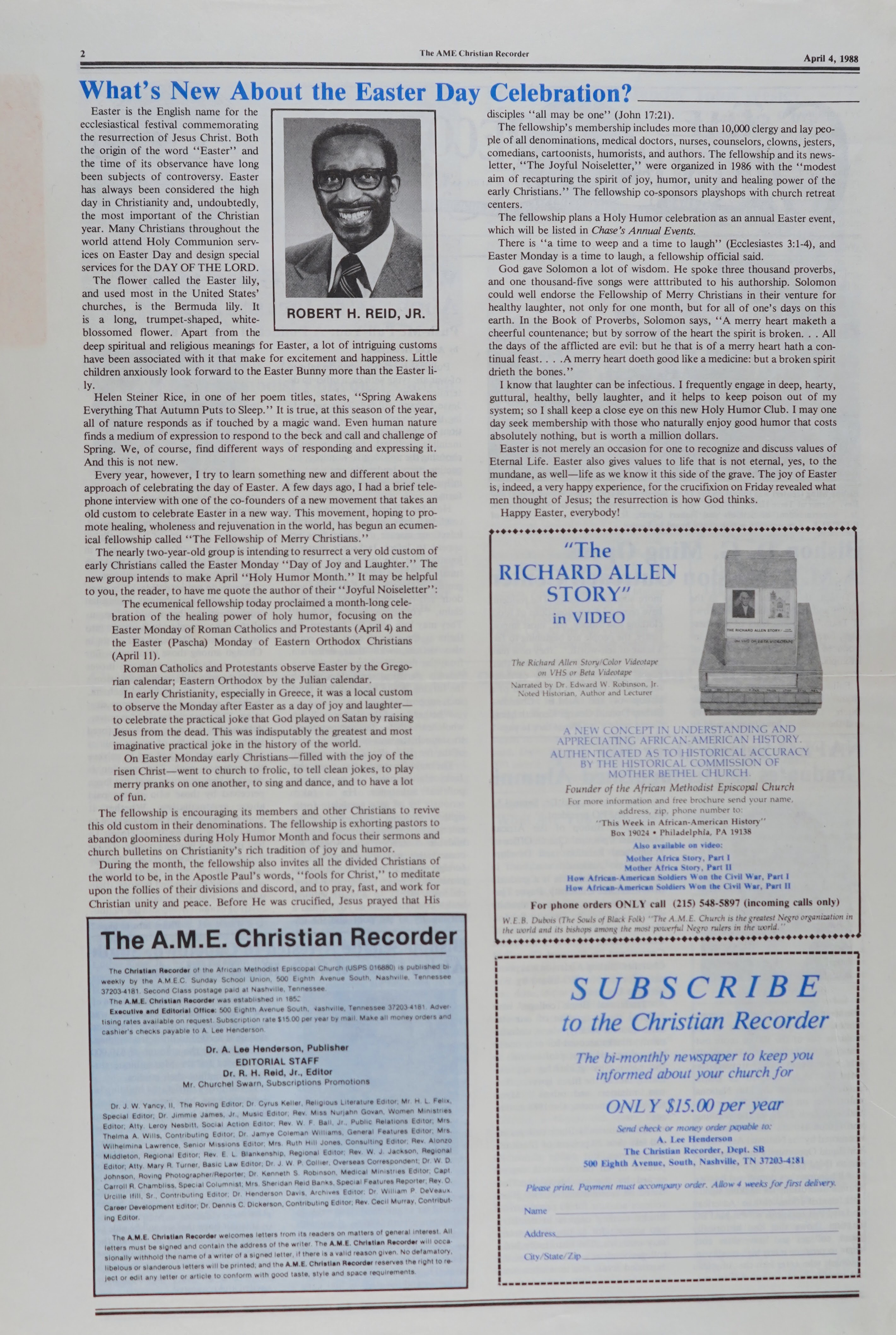
ROBERT H. REID, JR.
Helen Steiner Rice, in one of her poem titles, states, ‘‘Spring Awakens
Everything That Autumn Puts to Sleep.’’ It is true, at this season of the year,
all of nature responds as if touched by a magic wand. Even human nature
finds a medium of expression to respond to the beck and call and challenge of
Spring. We, of course, find different ways of responding and expressing it.
And this is not new.
Every year, however, I try to learn something new and different about the
approach of celebrating the day of Easter. A few days ago, I had a brief tele-
phone interview with one of the co-founders of a new movement that takes an
old custom to celebrate Easter in a new way. This movement, hoping to pro-
mote healing, wholeness and rejuvenation in the world, has begun an ecumen-
ical fellowship called ‘‘The Fellowship of Merry Christians.’”
The nearly two-year-old group is intending to resurrect a very old custom of
early Christians called the Easter Monday ‘‘Day of Joy and Laughter.’’ The
new group intends to make April ‘‘Holy Humor Month.’’ It may be helpful
to you, the reader, to have me quote the author of their ‘‘ Joyful Noiseletter’’:
The ecumenical fellowship today proclaimed a month-long cele-
bration of the healing power of holy humor, focusing on the
Easter Monday of Roman Catholics and Protestants (April 4) and
the Easter (Pascha) Monday of Eastern Orthodox Christians
(April 11).
Roman Catholics and Protestants observe Easter by the Grego-
rian calendar; Eastern Orthodox by the Julian calendar.
In early Christianity, especially in Greece, it was a local custom
to observe the Monday after Easter as a day of joy and laughter—
to celebrate the practical joke that God played on Satan by raising
Jesus from the dead. This was indisputably the greatest and most
imaginative practical joke in the history of the world.
On Easter Monday early Christians—filled with the joy of the
risen Christ—went to church to frolic, to tell clean jokes, to play
merry pranks on one another, to sing and dance, and to have a lot
of fun.
The fellowship is encouraging its members and other Christians to revive
this old custom in their denominations. The fellowship is exhorting pastors to
abandon gloominess during Holy Humor Month and focus their sermons and
church bulletins on Christianity’s rich tradition of joy and humor.
During the month, the fellowship also invites all the divided Christians of
the world to be, in the Apostle Paul’s words, ‘‘fools for Christ,’’ to meditate
upon the follies of their divisions and discord, and to pray, fast, and work for
Christian unity and peace. Before He was crucified, Jesus prayed that His
37203-4181. Second Class postage paid at Nashville, Tennessee,
The A.M.E. Christian Recorder was established in 185-
cashier's checks payable to A. Lee Henderson
Dr. A. Lee Henderson, Publisher
EDITORIAL STAFF
Dr. R. H. Reid, Jr., Editor
Mr. Churchel Swarn, Subscriptions Promotions
ing Editor,
The A.M.E. Christian Recorder welcomes letters from its readers on matters of general interest, All
letters must be signed and contain the address of the writer The A.M.E. Christian Recorder wil! occa
sionally withhold the name of a writer of a signed letter, if there is a valid reason given No defamatory,
libelous or slanderous letters will be printed, and the AM.E. Christian Recorder reserves (he right to re
ject or edit any letter or article to conform with good taste, style and space requirements.
The A.M.E. Christian Recorder
The Christian Recorder of the African Methodist Episcopal Church (USPS 016880) is published bi-
weekly by the A.M.E.C. Sunday School Union, 500 Eighth Avenue South, Nashville, Tennessee
Executive and Editorial Office: 500 Eighth Avenue South, Vashville, Tennessee 37203-4181. Adver-
tising rates available on request. Subscription rate $15.00 per year by mail, Make all money orders and
Dr. J. W. Yancy, II, The Roving Editor; Dr. Cyrus Keller, Religious Literature Editor, Mr. HL. Felix,
Special Editor, Dr. Jimmie James, Jr, Music Editor, Rev, Miss Nurjahn Govan, Women Ministries
Editor, Atty, Leroy Nesbitt, Social Action Editor, Rev. W. F. Ball, Jr, Public Relations Editor, Mrs.
Thelma A. Wills, Contributing Editor, Dr. Jamye Coleman Williams, General Features Editor, Mrs.
Wilhelmina Lawrence, Senior Missions Editor, Mrs Ruth Hill Jones, Consulting Editor, Rev. Alonzo
Middleton, Regional Editor, Rev. E. L. Blankenship, Regional Editor; Rev. W. J. Jackson, Regional
Editor; Atty. Mary R. Turner, Basic Law Editor, Dr. J. W P. Collier, Overseas Correspondent, Dr, W. D.
Johnson, Roving Photographer/Reporter, Dr, Kenneth S. Robinson, Medical Ministries Editor, Capt
Carroll A. Chambliss, Special Columnist, Mrs, Sheridan Reid Banks, Special Features Reporter, Rey, O.
Urcille Ifill, Sr, Contributing Editor, Or Henderson Davis, Archives Editor, Or, William P DeVeaux
Career Development editor; Dr. Dennis C. Dickerson, Contributing Editor; Rev, Ceci! Murray, Contribut:
April 4, 1988
disciples ‘‘all may be one’’ (John 17:21).
The fellowship’s membership includes more than 10,000 clergy and lay peo-
ple of all denominations, medical doctors, nurses, counselors, clowns, jesters,
comedians, cartoonists, humorists, and authors. The fellowship and its news-
letter, ‘‘The Joyful Noiseletter,’’ were organized in 1986 with the ‘‘modest
aim of recapturing the spirit of joy, humor, unity and healing power of the
early Christians.’’ The fellowship co-sponsors playshops with church retreat
centers.
The fellowship plans a Holy Humor celebration as an annual Easter event,
which will be listed in Chase’s Annual Events.
There is ‘‘a time to weep and a time to laugh’’ (Ecclesiastes 3:1-4), and
Easter Monday is a time to laugh, a fellowship official said.
God gave Solomon a lot of wisdom. He spoke three thousand proverbs,
and one thousand-five songs were atttributed to his authorship. Solomon
could well endorse the Fellowship of Merry Christians in their venture for
healthy laughter, not only for one month, but for all of one’s days on this
earth. In the Book of Proverbs, Solomon says, ‘‘A merry heart maketh a
cheerful countenance; but by sorrow of the heart the spirit is broken. . . All
the days of the afflicted are evil: but he that is of a merry heart hath a con-
tinual feast. . . .A merry heart doeth good like a medicine: but a broken spirit
drieth the bones.”’
I know that laughter can be infectious. I frequently engage in deep, hearty,
guttural, healthy, belly laughter, and it helps to keep poison out of my
system; so I shall keep a close eye on this new Holy Humor Club. I may one
day seek membership with those who naturally enjoy good humor that costs
absolutely nothing, but is worth a million dollars.
Easter is not merely an occasion for one to recognize and discuss values of
Eternal Life. Easter also gives values to life that is not eternal, yes, to the
mundane, as well—life as we know it this side of the grave. The joy of Easter
is, indeed, a very happy experience, for the crucifixion on Friday revealed what
men thought of Jesus; the resurrection is how God thinks.
Happy Easter, everybody!
POPS SEOESESESES ESE SESHSP SC SOSs Se GoGo He SoHo Se Se Ge HeHoGeHoHoos
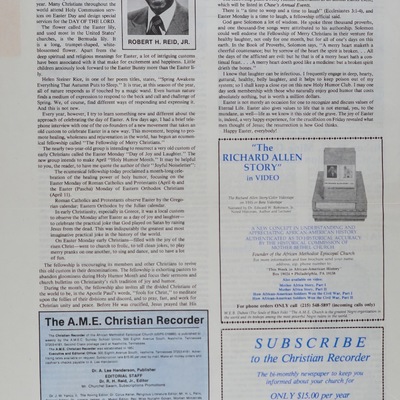
“The
RICHARD ALLEN
STORYX=
in VIDEO
The Richard Allen Story/Color Videotape
on VHS or Beta Videotape
Narrated by Dr. Edward W. Robinson, Jr
Noted Historian, Author and Lecturer
A NEW CONCEPT IN UNDERSTANDING AND
APPRECIATING AFRICAN-AMERICAN HISTORY.
AUTHENTICATED AS TO HISTORICAL ACCURACY
BY THE HISTORICAL COMMISSION OF
MOTHER BETHEL CHURCH
Founder of the African Methodist Episcopal Church
For more information and free brochure send your name,
address, zip, phone number to
“This Week in African-American History”
Box 19024 * Philadelphia, PA 19138
Also available on video:
Mother Africa Story, Part I
Mother Africa Story, Part Il
How African-American Soldiers Won the Civil War, Part I
How African-American Soldiers Won the Civil War, Part Il
For phone orders ONLY call (215) 548-5897 (incoming calls only)
W.E.B. Dubois (The Souls of Black Folk) “The A.M.E. Church is the greatest Negro organization in
the world and its bishops among the most powerful Negro rulers in the world.’
preveverererertrerer ert rs
(aaa eee eee eee eee See een eee een asae see eeEaasssaeas
SUBS CRigmas
to the Christian Recorder
The bi-monthly newspaper to keep you
informed about your church for
'
'
'
'
'
'
'
'
'
'
'
'
'
'
'
'
'
'
!
i
ONLY $15.00 per year
H Send check or money order payable to:
H A. Lee Henderson
H The Christian Recorder, Dept. SB
H 500 Eighth Avenue, South, Nashville, TN 37203-4381
'
' Please print, Payment must accompany order, Allow 4 weeks for first delivery.
'
'
| Name
Address.
City/State/Zip
|
|
|
===== DSC05469.JPG =====
April 4, 1988
The AME Christian Recorder
EEE,
The Church of My Choice
by Carroll R. Chambliss, Chaplain, U.S. Navy (Ret.)
Bicentennial Thrust
We are galloping through the four
(4) horsemen and their historic contri-
butions with all deliberate speed.
Throughout the observance, positive
vibes have been seen and felt at every
juncture (watershed). There is no
question the impact of the celebration
has reached the length and breadth of
African Methodism. Every nook and
cranny has come alive. I was in Nai-
robi, Kenya, when it began and hope
to be in St. Louis as it ends.
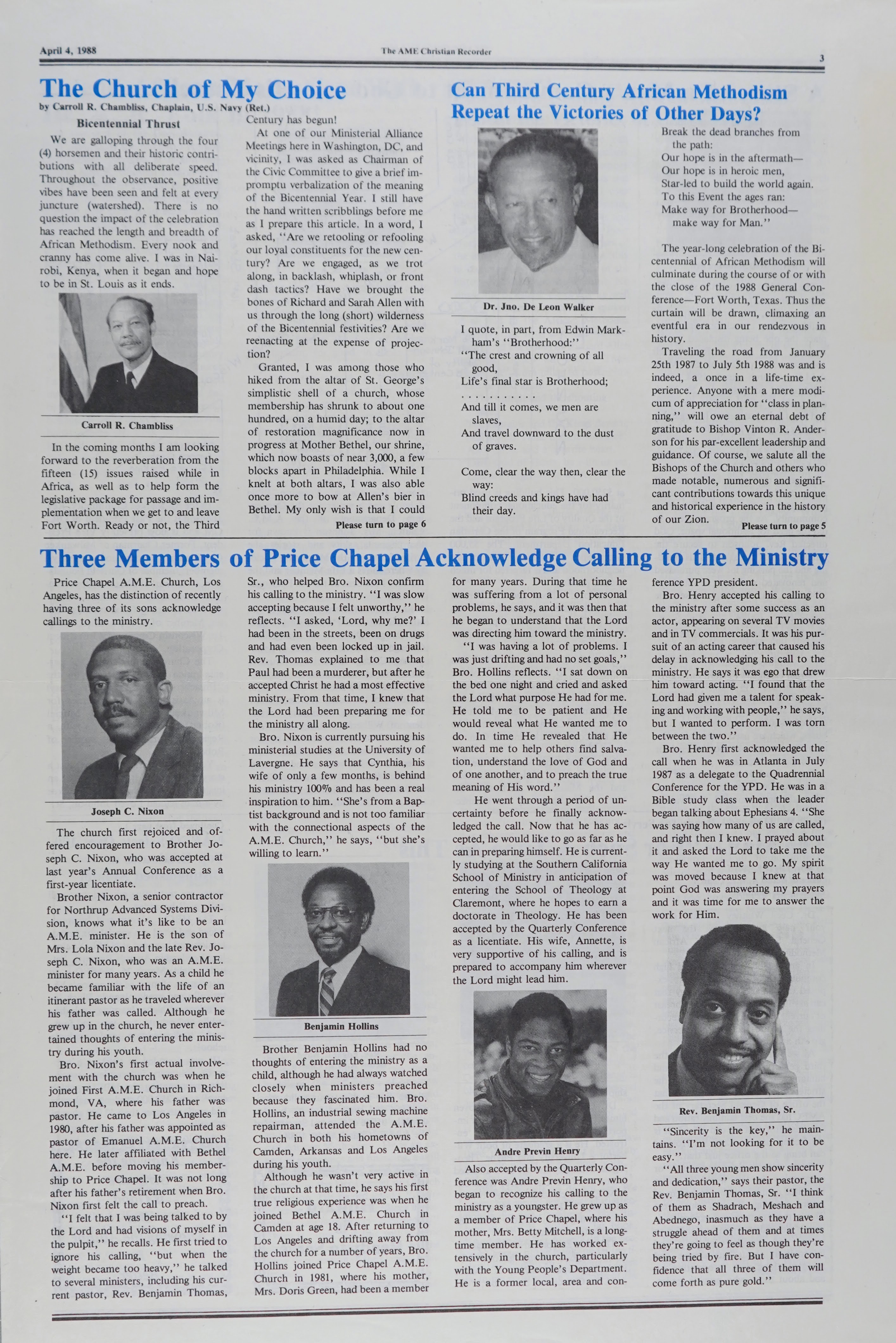
Carroll R. Chambliss
In the coming months I am looking
forward to the reverberation from the
fifteen (15) issues raised while in
Africa, as well as to help form the
legislative package for passage and im-
plementation when we get to and leave
Fort Worth. Ready or not, the Third
Century has begun!
At one of our Ministerial Alliance
Meetings here in Washington, DC, and
vicinity, | was asked as Chairman of
the Civic Committee to give a brief im-
promptu verbalization of the meaning
of the Bicentennial Year. | still have
the hand written scribblings before me
as I prepare this article. In a word, I
asked, ‘‘Are we retooling or refooling
our loyal constituents for the new cen-
tury? Are we engaged, as we trot
along, in backlash, whiplash, or front
dash tactics? Have we brought the
bones of Richard and Sarah Allen with
us through the long (short) wilderness
of the Bicentennial festivities? Are we
reenacting at the expense of projec-
tion?
Granted, I was among those who
hiked from the altar of St. George’s
simplistic shell of a church, whose
membership has shrunk to about one
hundred, on a humid day; to the altar
of restoration magnificance now in
progress at Mother Bethel, our shrine,
which now boasts of near 3,000, a few
blocks apart in Philadelphia. While I
knelt at both altars, I was also able
once more to bow at Allen’s bier in
Bethel. My only wish is that I could
Please turn to page 6
Can Third Century African Methodism
Repeat the Victories of Other Days?
sh
Dr. Jno, De Leon Walker
I quote, in part, from Edwin Mark-
ham’s ‘‘Brotherhood:’’
“The crest and crowning of all
good,
Life’s final star is Brotherhood;
And till it comes, we men are
slaves,
And travel downward to the dust
of graves.
Come, clear the way then, clear the
way:
Blind creeds and kings have had
their day.
Break the dead branches from
the path:
Our hope is in the aftermath—
Our hope is in heroic men,
Star-led to build the world again.
To this Event the ages ran:
Make way for Brotherhood—
make way for Man.”’
The year-long celebration of the Bi-
centennial of African Methodism will
culminate during the course of or with
the close of the 1988 General Con-
ference—Fort Worth, Texas. Thus the
curtain will be drawn, climaxing an
eventful era in our rendezvous in
history.
Traveling the road from January
25th 1987 to July Sth 1988 was and is
indeed, a once in a life-time ex-
perience. Anyone with a mere modi-
cum of appreciation for ‘‘class in plan-
ning,’’ will owe an eternal debt of
gratitude to Bishop Vinton R. Ander-
son for his par-excellent leadership and
guidance. Of course, we salute all the
Bishops of the Church and others who
made notable, numerous and signifi-
cant contributions towards this unique
and historical experience in the history
of our Zion.
bi Please turn to page 5
Three Members of Price Chapel Acknowledge Calling to the Ministry
Price Chapel A.M.E. Church, Los
Angeles, has the distinction of recently
having three of its sons acknowledge
callings to the ministry.
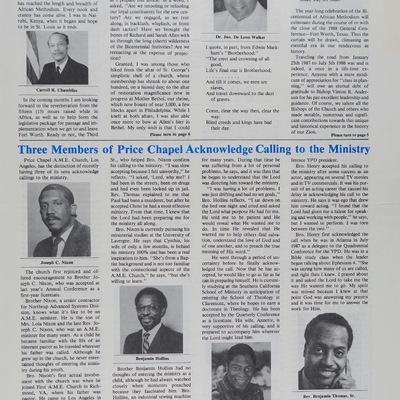
Joseph C. Nixon
The church first rejoiced and of-
fered encouragement to Brother Jo-
seph C. Nixon, who was accepted at
last year’s Annual Conference as a
first-year licentiate.
Brother Nixon, a senior contractor
for Northrup Advanced Systems Divi-
sion, knows what it’s like to be an
A.M.E. minister. He is the son of
Mrs. Lola Nixon and the late Rev. Jo-
seph C. Nixon, who was an A.M.E.
minister for many years. As a child he
became familiar with the life of an
itinerant pastor as he traveled wherever
his father was called. Although he
grew up in the church, he never enter-
tained thoughts of entering the minis-
try during his youth.
Bro. Nixon’s first actual involve-
ment with the church was when he
joined First A.M.E. Church in Rich-
mond, VA, where his father was
pastor. He came to Los Angeles in
1980, after his father was appointed as
pastor of Emanuel A.M.E. Church
here. He later affiliated with Bethel
A.M.E. before moving his member-
ship to Price Chapel. It was not long
after his father’s retirement when Bro.
Nixon first felt the call to preach.
“I felt that I was being talked to by
the Lord and had visions of myself in
the pulpit,’’ he recalls. He first tried to
ignore his calling, ‘‘but when the
weight became too heavy,’’ he talked
to several ministers, including his cur-
rent pastor, Rev. Benjamin Thomas,
Sr., who helped Bro. Nixon confirm
his calling to the ministry. ‘‘I was slow
accepting because I felt unworthy,’’ he
reflects. ‘‘I asked, ‘Lord, why me?’ I
had been in the streets, been on drugs
and had even been locked up in jail.
Rev. Thomas explained to me that
Paul had been a murderer, but after he
accepted Christ he had a most effective
ministry. From that time, I knew that
the Lord had been preparing me for
the ministry all along.
Bro. Nixon is currently pursuing his
ministerial studies at the University of
Lavergne. He says that Cynthia, his
wife of only a few months, is behind
his ministry 100% and has been a real
inspiration to him. ‘‘She’s from a Bap-
tist background and is not too familiar
with the connectional aspects of the
A.M.E. Church,’’ he says, ‘‘but she’s
willing to learn.’’
Benjamin Hollins
Brother Benjamin Hollins had no
thoughts of entering the ministry as a
child, although he had always watched
closely when ministers preached
because they fascinated him. Bro.
Hollins, an industrial sewing machine
repairman, attended the A.M.E.
Church in both his hometowns of
Camden, Arkansas and Los Angeles
during his youth.
Although he wasn’t very active in
the church at that time, he says his first
true religious experience was when he
joined Bethel A.M.E. Church in
Camden at age 18. After returning to
Los Angeles and drifting away from
the church for a number of years, Bro.
Hollins joined Price Chapel A.M.E.
Church in 1981, where his mother,
Mrs. Doris Green, had been a member
for many years. During that time he
was suffering from a lot of personal
problems, he says, and it was then that
he began to understand that the Lord
was directing him toward the ministry.
“T was having a lot of problems. I
was just drifting and had no set goals,”’
Bro. Hollins reflects. ‘‘I sat down on
the bed one night and cried and asked
the Lord what purpose He had for me.
He told me to be patient and He
would reveal what He wanted me to
do. In time He revealed that He
wanted me to help others find salva-
tion, understand the love of God and
of one another, and to preach the true
meaning of His word.’’
He went through a period of un-
certainty before he finally acknow-
ledged the call. Now that he has ac-
cepted, he would like to go as far as he
can in preparing himself. He is current-
ly studying at the Southern California
School of Ministry in anticipation of
entering the School of Theology at
Claremont, where he hopes to earn a
doctorate in Theology. He has been
accepted by the Quarterly Conference
as a licentiate. His wife, Annette, is
very supportive of his calling, and is
prepared to accompany him wherever
the Lord might lead him.
a ie
Andre Previn Henry
Also accepted by the Quarterly Con-
ference was Andre Previn Henry, who
began to recognize his calling to the
ministry as a youngster. He grew up as
a member of Price Chapel, where his
mother, Mrs. Betty Mitchell, is a long-
time member. He has worked ex-
tensively in the church, particularly
with the Young People’s Department.
He is a former local, area and con-
ference YPD president.
Bro. Henry accepted his calling to
the ministry after some success as an
actor, appearing on several TV movies
and in TV commercials. It was his pur-
suit of an acting career that caused his
delay in acknowledging his call to the
ministry. He says it was ego that drew
him toward acting. ‘‘I found that the
Lord had given me a talent for speak-
ing and working with people,’’ he says,
but I wanted to perform. I was torn
between the two.’’
Bro. Henry first acknowledged the
call when he was in Atlanta in July
1987 as a delegate to the Quadrennial
Conference for the YPD. He was ina
Bible study class when the leader
began talking about Ephesians 4. ‘‘She
was saying how many of us are called,
and right then I knew. I prayed about
it and asked the Lord to take me the
way He wanted me to go. My spirit
was moved because I knew at that
point God was answering my prayers
and it was time for me to answer the
work for Him.
Rev. Benjamin Thomas, Sr.
“Sincerity is the key,’’ he main-
tains. ‘I’m not looking for it to be
easy.”’
“All three young men show sincerity
and dedication,’’ says their pastor, the
Rev. Benjamin Thomas, Sr. ‘‘I think
of them as Shadrach, Meshach and
Abednego, inasmuch as they have a
struggle ahead of them and at times
they’re going to feel as though they’re
being tried by fire. But I have con-
fidence that all three of them will
come forth as pure gold.”
ee SOON
===== DSC05471.JPG =====
The AME Christian Recorder
April 4, 1988
A Story of a Man’s Commitment to God and His Church __
—
Rey. Lovell Johnson, Sr.
The St. Mark Story is the story of a
man committed to God, who was sent
to Milwaukee, WI, for the purpose of
building a new church building to re-
place the one being displaced by the
freeway. The man is Rev. Lovell
Johnson, Sr., pastor of St. Mark
A.M.E. Church since 1964. Rev.
Johnson did not just go to St. Mark
and build a million dollar structure
and pay for it, but before he began his
building program, Rev. Johnson began
a Program of Evangelism that has
drawn over 3,000 new members into
St. Mark A.M.E. Church.
He also developed a program of
service to the members of the congre-
gation and to the entire Milwaukee
community. As the program grew, so
did the need for additional space. God
directed Rev. Johnson to secure the
building across the street. This build-
ing and the parking lot were purchased
and renovated and now is valued at
$250,000. This building houses the
Food and Clothing Center, the Youth
Department of the Sunday School, the
Boy Scouts, the Senior Citizens Pro-
gram, and the Milwaukee United for
Better Housing Program, as well as
many other special programs.
A parking lot for 50 cars was devel-
oped. Two small buildings that had
been oil stations were purchased at a
cost of $54,000. One houses two mini
buses, which are used in the Bus Min-
istry. The second will soon be used for
economic development.
The St. Mark Human Resource and
Economic Development Center was
purchased and renovated. It is valued
ng
(20 Cars)
pa Parki
<m27)
eat PAO
2OG aL eae
17+" Street
at $250,000. This building is used pri-
marily for the educational component
of the Quality of Life Program and the
Recreational Program of the Christian
Education Department. The $5,000
Green Spot is a beauty area for the
neighborhood and is targeted for much
needed parking.
The loyal officers and members of
St. Mark have cooperated with this
man of God, so that all properties are
free of debt except for the Human Re-
sources Center.
In addition to this, St. Mark has
been proud to encourage the pastor
and his wife, Marguerite, in their lead-
ership positions in the Milwaukee
Community, the St. Paul-Milwaukee
District, the Chicago Conference, the
4th Episcopal District and the Connec-
tional Church.
Mrs. Johnson has worked as the vol-
unteer Director of Christian Education
and the Missionary Advisor in St.
Mark. She is presently the Connec-
Cecil W. Howard—Ready for Service
The Man—‘“‘For Such A Time As This’’
by Rev. Edgar E. Boyd
Pastor of Bethel A.M.E. Church
Los Angeles, California
Dr. Cecil Whitney Howard seeks
your help in becoming the next
General Secretary of the African
Methodist Episcopal Church!
In an age of electronics and high
computer sophistication, we are ex-
posed to a wealth of technology that
can assist our church in staying abreast
of current trends in ministry and recor-
ding the various acts of our service,
growth and development.
As we African Methodists enter the
third century of service to God and
humanity, it is vital that we take the
strictest of precaution to insure that
the office of General Secretary of the
AMEC has the best administration and
administrator that we can afford. It is
my feeling that Dr. Cecil W. Howard
can bring to the office just that.
Every organization, institution or
corporation in the world is either
benefited or inhibited by its system of
record keeping. Thusly, our great
Zion’s maintenance and expansion is
greatly dependent upon our ability to
record and provide vital facts and
information about our service and
ministry along with information on
and about those who provide leader-
Dr. Cecil W. Howard
ship and service for it.
Dr. Cecil W. Howard has proven
himself to be a man to whom this im-
portant responsibility can be en-
trusted. He is a graduate of both Wil-
berforce University and Payne Theo-
logical Seminary and has been awarded
a Doctor of Divinity degree from our
A.M.E. Church academic network. In
addition, Dr. Howard holds a Master
of Arts degree in History from the
Ohio State University.
This able and prepared man pastors
one of the leading congregations in the
Fifth Episcopal District, St. James
A.M.E. Church in St. Louis, Mo.
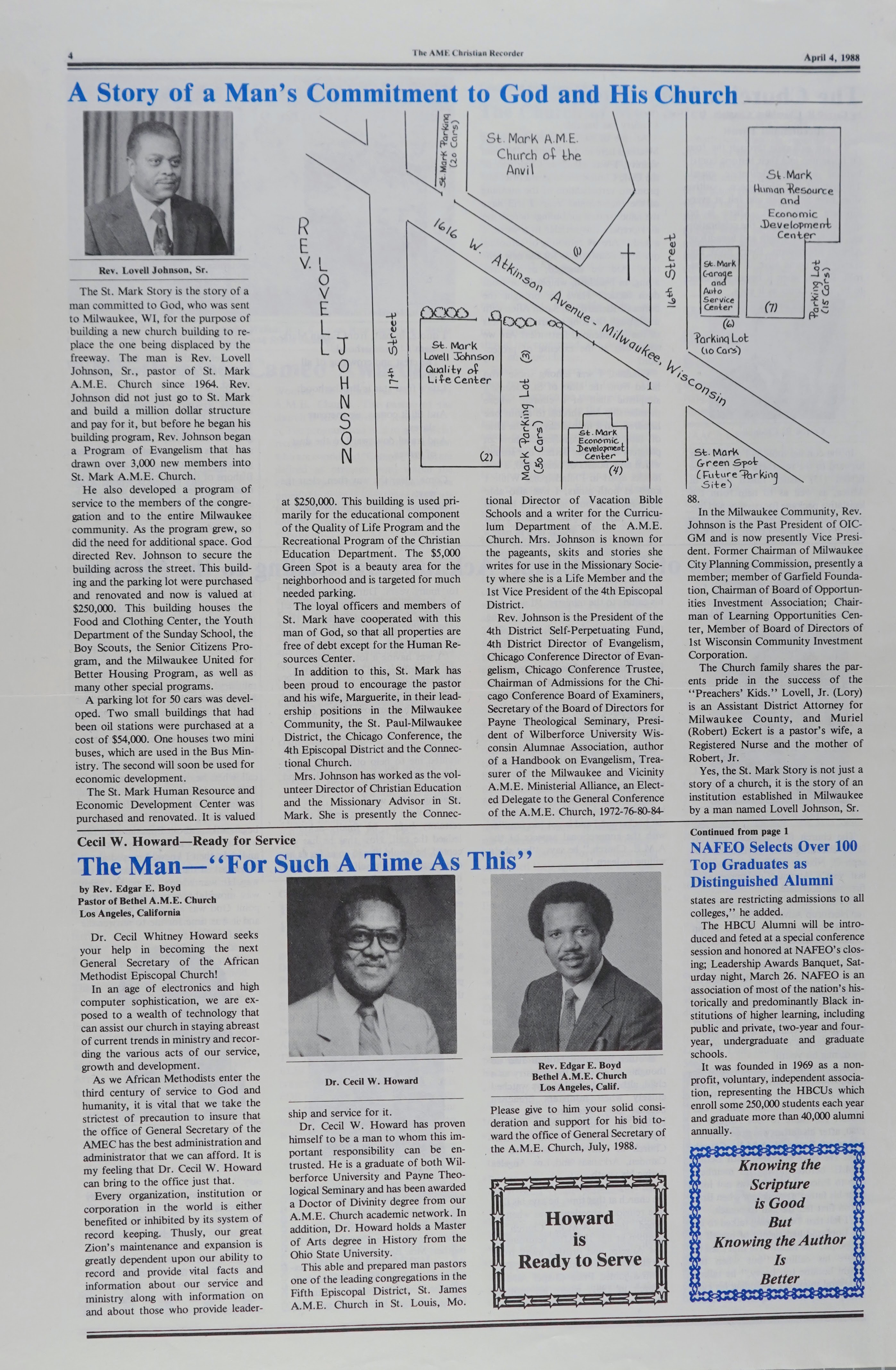
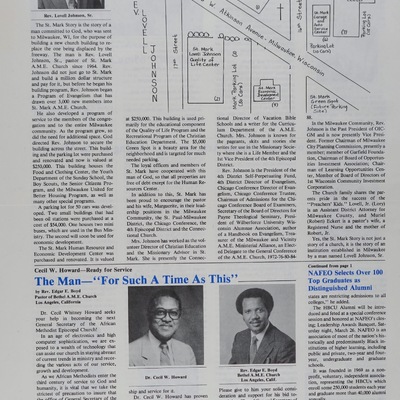
St. Mark
Lovell Johnson
Quality of
Lite Center
St.Mark A.ME.
Church of the
Anvil
Mark Parking Lot (@)
(50 Cars)
tional Director of Vacation Bible
Schools and a writer for the Curricu-
lum Department of the A.M.E.
Church. Mrs. Johnson is known for
the pageants, skits and stories she
writes for use in the Missionary Socie-
ty where she is a Life Member and the
1st Vice President of the 4th Episcopal
District.
Rev. Johnson is the President of the
4th District Self-Perpetuating Fund,
4th District Director of Evangelism,
Chicago Conference Director of Evan-
gelism, Chicago Conference Trustee,
Chairman of Admissions for the Chi-
cago Conference Board of Examiners,
Secretary of the Board of Directors for
Payne Theological Seminary, Presi-
dent of Wilberforce University Wis-
consin Alumnae Association, author
of a Handbook on Evangelism, Trea-
surer of the Milwaukee and Vicinity
A.M.E. Ministerial Alliance, an Elect-
ed Delegate to the General Conference
of the A.M.E. Church, 1972-76-80-84-
Rev. Edgar E. Boyd
Bethel A.M.E. Church
Los Angeles, Calif.
Please give to him your solid consi-
deration and support for his bid to-
ward the office of General Secretary of
_the A.M.E. Church, July, 1988.
luth Street
St.Mark
Human Resource
and
Economic
Development
Center
ey
a9
zs
ce
@ ia
Parking Lot
Go Cars)
St. Mark
Green Spot
(Future Forking
Site)
88.
In the Milwaukee Community, Rev.
Johnson is the Past President of OIC-
GM and is now presently Vice Presi-
dent. Former Chairman of Milwaukee
City Planning Commission, presently a
member; member of Garfield Founda-
tion, Chairman of Board of Opportun-
ities Investment Association; Chair-
man of Learning Opportunities Cen-
ter, Member of Board of Directors of
1st Wisconsin Community Investment
Corporation.
The Church family shares the par-
ents pride in the success of the
‘Preachers’ Kids.’’ Lovell, Jr. (Lory)
is an Assistant District Attorney for
Milwaukee County, and Muriel
(Robert) Eckert is a pastor’s wife, a
Registered Nurse and the mother of
Robert, Jr.
Yes, the St. Mark Story is not just a
story of a church, it is the story of an
institution established in Milwaukee
by a man named Lovell Johnson, Sr.
Continued from page 1
NAFEO Selects Over 100
Top Graduates as
Distinguished Alumni
states are restricting admissions to all
colleges,’’ he added.
The HBCU Alumni will be intro-
duced and feted at a special conference
session and honored at NAFEO’s clos-
ing; Leadership Awards Banquet, Sat-
urday night, March 26. NAFEO is an
association of most of the nation’s his-
torically and predominantly Black in-
stitutions of higher learning, including
public and private, two-year and four-
year, undergraduate and graduate
schools.
It was founded in 1969 as a non-
profit, voluntary, independent associa-
tion, representing the HBCUs which
enroll some 250,000 students each year
and graduate more than 40,000 alumni
annually.
Knowing the
Scripture
is Good
But
Knowing the Author %
ae
===== DSC05472.JPG =====
April 4, 1988
The AME Christian Recorder
Extend African Methodism With
Dr. A. R. Polk in 1988!
At the seat of the One Hundred
First Session of the Michigan Annual
Conference, convened at Union Me-
morial A.M.E. Church, Benton Har-
bor, MI, A.M.E. Church clergy and
laity in an overwhelming display of
support gave their solid endorsement
to the candidacy of Dr. A. R. Polk for
service as the Secretary/Treasurer,
Church Extension Department. Rev.
Robert James Eckert, native of the
Fifteenth Episcopal District, Senior
Minister, Mount Zion A.M.E.
Church, Battle Creek, MI, in a moving
and passionate appeal espoused the
virtues of Dr. A. R. Polk. Eckert re-
ferred to Polk as ‘‘a man with a viable
vision for the future, the third century
of African Methodism, and Church
Extension in particular.’’ He stated
that he had learned that ‘‘Polk has
been groomed for ministry and service
beyond the local church. While in Ala-
bama, where Dr. Polk was born, he
has a rich legacy, the which is indelibly
linked and woven into the fabric of
African Methodism. From his child-
hood, A. R. Polk was being intro-
duced to those principles and practices
which have made his ministry ‘mush-
room’ wherever he has served. The
church of Allen, in the third century,
needs the calm, consistent, creative
leadership of A. R. Polk as Secretary/
Treasurer, Church Extension. That is
why I am unequivocal, unashamed,
unapologetic concerning my support
of his candidacy at the Forty-Third
Session of the General Conference to
convene July 1988 at Dallas-Fort
Worth and pledge to do all to aid his
election.”’
The clergy and laity of the Michigan
Annual Conference were quick to lend
support and offer their endorsement to
Dr. A. R. Polk’s candidacy. Dr. Mar-
tin Luther Simmons and Dr. J. Allen
Parker, Presiding Elders of the North
and South Districts, respectively, were
encouragers and supporters of the en-
dorsement. Bishop Samuel S. Morris,
Jr., Prelate, Fourth Episcopal District,
presided. So electric was the endorse-
ment made by Eckert, that the result
was unanimous. Michigan could be
heard to say: ‘‘We support A. R. Polk,
Secretary/Treasurer, Church Exten-
sion, 1988!’
Unwilling to rest on the laurels of
this prestigious annual conference en-
dorsement, the Committee to Elect
Polk, moved in a timely manner to se-
cure the support and well-wishes of the
clergy and laity of the Fourth Epis-
copal District. The venue was Ebene-
zer A.M.E. Church, Detroit, where
Dr. Robert Thomas, Jr., candidate for
Episcopal Honors, is pastor. The
Fourth District Plenary Session closing
sermon has been preached, but before
the Holy Father, Bishop S. S. Morris,
Jr., made final and closing comments,
the candidates were afforded privilege
to present themselves. It was said con-
cerning A. R. Polk that ‘‘he has a long
career of excellence and the time has
come for Polk to serve the Church ina
larger function and responsibility.””
And so, after thirty years of labor, in
the ‘‘trenches and battlefields of Afri-
can Methodism,’’ Polk won the sup-
port, prayers, well-wishes, endorse-
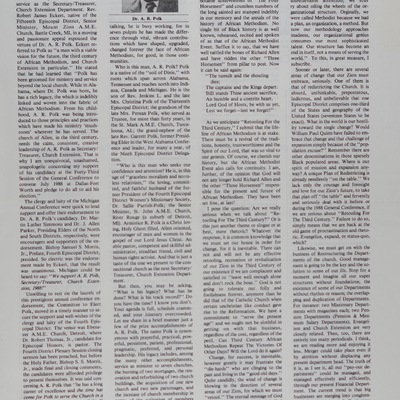
ment and promised suffrage of the
Fourth Episcopal District.
As the African Methodist Episcopal
Church Connection moves closer to
the seat of the 1988 General Confer-
ence, we are assured that much will be
voiced concerning Church Extension,
There are four candidates in the race,
but A. R. Polk is still doing more than
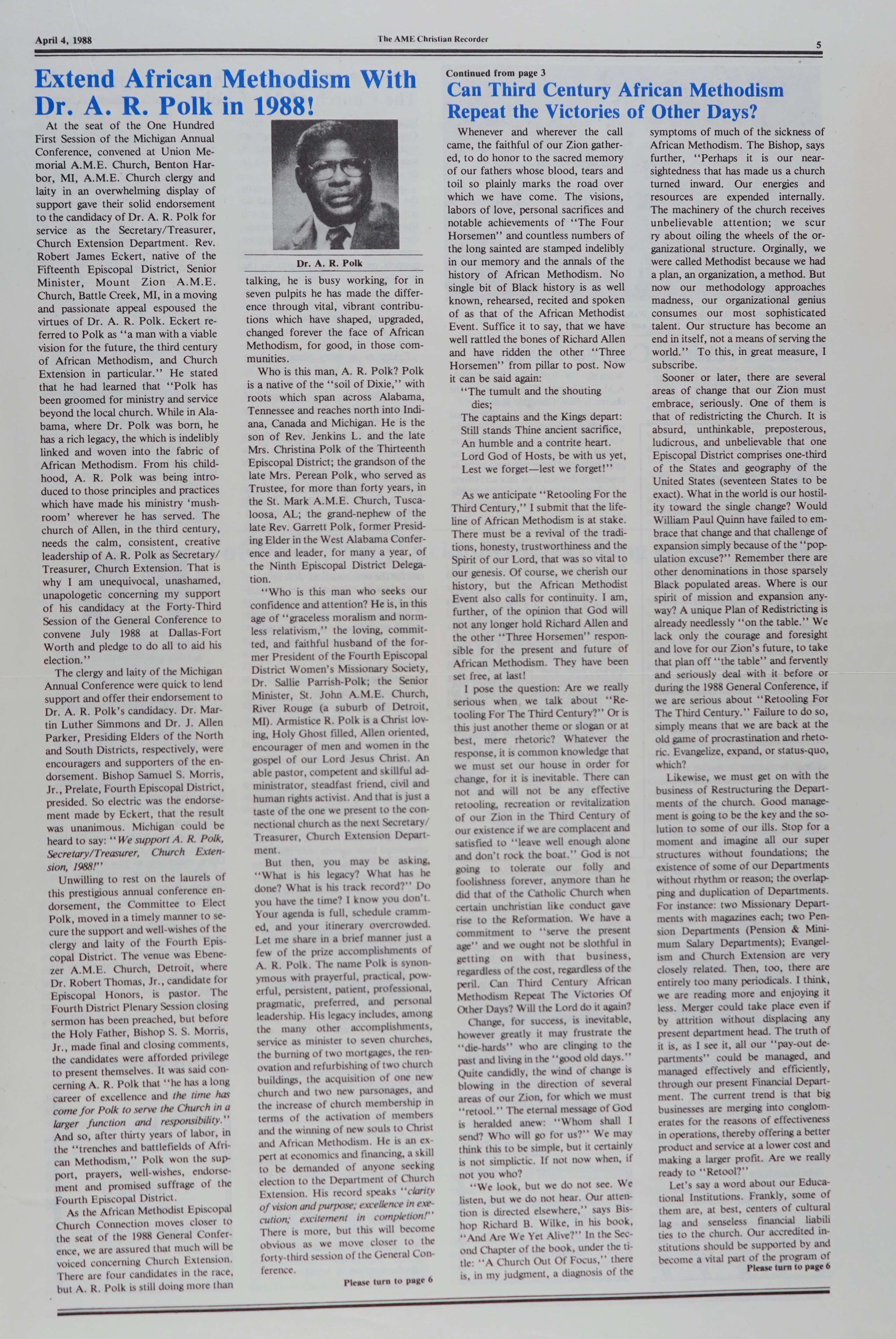
Dr. A. R. Polk
talking, he is busy working, for in
seven pulpits he has made the differ-
ence through vital, vibrant contribu-
tions which have shaped, upgraded,
changed forever the face of African
Methodism, for good, in those com-
munities.
Who is this man, A. R. Polk? Polk
is a native of the ‘‘soil of Dixie,’’ with
roots which span across Alabama,
Tennessee and reaches north into Indi-
ana, Canada and Michigan. He is the
son of Rev. Jenkins L. and the late
Mrs. Christina Polk of the Thirteenth
Episcopal District; the grandson of the
late Mrs. Perean Polk, who served as
Trustee, for more than forty years, in
the St. Mark A.M.E. Church, Tusca-
loosa, AL; the grand-nephew of the
late Rev. Garrett Polk, former Presid-
ing Elder in the West Alabama Confer-
ence and leader, for many a year, of
the Ninth Episcopal District Delega-
tion.
“‘Who is this man who seeks our
confidence and attention? He is, in this
age of ‘‘graceless moralism and norm-
less relativism,’’ the loving, commit-
ted, and faithful husband of the for-
mer President of the Fourth Episcopal
District Women’s Missionary Society,
Dr. Sallie Parrish-Polk; the Senior
Minister, St. John A.M.E. Church,
River Rouge (a suburb of Detroit,
MI). Armistice R. Polk is a Christ lov-
ing, Holy Ghost filled, Allen oriented,
encourager of men and women in the
gospel of our Lord Jesus Christ. An
able pastor, competent and skillful ad-
ministrator, steadfast friend, civil and
human rights activist. And that is just a
taste of the one we present to the con-
nectional church as the next Secretary/
Treasurer, Church Extension Depart-
ment.
But then, you may be asking,
“What is his legacy? What has he
done? What is his track record?’’ Do
you have the time? I know you don’t.
Your agenda is full, schedule cramm-
ed, and your itinerary overcrowded.
Let me share in a brief manner just a
few of the prize accomplishments of
A. R. Polk. The name Polk is synon-
ymous with prayerful, practical, pow-
erful, persistent, patient, professional,
pragmatic, preferred, and personal
leadership. His legacy includes, among
the many other accomplishments,
service as minister to seven churches,
the burning of two mortgages, the ren-
ovation and refurbishing of two church
buildings, the acquisition of one new
church and two new parsonages, and
the increase of church membership in
terms of the activation of members
and the winning of new souls to Christ
and African Methodism. He is an ex-
pert at economics and financing, a skill
to be demanded of anyone seeking
election to the Department of Church
Extension. His record speaks ‘‘clarity
of vision and purpose; excellence in exe-
cution; excitement in completion!”
There is more, but this will become
obvious as we move closer to the
forty-third session of the General Con-
ference.
Please turn to page 6
Continued from page 3
Can Third Century African Methodism
Repeat the Victories of Other Days?
Whenever and wherever the call
came, the faithful of our Zion gather-
ed, to do honor to the sacred memory
of our fathers whose blood, tears and
toil so plainly marks the road over
which we have come. The visions,
labors of love, personal sacrifices and
notable achievements of ‘‘The Four
Horsemen’’ and countless numbers of
the long sainted are stamped indelibly
in our memory and the annals of the
history of African Methodism. No
single bit of Black history is as well
known, rehearsed, recited and spoken
of as that of the African Methodist
Event. Suffice it to say, that we have
well rattled the bones of Richard Allen
and have ridden the other ‘‘Three
Horsemen’’ from pillar to post. Now
it can be said again:
“The tumult and the shouting
dies;
The captains and the Kings depart:
Still stands Thine ancient sacrifice,
An humble and a contrite heart.
Lord God of Hosts, be with us yet,
Lest we forget—lest we forget!’’
As we anticipate ‘‘Retooling For the
Third Century,”’ I submit that the life-
line of African Methodism is at stake.
There must be a revival of the tradi-
tions, honesty, trustworthiness and the
Spirit of our Lord, that was so vital to
our genesis. Of course, we cherish our
history, but the African Methodist
Event also calls for continuity. I am,
further, of the opinion that God will
not any longer hold Richard Allen and
the other ‘‘Three Horsemen’’ respon-
sible for the present and future of
African Methodism. They have been
set free, at last!
I pose the question: Are we really
serious when we talk about ‘‘Re-
tooling For The Third Century?”’ Or is
this just another theme or slogan or at
best, mere rhetoric? Whatever the
response, it is common knowledge that
we must set our house in order for
change, for it is inevitable. There can
not and will not be any effective
retooling, recreation or revitalization
of our Zion in the Third Century of
our existence if we are complacent and
satisfied to ‘‘leave well enough alone
and don’t rock the boat.’’ God is not
going to tolerate our folly and
foolishness forever, anymore than he
did that of the Catholic Church when
certain unchristian like conduct gave
rise to the Reformation. We have a
commitment to ‘‘serve the present
age’’ and we ought not be slothful in
getting on with that business,
regardless of the cost, regardless of the
peril. Can Third Century African
Methodism Repeat The Victories Of
Other Days? Will the Lord do it again?
Change, for success, is inevitable,
however greatly it may frustrate the
“‘die-hards’’ who are clinging to the
past and living in the **good old days."”
Quite candidly, the wind of change is
blowing in the direction of several
areas of our Zion, for which we must
“‘retool,’” The eternal message of God
is heralded anew: ‘‘Whom shall |
send? Who will go for us?’ We may
think this to be simple, but it certainly
is not simplictic. If not now when, if
not you who?
‘“*We look, but we do not see. We
listen, but we do not hear, Our atten-
tion is directed elsewhere,’’ says Bis-
hop Richard B. Wilke, in his book,
“And Are We Yet Alive?”’ In the Sec-
ond Chapter of the book, under the ti-
tle: ““A Church Out Of Focus,” there
is, in my judgment, a diagnosis of the
symptoms of much of the sickness of
African Methodism. The Bishop, says
further, ‘‘Perhaps it is our near-
sightedness that has made us a church
turned inward. Our energies and
resources are expended internally.
The machinery of the church receives
unbelievable attention; we scur
ry about oiling the wheels of the or-
ganizational structure. Orginally, we
were called Methodist because we had
a plan, an organization, a method. But
now our methodology approaches
madness, our organizational genius
consumes our most sophisticated
talent. Our structure has become an
end in itself, not a means of serving the
world.’’ To this, in great measure, I
subscribe.
Sooner or later, there are several
areas of change that our Zion must
embrace, seriously. One of them is
that of redistricting the Church. It is
absurd, unthinkable, preposterous,
ludicrous, and unbelievable that one
Episcopal District comprises one-third
of the States and geography of the
United States (seventeen States to be
exact). What in the world is our hostil-
ity toward the single change? Would
William Paul Quinn have failed to em-
brace that change and that challenge of
expansion simply because of the “‘pop-
ulation excuse?’’ Remember there are
other denominations in those sparsely
Black populated areas. Where is our
spirit of mission and expansion any-
way? A unique Plan of Redistricting is
already needlessly ‘‘on the table.’’ We
lack only the courage and foresight
and love for our Zion’s future, to take
that plan off ‘‘the table’ and fervently
and seriously deal with it before or
during the 1988 General Conference, if
we are serious about ‘‘Retooling For
The Third Century.”’ Failure to do so,
simply means that we are back at the
old game of procrastination and rheto-
ric. Evangelize, expand, or status-quo,
which?
Likewise, we must get on with the
business of Restructuring the Depart-
ments of the church. Good manage-
ment is going to be the key and the so-
lution to some of our ills. Stop for a
moment and imagine all our super
structures without foundations; the
existence of some of our Departments
without rhythm or reason; the overlap-
ping and duplication of Departments.
For instance: two Missionary Depart-
ments with magazines each; two Pen-
sion Departments (Pension & Mini-
mum Salary Departments); Evangel-
ism and Church Extension are very
closely related. Then, too, there are
entirely too many periodicals. I think,
we are reading more and enjoying it
less. Merger could take place even if
by attrition without displacing any
present department head. The truth of
it is, as I see it, all our “‘pay-out de-
partments’ could be managed, and
managed effectively and efficiently,
through our present Financial Depart-
ment. The current trend is that big
businesses are merging into conglom-
erates for the reasons of effectiveness
in operations, thereby offering a better
product and service at a lower cost and
making a larger profit. Are we really
ready to ‘‘Retool?”’
Let’s say a word about our Educa-
tional Institutions. Frankly, some of
them are, at best, centers of cultural
lag and senseless financial _ liabili
ties to the church. Our accredited in-
stitutions should be supported by and
become a vital part of the program of
Please turn to page 6
eS
===== DSC05473.JPG =====
The AME Christian Recorder
April 4, 1988
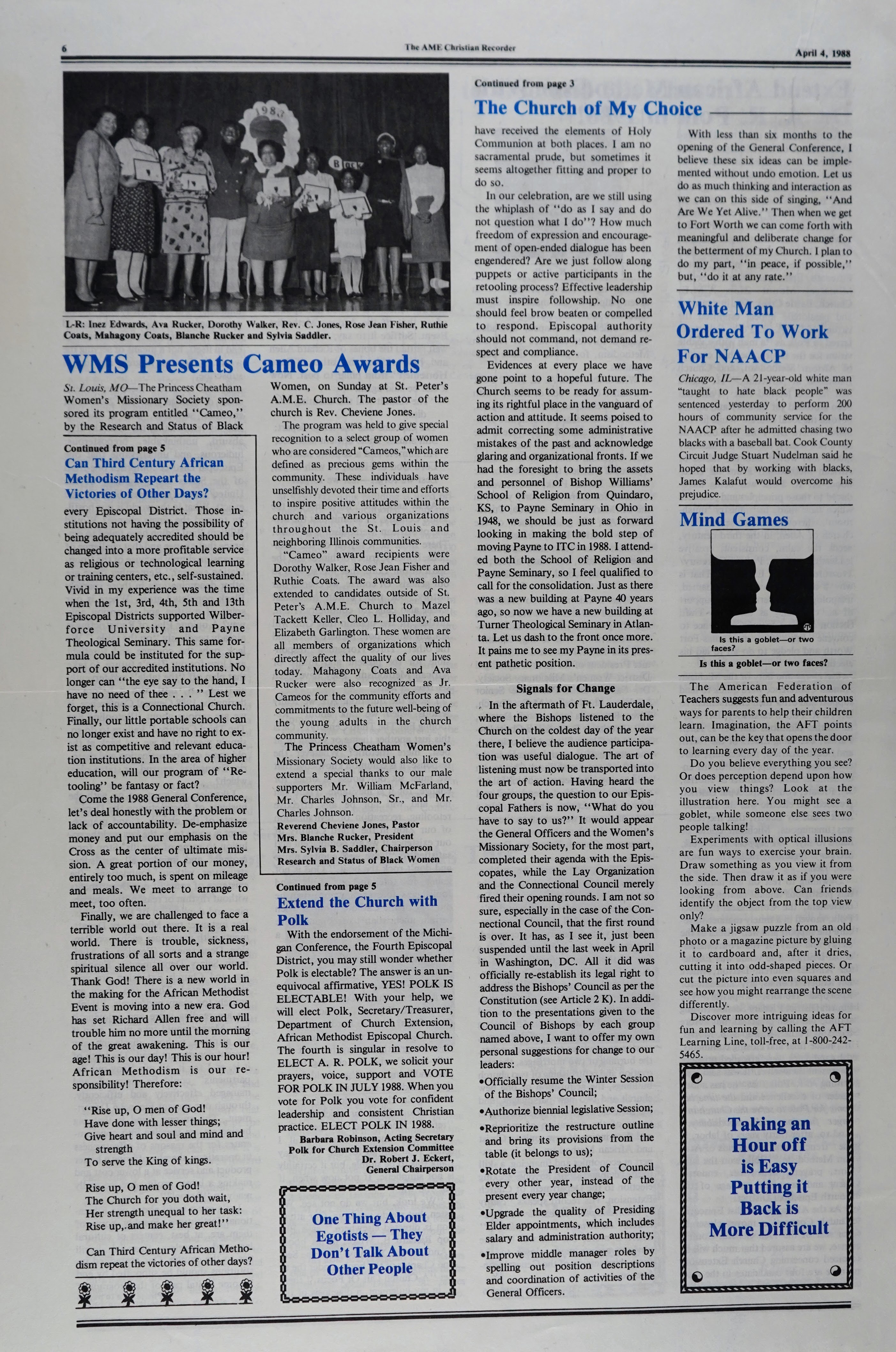
L-R: Inez Edwards, Ava Rucker, Dorothy Walker, Rev. Cc. Jones, Rose Jean Fisher, Ruthie
Coats, Mahagony Coats, Blanche Rucker and Sylvia Saddler.
WMS Presents Cameo Awards
S1. Louis, MO—The Princess Cheatham
Women’s Missionary Society spon-
sored its program entitled ‘‘Cameo,’’
by the Research and Status of Black
Continued from page 5
Can Third Century African
Methodism Repeart the
Victories of Other Days?
every Episcopal District. Those in-
stitutions not having the possibility of
being adequately accredited should be
changed into a more profitable service
as religious or technological learning
or training centers, etc., self-sustained.
Vivid in my experience was the time
when the Ist, 3rd, 4th, Sth and 13th
Episcopal Districts supported Wilber-
force University and Payne
Theological Seminary. This same for-
mula could be instituted for the sup-
port of our accredited institutions. No
longer can ‘‘the eye say to the hand, I
have no need of thee... ’’ Lest we
forget, this is a Connectional Church.
Finally, our little portable schools can
no longer exist and have no right to ex-
ist as competitive and relevant educa-
tion institutions. In the area of higher
education, will our program of ‘‘Re-
tooling’’ be fantasy or fact?
Come the 1988 General Conference,
let’s deal honestly with the problem or
lack of accountability. De-emphasize
money and put our emphasis on the
Cross as the center of ultimate mis-
sion. A great portion of our money,
entirely too much, is spent on mileage
and meals. We meet to arrange to
meet, too often.
Finally, we are challenged to face a
terrible world out there. It is a real
world. There is trouble, sickness,
frustrations of all sorts and a strange
spiritual silence all over our world.
Thank God! There is a new world in
the making for the African Methodist
Event is moving into a new era. God
has set Richard Allen free and will
trouble him no more until the morning
of the great awakening. This is our
age! This is our day! This is our hour!
African Methodism is our re-
sponsibility! Therefore:
“Rise up, O men of God!
Have done with lesser things;
Give heart and soul and mind and
strength
To serve the King of kings.
Rise up, O men of God!
The Church for you doth wait,
Her strength unequal to her task:
Rise up,.and make her great!’’
Can Third Century African Metho-
dism repeat the victories of other days?
gg FF
Women, on Sunday at St. Peter’s
A.M.E. Church. The pastor of the
church is Rev. Cheviene Jones.
The program was held to give special
recognition to a select group of women
who are considered “Cameos,” which are
defined as precious gems within the
community. These individuals have
unselfishly devoted their time and efforts
to inspire positive attitudes within the
church and various organizations
throughout the St. Louis and
neighboring Illinois communities.
“Cameo” award recipients were
Dorothy Walker, Rose Jean Fisher and
Ruthie Coats. The award was also
extended to candidates outside of St.
Peters A.M.E. Church to Mazel
Tackett Keller, Cleo L. Holliday, and
Elizabeth Garlington. These women are
all members of organizations which
directly affect the quality of our lives
today. Mahagony Coats and Ava
Rucker were also recognized as Jr.
Cameos for the community efforts and
commitments to the future well-being of
the young adults in the church
community.
The Princess Cheatham Women’s
Missionary Society would also like to
extend a special thanks to our male
supporters Mr. William McFarland,
Mr. Charles Johnson, Sr., and Mr.
Charles Johnson.
Reverend Cheviene Jones, Pastor
Mrs. Blanche Rucker, President
Mrs. Sylvia B. Saddler, Chairperson
Research and Status of Black Women
Continued from page 5
Extend the Church with
Polk
With the endorsement of the Michi-
gan Conference, the Fourth Episcopal
District, you may still wonder whether
Polk is electable? The answer is an un-
equivocal affirmative, YES! POLK IS
ELECTABLE! With your help, we
will elect Polk, Secretary/Treasurer,
Department of Church Extension,
African Methodist Episcopal Church.
The fourth is singular in resolve to
ELECT A. R. POLK, we solicit your
prayers, voice, support and VOTE
FOR POLK IN JULY 1988. When you
vote for Polk you vote for confident
leadership and consistent Christian
practice. ELECT POLK IN 1988.
Barbara Robinson, Acting Secretary
Polk for Church Extension Committee
Dr. Robert J. Eckert,
General Chairperson
One Thing About
Egotists — They
Don’t Talk About
Other People
Continued from page 3
The Church of My Choice
have received the elements of Holy
Communion at both places. 1 am no
sacramental prude, but sometimes it
seems altogether fitting and proper to
do so,
In our celebration, are we still using
the whiplash of ‘‘do as I say and do
not question what I do’’? How much
freedom of expression and encourage-
ment of open-ended dialogue has been
engendered? Are we just follow along
puppets or active participants in the
retooling process? Effective leadership
must inspire followship. No one
should feel brow beaten or compelled
to respond. Episcopal authority
should not command, not demand re-
spect and compliance.
Evidences at every place we have
gone point to a hopeful future. The
Church seems to be ready for assum-
ing its rightful place in the vanguard of
action and attitude. It seems poised to
admit correcting some administrative
mistakes of the past and acknowledge
glaring and organizational fronts. If we
had the foresight to bring the assets
and personnel of Bishop Williams’
School of Religion from Quindaro,
KS, to Payne Seminary in Ohio in
1948, we should be just as forward
looking in making the bold step of
moving Payne to ITC in 1988. I attend-
ed both the School of Religion and
Payne Seminary, so I feel qualified to
call for the consolidation. Just as there
was a new building at Payne 40 years
ago, so now we have a new building at
Turner Theological Seminary in Atlan-
ta. Let us dash to the front once more.
It pains me to see my Payne in its pres-
ent pathetic position.
Signals for Change
, In the aftermath of Ft. Lauderdale,
where the Bishops listened to the
Church on the coldest day of the year
there, I believe the audience participa-
tion was useful dialogue. The art of
listening must now be transported into
the art of action. Having heard the
four groups, the question to our Epis-
copal Fathers is now, ‘‘What do you
have to say to us?’’ It would appear
the General Officers and the Women’s
Missionary Society, for the most part,
completed their agenda with the Epis-
copates, while the Lay Organization
and the Connectional Council merely
fired their opening rounds. I am not so
sure, especially in the case of the Con-
nectional Council, that the first round
is over. It has, as I see it, just been
suspended until the last week in April
in Washington, DC. All it did was
officially re-establish its legal right to
address the Bishops’ Council as per the
Constitution (see Article 2 K). In addi-
tion to the presentations given to the
Council of Bishops by each group
named above, I want to offer my own
personal suggestions for change to our
leaders:
eOfficially resume the Winter Session
of the Bishops’ Council;
e Authorize biennial legislative Session;
eReprioritize the restructure outline
and bring its provisions from the
table (it belongs to us);
eRotate the President of Council
every other year, instead of the
present every year change;
eUpgrade the quality of Presiding
Elder appointments, which includes
salary and administration authority;
eImprove middle manager roles by
spelling out position descriptions
and coordination of activities of the
General Officers.
With less than six months to the
opening of the General Conference, |
believe these six ideas can be imple-
mented without undo emotion, Let us
do as much thinking and interaction as
we can on this side of singing, ‘‘And
Are We Yet Alive.’’ Then when we get
to Fort Worth we can come forth with
meaningful and deliberate change for
the betterment of my Church. I plan to
do my part, ‘‘in peace, if possible,’
but, ‘‘do it at any rate.’’
White Man
Ordered To Work
For NAACP
Chicago, IL—A 21-year-old white man
“taught to hate black people” was
sentenced yesterday to perform 200
hours of community service for the
NAACP after he admitted chasing two
blacks with a baseball bat. Cook County
Circuit Judge Stuart Nudelman said he
hoped that by working with blacks,
James Kalafut would overcome his
prejudice.
Mind Games
G
Is this a goblet—or two
faces?
Is this a goblet—or two faces?
The American Federation of
Teachers suggests fun and adventurous
ways for parents to help their children
learn. Imagination, the AFT points
out, can be the key that opens the door
to learning every day of the year.
Do you believe everything you see?
Or does perception depend upon how
you view things? Look at the
illustration here. You might see a
goblet, while someone else sees two
people talking!
Experiments with optical illusions
are fun ways to exercise your brain.
Draw something as you view it from
the side. Then draw it as if you were
looking from above. Can friends
identify the object from the top view
only?
Make a jigsaw puzzle from an old
photo or a magazine picture by gluing
it to cardboard and, after it dries,
cutting it into odd-shaped pieces. Or
cut the picture into even squares and
see how you might rearrange the scene
differently.
Discover more intriguing ideas for
fun and learning by calling the AFT
Learning Line, toll-free, at 1-800-242-
5465.
Taking an
Hour off
is Easy
Putting it
Back is
More Difficult
===== DSC05474.JPG =====
April 4, 1988
The AME Christian Recorder
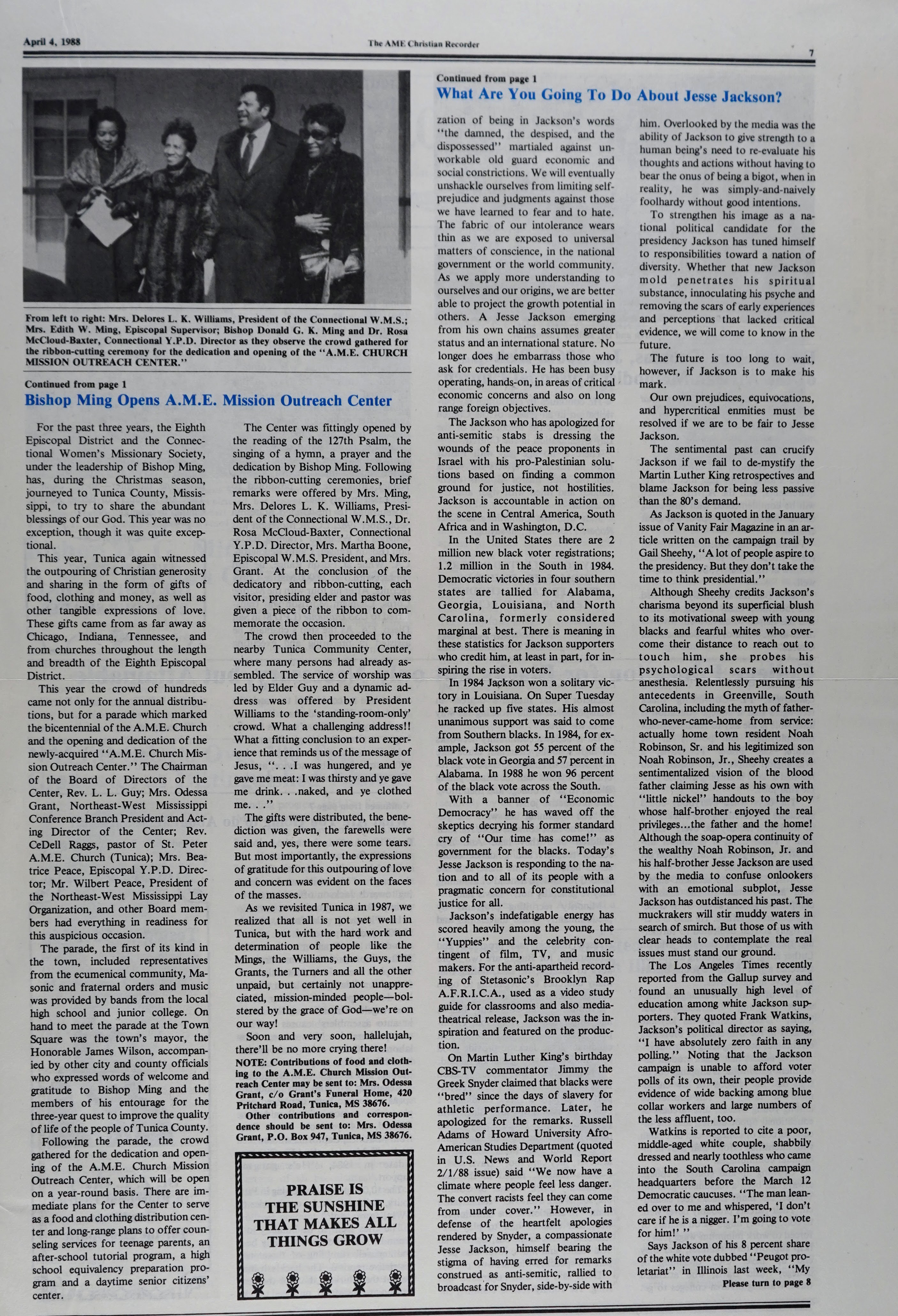
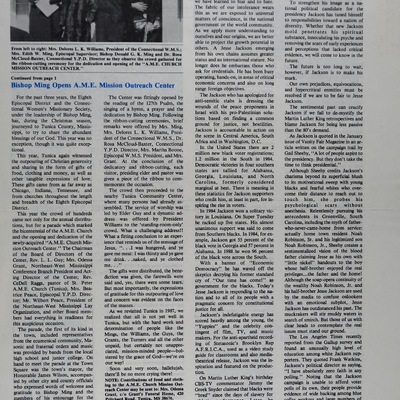
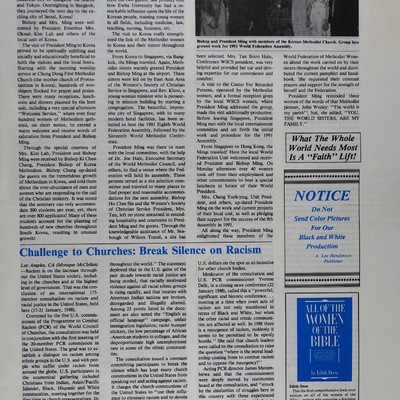
From left to right: Mrs. Delores L. K. Williams, President of the Connectional W.M.S.;
Mrs. Edith W. Ming, Episcopal Supervisor; Bishop Donald G. K. Ming and Dr. Rosa
McCloud-Baxter, Connectional Y.P.D. Director as they observe the crowd gathered for
the ribbon-cutting ceremony for the dedication and opening of the ‘‘A.M.E. CHURCH
MISSION OUTREACH CENTER.”
Continued from page 1
Bishop Ming Opens A.M.E. Mission Outreach Center
For the past three years, the Eighth
Episcopal District and the Connec-
tional Women’s Missionary Society,
under the leadership of Bishop Ming,
has, during the Christmas season,
journeyed to Tunica County, Missis-
sippi, to try to share the abundant
blessings of our God. This year was no
exception, though it was quite excep-
tional.
This year, Tunica again witnessed
the outpouring of Christian generosity
and sharing in the form of gifts of
food, clothing and money, as well as
other tangible expressions of love.
These gifts came from as far away as
Chicago, Indiana, Tennessee, and
from churches throughout the length
and breadth of the Eighth Episcopal
District.
This year the crowd of hundreds
came not only for the annual distribu-
tions, but for a parade which marked
the bicentennial of the A.M.E. Church
and the opening and dedication of the
newly-acquired ‘‘A.M.E. Church Mis-
sion Outreach Center.’’ The Chairman
of the Board of Directors of the
Center, Rev. L. L. Guy; Mrs. Odessa
Grant, Northeast-West Mississippi
Conference Branch President and Act-
ing Director of the Center; Rev.
CeDell Raggs, pastor of St. Peter
A.M.E. Church (Tunica); Mrs. Bea-
trice Peace, Episcopal Y.P.D. Direc-
tor; Mr. Wilbert Peace, President of
the Northeast-West Mississippi Lay
Organization, and other Board mem-
bers had everything in readiness for
this auspicious occasion.
The parade, the first of its kind in
the town, included representatives
from the ecumenical community, Ma-
sonic and fraternal orders and music
was provided by bands from the local
high school and junior college. On
hand to meet the parade at the Town
Square was the town’s mayor, the
Honorable James Wilson, accompan-
ied by other city and county officials
who expressed words of welcome and
gratitude to Bishop Ming and the
members of his entourage for the
three-year quest to improve the quality
of life of the people of Tunica County.
Following the parade, the crowd
gathered for the dedication and open-
ing of the A.M.E. Church Mission
Outreach Center, which will be open
on a year-round basis. There are im-
mediate plans for the Center to serve
as a food and clothing distribution cen-
ter and long-range plans to offer coun-
seling services for teenage parents, an
after-school tutorial program, a high
school equivalency preparation pro-
gram and a daytime senior citizens’
center.
The Center was fittingly opened by
the reading of the 127th Psalm, the
singing of a hymn, a prayer and the
dedication by Bishop Ming. Following
the ribbon-cutting ceremonies, brief
remarks were offered by Mrs. Ming,
Mrs. Delores L. K. Williams, Presi-
dent of the Connectional W.M.S., Dr.
Rosa McCloud-Baxter, Connectional
Y.P.D. Director, Mrs. Martha Boone,
Episcopal W.M.S. President, and Mrs.
Grant. At the conclusion of the
dedicatory and ribbon-cutting, each
visitor, presiding elder and pastor was
given a piece of the ribbon to com-
memorate the occasion.
The crowd then proceeded to the
nearby Tunica Community Center,
where many persons had already as-
sembled. The service of worship was
led by Elder Guy and a dynamic ad-
dress was offered by President
Williams to the ‘standing-room-only’
crowd. What a challenging address!!
What a fitting conclusion to an exper-
ience that reminds us of the message of
Jesus, ‘‘. . .1 was hungered, and ye
gave me meat: I was thirsty and ye gave
me drink. . .naked, and ye clothed
me...”
The gifts were distributed, the bene-
diction was given, the farewells were
said and, yes, there were some tears.
But most importantly, the expressions
of gratitude for this outpouring of love
and concern was evident on the faces
of the masses.
As we revisited Tunica in 1987, we
realized that all is not yet well in
Tunica, but with the hard work and
determination of people like the
Mings, the Williams, the Guys, the
Grants, the Turners and all the other
unpaid, but certainly not unappre-
ciated, mission-minded people—bol-
stered by the grace of God—we’re on
our way!
Soon and very soon, hallelujah,
there’ll be no more crying there!
NOTE: Contributions of food and cloth-
ing to the A.M.E. Church Mission Out-
reach Center may be sent to: Mrs. Odessa
Grant, c/o Grant’s Funeral Home, 420
Pritchard Road, Tunica, MS 38676.
Other contributions and correspon-
dence should be sent to: Mrs. Odessa
Grant, P.O. Box 947, Tunica, MS 38676.
PRAISE IS
THE SUNSHINE
THAT MAKES ALL
THINGS GROW
Continued from page 1
What Are You Going To Do About Jesse Jackson?
zation of being in Jackson’s words
“the damned, the despised, and the
dispossessed’’ martialed against un-
workable old guard economic and
social constrictions, We will eventually
unshackle ourselves from limiting self-
prejudice and judgments against those
we have learned to fear and to hate,
The fabric of our intolerance wears
thin as we are exposed to universal
matters of conscience, in the national
government or the world community.
As we apply more understanding to
ourselves and our origins, we are better
able to project the growth potential in
others. A Jesse Jackson emerging
from his own chains assumes greater
status and an international stature. No
longer does he embarrass those who
ask for credentials. He has been busy
operating, hands-on, in areas of critical
economic concerns and also on long
range foreign objectives.
The Jackson who has apologized for
anti-semitic stabs is dressing the
wounds of the peace proponents in
Israel with his pro-Palestinian solu-
tions based on finding a common
ground for justice, not hostilities.
Jackson is accountable in action on
the scene in Central America, South
Africa and in Washington, D.C.
In the United States there are 2
million new black voter registrations;
1.2 million in the South in 1984.
Democratic victories in four southern
states are tallied for Alabama,
Georgia, Louisiana, and North
Carolina, formerly considered
marginal at best. There is meaning in
these statistics for Jackson supporters
who credit him, at least in part, for in-
spiring the rise in voters.
In 1984 Jackson won a solitary vic-
tory in Louisiana. On Super Tuesday
he racked up five states. His almost
unanimous support was said to come
from Southern blacks. In 1984, for ex-
ample, Jackson got 55 percent of the
black vote in Georgia and 57 percent in
Alabama. In 1988 he won 96 percent
of the black vote across the South.
With a banner of ‘‘Economic
Democracy’’ he has waved off the
skeptics decrying his former standard
cry of ‘‘Our time has come!’’ as
government for the blacks. Today’s
Jesse Jackson is responding to the na-
tion and to all of its people with a
pragmatic concern for constitutional
justice for all.
Jackson’s indefatigable energy has
scored heavily among the young, the
“‘Yuppies’’ and the celebrity con-
tingent of film, TV, and music
makers. For the anti-apartheid record-
ing of Stetasonic’s Brooklyn Rap
A.F.R.I.C.A., used as a video study
guide for classrooms and also media-
theatrical release, Jackson was the in-
spiration and featured on the produc-
tion.
On Martin Luther King’s birthday
CBS-TV commentator Jimmy the
Greek Snyder claimed that blacks were
“‘bred’’ since the days of slavery for
athletic performance. Later, he
apologized for the remarks. Russell
Adams of Howard University Afro-
American Studies Department (quoted
in U.S. News and World Report
2/1/88 issue) said ‘‘We now have a
climate where people feel less danger.
The convert racists feel they can come
from under cover.’’ However, in
defense of the heartfelt apologies
rendered by Snyder, a compassionate
Jesse Jackson, himself bearing the
stigma of having erred for remarks
construed as anti-semitic, rallied to
broadcast for Snyder, side-by-side with
him, Overlooked by the media was the
ability of Jackson to give strength to a
human being’s need to re-evaluate his
thoughts and actions without having to
bear the onus of being a bigot, when in
reality, he was simply-and-naively
foolhardy without good intentions.
To strengthen his image as a na-
tional political candidate for the
presidency Jackson has tuned himself
to responsibilities toward a nation of
diversity. Whether that new Jackson
mold penetrates his spiritual
substance, innoculating his psyche and
removing the scars of early experiences
and perceptions that lacked critical
evidence, we will come to know in the
future.
The future is too long to wait,
however, if Jackson is to make his
mark.
Our own prejudices, equivocations,
and hypercritical enmities must be
resolved if we are to be fair to Jesse
Jackson.
The sentimental past can crucify
Jackson if we fail to de-mystify the
Martin Luther King retrospectives and
blame Jackson for being less passive
than the 80’s demand.
As Jackson is quoted in the January
issue of Vanity Fair Magazine in an ar-
ticle written on the campaign trail by
Gail Sheehy, ‘‘A lot of people aspire to
the presidency. But they don’t take the
time to think presidential.’’
Although Sheehy credits Jackson’s
charisma beyond its superficial blush
to its motivational sweep with young
blacks and fearful whites who over-
come their distance to reach out to
touch him, she probes his
psychological scars without
anesthesia. Relentlessly pursuing his
antecedents in Greenville, South
Carolina, including the myth of father-
who-never-came-home from service:
actually home town resident Noah
Robinson, Sr. and his legitimized son
Noah Robinson, Jr., Sheehy creates a
sentimentalized vision of the blood
father claiming Jesse as his own with
“little nickel’? handouts to the boy
whose half-brother enjoyed the real
privileges...the father and the home!
Although the soap-opera continuity of
the wealthy Noah Robinson, Jr. and
his half-brother Jesse Jackson are used
by the media to confuse onlookers
with an emotional subplot, Jesse
Jackson has outdistanced his past. The
muckrakers will stir muddy waters in
search of smirch. But those of us with
clear heads to contemplate the real
issues must stand our ground.
The Los Angeles Times recently
reported from the Gallup survey and
found an unusually high level of
education among white Jackson sup-
porters. They quoted Frank Watkins,
Jackson’s political director as saying,
“J have absolutely zero faith in any
polling.’ Noting that the Jackson
campaign is unable to afford voter
polls of its own, their people provide
evidence of wide backing among blue
collar workers and large numbers of
the less affluent, too.
Watkins is reported to cite a poor,
middle-aged white couple, shabbily
dressed and nearly toothless who came
into the South Carolina campaign
headquarters before the March 12
Democratic caucuses. ‘‘The man lean-
ed over to me and whispered, ‘I don’t
care if he is a nigger. I’m going to vote
for him!’ ”’
Says Jackson of his 8 percent share
of the white vote dubbed ‘‘Peugot pro-
letariat’’ in Illinois last week, ‘‘My
Please turn to page 8
===== DSC05475.JPG =====
The AME Christian Recorder
April 4, 1988
Ebenezer A.M.E. Church and Dr. Robert Thomas, Jr.
Elect Robert Thomas, Jr., 106th Bishop
of the African Methodist Episcopal Church
“He hath showed thee, O man, what
is good; and what doth the Lord require
of thee, but to do justly, and to love
mercy, and to walk humbly with thy
God?” Micah 6:8
Robert Thomas, Jr., affectionately
called Pastor Bob, has met the re-
quirements, and the A.M.E. Church
will be complemented with him being
elected one of the Bishops of our great
church.
Pastor Bob has touched the lives of
many people; not just the men and
women in the ministry, but the laity as
well.
Pastor Bob has spiritually cultivated
and motivated many among the laity
and has helped to elevate our involve-
ment in the work of the Connectional
Church. :
He continues to encourage lay par-
ticipation in all phases of the Church
and promotes the importance of the
Lay Organization in the Church.
There is no age gap with Pastor
Bob, he leads and directs the young
and the old. Pastor Bob is open-
minded and filled with vigor and en-
thusiasm.
Join with the Committee to Elect
Robert Thomas, Jr., in saying:
“MY VOTE ELECTED ROBERT
THOMAS, JR., BISHOP OF
THE AFRICAN METHODIST
EPISCOPAL CHURCH!”’
Netter Page Weeks
Delegate 1988 General Conference
Lieutenant Commander John Wesley
Morrison, CHC, USN (Chaplain Corps)
LCDR Morrison is assigned as an in-
structor at the Navel Chaplains
School, Newport, Rhode Island.
Chaplain Morrison was born in
Flushing, NY, on May 30, 1952. He
came to know the Lord as his personal
Savior at the age of 13, while attending
a summer Bible camp in Pinebush,
NY. He graduated from Ward Melville
High School in 1970 and Wilberforce
University, Wilberforce, OH, in 1974.
LCDR Morrison earned his master’s
of divinity from the Interdenomina-
tional Theological Center, Atlanta, in
1980. He is an ordained elder and
member of the New York Annual
Conference in the African Methodist
Episcopal Church.
Chaplain Morrison was commis-
sioned an ensign in the Navy in July
1977, and completed the Navy Cha-
plains School in August of the same
year. After ordination he entered ac-
tive duty in October 1980.
Upon entering active duty, LCDR
Morrison was sent to the base chapel
at the Naval Support Activity (NSA),
Naples, Italy. He was promoted to
lieutenant in July 1981.
Returning to the United States in
September 1982, LCDR Morrison was
assigned to Weapons Training Batta-
lion (Edson Range), Camp Pendleton,
CA. While at Edson Range, he had
contact with over 24,000 Marine Corps
recruits. After his tour with the Marine
Corps, Chaplain Morrison was trans-
ferred to USS Dubuque (LPD 8) in San
Diego, CA. As the ship’s chaplain, he
assisted in preparing and executing
Lt. Commander John Wesley Morrison
programs for the ship’s homeport
change to Sasebo, Japan.
In June 1986, Chaplain Morrison
was promoted to Lieutenant Com-
mander and after 14 months overseas
was assigned to the Armed Forces
Staff College in Norfolk, VA. After
graduation in June 1987, LCDR Mor-
rison was transferred to his present as-
signment.
Chaplain Morrison is married to the
former Cheryl Ann Robinson; they
have one daughter—Sherell Aniece.
They are members of Bethel A.M.E.
Church in Setauket, NY.
i
OVER-EATING —
THE DESTINY THAT
ENDS OUR SHAPES
s
College Education for Blacks not only Necessary, but Attainable
Gainesville, FIL—Convincing Black
teen-agers that a college education is
attainable is the key to reducing Black
unemployment and poverty in the
future, said Frank T. Davis, a
Washington employment expert who
has had a hand in helping 270,000 peo-
ple find jobs.
“The days when everybody could
specialize in something like bricklaying
or work in a factory are over,’’ Davis
said. ‘‘These days, it is almost im-
perative that a young Black person get
a college education.”’
Davis, 52, is outplacement super-
visor and assistant to the assistant
comptroller general at the U. S. Gene-
ral Accounting Office. He also is a ci-
vil rights activist dedicated to further-
ing the dream of the late Martin
Luther King, Jr., by making about 100
speeches a year to inspire young Blacks
to believe in themselves.
Host of a local Washington tele-
vision program, ‘‘Marketing Your
Skills,’ Davis recently was keynote
speaker at the University of Floridia’s
ceremonies marking King’s birthday.
Davis admits that Black student en-
rollment nationwide is slipping, but he
feels that the reasons for low enroll-
ment—a lack of self-confidence
among young Blacks, unawareness of
educational opportunities, and the es-
calating cost of college—can be beaten
with intensified efforts that start in in-
dividual communities.
“Growing up and going to college
always has been a reasonable goal for
Whites, but many Blacks feel exclud-
ed. Their parents probably never went
to college, they might be on welfare or
forced to work minimum-wage jobs to
help support their families, and they
end up never even dreaming of
college,’’ said Davis, who attended
three Washington-area colleges to get
bachelor’s and master’s degrees in
transportation while working his way
up in the GAO.
Davis believes community networks
of high schools, churches, clubs like
Boy Scouts of America, and college re-
cruiting offices can convince young
Blacks to go to college and then move
into productive jobs.
“The beginning lies with the pa-
rents, who have to want more for their
children than they had. And high
school teachers and guidance coun-
selors have to assume these kids are
headed for college instead of assuming
they’re generally not,’’ Davis said.
Minority recruiting programs by
predominantly White universities and
in
creased financial aid programs and
scholarships for Blacks are two more
keys to success, he said, noting that
many churches are beginning to open
college scholarship funds.
Prominent, self-confident Blacks
like singer Marian Anderson, Olym-
pian Jesse Owens, and presidential
candidate Jesse Jackson provide good
role models for young Blacks, he said.
“No matter how Jesse Jackson
fares in his Presidential bid, it’s so im-
portant to have a Black candidate. I
believe thousands of young Blacks will
go to college just because they realize
that if he can come from the same kind
of background as them and be an
achiever, they can, too,’’ Davis said.
Davis himself, raised in the pre-
dominantly Black District of Colum-
bia, seems like a leftover “‘Renaissance
man.”’ In addition to the athletic pro-
wess that enabled him to play pro-
fessional tennis in the 50s, Davis is an
avid reader and music lover who pep-
pers his speeches with his own poetry.
Davis said his own inspiration was
King. He fondly recalls climbing the
tallest tree he could find to watch the
August 28, 1963, march on Washing-
ton led by King. ‘‘That’s when I really
began to share Dr. King’s dream,”’ he
said. Davis has since won more than
370 awards for public service, and be-
came the only Black to win the pres-
tigious U. S. Congressional Excalibur
Award.
“T really started to believe that I
could make a difference in some small
way, and that’s what today’s Black
teen-agers need to believe.’’
Continued from page 7
What Are You Going to do About Jesse Jackson?
focus is not so much on the color of
votes but the number of voters.”’
The labor rallies with their chants of
thousands of blue collar workers lean-
ing towards Jackson offer him reason
to hope for their growing support.
In Pittsburg, California, nearly
10,000 people protested the use of
non-union construction workers on a
$350 million project to modernize a
steel plant there. Jackson was there of-
fering his solidarity, similar to what he
has done, reports labor writer of the
Los Angeles Times Henry Weinstein,
in auto assemblers’ causes in Flint,
meatpackers in Milwaukee, farm
laborers in Calexico, hospital orderlies
in Philadelphia, paper workers in
Mobile, and firefighters in St. Louis.
Regarding as ‘‘the only candidate
speaking for workers, oppressed peo-
ple, union or non-union,”’ said Gene
Gifford, a 44-year old steam fitter
from Martinez, California who backed
Walter F. Mondale, the AFL-CIO can-
didate in 1984, ‘‘He’s got my
support.’”
The 10,000 people protesting in Pitt-
sburg, California broke out in cries of
‘Win, Jesse, win!’’
The cries seem to be building to a
groundswell, although there may be a
counterswell rumbling of threatened
restrictive reprisal. The backlash may
be out there lurking, but for those of
us who are not afraid, our need to take
a Stand again, Somewhere, urges Sup-
port.
Tested Leadership
Dr. Z. L. Grady
7th Episcopal District
Candidate
for the Bishophric
Dawywrwwwal ©
===== DSC05476.JPG =====
April 4, 1988
The AME Christian Recorder
tissk*t Ne
~ atnpgene =
us
1! pee
View of the construction from the back side of the Church. In the background is the
highrise skyline of downtown Seattle. The construction level in view is the Fellowship
Hall/ multi-purpose room.
Close-up view of construction at First A.M.E. From within the upper level, a panoramic
view of downtown Seattle and the Olympic Mountains is possible.
Seattle, Washington’s, oldest Black
church, First A.M.E. Church, moves
into its second century of existence
with a major building expansion pro-
ject under way. While Seattle was still
a young city, first A.M.E. was born
under the leadership of seven visionary
Christian pioneers in the Pacific
Northwest in 1886. It stands as a bea-
con among the A.M.E. Churches in
the Puget Sound Conference of the
Fifth Episcopal District. First A.M.E.
sits proudly atop Capitol Hill, one of
seven major hills in the city. From this
vantage point, members of the Church
have a panoramic view of downtown
Seattle and the Olympic Mountain
range.
The present building was erected in
1912 and was designated a Historical
Landmark by the Washington State
Landmarks Preservation Board in
1984. The church was expanded in
1954. Over the years First A.M.E. has
increased its membership to some
1,500 members. In like manner, the
church has expanded its services to the
community to the point where these
services now include a pre-school, a
Headstart program, a prison ministry,
an emergency feeding program, a job
placement program, a legal aid pro-
. or rr
bnar Ic (hnan
Dr. John R. Bryant
In my thirty years in the A.M.E.
Church, it has been a rare occasion to
meet a pastor like Dr. John R. Bryant.
Most candidates and major pastors are
concerned about major issues and major
churches. In the 10 years I have known
Dr. Bryant, he has shown love and
compassion for pastors like myself, who
labor in small churches. The words of
Christ, St. Matthew 25:40: “Inasmuch as
ye have done it unto one of the least of
these my brethren, ye have done it unto
me.”
In 1986, I spoke to Dr. Bryant about a
TV station that airs Black churches in
Baltimore (the program started in 1980);
there had never been an A.M.E. Church
aired, although Bethel’s choir had
brought the music for an African
preacher. Dr. Bryant told me he would
do something about it. He didn’t wait a
AS Upeil, 2
j
Street-side view of construction at First A.M.E. The sanctuary is out of view on the right.
Upper level is a fellowship hall, offices, and a library. Lower level has classrooms and a
conference room,
gram, a hypertension screening pro-
gram, and the fellowship and opera-
tion of three major, multi-unit housing
complexes for Senior citizens and low
to moderate income families. These
programs, and others which are on the
horizon at First A.M.E. Church, such
as a Young Peoples’ Church and an
educational program to enhance aca-
demic achievement by Black students
in the Seattle School district, contri-
buted to the need to expand the phy-
sical facilities of the church.
“yy r
SU BRRSERAE BERo
month or two: in two weeks, St. John
A.M.E. was aired.
Last June, at our Bicentennial
Celebration in Philadelphia, PA., I
asked Dr. Bryant to preach my Men’s
Day, 2/21/88. He could not come, but
he supplied me with not one, but two,
dynamic preachers, plus an evangelistic
team. Seven of my youth accepted the
Lord.
Some candidates bend over
backwards for your vote. Dr. Bryant
knows I have no vote to give, but his love
for his church shows me he is ready to be
a bishop for a district. Pastors could rest
at night, working with a man like Dr.
Bryant. LET’S ELECT HIM!!
Rev. Joseph E. Brame
Pastor, St. Paul A.M.E. Church
Harrington, DE
The Rev. James H. Oxley, pastor of
First A.M.E. Church, provided the
spiritual impetus and leadership ne-
cessary to raise the funds for expan-
sion. Rev. Oxley’s determined leader-
ship and dedication to ‘‘expanding the
church’s Christian education
mission,’’ stimulated many members
to pledge and contribute $1000 each
toward the building project. Each year
First A.M.E. Church has an Annual
Tea, which is the major fund-raising
activity for the church. For the last se-
veral years the Tea has resulted in con-
tributions totalling $40,000 on Annual
Tea Sunday. This year’s Tea resulted
in contributions of $62,000. This level
Yd
Best Black Sermons
by William M. Philpot
These sermons typify the best
preaching that is done in
Black churches today. Each
sermon has been chosen be-
cause of its excellent homilet-
ical form and accuracy in de-
picting Black experience.
HOOSCOCCOC COO SOOO OS OOOO OHO OOOOH O SOSH OOHOHHHOSHSOOOSOO HH OOSSOHOH SOHO SHOCOO OOO OOOOSD
Please add 13% postage and handling.
of contribution is an obvious indica-
tion of the commitment of First
A.M.E. Church members to the
building expansion project and to the
new programs Rev. Oxley has set into
motion as First A.M.E. Church con-
tinues to serve its Community.
Under the watchful eyes of Rev. Ox-
ley and Presiding Elder Jewel B. De-
Witty, First A.M.E.’s Stewards and
Trustees broke ground for the new
building in June 1987. Construction
began in mid-November. The new
building, largely an educational wing,
will add 12,200 square feet of space to
the church. Included in the new space
will be classrooms, a Fellowship Hall/
multi-purpose room with a seating ca-
pacity of 545, a conference room, ad-
ministrative offices, a library, and new
kitchen and banquet facilities. The
new addition to the church will be con-
gruent with the existing architectural
features, preserving the physical inte-
grity, beauty and elegant grace of this
local historic landmark. The building
project will be completed by mid-April
1988.
Rev. Oxley remains committed to
the forward movement of First
A.M.E. Church and brings the vision,
leadership, and sense of Christian pur-
pose and mission necessary to send the
Church effectively onward and upward
into its second hundred years in Seat-
tle.
PYYTTTITTT TT a)
rc : — az ES,
““Somebody’s Calling
My Name”
by Wyatt Tee Walker
Walker presents a thorough
study tracing the musical ex-
pressions of Black religion
from its ancestoral roots in
Africa to its influence upon
Black religion today.
WTW-121 ......-0- es $8.95
PO OCOHCO OOOO OOCO OOO OOOOOOO OOOO OOOO OOOO OOO OHO OOOOH OOO SOOO OO OOOOOOOOOSOHOSOOOOOOO
——————————
===== DSC05477.JPG =====
10
The AME Christian Recorder
April 4, 1988
The Third Episcopal District Gave the A.M.E. Church a Prolific Editor for the
A.M.E. Christian Record
Robert Henry Reid,, Jr., native of
the ‘‘Blue Grass State,’’ was born in
Pryorsburg, KY. He was educated in
the public schools of that state, and
was graduated from State Street High
School, Bowling Green, KY. He at-
tended Municipal College, Louisville,
and is an alumnus of Wilberforce Uni-
versity and Payne Theological Semi-
nary, Wilberforce, OH, class of ’47.
He pursued graduate studies in Busi-
ness Economics at Ohio State Univer-
sity, Columbus, OH, and a one-term
special course in economics at the In-
dustrial Economics Institute, Oglebay
Park, WV.
Rev. Reid, as an ordained clergyman
of the African Methodist Episcopal
Church, has pastored from mission ap-
pointments to metropolitan pulpits.
He is a holder of honorary degrees
from Edward Waters College/B. F.
Lee Seminary, Jacksonville, FL;
Monrovia College, Liberia, West
Africa; Westwood Seminary, Dayton,
OH and Jackson Theological Semi-
nary/ Shorter College, Little Rock,
AR.
He was columnist for the Pittsburgh
Courier, Ohio State News and The
Ohio Sentinel, with byline. He edited,
managed and circulated The Third Dis-
strict Informer, Tawawa Herald, Bethel
Star and the Third District Public Re-
lations Journal. He instructed in Steno-
graphic and Journalistic Preparation,
Tawawa School of Religion, Wilber-
force University, Wilberforce, OH. He
was author and columnist of ‘‘Cap-
tured Facts’’ and is the author of Jrony
of Afro-American History: An Over-
view of A.M.E. History And Related
Developments.
Rev. Reid is former president of
Wilberforce University Alumni As-
sociation, Capital City Chapter, Co-
lumbus, OH. He was named one of
the ten ‘‘Top Men of the Year’’ from a
city of 500,000 population by the Co-
lumbus Citizen newspaper, Columbus,
OH. He served as Senate Chaplain for
the State of Pennsylvania, 1959-60,
and was listed in Pennsylvania’s Who’s
Who; was radio pastor for six years for
Duquesne-McKeesport, PA, Council
of Churches, and, in 1957, was a
member of the Duquesne Chamber of
Commerce.
In 1960 he became the first Black
president of the Duquesne Council of
Churches. In 1961 he was the first
Black candidate for the Duquesne
Board of Public Education. In 1964 he
was the Allegheny County, PA, Anti-
Poverty Chairman of the Education
Committee. In 1965 he became the Ex-
ecutive Director of the Duquesne
Anti-Poverty Office of Economic Op-
portunity Commission (O.E.O). He
was a board member for the Tri-City
Opportunities Industrialization Cen-
ter, Inc. He served as a volunteer cha-
plain at the Hamilton County Juvenile
Court, Cincinnati, OH, and, in 1971,
became a member of the University of
Cincinnati Steering Committee, inter-
preting the Associate Art Degree Pro-
gram to the Black community. He was
the first and only Black to serve as
President of the Cincinnati Council of
Christian Communions. For two
terms, he served as vice-president of
the Board of Directors for ‘‘New Life
For Girls,’’ operating three facilities:
two half-way houses and the Light-
house Runaway Shelter. He served as a
panelist on Cincinnati’s popular tele-
vision program ‘‘Dialogue.”’
Rev. Reid is a Master Mason, F. and
A.M., Prince Hall Affiliation, 32nd
er, Dr. Robert Henry Reid, Jr., 1976 to Present
John Brown Russwurm
Founder of American’s
First Black Newspaper
Faster a Te of Christian Victory Instead of Worldly ea
stating, Easter Should Be 4 Misdonary Observance for Overseas
Degree, and a Shriner. He is a member
of Kappa Alpha Psi Fraternity, a life
member of the NAACP and a member
of B.S. and A., Inc.
He served for thirty-five years as a
successful A.M.E. pastor. He is a
world traveler, lecturer and preacher;
and visited Europe, Asia and Africa,
with extended tours of Israel and the
Holy Land in 1959 and 1972. On his
second African visit, he traveled over
30,000 miles visiting A.M.E. missions.
On a third visit to Israel, he served as a
member of the reconciliation team for
Arabs and Jews. He was official repre-
sentative to the A.M.E. Church’s Dia-
mond Jubilee, Hamilton, Bermuda,
and he made a 3,000-mile tour of Mex-
ico in a poverty study. He was a spe-
cial, invited guest to Liberia, West Af-
rica, for the inauguration of President
William V. Tubman, January 15,
1968.
For nine years Rev. Reid served as
pastor of St. Paul A.M.E. Church,
Cincinnati, OH, from which church he
was elected, in 1976, to serve as
General Officer of the African Metho-
dist Episcopal Church as its Editor of
The A.M.E. Christian Recorder. He is
a fourth generation preacher: his great-
grandfather, grandfather and father
were all A.M.E. preachers.
He is listed in the 1976 publication,
“‘Community Leaders and Note-
worthy Americans,”’ in recognition of
past achievements and outstanding ser-
vice to community and state. He is
also listed in Wilberforce University’s
First National Alumni Directory,
1983. He has twice served as a quin-
quennium member of the World Me-
thodist Council, meeting in Honolulu,
Hawaii, and Nairobi, Kenya.
Shortly after leaving the Wilberforce
University community, in the late for-
ties, he was appointed Deputy
Treasurer for Franklin County at Co-
lumbus, OH. It was in Columbus that,
through his relentless struggle for the
cause of justice, educational and racial
equality, he, almost single-handedly
leading children in a protest march
around the old dilapidated Mt. Vernon
Elementary School, brought pressure
to bear upon the school board and the
city, which resulted in the construction
of a modern school building on the
same site.
Upcompromising in his fight for
equal opportunity for Blacks and
other minorities, he has asserted him-
self in the interest of minorities before
the political, economic, religious and
social forces of every community in
which he has lived. He has been fear-
less in the fight and struggle for full
and unlimited freedom NOW for the
Black people of America. He has been
eager to achieve, yet patient to inves-
tigate. He has heard the continuing sad
cry of the derelict and responded with
altruistic service. He has chosen his di-
rection for life and, as a God-called
preacher, cast his lot with common
people and given hope to the timid and
fearful.
Helper of the helpless, servant of
the poor, preacher for the underpri-
vileged, proclaimer of liberty through
Christ, valiant soldier in the battle for
humanity, rugged and stalwart general
in the Army of Jehovah, hero in the
conflict, foot soldier in the frontline
fight and gallant warrior in the cause
of truth, he has remained a lover of his
fellowman and a Nimesis to the forces
of injustice.
As Editor of the A.M.E. Christian
Recorder, the oldest continuously-
circulated newspaper owned by Blacks
in the world, he has yet continued his
fight through his many award-winning
editorials.
World traveler, lecturer, preacher,
reconciler, prolific writer and General
Officer of the African Methodist Epis-
copal Church.
A.M.E.
CHURCH NEWSPAPER
HISTORY, ABBREVIATED
The A.M.E. Church, at one time in
its history, operated three newspapers:
the Christian Recorder is the oldest.
The Southern Christian Recorder was
founded in 1882 by Bishop Henry
McNeil turner. The Western Christian
Recorder was founded in 1900 by Dr.
J. Frank McDonald. The Christian Re-
corder and the Southern Christian Re-
corder were Officially merged at the
General Conference in Los Angeles in
1960. The 1980 General Conference
changed the Christian Recorder from a
weekly newspaper to a fortnightly,
now published every 14th day, with
Monday as the publishing date, from
the A.M.E. Sunday School Union
Publishing House, Nashville, Tennes-
see.
Noble History
The Christian Recorder does, in-
deed, have a noble history and respec-
ted tradition that dates back to the
New York Annual Conference of the
First Episcopal District, where, in
1836, a resolution established a quar-
terly periodical, the first copy being
printed in 1841. In. 1848, the Christian
Herald was the name of our paper that
was operated out of Pittsburgh, PA.
In 1852, when the operation was mov-
ed to Philadelphia, the mame was
changed from the Christian Herald to
the Christian Recorder, and published
by the A.M.E. Book Concern.
Dr. Robert H. Reid, Jr.
Distinguished Editors
Some of the names of distinguished
editors of the Christian Recorder in-
clude Rev. M. M. Clark, Rev. A. R.
Green, Rev. J. P. Campbell, Rev.
Elisha Weaver, Rev. A. L. Sanford,
Rev. James Lynch and Rev. Benjamin
T. Tanner. In 1884, Rev. B. F. Lee,
President of Wilberforce University,
was made Editor of the Christian
Recorder and remained in that position
until he was elected bishop in 1892.
Rev. H. T. Johnson, who succeeded
Bishop Lee, died in office and Dr. R.
R. Wright, Jr., became editor. Other
names of former editors include Dr.
George A. Singleton, Dr. David Nor-
ris, Dr. Fred Hughes, Dr. B. J. Nolen,
Dr. L. S. Odom and Dr. A Lewis
Williams, the only living former
editor.
Dr. R. H. Reid, Jr., the current
editor, was elected in June 1976 at the
General Conference held in Atlanta,
GA. Editor Reid has the distinction of
being the church’s BICENTENNIAL
EDITOR, as the A.M.E. Church
celebrated its 200th birthday, during
the Year of Our Lord One Thousand
Nine Hundred Eighty-Seven. He is the
author of the Bicentennial Primer, a
book entitled Jrony of Afro-American
History: An Overview of A.M.E.
History and Related Developments.
Four Christian Recorder Editors
Elected Bishops
Rev. Jabez Pitt Campbell was elect-
ed and consecrated bishop in 1864, and
died after serving 27 years. Rev. Ben-
jamin Tucker Tanner was elected and
consecrated bishop in 1888, and died
after serving 27 years. Rev. Benjamin
Franklin Lee was elected and conse-
crated bishop in 1892, and died after
serving 34 years. Rev. Richard Robert
Wright, Jr., was elected and conse-
crated bishop in 1936 and died after
serving 31 years.
Let History Have Its Day
Not only we, but all of our posteri-
ty, will be better served if we let
history have its day! The A.ME.
Christian Recorder is the oldest
newspaper of the eleven oldest Black
publications in our nation, the
Recorder being 28 years older than the
next oldest Black newspaper, and 57
years older than the last of the eleven:
1. The Christian Recorder, 1848; 2. The
Star of Zion, 1876; 3. The American
Baptist, 1878; 4. The Philadelphia Tri-
bune, 1884; 5. The Baltimore Afro-
American, 1892; 6. The Houston In-
former and 7. Texas Freeman, 1893; 8.
The Iowa Bystander, 1894, 9. The In-
dianapolis Recorder, 1895; 10. The
Norfolk Journal and Guide, 1900; and
11. The Chicago Defender, 1905.
The A.M.E. Christian Recorder, in
the field of journalism, is the oldest
Continuously circulated newspaper
owned by Blacks in the world.
===== DSC05478.JPG =====
April 4, 1988
The AME Christian Recorder
FIRST EPISCOPAL DISTRICT
AME CHURCH
ANNUAL CONFERENCE SCHEDULE
BISHOP FRANK C. CUMMINGS
DELAWARE ANNUAL
CONFERENCE
April 13, 1988
WMS Conference
April 14-17, 1988
Murphy A.M.E. Church
718 Yarnall Streets
Chester, PA 19013
The Rev. A, T. Holtz, Jr., Hast Pastor
Church Telephone: (215) 497-9925
Pastor’s Telephone: (215) 497-2127
The Rey. Atwood F. Foreman, Host P.E.
NEW ENGLAND ANNUAL
CONFERENCE
April 20, 1988
WMS Conference
April 21-24, 1988
Grant A.M.E. Church
1906 Washington Street
Boston, MA 02118
The Rey. Roland McCall, Host Pastor
Church Telephone: (617) 427-0670
Pastor’s Telephone: (617) 986-2241
The Rev. Herbert L. Eddy, Host P.E.
NEW YORK ANNUAL
CONFERENCE
May 10, 1988
WMS Conference
May 11-15, 1988
Bethel A.M.E. Church
1525 Michigan Avenue
Buffalo, NY 14208
The Rev. Eugene McAshan, Host Pastor
Church Telephone: (716) 886-1650
Pastor’s Telephone: (716) 835-8992
The Rev. Vernon I. Lowe, Host P.E.
PHILADELPHIA ANNUAL
CONFERENCE
May 17, 1988
WMS Conference
May 18-22, 1988
Hickman Temple A.M.E. Church
Baltimore Ave. at 50th Street
Philadelphia, PA 19143
The Rey. J. D. Patterson, Host Pastor
Church Telephone: (215) 476-5340/747-0881
Pastor’s Telephone: (215) 472-5905
The Rey, A. McNeil White, Host P.E.
? It Is Not
ay Enough To Aim,
5 You Must Hit! @
THE NEW
CATECHISM
The New Catechism For Youth Proba-
tionaries Members Of African Methodism,
by G. Lovelace Champion, Sr. Instruc-
tional as well as informative to yduth and
adults, the author is concerned with doc-
trines and usages of the A.M.E. Church
and Christian Faith.
GLC-I9IG Gini vctiwrs ieee rea es ses $3.50
ANNUAL CONFERENCE SCHEDULE
SECOND EPISCOPAL DISTRICT
A.M.E. CHURCH
1988 ANNUAL CONFERENCE
BISHOP JOHN HURST ADAMS
BALTIMORE
ANNUAL CONFERENCE
April 5-8, 1988
Waters A.M.E. Church
417 N. Aisquith
Baltimore, MD 21202
The Rey. John W. Duckette, Host Pastor
Church Telephone: (301) 675-2640
Pastor’s Telephone: (202) 726-5792
WASHINGTON
ANNUAL CONFERENCE
April 19-22, 1988
Turner Memorial A.M.E. Church
606 Eye Street, N. W.
Washington, D. C. 20001
The Rev. Goodwin Douglas, Pastor
Church Telephone:(202) 638-2343
Pastor’s Telephone:(301) 654-4426
VIRGINIA
ANNUAL CONFERENCE
May 3-6, 1988
Bethel A.M.E. Church
614 N. Third Street
Richmond, VA 23219
The Rev. Rodger Hall Reed, Pastor
Church Telephone: (804) 643-8157
Pastor’s Telephone: (804) 272-8737
NORTH CAROLINA
ANNUAL CONFERENCE
May 10-13, 1988
St. Luke A.M.E. Church
522 Hillsboro Street
Fayetteville, NC 28301
The Rey. J. A. Humphrey, Pastor
Church Telephone: (919) 485-7794
Pastor’s Telephone.(919)488-2771
WESTERN NORTH CAROLINA
ANNUAL CONFERENCE
May 24-27, 1988
Bethel A.M.E. Church
200 Regan Street
Greensboro, NC 27401
The Rev. M. T. Wilson, Pastor
Church Telephone: (919) 273-5268
Pastor’s Telephone:(919) 852-0731
SECOND EPISCOPAL DISTRICT
PLANNING MEETING
June 16-18, 1988
Bethel A.M.E. Church
Druid Hill & Lanvale Streets
Baltimore, MD 21217
The Rev. John R. Bryant, Pastor
Church Telephone: (301)523-3273
Pastor’s Telephone:(301) 542-2902
C U In Conference
wwuGreetings! WA
Dr. T. E. Harper
Presiding Elder
First Episcopal District
Leadership
SIXTH EPISCOPAL DISTRICT for the
AME CHURCH .
ANNUAL CONFERENCE SCHEDULE Third Century
il
BARRE RRNA
f
BISHOP F, H. TALBOT
SOUTH GEORGIA
ANNUAL CONFERENCE
April 13-17, 1988
Nelson Chapel A.M.E. Church
Bainbridge, Georgia
The Rev. L. A. Townes, Host Pastor
The Rev. E. O. Benefield, Host P.E.
SOUTHWEST GEORGIA
ANNUAL CONFERENCE
April 20-24, 1988
St. Paul A.M.E. Church
Columbus, GA
The Rev, John Rolle, Host Pastor
The Rev. A. M. Threatt, Host P.E.
a
12th Episcopal District
Candidate
for the
Bishopric
Dr. G. E. West
REST WEEK %
April 25-May 1, 1988 e
OLD GEORGIA ANNUAL
CONFERENCE
May 4-8, 1988
St. James A.M.E. Church
Savannah, Georgia
The Rev. Jack J. Bradshaw, Host Pastor
The Rev. T. J. Kent, Host P.E.
x
:
4
é
f
:
Re
f
&
elsesieesieleee
CHURCH
COMPUTER
SOFTWARE
AUGUSTA GEORGIA
ANNUAL CONFERENCE
May 11-15, 1988
First A.M.E. Church
Athens, Georgia
The Rev. Claude R. James, Host Pastor
The Rev. M. S. Colquitt, Host P.E.
REST WEEK
May 16-22, 1988
MACON GEORGIA
ANNUAL CONFERENCE
May 25-29, 1988
Wesley Chapel A.M.E. Church
Milledgeville, GA
The Rev. C. H. Boddy, Host Pastor
The Rey. William Carter, Host P.E.
It'S aS easy as
AMEC!
Contact the nation’s leading
ATLANTA-NORTH GEORGIA church computer systems:
ANNUAL CONFERENCE
June 1-5, 1988
Big Bethel A.M.E. Church
Atlanta, GA
The Rev. McKinley Young, Host Pastor
The Rev. W. L. Scarbrough, Host P.E.
AMEC Plus
and
AMEC Jr.
POST CONFERENCE
CONVOCATION
June 18, 1988
Steward Chapel A.M.E. Church
Macon, GA
10:00 a.m.-3:00 p.m.
The Rev. C. E. Shepherd, Host Pastor
The Rev. R. H. Martin, Host P.E.
&® @¢ 8 } B
Every True AME should have the Book of
Worship to accompany your Bible, Hym-
nal Book, and a Sunday School Quarterly
African
Methodist
Episcopal
Church
A.M.E.C. Sunday School Union
500 Eighth Avenue South
Nashville, TN 37203-4181
615/256-5882
“The Committee's choice. . .since 1984”
Reduced
The Book of Worship is a new book with a new name, offered in the hope that it will serve a
new age in our church. The change within is symbolic of the attempt to help Christians and
those who may become Christians to hear God's word, and worship Him, in the language of
their needs and aspirations today.
Please include 13% postage and handling . - -$5.00
===== DSC05479.JPG =====
12
The AME Christian Recorder
April 4, 1988
Bishop Stokes’ Popularity In Texas
by Dr. J. W. Yancy, Il, Public Relations
Upon leaving the White House for
the last time, President Jimmy Carter
said, ‘‘I’ll leave my place in history to
be placed by the writers and historians
—not with the politicians.’’ The pro-
per place of Bishop and Mrs, Rembert
E. Stokes in Texas A.M.E. history will
be placed by the writers and historians
of Texas—but not the Texas church
politicians.
The 1987 series of conferences was
marked by repeated festive invitations
tendered Bishop and Mrs. Stokes. The
picture shown was taken at the Bicen-
tennial Celebration held during the
N.E. Texas Conference, one of three
such honorariums given the Texas pre-
late and his wife within a three-month
period in the North East Texas Con-
ference area.
Rev. Ray Charles Emanuel hosted a
community-wide testimonial in the
Oakwood Community, drawing 1,200
people. Rev. Emanuel pastors in the
community, having succeeded his
father, the late Rev. L. C. Emanuel,
who built two churches in the area.
Rev. William Burnett, pastor of Ebe-
nezer A.M.E., Tyler, served as co-
host.
Rey. William Vaughn, Jr., pastor of
historic Allen Chapel A.M.E. Church,
Athens, staged a third conclave for
Bishop and Mrs. Stokes, an affair
which drew crowds from all over
Northeast Texas. Revs. A. L. Brown,
L. E. Reid and George Bailey, presid-
ing elders of Northeast Texas, were in
supreme ‘‘presiding elder evidence’’ at
all occasions.
At the Tyler Conference Bicenten-
nial, a motorcade took the Bishop
Stokes caravan to the Texas College
campus, University of Texas (at Tyler)
campus and the Tyler Rose section.
Tyler, the Rose Capitol City, presented
Mrs. Stokes with an exquisite bouquet
of rare roses. At the dinner at the Civic
Center, Mrs. Stokes wore a rare petal-
design dress. The floral attire was a
compliment to Tyler as the Rose Cap-
itol.
At no place was Dr. Stokes more at
home than on the Texas College cam-
pus. Texas College is a C.M.E.
school. For ten years (1902-1912),
Bishop C. H. Phillips, father of Dr,
Nancy, served as C.M.E. Bishop of
Texas. At Texas College, the gold car-
pet was rolled out to Dr. Nancy.
From Midland, N.W. Texas Con-
ference, to Dallas, North Texas Con-
ference (all seven), similar demonstra-
tions were exhibited. Rev. I.C.
Cooper, presiding elder of the N.W.
Texas Conference, was the epitome of
his bishop’s Conference Steward. Rev.
S. V. Ferguson, entertaining pastor at
St. Luke, Midland, had his church fel-
lowship hall garlanded with decora-
tions for a gala dinner reception.
Dr. Bennie Wilson, host presiding
elder, and Dr. I. G. Gordon, host
pastor at St. John, Brenham, had
things whipped into shape. The un-
usual feature about this conference
was that all women preachers manned
the pulpit for opening session. Rev.
Julia Ferguson of Shorter Chapel
A.M.E. Church, Giddings, brought
the Annual Sermon. It was really
‘‘Ministerial Women’s Day,’’ because
only women pastors participated. Dr.
F. D. McDonald was associate presid-
ing elder. '
San Antonio, seat of the S.W. Texas
Conference, sustained the catholic
glare in entertaining this conference.
Rev. A. R. Nelson, pastor of Bethel
A.M.E. Church, for 27 years, was a
magnificent host. Dr. O. W. Hodges
was host presiding elder and Rev.
Lloyd Chenault was associate presid-
ing elder.
The Missionary Society, supervised
by Dr. Nancy Phillips Stokes, staged
a historical pageant of the A.M.E.
Church, from Richard Allen to the
present time. Dr. Julia Knight, noted
teacher and churchwoman of San An-
tonio, raised (by herself) $1,000 for
Paul Quinn College. The expertise of
Dr. L. E. Ausbie, former presiding
elder of the S.W. Texas Conference,
was still cherished and sought in this
conference. Dr. Ausbie, Wilberforce
graduate (Payne Seminary), was ap-
pointed to fill Dr. Q. C. Roberson’s
Corpus Christi-San Antonio District
when P. E. Roberson died.
The highlight of the Texas Confer-
ence, held at Wesley Chapel A.M.E.
West African Special News Bulletin
Ghana Conference Yields 4 Ordainees,
21 Converts and 81 Baptized
Bishop Vernon R. Byrd
Kumasi, Ghana—The Holy Ghost
kissed all of the conferences in West
Africa. . .especially in Ghana. ’Twas
on youth night when a young brother
from the United Methodist Church
preached ‘‘despise not the days of thy
youth.’’ Twenty-one youngsters gave
their hearts to Christ; over 500 joined
with the bishop in praising God.
Following the ordination of three
deacons and one elder, Bishop Byrd
baptized 81 persons. Please pray for us
in this part of God’s world.
Liberia, West Africa—Rev. Dr. and
Mrs. J. Benedict Mason hosted the an-
nual conference for Liberia last Jan-
uary. What a marvelous job they did!
One Saturday night the Lord used Rev.
Dr. Eral Thompson of St. Paul
A.M.E. Church, Lima, OH, to preach
with such power that 26 youngsters
surrendered their lives to Christ. West
Africa is still on fire!
Mrs. Thelma January, wife of Rev.
J. E. January, pastor of Eliza Turner
A.M.E. Church, Monrovia, is the
newly-appointed 14th Episcopal Dis-
trict President of the WMS, in attend-
ance at the Liberia, Ghana, Sierra
Leone Conferences. President January
will join Bishop Byrd and Overseas
Director, Mrs. Cynthia Randal, in Ni-
geria, March Ist, for the Negria An-
nual Conference. This will mark the
end of the 1984-1988 conference period
in West Africa.
Dr. E. K. Randal, MD, Reporter
Secretary of Conference
Marked by Festivities
Seated with Bishop and Mrs. Stokes (far right) are officials of Tyler and Smith County:
Judge and wife, Mayor and wife of Tyler, Tyer Chief-of-Police, President of Chamber of
Commerce. Standing are Rev. and Mrs. William Burnett, Conference host and hostess;
Rev. and Mrs. R. C. Emanual, co-host and hostess; Ebenezer receptionist, County
Commissioner, and Dr. George Bailey and Conference Host Presiding Elder.
Church, Houston, was the Bicenten-
nial Banquet honoring Bishop Stokes
for being President of the Council of
A.M.E. Bishops. Rev. E. E. Coates
was entertaining pastor. Rev. X. L.
Williams was host presiding elder and
Revs. L. W. Jenkins and O. L.
Dawson were associate presiding
elders.
Bishop John Hurst Adams, guest
for the Bicentennial Banquet, flew into
Houston early Wednesday and presid-
ed at one session of the Texas Confer-
ence. Dr. Hercules Miles, Secretary-
Treasurer of Church Extension, also
graced the Wesley rostrum. Dr. Garret
Henning of St. Paul A.M.E. Church,
St. Louis, was a platform conference
visitor. Rev. James K. Baldwin, Bethel
A.M.E. Church, Wilmington, DE,
preached the ‘‘Hour of Power’’ ser-
‘mon. Thrilling and driving, Dr. Bald-
win threw the conference into a spirit-
ual dither in his sermon finale by recit-
ing ‘‘The Killing of the Old Rat.”
Texas A.M.E. history does not re-
cord the record crowd that attended
the Bicentennial Dinner. Dr. John R.
Bryant was guest speaker, using for his
subject ‘‘God Sent an Angel.’’ At the
close of his message, if the ‘‘doors of
the church’’ had been opened, every-
body present would have joined church
over again.
OUTSTANDING
BLACK SERMONS
Volume 2
Waiter B Hoard. edito
Outstanding Black
Sermons, Volume 2
by Walter B. Hoard
A new collection of sixteen ser-
mons by outstanding preachers
from the Black Christian com-
munity. A helpful sermon
development resource for all
preachers.
WBH-123A .....---+-2+5 $4.95
Please add 13% postage and handling.
The dashing U.S. Congressman,
Floyd Flake, pastor of Allen Chapel
A.M.E. Church, Jamaica, NY, heard
of the Bicentennial Banquet, flew into
Houston unannounced, appeared on
the scene and went about all over the
banquet hall renewing acquaintances
and shaking hands. Dr. and Mrs. E. E.
McAshan, Bethel A.M.E. Church,
Buffalo, NY, and Dr. Miles made
dashing banquet appearances.
Dr. X. L. Williams, seemingly the
“master mind’’ of the Bicentennial
Celebration, had every facet of Texas
A.M.E. official structure on the pro-
gram for greetings to Bishop and Mrs.
Stokes. People kept their banquet invi-
tations for A.M.E. keepsakes. Speak-
ing of dressing, seemingly, the Texas
Conference women bought out
Foley’s and Joskes of Houston for the
occasion. And Dr. Nancy. She must
have had Neiman-Marcus of Dallas to
arrange her dress attire. These fetching
models could have styled for Sak’s of
Fifth Avenue, New York, wearing
these same bicentennial fashions.
YOUR DAILY
INVESTMENT
In The Silent Moment
PAYS WEEKLY
DIVIDENDS
eading The Silent Moment not only enriches|
R your day. It can enrich your weekly Bible
study, too—especially when you're studying with
AMEC Sunday School material.
Because the daily Scripture readings in The
Silent Moment are the same daily readings
recommended by A. Lee Henderson for daily spirit-
ual inspiration. It also ties into the Sunday School
lessons. Which means these few minutes you spend
reading, and thinking, and praying each day are
actually preparing you for a more spiritual directed
day. Also for a more profitable class time on
Sunday.
If you're not xlready using AMEC Sunday
School literature in your Sunday School
Class, try AMEC literature next quarter and
see how well it rewards your daily devotion.
To order your Sunday School materials or
request free samples, simply call (615)
256-5882, write the address below, or check
with your Episcopal District Bookstore.
AMEC SUNDAY SCHOOL UNION
500 Eighth Avenue South
Nashville, Tennessee 37203
hs
===== DSC05480.JPG =====
April 4, 1988
The AME Christian Recorder
13
Stewardship Program Takes Root What Does it Mean to Care?
and Blossoms In
Rev. Archie Richmond
Highland, NJ—One of the first pro-
grams instituted in 1984 by the presid-
ing prelate of the First Episcopal Dis-
trict, Bishop Frank Curtis Cummings,
was a viable stewardship program.
There are many definitions for stew-
ardship. ‘‘Stewardship is the awareness
of accountability.’’ ‘‘Stewardship is
man’s reaction to God’s act of re-
demption.’’ There is another defini-
tion that I have coined: Stewardship is
God’s relationship with us, and our re-
lationship with Him. The one that I
would like to lift up in this article is
visible in 2 Corinthians 8:2, 5.
“Though they have been going
through much trouble and hard times,
they have mixed their wonderful joy
with their deep poverty, and the result
has been an overflow of giving to oth-
ers. Best of all, they went beyond our
highest hope, for their first action was
to dedicate themselves to the Lord and
to us, for whatever directions God
might give to them through us.”’
It is total commitment that I glean
from the verses above. Total commit-
ment ‘‘is to first give ourselves to the
Lord.’’ Total commitment is giving
our time, talents, and tithes to God.
We don’t withhold anything from
God. We realize that ‘‘the earth is the
Lord’s, and the fullness thereof; the
world, and they that dwell therein’’
(Psalm 24:1).
One phase of stewardship that we
praise God for is the commitment to
tithing. The First District is rapidly
becoming a tithing District. It is often
said that money is the last thing that
Christians will surrender to God. This
is one sign of spiritual growth and
commitment to God in the First Dis-
trict. Churches throughout the District
are together in the tithing program.
The attitude of the people deter-
mines the progress of the program.
Thank God, for the attitude of both
clergy and lay people concerning tith-
ing that has lifted us to the spiritual at-
titude of acceptance.
Bishop Frank Curtis Cummings, in-
spired by God, began to lift up tithing
in every session wherever we met. We
began to think of our only source of
blessings. God is the only fountain
from which we receive more than we
need. We began to think tithing. | am
convinced that if a church is not a tith-
ing people, there is something wrong
with either their faith or training, or a
combination of the two.
Our Episcopal Leader had a vision
and a plan of action. He appointed a
Director of Stewardship in the First
District with a rich background in pas-
toral service and twenty-one years of
experience in fundraising. He also ap-
pointed a director in each conference.
Most of the, presiding elders have ap-
pointed directors in their districts. Our
Episcopal Leader commissioned the
Director of Stewardship in the First
District to go into every conference
and conduct workshops and training
sessions on stewardship. The Director
First District
has traveled in every district and ac-
cepted the challenge with much enthu-
siasm. Cassette tapes and video tapes
are tools that are being used to assist in
training. The president of every con-
ference Lay Organization has willingly
embraced tithing and organized for
workshops in their conferences and
districts.
The emphasis in each of the work-
shops has been to convey the truth that
tithing is a mandate from God:
“Thou shalt truly tithe all the increase
of thy seed, that the field bringeth forth
year by year. And thou shalt eat before
the Lord thy God, in the place which he
shall choose to place his name there, the
tithe of thy corn, of thy wine, and of
thine oil, and the firstlings of thy herds
and of thy flocks; that thou mayest learn
to fear the Lord thy God always”
(Deuteronomy 14:22, 23).
Tithing is God’s plan for operating
His Church. We have to forget about
our plans, which are often not the
plans of God. He wants us to put Him
first. We don’t give because God is in
need. ‘‘The cattle upon a thousand
hills is mine.’’ I think the author of the
above words would say today that all
the cattles, homes, cars, bank ac-
counts, and everything else we think
we own belongs to God. The air we
breathe and the blood that runs
through our arteries are gifts of God.
We give tithes to acknowledge God as
the source of all blessings. We give to
acknowledge God as the owner of all
things. We give tithes to keep us from
greed and covetousness. We give tithes
to assist the Mission of the Church. We
give God the glory, honor, and praises
through worship. We worship God in
giving.
We thank God for the churches in
the First District that have accepted
God’s plans, through tithing, for fi-
nancing the churches. In most of the
churches where workshops on stew-
ardship have been held, half of the
people in attendance leave with a com-
mitment to tithing. This happens be-
cause the workshops are Bible-based,
and the Holy Spirit, through the Word
of God, convicts the hearers on God’s
way.
We give God the glory for trans-
forming our churches from a begging
people to a tithing people. We fully
realize that our Father is rich in houses
and lands and He holds the world in
His hands.
If we put God first in our living and
giving, the words of Malachi come
true:
“Bring ye all the tithes into the store-
house, that there may be meat in mine
house, and prove me now herewith,
saith the Lord of hosts, if I will not
open you the windows of heaven, and
pour you out a blessing, that there shall
not be room enough to receive it”
(Malachi 3:10).
We thank God for our unparalleled
leader, Bishop Frank Curtis
Cummings, for giving us direction in
the stewardship program that has given
the churches a strong financial base
upon which to build for the future.
It is our dream, Our prayer, our
hope that the African Methodist Epis-
copal Church will become a tithing
Church. It has always been God’s plan
for the church. With God’s help, we
can be sure that the financial and spir-
itual blessings will continue if we trust
His plan for the church.
Archie L. Richmond, Director of
Stewardship for the First
Episcopal District
Dr. Y. B. Bruce
Often when we ask a political candi-
date why they want to be elected their
response is because I care. Now the
truth of the matter is we never find out
what they care about until it is too
late, several months after the election
is over. For some strange reason there
is often a simularity within the frame
of African Methodism. Maybe it is
because we use the same format of the
Democratic process to choose our
leaders. There may not be a better way
to select those who are to be our
leaders and heads of various depart-
ments. The writer is convinced that all
those who have been asked to be con-
sidered for various positions do care.
But what do they mean when they say I
care? Let me tell you of an incident to
explain what I’m asking. Founder’s
Day across the connection is perhaps
the biggest day on the calendar for all
concerned. It is a time when most
charges would try to find the biggest
and best possible person to lead their
celebration. This would make one feel
that all General Officers would be at
their choice of the major points in the
connection and considering the way we
do things would do just that. But on
the other hand this was not to be for
Dr. Y. Benjamin Bruce, for he chose
to do the opposite. See Knoxville, TN
is not a very important town on the
connection map. Why? Because there
are only three (3) A.M.E. Churches in
the Metro area, three Itinerant Elders,
about 700 members of which there is
only one lay delegate and one youth
PTTTITITT TTT
Olin P Moyd
Interpreting God’s Word
In Black Preaching
by Warren H. Stewart, Sr.
To assist the preacher with
the task of interpreting and
communicating the Word so
that it will be relevant and
understood by the congrega-
tion.
WHS-212A ......-0+5> $8.95
90000000060000000 0000005 s50b05505500005065555055500099050000089000000000000000000000000000000008
Please add 13% postage and handling.
delegate, to the General Conference.
Now, of the three churches there is
ONE Clayborn Temple who is living
through a rough turbulance of two
years, and for all practical purposes is
just making ends meet.
But these things that are very im-
portant to most, were not an issue dur-
ing the planning stage in December.
Dr. Bruce clearly stated after hearing
about Clayborn’s situation ‘‘I am go-
ing to be in town in February to see
my son at U. T. set up a program and I
will come to preach for you to help
your church,’? and that he did.
Founders Day Feb. 14, 1988 in Knox-
ville must have been the best ever. Sun-
day morning at 10:45 Dr. Bruce with
plenty of power sent the words
through the sanctuary of Bethel; ‘‘If
the Lord want somebody send me.’’
At 4:00 p.m. Rev. J. T. Broadnax and
the people of Bethel were at Clayborn
to assist in creating a great spiritual ex-
perience. Dr. Bruce then used the 23rd
Psalms to tell of A Caring Shepherd. It
was Revival time at Clayborn, one of
the members stated ‘‘I don’t know
when I have left a service feeling this
good.”’
The people of Clayborn are still re-
joicing and we are moving forward
from that point. We pause to say to
Dr. Bruce—thanks for caring. The
people of Bethel strongly agree. Now
we say to the Church, Y. B. Bruce has
shown what it means to care. We need
more people like him. Since he is only
one of a kind let’s keep him as
DIRECTOR OF WORSHIP AND E-
VANGELISM.
Rey. Phillip B. Griffin, Pastor
Clayborn Temple A.M.E. Church
Knoxville, TN
The Hardest Lessons
to Learn ARE those
We Already Know
Redemption in Black
Theology
by Olin Moyd
Olin Moyd considers redemp-
tion the vital core of Black
theology. He describes his
view of redemption as the
need not only to be “delivered
from something,” but also
the need to be “accepted into
something.”
Seeeeseesesesessessssssesssssessesseed
SHEHHSSHSEHHSSESSSSESSEHSEHEOSHSESSEHEEEEESESEHESESHEESESESS
eeeeeeeoseereres
===== DSC05481.JPG =====
The AME. Christian Recorder
April 4, 1988
Willie Robinson, the University of Florida’s new Assistant Dean for Student Affairs,
discusses college life with Simone McKen, a 20-year-old UF journalism major from Orlan-
do. (UF photo by Walter Coker)
‘Racism Is a Problem Within the
Hearts and Minds of Whites’’
Gainesville, FL—When educator
Willie Robinson tries to explain to
Whites how difficult it can be for
Blacks to enter predominantly white
universities, he simply turns the tables
on them.
“*T tell them to imagine being sud-
denly thrust into a foreign environ-
ment. The music they’re hearing is not
what they like, the culture around
them is completely different from
what they’ve grown up with. They
don’t even know how to find the kind
of church or barber they’re used to,”’
said Robinson, who began duties last
month as the University of Florida’s
new Assistant Dean for Student
Affairs.
Making culture shock a little easier
to swallow for UF’s 2,000 Black stu-
dents, 2,000 Hispanics and other mi-
Norities is Robinson’s primary goal in
his new job, and he says he’s up to the
challenge.
“T work with individual students
and with groups to try to make them
feel comfortable here, to have a good
fit. I encourage students to participate
in both Black and White groups, so if
they see something they’re interested
in, they’ll go for it,’’ said the 36-year-
old Robinson, who has a bachelor of
science degree in economics and a mas-
ter’s degree in education from Tuske-
gee Institute.
In addition to cultural problems,
minority students face several special
problems when they enter a predomi-
nantly white university, such as eco-
nomic and educational differences
with mainstream Whites, Robinson
said.
‘*A minority student might not have
the economic resources White stu-
dents have, because like it or not, the
average income of Black families is
lower than that of Whites,’’ he said.
Robinson steers students to the univer-
sity’s student financial aid office and
suggests scholarship and fellowship
opportunities.
He also talks to a lot of minority
students who find the going tough aca-
demically. ‘‘Depending on their high
school background, they might not be
well prepared for the academic chal-
lenges here,’’ he said.
Robinson urges minority students to
take advantage of academic support
services and to develop good study
habits and skills, and the first thing he
tells them is that college is ‘‘nothing
like high school.”’
One of the biggest problems Black
students face in a mainstream White
community is racism, he said. ‘‘Rac-
ism is always a problem. Some say it
doesn’t exist anymore, and I say
‘Bull!’ ’? he said. ‘‘It was easier to
identify it in the ’60s, when racist signs
were up in buses, restaurants, and on
the street, but there are more subtle
forms of racism today that are just as
real and threatening.”’
He tells minority students to realize
that racism is a problem within the
hearts and minds of Whites. ‘‘I tell
them they have just as much a right to
be here as anybody else, and they
should find their niche and develop
something of a thick skin. Some White
students will just never accept Blacks,
but there’s a lot we all can do to im-
prove relations.’’
Robinson has enjoyed working with
individual students ever since his first
job as an intern in student affairs at
Tuskegee. He then spent four years as
a counselor and assistant to the vice-
chancellor for student development at
Western Carolina University and four
years as student services coordinator
and director of the Black Culture Cen-
ter at the University of Missouri.
‘‘Through it all, the incidents that
stand out most to me are when I really
made a difference in a student’s life.
That makes it all worthwhile,’’ he
said.
Robinson is never afraid to get per-
sonally involved in a student’s prob-
lem. He remembers counseling one
freshman who registered for three
courses—physics, chemistry and math.
She was told she had an easy schedule
because it only included three courses,
but Robinson recognized that she was
undertaking three difficult courses all
at once.
He ended up having to go to the stu-
dent’s advisor himself to urge a
change, and he succeeded. ‘‘I left work
that day really feeling like I’d accomp-
lished something.”’
Every Member
of the
A.M.E. Church
Should Rush a
Black and White
Photo and a Short
Bioigraphical Sketch
to:
A. Lee Henderson
500 8th Avenue, South
Nashville, TN 37203
Rev. Taylor L. Thompson Elected President
Of A.M.E. Ministerial Alliance
Pittsburgh, PA—When the Greater
Pittsburgh A.M.E, Church Ministerial
Alliance held their annual election of
officers in St. James A.M.E. Church,
Pittsburgh, Rev, Taylor T. Thompson
was elected president for 1988. He is
the pastor of St. Paul A.M.E. Church,
Beltzhoover,
Other elected officers were the Revs.
William Estes, vice president; Donald
E, Owens, Sr., recording secretary;
Estil Bryant, assistant secretary; David
U. Brown, treasurer; Marion Young,
Parliamentarian; James Hux _ III,
Chaplain, and at-large Board members
Moses Wright, Robert Taylor and
Charles Buckner.
The Alliance sponsors annual
Thanksgiving Worship Service, Foun-
ders’ Day Observance, Spring Revivals,
lend support to interdenominational
activities, and maintain a Food Vou-
cher Program and the Third Episco-
pal District Ministerial Education
Fund, Ongoing and most recent pro-
ject is the Tabatha Foster Family
Fund.
The Alliance, with approximately 25
active church participants, is a part of
the Third Episcopal District, Pitts-
burgh Conference, and encompasses
Pittsburgh, Allegheny and Scranton
Presiding Elder Districts. The Rt. Rev.
Richard Allen Hildebrand is Presiding
Bishop.
All Roads Lead to Texas.
19
88
A.M.E. Department of Church Extension
and the Allen Insurance Agency
invite your church to participate in the
official property and liability insurance
program for A.M.E. churches.
Researched and endorsed by the
A.M.E. Church Extension Depart-
ment.
Many churches find the insurance market-
place to be cold and complex. That’s
understandable, of course. With hundreds
of companies, thousands of agents and a
myriad of coverages to choose from, it’s
difficult to know which is right for you.
To help make your choice easier, your
Church Extension Department and the
Allen Insurance Agency (owned in part by
the A.M.E. church) researched many com-
panies and coverages. They uncovered one
company that stood above the clutter. One
company that was subsequently given the
endorsement of your Church Extension
Department. That company is Church
Mutual Insurance Company.
Church Mutual offers the security
you want and. need.
Church Mutual is a specialist in providing
property and liability insurance to church-
es. The company has a network of highly
trained representatives and agents in 30
states.* People who work with churches
day in and day out, and now insure more
than 35,000. People who deliver the service
and coverages your want and need.
Founded in 1897, Church Mutual offers the
financial strength and stability that is so
important at the time you suffer a major
loss. You can feel confident knowing that
The Benefits are yours.
With Church Mutual, you’ll get prompt,
attentive service—and much more:
@ Complete survey of your facilities and
exposures, with expert assistance in
establishing insurance values for your
church property.
B A plan of insurance tailored to the pre-
cise needs of your church.
™@ Loss control recommandations and
brochures.
@ Competitive premiums.
B® Periodic reviews to keep your plan up
to date.
@ Fast, fair settlement of claims.
Take the first step with a free eval-
uation.
To personally acquaint you with the advan-
tages of the A.M.E. endorsed insurance
program, Church Mutual will be happy to
provide an evaluation of your church’s in-
surance protection needs—at no cost to
you, and with no obligation on your part.
Just fill out and mail the coupon today.
Learn first-hand why Church Mutual is the
trusted choice for A.M.E. churches.
YES, 1 am interested in learning more about the
I A.M.E. insurance program offered by Church Mutual!
| Please contact me to schedule a free evaluation of my
| church’s insurance needs.
A.M. Best Company—the nationally re- !
spected industry analyst—has awarded 1
Church Mutual its highest rating, A+
(Excellent).
INSURANCE COMPANY
Murrill, Wisconsin
The Specialist
1986 Church Mutual Insurance Company
| Name
Mail to:Church Mutual Insurance Company
3000 Schuster Lane, P.O. Box 357,
Merrill, WI 54452
©The program offered by Church Mutual is available at this time
in these 30 states: AL, AZ, AR, CA, OO, FL, GA, ID, IL,
IA, KS, KY, MI, MN, MO, MT, NE, NC, ND, OH, OK,
PA, SD, TN, VA, WA, WV and WI.
re
===== DSC05482.JPG =====
April 4, 1988
The AME Christian Recorder
World President, Mrs. Edith W. Ming, Visits Far East
Mrs. Edith W. Ming, World Presi-
dent of the World Federation of Meth-
odist Women, accompanied by her
husband, Bishop Donald G, K. Ming,
made a historic visit to the Far East.
Leaving Dallas-Fort Worth Airport on
Thai Airlines, they journeyed to the
beautiful city of Bangkok via Seattle
and Tokyo. Overnighting in Bangkok,
they journeyed the next day to the ex-
citing city of Seoul, Korea!
Bishop and Mrs. Ming were wel-
comed by President Emeritus Mrs.
Oknah Kim Lah and others of the
local unit of Korea.
The visit of President Ming to Korea
proved to be spiritually uplifting and
socially and educationally beneficial to
both the visitors and the local hosts.
Starting with the morning worship
service at Chung Dong First Methodist
Church (the mother church of Protes-
tantism in Korea), hundreds of wor-
shipers flocked for prayer and praise.
There were many receptions, lunch-
eons and dinners planned by the host
unit, including a very special afternoon
“*Welcome Service,’’ where over four
hundred women of Methodism gath-
ered, on short notice, to extend a
warm welcome and receive words of
salutation from President and Bishop
Ming.
Through the special courtesy of
Mrs. Kim Lah, President and Bishop
Ming were received by Bishop Ki Chun
Chang, President Bishop of Korea
Methodism. Bishop Chang up-dated
the guests on the tremendous growth
of Methodism in Korea, and told them
about the over-abundance of men and
women who are responding to the call
of the Christian ministry. It was noted
that the seminary can only accommo-
date 300 students per year; yet, there
are over 800 applicants! Many of these
students account for the planting of
hundreds of new churches throughout
South Korea, resulting in unusual
growth!
From the Bishop's office, the Mings
went on to Ewha Women’s University,
where over 27,000 young women find
fulfillment in their pursuit of academic
excellence. Dr. Li Sook Chung, Presi-
dent of the university, rearranged her
schedule in order that she might re-
ceive the two guests. She proudly told
how Ewha University has had a re-
markable influence upon the life of the
Korean people, training young women
in all fields, including medicine, law,
teaching, nursing, business, etc.
The visit to Korea really strength-
ened the link of the Methodist women
in Korea and their sisters throughout
the world.
From Korea to Singapore, via Bang-
kok, the Mings traveled. Again, Meth-
Odist sisters warmly greeted President
and Bishop Ming at the airport. These
sisters were led on by East Asia Area
of the Women’s Society of Christian
Service in Singapore, and Rev. Khoo, a
young woman minister who is pioneer-
ing in mission building by starting a
congregation. The beautiful, impres-
sive city of Singapore, with its many
modern hotel facilities, has been se-
lected to host the 1991 Eighth World
Federation Assembly, followed by the
Sixteenth World Methodist Confer-
ence.
President Ming was there to meet
with the local committee, with the help
of Dr. Joe Hale, Executive Secretary
of the World Methodist Council, and
others, to find a venue where the Fed-
eration will hold its assembly. These
persons served as a site selection com-
mittee and traveled to many places to
find proper and reasonable accommo-
dations for the next assembly. Bishop
Ho Chee Sin and the Women’s Society
of Christian Service President, Mrs.
Tan, left no stone unturned in extend-
ing hospitality and courtesies to Presi-
dent Ming and the guests. Through the
knowledgeable assistance of Mr. Sea-
bough of Wilcox Travel, a site has
Bishop and President Ming with members of the Korean Methodist Church. Group lays
ground work for 1991 World Federation Assembly.
been selected. Mrs. Tan Boon Hale,
Conference WSCS president, was very
helpful and provided her car and driv-
ing expertise for our convenience and
comfort.
A visit to the Center For Retarded
Persons, operated by the Methodist
women, and a formal reception given
by the local WSCS women, where
President Ming addressed the group,
made this visit additionally productive.
Before leaving Singapore, President
Ming met with the local entertainment
committee and set forth the initial
work and procedure for the 1991
Assembly.
From Singapore to Hong Kong, the
Mings traveled! Here the local World
Federation Unit welcomed and receiv-
ed President and Bishop Ming. On
Monday afternoon over 40 women
took off from their employment and
other commitments to host a special
luncheon in honor of their World
President.
Mrs. Cheng Yueh-ying, Unit Presi-
dent, and others, up-dated President
Ming on the work and current projects
of their local unit, as well as pledging
their support for the success of the 8th
Assembly in 1991.
All along the way, President Ming
enlightened these members of the
Challenge to Churches: Break Silence on Racism
Los Angeles, CA (Monique McClellan)
—Racism is on the increase through-
out the United States society, includ-
ing in the churches and at the highest
level of government. That was the con-
clusion of an international 175-
member consultation on racism and
racial justice in the United States, held
here (17-21 January, 1988).
Convened by the five U.S. commis-
sioners of the Programme to Combat
Racism (PCR) of the World Council
of Churches, the consultation was held
in conjunction with the first meeting of
the 20-member PCR commission in
the United States. The goal was to es-
tablish a dialogue on racism among
ethnic groups in the U.S. and with peo-
ple who suffer under racism from
around the globe. U.S. participants in
the ecumenical gathering included
Christians from Indian, Asian/Pacific
Islander, Black, Hispanic and White
communities, meeting together for the
first time as church representatives. In-
ternational participants came from five
continents. Christian communions
were called to confess their guilt in
maintaining institutional racism in
their own structures and in society.
With a final statement ‘‘Challenge
to the churches—towards a racially
just world’’ the consultation issued a
strong call to churches in the U. S. and
to the member communions of the
World Council of Churches ‘‘to begin
a new and deliberate journey towards
racial justice in the United States and
throughout the world.’’ The statement
deplored that in the U.S. gains of the
past. decade towards racial justice are
being eroded, that racially motivated
violence against all racial ethnic groups
is rising rapidly, and that treaties with
American Indian nations are broken,
disregarded and illegally altered.
Among 25 points listed in the docu-
ment are also noted the ‘‘English as
official language’? campaign, unfair
immigration legislation, racist bumper
stickers, the low percentage of African
-American students in colleges, and the
disproportionate high unemployment
rate in some of the ethnic communi-
ties.
The consultation issued a covenant
committing participants to break the
silence which has kept many church
communions in the United States from
speaking out and acting against racism.
It charges the church communions of
the United States to ‘‘use their influ-
ence to eliminate racism and to devote
major resources to this urgent task.
We. .. will risk our own security in
these very churches and ecumenical
bodies. . .to keep silent at such a time
as this is to invite despair and death for
the people of God.’”’ U.S. church com-
munions were charged to increase their
financial contributions to the PCR
Special Fund to at least 150,000 U.S.
dollars in 1988, up from 2,000 U.S.
dollars in 1986. On behalf of the Unit-
ed Church of Christ, its national presi-
dent, Avery Post, committed 15,000
U.S. dollars on the spot as an incentive
for other church bodies.
Moderator of the consultation and
U.S. PCR commissioner Yvonne
Delk, in a closing news conference (22
January 1988), called this a ‘‘powerful,
significant and historic conference. . .
meeting at a time when overt acts of
racism are not only manifested in
terms of Black and White, but when
the other racial and ethnic communi-
ties are affected as well. In 1988 there
is a resurgence of racism, suddenly it
seems to be permitted to be openly
hostile.”? She said that church leaders
were called to the consultation to raise
the question ‘‘where is the moral lead-
ership coming from to combat racism
and to oppose the insurgency?’’
Acting PCR director James Mutam-
birwa said that the commissioners
were deeply moved by testimonies
heard at the consultation, and ‘‘struck
by the similarities of struggles here in
this country with those experienced
around the world.’’ He said that in
their work PCR staff see so much suf-
fering, pain and death causing them to
lose courage, but ‘‘this experience was
an energizer, telling us that there are
people here who are determined to
fight oppression, and who are confi-
dent of victory.”’
Ecumenical Press Service
World Federation of Methodist Wom-
en about the work carried on by their
sisters throughout the world and distri-
buted the current pamphlet and hand-
book. She requested their constant
prayers and support for the strength of
herself and the Federation.
President Ming reminded these
women of the words of that Methodist
pioneer, John Wesley: ‘‘The world is
my parish’’; but, she added, ‘“YOU,
THE WORLD SISTERS, ARE MY
FAMILY.”’
What The Whole
World Needs Most
Is A ‘‘Faith’’ Lift!
NOTICE —
Do Not
Send Color Pictures
For Our
Black and White
Production
A. Lee Henderson
Publisher
ALL OF THE
WOMEN
OF THE.
BIBLE
by Edith Deen
een <a
Edith Deen
This the first comprehensive book ever
written on all of the women of the
Bible— women who comprise a feminine
protrait galley unsurpassed in the world
of literature. All are here—saints and
harlots, faithful mothers and wives,
queens, sorceresses, concubines,
business women— in rich, inspiring
detail. Flavored with the color and
drama of the original stories, Mrs.
Deen’s comments on these women, their
influence, and their times give the book a
quality that is as instuctive as it is enter-
taining.
Please add 13% postage and handling
===== DSC05483.JPG =====
16 The AME Christian Recorder
LL ——_—_—_—_—_—_______—— ts
Outstanding Layman Participates 2S 4 SS FSS ESS ESN ENE NEN
In Ecumenical Service x
*
years of service. He was the first affir-
mative action officer at Tinker and in
that role developed a strong sense of *
advocacy. He also serves on a number
of local, state, and national advisory
boards, including the General Board of +
the Connectional A.M.E. Church, the
Board of Directors of the Areawide
Aging Agency, and the Board of Trus- 4.
tees of Shorter College in Little Rock,
AR. He serves as the Chairman of the
Board of the Oklahoma City Board of aa
Park Commissioners, and is Ist Vice- Rev. Elizabeth Scott
Bro. Chester Gipson eee a BD ce ange of Candidate for the Bishopric
.M.E. Church. He is also an ac-
President of the Oklahoma Conference tive member of a number of national >; Presently: Pastor of Quinn Memorial A.M.E. Church, 515 North
of Churches represents 16 denominations and state groups, including the Nation- Street, Steubenville, OH.
at Interfaith Event. al Association of Retired Federal Em- »! Past: Director, Justice for Women, Division of Church and
Oklahoma City, OK—Chester Gipson, ployees (NARFE), the Myriad Gar- Society. National Council of the Churches of Christ in
an influential lay leader in the A.M.E. dens Authority, the American Associa- ; the U.S.A,
Church, represented the Oklahoma tion of Retired Persons (AARP), and At the Council: The Reverend Elizabeth Scott directs the Justice for
Conference of Churches during the the National Association for the Women program of the NCCC’s Division of Church
planting of a fellowship garden at Col- Advancement of Colored People and Society. Under her supervision, the office en-
lins Community A.M.E. Church re- (NAACP). courages dialogue with and among denominations
cently. The church was the target of a The Oklahoma Conference of * working toward the eradication of sexism and bigotry
cross-burning incident, which followed Churches unites the efforts of 16 de- and their residual damage.
closely a malicious anti-Semitic attack nominations in ecumenical ministry A major development within the Justice for Women
on a local Jewish synagogue and the for the State of Oklahoma. One of the 4. Ceruanccne = for women in prison, overseen by
Jewish temple. Conference’s goals is ‘‘to organize for Rebionie * .
Rabbi Charles Shalman, leader of advocacy and justice by mobilizing the ae oe a vein penlbetassace Eee
the synagogue which was damaged, felt religious community for action in re- 4 ‘ = pau Pe ‘ t = — eign -
a united response to the attacks was gard to social and moral issues as they cogs tri y 8 “j so cece gse works:
needed and called on the religious relate to the farm crisis, plant closings, of the % ee #7 reat ee Sere
community to gather for the tree and skyrocketing poverty, flood disaster, & idk ae F ee Seria ats tecelas,
bulb planting—symbolizing growth, racism, and the human tragedy result- Italy, West G i ste weg
strength, and renewal. ing from these conditions. iciiectl ne Sha Sle Viebieesh aed Chey: Minkotries
The response was overwhelming. A Participating communions in the PD asitions: Pittsburgh, PA, 1978-1980 a 2
crowd of several hundred people filled Oklahoma Conference of Churches sseabun: Altlows Vietioil E : 1 Church, 1971-
the Collins Church and the overflow are: African Methodist Episcopal :
stood out on the lawn during the serv- Church, African Methodist Episcopal %' —. =i oer a Went
ice. Marcellus Fields, pastor of the Zion Church, Christian Church (Disci- Broadcasting Co., Pi P re 1973-
Collins Church, hosted the event and ples of Christ), Christian Methodist - £4 ets
introduced a number of luminaries Episcopal Church, Church of the M <Urben Action Coordinator, Univenity “of: Pata:
participating in the ceremonies. Brethren, Cumberland Presbyterian
. ‘ : burgh, 1971-1973.
Among them were George Mimms, Church, U.S.A., Society of Friends, —Director, Women’s Opportunities, University of
Urban League; Oklahoma City Coun- The Episcopal Church, The Reformed M Pittsburgh, 1970-1971.
cilmen Goree . James and Mark Church in America, The Roman Cath- Saivives 06 Trustee, Duquesne University, Pittsb urgh, PA.
Schwartz; Rabbi David Packman, and olic Church, United Church of Christ, , 3
sean ae : : Organizations: Trustee, National Association for the Advancement of
civil rights activist Clara Looper. and the United Methodist Church. M Colored People (NAACP).
Chester Gipson, who centered his Benchmarks: | —Secretary and Commissioner, Pennsylvania Human
comments for the event around the The Smallest Deed Relations Commesion
Symmes OF trees, ts the newly mech Is Greater Than The —Member of Committee on American Iranian Crisis
ed President of the Oklahoma Confer- - *% Resolution—visited Iran, 1960
ence of Churches’ Board of Directors. Largest Intentions ngbesbier “Weenen’s: Barisal “Geealiiee Vieie
He is retired from Tinker AFB after 32 Professor, Chatham College, Pittsburgh, PA
S fol dulletin A t > —Listed in Who’s Who of American Women (1978)
pecial Bulletin Announcemen —Producer/Director/Moderator Radio Programs
—Participated in nationally produced television se-
The 43rd General Conference of the participate by their pastors and youth * ries: ‘The Family Game”’ (1971) ;
African Methodist Episcopal Church leaders will engage in preparatory studies Education: sto A., M.B.A., Antioch University, Yellow Springs,
will convene in Fort Worth, Texas, to deepen their knowledge of the
July 6th thru July 14th, 1988. The right Christian faith, denominational history 4 fad Courses, Pittsburgh Theological Seminary,
Reverend Rembert E. Stokes of the Black studies and brotherhood Pittsburgh, PA; Duquesne University—Christian
10th Episcopal District will be Host awareness. Several academic Doctrine
Bishop to the thousands of clergy and scholarships will be awarded. The young 4 —Special Courses in Human Relations ;
laity who will gather for this quadren- person reporting the highest amount of Affiliation: Ms, Scott is a minister of the African Methodist Epis-
nial legislative assembly Dr. Nancy P. money over the participation quota will copal Church.
Stokes, Episcopal Supervisor of the be crowned “Mr. or Miss Bicentennial “ey At Home The Reverend Scott is the mother of five sons and two
district, the First Lady and official A.M.E. of 1988.” There is no limitation daughters. She resides in Teaneck, NJ.
hostess, is assisting her husband in on the number of qualified young people Issues: Key issues of concern to Elizabeth Scott include:
planning to make this quadrennial who may participate in the Dedication m Women
meeting especially memorable. from a local church, area, presiding elder Human Rights
One of the numerous highlights of district or an episcopal district, For Peace
the meeting will be the 10th further information contact one of the M Disarmament and Militarism
Quadrennial Christian Debutante- following: sm . Prison
Master (DMC) Dedication Ceremony Dr. Julma B. Crawford ‘omen in Economics
at the seat of the General Conference, Connectional Administrator Foreign Travel: 1985 Kenya—United Nations International Con-
5:00 P.M., the first Sunday afternoon, Debutante-Master Commission (DMC) * ference—Decade of Women
July 10, 1988, Unmarried young 1744 East 73rd Place 1980 Israel—Women’s Seminar
people entering adulthood (ages 17- Chicago, IL 60649 1980 Iran—Review of the Hostage Crisis
20) will dedicate their lives to greater t ; % 1982 England/Italy—Women and Peace
Christian witness in an inspirational Mrs. Suly B. Coleman, 10th District 1983 West Germany—Women and Peace
religious service involving pageantry, ~ pepaplcy Fm 1984 Soviet Union—The Church—Military and Peace
music, choral readings and prayers. An Gaetan TX 77550 ~% Addendum: Reverend Scott was a candidate for the Bishop in the
elaborate reception will follow the > African Methodist Episcopal Church in 1984. She was
dedication. Professional video taping of Mrs. Izean F. Davidson not successful in this effort, but feels she made a
the entire activity will enable interested 10th District * tremendous impact in the conference. She will run
persons to possess a lasting Director of Christian Education again in 1988.
remembrance of the occasion. 4509 Rolling Hills Drive or a on" = o ¥ ¥ " r
Honorees who will be selected to
Ss
Fort Worth, TX 76119
-
Date
-
1988-4-4