-
Title
-
January 25, 1988
-
Description
-
===== DSC05402.JPG =====
Vol. 137, No. 9
January 25, 1988
PRICE: 50 CENTS
Methodist
Episcopal
Church
1787-1987
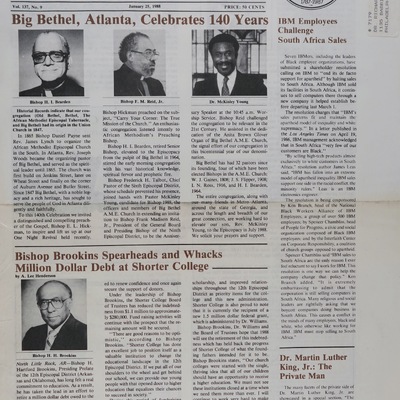
Big Bethel, Atlanta, Celebrates 140 Years 18M Employees
Bishop H. I. Bearden
Bishop F. M. Reid, Jr.
Dr. McKinley Young
Historial Records indicate that our con-
gregation (Old Bethel, Bethel, The
African Methodist Episcopal Tabernacle,
and Big Bethel) had its origin in the Union
Church in 1847.
In 1865 Bishop Daniel Payne sent
Rev. James Lynch to organize the
African Methodist Episcopal Church
in the South. In Atlanta, Rev. Joseph
Woods became the organizing pastor
of Big Bethel, and served as the spirit-
ual leader until 1865. The church was
first build on Jenkins Street, later on
Wheat Street and finally on the corner
of Auburn Avenue and Butler Street.
Since 1847 Big Bethel, with a noble leg-
acy and a rich heritage, has sought to
serve the people of Godin Atlanta dili-
gently and faithfully.
To this 140th Celebration we invited
a distinguished and compelling preach-
er of the Gospel, Bishop E. L. Hick-
man, to inspire and lift us up at our
One Night Revival held recently.
Bishop Hickman preached on the sub-
ject, ‘Carry Your Corner: The True
Mission of the Church.’’ An enthusias-
tic congregation listened intently to
African Methodism’s Preaching
Bishop.
Bishop H. I. Bearden, retired Senior
Bishop, elevated to the Episcopacy
from the pulpit of Big Bethel in 1964,
stirred the early morning congregation
with his vast historical knowledge,
spiritual fervor and prophetic fire.
Bishop Frederick H. Talbot, Chief
Pastor of the Sixth Episcopal District,
whose schedule prevented his presence,
joined hands with Pastor McKinley
sary Speaker at the 10:45 a.m. Wor-
ship Service. Bishop Reid challenged
the congregation to be relevant in the
21st Century. He assisted in the dedi-
cation of the Anita Brown Glover
Organ of Big Bethel A.M.E. Church,
the signal effort of our congregation in
this bicentennial year of our denomi-
nation.
Big Bethel has had 32 pastors since
its founding, four of which have been
elected Bishops in the A.M.E. Church:
W. J. Gaines, 1808; J. S. Flipper, 1908;
I. N. Ross, 1916, and H. I. Bearden,
1964.
The entire congregation, along with
Young, candidate for-Bishop-1988,-the-----our~many. friends. in- Metro. Atlanta,
officers and members of Big Bethel
A.M.E. Church in extending an invita-
tion to Bishop Frank Madison Reid,
Jr., President of the General Board
and Presiding Bishop of the Ninth
Episcopal District, to be the Anniver-
around the state of Georgia, and
across the length and breadth of our
great connection, are working hard to
elevate our son, Rev. McKinley
Young, to the Episcopacy in July 1988.
We solicit your prayers and support.
Bishop Brookins Spearheads and Whacks
Million Dollar Debt at Shorter College
by A. Lee Henderson
Bishop H. H. Brookins
North Little Rock, AR—Bishop H.
Hartford Brookins, Presiding Prelate
of the 12th Episcopal District (Arkan-
sas and Oklahoma), has long felt a real
commitment to education. As a result,
he has taken the lead in an effort to
retire a million dollar debt owed to the
Federal Government by Shorter
College.
This obligation was incurred when
an audit revealed 1.1 million dollars
was due the Federal Government.
Since that indebtedness Shorter Col-
lege has experienced circumstances
where business and civic leaders have
expressed concern about the future of
the school. With this debt present,
Bishop Brookins knew that the viabil-
ity of the school must be demonstrat-
ed to renew confidence and once again
secure the support of donors.
Under the leadership of Bishop
Brookins, the Shorter College Board
of Trustees has reduced the indebted-
ness from $1.1 million to approximate-
ly $280,000. Fund raising activities will
continue with the prospect that the re-
maining amount will be secured.
“There are good reasons to be opti-
mistic,’’ according to Bishop
Brookins. ‘‘Shorter College has done
an excellent job to position itself as a
valuable institution to change the
educational landscape in the 12th
Episcopal District. If we put all of our
shoulders to the wheel and get behind
our school, we can provide our young
people with that opened door to higher
education that equalizes their chances
to succeed in society.”’
During this period of fundraising
and new life for the college, Shorter
has also installed a new interim presi-
dent, Dr. H. Benjamin Williams. Im-
mediately after assuming this post in
July 1987, Dr. Williams began to work
closely with Bishop Brookins, and with
civic and religious leaders. In addition
to his activities with the debt retire-
ment, Dr. Williams has targeted in-
creased enrollment, additional alumni
support, striving for excellence in
scholarship, and improved relation-
ships throughout the 12th Episcopal
District as priority items for the col-
lege and this new administration.
Shorter College is also proud to note
that it is currently the recipient of a
new 1.5 million dollar federal grant,
which is administered by Dr. Williams.
Bishop Brookins, Dr. Williams and
the Board of Trustees hope that 1988
will see the retirement of this indebted-
ness which has held back the progress
of Shorter College of what the found-
ing fathers intended for it to be.
Bishop Brookins states, ‘‘Our church
colleges were started with the single,
thriving idea that all of our children
should have an opportunity to receive
a higher education. We must not see
these institutions closed at a time when
we need them more than ever. I will
continue to work very hard to make
the opportunity available to all per-
sons seeking a higher education.”’
Bishop Brookins went on to say, “‘Our
slave forefathers founded these institu-
tions of higher learning with their
meager talents. We, today, have great-
er financial resources, therefore, we
cannot close these institutions. How-
ever, we do need to do whatever is
necessary as churchmen and educators
to upgrade them.”’
Challenge
South Africa Sales
Seven IBMers, including the leaders
of Black employee organizations, have
submitted a shareholder resolution
calling on IBM to ‘‘end its de facto
support for apartheid’ by halting sales
to South Africa. Although IBM sold
its facilities in South Africa, it contin-
ues to sell computers there through a
new company it helped establish be-
fore departing last March 1.
The resolution charges that ‘‘IBM’s
sales patterns fit and maintain the’
apartheid model of inequality and white
supremacy.’’ In a letter published in
the Los Angeles Times on April 19,
1986, IBM management acknowledged
that in South Africa ‘‘very few of our
customers are Black.”’
“By selling high-tech products almost
exclusively to white customers in South
Africa,” resolution author James Leas
said, “IBM has fallen into an extreme
model of apartheid inequality. IBM sales
support one side in the racial conflict, the
minority rulers.” Leas is an IBM
electronics engineer.
The resolution is being cosponsored. _
by Ken Branch, head of the National
Black Workers Alliance of IBM
Employees, a group of over 500 IBM
employees; by Spencer Chambliss, head
of People for Progress, a civic and social
organization composed of Black IBM
employees; and by the Interfaith Center
on Corporate Responsibility, a coalition
of church groups opposed to apartheid.
Spencer Chambliss said “IBM sales to
South Africa are the only reason | ever
feel reluctant to say | work for IBM. This
resolution is one way we can help the
company change that policy.” Ken
Branch added, “It is extremely
embarrassing to admit that the
corporation is still selling computers in
South Africa. Many religious and social
leaders are rightfully asking that we
boycott companies doing business in
South Africa. This causes a conflict in
the minds of many employees, black and
white, who otherwise like working for
IBM. IBM must stop selling to South
Africa.”
Dr. Martin Luther
King, Jr.: The
Private Man
The many facets of the private side of
Dr. Martin Luther King, Jr. are
showcased in a special section, “The
Intimate King,” in the January Ebony.
Ebony shows rare photographs
ranging from Dr. King sharing a private
humorous moment with his wife Coretta
Scott King, to his blowing out the
candles on his 36th birthday cake.
The January Ebony also features:
“The Continuing Struggle For A
National King Holiday,” “Remembering
The Young King,” and “Advice For
Getting What You Want In 1988.”
T7179
=]
rs
19119
*
[CHARD F. NORR
ST
BARRINGER
~ADEL PH TA
DR.
===== DSC05403.JPG =====
2 The AME Christian Recorder
January 25, 1988
The Hands of Doomsday Clock Have Been Set Back
Much transpired at the Super Power
Summit Conference between two lead-
ers of the two most powerful nations
of the world on December 7, 1987.
Russia’s Chief Executive Officer,
Mikhail Gorbachev, said, ‘‘A poor
peace is better than a good quarrel.’’
Mr. Gorbachev and President Ron-
ald Reagan met to make ‘‘WISDOM
ARRANGEMENTS”’ by the reduc-
tion of war missiles and the banning of
nuclear weapons. That was history in
the making, where common sense and
reason have won a peace treaty of a
sort.
A young school child was asked,
“‘What do you think about Mr. Reagan and Mr. Gorbachev’s meeting to talk
about peace?’’ The youngster said, ‘‘I think it’s not what they did, but what
they are going to do that’s important. Will they really keep the peace?’’ The
summit talks were very strong, especially when they talked about no more
nuclear weapons for an eternity.
Austin Kiplinger, a Washington news editor, assessing the summit, said,
“Don’t read too much into the current summit talks. Important, but mainly
as a stepping-stone to more significant future discussions. Remember, the
deal covers only 3% of the two nation’s nuclear arsenals. Agreements on
more comprehensive reductions will be MUCH harder to reach. Meanwhile,
the treaty is a political grand slam for Reagan and Gorbachev.
“As for what comes next. . .U.S. and Russia have different goals, and any
hope of even broader agreements must take that fact into account. The Rus-
sians want first to reduce the nuclear threat to their homeland. . .second to
get the U.S. out of Europe. U.S. aims to maintain a deterrant to Soviet
aggression and wangle reductions in Russian troops and tanks. Balancing the
difference will take years . . .beyond Reagan’s term. He’s unlikely to sign a
wide-ranging treaty at the Moscow summit in ’88. That’s a goal for the next
President. . .and Gorbachev or his successor.”’
Well, the fact that they are talking about and agreeing to the dismantling
and destruction of medium and short-range missiles constitutes a vital and
necessary beginning. That does, indeed, set the hands of doomsday’s clock
back. These treaties do deal with those possibilities that can destroy the
human race. The world is concerned about the potential for its destruction by
man-conceived and man-made devices. The one great threat, of course, is the
nuclear power that is so lethal and devastating that survivors would choose
death over life. Someone phrased it, ‘THE LIVING WOULD ENVY THE
DEAD.”’
This is what all seem to agree on as the only results of a nuclear war; life
would have no further meaning to any who might survive. When one looks at
nuclear power and the performance abilities of this ‘‘miracle power,”’ and
reflects on the attitudes of those who hold the control—or who may come to
possess that capacity—rational beings, both secular and religious, will be glad
that the hands of the doomsday clock have been pushed back just a little bit.
You see, it doesn’t really make factual difference whether our neighbors or
our enemies like us or we like them. The issue is SURVIVAL—and I don’t
mean survival of the fittest. In this nuclear age, SURVIVAL is the order of the
age, today and all of our tomorrows.
This editor agrees that we need genuine action in this day of nuclear power
which can very easily become the world’s doomsday or Judgment Day as a
result of a tragic nuclear disaster that will become THE holocaust. I concur
ROBERT H. REID, JR.
OCRAMAAQoAdo QA WWW QU ww» qu vu wu wu xu quou won www wwwowWweawM iw WWW
The A.M.E. Christian Recorder
The Christian Recorder of the African Methodist Episcopal Church (USPS 016880) is published bi-
weekly by the A.M.E.C. Sunday Schoo! Union, 500 Eighth Avenue South, Nashville, Tennessee
37203-4181. Second Class postage paid at Nashville, Tennessee
The AM.E. Christian Recorder was established in 1852
Executive and Editorial Office: 500 Eighth Avenue South, Nashville, Tennessee 37203-4181. Adver-
tising rates available on request Subscription rate $15.00 per year by mail. Make all money orders and
cashier's checks payable to A, Lee Henderson.
Dr. A. Lee Henderson, Publisher
EDITORIAL STAFF
Dr. R. H. Reid, Jr., Editor
Mr. Churchel Swarn, Subscriptions Promotions
Or. J. W. Yancy, I, The Roving Editor; Dr. Cyrus Keller, Religious Literature Editor, Mr. H. L. Felix,
Special Editor, Dr. Jimmie James, Jr, Music Editor, Rev. Miss Nurjahn Govan, Women Ministries
Editor; Atty, Leroy Nesbitt, Social Action Editor; Rev. W, F. Ball, Jr, Public Relations Editor, Mrs.
Theima A. Wills, Contributing Editor, Dr. Jamye Coleman Williams, General Features Editor, Mrs.
Wilhelmina Lawrence, Senior Missions Editor, Mrs Ruth Hill Jones, Consulting Editor, Rev, Alonzo
Middleton, Regional Editor, Rev. E. L Blankenship, Regional Editor, Rev, W, J. Jackson, Regional
Editor; Atty, Mary R. Turner, Basic Law Editor; Dr. J. W. P, Collier, Overseas Correspondent; Or W.0
Johnson, Roving Photographer/Reporter, Dr, Kenneth S. Robinson, Medical Ministries Editor; Capt
Carroll R. Chambliss, Special Columnist, Mra. Sheridan Reid Banks, Special Features Reporter, Rev. 0
Urcille Ifill, Sr., Contributing Editor; Dr. Henderson Davis, Archives Editor; Or, Willlam P. DeVeaux
Career Development Editor; Dr. Dennis C. Dickerson, Contributing Editor; Rev Ceci! Murray, Contribut-
ing Editor.
The A.M.E. Christian Recorder welcomes letters trom its readers on matters of general interest, All
letters must be signed and contain the address of the writer. The A.M.E, Christian Recorder will occa
sionally withhold the name of a writer of a signed letter, if there is a valid reason given, No defamatory,
libelous or slanderous letters will be printed; and the A.M.E. Christian Recorder reserves (he right to re
ject or edit any letter or article to conform with good taste, atyle and space requirements
NANANNAANANANANAANA NAAN ANA NAA aa
DAWA NNN NNN AN NANA NNT
that one of the most urgent options of the 21st century for us all is to choose
life that mankind may live with the benefits of nuclear power.
Our priorities must be established so that the world can be a liaven.
Defense for life, and not death and destruction, should claim our best efforts.
Feeding the hungry, housing the poor, educating the illiterate, providing
medicine and health care for the sick, and making jobs for the unemployed
Ought to be an important agenda for every nation and, particularly, for the
wealthier governments.
Nations and individuals owe something to our children and theirs. Recogni-
tion of the Sovereign and Superior Intelligence of the Universe would help
mankind, even in a crisis, to develop a basic and verifiable trust and apprecia-
tion for one’s fellowman, for one’s neighbor. Let us hope that there are
enough COMMON SENSE people in this world to keep any leader of the
world from destroying this universe by accident or on purpose. If this is not
the answer, then let us truly hope that God will not let the world that He
created be destroyed by nuclear power or any other power that would wreak
needless suffering on humankind.
Whether you believe that God created this world and gave it purpose, or
that, through evolution and by accident the world came to be, we are all here
and none should play the part of a fool or an idiot and help destroy the good
earth and its inhabitants by DOOMSDAY POWER—or any other POWER!
So, let’s not just set the hands back on doomsday’s clock. It’s best we stop
the clock at five minutes ’til midnight, or five minutes before doomsday, and
live happily ever after.
ee Lt ttt |
SUBS CRPBaaS
to the Christian Recorder
The bi-monthly newspaper to keep you
informed about your church for
ONLY $15.00 per year
Send check or money order payable to.
A. Lee Henderson
The Christian Recorder, Dept. SB
500 Kighth Avenue, South, Nashville, TN 37203-4181
City/State/Zip _ aii aa
'
: '
{ 1
i 1
H Please print. Payment must accompany order. Allow 4 weeks for first delivery. 4
: '
' Name 1
H 1
t nee eee ~ :
; 1
; 1
; 1‘
: o
f a
by
OAM eee miaeyele yey
“The
RICHARD ALLEN
STORY”
in VIDEO
The Richard Allen Story Color Videotape
on VHS or Beta Videotape
Narrated by Dr. Edward W, Robinson, Jr
Noted Historian, Author and Lecturer
Vv CONCEPT IN UNDERSTANDING AND
CIATING AFRICAN-AMERICAN HISTORY
NTICATED AS TO HISTORICAL ACCURACY
Y THE HISTORICAL COMMISSION OF
MOTHER BETHI CHURCH
ethodist Episcopal Church
For more information and free brochure send your name
address, zip, phone number to
This Week in African-American History”
Box 19024 ¢ Philadelphia, PA 19138
Also available on video:
Mother Africa Story, Part I
Mother Africa Story, Part Il
How African-American Soldiers Won the Civil War, Part I
How African-American Soldiers Won the Civil War, Part Il
For phone orders ONLY call (215) 548-5897 (incoming calls only)
W.E.B. Dubois (The Souls of Black Folk) ‘The A.M.E. Church is the greatest Negro organization in
the world { its bishops among the most powerful Negro rulers in the world
===== DSC05404.JPG =====
January 25, 1988
The AME Christian Recorder
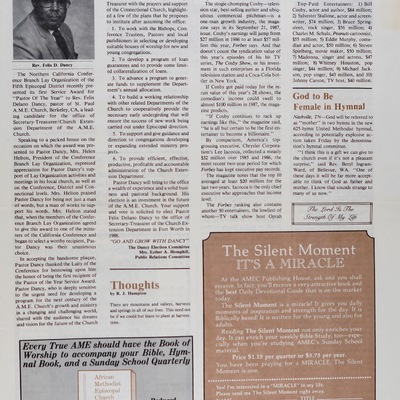
Reverend Felix
Receives Northern Calif
~ J
Conference Lay Organization
Pastor Of The Year Award
Rev. Felix D. Dancy
The Northern California Confer-
ence Branch Lay Organization of the
Fifth Episcopal District recently pre-
sented its first Service Award for
‘‘Pastor Of The Year’’ to Rev. Felix
Delano Dancy, pastor of St. Paul
A.M.E. Church, Berkeley, CA, a lead-
ing candidate for the office of
Secretary-Treasurer/Church Exten-
sion Department of the A.M.E.
Church.
Speaking to a packed house on the
occasion on which the award was pre-
sented to Pastor Dancy, Mrs. Helen
Helton, President of the Conference
Branch Lay Organization, expressed
appreciation for Pastor Dancy’s sup-
port of Lay Organization activities and
meetings in his local church, as well as
on the Conference, District and Con-
nectional levels. Mrs. Helton praised
Pastor Dancy for being not just a man
of words, but a man of works to sup-
port his words. Mrs. Helton stated
that, when the members of the Confer-
ence Branch Lay Organization agreed
to give this award to one of the minis-
ters of the California Conference and
began to select a worthy recipient, Pas-
tor Dancy was their unanimous
choice.
In accepting the handsome plaque,
Pastor Dancy thanked the Laity of the
Conference for bestowing upon him
the honor of being the first recipient of
the Pastor of the Year Service Award.
Pastor Dancy, who is deeply sensitive
to the urgent need for developing a
program for the next century of the
A.M.E. Church’s growth and ministry
in a changing and challenging world,
shared with the audience his dreams
and vision for the future of the Church
Extension Department.
Pastor Dancy, who is optimistic that
he will be elected the new Secretary-
Treasurer with the prayers and support
of the Connectional Church, highlight-
ed a few of the plans that he proposes
to institute after assuming the office:
1. To work with the Bishops, Con-
ference Trustees, Pastors and local
parishioners in selecting or developing
suitable houses of worship for new and
young congregations.
2. To develop a program of loan
guarantees and to provide some limit-
ed collateralization of loans.
3. To advance a program to gener-
ate funds to supplement the Depart-
ment’s annual allocation.
4. To build a working relationship
with other related Departments of the
Church to cooperatively provide the
necessary early undergirding that will
ensure the success of new work being
carried out under Episcopal direction.
5. To support and give guidance and
direction to congregations developing
or expanding extended ministry pro-
jects.
6. To provide efficient, effective,
productive, profitable and accountable
administration of the Church Exten-
sion Department.
Pastor Dancy will bring to the office
a wealth of experience and a solid busi-
ness and pastoral background. His
election is an investment in the future
of the A.M.E. Church. Your support
and vote is solicited to elect Pastor
Felix Delano Dancy to the office of
Secretary-Treasurer of the Church Ex-
tension Department in Fort Worth in
1988.
“GO AND GROW WITH DANCY”
The Dancy Election Committee
Mrs. Esther A. Hemphill,
Public Relations Committee
=
by R. J. Hampton
There are mountains and valleys, harvests
and springs in all of our lives. This need not
be if we could but learn to plant at harvest-
time.
Every True AME should have the Book of
Worship to accompany your Bible, Hym-
nal Book, and a Sunday School Quarterly
Reduced
j
The Book of Worship is a new book with a new name, offered in the hope that it will serve a
new age in our chu!
rch. The change within is symbolic of the attempt to help Christians and
those who may become Christians to hear God's word, and worship Him, in the language of
their needs and aspirations today.
BOW-815
Please include
13% postage and handling «- -$5.00
Stallone, Madonna Make Rich List
wy
by James M. Kennedy
New York, NY—The richest captain of
the entertainment industry still smokes
a big cigar.
Comedian Bill Cosby is the world’s
highest paid entertainer, with estimat-
ed earnings of at least $84 million in
1986 and 1987, according to Forbes
magazine.
The stogie-chomping Cosby—ttelevi-
sion star, best-selling author and ubiq-
uitous commercial pitchman—is a
one-man growth industry, the maga-
zine says in its September 21, 1987,
issue, Cosby’s earnings will jump from
$27 million in 1986 to at least $57 mil-
lion this year, Forbes says. And that
doesn’t count the syndication value of
this year’s episodes of his hit TV
series, The Cosby Show, or his invest-
ment in such enterprises as a Florida
television station and a Coca-Cola bot-
tler in New York.
If Cosby got paid today for the re-
run value of this year’s 28 shows, the
comedian’s income could swell to
almost $100 million in 1987, the maga-
zine predicts.
“If Cosby continues to rack up
earnings like this,’’ the magazine said,
‘the is all but certain to be the first en-
tertainer to become a billionaire.’’
By comparison, America’s top-
grossing executive, Chrysler Corpora-
tion’s Lee Iacocca, collected a measly
$32 million over 1985 and 1986, the
most recent two-year period for which
Forbes has kept executive pay records.
The magazine notes that the top 10
averaged at least $20 million for the
last two years. Iacocca is the only chief
executive who approaches that income
level.
The Forbes ranking also contains
another 30 entertainers, the lowliest of
whom—TV talk show host Oprah
Winfrey—earned $10 million over
1986-1987. Eighteen of the 40 made
their fortunes in the music business,
and five of the 40 are women. In addi-
tion to Madonna, Whitney Houston
and Winfrey, the other women on the
last are Jane Fonda and Barbara Strei-
sand.
Top-Paid Entertainers: 1) Bill
Cosby, actor and author, $84 million;
2) Sylvester Stallone, actor and screen-
writer, $74 million; 3) Bruce Spring-
steen, rock singer, $56 million; 4)
Charles M. Schulz, Peanuts cartoonist,
$55 million; 5) Eddie Murphy, come-
dian and actor, $50 million; 6) Steven
Spielberg, movie maker, $50 million;
7) Madonna, singer and actress, $47
million; 8) Whitney Houston, pop
singer, $44 million; 9) Michael Jack-
son, pop singer, $43 million, and 10)
Johnny Carson, TV host, $40 million.
God to Be
Female in Hymnal
Nashville, TN—God will be referred to
as ‘‘mother’’ in two hymns in the new
625-hymn United Methodist hymnal,
according to potentially explosive ac-
tion taken Friday by the denomina-
tion’s hymnal committee.
“*T think this is a gift we can give to
the church even if it’s not a pleasant
surprise,’’ said Rev. Beryl Ingram-
Ward, of Bellevue, WA. ‘‘One of
these days it will be far more accept-
able to think of God as father and
mother. I know that sounds strange to
many of us now.’’
She Lord Is Lhe
Sireagth f My Gf
===== DSC05405.JPG =====
The AME Christian Recorder
January 25, 1988
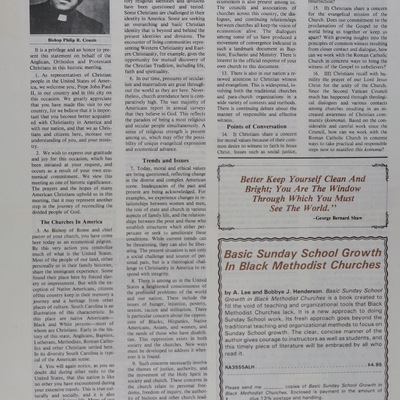
Statement to Pope John Paul II, by Bishop Philip R. Cousin, Spokesperson for
Representatives of Christian People In the U.S.A., Columbia, South Carolina
Bishop Philip R. Cousin
It is a privilege and an honor to pre-
sent this statement on behalf of the
Anglican, Orthodox and Protestant
Christians in this historic meeting.
1. As representatives of Christian
people in the United States of Amer-
ica, we welcome you, Pope John Paul
II, in our country and in this city on
this occasion. We greatly appreciate
that you have made this visit to our
country, for we believe that it is impor-
tant that you become better acquaint-
ed with Christianity in America and
with our nation, and that we as Chris-
tians and citizens here, increase our
understanding of you, and your minis-
try.
2. We wish to express our gratitude
and joy for this occasion, which has
been initiated at your request, and
occurs as a result of your own ecu-
menical commitment. We view this
meeting as one of historic significance.
The prayers and the hopes of many
American Christians uphold us in this
meeting, that it may represent another
step in the journey of reconciling the
divided people of God.
The Churches In America
3. As Bishop of Rome and chief
pastor of your church, you have come
here today as an ecumenical pilgrim.
By this very action you symbolize
much of what is the United States.
Most of the people of our land, either
personally or in their family histories,
share the immigrant experience. Some
found their place here by forced slav-
ery or impressment. But with the ex-
ception of Native Americans, citizens
ofthis country keep in their memory a
journey and a heritage from other
places of culture. South Carolina is an
illustration of this characteristic. In
this place are native Americans—
Black and White persons—most of
whom are Christians. Early in the his-
tory of this state, Anglicans, Baptists,
Lutherans, Methodists, Roman Catho-
lics and other Christians settled here.
In its diversity South Carolina is typi-
cal of the American scene.
4. You will again notice, as you no
doubt did during other visits to the
United States, that this nation is like
no other you have encountered during
your extensive travels, This is true cul-
turally and socially, and it is also
true of our religious life. Many of our
earliest immigrants from Europe—
Jew and Christian alike—came here
seeking religious freedom, From the
beginning of our constitutional life we
have had a commitment to freedom of
religious expression, though some-
times unrealized. We have neither an-
cient sees nor state churches, a gather-
ing of Christian traditions, American
Christians have been shaped by this
pluralism, which includes freedom of
religious expression, and have helped
in turn to influence the nature of this
pluralism, The variety of church life
almost exceeds imagination. It in-
cludes the Roman Catholic church, the
Black churches, the Orthodox church-
es, movements and organizations with
American origins, and a variety of
forms of witness.
5. In the course of American his-
tory religious identities and divisions
have been questioned and tested.
Some Christians are challenged in their
identity in America. Some are seeking
an overarching and basic Christian
identity that is beyond and behind the
present identities and divisions. The
encounter of living communities repre-
senting Western Christianity and East-
ern Christianity, for example, gives the
opportunity for mutual discovery of
the Christian Tradition, including life,
faith and spirituality.
6. In our time, pressures of secular-
ism and materialism are great through-
out the world as they are here. Never-
theless, church attendance here is com-
paratively high. The vast majority of
Americans report in annual surveys
that they believe in God. This reflects
the paradox of being a most religious
and secular people simultaneously. A
sense of religious strength is present
among us, which may offer the possi-
bility of unique evangelical expression
and ecumenical advance.
Trends and Issues
7. Today, moral and ethical values
are being questioned, reflecting change
in the diverse and complex American
scene. Inadequacies of the past and
present are being acknowledged. For
examples, we experience changes in re-
lationships between women and men,
the role of state and church in various
aspects of family life, and the relation-
ships between the poor and those who
establish structures which either per-
petuate or seek to ameliorate these
conditions. While current trends can
be threatening, they can also be liber-
ating. The present situation is not only
a social challenge and source of per-
sonal pain, but is a theological chal-
lenge to Christianity in America to re-
spond with integrity.
8. There is among us in the United
States a heightened consciousness of
the profound problems of the world
and our nation, These include the
issues of hunger, injustice, poverty,
sexism, racism and militarism, There
is particular concern about the oppres-
sion of Blacks, Hispanics, Native
Americans, Asians, and women, and
the needs of those who have disabili-
ties. This oppression exists in both
society and the churches, New ways
must be developed to address it wher-
ever it is found.
9. Such concerns necessarily involve
the themes of justice, authority, and
the movement of the Holy Spirit in
society and church, These concerns in
the church relate to personal free-
doms, freedom of inquiry, the author-
ity of bishops and other church lead-
ers, and even the authority of Scripture
and traditions, The spirit is the source
of a liberty which permits us faithfully
to renew traditions and to be open to
new occasions which call for new
duties.
10. There is also among us in the
United States a continuing deep inter-
est in the Bible and its application to
life and society. This has taken various
directions among Christians, with a re-
sulting spectrum of understandings
and applications. In all of this we sense
a spiritual yearning which cannot be
satisfied by secularism or materialism.
11. There is as well among us an in-
creasing interest in spirituality. In the
midst of our materialism, Bible study,
retreats, meditation, and prayer are in
the ascendancy.
12. A continuing interest in
ecumenism is also present among us.
The councils and associations of
churches across this country, the dia-
logues, and continuing relationships
between churches all keep the vision of
ecumenism alive. The dialogues
among some of us have produced a
movement of convergence indicated in
such a landmark document as Bap-
tism, Eucharist and Ministry. There is
interest in the official response of your
own church to this document.
13. There is also in our nation a re-
newed attention to Christian witness
and evangelism. This is widespread, in-
volving both the traditional churches
and para-church organizations in a
wide variety of contexts and methods.
There is continuing debate about the
manner of responsible and effective
witness.
Points of Conversation
14. I) Christians share a concern
for moral values because of their com-
mon desire to witness to faith in Jesus
Christ. Issues such as social justice,
family life, the impaci of technologies,
stewardship of creation, and global
peace remain urgent for us. In what
concrete way is collaboration possible
with the Roman Catholic Church to
promote justice, to exercise compas-
sion, and to search for the peace of the
resurrection?
15. II) Christians share a concern
for the evangelical mission of the
Church. Does our commitment to the
proclamation of the Gospel to the
world bring us together or keep us
apart? With growing insights into the
principles of common witness resulting
from closer contact and dialogue, how
can we work with the Roman Catholic
Church in concrete ways to bring the
witness of the Gospel to unbelievers?
16. III) Christians recall with hu-
mility the prayer of our Lord Jesus
Christ for the unity of the Church.
Since the Second Vatican Council
much has happened through theologi-
cal dialogues and various contacts
among churches resulting in an in-
creased awareness of Christian com-
munity (koinonia). Based on the con-
siderable and careful work since the
Council, how can we work with the
Roman Catholic Church in concrete
ways to take practical and responsible
steps now to manifest this Koinonia?
Oe
Better Keep Yourself Clean And
Bright; You Are The Window
Through Which You Must
See The World.’’
—George Bernard Shaw
Basic Sunday School Growth
In Black Methodist Churches
by A. Lee and Bobbye J. Henderson. Basic Sunday School
Growth in Black Methodist Churches is a book created to
fill the void of teaching and organizational tools that Black
Methodist Churches lack. It is a new approach to doing
Sunday Schoo! work. Its fresh approach goes beyond the
traditional teaching and organizational methods to focus on
Sunday School growth. The clear, concise manner of the
author gives courage to instructors as well as students, and
this timely piece of literature will be embraced by all who
read it.
RA3555ALH
Please send me ________ copies of Basic Sunday School Growth in
Black Methodist Churches. Enclosed is payment in the amount of
$ ____ plus 13% postage and handling.
Name _
Church.
Address
City
State
Phone ee :
AMEC Publishing House
500 Eighth Avenue South
Nashville, Tennessee 37203-4181
===== DSC05406.JPG =====
January 25, 1988
The AME Christian Recorder
Bethel A.M.E. Church, Co
Politics
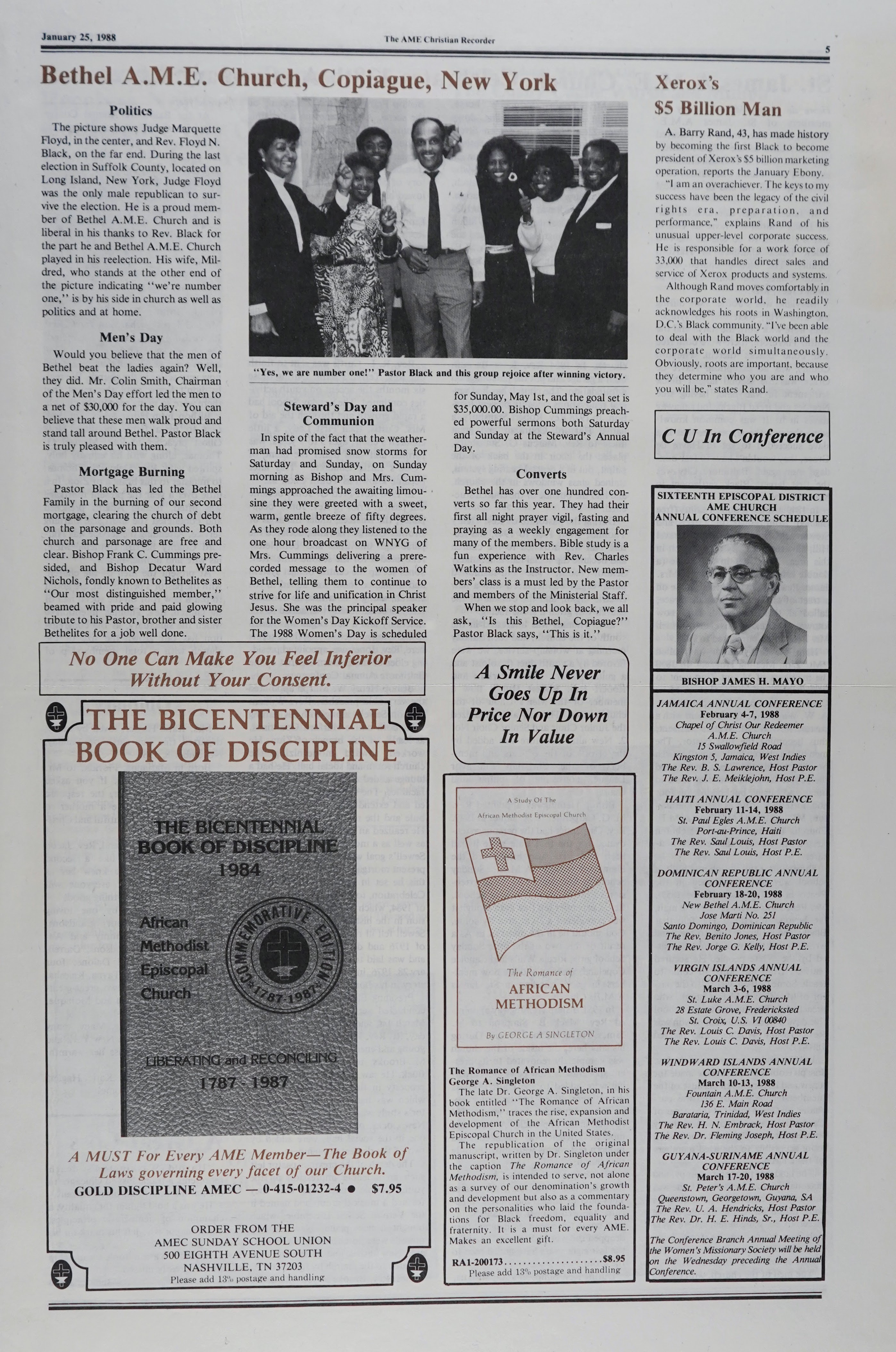
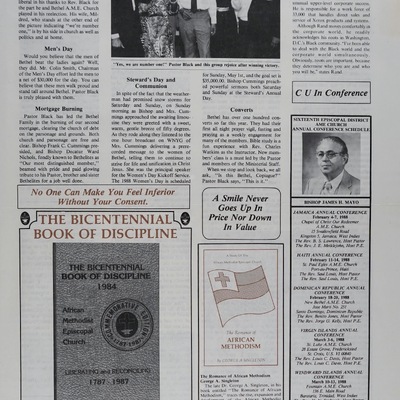
The picture shows Judge Marquette
Floyd, in the center, and Rev. Floyd N.
Black, on the far end. During the last
election in Suffolk County, located on
Long Island, New York, Judge Floyd
was the only male republican to sur-
vive the election. He is a proud mem-
ber of Bethel A.M.E. Church and is
liberal in his thanks to Rev. Black for
the part he and Bethel A.M.E. Church
played in his reelection. His wife, Mil-
dred, who stands at the other end of
the picture indicating ‘‘we’re number
one,”’ is by his side in church as well as
politics and at home.
Men’s Day
Would you believe that the men of
Bethel beat the ladies again? Well,
they did. Mr. Colin Smith, Chairman
of the Men’s Day effort led the men to
a net of $30,000 for the day. You can
believe that these men walk proud and
stand tall around Bethel. Pastor Black
is truly pleased with them.
Mortgage Burning
Pastor Black has led the Bethel
Family in the burning of our second
mortgage, clearing the church of debt
on the parsonage and grounds. Both
church and parsonage are free and
clear. Bishop Frank C. Cummings pre-
sided, and Bishop Decatur Ward
Nichols, fondly known to Bethelites as
“Our most distinguished member,’’
beamed with pride and paid glowing
tribute to his Pastor, brother and sister
Bethelites for a job well done.
te
piague, New
York
““Yes, we are number one!’’ Pastor Black and this group rejoice after winning victory.
Steward’s Day and
Communion
In spite of the fact that the weather-
man had promised snow storms for
Saturday and Sunday, on Sunday
morning as Bishop and Mrs. Cum-
mings approached the awaiting limou- :
sine they were greeted with a sweet,
warm, gentle breeze of fifty degrees.
As they rode along they listened to the
one hour broadcast on WNYG of
Mrs. Cummings delivering a _prere-
corded message to the women of
Bethel, telling them to continue to
strive for life and unification in Christ
Jesus. She was the principal speaker
for the Women’s Day Kickoff Service.
The 1988 Women’s Day is scheduled
No One Can Make You Feel Inferior
Without Your Consent.
@ THE BICENTENNIAL
BOOK OF DISCIPLINE
A MUST For Every AME Member—The Book of
Laws governing every facet of our Church.
GOLD DISCIPLINE AMEC — 0-415-01232-4 @ $7.95
ORDER FROM THE
AMEC SUNDAY SCHOOL UNION
500 EIGHTH AVENUE SOUTH
NASHVILLE, TN 37203
Please add 13 postage and handling
for Sunday, May Ist, and the goal set is
$35,000.00. Bishop Cummings preach-
ed powerful sermons both Saturday
and Sunday at the Steward’s Annual
Day.
Converts
Bethel has over one hundred con-
verts so far this year. They had their
first all night prayer vigil, fasting and
praying as a weekly engagement for
many of the members. Bible study is a
fun experience with Rev. Charles
Watkins as the Instructor. New mem-
bers’ class is a must led by the Pastor
and members of the Ministerial Staff.
When we stop and look back, we all
ask, ‘‘Is this Bethel, Copiague?’’
Pastor Black says, ‘‘This is it.’’
A Smile Never
Goes Up In
Price Nor Down
In Value
A Study Of The
African Methodist Episcopal Church
The Romance of
AFRICAN
METHODISM
By GEORGE A SINGLETON
The Romance of African Methodism
George A. Singleton ;
The late Dr. George A. Singleton, in his
book entitled ‘‘The Romance of African
Methodism,” traces the rise, expansion and
development of the African Methodist
Episcopal Church in the United States.
The republication of the original
manuscript, written by Dr. Singleton under
the caption The Romance of African
Methodism, is intended to serve, not alone
as a survey of our denomination'’s growth
and development but also as a commentary
on the personalities who laid the founda-
tions for Black freedom, equality and
fraternity. It is a must for every AME.
Makes an excellent gift.
RA1-200173
Please add 13% postage and handling
Xerox’s
$5 Billion Man
A. Barry Rand, 43, has made history
by becoming the first Black to become
president of Xerox’s $5 billion marketing
Operation, reports the January Ebony.
“Iam an overachiever, The keys to my
success have been the legacy of the civil
rights era, preparation, and
performance,” explains Rand of his
unusual upper-level corporate success,
He is responsible for a work force of
33,000 that handles direct sales and
service of Xerox products and systems.
Although Rand moyes comfortably in
the corporate world, he readily
acknowledges his roots in Washington,
D.C.’s Black community. “I've been able
to deal with the Black world and the
corporate world simultaneously.
Obviously, roots are important, because
they determine who you are and who
you will be,” states Rand.
C U In Conference
SIXTEENTH EPISCOPAL DISTRICT
AME CHURCH
ANNUAL CONFERENCE SCHEDULE
JAMAICA ANNUAL CONFERENCE
February 4-7, 1988
Chapel of Christ Our Redeemer
A.M.E. Church
15 Swallowfield Road
Kingston 5, Jamaica, West Indies
The Rev. B. S. Lawrence, Host Pastor
The Rev. J. E. Meiklejohn, Host P.E.
HAITI ANNUAL CONFERENCE
February 11-14, 1988
St. Paul Egles A.M.E. Church
Port-au-Prince, Haiti
The Rev. Saul Louis, Host Pastor
The Rev. Saul Louis, Host P.E.
DOMINICAN REPUBLIC ANNUAL
CONFERENCE
February 18-20, 1988
New Bethel A.M.E. Church
Jose Marti No. 251
Santo Domingo, Dominican Republic
The Rev. Benito Jones, Host Pastor
The Rev. Jorge G. Kelly, Host P.E.
VIRGIN ISLANDS ANNUAL
CONFERENCE
March 3-6, 1988
St. Luke A.M.E. Church
28 Estate Grove, Fredericksted
St. Croix, U.S. VI 00840
The Rev. Louis C. Davis, Host Pastor
The Rey. Louis C. Davis, Host P.E.
WINDWARD ISLANDS ANNUAL
CONFERENCE
March 10-13, 1988
Fountain A.M.E. Church
136 E. Main Road
Barataria, Trinidad, West Indies
The Rey. H. N. Embrack, Host Pastor
The Rev. Dr. Fleming Joseph, Host P.E.
GUYANA-SURINAME ANNUAL
CONFERENCE
March 17-20, 1988
St. Peter’s A.M.E. Church
Queenstown, Georgetown, Guyana, SA
The Rev. U. A. Hendricks, Host Pastor
The Rev. Dr. H. E. Hinds, Sr., Host P.E.
The Conference Branch Annual Meeting of
the Women’s Missionary Society will be held
on the Wednesday preceding the Annuall
Conference.
===== DSC05407.JPG =====
The AME Christian Recorder
January 25, 1988
St. James A.M.E. Church Celebrates 138th Anniversary
Havre de Grace; MD—Recently the
members of St. James A.M.EB.
Church, Havre de Grace, MD, started
an observance of the 138th Anniver-
sary of its church. This celebration is
expected to continue one Sunday each
month up until the end of this fiscal
year.
St. James A.M.E. Church is the old-
est Black church in Havre de Grace,
and is thought to be one of the two
oldest Black churches in Harford
County. The second church being
Union United Methodist Church in
Swan Creek, MD.
Maryland was a border state during
the Civil War, therefore, its sympa-
thies were with both the north and the
south. Therefore, there were both free
and bond Blacks therein. Harford
County was no exception. Havre de
Grace was the second largest Black
settlement in Maryland, having free
Negroes and freed Blacks and runaway
slaves in it. It was common knowl-
edge, through the grapevine, that if a
slave succeeded to get to Havre de
Grace, they wouldn’t have to fear bon-
dage ever again. Baltimore City was
the first largest Black settlement in
Maryland.
In 1849 a small group of saints (free
Blacks) from Havre de Grace and
Stewartville, now known as Gravel
Hill, saw the necessity of a church in
this area. They met in the home (a
double brick house) of Mr. and Mrs.
James Peaco, who built their home on
a tract of land near Havre de Grace,
called at that time Zion Hill, now
known as Ontario Extended, which
Mr. Peaco had purchased in 1828.
Here the first church was called
“Mt. Zion Meeting House.”’ In 1850
the members of Mount Zion went to
Philadelphia to their first A.M.E.
Conference and prevailed upon Bishop
A. W. Wayman to furnish them with a
pastor. Rev. W. M. Waters was sent,
thus becoming the first pastor. The
men of the church built a small church
building beside the Peaco home, and
the people from far and near came in
horse and buggy, buckboard, on foot
and horseback from as far as Darling-
ton, MD, to attend Mt. Zion A.M.E.
Church. The members of the church
elected Mr. James Peaco church trea-
surer.
Shortly after the church was built, a
school was also established in the
Peaco home (around 1852 or 1853).
Mr. Peaco was a very progressive man,
far beyond his time. He felt that
Blacks should know how to read and
write, so that they would not be cheat-
ed by the White people. He secured
teachers from the north to come to
teach. Some of them were also the pas-
tor of Mt. Zion A.M.E. Church, who
preached on Sunday and taught school
five days a week. One such person was
Rev. Josiah Hughes who served
1870-71.
In 1873, under the leadership of Rev.
Joseph Robinson, plans were made for
anew and larger church because of the
membership. A plot of land was pur-
chased on Green Street at the corner of
Centennial Lane, which was centrally
located in town. This made the church
more accessible to the aged members
of the church.
The land was poor and swampy, and
diagonally across Centennial Lane was
a slaughter house. Hogs and cows
were driven down the middle of the
street to be slaughtered. There were
only two houses on the street, how-
ever, this area later became one of the
choice spots in the community.
The men of the church, with the aid
of Mr. Tobias Skinner’s horse,
brought the church building down
from Zion Hill to its Green Street
location in 1874. The Mitchell brothers
were hired to do the construction on
the building. Mr. James Peaco, who
was still treasurer of the church,
played a larger part in this operation,
When the work was completed in 1875
under the pastorate of Rev. William
Arnold, the congregation changed the
church’s name from Mt. Zion A.M.E.
Church to St. James A.M.E. Church,
which stands today in honor of Mr.
James Peaco.
In 1883 Rev, John Cox, who was
then pastor, saw to it that a parsonage
was built to house the pastor. In 1904
Rev. Joseph Robinson returned, and a
lecture hall was built behind the
church. In 1924 Rev. Ross Barnum
built a garage and put the parsonage on
a foundation. The church has had sev-
eral renovations since its present loca-
tion. In 1928 Rev. Robert Stansbury, a
native Harford Countian and great
uncle to Rev. Marcus G. Stansbury,
placed the choir in the back of the
pulpit, put in a central heating system,
stained glass windows in the church,
and had the outside of the church stuc-
coed.
During the pastorate of Rev. Henry
Thomas, from 1938 to 1949, the lec-
ture hall was attached to the church
and became the social hall and Sunday
School room. The old-fashioned
pump organ was replaced with a new
electric organ, and the outside of the
church was given a stone facing.
Rev. Thomas was interested in the
youth of the church, and each Sunday
morning at worship service, we were
favored by a youth duet (a soloist and
a guitar player), Lillian Perkins and
Robert Hill. Robert Hill is now a
member of the Men’s Choir of the
church. Rev. Thomas also organized
the Junior Choir and Senior Choir No.
2. New altar furniture was added by
the efforts of the officers and mem-
bers of the Christian Endeavor
League, consisting of pulpit and
chairs.
Bishop Hemingway appointed Rev.
M. G. Carpentier to St. James in 1949.
Rev. Carpentier had the parsonage ren-
ovated for the first time since it had
been built. He also established the
Hamilton: Court A.M.E. Sunday
School in Aberdeen, MD, as an exten-
sion to the St. James Sunday School.
Rev. Carpentier felt that even though it
was considered a slum area by some,
God should be in the midst of it. As a
result of this two of the little Sunday
School girls, Idenia Walls and Candice
Copeland, grew up and are now mem-
bers in good standing in St. James
A.M.E. Church.
In 1951 Bishop Hemingway appoint-
ed Rev. Mack B. Simpson to St.
James. He served for 15 years. During
his stay here, the inside of the church
was completely renovated to its pres-
ent appearance. New pews and carpet-
ing were added to the church. Glass
doors were added to the outer ap-
proach and swinging doors were added
to the inner approach. A new and
modern kitchen was installed, and
modern rest rooms were moved inside
the church.
The Simpson Women’s Chorus was
formed, who sang for eight years.
They later expanded themselves to be-
come the well-known Woman’s Unit-
ed Choral Ensemble. Still later, they
dropped the word ‘‘Woman,”’ and for
the last eight years have added men to
the group.
During Rev. Simpson’s stay with us,
Bishop Frank Madison Reid came on
the scene, After preaching a dynamic
sermon at a St, James morning service,
Bishop Reid sat down and died, This
registered deeply on the minds of the
members for years to come in the his-
tory of St. James. Bishop Baber fol-
lowed him.
Bishop Baber appointed Rey.
Emmanuel G. Terrell to St. James.
Rev. Terrell remained with us a year
and a half, and became involved in
home missions and denominational
youth activities. He initiated improve-
ments to the church property. He also
had the deteriorating out-building
which housed the old rest room facili-
ties removed. In January 1967 Rev.
Terrell established the Floral Club of
St. James.
Rev. R. L. Curtis was sent to finish
out Rev. Terrell’s term. During those
six months the accent on youth activi-
ties continued. The Sunday School had
a rapid growth and through the aid of
Mrs. Curtis, then First Lady, a little
children’s choir, ages 3 to 9 years, was
formed and sang under the name of
“‘God’s Little Children.’’ This later
became known as Youth Choir #2.
In 1968 Rev. Fred G. Jones became
our pastor. Prior to Rev. Jones’ occu-
pancy, the trustees, under the aegis of
Brother George Hawkins, declared the
parsonage unlivable and completely
renovated it for the second time. Rev.
Jones set up the central budget system
and a finance room was added to the
church, along with a finance commit-
tee. Air conditioning was added to the
sanctuary and a new organ was added
to the choir. After serving three terms
here, Rev. Jones was appointed presid-
ing elder of the Eastern District of the
Baltimore Annual Conference.
Bishop Henry W. Murph appointed
the very able preacher, Rev. William
Vernon Sewell, along with his darling
wife, both native Harford Countians,
as leader of this branch of Zion. He
worked toward modernizing the
church room and social hall. He had a
lounge added to the ladies rest room
facilities. The sanctuary was recarpet-
ed and extended to include the vesti-
bule and the rear of the chancel rail.
He realized an increase in membership
as well as a more informed laity. Rev.
Sewell’s goal was to liquidate the then
present mortgage on the church. To do
this he set in motion the Centennial
Celebration, to fall during the summer
of 1984, which was a momentus occa-
sion in the history of St. James. Rev.
Sewell fell ill right after the New Year
of 1976 and died February 24, 1976,
and was laid to rest Saturday, Febru-
ary 28, 1976, in Fairview A.M.E. Cem-
etery in his home community.
Presiding Elder William E. Mosley
conducted service the first Sunday,
March Ist, and on the following Sun-
day, Rt. Rev. Henry Murph sent a very
young and energetic pastor, Rev. Earle
M. Brooks, to be the leader of the
flock. He saw to the purchasing of the
property in the back of the church,
which was badly needed, and a pas-
tor’s study was built on to the church.
New clocks, one in the sanctuary and
one in the social hall, were added by
two of the dedicated members.
The death of the previous pastor left
such an indelible impression on the
young people under him that they
formed a musical group and named it
the Vernon Sewell Ensemble, which
bought a new piano. New cooking
utensils were purchased by the trustee-
aid. New dishes and silverware were
donated to the church by friends of St.
James. Rev. Brooks stayed with us for
three years.
At the Baltimore Annual Confer-
ence in April 1979, Bishop Murph sent
another just as young and full of ener-
gy, Rev. Robert M. Pritchett, to be
our pastor, Through him a new par-
sonage was obtained and remodeled,
Also, the Young Adult Choir was es-
tablished, which later became the St,
James Ensemble, Rev. Pritchett was
determined to get more men involved
in the church work. A men's usher
board was formed by the head usher,
Beatrice James. Rev. Pritchett, still
not satisfied, organized a men’s choir
under the direction of his long-term
friend, Brother Reginald Ryan, and
Mrs. Delores Richardson (now Rev.
Richardson). This brought the men of
the church out, They seemed to fall
out of every crack and cranny, and are
now very active in the church. We real-
ly didn’t know until this event that
there were so many men in the church.
Bishop John Hurst Adams, in 1984,
sent to us a fiery, shouting, Holy
Ghost preacher in Rev. Michael O.
Thomas, along with his equally holy,
spirited wife, Rev. Debyii S. Thomas,
to minister to this branch of Zion. Ina
little over a year the present mortgage
was lifted. Bishop Adams preached
and conducted the mortgage burning
service. Attending the service was Har-
ford County Sheriff Domenic Mele,
his wife and mother-in-law.
At present the men of the church,
with the pastor’s permission, are about
to put a new roof on the social hall of
the church. Rev. Thomas’ intention to
widen the sanctuary, as the congrega-
tion has out grown the size of the
church with a total membership of
364.
Obituary
Mrs. Katie Hagler, loved by many,
departed this fair earth on Sunday,
November 8, 1987.
Born in Marianna, Florida, to Mr.
and Mrs. Israel Pope. If you asked
anyone who knew her, the response
would be, ‘‘She’s like a mother to
me.” Katie lived a beautiful and Chris-
tian life.
Along with her husband, Rev. Jacob
Hagler, church was like a second
home. Most everyone knew her as
“Aunt Katie.’”? Most everyone will
remember her as everything good!
Katie is survived by one loving
daughter, Clara; four grandsons,
Emanuel, Marvin, Jimmy and An-
thony; four great-grandsons, Darren,
Keenan, Kareem and Dalone; four
great-granddaughters, Tayna, Kaiesha,
Vaikesha, Varmeka; two great-great-
granddaughters, Tayna and Monique,
and three daughters-in-law.
Katie loved traveling. Many, many
friends and relatives in New York and
Florida will surely miss her warmth,
love and kindness.
No more traveling Katie Hagler.
Heaven is now your home!
A Great Loss
“Harold Washington’s death
represents a tragic loss to Chicago, to
the nation, and to all black citizens.
He was a bold fighter for equality, a
champion of democratic principles,
and a mayor who left his mark on his
city.
Harold Washington’s leadership
will be greatly missed.”
—John E. Jacob
ee
===== DSC05408.JPG =====
January 25, 1988
The AME Christian Recorder
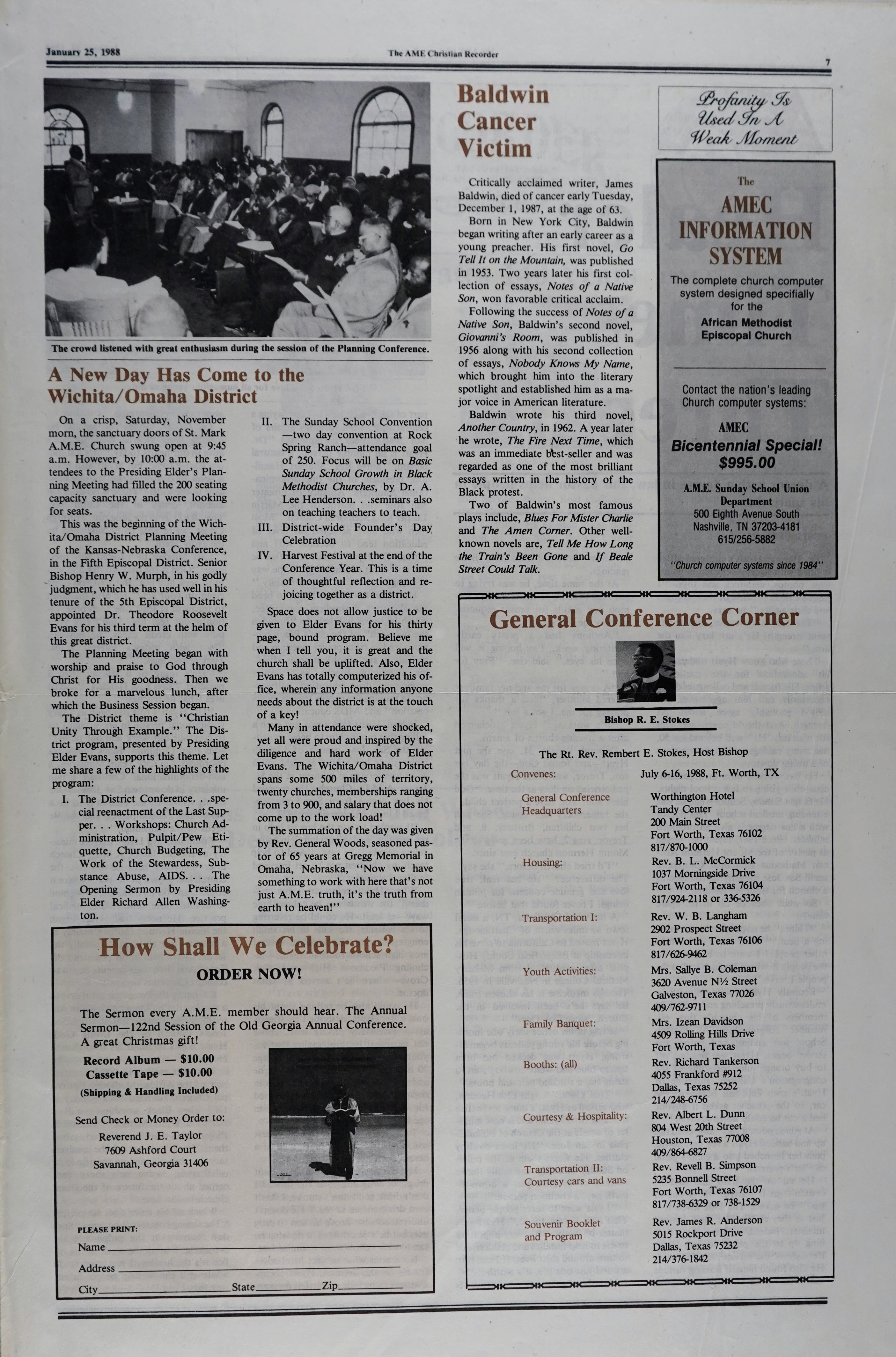
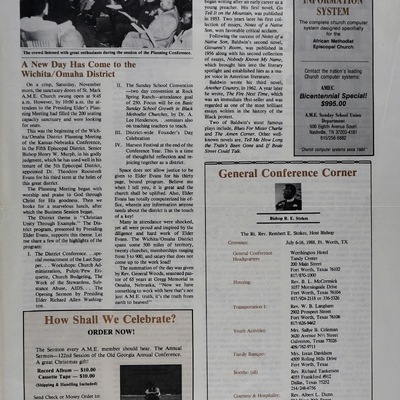
The crowd listened with great enthusiasm during the session of the Planning Conference.
A New Day Has Come to
the
Wichita/Omaha District
On a crisp, Saturday, November
morn, the sanctuary doors of St. Mark
A.M.E. Church swung open at 9:45
a.m. However, by 10:00 a.m. the at-
tendees to the Presiding Elder’s Plan-
ning Meeting had filled the 200 seating
capacity sanctuary and were looking
for seats.
This was the beginning of the Wich-
ita/Omaha District Planning Meeting
of the Kansas-Nebraska Conference,
in the Fifth Episcopal District. Senior
Bishop Henry W. Murph, in his godly
judgment, which he has used well in his
tenure of the 5th Episcopal District,
appointed Dr. Theodore Roosevelt
Evans for his third term at the helm of
this great district.
The Planning Meeting began with
worship and praise to God through
Christ for His goodness. Then we
broke for a marvelous lunch, after
which the Business Session began.
The District theme is ‘‘Christian
Unity Through Example.’’ The Dis-
trict program, presented by Presiding
Elder Evans, supports this theme. Let
me share a few of the highlights of the
program:
I. The District Conference. . .spe-
cial reenactment of the Last Sup-
per. . . Workshops: Church Ad-
ministration, Pulpit/Pew Eti-
quette, Church Budgeting, The
Work of the Stewardess, Sub-
stance Abuse, AIDS... The
Opening Sermon by Presiding
Elder Richard Allen Washing-
ton.
A great Christmas gift!
Record Album — $10.00
Cassette Tape — $10.00
(Shipping & Handling Included)
Send Check or Money Order to:
Reverend J. E. Taylor
7609 Ashford Court
Savannah, Georgia 31406
PLEASE PRINT:
Name
How Shall We Celebrate?
ORDER NOW!
The Sermon every A.M.E. member should hear. The Annual
Sermon—122nd Session of the Old Georgia Annual Conference.
II. The Sunday School Convention
—two day convention at Rock
Spring Ranch—attendance goal
of 250. Focus will be on Basic
Sunday School Growth in Black
Methodist Churches, by Dr. A.
Lee Henderson. . .seminars also
on teaching teachers to teach.
III. District-wide Founder’s
Celebration
IV. Harvest Festival at the end of the
Conference Year. This is a time
of thoughtful reflection and re-
joicing together as a district.
Day
Space does not allow justice to be
given to Elder Evans for his thirty
page, bound program. Believe me
when I tell you, it is great and the
church shall be uplifted. Also, Elder
Evans has totally computerized his of-
fice, wherein any information anyone
needs about the district is at the touch
of a key!
Many in attendance were shocked,
yet all were proud and inspired by the
diligence and hard work of Elder
Evans. The Wichita/Omaha District
spans some 500 miles of territory,
twenty churches, memberships ranging
from 3 to 900, and salary that does not
come up to the work load!
The summation of the day was given
by Rev. General Woods, seasoned pas-
tor of 65 years at Gregg Memorial in
Omaha, Nebraska, ‘‘Now we have
something to work with here that’s not
just A.M.E. truth, it’s the truth from
earth to heaven!”’
Address
Baldwin
Cancer
Victim
Critically acclaimed writer, James
Baldwin, died of cancer early Tuesday,
December 1, 1987, at the age of 63.
Born in New York City, Baldwin
began writing after an early career as a
young preacher. His first novel, Go
Tell It on the Mountain, was published
in 1953. Two years later his first col-
lection of essays, Notes of a Native
Son, won favorable critical acclaim.
Following the success of Notes of a
Native Son, Baldwin’s second novel,
Giovanni’s Room, was published in
1956 along with his second collection
of essays, Nobody Knows My Name,
which brought him into the literary
spotlight and established him as a ma-
jor voice in American literature.
Baldwin wrote his third novel,
Another Country, in 1962. A year later
he wrote, The Fire Next Time, which
was an immediate btst-seller and was
regarded as one of the most brilliant
essays written in the history of the
Black protest.
Two of Baldwin’s most famous
plays include, Blues For Mister Charlie
and The Amen Corner. Other well-
known novels are, Tell Me How Long
the Train’s Been Gone and If Beale
Street Could Talk.
Lrofantt Ss
Weak oa Voment
The
AMEC
INFORMATION
SYSTEM
The complete church computer
system designed specifially
for the
African Methodist
Episcopal Church
Contact the nation’s leading
Church computer systems:
AMEC
- Bicentennial Special!
$995.00
A.MLE. Sunday School Union
; Department
500 Eighth Avenue South
Bishop R. E. Stokes
The Rt. Rev. Rembert E. Stokes, Host Bishop
Convenes:
General Conference
Headquarters
Transportation I:
Youth Activities:
Family Banquet:
Booths: (all)
Courtesy & Hospitality:
Transportation II:
Courtesy cars and vans
Souvenir Booklet
and Program
July 6-16, 1988, Ft. Worth, TX
Worthington Hotel
Tandy Center
200 Main Street
Fort Worth, Texas 76102
817/870-1000
Rev. B. L. McCormick
1037 Morningside Drive
Fort Worth, Texas 76104
817/924-2118 or 336-5326
Rev. W. B. Langham
2902 Prospect Street
Fort Worth, Texas 76106
817/626-9462
Mrs. Sallye B. Coleman
3620 Avenue N%% Street
Galveston, Texas 77026
409/762-9711
Mrs. Izean Davidson
4509 Rolling Hills Drive
Fort Worth, Texas
Rev. Richard Tankerson
4055 Frankford #912
Dallas, Texas 75252
214/248-6756
Rev. Albert L. Dunn
804 West 20th Street
Houston, Texas 77008
409/864-6827
Rev. Revell B. Simpson
§235 Bonnell Street
Fort Worth, Texas 76107
817/738-6329 or 738-1529
Rev. James R. Anderson
5015 Rockport Drive
Dallas, Texas 75232
214/376-1842
===== DSC05409.JPG =====
The AME. Christian Recorder
A doctor with a degree in law, this pastor helps people in
his spare time.
PUBLISHER’S PAGE
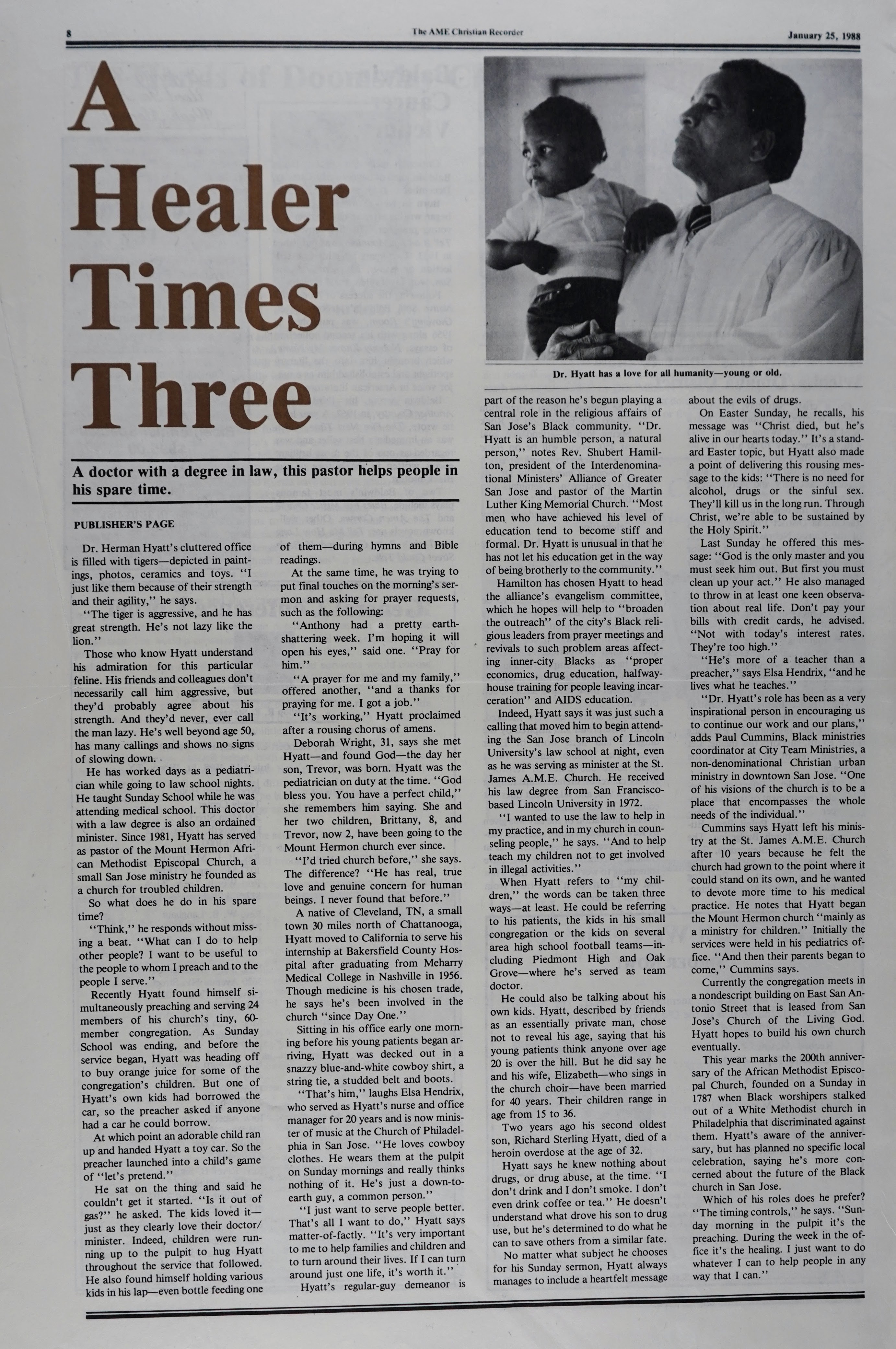
Dr. Herman Hyatt’s cluttered office
is filled with tigers—depicted in paint-
ings, photos, ceramics and toys. “‘I
just like them because of their strength
and their agility,’’ he says.
“The tiger is aggressive, and he has
great strength. He’s not lazy like the
lion.”’
Those who know Hyatt understand
his admiration for this particular
feline. His friends and colleagues don’t
necessarily call him aggressive, but
they’d probably agree about his
strength. And they’d never, ever call
the man lazy. He’s well beyond age 50,
has many callings and shows no signs
of slowing down.
He has worked days as a pediatri-
cian while going to law school nights.
He taught Sunday School while he was
attending medical school. This doctor
with a law degree is also an ordained
minister. Since 1981, Hyatt has served
as pastor of the Mount Hermon Afri-
can Methodist Episcopal Church, a
small San Jose ministry he founded as
a church for troubled children.
So what does he do in his spare
time?
“‘Think,”’ he responds without miss-
ing a beat. ‘“What can I do to help
other people? I want to be useful to
the people to whom I preach and to the
people I serve.”’
Recently Hyatt found himself si-
multaneously preaching and serving 24
members of his church’s tiny, 60-
member congregation. As Sunday
School was ending, and before the
service began, Hyatt was heading off
to buy orange juice for some of the
congregation’s children. But one of
Hyatt’s own kids had borrowed the
car, so the preacher asked if anyone
had a car he could borrow.
At which point an adorable child ran
up and handed Hyatt a toy car. So the
preacher launched into a child’s game
of ‘‘let’s pretend.’’
He sat on the thing and said he
couldn’t get it started. ‘‘Is it out of
gas?’’ he asked. The kids loved it—
just as they clearly love their doctor/
minister. Indeed, children were run-
ning up to the pulpit to hug Hyatt
throughout the service that followed.
He also found himself holding various
kids in his lap—even bottle feeding one
of them—during hymns and Bible
readings.
At the same time, he was trying to
put final touches on the morning’s ser-
mon and asking for prayer requests,
such as the following:
“Anthony had a pretty earth-
shattering week. I’m hoping it will
open his eyes,’”’ said one. ‘‘Pray for
him.”’
“‘A prayer for me and my family,”
offered another, ‘‘and a thanks for
praying for me. I got a job.”’
“It’s working,’’ Hyatt proclaimed
after a rousing chorus of amens.
Deborah Wright, 31, says she met
Hyatt—and found God—the day her
son, Trevor, was born. Hyatt was the
pediatrician on duty at the time. “God
bless you. You have a perfect child,”
she remembers him saying. She and
her two children, Brittany, 8, and
Trevor, now 2, have been going to the
Mount Hermon church ever since.
“<1’d tried church before,’’ she says.
The difference? ‘‘He has real, true
love and genuine concern for human
beings. I never found that before.”
A native of Cleveland, TN, a small
town 30 miles north of Chattanooga,
Hyatt moved to California to serve his
internship at Bakersfield County Hos-
pital after graduating from Meharry
Medical College in Nashville in 1956.
Though medicine is his chosen trade,
he says he’s been involved in the
church ‘‘since Day One.’’
Sitting in his office early one morn-
ing before his young patients began ar-
riving, Hyatt was decked out in a
snazzy blue-and-white cowboy shirt, a
string tie, a studded belt and boots.
“‘That’s him,’’ laughs Elsa Hendrix,
who served as Hyatt’s nurse and office
manager for 20 years and is now minis-
ter of music at the Church of Philadel-
phia in San Jose. ‘“He loves cowboy
clothes. He wears them at the pulpit
on Sunday mornings and really thinks
nothing of it. He’s just a down-to-
earth guy, a common person.”’
“J just want to serve people better.
That’s all I want to do,’’ Hyatt says
matter-of-factly. ‘‘It’s very important
to me to help families and children and
to turn around their lives. If I can turn
around just one life, it’s worth it.”’
Hyatt’s regular-guy demeanor is
January 25, 1988
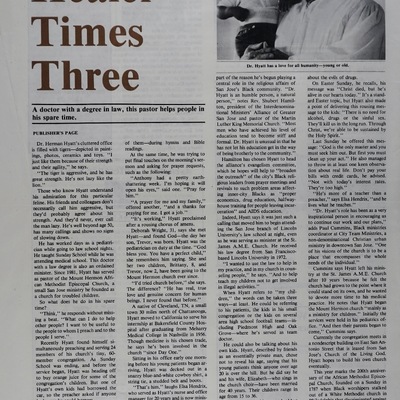
Dr. Hyatt has a love for all humanity—young or old. :
part of the reason he’s begun playing a
central role in the religious affairs of
San Jose’s Black community. ‘‘Dr.
Hyatt is an humble person, a natural
person,’’ notes Rev. Shubert Hamil-
ton, president of the Interdenomina-
tional Ministers’ Alliance of Greater
San Jose and pastor of the Martin
Luther King Memorial Church. ‘‘Most
men who have achieved his level of
education tend to become stiff and
formal. Dr. Hyatt is unusual in that he
has not let his education get in the way
of being brotherly to the community.”’
Hamilton has chosen Hyatt to head
the alliance’s evangelism committee,
which he hopes will help to ‘‘broaden
the outreach’”’ of the city’s Black reli-
gious leaders from prayer meetings and
revivals to such problem areas affect-
ing inner-city Blacks as ‘‘proper
economics, drug education, halfway-
house training for people leaving incar-
ceration’’ and AIDS education.
Indeed, Hyatt says it was just sucha
calling that moved him to begin attend-
ing the San Jose branch of Lincoln
University’s law school at night, even
as he was serving as minister at the St.
James A.M.E. Church. He received
his law degree from San Francisco-
based Lincoln University in 1972.
“<T wanted to use the law to help in
my practice, and in my church in coun-
seling people,’’ he says. ‘‘And to help
teach my children not to get involved
in illegal activities.’”’
When Hyatt refers to ‘‘my chil-
dren,’’ the words can be taken three
ways—at least. He could be referring
to his patients, the kids in his small
congregation or the kids on several
area high school football teams—in-
cluding Piedmont High and Oak
Grove—where he’s served as team
doctor.
He could also be talking about his
own kids. Hyatt, described by friends
as an essentially private man, chose
not to reveal his age, saying that his
young patients think anyone over age
20 is over the hill. But he did say he
and his wife, Elizabeth—who sings in
the church choir—have been married
for 40 years. Their children range in
age from 15 to 36.
Two years ago his second oldest
son, Richard Sterling Hyatt, died of a
heroin overdose at the age of 32.
Hyatt says he knew nothing about
drugs, or drug abuse, at the time. ‘‘I
don’t drink and I don’t smoke. I don’t
even drink coffee or tea.’” He doesn’t
understand what drove his son to drug
use, but he’s determined to do what he
can to save others from a similar fate.
No matter what subject he chooses
for his Sunday sermon, Hyatt always
manages to include a heartfelt message
about the evils of drugs.
On Easter Sunday, he recalls, his
message was ‘‘Christ died, but he’s
alive in our hearts today.’’ It’s a stand-
ard Easter topic, but Hyatt also made
a point of delivering this rousing mes-
sage to the kids: ‘‘There is no need for
alcohol, drugs or the sinful sex.
They’ |I kill us in the long run. Through
Christ, we’re able to be sustained by
the Holy Spirit.’’
Last Sunday he offered this mes-
sage: ‘‘God is the only master and you
must seek him out. But first you must
clean up your act.’’ He also managed
to throw in at least one keen observa-
tion about real life. Don’t pay your
bills with credit cards, he advised.
“Not with today’s interest rates.
They’re too high.’’
“‘He’s more of a teacher than a
preacher,”’ says Elsa Hendrix, ‘‘and he
lives what he teaches.’’
“Dr. Hyatt’s role has been as a very
inspirational person in encouraging us
to continue our work and our plans,”
adds Paul Cummins, Black ministries
coordinator at City Team Ministries, a
non-denominational Christian urban
ministry in downtown San Jose. ‘‘One
of his visions of the church is to be a
place that encompasses the whole
needs of the individual.’’
Cummins says Hyatt left his minis-
try at the St. James A.M.E. Church
after 10 years because he felt the
church had grown to the point where it
could stand on its own, and he wanted
to devote more time to his medical
practice. He notes that Hyatt began
the Mount Hermon church ‘‘mainly as
a ministry for children.’’ Initially the
services were held in his pediatrics of-
fice. ‘‘And then their parents began to
come,’’ Cummins says.
Currently the congregation meets in
a nondescript building on East San An-
tonio Street that is leased from San
Jose’s Church of the Living God.
Hyatt hopes to build his own church
eventually.
This year marks the 200th anniver-
sary of the African Methodist Episco-
pal Church, founded on a Sunday in
1787 when Black worshipers stalked
out of a White Methodist church in
Philadelphia that discriminated against
them. Hyatt’s aware of the anniver-
sary, but has planned no specific local
celebration, saying he’s more con-
cerned about the future of the Black
church in San Jose.
Which of his roles does he prefer?
“The timing controls,’’ he says. “Sun-
day morning in the pulpit it’s the
preaching. During the week in the of-
fice it’s the healing. I just want to do
whatever I can to help people in any
way that I can.”
===== DSC05410.JPG =====
January 25, 1988
The AME Christian Recorder
Organ Restored and Rededicated at Big Bethel Atlanta, Georgia
The Great Moller Organ of Big
Bethel A.M.E. Church, Atlanta, was
recently rededicated and named the
Anita Brown Glover Organ, in mem-
ory of Anita Brown Glover, Chair-
person of Big Bethel’s Renovation and
Restoration Project (1981-1982).
The Big Bethel A.M.E. Church
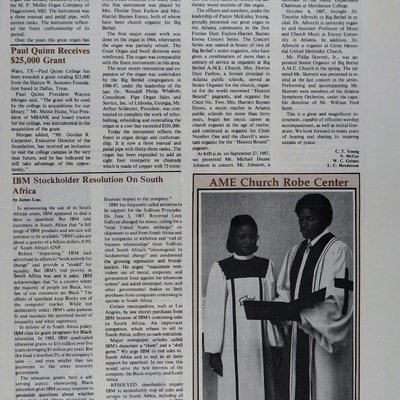
organ was initially installed in 1924 by
the M. P. Moller Organ Company of
Hagerstown, MD. The instrument was
a three manual and pedal pipe, with
sixteen ranks. The instrument reflect-
ed the finest craftsmanship of its
period.
Over the years this great organ has
Paul Quinn Receives
$25,000 Grant
Waco, TX—Paul Quinn College has
been awarded a grant totaling $25,000
from the Hatton W. Sumners Founda-
tion based in Dallas, Texas.
Paul Quinn President Warren
Morgan said, ‘‘The grant will be used
by the college in acquisitions for our
library.’’ Mr. Monte Hulse, Vice Pres-
ident of MBANK and board trustee
for the college, was instrumental in the
acquisition of the grant.
Morgan added, ‘‘Mr. Gordan R.
Carpenter, Executive Director of the
foundation, has received an invitation
to visit the college campus in the very
near future, and he has indicated he
will take advantage of this oppor-
tunity.’’
been played by many renowned artists.
Indeed, the initial dedicatorial recital
on the organ was performed by the late
Dr. Sheldon, organist for the city of
Atlanta. Since then it has been played
by notables such as the late Dr,
Wendell Philip Whalum, Dr. Colonius
Davis, Dr. G. Johnson Hubert and Dr.
Joyce Finch Johnson. For many years
this fine instrument was played by
Mrs. Florine Dyer Furlow and Mrs.
Harriet Baynes Enous, both of whom
have been church organist for Big
Bethel.
The first major repair work was
done on the organ in 1964, whereupon
the organ was partially rebuilt. The
Great Organ and Swell divisions were
reinforced. The organ was comparable
with the finest instruments in this area.
The most recent restoration and ex-
pansion of the organ was undertaken
by the Big Bethel congregation in
1986-87, under the leadership of the
late Dr. Wendell Philip Whalum,
Consultant. Pipe Organ Sales and
Service, Inc. of Lithonia, Georgia, Mr.
Arthur Schleuter, President, was con-
tracted to complete the work of refur-
bishing, rebuilding and reinstalling the
organ at a cost that exceeded $101,000.
Today the instrument reflects the
finest in organ design and craftsman-
ship. It is now a three manual and
pedal pipe with thirty-three ranks. The
organ has been expanded to add an
eight foot trompette en chamade
which is made of copper with 73 trom-
a
IBM Stockholder Resolution On South
Africa
by James Leas
In announcing the sale of its South
African assets, IBM appeared to deal a
blow to apartheid. But IBM told
customers in South Africa that “a full
range of IBM products and services will
continue to be available.” 1BM’s sales are
about a quarter of a billion dollars, 0.5%
of South Africa’s GNP.
Before “departing,” IBM had
advertised its efforts to “work actively for
change” and provide a “model” for
equality. But IBM’s real priority in
South Africa was and is sales. IBM
acknowledges that “in a country where
the majority of people are Black, very
few of our customers are Black.” The
effects of apartheid keep Blacks out of
the computer market. While not
deliberately unfair, IBM’s sales patterns
fit and maintain the apartheid model of
inequality and white supremacy.
In defense of its South Africa policy,
IBM cites its grant programs for Black
education. In 1985, IBM quadrupled
education grants to $15 million over five
years (averaging $3 million per year). But
this fund is less than 2% of the company’s
sales — and even smaller than tax
payments to the white minority
government.
The education grants have a self-
serving aspect: showcasing Black
education gives IBM an easy response to
persistent questions about whether
technology sold almost exclusively to
Whites helps perpetuate White domi-
nation.
IBM can look to its own past for a
more clear-cut model of corporate
withdrawal: in 1977, when IBM pulled
out of India after a dispute with the
Indian government, the company
provided generous severance settlements
for employees and totally discontinued
sales, service, parts, and supplies.
Furthermore, Kodak fully departed
from South Africa — selling assets and
halting all shipments — with “minimal
financial impact to the company.”
IBM has frequently called attention to
its support for the Sullivan Principles.
On June 3, 1987, Reverend Leon
Sullivan changed his stance, calling for a
“total United States embargo” on
shipments to and from South Africa and
for companies to withdraw and “end all
business relationships” there. Sullivan
cited South Africa’s “intransigence to
fundamental change” and condemned
the growing repression and brutal-
ization. He urged ‘‘maximum non-
violent use of moral, corporate, and
government force against the inhumane
system” and asked municipal, state, and
other governmental bodies to limit
purchases from companies continuing to
operate in South Africa.
Certain municipalities, such as Los
Angeles, by law restrict purchases from
IBM because of IBM’s continuing sales
to South Africa. An important
competitor, which refuses to sell to
South Africa, suffers no such restriction.
Major newspaper articles called
IBM’s departure a “sham” and a “shell
game.” We urge IBM to end sales to
South Africa and to end its de facto
support for apartheid. In our view, this
would serve the best interests of the
company, the Black majority, and South
Africa.
RESOLVED, shareholders request
IBM to immediately stop all sales and
services to South Africa, including all
direct or indirect shipments of IBM
computers, equipment, software, parts,
supplies, and materials, until apartheid
ends.
NOTICE
Do Not Send Color
Pictures For Our Black
And White Production
A. Lee Henderson
Publisher
pette pipes which add to the impres-
siveness of this grand instrument. The
organ has some 2012 pipes and over
half of the facade contains speaking
pipes. In addition, the sixteen foot
violoin are constructed out of sugar
pine. The visible wood case behind the
choir loft is made of oak. The greatest
care has been taken to restore the au-
thentic wood sections of this organ,
The officers and members, under the
leadership of Pastor McKinley Young,
proudly presented our great organ to
the Atlanta community in the first
Florine Dyer Furlow-Harriet Baynes
Enous Concert Series. The Concert
Series was named in honor of two of
Big Bethel’s senior organists, who have
given a combination of more than a
century of service as organists at Big
Bethel A.M.E. Church. Mrs. Florine
Dyer Furlow, a former principal in
Atlanta public schools, served as
Senior Organist for the church, organ-
ist for the world renowned ‘‘Heaven
Bound’’ pageants, and organist for
Choir No. Two. Mrs. Harriett Baynes
Enous, a music teacher in Atlanta
public schools for more than forty
years, began her music career as
church organist at the age of twelve,
and continued as organist for Choir
Number One and the church’s assis-
tant organist for the ‘‘Heaven Bound’’
pageant.
At 6:00 p.m. on September 27, 1987,
we presented Mr. Michael Duane
Johnson in concert. Mr. Johnson, a
your order.
A.M.E.C. Sunday School Union ¢ 500 Eighth Avenue South
Nashville, TN 37203-4181 © Phone (615) 256-5882
AME Church Robe Center
ORDER IMMEDIATELY!
Beautiful Choir Robes and Clergy Robes are now available
through the Sunday School Union. Call us or write today for
native of Steubenville, Ohio, is pres-
ently the Assistant Minister of Music
and church organist for the West
Hunter Street Baptist Church, pas-
tored by Rev. Dr, Ralph David Aber-
nathy. In addition to his church re-
sponsibilities, he is also the chapel and
college organist and Administrative
Assistant to the Music Department
Chairman at Morehouse College.
October 4, 1987, brought Dr.
Timothy Albrecht to Big Bethel in re-
cital. Dr. Albrecht is university organ-
ist and Assistant Professor of Music
and Church Music at Emory Univer-
sity in Atlanta. In addition, Dr.
Albrecht is organist at Glenn Memo-
rial United Methodist Church.
Mr. Philip Skerrett, Jr., was ap-
pointed Senior Organist of Big Bethel
A.M.E. Church in the spring. The tal-
ented Mr. Skerrett was presented in re-
cital at the last concert in the series.
Performing and accompanying Mr.
Skerrett were members of the Atlanta
Symphony Orchestra, under the capa-
ble direction of Mr. William Fred
Scott.
This is a great and magnificent in-
strument, capable of effective worship
accompaniment, as well as recital liter-
ature. We look forward to many years
of hearing and sharing its inspiring
sounds of praise.
C. T. Young
N. McGee
W. C. Grimes
L. C. Henderson
===== DSC05411.JPG =====
R—E———E Eee
10
HR eee bet ee A
The AME Christian Recorder
SAGE ea eh PE be
abe eae eR Oa Res cial Ge we Red ak el
January 25, 1988
—eeeeeeaueaeauauquauanuaununuayqq REESE
Central New Orleans Bogalusa
District Celebrates 200 Years
“Sign Me Up For The Christian
Jubilee” was sung by our Presiding
Elder, Rev. Clarence Collins, Mr.
Mary Collins, Pastors, Officers and
members of the Central New Orleans
Bogalusa District, as they gathered to-
gether celebrating 200 years and the
District year’s work. All were dressed
in green and white tee shirts stamped
with Christian Jubilee “87” Central
New Orleans Bogalusa District A. M.
E. Church.
Doughty Chapel A. M. E. Church,
Crystal Springs, LA, and Union
Chapel A. M. E. Church, Kentwood,
LA, formed a mass choir, with Jackie
Vernon and Rev. Leon Sanders as
musicians. Everyone celebrated with
Rev. and Mrs. Herbert Sims and
congregation. Mrs. Donice Thomas,
chairperson for the occasion, did not
leave a stone unturned.
This glorious occasion began at 8:00
a.m. with prayer service. Beginning at
9:00 a.m., Rev. Robert Hall, Mrs.
Leona Fisher, and others lectured on
topics: “Child & Parent Relationships,”
“Helping your child to say no to Alcohol,
Sex, and Drugs”, “Short tips on AIDS—
The Churches answer to the problems.”
At 11:00 a.m. Worship and Praise with
Rev. M. J. Black, Jr. presiding,
Sermonettes: Rev. Robert Hall, Rev. C.
Muse. The mass choir sang “Sign Me Up
For The Christian Jubilee.” Then came
the invitation and worshiping with gifts,
Rev. David Campbell presiding. At
12:00 noon dinner was served in the
church cafeteria. All returned to the
sanctuary for the remainder of the
service at 1:30 p.m.
Flowers, fruit, and candy were
presented to Rev. and Mrs. Herbert
Sims as a token of Thanksgiving and
Appreciation. A toast was made to the
Central New Orleans Bogalusa District
from Presiding Elder Collins, that all
would live one thousand years and
continue to work with him. In return, the
District made a toast to the Elder that he
would live 2,000 years and remain their
Elder,
The Mass Choir sang “Sign Me Up.”
Mrs. Evelyn Markey rendered a solo, “I
Give You Jesus”; Doughty Chapel Choir
sang” Revive Us Again.” The Mass
Choir sang “Thank You Lord.” The
service ended with remarks from Pastor
Sims and Presiding Elder Collins.
Refreshments were served immediately
afterwards.
The Sunday morning service began at
9:30 a.m. with Sunday School. At 11:00
a.m. Presiding Elder Collins was present
to hold Union Chapels’ Fourth Quarter
for this conference year. Our hearts,
minds and souls are still rejoicing over
our “Christian Jubilee.” The Holy Spirit
remained, enabling us to have a shouting
good time. Elder Collins spoke from
Proverbs 14:34, “The World Series.” The
business of the Quarter was taken care of
immediately after the service. After the
closing of the service, the presiding Elder
and his wife dined with Rev. and Mr.
Sims at the parsonage.
After such a glorious Christian Jubilee
and spiritual 4th Quarter, Pastor Sims
thought it no more fitting a time to have
a week of prayer service before going
into our annual Revival, with our
Presiding Elder as the Evangelist,
beginning August 31st through Sep-
tember 4th. Monday night’s message,
“What Must I Do to be Saved?”’ (Acts
16:30); Tuesday night, ‘‘Ezekiel’s
Vision Midst Dry Bones,’’ (Ezek. 37:
1-3); Wednesday night, ‘‘You Can
Run, But You Can’t Hide.’’ (Jonah
1:3); Thursday night, ‘‘When It Seems
the Lord Is Taking Too Much Time.”’
(St. John 11:1); and Friday night,
““We’ve Come This Far By Faith,”’
(Cor. 13:13).
Each night the Presiding Elder let
the Lord use him. The Holy Spirit
came in and Union Chapel caught on
fire. Twenty-six adults and youth re-
committed themselves to Christ.
Isadora Sims, Reporter
Stuttgart-Forrest City District
Holds Planning Council
The Planning Council for the Stutt-
gart-Forrest City District was held
recently at Nicholes Chapel A.M.E.
Church, DeWitt, AR, Rev. L. R. Neal,
Host Pastor. The pastors met at 9:30
a.m. and made their reports. All
charges made full reports. The Wor-
ship Service began at 10:00 a.m., with
the Presiding Elder in charge. After
singing ‘‘Down at the Cross,’’ He pre-
sented Rev. Napoleon Davis to preside
for the opening session. The call to
worship was by Bro. Johnny Kelly.
Then the hymn ‘‘O For a Thousand
Tongues to Sing’? was sung. The
Morning Prayer was led by Rev. W. L.
Scott.
The District Choir led in singing ‘‘I
Am On the Battlefield For My Lord.”
The Old Testament scripture was read
by Rev. W. A. Doubois (Psalm 115),
and the New Testament scripture by
Rev. Diane Burl (Matt. 25:1-10).
The Decalogue was led by Rev. M.
C. Lawson, and the Mission Offering
was taken by Rev. Welton Boyce and
Rev. Selma Moore.
The District Choir led in singing
“Prayer Changes Things.”’
The Presiding Elder was presented
by Rev. A. S. Johnson, who in turn
presented Rev. James Clark, who
brought the morning message. He se-
lected for his subject: ‘‘Don’t Let
Your Light Go Out’’ (Matt. 25). The
invitation for Christian Discipleship
was given by Rev. L. O. Taylor, pas-
tor, St. Luke A.M.E. Church, Forrest
City. The Finance Committee accept-
ed the public offering.
The Presiding Elder thanked all the
people for their support, and asked for
their support for the New Year.
The Business Session was held—set-
ting dates for the New Year. The pas-
tor and members of Nicholes Chapel
A.M.E. Church left no stone unturned
in making this Council a great success.
Rev. M. H. Elliott, Presiding Elder,
was presented and brought greetings
from the New Port-Jonesboro Dis-
trict. Rev. C. C. Akins is the Presiding
Elder of the Stuttgart-Forrest City Dis-
trict.
The First Quarterly Conference for
Bethel A.M.E. Church, Nicholes Cha-
pel A.M.E. Church and Hill Chapel
A.M.E. Church was held at Bethel
A.M.E. Church November 1, 1987.
The Conference was presided over
by Presiding Elder C. C. Akins, and
was well attended. All reports were
made and much progress has been
made. They are looking forward to
another good year.
To God be the glory!
cece ee ee ee ee ee ee
Forty-Third Quadrennial Session
| General Conference j
| AFRICAN METHODIST EPISCOPAL CHURCH (
i FT. WORTH, TX |
i July 6-16, 1988 {
| Those persons desiring to submit proposed legislation are (
\ requested to utilize the approved legislation format as
outlined below.
j PROPOSED LEGISLATION (
(Bill No. Page ___of (
| Title: \
( Reference: )
| Intent: \
(1. {
\ 2. \
4 3. ‘
(4. \
| Etc. |
( ALL LAWS AND PARTS OF LAWS IN CONFLICT WITH THIS LAW |
| ARE REPEALED. \
\ Submitted _ by. \
\ Date \
! FROM: Dr. Richard Allen Chappelle, Sr.
- 2 ew ew ew oe a a ee ae ae ae eae ae ae ee =
Idd
BICENTENNIAL CELEBRATION DETAILS
From Bishop Vinton R. Anderson, Bicentennial Chairman
Z
ULLLL
Bishop William Paul Quinn Bishop H. W. Murph, Host
THE WILLIAM PAUL QUINN FOCUS
AND WESTWARD EXPANSION EMPHA-
SIS—ST. LOUIS, MISSOURI/EAST ST.
LOUIS, ILLINOIS
This final event will be dually hosted by the 4th and Sth Episcopal
Districts, connecting the east and west banks of the Mississippi River. We will
dramatize Quinn’s preaching from the Illinois side to the slaves on the
Missouri side.
MAY 17-19, 1988
9:30 A.M.-12:30 P.M. The Paul Quinn
Lectures
2:30 P.M.- 10:00 P.M.
(a) Dedication of Historical Markers
(b) The Dramatization of the Quinn Event
(c) River Festival of Arts and Entertainment
Tuesday, May 17, 1988
Bishop R. E. Stokes
Host
Bishop Frank M. Reid, Jr.
President of the General Board
10:00 A.M.-6:00 P.M.
General Board Meeting
7:00 P.M. Recognition Event—hosted by the
4th and Sth Districts
General Board Closing Session
Wednesday, May 18, 1988
Thursday, May 19, 1988
GENERAL CONFERENCE, FORT WORTH,
TEXAS (A culminating ceremony will close the
Bicentennial Celebration)
Nr OU LUUHELPULUTLULUALLLULLLULULULLULULULLLLLLLLULLLLULLLLLL LLL LULU LALLA ALi
JULY 6-16, 1988
N
LLL ZZ
LLLLLLL LLL LALLA LALLA ULLAL LLL LLL LILLE LLL LLL LLU LLL LLU LULU LLU LLL ULL LLL LLL LL LLL LULL LL LLL LLL LLL LLL LLL LLL ULLAL LLL LULL LLL ULLADULLA LLL LLLLLL LLL LLL LULL ALLL LLU LLLLLU LLL LLL LLL LLL DLL LLL LLL
===== DSC05412.JPG =====
January 25, 1988
The AME Christian Recorder
SSS il
What’s White and Read All Over? The Media.
by Benjamin F. Chavis, Jr.
Racism in the media—it is a con-
Stant refrain. However, the recent pro-
gram sponsored by the esteemed
Schomburg Library in Harlem to dis-
cuss this issue was different. On the
panel were some of the best journalists
in the business. All of them were Afri-
can Americans and they did not bite
their tongues.
These were no newcomers to the
field. All were seasoned veterans, and
some had more than 20 years in the
business. There was Les Payne, a Pul-
itzer Prize winner and now a syndicat-
ed columnist and Assistant Managing
Editor for Newsday. There was Jill
Nelson, former President of the New
York Association of Black Journalists
and currently a reporter for the Wash-
ington Post Magazine. There was
David Hardy, the main organizer of
the successful landmark discrimina-
tion suit against the New York Daily
News, and there was Marquita Poole,
an Emmy-award winning producer
with the ‘‘CBS Evening News.’’ Mod-
erating was Thulani Davis, a crusading
reporter with the New York Village
Voice.
If you want to know why media coy-
erage is often racist, you just need to
listen to the litany of statistics recited
by Ms. Davis at the beginning of the
session: Blacks make up less than 1%
of the newsroom management at this
country’s dailies, Only 6.3% of the
staff of these dailies is minority, and
that includes ail racial and ethnic em-
ployees. Fully 60% of the approxi-
mately 1750 dailies in this country have
no racial and ethnic employees at all.
Statistics are useless unless we begin
to analyze their importance in human
terms. David Hardy spoke with anger
about the fact that racial and ethnic
stories are not given the same weight as
White-centered stories. When they do
become important, the story is often
taken from the Black or Hispanic re-
porter who had been covering it and
given to a White reporter. In fact, it
was being taken off an Abscam story
which he himself broke, and seeing it
given to a White reporter, which finally
made Hardy organize and initiate the
Daily News suit. Jill Nelson agreed,
saying, ‘‘Black reporters are not allow-
Talbot A.M.E. Academy Holds Graduation
Georgia’s only A.M.E. School, K-12,
culminates its 1986-87 year with its first
kindergarten graduation exercises.
Savannah, GA—It was a joyous occa-
sion! Laughter and tears were mingled
in the sanctuary of Flipper Chapel
A.M.E. Church. Parents, students,
faculty and friends filled the building
to capacity. All were reflecting over a
school year of some struggles, disap-
pointments, sacrifices and many good
times.
Rev. Dan Stevenson, organizer and
present director, says that much
thanks should go to those who helped
by actively participating and praying
for its success. Deep appreciation goes
to the head of the 6th Episcopal Dis-
trict, Bishop Frederick Talbot, and to
Dr. Sylvia Ross Talbot for demon-
strating special concerns by journeying
to Savannah to share in the establish-
ment of the first accredited A.M.E.
school, K-12, in the State of Georgia.
Rev. Stevenson further states that
both of these dynamic individuals have
been mentors in his life, and he is
grateful to God for having put him in
the midst of individuals such as these
—individuals with an understanding
concern, caring leadership that sparked
his move on a venture that seemed im-
possible, not having a budget, but rely-
ing on prayer. Through this endeavor
society is being revolutionized and an-
other milestone in the history of the
A.M.E. Church is being marked, and
we, as followers of God, are sending a
signal to the world that we still believe
in the promise from which this church
evolved—that is, self-help.
Pastor Stevenson feels the need to
remedy the ills of society through the
use of education through prayer. He
feels this can be done by recommend-
ing an old remedy for a new approach.
He believes that with the inception of a
program such as he is proposing, and
which addresses the basic needs of all
mankind, the ills of our present-day
society can be solved. A well-known
psychologist, Maslow, said, “‘In order
to satisfy man, you must satisfy his
basic needs: food, shelter, and cloth-
ing.’’ Another educator said, ‘‘The
most important thing in the world to
achieve success is to be able to master
the three ‘‘R’s’’: reading, writing and
arithmetic.
Now, Rev. Stevenson goes on to
say, he does not necessarily disagree
with the earlier statements, because
all three, in separate instances, are im-
portant to have a complete person. He
continues by saying there is a fourth
“R’’ concept, religion (spiritual de-
velopment of a person). Oftentimes,
people are not comfortable with this
concept, therefore, it is not usually
used as a basis for psychological ap-
proach to cure or solve a problem in
the area of education. Most people see
religion—spiritual development—as a
means, but only a means to itself, not
interlocking with the other educational
points of view.
Rev. Stevenson sees spiritual devel-
opment as a means to undergird all
other areas mentioned. Why? Be-
cause, surely, just as it is necessary for
man to have food, shelter and clothing,
or the knowledge to read, write and do
arithmetic, man needs something to
“hold on to,’’? and that something is
religion (spiritual development), which
offers a number of answers to ques-
tions he cannot resolve with just having
the basics. It may not instantly answer
a question, but it can instantly give
hope to the true believer.
Now, with this philosophy in mind,
the academy has had a number of suc-
cesses this past school year. Accredi-
tation was granted from the Georgia
Accreditation Commission for mem-
bership as the first A.M.E. school in
Georgia’s history for grades K-12. An-
other accomplishment was the endors-
ing of the school, by the 122nd Georgia
Annual Conference, as the official
A.M.E. school for the Old Georgia
Conference, pledging their support for
a major fundraiser during each year.
Acting on the philosophy of doing
something for oneself, the Parent
Association has purchased and paid
for a 60-passenger bus with the help of
donations and chicken dinner sales.
A special moment during graduation
exercises came when one of the stu-
dents of Flipper A.M.E. School,
Telanna Kelly, presented Bishop and
Mrs. Talbot with a T-shirt and jacket
bearing the new name of the school.
By vote of students, the name of the
school was changed from Flipper
A.M.E. to Talbot A.M.E. Academy,
in honor of the support given by the
Talbot family.
ed to be visionaries, (0 comment or to
analyze’’ to which Davis added, ‘‘or to
be the final authority."’
Les Payne suggested that this racism
will continue to exist unless we chal-
lenge it—in the courts and by organiz-
ing. As he said, ‘*The media, one of
the most powerful forces in this coun-
try, is also the most racist. Only the
media is allowed to ‘correct its own
test papers’. . .and the test papers of
everyone else as well.’’ But, he added,
what the Daily News suit showed us
was that we were not at the mercy of
the media; we could take the case out-
side—to the courts—and win,
The fact that racial and ethnic com-
munities could effect a change, how-
ever, was the real nut of the discus-
sion. The numerous discrimination
suits and boycotts which had been suc-
cessfully mounted against the New
York Times, the Baltimore Sun, UPI
and others were heralded, The impor-
tance of passing on the legacy of strug-
gle among the younger racial and eth-
nic reporters and teaching critical
thinking to all our youth was noted.
But particularly emphasized was the
crucial role which the community
must play. As Hardy said, ‘‘Change
has to come from the top, but it can-
not come without the involvement of
the community.’’ Supporting this,
Nelson noted that we must organize to
respond to the media, both positively
and negatively. She noted that news or-
ganizations generally assume that each
letter represents 200 others. Yet, racial
and ethnic groups don’t use this tool as
aggressively as they should.
It really is up to us. If you don’t like
something you’ve heard or seen in
your local paper or on a radio or TV
station—take a few minutes to call or
write, and-get your friends and family
to do the same. Also support those in
the media who take positions you
agree with. We cannot bemoan our
lack of power when we refuse to-exer-
cise the power we do have.
“James Cone is the premier
black theologian writing today.
And this book is vintage
Cone—prophetic, passionate,
pertinent, and provocative.”
—CORNEL WEST
A driving concern to speak the
truth with love, courage, and
care for the poor and voiceless is
richly and powerfully evident
in this collection of recent
essays by James Cone.
Cone addresses topics of
black theology and its
relationship to other
Christian theologies and
secular ideologies, the
role of the black church in
American history, Christian
faith and political praxis,
and the ship. He also offers his
initial reflections on his 1985
trip to South A frica—an
experience that has had a deep
influence on his theological
perspective.
“A valuable contribution to on-
going religious dialogue.”
—BOOKLIST
Paper, $8.95
ORDER FROM:
A.M.E.C. Sunday School Union
500 Eighth Avenue South
Nashville, Tennessee 37203-4181
(615) 256-5882
Buy Your
Religious
Supplies From
Your Own
Publishing House
A.M.E.C. Publishing House
500 Eighth Avenue South
Nashville, TN 37203-4181
(615) 256-5882
DR. GEORGE ALEXANDER SEWELL
Where Are You Going, by Dr. George
Alexander Sewell. Rhetorical and personal
in content with the social concerns in
“trouble times”, the author, in his collec-
tion of sermons, gives his readers new
thoughts in which mankind can seek
something constant and dependable. —
Please add 13% postage and handling
===== DSC05413.JPG =====
12
The AME Christian Recorder
January 25, 1988
Paul Quinn College Receives Matching Grant For Campus
Waco, TX—Paul Quinn College is one
of 51 independent colleges selected by
Lilly Endowment, Inc., to receive a
matching grant for a major investment
in its campus.
According to Dr. Warren Morgan,
HUD Secretary
Addresses
White House
Secretary of Housing and Urban
Development, Samuel R. Pierce, Jr.,
told a New York City conference on
drug abuse December 16, 1987, that “by
glamorizing or accepting drugs in our
society, we make a mockery of the loving
support we offer our young.” The
conference was held at the Marriott
Marquis.
In addressing the White House
Conference For A Drug-Free America,
Secretary Pierce focused particular
attention on the responsibility of adults
in educating today’s youth against the
use of drugs. “I draw attention to the
young because it is our responsibility to
teach and train them. Youngsters
welcome our attention. They can ac-
cept our high expectations if we let
them know those expectations are
founded in a commitment to nurture
their growth and development.
~ 1 hey can be receptive to the guidance
and discipline we offer if our
commitment tells them we care, that we
believe in them,” the HUD Secretary
added. “But, all the guidance we impart
will ring hollow, if our actions defy that
guidance.”
The Conference, mandated by the
Anti-Drug Abuse Act of 1986, and
established by President Reagan’s
Executive Order No. 12595, on May 5,
1987, is authorized to review and assess
all areas of the drug abuse crisis in the
United States.
A member of the National Drug
Policy Board, Secretary Pierce has been
at the forefront in involving his
Department in the battle against drugs in
public housing. Last May, HUD co-
sponsored a National Conference on
Drug-Free Public Housing with the
National Association of Housing and
Redevelopment Officials. The
Conference proved so useful, the
Department has subsequently held a
series of five additional regional
conferences.
I
LLOF THE
WOMEN
OF THE.
BLE
by Edith Deen
ee
Edith Deen
This the first comprehensive book ever
written on all of the women of the
Bible— women who comprise a feminine
protrait galley unsurpassed in the world
of literature. All are here—saints and
harlots, faithful mothers and wives,
queens, sorceresses, concubines,
business women— in rich, inspiring
detail. Flavored with the color and
drama of the original stories, Mrs.
Deen’s comments on these women, their
influence, and their times give the book a
quality that is as instuctive as it is enter-
taining.
Please add 13% postage and handling
President, Paul Quinn College plans to
address five discrete areas of concen-
tration:
* Student Assessment/Counseling
* Co-Curricular Activity Programs
* An Incentive Program
* Curriculum Design and Revision
Program
* Career Placement Program
Total project costs are estimated at
$1,385,000, If Paul Quinn successfully
raises $500,000, Lilly Endowment will
provide $500,000.
Last fall the Indianapolis-based
charitable foundation challenged the
32 independent, four-year, accredited
undergraduate colleges and universities
in Indiana and the 40 affiliated with the
United Negro College Fund (UNCF)
to dream of a major capital project or
other one-time investment that could
significantly raise the quality and dis-
tinctiveness of their academic or cam-
pus offerings.
Furthermore, the endowment chal-
lenged these institutions to raise sup-
port for their projects, with the prom-
ise that if their dream was among the
most distinctive submitted, the En-
dowment would match each dollar
raised up to $500,000 per school. The
Endowment pledged to fund as many
distinctive proposals as it could, up to
an approximate maximum of $12 mil-
lion for each group of schools,
A total of 66 schools submitted pro-
posals: 28 from Indiana and 38 from
UNCF-affiliates. Independent judges
selected proposals for funding from 25
Indiana and 26 UNCF-member institu-
tions. Assuming they all meet their
fundraising goals, the Endowment will
divide a total of $24.3 million between
the two groups.
In announcing the grant recipients,
William C. Bonifield, Lilly Endow-
ment’s vice president for education,
described the intended benefits of the
program. ‘‘Many of these independent
schools, strapped by the pressures of
immediate survival, have now had an
Opportunity to pursue a vision and in-
ventory their fundraising resources.
The net effect of their efforts will be
the creation of nearly $50 million
worth of major educational improve-
ments, all contributed by the private
sector.”’
The ‘‘Dream of Distinction’’ grant
program reflects Lilly Endowment’s
commitment to independent colleges
and universities, particularly those that
Serve minorities and Indiana students.
CATECHISM
The New Catechism For Youth Proba-
tionaries Members Of African Methodism,
by G. Lovelace Champion, Sr. Instruc-
tional as well as informative to y .uth and
adults, the author is concerned with doc-
trines and usages of the A.M.E. Church
and Christian Faith.
GLC-WIC . has 0 6s on ta ee $3.50
JOHN W. DE GRUCHY
Minister of the United
Congregational Church of
Southern Africa
Associate Professor of
Religious Studies, University
of Capetown
THE CHURCH STRUGGLE
IN SOUTH AFRICA
by John W. de Gruchy
“De Gruchy presents a South
African church history. an
ness and the black theology that
has grown from it
ingly fair in explaining beliets
with which he disagrees...”
Edited by John W. de Gruchy
and Charles Villa-Vicencio
provide historical. ethical.
and theological critiques of the
idea of apartheid. which. as the
authors indicate. had its origins
in the churches... -
Paper, $5.99
BONHOEFFER AND
SOUTH AFRICA
by John W. de Gruchy
Remarkable Bonhoefter is
one of the most relevant theo-
logians tor South Africa today
least known... We now have a
this state of affairs
Southern Africa
Paper, $9.95
analysis of the roots of apartheid.
and the story of black conscious-
He is unstint-
Paper,$10. 957 Library Journal
APARTHEID IS A HERESY
These essays by Christian leaders
— Choice
but he is possibly also one ot the
book that can do much to remedy
— Journal of Theology for
South Africa
DESMOND TUTU
Anglican Bishop of
Johannesburg
Winner of the 1984 Nobel
Peace Prize
HOPE AND SUFFERING
by Desmond Tutu
Whether or not he had won a
Nobel. Tutu. by the evidence in
this small but stunning volume
would still have been a force that
no regime could stop or silence
— Washington Post Book World
“For anyone wishing to
understand the church s
challenge in South Atrica. this
is the essential book
_National Catholic News Service
Paper, $5.95
CRYING IN THE
WILDERNESS
by Desmond Tutu
Tutu is eloquent in describing
the suffering of black people
under the racist government
— Kliatt Young Adult
Paperback Book Guide
Paper,$6.95
ALLAN BOESAK
Minister of the Dutch
Reformed Mission Church
in South Africa
President of the World
Alliance of Reformed
Churches
WALKING ON THORNS: The
Call to Christian Obedience
by Allan Boesak
Boesak speaks most tellingly of
the courage and trust in God
necessary for anyone who seeks
to be obedient to the gospel in the
reality of fear for personal or
tamily satety
Paper,$4.95
— Sojourners
ORDER FROM:
A.M.E. Sunday School Union
500 Eighth Avenue South
Nashville, TN 37203-4181
(615) 256-5882
-
Date
-
1988-1-25