-
Title
-
January 28, 1985
-
Description
-
===== DSC04805.JPG =====
VOLUME 133. No. 30
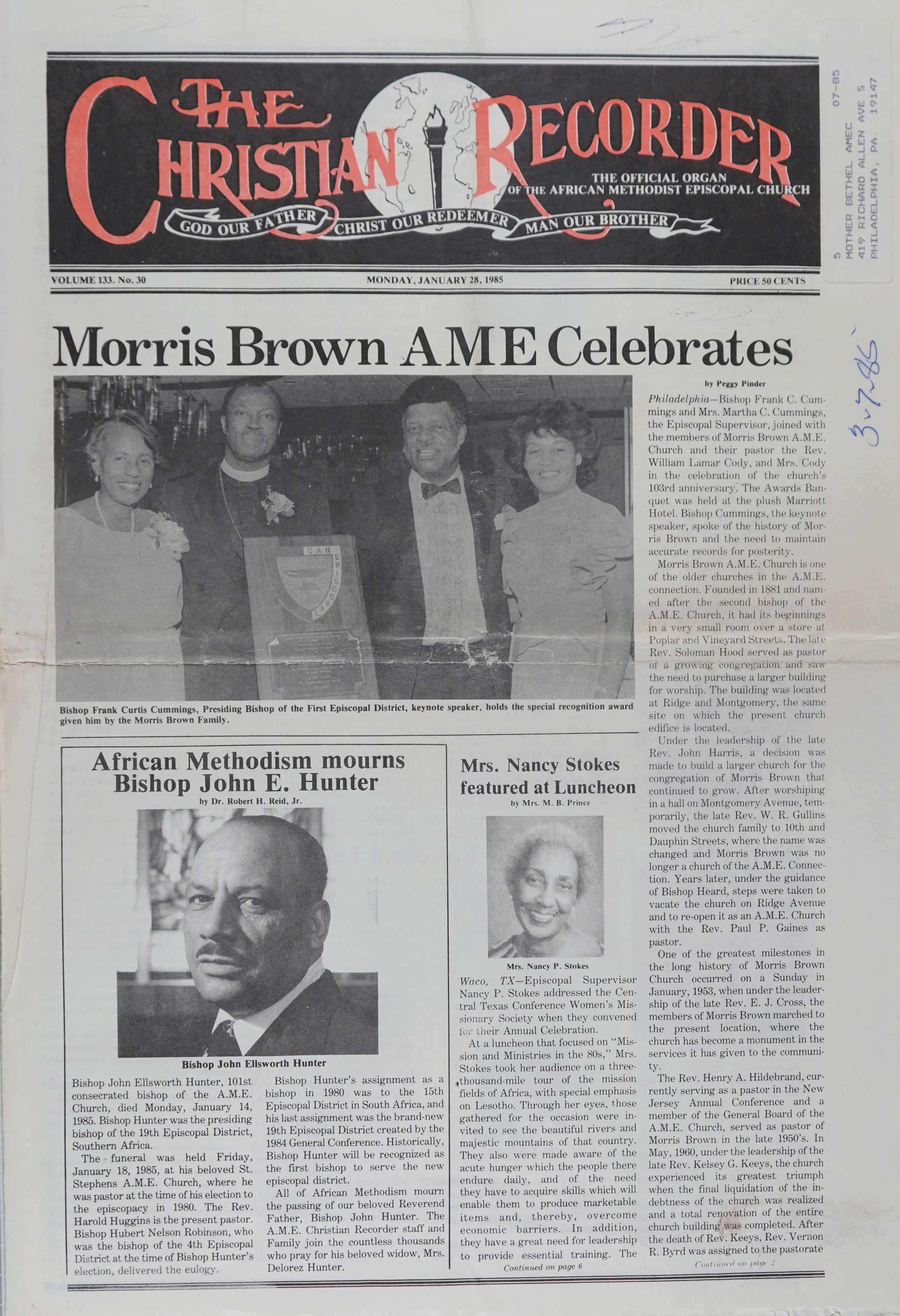
given him by the Morris Brown Family.
Bishop
Bishop John Ellsworth Hunter, 101st
consecrated bishop of the A.M.E.
Church, died Monday, January 14,
1985. Bishop Hunter was the presiding
bishop of the 19th Episcopal District,
Southern Africa.
The - funeral was held Friday,
January 18, 1985, at his beloved St.
Stephens A.M.E. Church, where he
was pastor at the time of his election to
the episcopacy in 1980. The Rev.
Harold Huggins is the present pastor.
Bishop Hubert Nelson Robinson, who
was the bishop of the 4th Episcopal
District at the time of Bishop Hunter’s
election, delivered the eulogy.
eS
Morris Brown
African Methodism mourns
John E. Hunter
by Dr. Robert H. Reid, Jr.
Bishop John Ellsworth Hunter
DECORDE
THE OFFICIAL
ORGAN
E AFRICAN METHODIST EPISCOPAL CHURCH
MONDAY, JANUARY 28, 1985
Bishop Frank Curtis Cummings, Presiding Bishop of the First Episcopal District, keynote speaker, holds the special recognition award
Bishop Hunter’s assignment as a
bishop in 1980 was to the 15th
Episcopal District in South Africa, and
his last assignment was the brand-new
19th Episcopal District created by the
1984 General Conference. Historically,
Bishop Hunter will be recognized as
the first bishop to serve the new
episcopal district.
All of African Methodism mourn
the passing of our beloved Reverend
Father, Bishop John Hunter. The
A.M.E. Christian Recorder staff and
Family join the countless thousands
who pray for his beloved widow, Mrs.
Delorez Hunter.
PRICE 50 CENTS
Mrs. Nancy Stokes
featured at Luncheon
by Mrs. M. B. Prince
Je
nite
Mrs. Nancy P. Stokes
Waco, TX—Episcopal Supervisor
Nancy P. Stokes addressed the Cen-
tral Texas Conference Women’s Mis-
sionary Society when they convened
for their Annual Celebration.
At a luncheon that focused on “Mis-
sion and Ministries in the 80s,” Mrs.
Stokes took her audience on a three-
athousand-mile tour of the mission
fields of Africa, with special emphasis
on Lesotho. Through her eyes, those
gathered for the occasion were in-
vited to see the beautiful rivers and
majestic mountains of that country.
They also were made aware of the
acute hunger which the people there
endure daily, and of the need
they have to acquire skills which will
enable them to produce marketable
items and, thereby, overcome
economic barriers. In addition,
they have a great need for leadership
to provide essential training. The
Continued on page 6
AME Celebrates
by Peggy Pinder
Philadelphia—Bishop Frank C. Cum-
mings and Mrs. Martha C. Cummings,
the Episcopal Supervisor, joined with
the members of Morris Brown A.M.E.
Church and their pastor the Rey.
William Lamar Cody, and Mrs. Cody
in the celebration of the church's
103rd anniversary. The Awards Ban-
quet was held at the plush Marriott
Hotel. Bishop Cummings, the keynote
speaker, spoke of the history of Mor-
ris Brown and the need to maintain
accurate records for posterity.
Morris Brown A.M.E. Church is one
of the older churches in the A.M.E.
connection. Founded in 1881 and nam-
ed after the second bishop of the
A.M.E. Church, it had its beginnings
in a very small room over a store at
Poplar and Vineyard Streets. The late
Rev. Soloman Hood served as pastor
of a groWing congregation and saw
the need to purchase a larger building
for worship. The building was located
at Ridge and Montgomery, the same
site on which the present church
edifice is located.
Under the leadership of the late
Rev. John Harris, a decision was
made to build a larger church for the
congregation of Morris Brown that
continued to grow. After worshiping
in a hall on Montgomery Avenue, tem-
porarily, the late Rev. W. R. Gullins
moved the church family to 10th and
Dauphin Streets, where the name was
changed and Morris Brown was no
longer a church of the A.M.E. Connec-
tion. Years later, under the guidance
of Bishop Heard, steps were taken to
vacate the church on Ridge Avenue
and to re-open it as an A.M.E. Church
with the Rev. Paul P. Gaines as
pastor.
One of the greatest milestones in
the long history of Morris Brown
Church occurred on a Sunday in
January, 1953, when under the leader-
ship of the late Rev. E. J. Cross, the
members of Morris Brown marched to
the present location, where the
church has become a monument in the
services it has given to the communi-
ty.
The Rey. Henry A. Hildebrand, cur-
rently serving as a pastor in the New
Jersey Annual Conference and a
member of the General Board of the
A.M.E. Church, served as pastor of
Morris Brown in the late 1950’s. In
May, 1960, under the leadership of the
late Rey. Kelsey G. Keeys, the church
experienced its greatest triumph
when the final liquidation of the in-
debtness of the church was realized
and a total renovation of the entire
church building was completed. After
the death of Rev. Keeys, Rev. Vernon
R. Byrd was assigned to the pastorate
Continned on page 2
eee aeons
5
=|
AMEC
EN
F
ALL
BETHEL
RICHARD
PHILADELPHIA
MOTHER
3-7
===== DSC04806.JPG =====
we
Continued from page 1
Morris Brown Celebrates
at Morris Brown and, under his
leadership, many new ideas were in-
itiated and carried out. The church ex-
tension and total renovation of the
sanctuary were completed, Rey. Byrd
was assigned to the New Jersey Con-
ference in the late 1970's and, in July
1984, was elected a bishop of the
A.M.E. Church, He is now presiding
over the 14th Episcopal District in
Africa.
The present pastor of Morris
Brown, Rev. Cody, began his
pastorate there in 1979. In 1982, the
Morris Family welcomed Mrs. Birdie
Cody, lovely bride of Pastor Cody,
and the family atmosphere of this great
church continues.
Pastor Cody presented Bishop
Cummings with a_— special
Humanitarian Award and said, “We
are looking forward to eight great
years with our new bishop.” Also, at
the gala celebration, the church
honored thirteen brothers and sisters
of the church: Mary E. Carter, Laura
Harmon, Louise Hickman, Yvonne
Hutchinson, Mildred W. Lowdermilk,
Janie Salley McCleary, Gilberta
Mock, John Marion Patton, Sr.,
Elizabeth White, Kevin H. Mayfield,
Sharon L. Pugh, Donna Melton and
Monique Michele Smith.
The Anniversary Committee, with
Sis. Mabel Frank serving as Chairper-
son, and Sis. Alice Rivers, Co-
Chairperson, did a splendid job of pro-
gramming the outstanding celebra-
tion of 103 years of service of a great
church,
9 Protestant churches
Nashville Banner
Baltimore—Representatives of nine
Protestant denominations, represen-
ting 23 million U.S. Christians, have
moved closer to a merger envisioned
for more than two decades by adop-
ting a theological consensus outlining
shared administration and ministry.
The 70-page statement, “In Quest
of a Church of Christ Uniting” was
approved Friday by 99 delegates to
the Consultation on Church Union, It
calls for a gradual convergence of all
Christian faiths, with a common or-
dained ministry and shared worship,
communion, administration and mis-
sions.
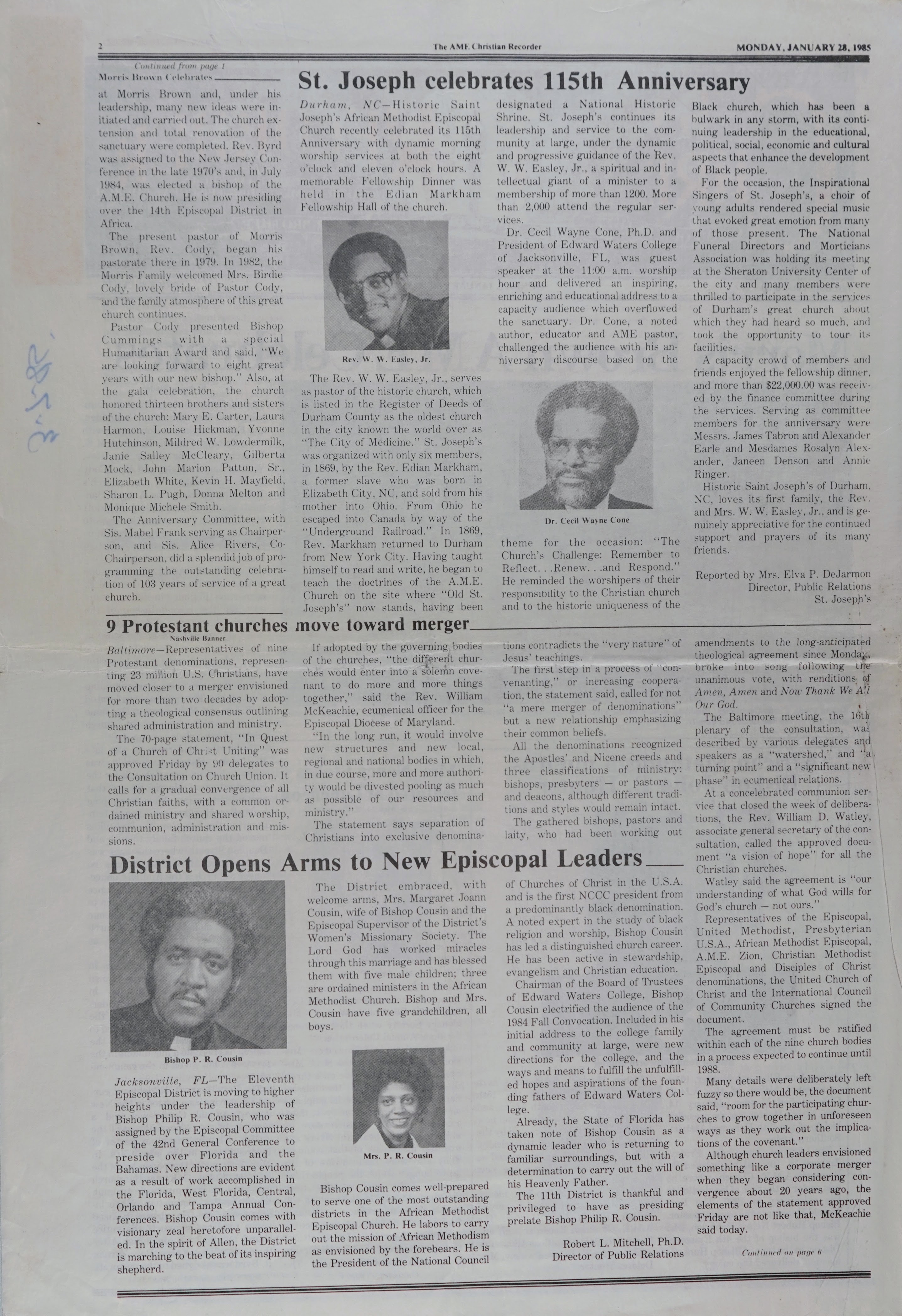
Bishop P. R. Cousin
Jacksonville, FL—The Eleventh
Episcopal District is moving to higher
heights under the leadership of
Bishop Philip R. Cousin, who was
assigned by the Episcopal Committee
of the 42nd General Conference to
preside over Florida and the
Bahamas. New directions are evident
as a result of work accomplished in
the Florida, West Florida, Central,
Orlando and Tampa Annual Con-
ferences. Bishop Cousin comes with
visionary zeal heretofore unparallel-
ed. In the spirit of Allen, the District
is marching to the beat of its inspiring
shepherd.
move toward merger
District Opens Ar
The AME Christian Recorder
MONDAY, JANUARY 28, 1985
St. Joseph celebrates 115th Anniversary
Durham, NC—Historie Saint
Joseph’s African Methodist Episcopal
Church recently celebrated its 115th
Anniversary with dynamic morning
worship services at both the eight
o'clock and eleven o'clock hours. A
memorable Fellowship Dinner was
held in the Edian Markham
Fellowship Hall of the church.
se
Rev. W. W. Easley, Jr.
The Rev. W. W. Easley, Jr., serves
as pastor of the historic church, which
is listed in the Register of Deeds of
Durham County as the oldest church
in the city known the world over as
“The City of Medicine.” St. Joseph’s
was organized with only six members,
in 1869, by the Rey. Edian Markham,
a former slave who was born in
Elizabeth City, NC, and sold from his
mother into Ohio. From Ohio he
escaped into Canada by way of the
“Underground Railroad.” In 1869,
Rev. Markham returned to Durham
from New York City. Having taught
himself to read and write, he began to
teach the doctrines of the A.M.E.
Church on the site where “Old St.
Joseph’s” now stands, having been
If adopted by the governing, bodies
of the churches, ‘‘the differerit chur-
ches would enter into a solemn cove-
nant to do more and more things
together,” said the Rev. William
McKeachie, ecumenical officer for the
Episcopal Diocese of Maryland.
“In the long run, it would involve
new structures and new local,
regional and national bodies in which,
in due course, more and more authori-
ty would be divested pooling as much
as possible of our resources and
ministry.”
The statement says separation of
Christians into exclusive denomina-
The District embraced, with
welcome arms, Mrs. Margaret Joann
Cousin, wife of Bishop Cousin and the
Episcopal Supervisor of the District’s
Women’s Missionary Society. The
Lord God has worked miracles
through this marriage and has blessed
them with five male children; three
are ordained ministers in the African
Methodist Church. Bishop and Mrs.
Cousin have five grandchildren, all
boys.
Mrs. P. R. Cousin
Bishop Cousin comes well-prepared
to serve one of the most outstanding
districts in the African Methodist
Episcopal Church. He labors to carry
out the mission of African Methodism
as envisioned by the forebears. He is
the President of the National Council
designated a National Historie
Shrine. St. Joseph’s continues its
leadership and service to the com-
munity at large, under the dynamic
and progressive guidance of the Rey.
W. W. Easley, Jr., a spiritual and in-
tellectual giant of a minister to a
membership of more than 1200, More
than 2,000 attend the regular ser-
vices,
Dr. Cecil Wayne Cone, Ph.D. and
President of Edward Waters College
of Jacksonville, FL, was guest
speaker at the 11:00 a.m. worship
hour and delivered an_ inspiring,
enriching and educational address to a
capacity audience which overflowed
the sanctuary. Dr. Cone, a noted
author, educator and AME pastor,
challenged the audience with his an-
niversary discourse based on the
Dr. Cecil Wayne Cone
theme for the occasion: ‘‘The
Church’s Challenge: Remember to
Reflect. ..Renew...and Respond.”
He reminded the worshipers of their
responsibility to the Christian church
and to the historic uniqueness of the
tions contradicts the “very nature” of
Jesus’ teachings.
The first step in a process of “‘con-
yenanting,” or increasing coopera-
tion, the statement said, called for not
“a mere merger of denominations”
but a new relationship emphasizing
their common beliefs.
All the denominations recognized
the Apostles’ and Nicene creeds and
three classifications of ministry:
bishops, presbyters — or pastors —
and deacons, although different tradi-
tions and styles would remain intact.
The gathered bishops, pastors and
laity, who had been working out
ms to New Episcopal Leaders __
of Churches of Christ in the U.S.A.
and is the first NCCC president from
a predominantly black denomination.
A noted expert in the study of black
religion and worship, Bishop Cousin
has led a distinguished church career.
He has been active in stewardship,
evangelism and Christian education.
Chairman of the Board of Trustees
of Edward Waters College, Bishop
Cousin electrified the audience of the
1984 Fall Convocation. Included in his
initial address to the college family
and community at large, were new
directions for the college, and the
ways and means to fulfill the unfulfill-
ed hopes and aspirations of the foun-
ding fathers of Edward Waters Col-
lege.
Already, the State of Florida has
taken note of Bishop Cousin as a
dynamic leader who is returning to
familiar surroundings, but with a
determination to carry out the will of
his Heavenly Father.
The 11th District is thankful and
privileged to have as presiding
prelate Bishop Philip R. Cousin.
Robert L. Mitchell, Ph.D.
Director of Public Relations
Black church, which has been a
bulwark in any storm, with its conti-
nuing leadership in the educational,
political, social, economic and cultural
aspects that enhance the development
of Black people.
For the oceasion, the Inspirational
Singers of St. Joseph’s, a choir of
young adults rendered special music
that evoked great emotion from many
of those present. The National
Funeral Directors and Morticians
Association was holding its meeting
at the Sheraton University Center of
the city and many members were
thrilled to participate in the services
of Durham’s great church about
which they had heard so much, and
took the opportunity to tour its
facilities.
A capacity crowd of members and
friends enjoyed the fellowship dinner,
and more than $22,000.00 was receiv-
ed by the finance committee during
the services. Serving as committee
members for the anniversary were
Messrs. James Tabron and Alexander
Earle and Mesdames Rosalyn Alex-
ander, Janeen Denson and Annie
Ringer.
Historic Saint Joseph's of Durham,
NC, loves its first family, the Rev.
and Mrs. W. W. Easley, Jr., and is ge-
nuinely appreciative for the continued
support and prayers of its many
friends.
Reported by Mrs. Elva P. DeJarmon
Director, Public Relations
St. Joseph’s
or
amendments to the long-anticipated
theological agreement since Mondays,
broke into song following tre
unanimous vote, with See
Amen, Amen and Now Thank We All
Our God. ‘
The Baltimore meeting, the 16th
plenary of the consultation, was
described by various delegates and
speakers as a ‘watershed,’ and “a}
turning point” and a “significant new |
phase” in ecumenical relations.
At a concelebrated communion ser- |
vice that closed the week of delibera- |
tions, the Rev. William D. Watley, |
associate general secretary of the con- |
sultation, called the approved docu-
ment ‘‘a vision of hope” for all the
Christian churches.
Watley said the agreement is “our
understanding of what God wills for
God’s church — not ours.”
Representatives of the Episcopal,
United Methodist, Presbyterian
U.S.A., African Methodist Episcopal,
AM.E. Zion, Christian Methodist
Episcopal and Disciples of Christ
denominations, the United Church of
Christ and the International Council
of Community Churches signed the
document.
The agreement must be ratified
within each of the nine church bodies
in a process expected to continue until
1988.
Many details were deliberately left
fuzzy so there would be, the document
said, “room for the participating chur-
ches to grow together in unforeseen
ways as they work out the implica-
tions of the covenant.”
Although church leaders envisioned
something like a corporate merger
when they began considering con-
vergence about 20 years ago, the
elements of the statement approved
Friday are not like that, McKeachie
said today.
Continued on page 6
C—O
===== DSC04807.JPG =====
MONDAY, JANUARY 28, 1985
The AME Christian Recorder
The Word of God Preached sua==ee
Rev. Winton M. Hill, I
Reverend Winton M. Hill electrified
the South Ohio Annual Conference as
he preached the Annual Sermon. He
was a master of description. The
spirit was high and the word was
preached. Reverend Hill took Genesis
26P:18 as a text. Subject: The Wells
From Which Our Father Drank.
Bishop Richard Allen Hildebrand,
Mrs. Hildebrand, Presiding Elders,
Pastors, Women’s Missionary Society
leaders, to the leadership of the Lay
Organization, my Christian brothers
and sisters.
I greet you in the name of Jesus. I
thank Bishop Hildebrand and the
Presiding Elders for recommending
me to preach the annual sermon for
the South Ohio Annual Conference.
It is with great anxiety that I ap-
proach this opportunity, not so much
because it is the annual sermon but
because it is the “word of God,” to be
shared among the people of God. I
pray sincerely and I invite you to pray
with me, as I attempt to share the
“Word,”
Remember well, the wells from
which our fathers drank.
Text: Genesis 26:18 .. And Isaac
digged again the wells of water, which
they had digged in the days of
Abraham his father; for the
Philistines had stopped them after the
death of Abraham: and he called their
names after the names by which his
father had called them.
It is interesting that we find that
Isaac comes and again he digs the
same wells.
We should note that he does not dig
new wells, instead he goes to the spot
where the proven wells were. Isaac
had enough sense to know that what
his father had found to be good to him
would also be good to him. I’m from
North Carolina, you know, as a little
boy sometimes in the summer our
pumps would go a little dry and every
now and then my grandfather would
move the pump to a new location; but
more often than not, he would simply
leave a can of water next to the pump.
As we moved the handle up and down
no water into the pump and the water
would come up. Isaac knew that
is was easier to draw water from-
proyen wells, than from new wells.
Isac also knew that the wells of the
father were wells rich in sentiment.
When Isaac went back to where he
had been with Abraham, old
memories awoke. The water he drank
not only quenched the thirst of body,
but of spirit as well.
The first well he named Esek, which
means contention: The second well he
named Sitnah, which means enmity:
The third well, the herdsmen of Gerar
did not follow, he named Rehoboth,
which means enlargement, and he
said, “For now the Lord has made
News from the Northwest Texas Conference
* (The Northwest Texas under the
direction of Rev, 1. C. Cooper,
Presiding Elder, met in a planning
meeting with ministers, officers and
laity of the conference on Saturday,
November 10, 1984, at Gospel Chapel
African Methodist Episcopal Church,
Slaton, TX. Rev. Edwin N. Scott,
pastor, served as host.
At 10:00 am., Presiding Elder
Cooper and ministers assembled for
business of the day.
First on the agenda was the reaffir
mation and appointment of officers.
Secretary, Rev. W. L. Woodfaulk,
Assistant Secretary, Mrs. Al Pearl
Jones, Conference Dean, Rev. C. L.
Boyd, District Dean, Elmer Wright,
Associate, Rev. Leo Smith, Sunday
School Superintendent, Mr. Cecil
Houston, Assistant, Ms. Louise
Hardeman, District Musician, Mrs.
Fannie Burnett, Assistant, Mrs. W.
L. Woodfaulk.
Minutes were read for information,
The high noon worship service con
ducted by Rev. I, C, Cooper,
Presiding Elder, was excellent and
highly spiritual. The call to worship
was done by Rev. Chenault, pastor of
Johnson Chapel, Amarillo, TX. Hymn
was lined by Rev. H. G Williams,
pastor of Allen Chapel, Snyder,
prayer rendered by Rev. Floyd
Green, pastor, Simms Chapel, Stam
ford, TX. Rev. Caiaphai Cain, pastor
at Fabens, read the Old Testament
scripture, Rev, E. L, Wright, pastor,
Lee Chapel, Brownwood, read the
New Testament The
decalogue was given by Rev M. L.
Goffney, pastor, St. Matthews,
Monohans, TX.
Presiding Elder Cooper presented
Vernard Leaks,
scripture.
the speaker, Rev
pastor, Tyree Chapel, Ballenger, TX.
Rev. Leaks’ seripture was taken from
1 Kings 21st chapter. He chose as a
subject: The Boomerang. This was a
message that touched the hearts and
souls of all present. Rev. Leaks said
to the congregation, “to work
together. If we do not work together,
we will not reap the harvest.”
Before the close of the meeting,
Presiding Elder Cooper gave impor-
tant dates of meetings to be held. The
are: Planning Meeting, November 2,
1985, Bethel A.M.E, Church, Sweet
water, TX. District
March 15, 1985, Greater St. Paul, San
Angelo, TX, Sunday School Conven
tion and Continuing Education
Workshop, June 12-14, 1985, Greater
St. Luke, Midland, TX. Founder's
Day, Paul Quinn, February 20-21,
1985, Waco, TX. Tenth District
Budget, May 15-16, 1985
Hats off to Presiding Elder Cooper
for a job well done thus far He is a
man of God, a jewel for the Northwest
Texas Conference, and a most inform
ed and dignified leader, He } as his
work together. Amen,
Conference,
The Missionary Society of the
Northwest Texas Conference under
the direction of Mrs, Ellen Ann
Smith, Conference President, met ina
yearly Planning Meeting on Saturday,
November 17, 1984, at Baker Chapel
African Methodist Episcopal Church,
TX, Rev. D. Edwin
Johnson is the pastor
Registration was headed by Florine
Goffney of St Matthews, Monohans,
TX
The meeting opened with a spirited
worship period led by Mrs. Al Pearl
sig Spring,
—————— —
room for us, and we shall be fruitful in
the land.”
Every good person’s life must seek
to be like Isaac, in that it would not
want to maintain itself at the place of
contention or strife, but will seek the
place where peaceful happiness may
be enlarged. The miracle is not that
God provided water in the desert —
God can do anything — the miracle is
that from Rehoboth, he went up to
Beersheba and here for the first time
appear the Words which are to echo
and re-echo in the Bible — ‘“‘The God
of Abraham.” The full reality of God,
no language can describe ‘I am that I
am.” But the meaning of God for any
generation may be largely determin-
ed by what the preceding generation
has known.
We often respond in like manner as
reflected in our songs of faith.
“T still remember mother’s prayer”
or “Faith of our fathers.”’ Think of the
enrichment which comes to a child
when God is first of all “my father’s
God,” the God of Abraham: from the
beginning the Jewish people
understood that and built their faith
upon it. Religious inheritance which is
transmitted through individuals, and
through families, may become em-
bodied in a nation. Consider the im-
measurable results in history of the
fact that for the Jewish race the God-
to be worshipped and obeyed was the
God of Abraham.
Like the children of Israel we in the
African Methodist Episcopal Church,
we progress on our pilgrim journey,
are not without a past. We have a
patriarch in Richard Allen. He was
born February 14, 1760 at
Philadelphia, PA, born a slave to a
Quaker lawyer the Hanorable Ben-
jamin Chew, Chief Justice of the Com-
mon Wealth of PA.
Later sold to Farmer Stokely, sold
as property, much in the fashion of
horses, pigs or sheep. Like father
Abraham, Richard Allen slaved a uni-
que, intimate like altering relation-
ship with the Divine. He said, of his
experience in slavery ‘‘I had it often
impressed upon my mind that I
should one day enjoy my freedom; for
slavery is a bitter pill.”
The old old story had been
transformed through the dynamics of
the Holy Spirit into the new wine.
Through the act of converting a slave,
freeing him from bondage God had
begun the process of creating a new
wine skin. Capable of containing and
disseminating the invigorating Gospel
of liberation, which taught that Jesus
Christ was born, live, died and resur-
rected to end evil. And further defin-
ed slavery and those who promoted,
profited from it or accepted it as evil.
This new revelation of God would
determine and influence the popular
piety of African Americans for the
next 200 years. Men, women, boys
and girls would be heard singing in
fields of slavery songs of hope and
liberation. People who never heard
the name Richard Allen, would catch
the fever of liberation theology and
proclaim “I got shoes, you got shoes,
all God’s children got shoes.”’ Many of
the people who sang these songs
would never literally wear shoes, but
they understood that God had reveal-
ed to them through the vision of
Richard Allen that they were “the
people of God.”
Not only did God convert and free
Richard Allen but he also led him to
Covtimnwd an page &
Echoes from the 13th
Rev. C. E. Jenkins, Sr.
Public Relations
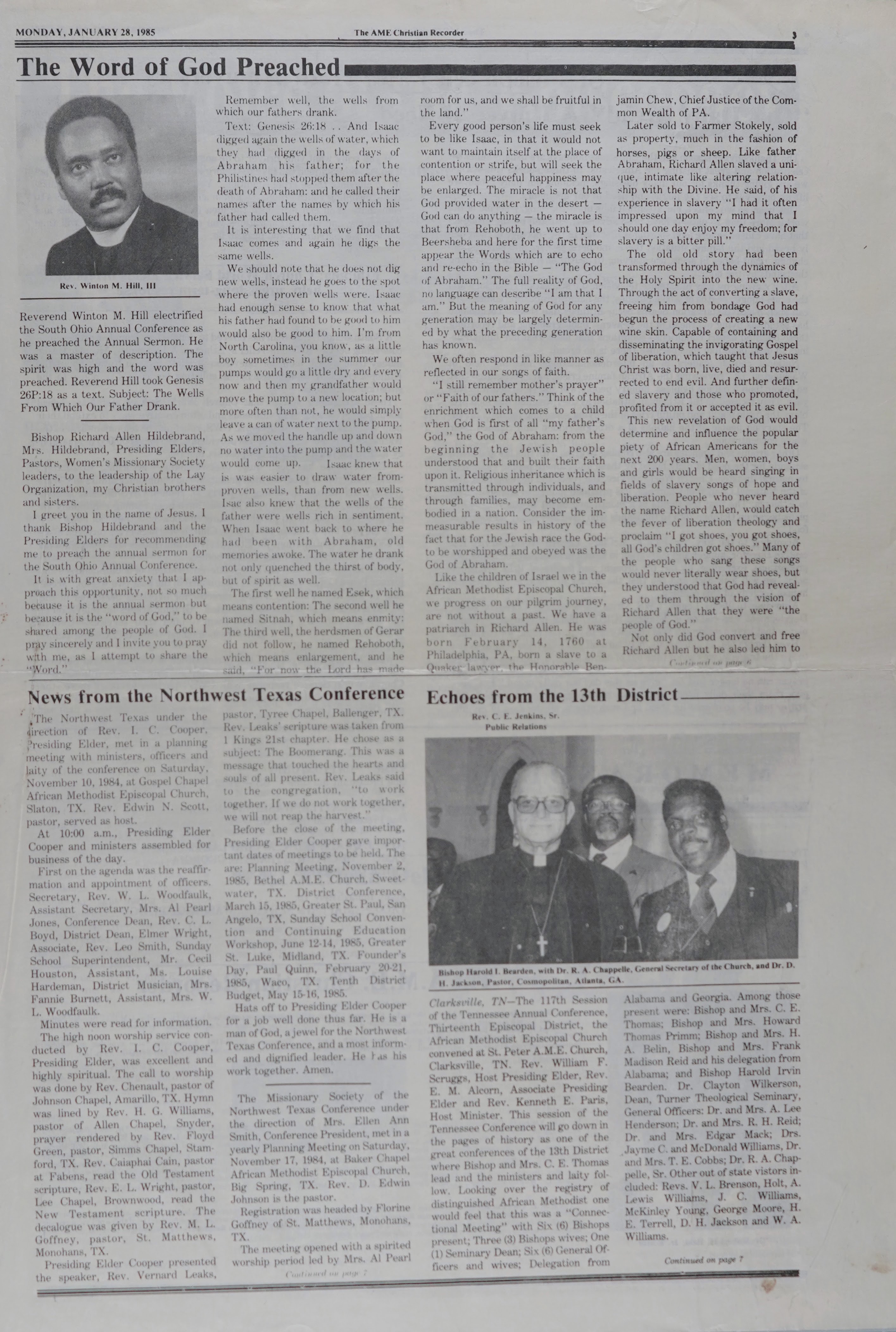
Bishop Harold |. Bearden, with Dr, R. A. Chappelle, General Secretary of the Church, and Dr, D,
District
H. Jackson, Paster, Cosmopolitan, Atlanta, GA.
Clarksville, TN—The 117th Session
of the Tennessee Annual] Conference,
Thirteenth Episcopal District, the
African Methodist Episcopal Church
convened at St, Peter A.M.E, Church,
Clarksville, TN. Rev, William F.
Scruggs, Host Presiding Elder, Rev.
E. M. Aleorn, Associate Presiding
Elder and Rev. Kenneth E. Paris,
Host Minister. This session of the
Tennessee Conference will go down in
the pages of history as one of the
great conferences of the 18th District
where Bishop and Mrs, C, E Thomas
lead and the ministers and laity fol
low. Looking over the registry of
distinguished African Methodist one
would feel that this was a “Connec
tional Meeting” with Six (6) Bishops
present; Three (8) Bishops wives; One
(1) Seminary Dean; Six (6) General Of
‘ from
ficers and wi ation
Alabama and Georgia. Among those
present were: Bishop and Mrs, C. E.
Thomas; Bishop and Mrs, Howard
Thomas Primm; Bishop and Mrs. H.
A. Belin, Bishop and Mrs. Frank
Madison Reid and his delegation from
Alabama; and Bishop Harold Irvin
Bearden, Dr, Clayton Wilkerson,
Dean, Turner Theological Seminary,
General Officers: Dr. and Mrs. A. Lee
Henderson; Dr. and Mrs. R, H. Reid;
Dr. and Mrs, Edgar Mack; Drs.
Jayme C. and McDonald Williams, Dr.
and Mrs. T. E. Cobbs; Dr. R. A. Chap-
pelle, Sr. Other out of state vistors in-
eluded: Revs. V. L. Brenson, Holt, pe
Lewis Williams, J. C. Williams,
McKinley Young, George Moore, H,
£. Terrell, D. H, Jaekson and W. A.
Williams.
Coutinwed om page
===== DSC04808.JPG =====
The AME Christian Recorder
MONDAY, JANUARY 28, 1985
EDITORIAL
**Our Daily Bread’’ A Universal Need
The Thanksgiving season and the Christmas holidays are usually times for
celebration and great feasting for Americans. In these special times when
we are giving thanks for our many blessings, including our daily bread, we
lift up our eyes to see the plight and need of our neighbors.
This year, as we reflect, our attention falls upon the hungry people of the
world. More than 25 nations have been adversely affected by the droughts
that have caused severe food shortages. Because of the shortage of their dai-
ly bread and the famine situation there, mothers, fathers and children, in-
cluding infant babes in arms, are starving to death. This ill fate is claiming
thousands by the hour.
After viewing by way of satellite television the starvation conditions and
the cruel hunger deaths of whole families, the haunting question comes, how
ean such massive starvation deaths occur in times like these? Technology
has satellites flying overhead in the heavens, photographing and recording
these blighted desert conditions—conditions that allow real live human be-
ings to drop dead like flies because there is no bread.
National church leaders in an interdenominational meeting held in
Washington, DC, reviewing the African famine crisis, have recognized that
no fewer than 5 million helpless, hungry people will starve to death in this
year. They focused on the Ethiopian situation as they weighed this food pro-
blem, the futile plight and pitiful cries of the dying searching for daily bread.
The starving people of the nations of a drought-ridden land claimed their
whole concentration.
Other groups and agencies are also coming to grips with this life and death
struggle for the need of daily bread by these unfortunate people victimized
by natural disaster. Church World Service, the relief and development arm
of the National Council of Churches, has provided money to transport food
to Ethiopia. The first ten flights of a month-long airlift to starving Ethio-
pians began on October 26th to thousands who have absolutely no source of
food.
According to the Rev. Dr. Paul F. McClary, Church World Service Ex-
ecutive Director, hunger and starvation in Ethiopia have reached mammoth
proportions, exceeding, by far, the drought and famine of 1973. “At some
point, we will look back and see that the Africa situation is the greatest
human tragedy of this century.”
According to Willis Logan, CWS Africa Director, the Christian Relief
Development Association of Ethiopia (CRDA) plans to charter Hercules
planes that have a maximum load capacity of 18 tons per flight for the aiflift.
Even though we, as individuals, may turn off our television sets so as not
to see the tragedy, we cannot tune out of our minds this international bread
crisis. When you carve your turkey and slice that sugar-cured ham, your
prayer can no longer just be, “‘give us this day our daily bread,” but, also,
give them their daily needs; and make me an instrument by which this
prayer may be answered for them and such others, all the days of my life.
If you truly want your prayer to be answered, you ean help to make it so,
You, as an individual, can give to the organizations and agencies that are set
up to alleviate these cruel conditions, You can encourage church organiza
tions, including youth groups, to join in a concerted effort to raise monies to
contribute. You can introduce the idea to the fraternities, sororities and
community and civic organizations you are affiliated with. You will then
become the instrument you pray to be.
Ethiopia: Church World Service Fields offers of
help, urges long-term response
A South Bend, IN, woman has offered to donate fees from her professional
counseling service to famine relief in Ethiopia. A Fairbanks, AK, man raised
money from a local bank for television air time for him to talk about the
Ethiopia crisis. A Florida teacher is enlisting her class’s response to the
situation in Ethiopia.
These are among stories that Church World Service staff have heard
about people seeking in spontaneous and often creative ways to extend their
help to starving people in Ethiopia. CWS, relief and development arm of the
National Council of Churches, has provided more than $500,000 in emergen-
cy assistance to Ethiopia in the past six months.
“The response has been quite overwhelming,” according to John F.
Schultz, director of program interpretation and community affairs in CWS’s
Elkhart, IN offices. According to Larry D. Hollon, CWS director of com-
munications, New York City, “The calls have been coming continually for
the past two weeks from people wanting to know how they can help.”
In the first two weeks of November, Church World Service received near-
ly $300,000 in contributions for Ethiopia from individuals and from National
Council of Churches member church bodies.
Other kinds of help also have been offered. “Dozens of doctors, nurses and
former Peace Corps workers have telephoned in the past two weeks,” accor-
ding to the Rev. Paul W. Young, director for overseas personnel in the
NCCC’s Division of Overseas Ministries. “Graphic scenes on television of
the terrible suffering have moved them to offer their services.’’ Church
World Service will send a four-person medical team to Ethiopia before
Christmas, Hollon said. f
Willis H. Logan, director of the Africa Office of Church World Service,
traveled to Ethiopia to discuss that country’s long-term food needs and ~
Church World Service response with CWS’s partner agencies there—the
Christian Relief and Development Association of Ethiopia and the Ethio-
pian Orthodox Church.
MEMORANDUM
TO: AME Christian Recorder
FROM: Office of Ecumenical Relations and Urban Affairs
The Rt. Reverend Vinton R. Anderson, Bishop
RE: VACANCY ANNOUNCEMENTS FOR CHAPLAINS IN
VETERANS ADMINISTRATION HOSPITALS
VAMC DAYTON, OHIO
One Protestant full time GS — 11/12
VAMC SEATTLE, WASHINGTON
One Protestant full time GS — 11
TO ALL QUALIFIED V. A. CHAPLAINS:
VAMC DECATUR (ATLANTA), GEORGIA
CHIEF OF SERVICE GM—13
Apply Immediately To:
VACO — CHAPLAIN SERVICE, WASHINGTON, DC
The A.M.E. Christian Recorder
nist; Mrs. Sheridan Reid
Editor.
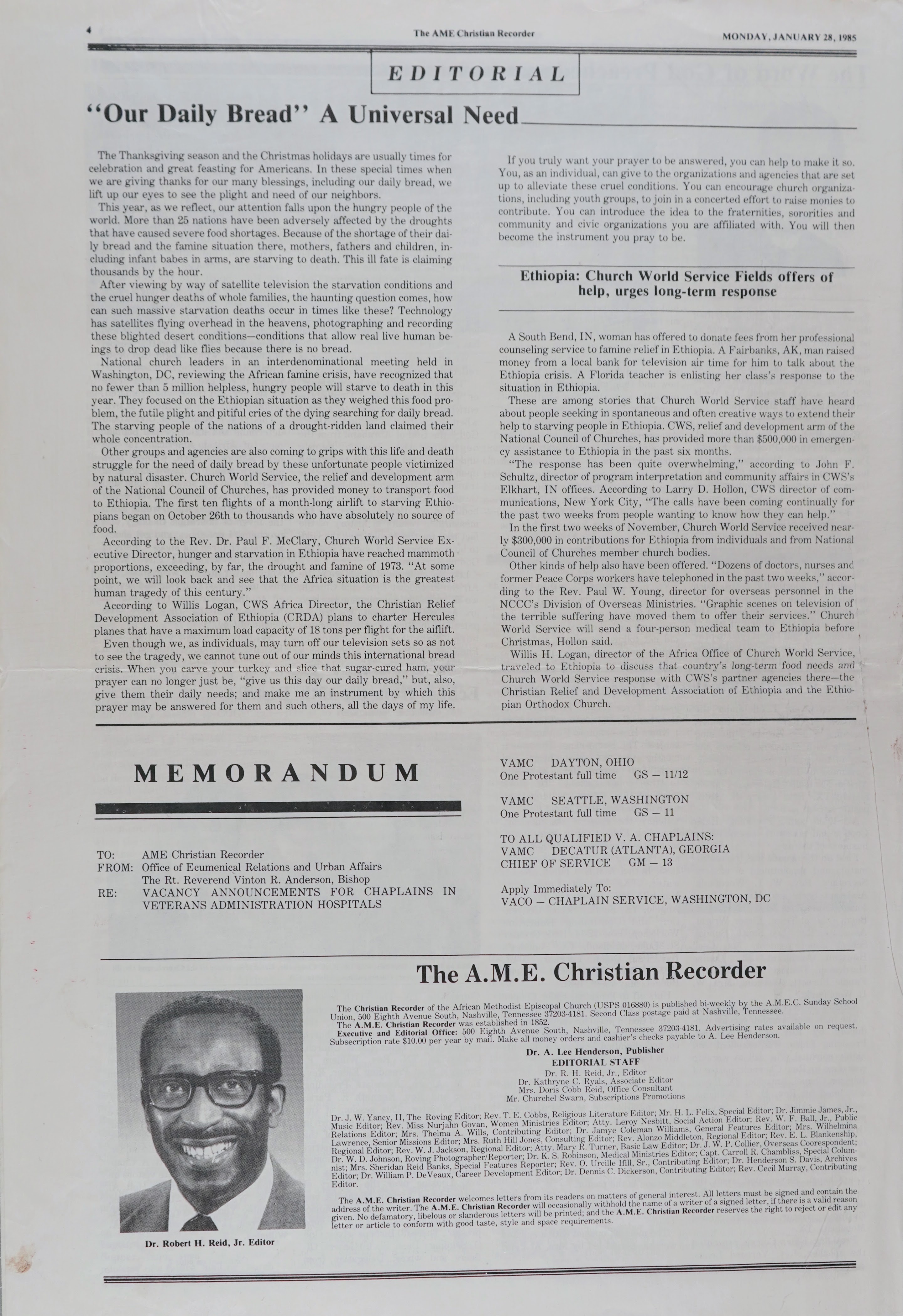
Dr. Robert H. Reid, Jr. Editor
é ss of t vriter. The A.M.E. Christian i > name of genet : ‘
given, No delamatory libelous or slanderous letters will be printed; and the A.M.E. Christian Recorder reserves the right to reject or edit any
e
tter or article to conform with good taste, style and space requirements.
The Christian Recorder of the African Methodist Episcopal Church (USPS 016880) is published bi-weekly by the A.M.E.C. Sunday School
Union, 500 Eighth Avenue South, Nashville, Tennessee 37203-4181. Second Class postage paid at Nashville, ‘Tennessee.
The A.M.E. Christian Recorder was established in 1852.
Executive and Editorial Office: 500 Eis
Subsecription rate $10.00 per year by mail.
hth Avenue South, Nashville, Tennessee 37203-4181. Advertising rates available on request.
Make all money orders and cashier’s checks payable to A. Lee Henderson.
Dr. A. Lee Henderson, Publisher
EDITORIAL STAFF
Dr. R. H. Reid, Jr., Editor
Dr. Kathryne C. Ryals, Associate Editor
Mrs. Doris Cobb Reid, Office Consultant
Mr. Churchel Swarn, Subscriptions Promotions
i i 5. C igious Literature Editor; Mr: ‘elix iz itor; Dr. Jimmie James, Jr.,
_J.W. Yancy, II, The Roving Editor; Rev. T. E. Cobbs, Religious Literature Editor; Mr. H. L. Felix, Special Editor i Jimn : Jr.
Muse Eiiton! ev. Miss Nurjahn Govan, Women Ministries Editor; Atty. Leroy Nesbitt, Social Action Editor; Rat # SF pues
Relations Editor; Mrs. Thelma A. Wills, Contributing Editor; Dr. Jamye Coleman Williams, General Features pe it tan i ee a
Lawrence Senior Missions Editor; Mrs. Ruth Hill Jones, Consulting Editor; Rev. Alonzo Middleton, Re ional Editor; ev. E. . lan ed
Regional Editor; Rev. W. J. Jackson, Regional Editor; Atty. Mary R. Turner, Basic Law Editor; Dr. J. . P. Collier, Overseas Eo es ceaae c
Dr. W. D. Johnson a Photo ene et Dr. K. S. one Marae ee ie a, Carroll Fy Chaat Pe inh gages
t; Mrs. : anks rial Features Reporter; Rev. O. Urcille Ifill, Sr., Contributing Maiko Py Es rson S. s, Archives
Editor; Dr. William P. erate ae Davelopinent Editor; Dr. Dennis C. Dickerson, Contributing Editor; Rev. Cecil Murray, Contributing
its readers atters ral interes ] letters must be signed and contain the
isti der welcomes letters from its readers on matters of general interest. All let 3 sand Cor ;
Tues aca ey Chrisuail Ker orvet Recorder will occasionally withhold the name of a writer of a signed letter, if there is a valid reason
ene
===== DSC04809.JPG =====
MONDAY, JANUARY 28, 1985
The AME Christian Recorder
The Voice of the Episcopac
Bishop H. H. Brookins
Bishop Brookins
presides at West
Arkansas Conference
Magnolia, AR—With the Rt. Rev. H.
H. Brookins, Bishop of the 12th
Episcopal District, presiding, the
West Arkansas Annual Conference
opened at St. Phillips A.M.E. Church.
The Rev. R. J. Hampton, pastor of
Visitors Chapel A.M.E. Church, Hot
Springs, delivered the annual sermon
on “Attitudes That Sustain; Faith to
Endure.” Using a text from Psalms
27, Rev. Hampton was at his best as
he stirred the congregation to a
spiritual high.
As he set the conference in motion,
Bishop Brookins challenged the con-
stituency to a new direction, spiritual-
ly and economically. The bishop said
that “we are worshiping like the
white man used to worship, and the
white man is worshiping like we used
‘to worship.” He charged the West to
‘put back into the church what used to
be there. He further challenged the
’ West Arkansas Annual Conference to
er
join in the economic development pro-
gram that has been implemented for
the 12th Episcopal District.
The Conference was well attended
by members and visitors from across
the Twelfth District, and was graced
with the distinguished presence of Dr.
G. H. J. Thibodeaux, a general officer
and Director of Evangelism. Dr.
Thibodeaux brought the message on
Wednesday night during the Upper
Room experience. On Thursday after-
noon, the Rt. Rev. Decatur Ward
Nichols, retired Senior Bishop of the
African Methodist Episcopal Church,
preached; and Rev. (“Gate Mouth”’)
Moore from the Highth Episcopal
District was the Thursday night
preacher. The Rev. J. R. Williams did
a superb job with the musical in-
struments. “J. R.” really “put things
in order.”
Other features of the Conference in-
cluded the Missionary ‘Night in
White,” which was a beautiful occa-
sion, as the women of the church
reflected on its heritage in songs. Two
young men were admitted to the an-
nual conference on trial to preach, and
four others were elected and ordained
Deacons of the church.
With a message on “New People in
a New World,” Bishop Brookins clos-
ed out the conference on Sunday,
preaching from Revelations 21:1. The
spirit was high all week, and it is ob-
vious that the West Arkansas Annual
Conference is on its way!
Rev. Thomas W. Adair, Reporter
Bishop Morris
Bishop S. S. Morris
Chicago, IL—Tonight is an occasion
for remembering and reflection on an
event in the life of David, found in 2nd
Samuel 23:13-17. A tired army com-
mander, weary with a day of march
and conflict, sits before a campfire
remembering earlier, more pleasant
times. Cold food and flat, tepid water
from his canteen, nudge memory into
a barely audible ery—“Oh that one
would give me to drink from the well
of Bethlehem.’”’ Unknown to him
three of his bodyguards overheard his
ery. Slipping quietly away, they went
through the lines of Philistines sur-
rounding the city and returned,
undetected, with a vessel filled with
fresh water from the spring. They
took it to David. He would not drink.
“Should I drink of the blood of the
men who went at the risk of their
lives?” and he “poured it out unto the
Lord.”
No more can we consume for our
personal pleasure and_ satisfaction
that which represents the fruits of
sacrifice and struggle of others. The
water from the spring in Bethlehem is
West African Delegates meet with Bishop Byrd
Liberia—In a
session. West
Monrovia,
conference
pre-
African
delegates met with the bishop-elect of
the 14th Episcopal District, the Rt.
Rev. Vernon R. Byrd. On a hot Thurs-
day afternoon, a gentle breeze blow-
ing in from a nearby ocean became a
part of a beautiful atmosphere of love
and welcome for the District’s new
episcopal leaders.
Bishop V. R. Byrd
The Prelate
Mother Byrd
Episcopal Supervisor
Devotions having been held and
proper introductions made, Bishop
Byrd continued the meeting with the
reading of a resolution from the
District Laymen which proclaimed
that the 14th District can no longer af-
ford absentee episcopal leadership, a
rr
sets District Objectives
too precious a gift to be profaned by
common usage. “It’s only water,”
some will say. “Drink it; it was
brought for you,” say others.
The water drawn from the agony of
years of slavery and struggle is fit on-
ly to be “poured out unto the Lord,”
the God of our weary years and silent
tears.
So, tonight, we gather to initiate
our Fund for Human Services. To
those unaware, unseeing, unknowing,
it is only water—and that scarcely
enough to satisfy the needs and
desires of one person. It is nothing
when poured into the sea of human
need.
For us, it is a concrete expression of
the historic and continuing commit-
ment of the A.M.E. Church to pro-
phetic witness and service. The Fund
is one response of a Black church in a
white society to the question of what
the church can and should do today
that has immediate and ultimate
worth. A shrug of the shoulders will
not do, nor will the callous reply of the
cynic “So it was in the beginning, so it
is now, and so it ever shall be.”
The Fund is an expression of the
calling, right and duty encumbent on
Black Christians, as they collectively
respond to the will of God, by speak-
ing and acting in the public arena on
public issues. Through this Fund, a
continuing effort will be made to
relieve human suffering, and to do so
in ways that attack the cause as well
as ameliorate the symptoms.
Admittedly this commitment is a
touchy issue at this moment in na-
&
Pictured here are delegates from Ghana, Nigeria, Sierra Leone and Liberia. Also, in this setting
tional history. The high visibility and
vociferous cries from the religious
right seek to deter those who wish to
do more than bind up the wounded
and comfort the broken hearted.
Black churches cannot be turned
aside from their mission; they need
make no apology for this ready will-
ingness to identify, define and
describe public issues, to propose
solutions, and initiate action deemed
appropriate for their resolution.
This is risky business. Such a
posture readily lends itself to the
assumption of final, ultimate, divine
wisdom and authority before which all
must bow. Always the church must
speak and act in light of its highest
level of understanding, but in full
awareness of its limitation in wisdom
and knowledge, of its own complicity
in situations it seeks to address and
change, and its own sinfulness. Yet,
like Nat Turner, the Black church can
do no other than take the risk, read
and interpret the signs revealed in
ears of corn, then speak and act with
courage and conviction. ;
Twin criticisms are leveled at Black
churches: their purpose being to com-
pel withdrawal from the debate over
public issues such as, the racism ram-
pant in every area of American life,
the proliferation of nuclear weapons,
environmental pollution, hunger,
population growth, energy, the
economic dislocation resulting from
massive military expenditures,
unemployment, the social impact of
new technologies, genetic experimen-
tation, ete.
Continued on page é
are Mother Theora L. Byrd, Episcopal Supervisor; Mrs. Randal, Overseas Connectional B'S OK
Director; and Mrs. L. C. York, President of Monrovia Coilege.
matter to which the General Church
has given serious attention. Bishop
Byrd proceeded to appoint an
Episcopal Residence Committee to
seek a proper place for the housing of
the family. As of this
writing, temporary quarters have
been secured and negotiations for a
permanent residence are well under
way.
Those attending the meeting heard
each delegation from the respective
countries outline their needs and con-
cerns. A common request was that
the Bishop and the Supervisor make
pre-conference visits to their coun-
tries. Further, reports revealed that
episcopal
2000 AMEs had been lost in Nigeria.
Bishop Byrd pledged to visit each
country and conduct a Crusade For
Christ and for new members for the
Church of Richard Allen.
Bishop Byrd assured the West
African delegates that prayerful and
financial support would be forthcom-
ing from their sisters and brothers in
America. Following beautiful
remarks by the Episcopal Supervisor,
Mother Theora Byrd, the meeting
was closed in an aura of great an-
ticipation. PRAISE GOD!
Rev. George Wilson
Secretary/Reporter
===== DSC04810.JPG =====
the AME Christian Recorder
MONDAY, JANUARY 28, 1985
A dinner was held for the members of the Executive Board of the Connectional Lay Organization,
The Board of Incorporators of the
African Methodist Episcopal Church
met Friday, November 16, 1984, at
the A.M.E. Sunday School Union, 500
8th Avenue South, Dr. A. Lee
Henderson, Secretary-Treasurer. The
President or Chairman of the Board is
Bishop Richard Allen Hildebrand,
Presiding Bishop of the 3rd Episcopal
District.
The following members of the
Board of Incorporators were present,
namely, (Left to Right) Dr. Jamye C.
Williams, Secretary; Bishop Richard
Allen Hildebrand, President; Rev.
David Harris, Ft. Worth, TX; Mr.
Robert Butler, Treasurer, Cleveland,
OH; Dr. R. A. Chappelle, Church
Secretary, St. Louis, MO; Rev. E. L.
Daniels, Thomasville, GA; Judge
Revius Ortigue, New Orleans, LA;
Dr. Martin L. Simmons, Detroit, MI;
Atty. Christopher Mercer, General
Counsel A.M.E. Church, Little Rock,
AR; Dr. Joseph C. McKinney,
Treasurer A.M.E. Church,
Washington, DC; (Not shown) Bishop
Frank Cummings, Philadelphia, PA.
Church Unity moves closer?
Baltimore, MD—The churches of 23
million Americans will be asked to
vote on extensive theological
agreements reached over the last 15
years and aimed at eventual union, if
all goes according to plan. Leaders of
the nine-denomination Consultation
on Church Union believe they have
fashioned a consensus on unity,
membership, faith, worship,
sacraments and ministry which the
16th plenary session of COCU can
adopt.
Adoption by the 90 COCU
delegates—10 from each denomina-
tion—would send the agreements to
the denominations for their individual
action. It would be the second vote by
denominations on COCU agreements
in the 22-year history of the union
movement. The first was in the 1970s,
when the nine churches each favored
“mutual recognition of member-
ships,” the first step toward free inter-
change of members.
“Tt’s a watershed in Consultation
life,’ said the Rev. Dr. Gerald F.
Moede, Princeton, NJ, COCU general
secretary. “If the agreement is
adopted in Baltimore, common life
will begin in earnest.” In anticipation
of that agreement, Bishop Arthur
Marshall, Jr., of the African
Methodist Episcopal Zion Church,
Atlanta, GA, and president of COCU,
has invited historical figures of the
union movement to participate in the
event as guests.
Three separate COCU commis-
sions, made up of clergy and layper-
sons from the various denominations,
have been working on the material for
presentation at the sessions in the
Baltimore Hilton. United Methodist
theologian John Deschner of Dallas
will deliver the keynote address and
the Rev. Dr. William Watley,
associate general secretary of COCU
and a member of the African
Methodist Episcopal Church, will’
preach at the closing service.
The consensus which will be voted
on acknowledges the sacraments of
baptism and the Eucharist, or Lord’s
Supper, and sees the ordained
inistry of a future “uniting church”
as three-fold—including bishops,
presbyters and deacons. Key to the
gradual union process is what is being
called “covenanting,” which involves
acts and a process of developing rela-
tionships that will bring the nine chur-
ches closer together. Nowhere down
the road is there envisioned one
massive denomination that will
eliminate diversity in tradition, style
and ways of worship. In fact, an objec-
tive is to retain and encourage this
diversity while developing common
life, worship and mission.
One commission is proposing a
series of steps in the covenanting pro-
cess that includes the churches
recognizing each other as true chur-
ches in the ‘‘apostolie faith,”
establishment of a single ministry and
a regular sharing of the Eucharist
across denominational lines, and in-
itiation of common planning and car-
rying out of mission. The ‘‘emerging
theological consensus,” as it is called.
developed out of principles of union
enumerated in the 1960s, responses
by the churches to an early ‘“‘plan”’ of
union, plus experimentation with
union models and consideration of
sociological factors during the 1970s.
The resulting work pays special atten-
tion to the role that racism, sexism
and prejudice against disabled per-
sons play in keéping the churches
divided.
The nine churches in COCU repre-
sent a broad spectrum of types of
government, kinds of ministry and
style of worship. Five of the nine have
predominantly white memberships,
one consists of black and white in ap-
proximately equal numbers, and
three are predominantly black.
The nine churches are the African
Methodist Episcopal Church, the
African Methodist Episcopal Zion
Church, the Christian Church
(Disciples of Christ), the Christian
Methodist Episcopal Church, the
Episopal Church, the International
Council of Community Churches, the
Presbyterian Church U.S.A., the
United Church of Christ and the
United Methodist Church.
Lay Organization in
Executive Session
The Executive Board of the Connec-
tional Lay Organization of the A.M.E.
Church met at the Hyatt Regency
Hotel in Downtown Nashville,
November 15-17, 1984, with the Con-
nectional President, Mr. J. D.
Williams, presiding. Also present was
Continued on page 7
Continued Prom page t
Mrs.Stokes featured, . .
women of the Missionary Society
were challenged to respond to these
needs,
Edwards Chapel A.M.B. Chureh
Was the site of the annual meeting and
Mesdames Loretta Hill, president,
and Elizabeth Brown, first vice
president, presided, Activities of the
day included a panel discussion on
“Know Your Missionary Society” and
a skit, “Children of the King,”
presented as the main feature of the
“Night in White,”
The Episcopal District Planning
Meeting for the Missionaries was held
at St. Luke A.M.I. Church, with
Episcopal President Mae Leonard
presiding. At this meeting, the
Episcopal Supervisor, Mrs. Stokes,
set forth the goals she has chosen for
the District, and procedures for
achieving the goals, which include: (1)
the raising of $75,000 beyond the cur-
rent assessments for the District
treasure; (2) setting in motion the
adoption of the 18th District
(Botswana, Mozambique, Swaziland,
Lesotho) and the collecting of clothing
to send to those countries; (3) to
publish a quarterly newsletter at the
state level; and (4) to develop a
district WMS-YPD-Ministers’ Wives
and Widows Directory. These and
other recommendations were en-
thusiastically received and commend-
ed.
a
Continued from page 3
The Word of God Preached... -
St. George Methodist Episcopal
Church, where we find him seated in
the balcony with other persons of col-
or, they are involved in deep sincere
and reverent prayer. When white
brethren forced them from their
knees, they all went out in a body to
worship under their own fig tree and
vine.
This was the first well that our
fathers dug, the well of human equali-
ty, though poor, humbled by their
social powerlessness. They refused to
be treated as inferiors. All around our
churches are battered and bruised
victims of unempathetic, uncaring,
misdirected government policies. Peo-
ple who have given up, many who can
neither read or write.
One such man came to me a few
weeks ago and said, “Reverend, poor
folk can’t vote anymore,” “They
changed the law.” During my in-
vestigation of his concern I
discovered that a woman had been ar-
rested because she was attempting to
register people to vote in the food
stamp office. We must continue to dig
the well of “human equality,” Richard
Allen dug it but the oppressors have
filled it in with stones. Let us
remember this, the well of human
equality and uncover the well.
The second well our fathers dug was
the well of self help. They decided to
build their own church. Once com-
pleted they called it “Bate-El” (The
house of God.) They assessed their
own needs then planned and im-
plemented steps to resolve their
dilemma. In 1984 we have other peo-
ple who believe they have the answer
to “our problem.” Richard Allen, did
not rely on the ability of the Whigs or
the Tory’s to analyze what was good
for African Americans. He had dug
and drank the water from the well
called self help.
The third well our fathers dug was
the well of Union, the coming
together, the sticking together and
the sharing in the suffering and in the
liberation of one another. In 1816 they
formed the African Methodist
Episcopal Church as a Connectional
Church. In 1844 they started Union
Seminary to educate their preachers.
In 1863 they purchased Wilberforce
University. They believed that with ~~
faith in God, the guidance and power
of the Holy Spirit that nothing ‘was
impossible. Whenever they assembl-
ed in Jesus’ name the Holy Spirit
came and filled them with fire and
became in their lives, a very life giv-
ing, continuously flowing stream of
renewal within them individually and
cooperatively. Our people in 1984 are
scattered, we still have the light
against the dark and vice versa. The
educated against the uneducated, the
black republicans against the black
democrats. Let us re-dig the well call-
ed Union, that was dug in the days of
Richard Allen.
Publisher’s Note: These are only excerpts
of the wonderful sermon delivered by
Reverend Hill.
a
ie
Continued from page 2
9 Protestant Churches...
“I’m not even sure that it matters
that we have a single organization,”
he said. ‘What matters is that we
worship God in spirit and truth and
that we’re doing it in as great a
degree of unity and community as
possible.
“Instead of competing church agen-
cies all kind of doing the same thing,
more or less in competition with each
other, we’d be doing it in common. No
one denomination is complete in and
of itself.
“The denomination that tries to live
by itself will die by itself. We have to
live for and with and by each other.”
===== DSC04811.JPG =====
The AME Christian Recorder
The claim is made that the Black
church is so spiritual and other world-
ly, as_to be incapable of addressing
such concerns. Some, making this
claim, stoutly declare this is exactly
as it should be, for Black Christians
should “seek first the kingdom,” and
eschew the struggles of this world. On
the other hand, the criticism is offered
that Black churches are so secular and
worldly as to be corrupt and therefore
completely irresponsible and
unreliable in their advice and counsel.
Of course, Black churches are deep-
ly spiritual, proclaiming a personal
faith calling upon all to remember and
serve the Lord, who brought them
“out of the land of Egypt and out of
the house of bondage.” Black chur-
ches affirm the need to remember and
“rock from whence they were hewn
and the pit from which they were
dug.” Thus Black Christians must lay
hold of the unfailing source of
strength and courage required to say
“NO” to the NOs of a racist society.
Some in Black churches may
counsel sit down, servant, sit down.”
Always, however, the response has
been “My soul’s so happy I can’t sit
down,” Black churches have ‘‘been in
the storm so long,” have “been buked
and scorned” but remain determined
to “stay on the battlefield,” certain
that “when the battle of life is over,”
they “have a home in that land,”
where “the wicked cease from troubl-
ing and the weary shall be at rest.”
One writer has noted that medieval
piety has portrayed, Jesus as a droop-
ing, pain drenched, bleeding, defeated
figure on a cross. Such representa-
_. tion, however, does not truly repre-
_ sent the picture set forth in the New
“Testament. There Jesus’ passion is
not that of a passive victim. Rather,
he is the one whose mighty victory
over death and the grave put an end
to the rule of the principalities and
powers of this world. His passion was
a mighty work of deliverance.
So with Black churches. Their
spiritual life has led not to compliance,
accomodation, submission and sur-
render, but to a resilient courage and
power to speak and act boldly “in the
liberty wherewith Christ has set
them free.”
There is no gainsaying the fact that
secular influence has corrupted many
in Black churches and erodes their
capacity for faithful witness and ser-
vice. The inner life and public witness
of the church has been polluted by
their acceptance and accomodation to
the powers of the world. None can
testify to this better than those who
reside in major urban centers, such as
Chicago. Such unfaithful leadership is
an aberration which no more
represents the main stream of Black
church life than escapism represents
the spiritual life of the church.
Constant eternal vigilance is re-
quired to prevent these
derangements from absorbing our
zeal and energy for public engage-
ment in public issues. Not only is the
quality of life under threat; survival
itself is in question.
il
Black churches have a multiple role
to play. They are centers of nurture
committed to the Christian formation
of persons, so they may live fully
human lives in a world bent on their
deformation. Our tradition of witness
and service, noted above, will be
handed on. So, too, will effort be made
to cultivate and maintain a new, in-
clusive perspective, which gives full
view to global issues of which local
National concentration on security
at any cost compels Black churches to
see and expose fissures in any plans
for a peaceful future which depend on
the needless escalations of the nuclear
arms race. The terrible potential for
dangerous and destructive side ef-
fects consequent upon human failure
or accident in handling nuclear
materials cannot be ignored. Appeals
to patriotism should not conceal the
economic disruption in national
welfare arising out of huge annual
deficits incurred in underwriting the
national defense budget.
Black churches must call attention
to the inequitable distribution of suf-
fering which national debt and con-
tinual inflation impose upon the poor
and powerless. Their unenviable task
is to help people see beyond the
material relief that the arms race may
generate. Instead the struggle to
establish new grounds for a liveable,
peaceful future for the next genera-
tions must be advanced.
Commitment to liberation and
freedom for Blacks in the U.S. has its
expression in concern and action to
aid and support those in Southern
Africa who are without power in their
own country. This situation raises the
question for Black churches regarding
the manner and extent to which Black
Christians can function in relationship
to government which supports and
provides resources for the oppressive
government of South Africa. At the
very least, every Black congregation
can become a center for information
about the Black liberation struggle in
Southern Africa. Better still, con-
gregations can offer support to agen-
TE Oe ace
the Chairman of the Commission
Bishop Henry A. Belin, Presiding
Bishop of the 15th Episcopal District,
Worship Experience
Sunday, November 18, 1984, was
another high day in the City of
Nashville. The 11 a.m, worship ser-
vice of St. John A.M.E, Church, ‘The
Mother Church in the State of Ten-
nessee” was blessed with many of the
dedicated A.M.E.’s who remained
over for worship service. Rey, C, bE.
Jenkins, Sr., is the pastor of St. John,
The following were
acknowledged and welcomed by the
pastor and Dr. Jamye C. Williams,
Editor of the AME Review and a
member of St. John;
persons
Roosevelt
Continned from page 6
News from N. W. Texas...
Jones, Conference Worship Director.
Presiding in the Morning Session
was: Mrs. Winnie Wright, First Vice
President.
Plans for the year and appointment
of Committee Chairpersons were
made by President Smith. Appointed
to serve as Area One Chairperson
was, Mrs. Emma Carroll; Area Two,
Mrs. Naomi L. Graham.
Mrs. Smith gave clear cut informa-
tion, directions, and instructions con-
cerning work, responsibilities and ex-
pectations of the Northwest Texas
Conference Missionaries on the local,
conference, episcopal and national
Lawson, St. James, Newark, NJ;
Margaret Ann Fields, Warren,
Toledo, OH; Timothy Johnson, St.
Matthew, Philadelphia, PA; Joel KE,
McLeod, Sr., Turner Memorial,
Washington, DC; Alma D. Mackey,
Bethel, Dallas, TX; Harold Gray,
Allen Chapel, Indianapolis, IN; Chur-
chel Swarn, Bethel, Plainfield, IN;
George C. MeLean, St. Matthew,
Philadelphia, PA; Harriet Truman,
New Bethel, Germantown, PA;
Robert Butler, St. James, Cleveland,
OH; Leona H. Butler, St. James,
Cleveland, OH; Roselle Ellis, Greater
Allen, Dayton, OH; Donald E. Ellis,
Greater Allen, Dayton, OH; Albert B.
Brewer, Ward Chapel, Houston, TX;
Amanda Johnson, Metropolitan,
Washington, DC,
levels, She said, to the missionaries,
and I quote, “There is work to be
done, and we are going to do it.”
Dates were given for important
meetings, leaving no room for ex-
cuses.
The YPD under the direction of
Mrs. Billye Wright, met in an
organization meeting on the same
date as scheduled above. Elected
president of the YPD was Robert
Wallis of Greater St. Luke, Midland,
XS
The meeting was well attended. The
conference is proud of their leaders.
N. L. Graham, Conference Reporter
Continued from page 3
Echoes from 13th...
restrict the sale of the Krugerrand,
and investments by U.S. companies
and banks in South Africa. If nothing
else, churches could ask members not
to purchase diamonds, most of which
come from South Africa.
Famine, the migration of displaced
people, unemployment and other pro-
blems belong on the agenda of every
Black church. Black Missionary
Societies do well to participate in
studies sponsored by interdenomina-
tional mission bodies; however, this in
no way should interfere with or pre-
vent a continuing study of the needs
of Black people in the Caribbean,
Africa, and Latin America.
The Black Church lives with
domestic problems. The discrimina-
tion and exclusion built for genera-
tions into education, health, welfare
services, employment and other areas
including access to and full participa-
tion in the political life of the nation
are a daily component of Black life.
The Black future is under siege. Black
churches must ‘declare to Jacob his
sin and to sau his transgression.”
True, no congregation nor any
denomination can deal with all the
above and their implications. But all
are obligated to identify an act in-
dividually and collectively on pro-
grams contributing to Black survival
and future.
The following represent some steps
open to the 4th District:
First: In every city and
metropolitan area, let the A.M.E.
Church take the initiative in
facilitating the organization of an in-
clusive Black Church Council, the
purpose of which will be to encourage
and enable coordinated, cooperative
action by Black churches on issues
challenging Black survival. It is a ma-
jor tragedy that in a city like Chicago,
Continued on page &
Rev. H. L. Parks, Rey. Earl Long, Deacon; Rev.
Edith Billingsley, Deacon; Dr. Wilkerson, Rev.
Jerome Overton, Deacon; Rey. Charles Jones,
Rev. Pattie Hardimon, Deacon; and Rey. An-
drew Hall.
Dr. Elmer Martin preaches Planning Session ser-
mon.
Great Sermons
This was a conference of great ser-
mons by Revs: Sidney Bryant, Ken-
neth S. Robinson, A. L. Williams and
Bishop Harold Irvin Bearden. The
Holy Ghost came and people shouted
all over the Church. What a con-
ference! What great preaching by
these stalwart men of God! There was
also great singing as the Tennessee
Conference Choir led on by Mr. James
Seandrick in their annual concert.
Mrs. C. E. Jenkins, Sr., Dr. Chappelle, Mrs.
Susie Thomas and Mrs. Mary Parks.
Mrs. Vera Matthews, President of 13th District
Missionaries for the past 8 years turn banner
over to Mrs. Thelma Hooks newly elected Presi-
deni,
ee
“The group turned the conference out
and chairs went one way and people
another.
Nashville, TN—The Planning Session
of the 13th District met following the
series of conferences at St. John,
Nashville, where your scribe is the
humble servant. In this one day
meeting Dr. Elmer M. Martin was the
preacher of the hour and heaven came
down and joy filled our souls. Bishop
and Mrs. Thomas gave their program
to the District and it was adopted.
THE CHURCH IS MOVING ON.
and parochial problems are a part.
===== DSC04812.JPG =====
8
The AMF Christian Recorder
MONDAY, JANUARY 28, 1985
TT TOO
Lay Organization accepts
new challenge
Kansas City, MO—Mrs. Marlyn
Campbell, upon assuming the
Presidency of the Northwest Missouri
Conference Branch Lay Organization,
challenged the organization to be a
relevant force for good in the Kansas
City community. Mrs. Campbell sug-
gested that, since there had been re-
cent reports in the news media re-
garding a severe food shortage in the
food banks throughout the city, the
organization should start a project
whereby each month a person in need
could be helped. The Lay membership
adopted the idea as a project for the
coming year, and each member was
asked to bring two canned food items
to the monthly meetings. It was also
voted to provide $25 per month for
fresh meats. A service agency was
contacted and the name of a 75-year-
old widow, living alone, who had
recently had open-heart surgery, Was
referred to the Lay Organization.
Recently, at the monthly meeting
that was attended by approximately
45 members, including Mr. J. D.
Williams, Connectional President, the
manifestation of love and concern was
overwhelming. Every person brought
more than what had been asked for.
Mrs. Darlene Bailey and Ms. Gloria
Nichols, after consulting with the
widow, shopped for meat and
delivered her a food basket. It was a
touching experience. The gentle
widow, with her strong faith in God,
stated that she had been able to at-
tend church only twice during the
year because of her poor health.
Before her health failed, however, she
was a regular and faithful church
member.
The response to the request for can-
ned goods was so great that enough
was provided to last throughout the
winter. The Lay Organization is en-
thusiastic about this new involvement
and, under the leadership of Mrs.
Campbell, looks forward to engaging
in more Christian service.
Reported by Gloria Nichols
Canter
wd from page?
there is ne such city-wide organiza-
tion through which Black churches
can gather to meet and plan for
witness and service.
Second: In every city A.M.E. con-
gregations are under obligation to
discover ways-of contributing. tothe
education of children and adults:
Let congregations adopt a public
school.
Let congregations open their
facilities for after school programs to
help children with their homework.
Let congregations share in pro-
viding career and personal counseling
for children and young people.
Let congregations provide scholar-
ship aid for young people who seek
higher education.
Let our churches organize their
members to attend and monitor
meetings of the Board of Education.
Let our churches encourage parents
to attend P. T. A. meetings, meet
with teachers, counselors, and their
own children, regarding their
children’s education.
Let our churches give attention to
the operation, program and manage-
ment of community colleges which
now represent the only upper level
educational opportunity for thousands
of Blacks.
Third: Black churches cannot
escape the need to provide relief for
human needs. Food pantries are
necessary if people are to get food, for
example. But the church must never
mistake the alleviation of symtoms for
a solution of the problem. The political
and economic system which produces
chronic hunger must be examined and
dealt with at the same time “surplus”
food is distributed.
Fourth: Black churches represent
the organized, basic, grassroots
gathering so important to the
development of political power. Politi-
cians recognize this and exploit it to
the fullest. Too often, Black congrega-
tions become willing pawns to
political interests that consistently
work against the self-interest of Black
communities.
Gerrymandering, disproportionate
representation in city, county, and
state government, will continue as
long as Blacks surrender to the
manipulation and blandishments of
politicians, Black or White, who are
not accountable to Black com-
munities.
Voter registration, voter education,
financial support for political bodies,
among other activities, offer impor-
tant avenues for Black church action.
Note must be taken of what should
be obvious, namely that political ex-
ploitation and domination by Black
politicians is as onerous as that by
whites. Hence, while Black churches
act to support and advance political
participation, they must retain suffi-
cient distance and perspective to
review, evaluate and criticize the
political scene no matter who is in
power. Such a posture is not easy to
establish. Material gain, potential
preferments, the blandishments of
praise and position corrupt and
destroy the church which becomes too
much in the world.
Many of you will note, and properly
so, that nothing has been said directly
about Black families, crime and
violence, health and health services,
and other equally important and
critical concerns.
The church cannot do all things at
the same time. Once local congrega-
tions and our Annual Conferences
engage themselves in the activities
such as are noted above, there is
every likelihood that the new life
generated will be reflected in ready
engagement in new areas of concern
affecting the role and function of the
church in the world.
The Fund for Human Services, an
expression and source of strength for
what has been cited above, represents
our considered effort to serve the pre-
sent age.
If our faithful witness and service
becomes the spring for the water of
which our children’s children yearn, it
may be that they, too, will offer up the
water in thanksgiving to God for what
we have done in our day. For this, let
us work and pray.
Obituary
4 A
Aritha White Peace
The full life of Mrs. Aritha White
Peace came to a close as she went
home to be with the Lord whom she
loved and served all of her earthly
life.
She was the second child of Julia
Chenault White and Mitchell A.
White, born in Madison County Ken-
tucky.
She was converted at an early age
and joined the East End Methodist
Church and later moved her member-
ship to St. Pau! African Methodist
Episcopal Church where she was a
staunch member until her death. She
served as President of the A.C.E.
League, member of the Sunday
School, and a member of the Senior
Choir. At the time of death she served
as Class Leader of Class #6, a member
of the Hattie A. Gholston Missionary
Society, teacher of the Adult Sunday
School class, member of the Kentucky
Conference Ministers’ Wives Club,
and President of the Cornie Parks
Club from the time of its inception.
She was educated in the Richmond
City Schools, received her Bachelors
Degree from Kentucky State College,
and attended the University of
Michigan and the University of Ken-
tucky. She taught for many years in
the Madison County School System,
and the Richmond City Schools from
which she retired in the early 1970's.
She was united in marriage to the
Reverend Miller Peace in 1951 who
preceded her in death. She shared a
ministry with him in the cities of Rich-
mond, KY; Clarksville, Chattanooga
and Memphis, TN.
She was active in civic affairs as a
member of the Concord Homemakers
Club, Richmond High Alumni
Association, Retired Teachers
Association, Kentucky State Alumni
Association and the Women’s
Literary Club.
She leaves to celebrate her home
going: Two sisters; Mrs. Sedalia C.
Schooler,- Xenia, OH; Mrs. Melvina
Hughley, Santa Monica, CA; Three
brothers, Alonzo White, Ethelbert
White, Owen Z. White, Sr., all of
Richmond, KY; Four step children,
four nieces, five nephews, three grand
nieces, four grand nephews, and a
host of relatives and friends.
C.M.E. Bishop Dead
at age 75
Memphis, TN—Bishop John Madison
Exum, the 38th Bishop of the Chris-
tian Methodist Episcopal Church died
at his home in Memphis.
He was the presiding bishop of
Ghana, Nigeria and Liberia, He was
chairman of the Pan-Methodist
Bicentennial Celebration Committee.
Senior Bishop Chester A. Kirkendall,
of the C.M.E. Church, delivered the
eulogy.
Bishop Exum who was honorably
retired in 1982, was recalled into ser-
vice in late 1982, when Bishop James
L. Cummings died. He was assigned
to the Tenth Episcopal District, West
Africa).
According to C.M.E, Church law,
the college of Bishops and the General
Conference’s committee on
Episcopacy will meet and_ recall
another retired bishop as a “supply”
to fill the vacancy left by Bishop Ex-
um’s death. The retired bishop of the
C.M.E. Church are, Bishops Elisha P.
Murchison, P. Randolph Shy, and
Henry C, Bunton.
Sherman-Denison
holds District
Council
Paris, TX—The Rey. A. L. Brown,
Presiding Elder of the Sherman-
Denison District, greeted those
assembled for the Annual District
Council at the Ebenezer A.M.E.
Church by saying: “Since it has
become ours to work together for
another year, let us lay aside every
thing that will hinder the success of
the District. Let us work toward bet-
ter relationships and brotherly con-
sideration, find our places, and work
for the building of God’s kingdént®,
here on earth. Personally, I want to
extend to those of you who joined me
at the Planning Session in Waco, my
sincere thanks. Also, for the feeling
that was shown to those who were
less fortunate and for sharing with
them your feelings by assisting in a
time of need, again, I say thank you.
Let brotherly love continue.”
The meeting was opened with devo-
tions and a beautiful Love Feast and
was climaxed with a sermon by the
presiding elder, entitled “Hell is Nak-
ed Before Him.” The worship service
was followed by lunch, organization,
roll call and business.
The finance committee, board of ex-
aminers and district officers were re-
elected and plans for the ensuing con-
ference year were made. It was an-
nounced that 1985 will mark the 30th
Anniversary for the Sherman-
Denison District; and an anniversary
celebration is scheduled for June 8 at
Taylor Chapel A.M.E. Church in Quit-
man, TX.
A successful and productive Council
session closed with those taking their
departure leaving with this “Thought
for Today”:
Faith, then, must open the furrow,
And hope, too, must drop in her seed.
Love, then, shall gather her harvest.
Go forth in earnest—take heed:
“For they that sow in tears shall
reap in joy.”
Rev. Robert L. Uzzel, Director
Public Relations
Sherman-Denison District
-
Date
-
1985-1-28