-
Title
-
May 17, 1928
-
Description
-
===== DSC04366.JPG =====
po
ly Ed
ition
THE-OFFICIAL 0
D
AN ®
He or NETRODIST-ESSCOPAL CHURCH
CHICAGO, ILL., THURSDAY, MAY 17, 1928
PRICE 5 CENTS
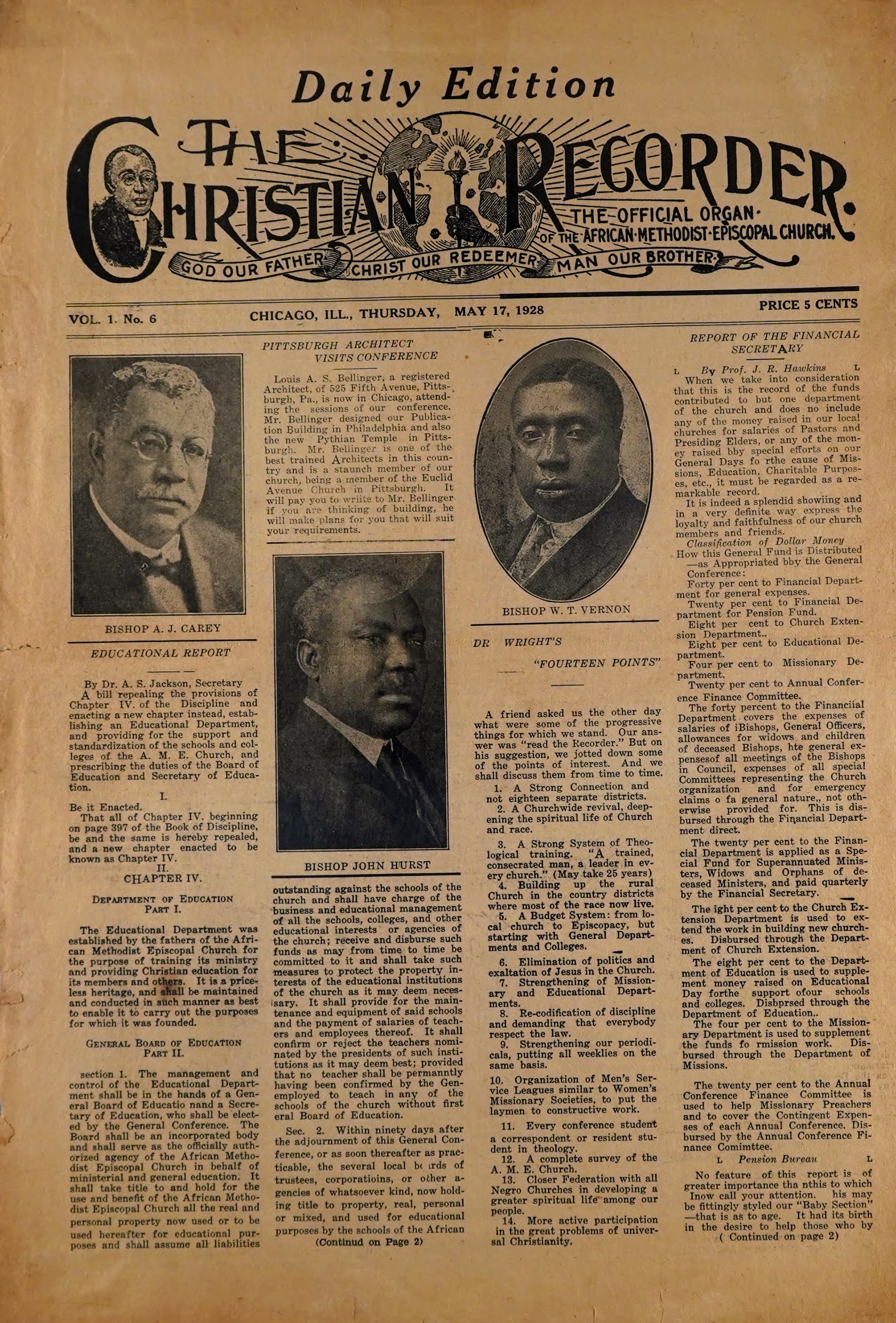
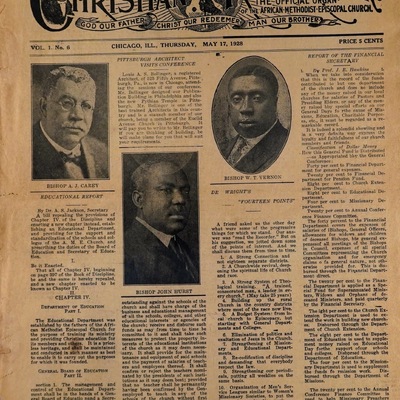
BISHOP A. J. CAREY
———
EDUCATIONAL REPORT
By Dr. A. S. Jackson, Secretary
A bill repealing the provisions of
Chapter IV. of the Discipline and
enacting a new chapter instead, estab-
lishing an Educational Department,
and providing for the support and
standardization of the schools and col-
leges of. the A. M. E. Church, and
prescribing the duties of the Board of
Education and Secretary of Educa-
tion.
x
Be it Enacted.
That all of Chapter IV. beginning
on page 397 of the Book of Discipline,
be and the same is hereby repealed,
and a new chapter enacted to be
known as Chapter IV.
EE
CHAPTER IV.
DEPARTMENT OF EDUCATION
Part I.
The Educational Department was
established by the fathers of the Afri-
can Methodist Episcopal Church for
the purpose of training its ministry
and providing Christian education for
its members and ot It is a price-
less heritage, and be maintained
and conducted in stich manner as best
to enable it to carry out the purposes
for which it was founded.
GENERAL Boarp oF EDUCATION
Part IL.
section 1. The management and
control of the Educational Depart-
ment shall be in the hands of a Gen-
eral Board of Educatio nand a Secre-
tary of Education, who shall be elect-
ed by the General Conference. The
Board shall be an incorporated body
and shall serve as the officially auth-
orized agency of the African Metho-
dist Episcopal Church in behalf of
ministerial and general education. It
shall take title to and hold for the
use and benefit of the African Metho-
dist Episcopal Church all the real and
personal property now used or to be
used hereafter for educational pur-
poses and shall assume all liabilities
‘
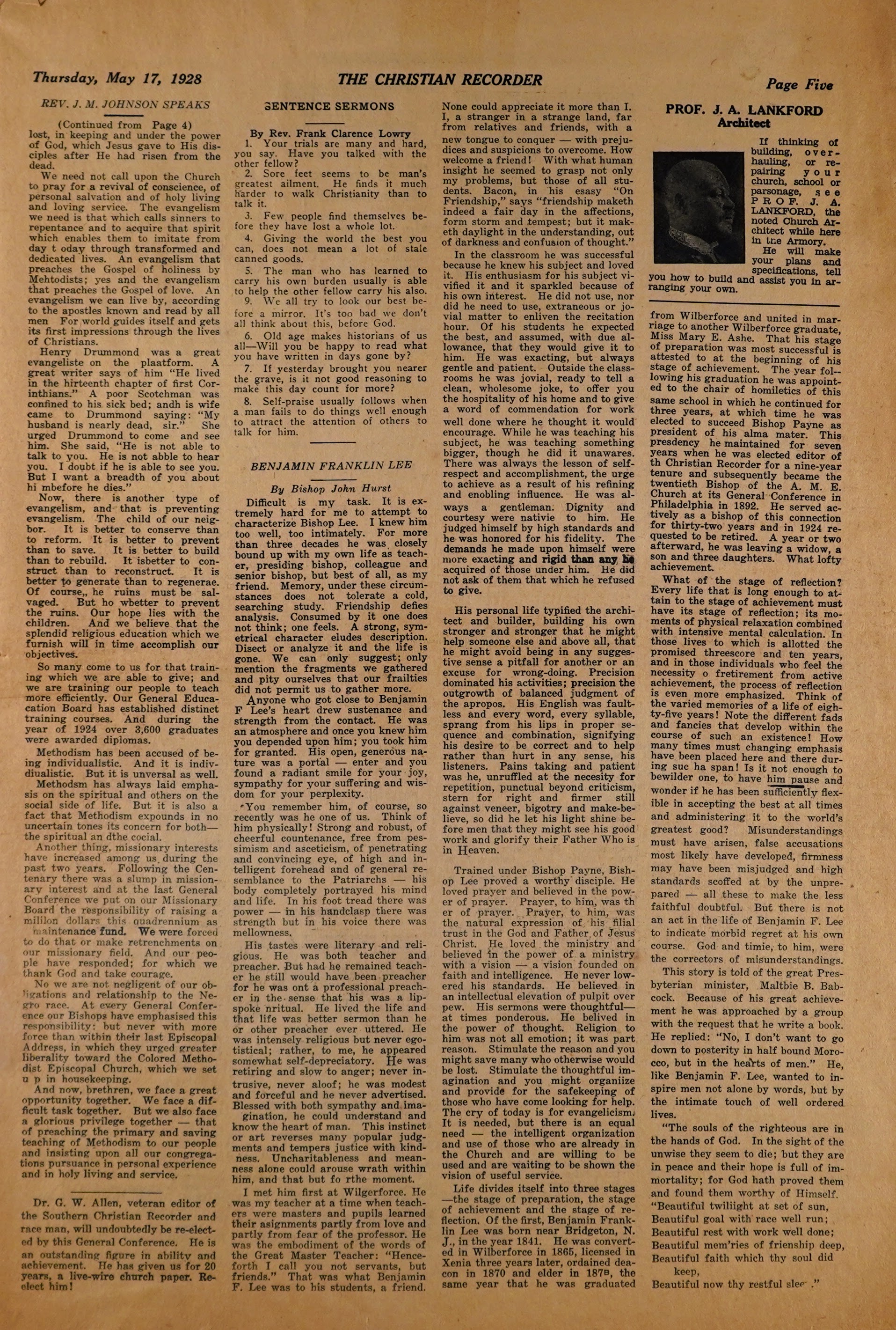
PITTSBURGH ARCHITECT
VISITS CONFERENCE
Louis A. S. Bellinger; a registered
Architect, of 525 Fifth Avenue, Pitts-_
burgh, Pa., is now in Chicago, attend-
ing the sessions of our conference.
Mr. Bellinger designed our Publica-
tion Building in Philadelphia and also
Pythian Temple in Pitts-
Mr. Bellinger is one of the
rained Architects in this coun-
try and is a staunch member of our
church, being a member of the Huclid
Church in Pittsburgh. It
+ you to wriite to Mr. Bellinger
thinking of building, he
plans for you that will suit
the new
BISHOP JOHN HURST
outstanding against the schools of the
church and shall have charge of the
“business and educational management
of all the schools, colleges, and other
educational interests’ or agencies of
the church; receive and disburse such
funds as may from time: to time be
committed to it and shall take such
measures to protect the property in-
terests of the educational institutions
of the church as it may deem neces-
isary. It shall provide for the main-
tenance and equipment of said schools
and the payment of salaries of teach-
ers and employees thereof. It shall
confirm or reject the teachers nomi-
nated by the presidents of such insti-
tutions as it may deem best; provided
that no teacher shall be permanntly
having been confirmed by the Gen-
employed to teach in any of the
schools of the church without first
eral Board of Education.
Sec. 2. Within ninety days after
the adjournment of this General Con-
ference, or as soon thereafter as prac-
ticable, the several local bi ids of
trustees, corporatioins, or other a-
gencies of whatsoever kind, now hold-
ing title to property, real, personal
or mixed, and used for educational
purposes by the schools of the African
(Continud on Page 2)
.
BISHOP W. T. VERNON
DR WRIGHT'S
“FOURTEEN POINTS”
A friend asked us the other day
what were some of the progressive
things for which we stand. Our ans-
wer was “read the Recorder.” But on
his suggestion, we jotted down some
of the points of interest. And we
shall discuss them from time to time.
1. A Strong Connection and
not eighteen separate districts.
2. A Churchwide revival, deep-
ening the spiritual life of Church
and race.
8. A Strong System of Theo-
logical training. “A trained,
consecrated man, 4 leader in ev-
ery church.” (May take 25 years)
4. Building up the rural
Church in the country districts
where most of the race now live.
~ -§, A Budget System: from lo-
cal church to Episcopacy, but
starting with General Depart-
ments and Colleges.
6. Elimination of politics and
exaltation of Jesus in the Church.
7. Strengthening of Mission-
ary and Educational Depart-
ments.
8. Re-codification of discipline
and demanding that everybody
respect the law.
9. Strengthening our periodi-
cals, putting all weeklies on the
same basis.
10. Organization of Men’s Ser-
vice Leagues similar to Women’s
Missionary Societies, to put the
laymen. to constructive work.
11. Every conference student
a correspondent or resident stu-
dent in theology.
12. A complete survey of the
A. M. E. Church.
18. Closer Federation with all
Negro Churches in developing a
greater spiritual life~among our
people. *
14. More active participation
in the great problems of univer-
sal Christianity.
REPORT OF THE FINANCIAL
SECRETARY
L By Prof. J. R. Hawkins L
When we take into consideration
that this is the record of the funds
contributed to but one department
of the church and does no include
any of the money raised in our local
churches for salaries of Pastors and
Presiding Elders, or any of the mon-
ey raised bby special efforts on_ our
General Days fo rthe cause of Mis-
sions, Education, Charitable Purpos-
es, ete., it must be regarded as a re-
markable record.
Tt is indeed a splendid showiing and
in a very definite way express the
Joyalty and faithfulness of our church
members and friends.
Classification of Dollar Money
How this General Fund is Distributed
—as Appropriated bby the General
Conference:
Forty per cent to Financial Depart-
ment for general expenses.
Twenty per cent to Financial De-
partment for Pension Fund.
Eight per cent to Church Exten-
sion Department..
Eight per cent to Edueational De-
partment.
Four per cent to Missionary De-
~ partment.
Twenty per cent to Annual Confer-
ence Finance Committee.
The forty percent to the Financiial
Department covers the expenses of
salaries of iBishops, General Officers,
allowances for widows and children
of deceased Bishops, hte general ex-
pensesof all meetings of the Bishops
in Council, expenses of all special
Committees representing the Church
organization and for emergency
claims o fa general nature,, not oth-
erwise provided for. This is dis-
pursed through the Financial Depart-
ment direct.
The twenty per cent to the Finan-
cial Department is applied as a Spe-
cial Fund for Superannuated Minis-
ters, Widows and Orphans of de-
ceased Ministers, and paid quarterly
by the Financial Secretary.
The ight per cent to the Church Ex-
tension Department is used to ex-
tend the work in building new church-
es, Disbursed through the Depart-
ment of Church Extension.
The eight per cent to the Depart-
ment. of Education is used to supple-
ment money raised on Educational
Day forthe support ofour schools
and colleges. Disbprsed through the
Department of Education..
The four per cent to the Mission-~
ary Departmeént is used to supplement
the funds fo rmission work. Dis-
bursed through the Department of
Missions.
The twenty per cent to the Annual
Conference Finance Committee is
used to help Missionary Preachers
and to cover the Contingent Expen-
ses of each Annual Conference. Dis-
bursed by the Annual Conference Fi-
nance Comimttee.
L Pension Bureau L
No feature of this report is of
greater importance tha nthis to which
Inow call your attention. his may
be fittingly styled our “Baby Section”
—that is as to age. It had its birth
in the desire to help those who by
-( Continued on page 2)
===== DSC04367.JPG =====
Page “wo
EDUCATIONAL REPORT
(Continued from Page 1)
Methodist Episcopal Church, or sub-
¥ #, shalleause title to the
erred to the General
m for the use d
ican Methodist Epis-
; provided, ho
ventory of
* and Nabil
ineation, the Bi
Board of Trt
in question
stitution
y of the
of property un-
i take place until
ventory has been
one-
anid at st one or more than
shall be bishops, with at least
one member resident in Each Episco-
pal District In America. The direc-
tors shall be ainated by the Coun-
cl of Bishops and the etary of
Education and confirmed by the Gen-
‘ Conference, Their term of office
| he for four years. The Secre-
tary of Edueation shall be ex-officio
a member of the Board ofDirectors
and shall be its Secretary-Treasurer.
4. Vacancies in the Board of
ore shall be filled by the Bish-
Council, the person so appointed
to werve until the next succeeding
General Conference.
Part II.
Sec. 1. The officerso f the Board
shall be a president, who shall be e-
lected by the Council of Bishops, one
r more Vice-presidents, Secretary-
Treasurer, a Recording Secretary,
und auch other officers or agents paid
or unpaid, as the Board may from
time to time determine, The officers,
except such as are elected by the Gen-
eral Conference, shall be elected at
the first x ing of the Board after
each Gen Conference, The sal-
g ficers and employees ex-
¢ retary of Education shall
and the By shall pre-
duties o fe
ubject to
n
the
shall be
ontrol
general) intertats. He
md. publish an annual
ndition of the
int and of all
management.
each Episco-
», hold
He
nal-
ola under
He shall travel thr
yal Diatrict in
Y meetings and a
ll reeeive for his
ee ueh
aa the General Conference shall
He ahall be the custodian
funds of the General Board of
Education and shall deposit the same
in bank at the direction of the Diree-
tora of the Board. He shall execute
a good an dwufficient bond for the
faithful performance of his duties
in any aum as the Directors of the
Sec. 3. Any vacancy in the office
General Board shall determine.
of the Secretary of Education caused
by death, resignation, or otherwise,
shall be filled in temporarily by the
Board of Directors until the Bishops’
Counel] shall fill the vacancy, and
the person so appointed shall hold
office until the next succeeding Gen-
eral Conference,
Part IV,
See. 1, The Board of Directors
ahall hold an annaal meeting at such
time and place aa it may determine,
subject to the provialona of the char-
ter, and may hold such special meet-
ings aa, from time to time, may be
THE CHRISTIAN RECORDER
necessary. Seven members of the
Board shall constitute a quorum for
the transaction of business,
Sec. 2. The Board of Directors
may appoint an Executive Committee
of such number as it may determine
and may commit to said Executive
Committee such busines sor confer
upon it power, not inconsistent with
the charter or with Géneral Confer-
ence legislaion, as the Board may de-
termine,
See. 3. There shall be appointed
annually by the Board of Directors
a Standing Committee on Finance,
of five members of the
cluding the Secretary of
vith whom may also be
ed as advisory members, two
nal persons not members of
d. To the care and manage-
1e Finance Committee shall
sted the funds of the corpora-
preparaion of the annual
the fixing of the official bond
Secretary-Treasurer, and the
investment of the moneys of
the corporation under the direction
of the Board of Directors. No invest-
ment of securities shall be changed by
the Treasurer without the consent of
a majority of the Finance Committee
first obtained by resolution adopted
at a regular meeting thereof. Min-
utes of all proceedings of the Board
of Directors shall be kept and sub-
mitted to the Board of Directors for
approyal, The Board may appoint
such othe reommittees and prescribe
for them such powers and duties, not
General Conference legislation, as it
may deem necesary.
Sec, 4, The Board of Directors
shall receive from the Treasurers of
the Annual Conferences, the public
educational collection taken annually
in the charges throughout the church
and shall disburse the same for the
aid of educational institutions and
agencies of the African Methodist E-
piseopal Church under such rules as
the charter and Genera lConference
legislation.
Sec. 5.The Board of Directors shall
have a full complete audit made each
year of the accounts of the several
educational institutions under its
charge, and of the accounts of all offi-
cers and committees handling funds
of the General Board of Education.
Endowment Fund
Part V.
Sec. 1. There is hereby created a
special fund to be known as the Gen-
ral Endowment Fund, the principal
of which shall be used exclusively
for the permanent endowmen of the
educational institutions of the AAfri-
ean Methodist Episcopal Church. The
Board of Directors shall place in a
separate fund all moneys, gifts and
bequ ived for endowment pur-
poses 1 cause the same to be
ed and the shaHROI
sted and the same shall
for the
securely
be distribut
inv
1 only purposes
of permanent endowment of the
schools of the church.
Sec. 2, The Board shall allot an-
o each of the schools and col-
out of the Permanent Endow-
nually
leges
ment Fund, for the purposes of creat-
ing and increasing the permanent en-
dowment of such schools, a sum equal
to the amount raised by each school
for permanent purposes. No part of
the funds received by the schools for
permanent purposes, from whatsoever
sources, shall be used for any other
purpose, but the income derived from
the investment of the same may be
used for the gneral educational pur-
poses of such schools.
See, 3. The seyeral boards of trus-
tees of the schools and collegs of the
African Methodist Episcopal Church
shall be the agents of the General
Board of Education for the purpose
of managing, aiding and controlling
church, They shall perform TAOIN
the educational institutions of the
church, They shall perform such
duties as are assigned to them by
the General Board of Education or
by the General Conference legisla-
tion and shall be amenable in all re-
apecta to the General Board of Edu-
eation,
Educational Inatitutions
See, 1. The educational institutions
of the African Methodist Episcopal
Church in America shall be clasisfied
and maintained as follows:
1—One University.
2—Five accredited colleges.
3.—Two schools of Theology with
full course leading to degree.
4—The remainde rof said schools
shall be Secondary Schools.
5.—Limited courses of theological
instructions may be maintained at
all of the schools but no degrees in
theology may be awarded at any of
the schools except the two schools
above designated.
6—In the foreign mission fields,
where the classification of schools
under the national educational sys-
tem differs from that in the United
States of America, the tabulation and
descripition of schools shall harmon-
ize with the national system; and, in
official publications in the United
States of America, appropriate ex-
planatory notes shall be published in
the tables.
7—Whenever in the judgment of
the Directors of the General Board
any school shall have a sufficient en-
dowment fund and shall possess the
other necessary qualifications, the
same may be admitted to the college
grade as above defined by action of
th Directors.
Eligibilty
Sec. 2 The directors of the General
Board of Education shall make and
publish rules of eligibility and for the
conduct of the schools of the African
Methodist Episcopal Church. No
school, maintained or conducted con-
trary to the eligibility and conduct
rules of the General oBard of Educa-
tion, shall receive support from the
African ethodist Episcopal connec-
tion or any of its surbordinate bodies.
No new schools shall be established
without the consent of the directors
of the General Board; and the direc-
tors of said Board may, in cases
where in their judgment, it is impos-
sible to maintain a school in keeping
with the standards fixed by the Board
combine one or more schools for the
purpose of making a stronger insti-
tution or abolish the same: provid-
ed that n school shall be abolished
or combined with another school with-
out a full and fair hearing after due
notice to such school or schools. The
decision of the directors of the Gen-
eral Board of Education shall be
subject to review by the Bishops’
Council. fe
Sec. 3. The directors of the Gen-
eral Board of Education shall have
the power subject to an appeal to
the General Conference, to withhold
payment of any of the educational
funds of the church from which any
school which Shall fail to meet the
requirements of the Board in regard
to standards, endowment, and admin-
istration or either of them. Before
ordering the cessatioin of payment
to any school, the directors of the
General Board of Educaton, or a
committee appointed by them, shall
summon the authorities in charge of
said school, to appear and show cause
why payment of educational funds to
such institutions should not be dis-
continued, allowing to such school a
reasonable time in which to preperae
and present its case. If, after a fair
an dimpartial hearing, it shall be
determined that such school is not
meeting the requirements of the Gen-
eral Board, no further payments of
educational funds shall be made to
it until such time as the directors
of the General Board shall, by order,
restore it to the eligibility list. The
directors of the General Board, may
in eases where they deem it wise,
place such school on probation and
condiition, instead of suspending the
payment of funds.
Sec. 4. The Secretary of Educa-
tion shall publish in his annua Ire-
port a list of all the educational insti-
tutions of the African Methodist E-
cordance with Section 1 of this para-
graph, and the findings of the Uni-
versity council. It shall be the duty
of the president or other administra-
tive officer of each educational insti-
tution to furnish to the Secretary of
education such statistic sor other in-
formation as may enable him to make
a report of the standing and equip-
ment of each of the educational in-
(Continued, on Page 3)
Thursday, May 17, 1928
REPORT OF THE FINANCIAL
SECRETARY
(Continued from page 1) ‘
reason of the age and infifmities have
reached the stage of second child-
hood:
_It was eight years ago that we de-
cided to make better provision for
our worn-out ministers, our widows
and orphans of deceased ministers by
setting aside twenty per cent of our
general fund plus a Special Fund to
be reported from our several charges.
The present status of this Bureau
is shown in the following tables—
showing the number of claimants in
each District and how much money
has been reported and placed to their
credit and how it has been applied:
We have 414 superannuated minis-
ters, 1350 widows, 371 orphans; mak-
ing a total of 2,186 dependents to
whom we paid.
$328,031.00—divided as follows:
To Superannuates ...... $122,544.00
To Widdows . 192,507.00
To Orphans 12,980.00
While this is a decided improvement
on the former system, we can and
should do more for these worthy de-
pendents. The big question now is
“How Can This Be Done?” My a
swer is give them more money. it
is gratifying to note that there is
a keen interest shown regarding the
work of this Bureau. We all seem
agreeing as to the virtue of raising
more money for this Speciial Cause.
Some four or five persons have come
forward with certain proposals, and
in each case, the one making the pro-
posal offers himself as the one best
fitted to solve the problem. ‘This is
natural and most commendable. Very
few changes are suggested as to the
system itself,, bu tsome oer
ating a new department anew
secretary--treasurer —-with promises
of great things under plans that have
bee tried and failed. This
Conference is capable of meeting
issue and I have no doubt as to your
courage to do it.
My opinion is that all we need to
do is to give this Bureaumore money,
by settig aside a larger per centage
of the General Fund and getting the
ministers to agree to go back to their
people and ask and urge themtogive
more money for this cause. We can
well afford to set aside thirty per-
cent instead of twenty per cent of the
Dollar Money and raise 10 cents a
year from each memberf instead of
one cent.
At present every centraised and
reported is applied to this cause with-
out any expense account. This can
not be done if a new Department is
created, and I am nat-willing to be
silent and see a change made that
will be against the best interest of our
dependent claimants.
When we changed the law four
years ago and set aside twenty per
cent of the Dollar Money to be used
by the Annual Conference, it was
doné in the belief and with the un-
derstanding that it would help the
ministers by providing extra funds
for them out of thé Dolloar Money.
But, what are facts: Most of us
who are acqua’ with the inside
workings of our Annual Conferences
an dare responsible for the distribbu-
tion of this fund, know that there
has been very little extra benefits to
the ministers from this fund because
too much of it ha sbeen appropri-
ated for other purposes and_ covered
by the term “Sundries,” ‘Incident-
als,” and “Miscellaneous.” If we will
fix it so as to have less sundries, less
incidentals, and less miscellaneous,
10 per cent of the Dollar Money with
the regular Contingent Fund will
cover them and the other 100 per cent
ean go to the worthy, worn-out
preachers and our widows andor-
phans.
If we are in earnest about this mat-
ter andmean to do more for Pension-
ers, let us increase the revenue to be
handled by the Department of Fi-
nance where the System or Machin-
ery is already set up and working
smoothly without one dollar expense
to the Bureau, instead o fcreating a
new and separate Department.
eral
tihs
Thursday, May 17, 1928
ric. He brings to bear upon his
loyalty, deep in piety, ,and generous
. @... ON ANNUAL CONFERENCE
4 BOUNDARIES
~~ FIRST “‘DISTRICT—H_ P. -Ander-
son, ‘J. F.’ Vanderhorst, “Edward E.
1) _ Tyler, W. H. Jones, J. L. Link.
Sgt
" ‘SEGOND DISTRIOT—C. E. Stew-
‘A. Young, C, M. Reid, A. D
THIRD DISTRICT—H G. Payne,
Geo.'Maxwell, S, P. West, M. M. Lew-
is, A. L. Brown, H. L. Hughes
FOURTH DISTRICT—W E. Guy,
W.'D. Shannon, C. F. Stewart, J. W.
Goddard.
| “FIFTH DISTRICT—W. A.. Bur-
nett, H. W. King, A. W. Ward, J. B
w Isaacs. -
SIXT HDISTRICT—M, T. Robin-
son, R. J. Jefferson, J. H. Jones, S. H.
Charleston, B. V. Thornton, G. B.
Jackson, E. B. Brown, J. E. Brown.
_ SEVENTH DISTRICT — E. B.
Mack, A. P. Spears, L. R. Nichols,
L. F. Vance, D. H. Johnson, R. G.
Brogdon.
EIGHTH DISTRICT—T. S. J.
: hed Pendleton, E. Pullet, W. T. Johnson,
W .H. Davis, L. M. Staves, &.°S.
Stevens.
i NINTH
erson, C. G
DISTRIG&—R. C. Dick-
Hate'er, S. Griffin, R.
Gray, C. G. Duncan, J. W. WalRer *
TENTH DISTR. OT—J. HW. Smit
L. C. Wade, E,..%. Ronner, J. A:
' Swann, J. S. Bewe, J. M Bolding,
J H.H. Franklin, E. W. Morgan,
T. F. Ferguson.
ELEVVENTH DISTRICT—J. S.
Johnson, M. M. Young, R. B,°Brook-
~ ins, E. Harley, J. A. Brown, J: N.
Young.
THIRTEENTH DISPRICT—J. W.
TWELFTH DIST: —GQ Tr
Sims, J. W. Stinson, J. H. Redd, W.
B, Ferguson, 0. L. Moody, N. W.
Coleman. 4 Ral
Washington, J. R. Brown, H. A. Bel-
in, J. H. Martin, W. H. Mayhew, J.
D. Smith, Thomas A. Kennedy.
FOURTEENTH DISTRICT — J.
W. Frazier, R. C. Henderson, J. M.
Brown, W. A. Anderson, W. M. Oli-
ver. > 4
FIFTEENTH DISTRICT — J. D.
Howell.
- SIXTEENTH DISTRICT — S. B.
A, Campbell, D, A. Graham.
SEVENTEENTH DISTRICT —
Charles Demas.
BIGHTEENTH DISTRICT—Nel-
son Pryor.
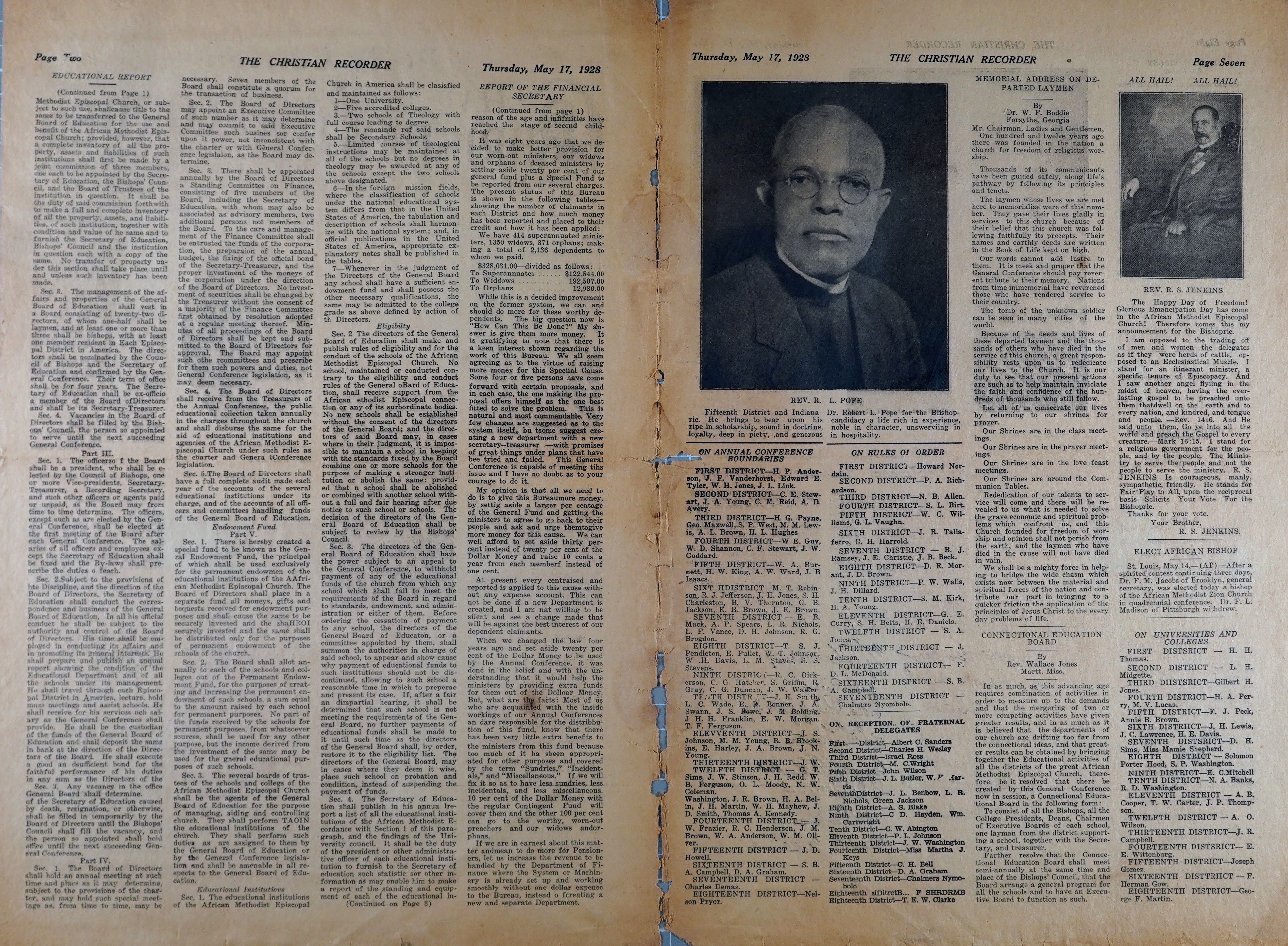
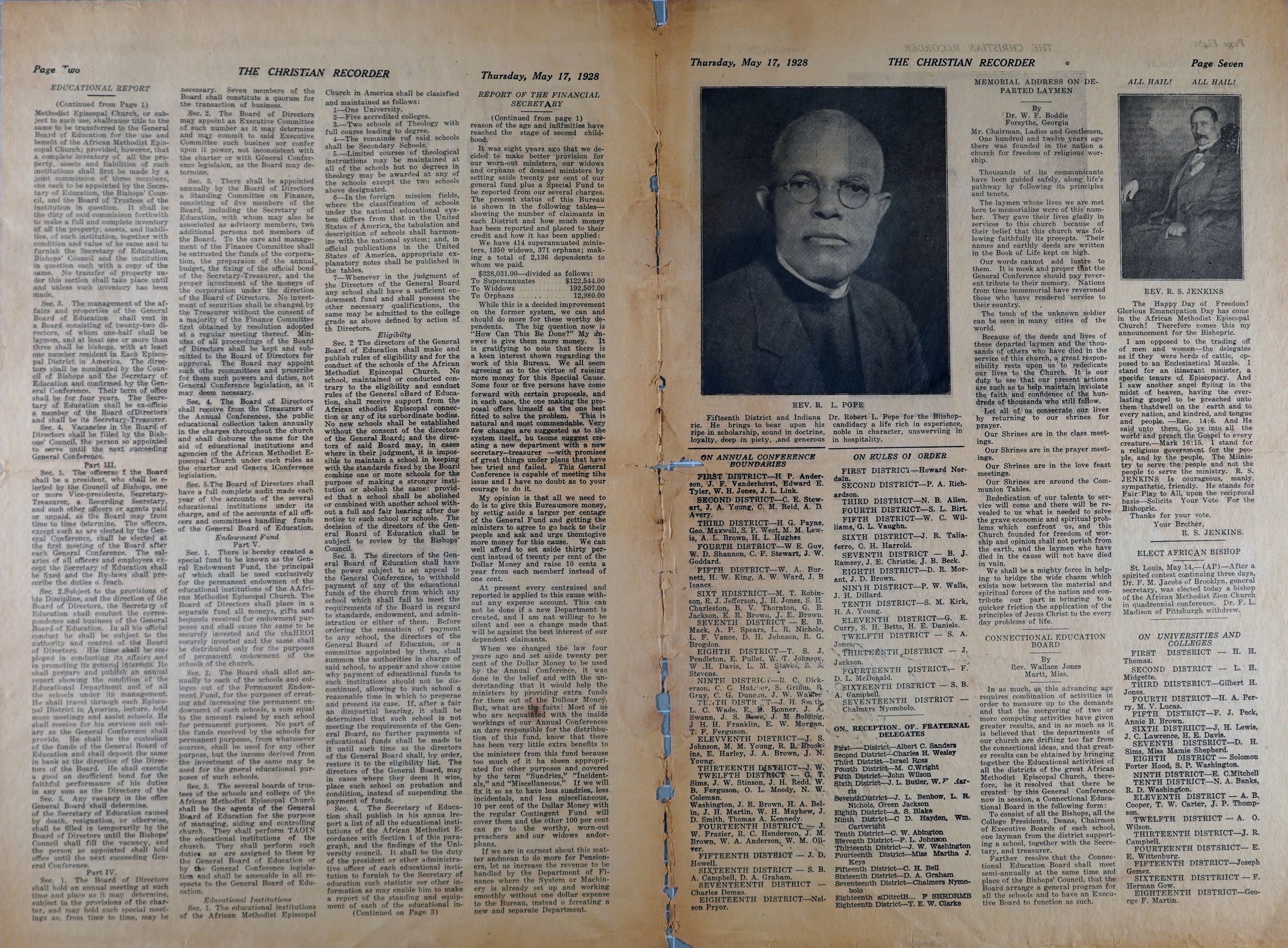
REV. R.
Fifteenth District and Indiana Dr. Robert L.' Pope for‘ the Biishop-
Tipe in. scholarship, sound in doctrine,
MACKEY
THE CHRISTIAN
L. POPE
candidacy a life rich in experience,
noble in character, unswerviing in
in hospitality.
ON RULES OF ORDER
FIRST DISTRICi—Howard Nor-
‘in.
SECOND DISTRICT—P. A. Rich-
ardson.
THIRD DISTRICT—N. B, Allen.
FOURTH DISTRICT—S. L. Birt.
FIFTH DISTRICT—W. C. Wil-
liams,'G. L. Vaughn.
SIXTH DISTRICT—J. R. Talia-
ferro, C. H. Harrold.
SEVENTH DISTRICT — B. J.
Ramsey, J. E. Christie, J. B. Beck.
EIGHTH DISTRICT—D. R. Mor-
ant, J. D. Brown.
NIN1H DISTRICT—P. W. Walls,
J. H. Dillard.
TENTH DISTRICT—S. M. Kirk,
H. A. Young.
ELEVENTH DISTRICT—G.. E.
Curry, S. H. Betts, H. E, Daniels.
TWELFTH DISTRICT — S. A.
Jones,
\ THIRTEENTH ,DISTRICT — J,
Jackson, . 3
FOURTEENTH PISTRICT— F.
D. L. McDonald. .
SIXTEENTH DISTRICT — S. B.
"A. © bell.
EVENTBENTH DISTRICT —
Chalmers Nyombolo.
ON. RECEPTION.. OF.. FRATERNAL
5. .DELEGATES
Fist ——District—Albert C. Sanders
Second District—-Charles H. Wesley
Third Distriet—Israel Ross
Fourth District—M. O.Wright
Fifth District—John Wilson
Sixth District—J. L. Butler, W.F dar-
ris.
SeventhDistrict—J. L. Benbow, L. R.
Nichols, Green Jackson
Eighth District—A. S. Blake
Ninth District—C D. Hayden, Wm.
Cartwright
Tenth District—C. W. Abington
Bleventh District—P. L. Johnson
‘Thirteenth District—J. W. Washington
Fourteenth District—Miss Martha J.
Keys
Fifteenth District—O. H. Bell
Sixteenth District—D. A. Graham
Seventeenth District—Chalmers Nymo-
bolo
Eighteenth siDitrctB.... F SHRDRMB
Eighteenth District—T, E. W. Olarke
RECORDER e
MEMORIAL ADDRESS ON DE-
PARTED LAYMEN
By
‘Dr. W. F. Boddie
Forsythe, Georgia
Mr. Chairman, Ladies and Gentlemen,
One hundred and twelve years ago
there was founded in the nation a
choral for freedom of religious wor-
ship.
Thousands of its communicants
have been guided safely, along: life’s
pathway by following its principles
and tenets.
The laymen whose lives we are met
here to memorialize were of this! num-
ber. They gave their lives gladly in
services to this church because of
their belief that this church was fol-
lowing faithfully its precepts. Their
names and earthly deeds are written
in the Book of Life kept on high.
Our words cannot add lustre to
them. It is meek and proper that the
General Conference should pay rever-
ent tribute to their memory. Nations
from time immemorial have reverened
those who have rendered “service to
their country.
The tomb of the unknown soldier
ean be seen in many cities of the
world.
Beeause of the deeds and lives of
these departed laymen and the thou-
sands of others who have died in the
service of this church, a great respon-
sibility rests upon us to rededicate
our liyes to the Church. It is our
duty to see that our present ‘actions
are such as to help maintain inviolate
the faith and’ confidence of the hun-
dreds of thousands who still follow.
Let. all) of us. consecrate our, lives
by returning to our shrines for
prayer.
Our Shrines are in the class meet-
ings.
Our Shrines are in the prayer meet-
ings.
Our Shrines
meetings.
Our Shrines are around the Com-
munion Tables.
Rededication of our talents to ser-
vice will come and there will be re-
vealed to us what is needed to solve
the grave economic and spiritual prob-
lems which confront us, and this
Church founded for freedom of wor-
ship and opinion shall not perish from
the earth, and the laymen who have
died in the cause will not have died
in vain.
We shall be a mighty force in help-
ing to bridge the wide chasm which
exists now between the material and
spiritual forces of the nation and con-
tribute our part in bringing to a
quicker friction the application of the
principles of Jesus Christ to the every
day problems of life.
are in the love feast
CONNECTIONAL EDUCATION
BOARD
By
Rev. Wallace Jones
Martt, Miss.
In as much, as this advancing age
requires combination of activities in
order to measure up to the demands
and that the mergering of two or
more competing activities have given
greater results, and in as much as it
is believed that the departments of
our church are drifting too far from
the connectional ideas, and that great-
er results can be obtained by bringing
together the Educational activities of
all the districts of the great African
Methodist Episcopal Church, there-
fore, be it resolved that there be
created by this General Conference
now in session, a Connectional Educa-
tional Board in the following form:
To consist of all the Bishops, all the
College Presidents, Deans, Chairmen
of Executive Boards of each school,
one layman from the district support-
ing a school, together with the Secre-
tary, and treasurer.
Farther resolve that the Connec-
tional Education Board shall meet
semi-annually at the same time and
place of the Bishops’ Council, that the
Board arrange a general program for
all the schools and to have an Execu-
tive Board to function as such.
£23
Page: Seven
ALL HAIL!
ALL HAIL!
REV. R. S. JENKINS
The Happy Day of Freedom!
Glorious Emancipation Day has come
in the African Methodist Episcopal
Church! Therefore comes this my
announcement for the Bishopric.
I am opposed to the trading off
of men and women—the delegates
as if they were herds of cattle, op-
posed to an Ecclesiastical Muzzle. I
stand for an itinerant minister, a
specific tenure of Episcopacy. And
I saw another angel flyiing in the
midst of heaven, having the ever-
lasting gospel to be preached unto
them thatdwell on the earth and to
every nation, and kindred, and tongue
and people. —Rev. 14:6, And He
said unto them, Go ye into all the
world and preach the Gospel to every
creature—Mark 16:15. I stand for
a religious government for the peo-
ple, and. by the people. The Miinis-
try to serve the’people and not the
people to serve the ministry. R. S.
JENKINS Is courageous, manly,
sympathetic, friendly. He stands for
Fair’Play to All, upon the reciprocal
basis—Sclicits Your Vote For the
Bishopric.
Thanks for your vote.
Your Brother,
R. §. JENKINS.
ELECT AFRICAN BISHOP
St. Louis, May 14,—(AP)—After a
spirited contest continuing three days,
Dr. F. M. Jacobs of Brooklyn, general
secretary, was elected today a bishop
of the African Methodist Zion Church
in quadrennial conference. Dr. F. L.
Madison of Pittsburgh withdrew.
ON UNIVERSITIES AND
COLLEGES
FIRST DISTSRICT — H. H.
Thomas:
SECOND DISTRICT — L. H.
Midgette.
THIRD DIISTSRICT—Gilbert H.
Jones.
FOURTH DISTRICT—H. A. Per-
ry, M. V. Lucas.
FIFTH DISTRICT—F, J. Peck,
Annie B, Brown.
SIXTH DISTRIICT—J, H. Lewis,
J. C. Lawrence, H. B. Davis.
SEVENTH DISTSRICT—D. H.
Sims, Miss Mamie Shepherd.
EIGHTH DISTRICT — Solomon
Porter Hood, S. P. Washington.
NINTH DISTRICT—E. C.Mitchell
TENTH DISTRICT—N. A. Banks,
R. D. Washington.
ELEVENTH DISTRICT — A. B.
Cooper, T. W. Carter, J. P. Thomp-
son.
TWELFTH DISTRICT — A. 0.
Wilson.
THIRTEENTH DISTRICT—J. R.
Campbell.
FOURTEENTH DISTSRICT— E.
E. Wittenburg.
FIFTEENTH DISTRICT—Joseph
Gomez.
SIXTEENTH DISTTRIICT — F.
Herman Gow.
EIGHTEENTH DISTRICT—Geo-
rge F. Martin.
===== DSC04368.JPG =====
Thursday, May 17, 1928
EDUCATIONAL REPORT
(Continued from Page 2)
stiitutions; provided, however,, that
in the case of educational institu-
tions in the foreign field, the inform-
ation desired shall be secured through
the Board of Foreign; Miscsions.
Sec, 5. It shall be the duty of the
directors of the General Board of
Education, with the advice and con-
currence of the University Council,
to reclassify the schools and col-
leges of the African Methodist Epis-
copal Church within ninety days af-
te rthe adjournment of this General
Conference or as soon thereafter as
practical and to publish the same,
and thereafter there shall be no new
clasification of said schools except
in keeping with the general provi-
sions of this act, or by action of the
General Conference. Such reclasifi-
cation shail be in accordance with
the provisions of this act and shall
be made in all respects as to loca-
tion and courses of study for the best
posi slbesevrie HRDL 890ff?S wt
possible service on the part of the
educational institutions of the church
to its communicants and adherents.
The curricula and courses of study
shall be so arranged that students
transfering from one of the A. M.
E. schools to another shall have the
same classification in both schools.
Vv.
University Council
Part VII.
See. 1. The University Council of
the African Methodist Episcopal
Church shall be apopinted at the be-
ginning of each quadrennium by the
dircetors of the General Board of
Education. It shall consist of the
President of the University and three
colelge presidents, two deans of theo-
logy, the Secretary of Education and
two other members who shall actively
be engaged in educational work.
See. 2. It shall be the duty of the
University Council to protect the edu-
cational standards of the church. The
council shall have authority to es-
tablish standards for the various edu-
cational institutions of the African
Methodist Episcopal Church and shall
have advisory oversight of the edu-
cational work conducted under the
several Benevolent Boards of the
church with a view to ascertaining
its quality and effectiveness. Its find-
ings’ shal lbe reported to) the Secre-
tary of Education and approved by
the directors of the General Board of
Education before they shall become
binding.
See. 3. The council shall deter-
mine and at least, quadrennially, re-
vise the minimum requirements to be
maintained for admission, for grad-
uation and for promotion to bacca-
laureate degrees, in the educational in-
stitutions of the church. The re-
quirements thus established shall
provide in al leases for the historical
and literary study of the Bible and
shall be sufficient to entitle the schools.
of the church to be accredited ac-
cording to the requirements of the
agencies. of the United States for
standardizing colleges and secondary
schools.
Sec. 4. At the request of the Pres--
ident and Secretary of Education, or,
at. the written request of five direc-
tors o fthe General Board of Educa-
tion, the University Council shall in-
vestigate the scholastic requirements
and methods of any designated edu-
catioanl institution of the African
Methodist Episcopal Church and shall
report to the directors of the General
Board of Education its decision as
to whether the requirements and
methods of said institution are in
keeping with the requirements of the
General Board of Education. The
Council shall report at least quad-
rennially to the General Board of
Education a proper classification for
each educational institution of the
Church, and, on the basis of this re-
port when approved by the directors
of the General Board of Education,
the Sevretary of Education shall pre-
pare his official list of institutions
and shall be goverened in the admin-
istration of the affairs of the Gener-
al Boar dof Education.
Sec. 5. At the request of any of
the Benevolent Boards of the church
the University Council shall exam-
ine the quality of the educational
THE CHRISTIAN
>
Sat ao ‘ i
RECORDER
dork done under the auspices.of such’ “however, ,in keeping with the spirit
Board and shlal report to the Board
conecrned its estimate of ,the meriit
of-such educational work.
Sec. 6. The porate of Educa-
tion shall be the Executiive Secretary
of the University Council, and the
necessary expense of thé Pniversity
Council in the conduct of its work
shall be borne by the Board of Edu?
cation, except that expense incurred
on-behalf of any other of the Benev--
olent Boards of the church shall be
borne by that Board. “>
See. 7. The Universitl Council
shall meet in regular session at least
once in each quadrennium and at the
call of the Secretary of Education. *
L Educational Districts L
Part VIII
See. 1. The diistcerro fiC ?G..
Sec. 1. The directors of the Gen-
eral Board of Education shall have
power to arrange the Educational
Districts of the church in such man-
ner as best to carry out the purposes.
See. 2. The directors of the Gen-
eral Board of Education, in addition
to the eight percent of the dollar
money appropriated to educational
purposes, shall devise a system of
raising the necessary finances in the
several educational districts of the
church to maintain the educational
instituitons of each district, to pro-
vide for their equipment, permanent
endowment, the payment of teachers’
salaries, the amortization of their in-
debtedness and for expansion and
shall subbmit the same to the Bish-
ops’ Council for approval. When the
same shall have been approved by
the Council o fBishops, it shall be
binding upon all the officers, depart-
ments, ageneies and members of the
African Methodist Episcopal Connec-
tion.
See. 38.The two theological schools
provided for in subsection 3 of sec-
tion 1 of paragraph VI shall be con-
nectional schools and shall be maiin-
tained and supported by a prorata
amount from each educational diis-
trict. The amount due from each
educational district shall be taken
from the funds raised for educational
purposes in that district.
District Boards
Sec. 4. In educational District
there shall be a Board of Trustees
composed of one member fro meach
Annual Conference to be elected for
years at the first Annual Conference
held after each General Conference.
Vacancies. in the membership of the
board, caused by edath, resignation,
removal fro mthe district, or other-
wise shall be filled by the Annual
Conference which originally elected
the member. The Bishop presiding
over the Annual Conference entitled
to elect shall make temporary ap-
ointment until an election shall be
held,
Sec. 5, Under the direction of, the
Secretary of Education and the Gen-
eral Board of Directors, District
Boards of Trustees shall have super-
vision of the educational institutions
in their respective districts. They
shall act.as agents.of the General
Board of Education, receive and. dis-
burse suck funds as the. General
Board of Education shall entrust to
their management, assist in raising
funds for the educational purposes
of. their district, gather statistics and
other information necessary and use-
ful to the General Board of Educa-
tion in-the management of the educa-
tional institutions of their respective
districts, and shall perform such oth-
er duties as are assigned them by the
Secretary of Education or the Direc-
tors of the General Board of Educa-
tion or the Directors of the General
Board of Education, Districts, Boards
of Trustees shall meet annually in
regular session and shall make an
annual report to the Secretary of Ed-
ucation of their activities and of the
condition of the educational institu-
tions in their respective districts.
Special reports may be required of
them.
Sec. 6. At the first meeting of the
District Boards of Trustees they shall
organize by electing a secretary, a
treasurer, and such other officers as
may be necessary, who shall serve
for a term of four years, unless soon-
er removed. The Board shall have
power to appoint such committees as
it shall see fit, and to fix their duties,
ot “ b2
piles ae. ess
Fes a
ek Cee
of this act. The senior Bishop in an
Educational Distrigt » chair—
van on wae Board of Trustees, and the
other Bishops in, suc fier shall
be vice presidents pa 1! 1H or-
der of their seniority. . 9
Sec. 7. The District Secretary
shall cooperate with the Secretary of
Education in advancing the interests
of Education, and especially in ref-
erence to educational day.....He shall
correspond, with the pastors, and
ehurch and Sunday School officers,
and visit an assist as many of them
as possible in organizing for the an-
nual educational collections. He shall
correspond with the Secretary of Ed-
ucation and the authorities of schools
that are beneficiaries of his depart-
ment. He shall see that the pastors
and others report all educational day
moneys to. the proper office or offices
within ten days after the anniver-
sary.
Annual Conference Board
See. 8. At the first Annual Confer-
ence after the General Conference on
nomination by the Bishop, the con-
ference shall elect a conference Board
of Education consisting of three min-
isters and two laymen, This Board
shall continue in office four years, ex-
cept i nease of death, resignation, in
efficiency, or removal from the con-
ference district. .
_ See. 9. The Conference Board shall
organize immediately, electing a
The secretary and treasurer shall
chairman, secretary, and treasurer.
keep in substantial books a proper
recor dof the doings of the Board.
Sec. 10. The Annual Conference
Board of Education shall receive all
moneys reported to or raised at the
Annual Conference for the benefit of
and forward same to the Secretary
of Education ‘orto such other per-
See. 11. All conferences and dis-
trict boards shall be subsidiary and
amendable to the general board. Each
officer who handles educational funds
shall give bond of not less than $1,000.
Funds
Sec. 1. Not less tha ntén per cent
of the Dollar money raised in each
annual conference shall be paid to the
Secretary of Education by the con-
ference Finance Committee, to be ap-
plied according to the order of the
directors of the General Board of Ed-
ucation and in keeping with the ap-
propriations ordered by the General
Conference.
Sec. 2._ The General Board of Ed-
ucation shall have authority to re-
ceive donations and bequests, and
shall apply the same according to the
wish of the donor. But no donation
or bequest shall be accepted with such
conditions attached thereto as shall
require the same to be used for pur-
poses contrary to the tenets and laws
of the church.
Sec. 3. In each station and cir-
cuit there shall be formed an Educa-
tional Society whose duty it shall be
to assist the pastor in raising the
educational money assessed to his
sharge and to solicit donations for
educational purposes. It shall en-
courage African Methodists to take
out life andendowment insurance in
favor of the General Board of Edu-
cation and shall be responsible for the
interest of the membership in the
cause of education. The officers of
the society shall be president, secre-
tary, and treasurer. . The pastor
shall appoint the president, and the
other officers shall be elected bby the
society. Regular reports shall be
made b ythe society to the Quarterly
Conference.
Sec. 4. Each pasfr shall pay to
the Conference Board of Educaiton
such amounts as may be sent to Con-
ference from his charge, for educa-
tional purposes.
shall devote one eyening to the cause
Sec. 5. Every annual Conference
of education. The evening shall be
known as Payne Educational Anni-
versary Nnght, and shall be celebrat-
ed with the rendition of an education-
al program. The funds collected on
Payne Educational Anniversary night
shall be used solely for the purpose
of aiding the permanent endowment
fund of the schools of the educational
district of which the conference is a
»part.
cation Day. *
t
third Sabba hall baagt #
n each Septemb
wl
sively for the} 2
al institutions of the-church.
service of the day both in *churc
and: Sabbath Schools,, ,
reference - to, educational .
and the-entire collections of
in both departments shail be sae
ly set apart for this purpose.
See. 7. All pastors shall forwaa:
all the money. collected in the church.
es and Sunday Schools of their charg-
es on educational day to the Secre-
tary of Education or to such person ©
as he may direct within ten days aft-
er collecting. Each pastor shall fill
out such blanks as may be furnished
by the Seerdtary of Education, and
shall report his receipts and duplicate
blanks to the Annual Conference
Board of Education at the next ses-
sion of the Annual Conference. The
Secretary of Education’ shall publish
notice of Educational Day in all our
connectional, papers at least one
month prior to the time appointed,
and the pastors of all circuits, sta-
tions, and missions. shall publish it
from, all their pulpits. E i
Sec. 8. The dates for the Annual.
Conferen¢es, © District Conferences,
and Quarterly Conferences shall: be
so arranged'as not’ to require the ab-
sence of any pastor from his post of
duty at this important periiod:
Each Bishop, Presiding Elder, and
Pastor is required to lay before our
well-to-do members.and friends the
necessities of our schools,, and also
to seek to obtain students for the
same.
Sec. 9.It is recommended that at
least one scholarship be tstablished
and maintained in each Anual Con-
ference, on the basis of $50 annually,
to be included in the appropriations
of the Finance Committee, and made
payable to the Secretary of one of
the authorized Theological Seminar-*
ies.
L Miscellaneous ~ L
Sec. 1. The annual appropriations
made for the maintenance of the Un-
iversities, ,Colleges, and Schools,
paid the Secretary of Education as
funds will allow, shall not be less
thaan the appropriations provided for
on page 405 of the Discipline; pro-
vided: That if two or more schools
shall be combined, the aggregate of
the appropriations shall be paid to
the combined institution.
Sec. 8. For thei maintenance an.
appropriation of at least $1,000, each
shall be made annually from the Fi-
nancial Deartment, and paid to the
Treasurer of each school, on a pro-~
rata basis, as the condition of the
funds of the Financiial Department
may warrant, provided they are duly
organized and operative.
Sec. 3. All moneys raised by the
caonnection for educational work in
the First Educaitonal District shall
be divided equally between Wilber-
force University and Payne Thelogi-
cal Seminary. 7
Sec. 4, All sections and ‘para-
graphs of the Discipline or parts of
the same in conflict_with this act are
hereby repealed and al sections and
paragraphs or parts’ of' the same,
where amendment is necessary, are
herebby amended to conform to this
act, Signed:
Bishop W. A. Fountain ‘5
A. §, Jackson
Geo. L. Vaughn
H. Y. Arnett
D. H. Simms
For Board of Education, Respect-
fully, .~ f
A. S. JACKSON
The Ocean Link
By Emily E. Vernon
Twenty-five South Africaan let-
ters written fro mthe field.
missionary
copy. .
Basuto—Nyasaland Foundation
Every
worker should get a-
===== DSC04369.JPG =====
Daily Edition of the
Christian Recorder
Official Organ of the General Con-
ference of the A.M. E. CHURCH
Held in Chicago, Ill, May 7—24, 1928.
Entered as second-class matter at
Philadelphia, Pa.
REV R. R. WRIGHT, Jr., Ph. D.
Editor-in-Chief
THURSDAY, MAY, 17, 1928
WHAT IS YOUR COMBINATION?
A certain candidate was approached
the other day and asked by one of
his friends, “What is your combina-
tion?” His answer was, My combina-
tion is with Jesus Christ. .
It will be well that all candidates
find themselves in harmony wit
2 Jesus Christ. It will be well that all
candidates look to him as their chief
guide, as their chief hope. We can-
not run our Church on worldly politi-
cal lines each man must vote his con-
science. His conscience is the chief
thin.g
KIND OF MEN WE NEED.
The times have changed. The eall
. of the hour is for prepared men.
Competition demands only the best.
_-’ A prepared man is needed in the fore-
front. When we look back from
Allen to the present time, we are
much concerned with their successors.
We have a great number of excellent
men from which to choose. It be-
, hooves us to be more careful in the
choice that the standard shall not be
lost. We want strong men, courag-
eous men, men of piety, men of in-
telligence, men of accomplishments,
We need men who can do the work of
a man.
ON PLANS FOR CHURCH BUILDING
First District—J, R. Reed
Second District—G. A. Edwards
Third District—Mrs.
Effie B. Carter,
Francis Cundiff
Fourth District—I. 8. Stone
Fifth District—R. S. Everett, Mrs. O.
H. Burbridge
Sixth District—E. Griggs, J. W. Porch,
H. W. Grant
Seventh District—N. A. Bethea, G. C.
Johnson, W. C. Crawford
Eighth District—J. S. Mangum, D. M.
Dortch
Ninth District—A. D. W. Mitchell
Tenth District—W. S. Johnson, A. R.
Fifteenth District—W. A, Ratteray
Sixteenth District—Mrs. Hannah B.
_ Steady
Seventeenth District—F. Herman Gow
Eighteenth District—P. A. Hart
Eighteenth District—P, A. Hart
THE CHRISTIAN RECORDER
SIDE LIGHTS
Of The Conference
By Dr. W. H. Wright
Dr. R. H.Herbert, pastor of Trin-
ity A. . E. Church, Salt Lake City,
and alternate delegate from the Colo.
Conference is a conspicuous figure
about the General Conference.
Rev. J. T. Dawson, pastor B. M.
E. Church, Windsor, Ont., delivered
the Fraternal Address to the A. M.
E. General Conference for the B. M.
E. Church.
Mrs. IIren Ottis McGowan attend-
ed sessions of the General Confer-
ence,, yesterday.
Fla., is in the city attending the Gen-
eral Conference. She is stopping
with Mrs. Irene McGowan, 5138 So.
Parkway..
Mrs. Ferdinand Hansboro of Dal-
las, Texas is attending the sessiions
of the General Conference. She is
stopping at 3538 Vernon Avenue.
Mrs. Hansboro is a neice of Dr. G.
B. Young.
Mrs. Alice J. Durham and Mrs.
Clara Avery of Dayton, Ohio, are
Visitors to the sessions of the Gen+
eral Conference. K
Rev. W. A. Ragland of Opelika,
Alabama is a member of the General
Conference and is one of the helpers
in the Financial Department.
NOTICE ,
The Intercollegiate Club is host to
the collegiate and other young peo-
-ple’s groups at the Y. M. C. A., 3763
‘Wabash Ave., Sunday, May 20, from
5 to 7 p. m.
Speakers: Bishop J. A. Gregg and
Dr. J. H. Lewis, president of Morris
Brown University.
Special Musical Program.— Miss
Vivia Garth, president of Club..
NOTICE
- The Committee on Social Welfare
met May 10th at 1 p. m., for the pur-
pose of perfecting an organization.
The following officers were elected:
Attorney E. P. Blakemore, 5th
trict, chairman.
Rev. A. F. B. Hoary, 7th district,
vice chairman.
Rev. A. D. Avery, 2nd distriist, sec-
retary.
Mrs. J. H. Hale, 14th district, as-
sistant secretary.
Professor C. H. Johnson, 8rd dis-
trict, treasurer.
Dr. T. N. Lewis, 1st district, chap-
lain.
After some discussion in regard
to the social problems of our church,
a motion was made by A. D. Avery
that Prof. Johnson prepare a bill em-
bodying the sentiments ofthe Commit-
tee. y
By common consent the Committee
decided to meet every morning at
9:30 a. m, Adjournment.
_E. P. BLAKEMORE, Chairman.
A. D. AVERY, Secretary,
ON ENTERTAINMENT OF THE NEXT
GENERAL CONFERENCE
Third Wistrict—J. W. Arnold.
Fourth District—R. L. Pope, J. P. Q
Wallace.
Fifth District—L. H. Harris.
Seventh District—E. A. Adams, J. E.
Brewer.
Fifteenth District—Edward Duncan.
Sixteenth District — William Taylor
White.
Seventeenth District—Oharles Demas .
Eighteenth District—A. E, Hubbard.
IN A TIME LIKE THIS
By Rev. J. J. Wiitherspoon
(From A Breath of the Muse)
In a time like this
We pray that God may send
Unbondaged warriors—
Strong, bold, heroicmen,
Who will not judge the perilous gale
amiss—
In a time like this.
In a time like this—
Of priide and drunkent rage,,
While Justice sleeps
And calumny veils the stage;
For men with hands untied, who will
persist—
In a time like this.
In a time like this,,
When men haye made the purse
Their sovereign guide,,
Their mad rush and their curse,,
For hearts the roving torrents to de-
sist—
In a time like this.
In a time like this:
The world so slow to heed
Up from the mass,
Men who can think and lead
The world out of its bare and black
abyss— :
In a itme like this.
Men who will choose
To suffer for the Right!
Men whose sure visions
Rest upon the height!
Who'll strike straight forward with
_ a steady chest—
IN A TIME LIKE THIS,
REV. J. M. JOHNSON SPEAKS
Rey. John M. Johnson, president
of Board of Church Extension of the
Methodist Episcopal Church, South,
Fraternal Delegate fro mthe above
named Church to this General Con-
ference of the African Methodist
Episcopal Church, spoke as follows:
Mr. President, Bishops, and Mem-
bers of the General Conference of
the Africaan Methodist Episcopal
Church:
The College of Bishops of the
Methodist Episcopal Church South
in their recent sessiion appointed me
fraternal messenger to your great
Church. While recognizing the hon-
ors connected with the appointment,
I must confess that I received it with
much trepidation. It was John
Wesley who said saiad that a minis-
ter must be ready to do two things.
He must be ready to preach and he
must be ready to die.
Fraternal Messengers: II take it,
were little known in those days,, or,
perhaps, he would have included
them.
Anyway, I am here among you to
convey to you the Christian saluta-
tiion of more than two milliions of
Southern Methodists, and to express
their abiding interest in you, as well
as to assure you of their prayers, for
an increase in the physical equip-
ments which you have achieved, in
the great manifestation of liberality
among your constituency,, and above
all in the souls that you save through
the preaching of the glorious Gospel
of the blessed Christ.
Your fraternal messenger came to
us at Memphis two years ago, in the
person of Bishop Reverdy Ransome.
He impressed us in his fine Christian
spirit and by his eloquence. We truly
felt that through him the vast army
of African Methodist were speaking
to us, and the feeliing of fraternity
that we already had for you was
quickened by his visit. He brought
to us many interesting facts of your
history. But none perhaps, of great-
er interest than the reply of your in-
trepid founder and first leader, Bish-
op Allen. When he was urged to
organize under the Episcopal Church,
he refused, saying: “We are indebted
under God to the Methodist for the
light of the Gospel which we enjoy.
Fro all other denominations preached
to us high-flown doctrines that we are
- unable to comprehend.
Now, herein lies the secret of Meth-
odism’s marvelous success in that
earlier day. It is a secret which we
must not forget in this our day. Oth-
er denominations were preachiing
Thursday, May 17, 1928
speculative theology, while Methodist
were preaching a vital, practical the-
ology. You know, brethren, there
are doctrines that men speculate
about, and there are simple, practi-
cal doctrines that men live by. Now,
Methodism has always put the em-
phasis on the doctrine the changes
men’s heart andtransforms their
lives. It is the doctrine of Chris-
tian experience. One has said that
Methodism has excelled all other de-
nominations, because it has always
insisted upon Christian experience
and is constructed upon the truths
that underlie it. The great desirata
of every man’s soul is peace with
God. Job raised the greatest of all
questions when he asked, “How shall
a man be just with God?” Now, if
it is by a sufficiency of Grace that we
are able to pursue in life agreeable
to God, that is harmony with the be-
lief that no man is able to do his
best service for his fellowmen unless
he is able to help t hmen otheir way
to God. And no one can lead any-
one to God, if he himself does not
know God. He who wants to save
others should be saved himself. The
universal teaching of Methodists is
Salvation by faith, ,and Purity of
heart and liife. z
Now, I have gone into these things
not to bring yo a thesis intheology,
but to stir up your pure minds by
way of remembrance. To remind
you that this doctrine; this primaray,
vital, practical doctrine of Grace
saved England and America in that
earlier time and that it will be able
tot the AAmerica of our time. There
are those who cry out in despair,
saying, “They rave driven God out
of this world!” Well, God is not so
much driven out of this world as he
is smothered in this world. There
was little conscience in this world dur-
ing past early stages, and like as un-
to today sin abounds among us in
high and Tow places. There was and
there is murderers, thefts, idolatry;
greed and meanness.
AAn another thing that increases
our difficulty are the discoveries and
inventions of science. This is a ma-
book, we are not only facing mechan-
ehine age. According toa _ recent
jistic inventions, but we are faciing
the effect of a mechanized society.
We are becoming tenders of machines.
We are becoming slaves of machinery.
We are being sapped up by machinery,
One hundred and fifty years’ ago the
great scientific world speculated about
the power and possible use of newly-
discovered steam. Many wondered
what influence the new engines would
have on trans-oceanic travel. It was
said that it would doubtless enable a
ship to travel in the face of tide and
on land. But we have seen already
where great oceanic boats travel six
an oxhundred miles a day.. My fath-
er drove an ox-wagon. I drive an
automobile — a Buick. My son will
drive an airplane. He wants to now,
but his mother won’t allow him. But
the time will comewhen he will. Now
wha t matter it if we have a thou-
sand singing, buzzing machines; if.
we have sixty or seventy millions of
machines on land and two hundred
and fifty airplanes in the air, if our
hearts are all wrong when we start
and all wrong when we stop. What.
worth are these to us? What if phy-
sical, material prosperity increase and
men and women decay? Our only
hope, brethren is to speed up the
spiritual in comparison with the ma-
terial. Our only hope is to speed up
the building of manhood and woman-
hood.
Now, Methodism has always been
evangelical. And we Southern Meth-
odists have not lost the evangelical
passion. Would to God that it burn
with a fierce heat in our hearts.
During the last quadrennium, we
reported more than 250,000 accesions
to our Church. Our Bishops, in their
address, while expressing gratitude
for the increase, felt that combined
with our total membership. But they
warned us not to give way to pride
when it was said very frequently that
we were the largest body of Metho-
dists. For not until our hearts were
filled with a passion for the salvation
of souls; a passion for seeking the |
(Continued on Page 5)
===== DSC04370.JPG =====
Thursday, May 17, 1928
REV. J. M. JOHNSON SPEAKS
(Continued from Page 4)
lost, in keeping and under the power
of God, which Jesus gave to His dis-
ciples after He had risen from the
dead.
We need not call upon the Church
to pray for a revival of conscience, of
personal salvation and of holy living
and loving service. The evangelism
we need is that which calls sinners to
repentance and to acquire that spirit
which enables them to imitate from
day t oday through transformed and
dedicated lives. An evangelism that
preaches the Gospel of holiness by
Mehtodists; yes and the evangelism
that preaches the Gospel of love. An
evangelism we can live by, according
to the apostles known and read by all
men For world guides itself and gets
its first impressions through the lives
of Christians.
Henry Drummond was a_ great
evangeliste on the plaatform. A
great writer says of him “He lived
in the hirteenth chapter of first Cor-
inthians.” A poor Scotchman was
confined to his sick bed; andh is wife
came to Drummond saying: “My
husband is nearly dead, sir.” She
urged Drummond to come and see
him. She said, “He is not able to
talk to you. He is not abble to hear
you. I doubt if he is able to see you.
But I want a breadth of you about
hi mbefore he dies.”
Now, there is another type of
evangelism, and~ that is preventing
evangelism. The child of our neig-
bor. It is better to conserve than
to reform. It is better to prevent
than to save. It is better to build
than to rebuild. It isbetter to con-
struct than to reconstruct. It is
better to generate than to regenerae.
Of course, he ruins must be sal-
vaged. But ho whetter to prevent
the ruins. Our hope lies with the
children. And we believe that the
splendid religious education which we
furnish will in time accomplish our
‘objectives. :
So many come to us for that train-
ing which we are able to give; and
we are training our people to teach
more efficiently. Our General Educa-
cation Board has established distinct
training courses. And during the
year of 1924 over 3,600 graduates
were awarded diplomas.
Methodism has been accused of be-
ing individualistic. And it is indiv-
diualistic. But it is unversal as well.
Methodsm has always laid empha-
sis on the spiritual and others on the
social side of life, But it is also a
fact that Methodism expounds in no
uncertain tones its concern for both—
the spiritual an dthe cocial.
Another thing, missionary interests
have increased among us, during the
past two years. Following the Cen-
tenary there was a slump in mission-
ary interest and at the last General
Conference we put on our Missionary
Board the responsibility of raising a
mililon dollars this quadrennium as
maintenance fund, We were forced
to do that or make retrenchments on
our missionary field, And our peo-
ple have responded; for which we
thank God and take courage.
No we are not negligent of our ob-
ligations and relationship to the Ne-
gro race. At every General Confer-
ence our Bishops have emphasised this
responsibility: but never with more
force than within their last Episcopal
Address, in which they urged greater
liberality toward the Colored Metho-
dist Episcopal Church, which we set
u p in housekeeping.
And now, brethren, we face a great
opportunity together. We face a dif-
ficult task together. But we also face
a glorious privilege together — that
of preaching the primary and saving
teaching of Methodism to our people
and insisting upon all our congrega-
tions pursuance in personal experience
and in holy living and service,
Dr. G. W. Allen, veteran editor of
the Southern Christian Recorder and
race man, will undoubtedly be re-elect-
ed by this General Conference. He is
an outstanding figure in ability and
achievement. He has given us for 20.
p : as pore church paper. Re-
‘A
I
THE CHRIS TIAN RECORDER
SENTENCE SERMONS
By Rev. Frank Clarence Lowry
1. Your trials are many and hard,
you say. Have you talked with the
other fellow?
2. Sore feet seems to be man’s
greatest ailment. He finds it much
harder to walk Christianity than to
talk it.
3. Few people find themselves be-
fore they have lost a whole lot.
4. Giving the world the best you
can, does not mean a lot of stale
canned goods.
5. The man who has learned to
carry his own burden usually is able
to help the other fellow carry his also.
9. We all try to look our best be-
fore a mirror, It’s too bad_we don’t
all think about this, before God.
6. Old age makes historians of us
all—Will you be happy to read what
you have written in days gone by?
7. If yesterday brought you nearer
the grave, is it not good reasoning to
make this day count for more?
8. Self-praise usually follows when
a man fails to do things well enough
to attract the attention of others to
talk for him,
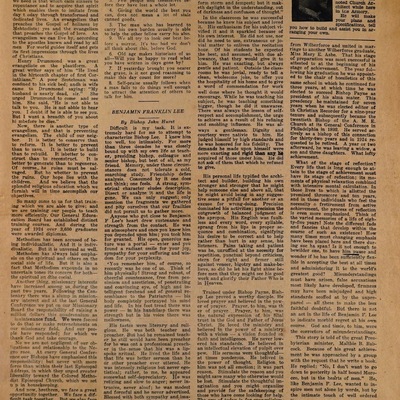
BENJAMIN FRANKLIN LEE
By Bishop John Hurst
Difficult is my task. It is ex-
tremely hard for me to attempt to
characterize Bishop Lee. I knew him
too well, too intimately. For more
than three decades he was. closely
bound up with my own life as teach-
er, presiding bishop, colleague and
senior bishop, but best of all, as my
friend. Memory, under these circum-
stances does not tolerate a cold,
searching study. Friendship defies
analysis. Consumed by it one does
not think; one feels. A strong, sym-
etrical character eludes description.
Disect or analyze it and the life is
gone. We can only suggest; only
mention the fragments we gathered
and pity ourselves that our frailties
‘did not permit us to gather more. —
Anyone who got close to Benjamin
F Lee’s heart drew sustenance and
strength from the contact. He was
an atmosphere and once you knew him
you depended upon him; you took him
for granted. His open, generous na-
ture was a portal — enter and you
found a radiant smile for your joy,
sympathy for your suffering and wis-
dom for your perplexity.
*You remember him, of course, so
recently was he one of us. Think of
him physically! Strong and robust, of
cheerful countenance, free from pes-
simism and asceticism, of penetrating
and convincing eye, of high and in-
telligent forehead and of general re-
semblance to the Patriarchs — his
body completely portrayed his mind
and life. In his foot tread there was
power — in his handclasp there was
strength but in his voice there was
mellowness, A
His tastes were literary -and reli-
gious. He was both teacher and
preacher. But had he remained teach-
er he still would have been. preacher
for he was ont a professional preach-
er in the-sense that his was a lip-
spoke nritual. He lived the life and
that life was better sermon than he
or other preacher ever uttered. He
was intensely religious but never ego-
tistical; rather, to me, he appeared
somewhat self-depreciatory. He was
retiring and slow to anger; never in-
trusive, never aloof; he was modest
and forceful and he never advertised.
Blessed with both sympathy and,ima-
gination, he could understand and
know the heart of man. This instinct
or art reverses many popular judg-
ments and tempers justice with kind-
ness. Uncharitableness and mean-
ness alone could arouse wrath within
him, and that but fo rthe moment.
I met him first at Wilgerforce. He
was my teacher at a time when teach-
ers were masters and pupils learned
their asignments partly from love and
partly from fear of the professor. He
was the embodiment of the words of
the Great Master Teacher: ‘“Hence-
forth I call you not servants, but
friends.” That was what Benjamin
F. Lee was to his students, a friend,
None could appreciate it more than I.
I, a stranger in a strange land, far
from relatives and friends, with a
new tongue to conquer — with preju-
dices and suspicions to overcome. How
welcome a friend! With what human
insight he seemed to grasp not only
my problems, but those of all stu-
dents. Bacon, in his esasy “On
Friendship,” says “friendship maketh
indeed a fair day in the affections,
form storm and tempest; but it mak-
eth daylight in the understanding, out
of darkness and confusion of thought.”
In the classroom he was successful
because he knew his subject and loved
it. His enthusiasm for his subject vi-
vified it and it sparkled because of
his own iriterest. He did not use, nor
did he need to use, extraneous or jo-
vial matter to enliven the recitation
hour. Of his students he expected
the best, and assumed, with due al-
lowance, that they would give it to
him. He was exacting, but always
gentle and patient. - Outside the class-
rooms he was jovial, ready to tell a
clean, wholesome joke, to offer you
the hospitality of his home and to give
a word of commendation for work
well done where he thought it would
encourage. While he was teaching his
subject, he was teaching something
bigger, though he did it unawares.
There was always the lesson of self-
respect and accomplishment, the urge
to achieve as a result of his refining
and enobling influence. He was al-
ways a gentleman: Dignity and
courtesy were nativie to him. He
judged himself by high standards and
he was honored for his fidelity. The
demands he made upon him: were
more exacting and Tiel than any, hé
acquired of those under him. He did
not ask of them that which he refused
to give.
His personal life typified the archi-
tect and builder, building his own
stronger and stronger that he might
help someone else and above all, that
he might avoid being in any sugges-
tive sense a pitfall for another or an
excuse for wrong-doing. Precision
dominated his activities; precision the
outgrowth of balanced judgment of
the apropos. His English was fault-
less and every word, every syllable,
sprang from his lips in proper se-
quence and combination, signifying
his desire to be correct and to help
rather than hurt in any sense, his
listeners. Pains taking and patient
was he, unruffled at the necesity for
repetition, punctual beyond criticism,
stern for right and firmer _ still
against veneer, bigotry and make-be-
lieve, so did he let his light shine be-
fore men that they might see his good
work and glorify their Father Who is
in Heaven.
Trained under Bishop Payne, Bish-
op Lee proved a worthy disciple. He
loved prayer and believed in the pow-
er of prayer. Prayer, to him, was th
er of prayer._Prayer, to him, was
the natural expression of, his filial
trust in the God and Father. of Jesus
Christ.
believed in the power ofa ministry.
with a vision — a vision founded on
faith and intelligence. He never low-
ered his standards. He believed in
an intellectual elevation of pulpit over
pew. His sermons were thoughtful—
at times ponderous. He belived in
the power of thought. Religion to
him was not all emotion; it was part
reason. Stimulate the reason and you
might save many who otherwise would
be lost. Stimulate the thoughtful im-
agination and you might organiize
and provide for the safekeeping of
those who have come looking for help.
The ery of today is for evangelicism,
It is needed, but there is an equal
need — the intelligent organization
and use of those who are already in
the Church and are willing to be
used and are waiting to be shown the
vision of useful service.
Life divides itself into three stages
—the stage of preparation, the stage
of achievement and the stage of re-
flection. Of the first, Benjamin Frank-
lin Lee was born near Bridgeton, N.
J.,in the year 1841. He was convert-
ed in Wilberforce in 1865, licensed in
Xenia three years later, ordained dea-
con in 1870 and elder in 1878, the
same year that he was graduated
He loved the ministry and’
"Page Five
PROF. J. A. LANKFORD
; If of
building, over-
hauling, or re-
your
church, school or
mage, see
PROF J. A.
specifications,
you how to build and assist you in Ee
ranging your own.
aE LE
from Wilberforce and united in mar-
riage to another Wilberforce graduate,
Miss Mary E. Ashe, That his stage
of preparation was most successful is
attested to at the beginning of his
stage of achievement. The year fol--
lowing his graduation he was appoint-
ed to the chair of homiletics of this
same school in which he continued for
three years, at which time he was
elected to succeed Bishop Payne as
president of his alma mater. This
presdency he maintained for seven
years when he was elected editor of
th Christian Recorder for a nine-year
tenure and subsequently became the
twentieth Bishop of the A. M. B.
Church at its GeneralConference in
Philadelphia in 1892. He served ac-
tively as a bishop of this connection
for thirty-two years and in 1924 re-
quested to be retired. A year or two
afterward, he was leaving a widow, a
son and three daughters. What lofty
achievement.
What of the stage of reflection?
Every life that is long enough to at-
tain to the stage of achievement must
have its stage of reflection; its mo-
ments of physical relaxation combined
with intensive mental calculation. In
those lives to which is allotted the
promised threescore and ten years,
and in those individuals who feel the
necessity o fretirement from active
achievement, the process of reflection
is even more emphasized. Think of
the varied memories of a life of eigh-
ty-five years! Note the different fads
and fancies that develop within the
course of such an existence! How
many times must changing emphasis
have been placed here and there dur-
ing sue ha span! Is it not enough to
bewilder one, to have him pause and
wonder if he has been sufficiently flex-
ible in accepting the best at all times
and administering it to the world’s
greatest good? Misunderstandings
must have arisen, false accusations
most likely have developed, firmness
may have been misjudged and high
standards scoffed at by the unpre-
pared — all these to make the less
faithful doubtful. But there is not
an act in the life of Benjamin F. Lee
to indicate morbid regret at his own
course. God and timie, to him, were
the correctors of misunderstandings.
This story is told of the great Pres-
byterian minister, Maltbie B. Bab-
cock. Because of his great achieve-
ment he was approached by a group
with the request that he write a book.
He replied: “No, I don’t want to go
down to posterity in half bound Moro-
cco, but in the hearts of men.” He,
like Benjamin F. Lee, wanted to in-
spire men not alone by words, but by
the intimate touch of well ordered
lives. —
“The souls of the righteous are in
the hands of God. In the sight of the
unwise they seem to die; but they are
in peace and their hope is full of im-
mortality; for God hath proved them
and found them worthy of Himself.
“Beautiful twiliight at set of sun,
Beautiful goal with race well run;
Beautiful rest with work well done;
Beautiful mem’ries of frienship deep,
Beautiful faith which thy soul did
keep,
Beautiful now thy restful slee .”
===== DSC04371.JPG =====
Page Six
' THE FUNCTION OF THE
RELIGIOUS PRESS
By George A. Singleton
The day of the radio is at hand.
In an instant news may be broad-
easted throughout.the world. The
method of demoralizing knowledge
has been almost entirely revolution-
ized, yet the press remains a potent
factor in the advance of civilization.
The religious press is the one great
hope of salvaging the social order. As
a vehicle of expression of ideas and
the dissemination of opinion it has
come increasingly into its own since
the days of the Reformation when
the Holy Scriptures were translated
into the ordinary speech of me nto the
present hour.
The function of the religious press
is to carry the ideals of the religion
of Jesus to the ends of the earth.
More people are reached today by
means of the religious journal than
by the misistry of the Word in all
the pulpits in the world. The strict-
ly religious journal, magazine and
periodicals are standing in their own
right and filling a great need. IIin
common parlance the function of the
religious press is to “sell” religion to
the man on the tsreet.
The church expects the religious
press. to be foremost in creating
public opinion... It_ leads, releases
triggers in the. brain of men, sets
them to thinking:
Shos them the hiigh, white star of
truth,
There bids them gaze and there as-
pire.
As creator of pubblic opinion the
press mst be sane, safe, and reliable,
‘but in the meantime it must not be
afraid of the truth. Upon this it
should stand Gibraltar-like and rally
the people around its standard. In
the days of the struggle for ecclesi-
astical rights,, the Saxon Monk, Mar-
tin Luther, became a great pham-
phleteer, and propagandist by means
of the press. It is less vital in
function today. It has been said by
a noted newspaper man, ,that he can
win any case in court i fhe has ac-
cess tothe front page of a great daily
newspaper. The religious press can
move agreat distance in the direction
of ultimately setting up the kingdom
of God, by holding up those idedls
and standards taught and espoused
by the Man of the seamless robe. The
religious press i nthe great A. M. E.
Church has the most wonderful op-
portunity imaginable to get in front
jn racial re-buildig and kingdom
erection. . While standing upon the
Rock of Ages it will attempt to has-
ten the day whe nthe social teaching
of Jesus will be practiced among all
men. The religious pressmust not
equivocate; it must not excuse; it
must not compromise; it must not
retreat a single inch, and it must be
felt in the church, and social life of
the people. Civilization is ever
changing an ddeveloping. Nothing is
static or stands still, and the re-
ligious press must keep in tune with
the heart-beat of men who earnestly
seek and work for the ideal of bro-
therhood. While conserving the
ideals of the past it will venture for-
ward and with prophetic insight her-
ald the coming of the day of our God.
Our fathers saw the need of the
ago. In 1841 our first religious jub-
lication appeared, In 1852 after the
suspension of the first, the Christian
Herald appeared, and later it was
called TheChristian Recorder. About
the same time, largely through the
influence of Bishop Daniel A. Payne,
the A. . E. Review came into exist-
ence. Since that day numerous have
timent and opinion from the largest
been the Recorders which mould sen-
timent and opinion from the largest
station to the most remote far-flung
mission point. We must not in this
moment cease to foster our journal-
istic ministry which has proven such
a strong factor in building and
strengthening the Church of Allen.
But with printed word tell the peo-
ple of the fatherhood of God, the
saviour-hood of Christ, and the bro-
therhood of man.
The Seventh Epiiscopal Dist.
THE CHRISTIAN RECORDER
~ a
GEORGE A. SINGLETON
’ COMMITTEFS
ON TEMPERANCE~
Lurst District—Nus Goldsboro.
Second District—Luke Grady.
Third District—P. J. Blackburn.
Fourth District—Dr. Mary G. Evans,
Mrs. Lillian Jamison.
Fifth District—Mrs. Annie B. Brown.
Sixth District—F. Moore, J. W. Wilcher,
C. H. Bell.
Seventh District—E. B. Mack, D. L.
Jones. i
Eighth District—Mrs. M. L. Felder, Mm.
Bingham.
Ninth District—E. L. Miles.
Tenth District—H. P. Evans, E. J. Hoff-
man, Mrs. M. C. J. Smith.
Eleventh District—L. Dickerson, G. J.
Oates, N. W. Williams.
Twelfth District—G. H. Evans.
Thirteenth District—I. S. Gordon.
Fourteenth District—T. W. Melson.
Fifteenth District—Mrs. E. E. Vernon,
Mrs. Ionia Morgan.
Sixteenth District—S. B. A. Campbell.
Seventeenth District—F. Herman Gow.
Eighteenth District—J. S. Smith.
ON STATISTICS
First District—S. T. Reed.
Second District—OC. M. Reid. “
Third District—Mrs. Lavada C. Norris,
W. A. Lucas.
Fourth District—oO. C. Miller.
Fifth District—F. D. Helm.
Sixth District—D. W. Stephens, W. C.
Kelly.
Seventh District—I. H. Wellborn, D. A.
Jones, O. E. Grice.
Eighth District—R. D. Davis, J. M.
Campbell.
Ninth District—R. A. Daley.
Tenth District—E. L. Grimes, J. A.
Jones.
Eleventh District—N. B. Kellix,L. R,
Third District—L. O. Ridley.
pete District—W. D. Shannon, H. A.
erry.
winded District—A. W. Ward, L. H. Smith
i
Sixth District—W. G. Alexand( , AL.
Sampson.
Seventh District—J. W. Murph, L. F.
Vance.
Eight District—R. A. Scott.
Ninth District—R. E. Brooks.
Tenth District—I. M. Burgan, T. A.
Steadham.
Eleventh District—T. W. Carter, Thos.
©. Calhoun, Mrs. L. B. Robinson.
H. M. Collins. ;
Twelfth District—E. J. Lunon.
Thirteenth District—E. D. Hughes.
Fourteenth District—A. T. Olark,
Fifteenth District—H. L. Gault.
ON ALLEN CHRISTIAN EN-
DEAVOR LEAGUE
FIRST DISTRICT—J. J. Derrick.
SECOND DISTRICT—F. G. Rus-
sell.
ape ae DISTRICT—F. A. B.
All. .
FOURTH DISTRICT—A. L. Mc-°
Ghee.
FIFTH DISTRICT—J. W. Young,
Wm. Dow. :
SIXTH DISTRICT—A. E. Clark,
Miss C. L. Adams.
SEVENTEENTH DISTRICT—S.
J. Dobbins, E. R. Anderson, W. R.
Bowman.
EIGHTH DISTRICT—J. M. Camp-
bell.
NINTH DISTRICT—Wm. L. Chap-
TENTH DISTRICT—J. A. Howard
P. B. Boales.
ELEVENTH DISTRICT—S. H.
Betts, J. D. Moore, I. A. White.
TWELFTH DISTRICT — S. E.
Kolen.
THIRTEENTH DISTRICT—H. A.
Belin.
FOURTEENTH DISTRICT—J. B.
Foxhall.
FIFTEENTH DISTRICT — Mrs.
Louise Stewart.
SIXTEENTH DISTRICT—S. B.A.
ampbell.
SEVENTEENTH DISTRICT —
Chalmers Nyombolo.
EIGHTEENTH DISTRICT — E.
Waters.
.ON REVISION OF DISCIPLINE
FIRST DISTRICT—T. J. Askew.
SECOND DISTRICT—W. H. C.
Brown.
THIRD DISTRICT—W. H. H.
Butler, W. T. Anderson.
FOURTH DISTRICT—C. L. Up-
thegrove, E. W. Guy, S. Joe Brown.
FIFTH DISTRICT—H. A. Wells.
SIXTH DISTRICT—John Harmon,
R. V. Branch, Jesse Brinson.
SEVENTH DISTRICT—M. A.
Hollins, J. L. Benbow, R. L.L Lee.
_EIGHTH DISTRICT — W. T-
Strong, A. S. Blake.
NINTH DISTRICT._J. R. Bur-
ghes.
TENTH DISTRICT—H. SS. Sims,
P. D. Saddler.
ELEVENTH DISTRICT—R. B.
Brookins, C. S. Long, Ellis Brown.
TWELFTH DISTRICT—V. M.
Townsend.
THIRTEENTH DISTRICT—B. G.
Dawson.
FOURTEENTH DISTRICT—
Wiseman.
SIXTEENTH DISTRICT—D. A.
Graham.
SEVENTEENTH DISTRICT—S.
J. Mabote.
EIGHTEENTH DISTRICT—J. H.
Wilson.
w.
ON ITINERANCY
FIRST DISTRICT—I. A. McCoy.
SECOND DISTRICT —. C. H,.
Stepteau.
THIRD DISTRIICT—H. L, Hughes
FOURTH DISTRICT—J. W, Wiley,
Homer Williams.
FIIFTH DISTRRICT—W. H. Peck
SIXTH DISTRICT—H. J. Peeples,
Dinkins.
8 R.
SEVENTH DISTRICT—D. ©. Deas,
L. D. Gamble, J. W. Douglass.
EIGHTH DISTRICT—Wm. Bingham.
NINTH DISTRICT—D. T. Babcock.
TENTH DISTRICT— J. H. H. Frank-
lin, M. L. Peel.
ELEVENTH DISTRICT—James Mur-
ray, J, D. Jennings. N, P. Hamilton.
TWELFTH DISTRICT—W. 8. Shel-
THIRTEENTH DISTRIOT—W. H.
Mayhew.
FOURTEENTH DISTRICT—O. W.
Allison.
DISTRIOT — Edward
Duncan.
DISTRICT — W. H.
Ketter.
DISTRICT—S. J.
Mabote
EIGHTEENTH DISTRIOT—T. M.
Green.
TITTLE Here
Thursday, May 17, 1928
TRUSTEES OF MONROVIA
COLLEGE
Rev. W. Taylor White, Cape Palms.
Rev. 8. B. A. Campbell, Grand Bassa.
Rey. J. L. Miller, Arthington,
Brother W. H. Ketter, Monrovia.
Hon, A. N. Yancy, Cape Palmas
Hon. R. A. Shermaan, Cape Mount.
Hon. Dixon Brown, Monrovia,
Hon. S. A. Ross, Sinoe
Hon. S. A. Gabbidon, Grand Bassa.
Hon. W. S. V. Tubman, Cape Palmas:
Mr. C. L. Acolatse, Monrovia.
Mrs. Helen Curtis, New York.
vrs. F, G. Ohenoweh, Cape Mount.
Mrs. R. L. Gaines, Grand Bassa.
Hon. W. J. M. Borroughs, Cape Pal_
S. J. Brown, Des Moines Ia.
J. G. Robinson, Philadelphia,
mas.
Mrs.
Mrs.
Pa.
Rey. F. E. R. Johnson, Monrovia.
Hon. T. J. R. Faulker, Monrovia.
Mr. L. B. Graham, Los Angeles, Cal.
P. S—The incorporation paper have
been applied for and have assed the
Lower House of The Liberian Govern-
ment. :
ON THE STATE OF THE COUNTRY
First District—Howard B. Lober
Second District—John Avery
Third District—H. P. Jones
Fourth District—E. D. Tiferington, R ©
L. Pope
Fifth District—J. H. Grant
yixth District—C. M. May, J.M Ross,
AR. Easter vt
Seventh District—J. E. Dixon, J. C. Mc-
Clellan, J. F. Player
Eighth District—J. L. Cunnings, J. M.
Campbell, Chas Isaacs i
Ninth District—E. M. Jackson
Tenth District—L J. Sanders, Mrs. B.
V. Fair
Eleventh District—L. R.. - Robinson,
James Murray, H. K. Kinnon
Twelfth District—H. H. King
Thirteenth District—Nixon Andrews
Fouteenth District—E. E. Underwood
Fifteenth District—William Taylor
White
Seventeenth District—S. J. Mabote
Highteenth District—W. H. Twine
ON BENEVOLENT INSTITUTION:
First District—M. A. Allen.
Second District—Berry O’Kelly.
Third District—P. A. Nichols.
Fourth District—J. E. Crisp.
Fifth District—F. J. Brooks. :
Sixth District—M. W. Webb, S. Fields,
Seventh District—J. S. Coe, J. fe
Shanklin.
Eighth District—Wm. Barnes.
Ninth District—E. H, Kendrick, J. B.
Johnson.
Tenth District—S. M. Sanders, Miss L.
A, Alexander.
Eleventh District—N. H. Leath, D. D,
D. Belliny, Miss M, A. Yellowhatr.
Twelfth District—J. A. Routen.
Thirteenth District—William Watt.
Fourteenth District—Ira T. Bryant.
Fifteenth District—Henry Talbert.
Sixteenth District—Mrs. Hannah B.
Steady.
Seventeenth District—S. J. Mabote.
Eighteenth District—J. Price.
ON BIBLE SC JIETY
First District—H. ~. Anderson.
Second District—O. H. Johnson, R. H
Brevard,
Fourth District—J. D. Costen.
Fifth District—Eugene Bell.
Sixth District—W. J. Jones, T. E. Scott.
Seventh District—S. Simmons, M. J.
Sumpter, J. W. Murph.
Eighth District—I. EB. Fields.
Ninth District—W. D. Dickson.
Tenth District—R. ©. Walker, W. O.
Boyd.
Eleventh District—R. W. Whitehurst, L.
H. Brown, J. D. Moore.
Twelfth District—Mrs. .uinnie U. Blan-
chard.
Thirteenth District—J. Brown.
Fourteenth District—W. H. Davis.
Fifteenth District—Mrs. Louise Stewart,
Edward Duncan.
Sixteenth District—Mrs Stta B. Gra-
eee District—Chalmers Nyom-
bolo.
Eighteenth District—John Lampton, eX
‘i
me
===== DSC04372.JPG =====
Page “wo
EDUCATIONAL REPORT
(Contin
Methodis:
ued from Page 1)
piscopal Church, or sub-
shalleause title to the
erred to the Ge
on for the
r resident in
n Americz
Ȣ nominated the Coun-
ops and the cretary of
n and confirmed hy the Gen-
diree-
‘<
era! Conference. Their term of office
hall be for four years. The Secre-
ta of Edueation shall be ex-officio
a member of the Board ofDirectors
hall be its Seeretary-Treagsurer.
4, Vacancies in the Board of
ectors shall be filled by the Bish-
ous’ Council, the peraon so appointed
to serve until the next succeeding
General Conference,
Part Il,
See, 1. The officerso f the Board
shall be a president, who shall be e-
leeted by the Council of Bishops, one
yr more Vice-preaidents, Secretary-
T urer, a Recording Secretary,
and such other officers or agents paid
vv unpaid, as the Board may from
thme to time determine, The officers,
except such as are elected by the Gen-
| Conte hall be elected at
the first m r of the Board after
each General ference, The gal-
aries of all officers and employees ex-
cept the Seeretary of Education shall
“ fixed and th laws shall pre-
eribe the duties « ach.
» the provisions of
the direction of the
» Secretary of
corres-
and busines the General
Education, In all his offictal
nidue hall be to the
thor d control thé Board
fi is time shall be: em-
and of
management
He ahall trave
yal Diatrict
my meeting
ahall receive
aa the Genery
ide He shall be the cu
he funds of the General Board of
cation and shall deposit the same
in bank at the direction of the Diree-
tora of the Board, He shall execute
a good an dsufficlent bond for the
faithful performance of his duties
in any sum ax the Directors of the
Sec, 3. Any vacancy in the office
General Board shall determine.
ef the Seeretary of Education caused
by death, resignation, or otherwise,
ahall be filled in temporarily by the
Board of Directora wntil the Bishops’
Couneil shall fill the vacancy, and
the person 20 appointed shall hold
office until the next anoceeding Gen-
eral Conference,
Part IV.
See, 1. The Beard of Directors
ahall hold an anwaal meeting at such
time and place aa it may determine,
xnbject to the provisiona of the char-
ter, and may hald such apecial meet-
ings as, from time to time, may be
THE CHRISTiAN RECORDER
necessary. Seven members of the
Board shall constitute a quorum for
the transaction of business.
Sec. 2. The Board of Directors
may appoint an Executive Committee
of such number as it may determine
and may commit to said Executive
Committee such busines sor confer
upon it power, not inconsistent with
the charter or with Géneral Confer-
gislaion, as the Board may de-
There shall be appointed
by the Board of Directors
ding Committee on Finance,
ting of five members of the
d, including the Sec ry of
tion, with whom may also be
ociated as advisory members, two
al persons not members of
Board. To the care and manage-
ment of the Finance Committee shall
be entrusted the funds of the corpora-
tion, the preparaion of the annual,
budget, the fixing of the official bond
of the Seeretary-Treasurer, and the
proper investment of the moneys of
the corporation under the direction
of the Board of Directors. No invest-
ment of securities shall be changed by
the Treasurer without the consent of
a majority of the Finance Committee
first obtained by resolution adopted
at a regular meeting thereof. Min-
utes of all proceedings of the Board
of Directors shall be kept and sub-
mitted to the Board of Directors for
approval. The Board may appoint
such othe rcommittees and prescribe
for them such powers and duties, not
General Conference legislation, as it
may deem necesary.
See, 4, The Board of Directors
shall receive from the Treasurers of
the Annual Conferences, the public
educational collection taken annually
in the charges throughout the church
and shall disburse the same for the
aid of educational institutions and
agencies of the African Methodist E-
piscopal Church under such rules as
the charter and Genera lConference
legislation.
Sec. 5.The Board of Directors shall
have a full complete audit made each
year of the accounts of the several
educational institutions under its
charge, and of the accounts of all offi-
cers and committees handling funds
of the General Board of Education.
Endowment Fund
Part V.
. 1. There is hereby created a
spe fund to be known as the Gen-
ral Endowment Fund, the ‘principal
of which shall be used exclusively
for the permanent endowmen of the
educational institutions of the AAfri-
can Methodist Episcopal Church. The
Board of Directors shall place in a
separate fund all moneys, gifts and
$ rec for endowment pur-
ise the same to be
t
poses and
securely i and the aHROL
ecurely invested and the same shall
ributed only for e purposes
0 rmanent endowment of the
ools of the church.
See, 2, The Board shall allot an-
nually to each of the schools and col-
leges out of the Permanent Endow-
ment Fund, for the purposes of creat-
ing and increasing the permanent en-
dowment of such schools, a sum equal
to the amount raised by each school
for permanent purposes. No part of
the funds received by the schools for
permanent purposes, from whatsoever
sources, shall be used for any other
purpose, but the income derived from
the Investment of the same may be
used for the gneral educational pur-
poses of such schools,
Sec, 8. The several boards of trus-
tees of the schools and collegs of the
African Methodist Episcopal Church
ahall be the agents of the General
Board of Education for the purpose
of managing, aiding and ccntrolling
church. They shall perform TAOIN
the educational institutions of the
church. They shall perform such
daties as are assigned to them by
the General Board of Education or
by the General Conference logisla-
tion and shall be amenable in all re-
apects to the General Board of Edu-
cation.
Educational Institutions
Sec, 1, The educational institutions
of the African Methodist Episcopal
ae
ee a a Lar g
Church in Ameriea shall be clasisfied
and maintained as follows:
1—One University.
2—Five accredited colleges.
3.—Two schools of Theology with
full course leading to degree.
4—The remainde rof said schools
shall be Secondary Schools.
5.—Limited courses of theological
instruetions may be maintained at
all of the schools but no degrees in
theology may be awarded at any of
the schools except the two schools
above designated.
6—In the foreign mission fields,
where the classification of schools
under the national educational sys-
tem differs from that in the United
States of America, the tabulation and
descripition of schools shall harmon-
ize with the national system; and, in
official publications in the United
States of America, appropriate ex-
planatory notes shall be published in
the tables.
7—Whenever in the judgment of
the Directors of the General Board
any school shall have a sufficient en-
dowment fund and shall possess the
other necessary qualifications, the
same may be admitted to the college
grade as above defined by action of
th Directors.
Eligibilty
Sec. 2 The directors of the General
Board of Education shall make and
publish rules of eligibility and for the
conduct of the schools of the African
Methodist Episcopal Church. No
school, maintained or conducted con-
trary to the eligibility and conduct
rules of the General oBard of Educa-
tion, shall receive support from the
African ethodist Episcopal connec-
tion or any of its surbordinate bodies.
No new schools shall be established
without the consent of the directors
of the General Board; and the direc-
tors of said Board may, in cases
where in their judgment, it is impos-
sible to maintain a school in keepir
with the standards fixed by the Boarc
combine one or more for the
purpose of making a stronger insti-
tution or abolish the same: provid-
ed that n school shall be abolished
or combined with another school with-
out a full and fair hearing after due
notice to such school or schools. The
decision of the directors of the Gen-
eral Board of Education shall be
subject to review by the Bishops’
Council. re
Sec. 3. The directors of the Gen-
eral Board of Education shall have
the power subject to an appeal to
the General Conference, to withhold
payment of any of the educational
funds of the church from which any
school which shall fail to meet the
requirements of the Board in regard
to standards, endowment, and admin-
istration or either of them. Before
ordering the cessatioin of payment
to any school, the directors of the
General Board of Educaton, or a
committee appointed by them, shall
summon the authorities in charge of
said school, to appear and show cause
why payment of educational funds to
such institutions should not be dis-
continued, allowing to such school a
reasonable time in which to preperae
and present its case. If, after a fair
an dimpartial hearing, it shall be
determined that such school is not
meeting the requirements of the Gen-
eral Board, no further payments of
educational funds shall be made to
it until such time as the directors
of the General Board shall, by order,
restore it to the eligibility list. The
directors of the General Board, may
in eases where they deem it wise,
place such school on probation and
condiition, instead of suspending the
payment of funds.
Sec. 4. The Secretary of Educa-
tion shall publish in his annua Ire-
port a list of all the educational insti-
tutions of the African Methodist E-
cordance with Section 1 of this para-
graph, and the findings of the Uni-
versity council, It shall be the duty
of the president or other administra-
tive officer of each educational insti-
tution to furnish to the Secretary of
education such statistic sor other in-
formation as may enable him to make
a report of the standing and ip-
ment of each of the educational in-
(Continued on Page 3)
er be opts
Thursday, May 17, 1928
REPORT OF THE FINANCIAL
SECRETARY
(Continued from page 1) Mf
reached the
hood:
reason of the age and infifmities tate 7
stage of second chi
cided to make better provision for
our worn-out ministers, our widows
and orphans of deceased ministers by
setting aside twenty per cent of our
general fund plus a Special Fund to
be reported from our several charges.
The present status of this Bureau
is shown in the following tables—
showing the number of claimants in —
each District and how much money
has been reported and placed to their
credit and how it has been applied:
We have 414 superannuated minis-
ters, 13850 widows, 371 orphans; mak-
ing a total of 2,136 dependents to
whom we paid.
$328,031.00—divided as follows:
To Superannuates ......
To Widdows ... ... 192,507.00
To Orphans 12,980.00
While this is a decided improvement
on the former system, we can and
should do more for these worthy de-
pendents. The big question now is
“How Can This Be Done?” My a
swer is give them more money. t
is gratifying to note that there is
a keen interest shown regarding the
work of this Bureau. We all seem
agreeing as to the virtue of raising
more money for this Speciial Cause.
Some four or five persons have come
forward with certain proposals, and
in each case, the one making the pro-
posal offers himself as the one best
fitted to solve the problem. ‘This is
natural and most commendable.
few changes are suggested ;
system itself,, bu tsome suggest oe
ating a new department
secretary--treasurer —with promises
of great things under pl: it have
bee tried and failed. T
Conference is capable of meeti i
issue and I have no doubt as to your
courage to do it.
My opinion is that all we need to
do is to give this Bureaumore money, —
of the General Fund and getting 1
ministers to agree to go back to their
people and ask and urge themtogive
more money for this cause. We can
well afford to set aside thirty per-
cent instead of twenty per cent of the
Dollar Money and raise 10 cents a
year from each memberf instead of
one cent.
At present every centraised and
reported is applied to this cause with-
out any expense account. This can
not be done if a new Department is
created, and I am nat-willing to be
silent and see a change made that
will be against the best interest of our
dependent claimants.
When we changed thé law four
years ago and set aside twenty per
cent of the Dollar Money to be used
by. the Annual Conference, it was
doné in the belief and with the un-
derstanding that it would help the
ministers by providing extra funds
for them out of thé Dolloar Money.
But, what are ‘acts? Most of us
who are acqua with the inside
workings of our Annual Conferences
an dare responsible for the distribbu-
tion of this fund, know that there
has been very little extra benefits to
the ministers from this fund because
too much of it ha sbeen appropri-
-ated for other purposes and. covered
by the term “Sundries,” “Incident-
als,” arid “Miscellaneous,” If we will
by settig aside a larger per centage
ie
fix it so as to have less sundries, less_
incidentals, and less miscellaneous,
10 per cent of the Dollar Money with
the regular Contingent Fund will
cover them and the other 100 per cent
can go to the worthy, worn-out
preachers and our widows andor-
phans.
If we are in earnest about this mat-
ter andmean to do more for Pension-
ers, let us increase the revenue to be
handled by the Department of Fi- —
nance where the System or Machin-
ery is already set up and working
without
smoothly -one dollar =)"
intend 0 fercating @
It was eight years ago that we de-_
$122,544.00
NNUAL CONFERENCE
AT
_ ‘Tyler, W. H. Jones, J. L: Link.
eB 'DISTRIOT—C. E. Stew-
Reid, A. D
ic. He brin,
IES
cart, J. “A. Young,
Geo.’
FOURTH DIST
W. D. Shannon,
‘Goddard.
_ y Isaa
SL
i son, R. J.
¥ _ Brogdon.
" EIGHTH
Stevens.
NINTH
erson, C.
Gray, C. G.
TENTH
Swann, J.
H. H.
G. Hate’
Baten DISTRICT—H G. Payne,
S. P. West, Lew-
‘FIFTH DISTRICT—W. A.. Bur-
nett, H. W. King, A. W. Ward, J. B
T HDISTRICT—M, T. Robin-
y Jefferson, J. H. Jones, S. H.
_ Charleston, B. V. Thornton, G. B.
Jackson, E. B. Brown, J..E. Brown.
SEVENTH. DISTRICT — E. B.
Mack, A. P. Spears, L. R. Nichols,
L. F. Vance, D. H. Johnson, R. G.
DISTRICT—T. S. J.
Pendleton, E. Pullet, W. T. Johnson,
W .H. Davis, L. M. Staves, 8.5.
>
DISTRIGr—R.
. Dune
[. F, Ferguson.
-ELEVVENTH DISTRICT—J. S.
ohnson, M. M. Young, R. By
ns, E. Harley, J. A. Brown,
ung. Seg”
THIRTEENTH DISPRICT—
ORTH DISERIOR —
i , J. W. Stinson, J. H. Redd, W.
Ferguson, 0. L, Moody, N. W.
Coleman.
Campbel
THENTH DISTRICT .
Washington, J. R. Brown, H. A. Bel-
in, J. H. Martin, W. H. Mayhew, J.
Smith, Thomas A. Kennedy.
FOURTEENTH DISTRICT — J.
W. Frazier, R. C. Henderson,
IFTEENTH DISTRICT — J.D. Fo
Pa Keys
‘EENTH DISTRICT — S. B. Fifteenth District—C. H. Bell
ll, D. A. Graham.
Demas.
fhe REV. R. L. POPE
. L. “Hughes
RICT—W E. Guy,
C. F. Stewart, J. W.
r, S. Griffin, R. _
J. W. WalRer
DISTR SJ. A Sm'thp <"
-. Bonner, J.
Rewe, J. M Bolding,
. Franklin, E. W. M |. ON. RECE
NTH DISTRIC
AAQHODAA
AMTAAHO ANT
THE CHRISTIAN RECORDER °
Fifteenth District and Indiana Dr. Robert’ L.' Pope for‘ the Biishop-
to bear upon his
ripe in scholarship, sound in doctrine, noble in character, unswerviing in
loyalty, deep in piety, ,and generous in hospitality.
candidacy a life rich in experience,
——
ON RULES OF ORDER
FIRST DISTRICi—Howard Nor-
dain.
SECOND DISTRICT—P. A. Rich-
ards
liams, G. L. Vaughn.
SIXTH DISTRICT—J. R. Talia-
ferro, C. H. Harrold.
Ramsey, J. E. Christie, J. B. Beck.
EIGHTH DISTRICT—D. R. Mor-
ant, J. D. Brown.
NINTH DISTRICT—P. W. Walls,
J. H. Dillard.
TENTH DISTRICT—S. M. Kirk,
H. A. Young.
ELEVENTH DISTRICT—G. E
Curry, S. H. Betts, H. E. Daniels.
TWELFTH DISTRICT — ‘S.A
Jonesy
’ THIRTEENTH ,DISTRICT — J
Jackson. ™ a
FOURTEENTH DISTRICT F.
D.L. McDonald. >
CSIXTEENTH DISTRICT — S. B.
“A. Gampbe
Chalmers Nyombolo.
iio ae Se
DELEGATES
First —District—Albert C. Sanders
Second District—Charles H. Wesley
Third Distriet—Israel Ross
Fourth Distriet—M. O.Wright
Fifth Distriet—John Wilson
~ sé
Nichols, Green Jackson
Eighth District—A. 8. Blake
Ninth District-C D. Hayden, Wm.
. M. Tenth District—O. W. Abington
own, W. A. Anderson, W. M. Oli- Bleventh District—P. L. Johnson
ch ‘Thirteenth District—J. W. Washington
urteenth District—Miss Martha J.
Sixteenth District—D. A. Graham
Snel ag District—Chalmers Nymo-
,
Highteenth siDitrctB...._ F SHRDRMB
h District—T. E, W. Clarke
:
rdson.
THIRD DISTRICT—N. B. Allen.
FOURTH DISTRICT—S. L. Birt.
FIFTH DISTRICT—W. C. Wil-
SEVENTH DISTRICT — Be rds
SEVENTEENTH DISTRICT —
PTION.. OF.. FRATERNAL
Sixth District—J. L. Butler, W.? ar-
ee. Os
SeventhDistrict—J. L. Benbow, L. R.
MEMORIAL ADDRESS ON DE-
PARTED LAYMEN ‘
By
‘Dr. W. F. Boddie
Forsythe, Georgia ‘
Mr. Chairman, Ladies and Gentlemen,
One hundred and twelve years ago
there was founded in the nation a
church for freedom of religious wor-
ship. aes
Thousands of: its communicants
have been guided safely, along, life’s
pathway by following its principles
and tenets.
The laymen whose lives we are met
here to memorialize were of this’ num-
ber. They gave their lives gladly in
services to this church because of
their belief that this church was fol-
lowing faithfully its precepts. Their
names and earthly deeds are written
in the Book of Life kept on high,
Our words cannot add lustre to
them. It is meek and proper that the
General Conference should pay rever-
ent tribute to their memory. Nations
from time immemorial have reverened
those who have rendered ‘service to
their country.
The tomb of the unknown soldier
can be seen in many cities of the
world.
Because of the deeds and lives of
these departed laymen and the thou-
sands of others who have died in the
service of this church, a great respon-
sibility rests tpon us to rededicate
our liyes to the Church. It is our
duty to see that our present actions
are such as to help maintain inviolate
the faith and confidence of the hun-
dreds of thousands who still follow.
Let all of'us consecrate our lives
by returning to our shrines for
prayer.
Our Shrines are in the class meet-
ings.
Our Shrines are in the prayer meet-
ings. é
Our Shrines are in the love feast
meetings. .
Our Shrines are around the Com-
munion Tables.
Rededication of our talents to ser-
vice will come and there will be re-
vealed to us what is needed to solve
the grave economic and spiritual prob-
Jems which confront us, and this
Church founded for freedom of wor-
ship and opinion shall not perish from
the earth, and the laymen who have
died in the cause will not have died
in vain. ¢
We shall be a mighty force in help-
ing to bridge the wide chasm which
, exists now between the material and
spiritual forces of the nation and con-
tribute our part in bringing to a
quicker friction the application of the
principles of Jesus Christ to the every
* day problems of life.
5 CONNECTIONAL EDUCATION
BOARD
: By
Rev. Wallace Jones
Martt, Miss.
>
In as much, as this advancing age
<requires combination of activities in
order to measure up to the demands
and that the mergering of two or
more competing activities have given
greater results, and in as much as it
js believed that the departments of
our church are drifting too far from
the connectional ideas, and that great-
er results can be obtained by bringing
together the Educational activities of
all the districts of the great African
Methodist Episcopal Church, there-
fore, be it resolved that there be
created by this General Conference
now in session, a Connectional Educa-
tional Board in the following form:
To consist of all the Bishops, all the
College Presidents, Deans, Chairmen
of Executive Boards of each school,
one layman from the district support-
ing a school, together with the Secre-
tary, and treasurer.
Farther resolve that the Connec-
tional Education Board shall meet
semi-annually at the same time and
place of the Bishops’ Council, that the
Board arrange a general program for
all the schools and to have an Execu-
tive Board to function as such. 5
os dk
Page Seven
ALL HAIL! — ALL HAIL!
REV. R. S. JENKINS
The Happy Day of Freedom!
Glorious Emancipation Day has come
in the African Methodist Episcopal
Church! Therefore comes this my
announcement for the Bishopric.
I am opposed to the trading off
of men and women—the delegates
as if they were herds of cattle, op-
posed to an Ecclesiastical Muzzle. I
stand for an itinerant minister, a
specific tenure of Episcopacy. And
I saw another angel flyiing in the
midst of heaven, having the ever-
lasting gospel to be preached unto
them thatdwell on the earth and to
every nation, and kindred, and tongue
and people. —Rey. 14:6. And He
said unto them, Go ye into all the
wotld and preach the Gospel to every
creature.—Mark 16:15. I stand for
a religious SONI for the peo-
ple, and by the people. The Miinis-
try to serve the’people and not the
people to serve the ministry. R. S.
JENKINS Is courageous, manly,
sympathetic, friendly. He stands for
Fair’Play to All, upon the reciprocal
basis—Solicits Your Vote For the
Bishopric.
Thanks for your vote.
Your Brother,
R. S. JENKINS.
ELECT AFRICAN BISHOP
St. Louis, May 14,—(AP)—After a
spirited contest continuing three days,
Dr. F. M. Jacobs of Brooklyn, gen al
secretary, was elected today a bishop
of the African Methodist Zion Church
in quadrennial conference. Dr. Pde
Madison of Pittsburgh withdrew.
ON UNIVERSITIES AND
COLLEGES
FIRST DISTSRICT — H. H.
Thomas:
SECOND DISTRICT — L. H.
Midgette.
THIRD DIISTSRICT—Gilbert H.
Jones.
FOURTH DISTRICT—H. A. Per-
ty, M. V. Lucas.
FIFTH DISTRICT—F, J. Peck,
Annie B, Brown.
SIXTH DISTRIICT—J, H. Lewis,
J. C. Lawrence, H. B. Davis.
SEVENTH DISTSRICT—D. 4.
Sims, Miss Mamie Shepherd.
EIGHTH DISTRICT — Solomon
Porter Hood, S. P, Washington.
NINTH DISTRICT—E. O.Mitchell
TENTH DISTRICT—N. A. Banks,
R. D. Washington.
ELEVENTH DISTRICT — A. B.
Cooper, T. W. Carter, J. P. Thomp-
son.
TWELFTH DISTRICT — A. 0.
Wilson,
THIRTEENTH DISTRICT—J. R.
Campbell.
FOURTEENTH DISTSRICT— E.
E, Wittenburg.
FIFTEENTH DISTRICT—Joseph
Gomez.
SIXTEENTH DISTTRIICT — F.
Herman Gow.
EIGHTEENTH DISTRICT—Geo-
rge F, Martin.
===== DSC04373.JPG =====
ony
Page Eight
DR. L. C. RIDLEY
For Bishop
We are pleased to not in this issue
the appearance of a letter advocating
and requesting the election of Dr.
Lendell Chas. Ridley to the Bishop-
ric of West Africa. As put by a
prominent prof , “a man of
his calibre des
Bishop.” The
presenting him should be sufficient
proof of this. To read their names
is to gain pause; Dr. Joseph L. John-
son, former U. S. Minister to Liberia;
Prof. Charles H. Johnson, head of the
Laymen’s Movement, and Director of
Art at Wiberforce; Rev. A. J. Allen,
Pastor of Euclid A. M. E. Church,
Dayton, Ohio, and president of ‘the
Minister’s Connectional Council of
the A.M. E. Church. This alone
should be enough to commend the
young man to the graces and kindlyl
favor of the General Conference. You
also must agree when you consider he
knows America from Florida to Sas-
katchewan,, has travelled on three
Continents,, lived in Europe and Afri-
ca, attended school 22 years, namely
Aleorn A. & M. College, Mississippi
and Wilberforce Unive: from
which he received A. B., B. D., D. D.,
and Ohio State University from
which he received M He taught
Hebrew and O. T. Ex is at Payne
Seminary, Wilberforce, 4 years;
worked with the Associated Chariities
Urban League and various Recreation
Departments.
REV. L. A. TOWNSLEY, D. D.
Dr. Townsley is creating much sup-
port i nbehalf of his efforts to be ele-
vated to the Episcopacy of the A. M.
E. Church. His many friends are
working for him and praying for his
success,
ON THE CHURCH EXTENSION
DEPARTMENT
First District—S. T. Boyd
Second District—L. H. Midgette
Third District—W H. Truss, M. M.
Lewis ~
Fourth District—I. N. Daniels
Fifth—District—W.C, Williams
Sixth District—E. W. Graham, J. S.
Coe, M. J. James
Eighth District—S. W. Foster, D. Dil-
Ninth District—G. R. Polk
Tenth District—J. V. B. Goins, C. C.
Hammond
Eleventh District—R. L. Murrell, R. D.
Nimmons, A. L. Lewis
Twelfth District—W. J. Baylum
Thirteenth District—I, S. Granderson
Fourteenth District—W. A. Lewis
Fiftenth District—Henry Cann, Mrs.
Tonia Morgan f
Sixteenth Distric—W. H. Ketter
Seventeenth District—F. Herman Gow
Eighteenth District—A. R. Dobbins
ON MEMOIRS
First District—E. T. Bruce
Second District—Watson Laws
Kennedy
Sixth District—J. R, Fleming, W. GQ
ie
SeventhDistrict—A.. F. B. Horry, W. B.
Boulder, J, 8, Shanklin
District—J.
Eleventh District—W. H. J. Powell
Thirteenth District—O, W. Williams
Fourteenth District—J. W, Frazier
Fifteenth District—Mrs. Alberta, Dun-
can, J. W. Saunders
Sixteenth District—H. M. Steady
Seventeenth District—Chalmers Nyom-
bole
Eighteenth District—O, B. Clements
THE ENCYCLOPEDIA OF
AFRICAN METHGDISM
——
By Dr. R. R. Wright, Jr.
Here is the Greatest Historical~
Compendium of our Church.
as,
been sold except 50, and they “P+ $.—DR. WRIGHT Has Also Been En
rai oe this rte} er and “other Conferences and by the Deleg
THE CHRISTIAN RECORDER
H. R. BARANCO
A Prominent Laymen from La. One
General Church.
To the Members of the General Con-
ference of 1928 and Members of the
A. M. E. Church generally:
Greetings:
There are many imortant things to
come up at our next General Confer-
ence, But none is more important
than the selection of the men who
shall administer the laws. For that
reason, we must carefully weigh every
man whose name is suggested for any
office in the church.
Among the many good men well
qualified, we have among us one whom
we have known many, many, years; we
have studied him at close range; we
have tried him thoroughly; we are con-
vinced that God can wonderfuly use
him for His Glory and for the advance-
ment of our Church and people.
th AN Wathewa
of the known. layman in the
We refer to Dr. R. R. Wright, Jr. He
is a real scholar, a careful
tor, a man of clean morals and unsel-
fish devotion to his church. ‘Unassum-
ing, fair-minded, always seeking to ren-
der service, he will prove an efficient
Bishop and a genuine Christian broth-
er. And he knows the church as few
know it. Nineteen years as editor of
the Christian Recorder has made him
an outstanding Conecntional character.
We concur in the recent appraisal by
Prof. Kelly Miller of Howard University
who says: “Dr. Wright Jr. would
make an ambassador of which neith-
er his church nor his race may be
hamed.”
“Swe have decided therefore, after
much prayerful consideration and in
accordance with the unanimous vote of
Thursday, May 17, 1928
FOR BISHOP
F. R. SIMS, A. My D, D.
A new and sweeping wave of) sen-
timent is passing over the delegates
of this General Conference Which
seems to make them determined. to
elect F. R. Sims} of Atlanta Georgia,
to the Bishopric. Georgia is; for
Sims! ¢
REV. F. Mx JOHNSON, D:D.
ReRv. Francis M.-Johnson, P,, E.,
Arlington District of the Southwest
Georgiia Conference of the+A, M. E.
Church, Dawson, Ga., is a prominent
candidate for the . Bishopric. His
many friends are predicting his elec-
tion. He is a great gospel-preacher
and a wonderful friend to the lay-
men. He is a man of progressive
ideas and the church will be safe jin
his hands.
N
our Anual Conference, 'to urge the next
General Conference to elevate Dr.
Wright to the sacred office of Bishop,
believing the same to be the will of
God. We will thus give larger oppor=
tunity for greater service in the church
to one of our best-trained and most
capable and consecrated ministers.
We hope to have your co-operation
in this laudable undertaking.
Yours for the Advancement’ of the
Church of Allen and the Kingdom of
God.
Signed: Delegates Representing the
Philadelphia Anual Conference.
P. S—Dr. Wright has also been en-
dorsed by the Delaware,, New Jersey,
New England and other conferences
and by the delegates of the First Epis-
copal District.
GF Pctrdng
tithoubr—
~
dorsed by the Delaware, New Jersey, New England
ates of the First Episcopal District. vVvO
fo. Ff
Philadelphia Annual: Gonference Endorses Dr. Wright
-
Date
-
1928-5-17