-
Title
-
August 22, 1988
-
Description
-
===== DSC05587.JPG =====
The AME Christian Recorder
Vol. 137, No. 24
?
:
August 22, 1988
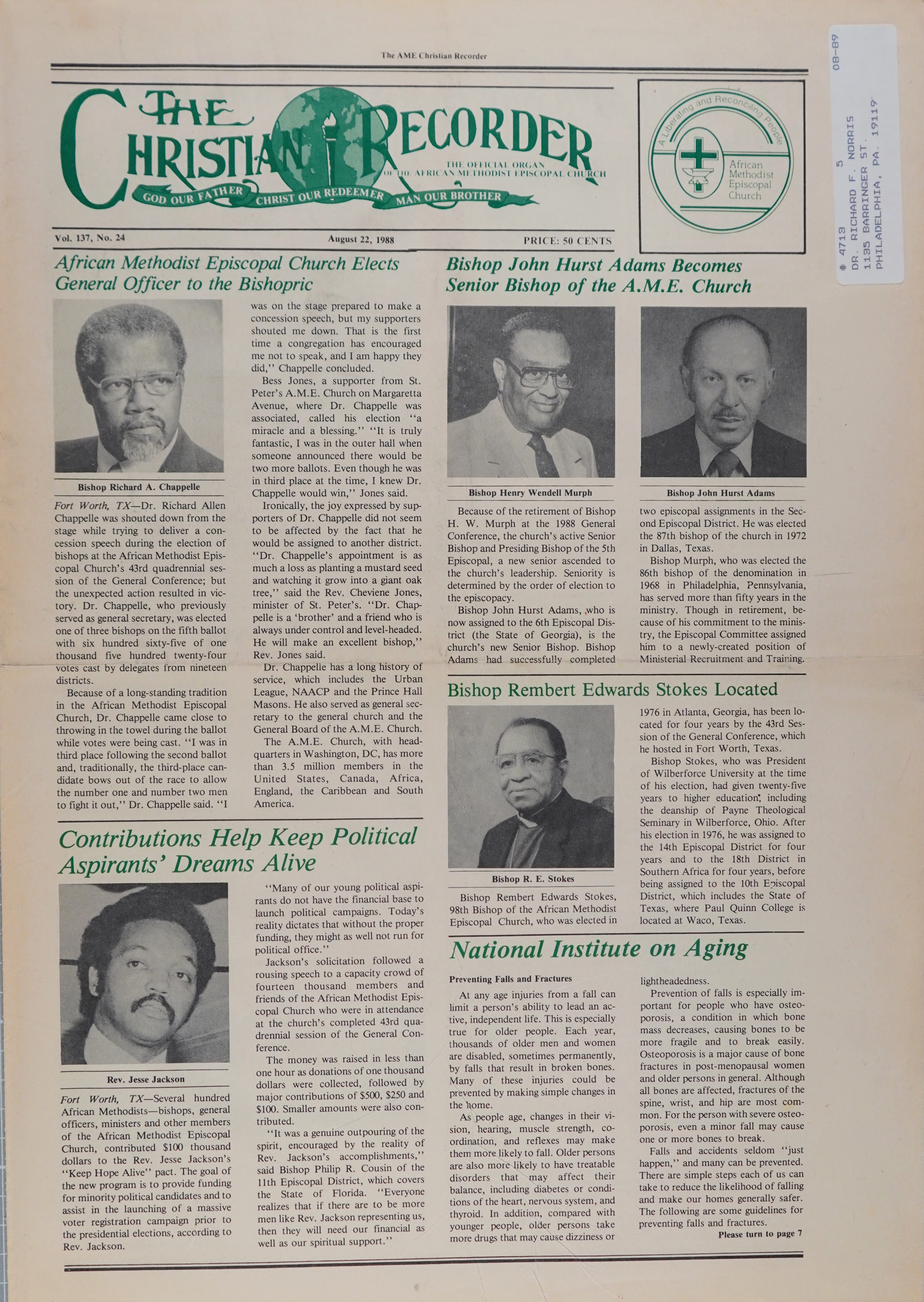
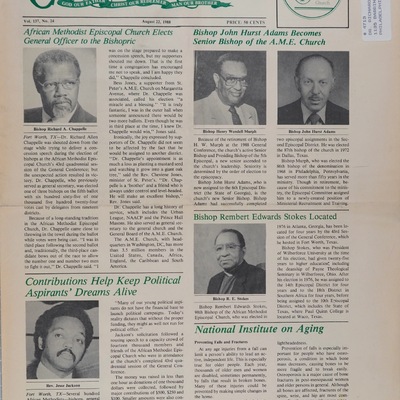
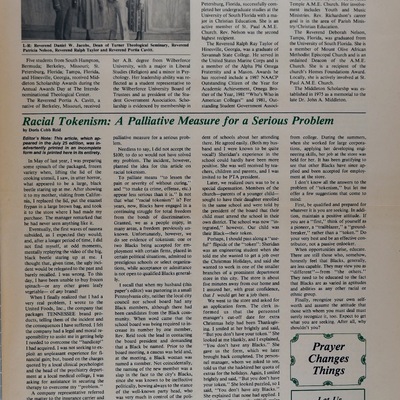
African Methodist Episcopal Church Elects
General caper to the Bishopric
Bishop Richard A. Chappelle
Fort Worth, TX—Dr. Richard Allen
Chappelle was shouted down from the
stage while trying to deliver a con-
cession speech during the election of
bishops at the African Methodist Epis-
copal Church’s 43rd quadrennial ses-
sion of the General Conference; but
the unexpected action resulted in vic-
tory. Dr. Chappelle, who previously
served as general secretary, was elected
one of three bishops on the fifth ballot
with six hundred sixty-five of one
thousand five hundred twenty-four
~ votes cast by delegates from nineteen
districts.
Because of a long-standing tradition
in the African Methodist Episcopal
Church, Dr. Chappelle came close to
throwing in the towel during the ballot
while votes were being cast. ‘‘I was in
third place following the second ballot
and, traditionally, the third-place can-
didate bows out of the race to allow
the number one and number two men
to fight it out,’’ Dr. Chappelle said. ‘‘I
was on the stage prepared to make a
concession speech, but my supporters
shouted me down. That is the first
time a congregation has encouraged
me not to speak, and I am happy they
did,’’ Chappelle concluded.
Bess Jones, a supporter from St.
Peter’s A.M.E. Church on Margaretta
Avenue, where Dr. Chappelle was
associated, called his election ‘‘a
miracle and a blessing.’’ ‘‘It is truly
fantastic, I was in the outer hall when
someone announced there would be
two more ballots. Even though he was
in third place at the time, I knew Dr.
Chappelle would win,’’ Jones said.
Ironically, the joy expressed by sup-
porters of Dr. Chappelle did not seem
to be affected by the fact that he
would be assigned to another district.
“Dr. Chappelle’s appointment is as
much a loss as planting a mustard seed
and watching it grow into a giant oak
tree,’ said the Rev. Cheviene Jones,
minister of St. Peter’s. ‘‘Dr. Chap-
pelle is a ‘brother’ and a friend who is
always under control and level-headed.
He will make an excellent bishop,”’
Rev. Jones said.
Dr. Chappelle has a long history of
service, which includes the Urban
League, NAACP and the Prince Hall
Masons. He also served as general sec-
retary to the general church and the
General Board of the A.M.E. Church.
The A.M.E. Church, with head-
quarters in Washington, DC, has more
than 3.5 million members in the
United States, Canada, Africa,
England, the Caribbean and South
America.
Contributions Help Keep Political
Aspirants’ Dreams Alive
Rev. Jesse Jackson
Fort Worth, TX—Several hundred
African Methodists—bishops, general
officers, ministers and other members
of the African Methodist Episcopal
Church, contributed $100 thousand
dollars to the Rev. Jesse Jackson’s
“Keep Hope Alive’’ pact. The goal of
the new program is to provide funding
for minority political candidates and to
assist in the launching of a massive
voter registration campaign prior to
the presidential elections, according to
Rey. Jackson.
“Many of our young political aspi-
rants do not have the financial base to
launch political campaigns. Today’s
reality dictates that without the proper
funding, they might as well not run for
political office.”’
Jackson’s solicitation followed a
rousing speech to a capacity crowd of
fourteen thousand members and
friends of the African Methodist Epis-
copal Church who were in attendance
at the church’s completed 43rd qua-
drennial session of the General Con-
ference.
The money was raised in less than
one hour as donations of one thousand
dollars were collected, followed by
major contributions of $500, $250 and
$100. Smaller amounts were also con-
tributed.
“Tt was a genuine outpouring of the
spirit, encouraged by the reality of
Rev. Jackson’s accomplishments,”’
said Bishop Philip R. Cousin of the
11th Episcopal District, which covers
the State of Florida. ‘‘Everyone
realizes that if there are to be more
men like Rev. Jackson representing us,
then they will need our financial as
well as our spiritual support.”
PRICE: 50 CENTS
ree an
eee lis
Epis coal
Church
Bishop John Hurst Adams Becomes
Senior Bishop of the A.M.E. Church
Bishop Henry Wendell Murph
Bishop John Hurst Adams
Because of the retirement of Bishop
H. W. Murph at the 1988 General
Conference, the church’s active Senior
Bishop and Presiding Bishop of the Sth
Episcopal, a new senior ascended to
the church’s leadership. Seniority is
determined by the order of election to
the episcopacy.
Bishop John Hurst Adams, who is
now assigned to the 6th Episcopal Dis-
trict (the State of Georgia), is the
church’s new Senior Bishop. Bishop
Adams had_ successfully completed
two episcopal assignments in the Sec-
ond Episcopal District. He was elected
the 87th bishop of the church in 1972
in Dallas, Texas.
Bishop Murph, who was elected the
86th bishop of the denomination in
1968 in Philadelphia, Pennsylvania,
has served more than fifty years in the
ministry. Though in retirement, be-
cause of his commitment to the minis-
try, the Episcopal Committee assigned
him to a newly-created position of
Ministerial Recruitment and Training.
eer eva Edwards Stokes Located
Bishop R. E. Stokes
Bishop Rembert Edwards Stokes,
98th Bishop of the African Methodist
Episcopal Church, who was elected in
1976 in Atlanta, Georgia, has been lo-
cated for four years by the 43rd Ses-
sion of the General Conference, which
he hosted in Fort Worth, Texas.
Bishop Stokes, who was President
of Wilberforce University at the time
of his election, had given twenty-five
years to higher education’ including
the deanship of Payne Theological
Seminary in Wilberforce, Ohio. After
his election in 1976, he was assigned to
the 14th Episcopal District for four
years and to the 18th District in
Southern Africa for four years, before
being assigned to the 10th Eniscopal
District, which includes the State of
Texas, where Paul Quinn College is
located at Waco, Texas.
National Institute on Aging
Preventing Falls and Fractures
At any age injuries from a fall can
limit a person’s ability to lead an ac-
tive, independent life. This is especially
true for older people. Each year,
thousands of older men and women
are disabled, sometimes permanently,
by falls that result in broken bones.
Many of these injuries could be
prevented by making simple changes in
the home.
As people age, changes in their vi-
sion, hearing, muscle strength, co-
ordination, and reflexes may make
them more likely to fall. Older persons
are also more-likely to have treatable
disorders that may affect their
balance, including diabetes or condi-
tions of the heart, nervous system, and
thyroid. In addition, compared with
younger people, older persons take
more drugs that may cause dizziness or
lightheadedness.
Prevention of falls is especially im-
portant for people who have osteo-
porosis, a condition in which bone
mass decreases, causing bones to be
more fragile and to break easily.
Osteoporosis is a major cause of bone
fractures in post-menopausal women
and older persons in general. Although
all bones are affected, fractures of the
spine, wrist, and hip are most com-
mon. For the person with severe osteo-
porosis, even a minor fall may cause
one or more bones to break.
Falls and accidents seldom ‘‘just
happen,’” and many can be prevented.
There are simple steps each of us can
take to reduce the likelihood of falling
and make our homes generally safer.
The following are some guidelines for
preventing falls and fractures.
Please turn to page 7
Ee
08-89
F. NORRIS
4135 BARRINGER 5ST
LPHIA, PA 19119
PHILADE
RICHARD
=]
a.
# A713
DI
===== DSC05588.JPG =====
2 The AME Christian Recorder
August 22, 1988
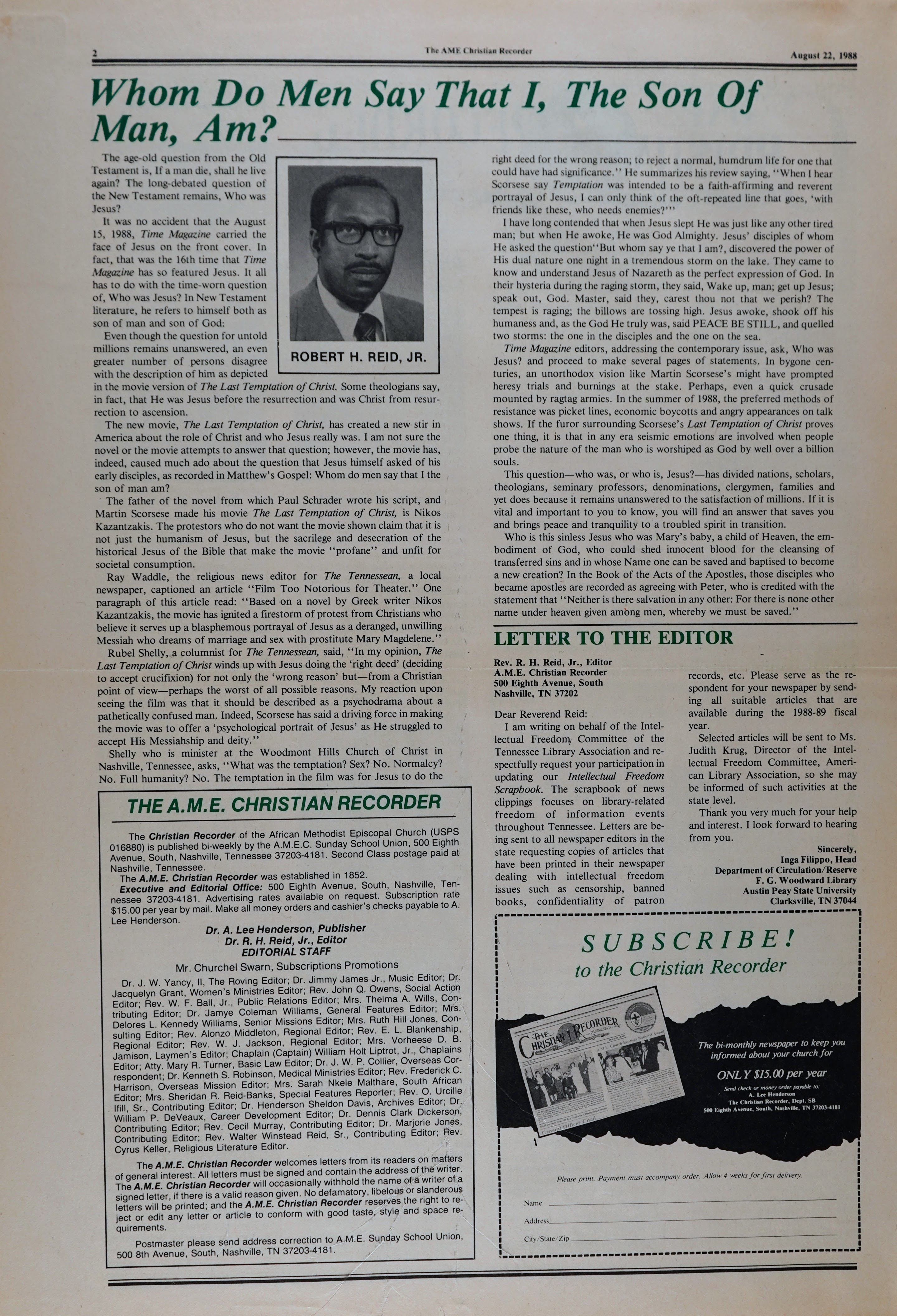
Whom Do Men Say That I, The Son Of
Man, Am?
The age-old question from the Old
Testament is, If a man die, shall he live
again? The long-debated question of
the New Testament remains, Who was
Jesus?
It was no accident that the August
15, 1988, Time Magazine carried the
face of Jesus on the front cover. In
fact, that was the 16th time that Time
Magazine has so featured Jesus. It all
has to do with the time-worn question
of, Who was Jesus? In New Testament
literature, he refers to himself both as
son of man and son of God:
Even though the question for untold
millions remains unanswered, an even
greater number of persons disagree
with the description of him as depicted
in the movie version of The Last Temptation of Christ. Some theologians say,
in fact, that He was Jesus before the resurrection and was Christ from resur-
rection to ascension.
The new movie, The Last Temptation of Christ, has created a new stir in
America about the role of Christ and who Jesus really was. I am not sure the
novel or the movie attempts to answer that question; however, the movie has,
indeed, caused much ado about the question that Jesus himself asked of his
early disciples, as recorded in Matthew’s Gospel: Whom do men say that I the
son of man am?
’ The father of the novel from which Paul Schrader wrote his script, and
Martin Scorsese made his movie The Last Temptation of Christ, is Nikos
Kazantzakis. The protestors who do not want the movie shown claim that it is
not just the humanism of Jesus, but the sacrilege and desecration of the
historical Jesus of the Bible that make the movie ‘‘profane’’ and unfit for
societal consumption.
Ray Waddle, the religious news editor for The Tennessean, a local
newspaper, captioned an article ‘‘Film Too Notorious for Theater.’” One
paragraph of this article read: ‘‘Based on a novel by Greek writer Nikos
Kazantzakis, the movie has ignited a firestorm of protest from Christians who
believe it serves up a blasphemous portrayal of Jesus as a deranged, unwilling
Messiah who dreams of marriage and sex with prostitute Mary Magdelene.”’
Rubel Shelly,.a columnist for The Tennessean, said, ‘‘In my opinion, The
Last Temptation of Christ winds up with Jesus doing the ‘right deed’ (deciding
ROBERT H. REID, JR.
right deed for the wrong reason; to reject a normal, humdrum life for one that
could have had significance.’ He summarizes his review saying, ‘*When | hear
Scorsese say Temptation was intended to be a faith-affirming and reverent
portrayal of Jesus, | can only think of the oft-repeated line that goes, ‘with
friends like these, who needs enemies?’”’
I have long contended that when Jesus slept He was just like any other tired
man; but when He awoke, He was God Almighty. Jesus’ disciples of whom
He asked the question*‘But whom say ye that | am?, discovered the power of
His dual nature one night in a tremendous storm on the lake. They came to
know and understand Jesus of Nazareth as the perfect expression of God. In
their hysteria during the raging storm, they said, Wake up, man; get up Jesus;
speak out, God. Master, said they, carest thou not that we perish? The
tempest is raging; the billows are tossing high. Jesus awoke, shook off his
humaness and, as the God He truly was, said PEACE BE STILL, and quelled
two storms: the one in the disciples and the one on the sea.
Time Magazine editors, addressing the contemporary issue, ask, Who was
Jesus? and proceed to make several pages of statements. In bygone cen-
turies, an unorthodox vision like Martin Scorsese’s might have prompted
heresy trials and burnings at the stake. Perhaps, even a quick crusade
mounted by ragtag armies. In the summer of 1988, the preferred methods of
resistance was picket lines, economic boycotts and angry appearances on talk
shows. If the furor surrounding Scorsese’s Last Temptation of Christ proves
one thing, it is that in any era seismic emotions are involved when people
probe the nature of the man who is worshiped as God by well over a billion
souls.
This question—who was, or who is, Jesus?—has divided nations, scholars,
theologians, seminary professors, denominations, clergymen, families and
yet does because it remains unanswered to the satisfaction of millions. If it is
vital and important to you to know, you will find an answer that saves you
and brings peace and tranquility to a troubled spirit in transition.
Who is this sinless Jesus who was Mary’s baby, a child of Heaven, the em-
bodiment of God, who could shed innocent blood for the cleansing of
transferred sins and in whose Name one can be saved and baptised to become
a new creation? In the Book of the Acts of the Apostles, those disciples who
became apostles are recorded as agreeing with Peter, who is credited with the
statement that ‘‘Neither is there salvation in any other: For there is none other
name under heaven given among men, whereby we must be saved.”’
LETTER TO THE EDITOR
Rev. R. H. Reid, Jr., Editor
A.M.E. Christian Recorder
to accept crucifixion) for not only the ‘wrong reason’ but—from a Christian
point of view—perhaps the worst of all possible reasons. My reaction upon
seeing the film was that it should be described as a psychodrama about a
pathetically confused man, Indeed, Scorsese has said a driving force in making
the movie was to offer a ‘psychological portrait of Jesus’ as He struggled to
accept His Messiahship and deity.’’
Shelly who is minister at the Woodmont Hills Church of Christ in
Nashville, Tennessee, asks, ‘‘What was the temptation? Sex? No. Normalcy?
No. Full humanity? No. The temptation in the film was for Jesus to do the
THE A.M.E. CHRISTIAN RECORDER
The Christian Recorder of the African Methodist Episcopal Church (USPS
016880) is published bi-weekly by the A.M.E.C. Sunday School Union, 500 Eighth
Avenue, South, Nashville, Tennessee 37203-4181. Second Class postage paid at
Nashville, Tennessee.
The A.M.E. Christian Recorder was established in 1852.
Executive and Editorial Office: 500 Eighth Avenue, South, Nashville, Ten-
nessee 37203-4181. Advertising rates available on request. Subscription rate
$15.00 per year by mail. Make’ all money orders and cashier’s checks payable to A.
Lee Henderson.
Dr. A. Lee Henderson, Publisher
Dr. R. H. Reid, Jr., Editor
EDITORIAL STAFF
Mr. Churchel Swarn, Subscriptions Promotions
Dr. J. W. Yancy, Il, The Roving Editor; Dr. Jimmy James Jr., Music Editor; Dr.
Jacquelyn Grant, Women’s Ministries Editor; Rev. John Q. Owens, Social Action
Editor; Rev. W. F. Ball, Jr., Public Relations Editor; Mrs. Thelma A. Wills, Con-
tributing Editor; Dr. Jamye Coleman Williams, General Features Editor; Mrs.
Delores L. Kennedy Williams, Senior Missions Editor; Mrs. Ruth Hill Jones, Con-
sulting Editor; Rev. Alonzo Middleton, Regional Editor; Rev. E. L. Blankenship,
Regional Editor; Rev. W. J. Jackson, Regional Editor, Mrs. Vorheese D. B.
Jamison, Laymen’s Editor, Chaplain (Captain) William Holt Liptrot, Jr., Chaplains
Editor; Atty. Mary R. Turner, Basic Law Editor; Dr. J. W. fee Collier, Overseas Cor-
respondent; Dr. Kenneth S. Robinson, Medical Ministries Editor; Rev. Frederick C.
Harrison, Overseas Mission Editor; Mrs. Sarah Nkele Malthare, South African
Editor; Mrs. Sheridan R. Reid-Banks, Special Features Reporter, Rev. O. Urcille
Ifill, Sr., Contributing Editor; Dr. Henderson Sheldon Davis, Archives Editor; Dr.
William P. DeVeaux, Career Development Editor; Dr. Dennis Clark Dickerson,
Contributing Editor; Rev. Cecil Murray, Contributing Editor; Dr. Marjorie Jones,
Contributing Editor; Rev. Walter Winstead Reid, Sr., Contributing Editor; Rev.
Cyrus Keller, Religious Literature Editor. j
The A.M.E. Christian Recorder welcomes letters from its readers on matters
of general interest. All letters must be signed and contain the address of thé writer.
The A.M.E. Christian Recorder will occasionally withhold the name ofa writer ofa
signed letter, if there is a valid reason given. No defamatory, libelous or slanderous
letters will be printed; and the A.M.E. Christian Recorder reserves the right to re-
ject or edit any letter or article to conform with good taste, style and space re-
quirements.
Postmaster please send address correction to A.M.E. Sunday School Union,
500 8th Avenue, South, Nashville, TN 37203-4181.
500 Eighth Avenue, South
Nashville, TN 37202
Dear Reverend Reid:
I am writing on behalf of the Intel-
lectual Freedom, Committee of the
Tennessee Library Association and re-
spectfully request your participation in
updating our Intellectual Freedom
Scrapbook. The scrapbook of news
clippings focuses on library-related
freedom of information events
throughout Tennessee. Letters are be-
ing sent to all newspaper editors in the
state requesting copies of articles that
have been printed in their newspaper
dealing with intellectual freedom
issues such as censorship, banned
books, confidentiality of patron
records, etc. Please serve as the re-
spondent for your newspaper by send-
ing all suitable articles that are
available during the 1988-89 fiscal
year.
Selected articles will be sent to Ms.
Judith Krug, Director of the Intel-
lectual Freedom Committee, Ameri-
can Library Association, so she may
be informed of such activities at the
state level.
Thank you very much for your help
and interest. I look forward to hearing
from you.
Sincerely,
Inga Filippo, Head
Department of Circulation/Reserve
F. G. Woodward Library
Austin Peay State University
Clarksville, TN 37044
SUBSCRIBE!
to the Christian Recorder
Please print. Payment must accompany order. Allow 4 weeks for first delivery.
The bi-monthly newspaper to keep you
informed about your church for
ONLY $15.00 per year
‘Send check or money order payable to:
‘ A. Lee Henderson
The Christian Recorder, Dept. SB
500 Eighth Avenue, South, Nashville, TN 37203-4181
Name* 22
Address= pen
City/State/Zip ——
ee al
Leeeeeeeee ee eeeee =
===== DSC05589.JPG =====
August 22, 1988
The AME Christian Recorder
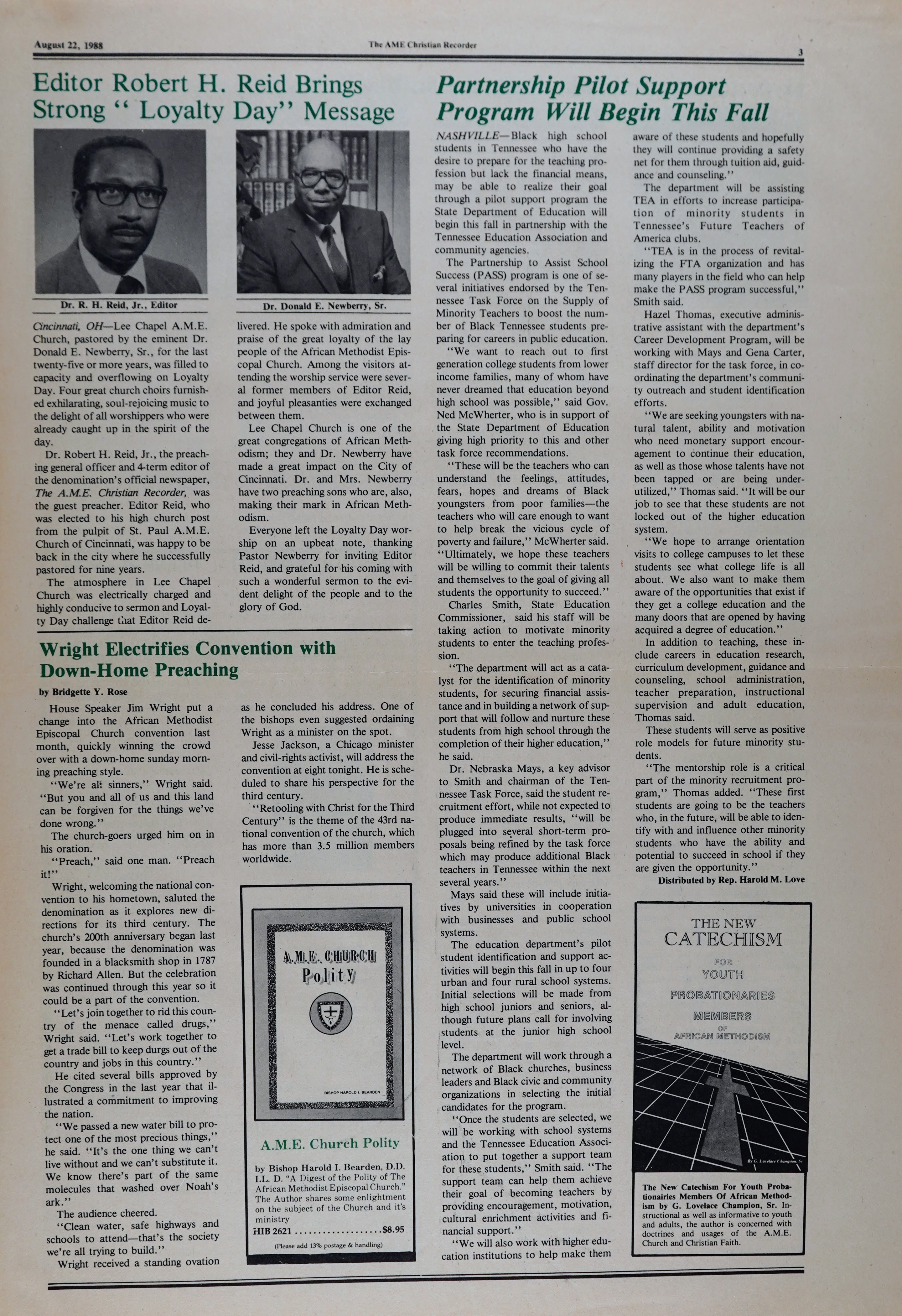
Editor Robert H. Reid Brings
Dr. R. H. Reid, Jr., Editor
Cincinnati, OH—Lee Chapel A.M.E.
Church, pastored by the eminent Dr.
Donald E. Newberry, Sr., for the last
twenty-five or more years, was filled to
capacity and overflowing on Loyalty
Day. Four great church choirs furnish-
ed exhilarating, soul-rejoicing music to
the delight of all worshippers who were
already caught up in the spirit of the
day.
Dr. Robert H. Reid, Jr., the preach-
ing general officer and 4 term editor of
the denomination’s official newspaper,
The A.M.E. Christian Recorder, was
the guest preacher. Editor Reid, who
was elected to his high church post
from the pulpit of St. Paul A.M.E.
Church of Cincinnati, was happy to be
back in the city where he successfully
pastored for nine years.
The atmosphere in Lee Chapel
Church was electrically charged and
highly conducive to sermon and Loyal-
ty Day challenge tnat Editor Reid de-
Strong ‘* Loyalty Day’’ Message
Dr. Donald E. Newberry, Sr.
livered. He spoke with admiration and
praise of the great loyalty of the lay
people of the African Methodist Epis-
copal Church. Among the visitors at-
tending the worship service were sever-
al former members of Editor Reid,
and joyful pleasanties were exchanged
between them.
Lee Chapel Church is one of the
great congregations of African Meth-
odism; they and Dr. Newberry have
made a great impact on the City of
Cincinnati. Dr. and Mrs. Newberry
have two preaching sons who are, also,
making their mark in African Meth-
odism.
Everyone left the Loyalty Day wor-
ship on an upbeat note, thanking
Pastor Newberry for inviting Editor
Reid, and grateful for his coming with
such a wonderful sermon to the evi-
dent delight of the people and to the
glory of God.
Wright Electrifies Convention with
Down-Home Preaching
; by Bridgette Y. Rose
House Speaker Jim Wright put a
change into the African Methodist
Episcopal Church convention last
month, quickly winning the crowd
over with a down-home sunday morn-
ing preaching style.
‘“*We’re ali sinners,’ Wright said.
“But you and all of us and this land
can be forgiven for the things we’ve
done wrong.”’
The church-goers urged him on in
his oration.
“Preach,’’ said one man. ‘‘Preach
ith”
Wright, welcoming the national con-
vention to his hometown, saluted the
denomination as it explores new di-
rections for its third century. The
church’s 200th anniversary began last
year, because the denomination was
founded in a blacksmith shop in 1787
by Richard Allen. But the celebration
was continued through this year so it
could be a part of the convention.
“‘Let’s join together to rid this coun-
try of the menace called drugs,”’
Wright said. ‘‘Let’s work together to
get a trade bill to keep durgs out of the
country and jobs in this country.”’
He cited several bills approved by
the Congress in the last year that il-
lustrated a commitment to improving
the nation.
“‘We passed a new water bill to pro-
tect one of the most precious things,”’
he said. ‘‘It’s the one thing we can’t
live without and we can’t substitute it.
We know there’s part of the same
molecules that washed over Noah’s
ark.”’
The audience cheered.
“Clean water, safe highways and
schools to attend—that’s the society
we’re all trying to build.”’
Wright received a standing ovation
as he concluded his address. One of
the bishops even suggested ordaining
Wright as a minister on the spot.
Jesse Jackson, a Chicago minister
and civil-rights activist, will address the
convention at eight tonight. He is sche-
duled to share his perspective for the
third century.
‘*‘Retooling with Christ for the Third
Century’’ is the theme of the 43rd na-
tional convention of the church, which
has more than 3.5 million members
worldwide.
ALMLE:. CHIR CHI
Polit ¥
A.M.E. Church Polity
by Bishop Harold I. Bearden, D.D.
LL. D. “A Digest of the Polity of The
African Methodist Episcopal Church.”
The Author shares some enlightment
on the subject of the Church and it’s
ministry
HIB 2621
(Please add 13% postage é& handling)
Partnership Pilot Support
Program Will Begin This Fall
NASHVILLE—Black high school
students in Tennessee who have the
desire to prepare for the teaching pro-
fession but lack the financial means,
may be able to realize their goal
through a pilot support program the
State Department of Education will
begin this fall in partnership with the
Tennessee Education Association and
community agencies.
The Partnership to Assist School
Success (PASS) program is one of se-
veral initiatives endorsed by the Ten-
nessee Task Force on the Supply of
Minority Teachers to boost the num-
ber of Black Tennessee students pre-
paring for careers in public education.
‘“‘We want to reach out to first
generation college students from lower
income families, many of whom have
never dreamed that education beyond
high school was possible,’’ said Gov.
Ned McWherter, who is in support of
the State Department of Education
giving high priority to this and other
task force recommendations.
‘These will be the teachers who can
understand the feelings, attitudes,
fears, hopes and dreams of Black
youngsters from poor families—the
teachers who will care enough to want
to help break the vicious cycle of
poverty and failure,’’ McWherter said.
“Ultimately, we hope these teachers
will be willing to commit their talents
and themselves to the goal of giving all
students the opportunity to succeed.’’
Charles Smith, State Education
Commissioner, said his staff will be
taking action to motivate minority
students to enter the teaching profes-
sion.
‘‘The department will act as a cata-
lyst for the identification of minority
students, for securing financial assis-
tance and in building a network of sup-
port that will follow and nurture these
students from high school through the
completion of their higher education,”’
he said.
Dr. Nebraska Mays, a key advisor
to Smith and chairman of the Ten-
nessee Task Force, said the student re-
cruitment effort, while not expected to
produce immediate results, ‘‘will be
plugged into several short-term pro-
posals being refined by the task force
which may produce additional Black
teachers in Tennessee within the next
several years.’”
Mays said these will include initia-
tives by universities in cooperation
with businesses and public school
systems.
The education department’s pilot
student identification and support ac-
tivities will begin this fall in up to four
urban and four rural school systems.
Initial selections will be made from
high school juniors and seniors, al-
though future plans call for involving
students at the junior high school
level.
The department will work through a
‘network of Black churches, business
leaders and Black civic and community
organizations in selecting the initial
candidates for the program.
“Once the students are selected, we
will be working with school systems
and the Tennessee Education Associ-
ation to put together a support team
for these students,’’ Smith said. ‘‘The
support team can help them achieve
their goal of becoming teachers by
providing encouragement, motivation,
cultural enrichment activities and fi-
nancial support.’’
“We will also work with higher edu-
cation institutions to help make them
aware of these students and hopefully
they will continue providing a safety
net for them through tuition aid, guid-
ance and counseling."’
The department will be assisting
TEA in efforts to increase participa-
tion of minority students in
Tennessee’s Future Teachers of
America clubs.
“TEA is in the process of revital-
izing the FTA organization and has
many players in the field who can help
make the PASS program successful,’’
Smith said.
Hazel Thomas, executive adminis-
trative assistant with the department’s
Career Development Program, will be
working with Mays and Gena Carter,
staff director for the task force, in co-
ordinating the department’s communi-
ty outreach and student identification
efforts.
‘*We are seeking youngsters with na-
tural talent, ability and motivation
who need monetary support encour-
agement to continue their education,
as well as those whose talents have not
been tapped or are being under-
utilized,’ Thomas said. ‘‘It will be our
job to see that these students are not
locked out of the higher education
system.
‘““We hope to arrange orientation
visits to college campuses to let these
students see what college life is all
about. We also want to make them
aware of the opportunities that exist if
they get a college education and the
many doors that are opened by having
acquired a degree of education.”’
In addition to teaching, these in-
clude careers in education research,
curriculum development, guidance and
counseling, school administration,
teacher preparation, instructional
supervision and adult education,
Thomas said.
These students will serve as positive
role models for future minority stu-
dents.
“The mentorship role is a critical
part of the minority recruitment pro-
gram,’’ Thomas added. ‘‘These first
students are going to be the teachers
who, in the future, will be able to iden-
tify with and influence other minority
students who have the ability and
potential to succeed in school if they
are given the opportunity.”’
Distributed by Rep. Harold M. Love
THE NEW
CATECHISM
YOUTH
PROBATIONARIES
MEMBERS
AFRICAN METHODISM
By G. Lovelace Champion. Sr
\
The New Catechism For Youth Proba-
tionairies Members Of African Method-
ism by G. Lovelace Champion, Sr. In-
structional as well as informative to youth
and adults, the author is concerned with
doctrines and usages of the A.M.E.
Church and Christian Faith.
————— ae
===== DSC05590.JPG =====
4
The AME Christian Recorder
August 22, 1988
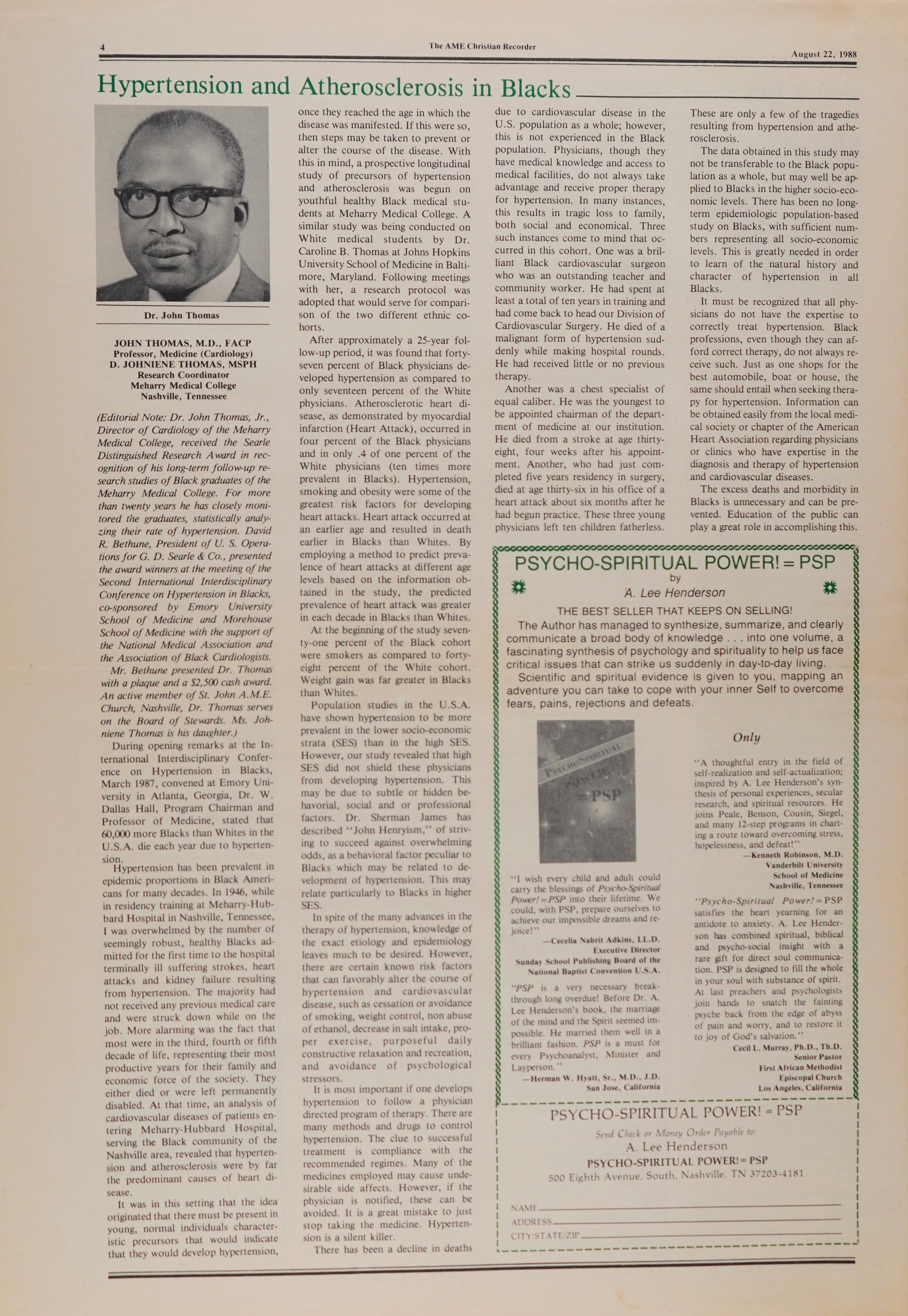
ee perension and Atherosclerosis in Blacks
Dr. John Thomas
JOHN THOMAS, M.D., FACP
Professor, Medicine (Cardiology)
D. JOHNIENE THOMAS, MSPH
Research Coordinator
Meharry Medical College
Nashville, Tennessee
(Editorial Note: Dr. John Thomas, Jr.,
Director of Cardiology of the Meharry
Medical College, received the Searle
Distinguished Research Award in rec-
ognition of his long-term follow-up re-
search studies of Black graduates of the
Meharry Medical College. For more
than twenty years he has closely moni-
tored the graduates, statistically analy-
zing their rate of hypertension. David
R. Bethune, President of U. S. Opera-
tions for G. D. Searle & Co., presented
the award winners at the meeting of the
Second International Interdisciplinary
Conference on Hypertension in Blacks,
co-sponsored by Emory University
School of Medicine and Morehouse
School of Medicine with the support of
the National Medical Association and
the Association of Black Cardiologists.
Mr. Bethune presented Dr. Thomas
with a plaque and a $2,500 cash award.
An active member of St. John A.M.E.
Church, Nashville, Dr. Thomas serves
on the Board of Stewards. Ms. Joh-
niene Thomas is his daughter.)
During opening remarks at the In-
ternational Interdisciplinary Confer-
ence on Hypertension in Blacks,
March 1987, convened at Emory Uni-
versity in Atlanta, Georgia, Dr. W.
Dallas Hall, Program Chairman and
Professor of Medicine, stated that
60,000 more Blacks than Whites in the
U.S.A. die each year due to hyperten-
a Hypertension has been prevalent in
epidemic proportions in Black Ameri-
cans for many decades. In 1946, while
in residency training at Meharry-Hub-
bard Hospital in Nashville, Tennessee,
I was overwhelmed by the number of
seemingly robust, healthy Blacks ad-
mitted for the first time to the hospital
terminally ill suffering strokes, heart
attacks and kidney failure resulting
from hypertension. The majority had
not received any previous medical care
and were struck down while on the
job. More alarming was the fact that
most were in the third, fourth or fifth
decade of life, representing their most
productive years for their family and
economic force of the society. They
either died or were left permanently
disabled, At that time, an analysis of
cardiovascular diseases of patients en-
tering Meharry-Hubbard Hospital,
serving the Black community of the
Nashville area, revealed that hyperten-
sion and atherosclerosis were by far
the predominant causes of heart di-
sease.
It was in this setting that the idea
originated that there must be present in
young, normal individuals character-
istic precursors that would indicate
that they would develop hypertension,
once they reached the age in which the
disease was manifested. If this were so,
then steps may be taken to prevent or
alter the course of the disease. With
this in mind, a prospective longitudinal
study of precursors of hypertension
and atherosclerosis was begun on
youthful healthy Black medical stu-
dents at Meharry Medical College. A
similar study was being conducted on
White medical students by Dr.
Caroline B. Thomas at Johns Hopkins
University School of Medicine in Balti-
more, Maryland. Following meetings
with her, a research protocol was
adopted that would serve for compari-
son of the two different ethnic co-
horts.
After approximately a 25-year fol-
low-up period, it was found that forty-
seven percent of Black physicians de-
veloped hypertension as compared to
only seventeen percent of the White
physicians. Atherosclerotic heart di-
sease, as demonstrated by myocardial
infarction (Heart Attack), occurred in
four percent of the Black physicians
and in only .4 of one percent of the
White physicians (ten times more
prevalent in Blacks). Hypertension,
smoking and obesity were some of the
greatest risk factors for developing
heart attacks. Heart attack occurred at
an earlier age and resulted in death
earlier in Blacks than Whites. By
employing a method to predict preva-
lence of heart attacks at different age
levels based on the information ob-
tained in the study, the predicted
prevalence of heart attack was greater
in each decade in Blacks than Whites.
At the beginning of the study seven-
ty-one percent of the Black cohort
were smokers as compared to forty-
eight percent of the White cohort.
Weight gain was far greater in Blacks
than Whites.
Population studies in the U.S.A.
have shown hypertension to be more
prevalent in the lower socio-economic
strata (SES) than in the high SES.
However, our study revealed that high
SES did not shield these physicians
from developing hypertension. This
may be due to subtle or hidden be-
havorial, social and or professional
factors. Dr. Sherman James has
described ‘‘John Henryism,”’ of striv-
ing to succeed against overwhelming
odds, as a behavioral factor peculiar to
Blacks which may be related to de-
velopment of hypertension. This may
relate particularly to Blacks in higher
SES.
In spite of the many advances in the
therapy of hypertension, knowledge of
the exact etiology and epidemiology
leaves much to be desired. However,
there are certain known risk factors
that can favorably alter the course of
hypertension and cardiovascular
disease, such as cessation or avoidance
of smoking, weight control, non abuse
of ethanol, decrease in salt intake, pro-
per exercise, purposeful daily
constructive relaxation and recreation,
and avoidance of psychological
stressors.
It is most important if one develops
hypertension to follow a physician
directed program of therapy, There are
many methods and drugs to control
hypertension, The clue to successful
treatment is compliance with the
recommended regimes. Many of the
medicines employed may cause unde-
sirable side affects. However, if the
physician is notified, these can be
avoided. It is a great mistake to just
stop taking the medicine. Hyperten-
sion is a silent killer.
There has been a decline in deaths
due to cardiovascular disease in the
U.S. population as a whole; however,
this is not experienced in the Black
population. Physicians, though they
have medical knowledge and access to
medical facilities, do not always take
advantage and receive proper therapy
for hypertension. In many instances,
this results in tragic loss to family,
both social and economical. Three
such instances come to mind that oc-
curred in this cohort. One was a bril-
liant Black cardiovascular surgeon
who was an outstanding teacher and
community worker. He had spent at
least a total of ten years in training and
had come back to head our Division of
Cardiovascular Surgery. He died of a
malignant form of hypertension sud-
denly while making hospital rounds.
He had received little or no previous
therapy.
Another was a chest specialist of
equal caliber. He was the youngest to
be appointed chairman of the depart-
ment of medicine at our institution.
He died from a stroke at age thirty-
eight, four weeks after his appoint-
ment. Another, who had just com-
pleted five years residency in surgery,
died at age thirty-six in his office of a
heart attack about six months after he
had begun practice. These three young
physicians left ten children fatherless.
PSYCHO- SPIRITUAL POWER! =
These are only a few of the tragedies
resulting from hypertension and athe-
rosclerosis.
The data obtained in this study may
not be transferable to the Black popu-
lation as a whole, but may well be ap-
plied to Blacks in the higher socio-eco-
nomic levels. There has been no long-
term epidemiologic population-based
study on Blacks, with sufficient num-
bers representing all socio-economic
levels. This is greatly needed in order
to learn of the natural history and
character of hypertension in all
Blacks.
It must be recognized that all phy-
sicians do not have the expertise to
correctly treat hypertension. Black
professions, even though they can af-
ford correct therapy, do not always re-
ceive such. Just as one shops for the
best automobile, boat or house, the
same should entail when seeking thera-
py for hypertension. Information can
be obtained easily from the local medi-
cal society or chapter of the American
Heart Association regarding physicians
or clinics who have expertise in the
diagnosis and therapy of hypertension
and cardiovascular diseases.
The excess deaths and morbidity in
Blacks is unnecessary and can be pre-
vented. Education of the public can
play a great role in accomplishing this.
PSP
xt A. Lee Pe st
THE BEST SELLER THAT KEEPS ON SELLING!
The Author has managed to synthesize, summarize, and clearly
communicate a broad body of knowledge .. .
into one volume, a
fascinating synthesis of psychology and spirituality to help us face
critical issues that can strike us suddenly in day-to-day living.
Scientific and spiritual evidence is given to you, mapping an
adventure you can take to cope with your inner Self to overcome
fears, pains, rejections and defeats.
“1 wish every child and adult could
carry the blessings of Psycho-Spiritual
Power! = PSP into their lifetime. We
could, with PSP, prepare ourselves to
achieve our impossible dreams and re-
joice!””
—Cecelia Nabrit Adkins, LL.D.
Executive Director
Sunday Schoo! Publishing Board of the
National Baptist Convention U.S.A.
“PSP is a very necessary break-
through long overdue! Before Dr. A.
Lee Henderson's book, the marriage
of the mind and the Spirit seemed im-
possible. He married them well in a
brilliant fashion, PSP is a must for
every Psychoanalyst, Minister and
Layperson.”’
Herman W, Hyatt, Sr., M.D., J.D.
San Jose, California
PSYCHO-SPIRITUAL POWER! =
or Money Ord
A. Lee Henderson
PSYCHO-SPIRITUAL POWER!= PSP
Nashville, TN 37203-4181
Send Check
500 Eighth Avenue, South
NAME
ADDRESS
CITY/STATE/ZIP —
Only
‘A thoughtful entry in the field of
self-realization and self-actualization;
inspired by A, Lee Henderson’s syn-
thesis of personal experiences, secular
research, and spiritual resources. He
joins Peale, Benson, Cousin, Siegel,
and many 12-step programs in chart-
ing a route toward overcoming stress,
hopelessness, and defeat!"*
—Kenneth Robinson, M.D.
Vanderbilt University
School of Medicine
Nashville, Tennessee
“*‘Psycho-Spiritual Power! =PSP
satisfies the heart yearning for an
antidote to anxiety. A. Lee Hender-
son has combined spiritual, biblical
and psycho-social insight with a
rare gift for direct soul communica-
tion. PSP is designed to fill the whole
in your soul with substance of spirit.
At last preachers and psychologists
join hands to snatch the fainting
psyche back from the edge of abyss
of pain and worry, and to restore it
to joy of God's salvation,”’
Cecil L. Murray, Ph.D., Th.D.
Senior Pastor
First African Methodist
Episcopal Church
Los Angeles, California
PSE
ler Payable to:
!
1
I
1
i
|
1
1
!
1
!
|
!
1
1
-
a __
===== DSC05591.JPG =====
August 22, 1988
The AME Christian Recorder
Middleton Scholars Receive $2,000 in Scholarships
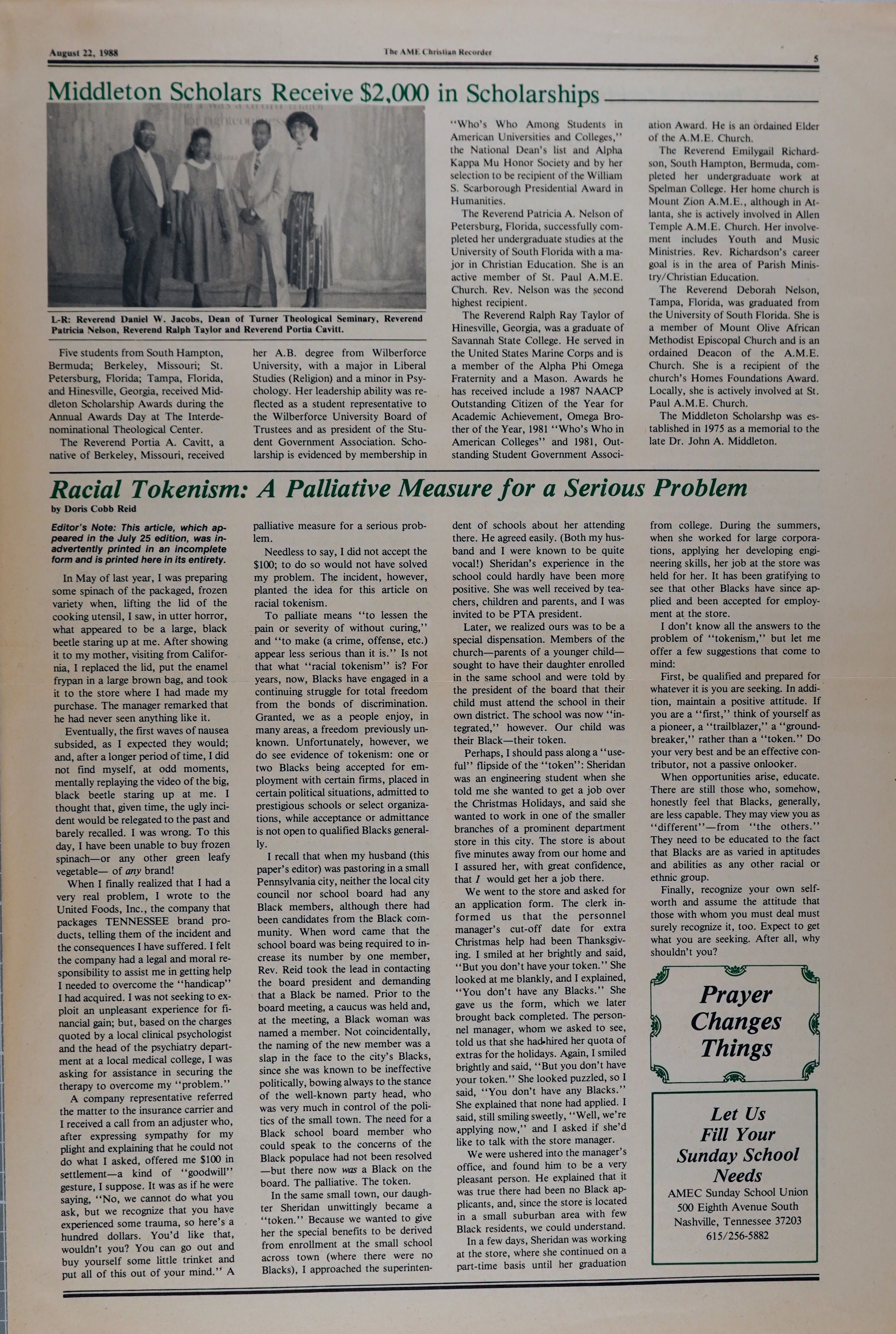
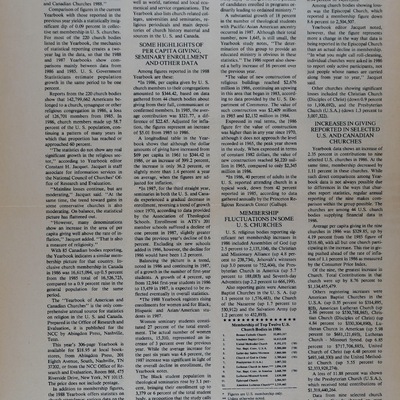
L-R: Reverend Daniel W. Jacobs, Dean of Turner Theological Seminary, Reverend
Patricia Nelson, Reverend Ralph Taylor and Reverend Portia Cavitt.
Five students from South Hampton,
Bermuda; Berkeley, Missouri; St.
Petersburg, Florida; Tampa, Florida,
and Hinesville, Georgia, received Mid-
dleton Scholarship Awards during the
Annual Awards Day at The Interde-
nominational Theological Center.
The Reverend Portia A. Cavitt, a
native of Berkeley, Missouri, received
her A.B. degree from Wilberforce
University, with a major in Liberal
Studies (Religion) and a minor in Psy-
chology. Her leadership ability was re-
flected as a student representative to
the Wilberforce University Board of
Trustees and as president of the Stu-
dent Government Association. Scho-
larship is evidenced by membership in
“Who's Who Among Students in
American Universities and Colleges,’’
the National Dean's list and Alpha
Kappa Mu Honor Society and by her
selection to be recipient of the William
S. Scarborough Presidential Award in
Humanities.
The Reverend Patricia A, Nelson of
Petersburg, Florida, successfully com-
pleted her undergraduate studies at the
University of South Florida with a ma-
jor in Christian Education. She is an
active member of St. Paul A.M.E.
Church. Rev. Nelson was the second
highest recipient.
The Reverend Ralph Ray Taylor of
Hinesville, Georgia, was a graduate of
Savannah State College. He served in
the United States Marine Corps and is
a member of the Alpha Phi Omega
Fraternity and a Mason. Awards he
has received include a 1987 NAACP
Outstanding Citizen of the Year for
Academic Achievement, Omega Bro-
ther of the Year, 1981 ‘‘Who’s Who in
American Colleges’? and 1981, Out-
standing Student Government Associ-
ation Award, He is an ordained Elder
of the A.M.E, Church,
The Reverend Emilygail Richard-
son, South Hampton, Bermuda, com-
pleted her undergraduate work at
Spelman College. Her home church is
Mount Zion A.M.E., although in At-
lanta, she is actively involved in Allen
Temple A.M.E. Church. Her involve-
ment includes Youth and Music
Ministries. Rev. Richardson's career
goal is in the area of Parish Minis-
try/Christian Education.
The Reverend Deborah Nelson,
Tampa, Florida, was graduated from
the University of South Florida. She is
a member of Mount Olive African
Methodist Episcopal Church and is an
ordained Deacon of the A.M.E.
Church. She is a recipient of the
church’s Homes Foundations Award.
Locally, she is actively involved at St.
Paul A.M.E. Church.
The Middleton Scholarshp was es-
tablished in 1975 as a memorial to the
late Dr. John A. Middleton.
Racial Tokenism: A Palliative Measure for a Serious Problem
by Doris Cobb Reid
Editor’s Note: This article, which ap-
peared in the July 25 edition, was in-
advertently printed in an incomplete
form and is printed here in its entirety.
In May of last year, I was preparing
some spinach of the packaged, frozen
variety when, lifting the lid of the
cooking utensil, I saw, in utter horror,
what appeared to be a large, black
beetle staring up at me. After showing
it to my mother, visiting from Califor-
nia, I replaced the lid, put the enamel
frypan in a large brown bag, and took
it to the store where I had made my
purchase. The manager remarked that
he had never seen anything like it.
Eventually, the first waves of nausea
subsided, as I expected they would;
and, after a longer period of time, I did
not find myself, at odd moments,
mentally replaying the video of the big,
black beetle staring up at me. I
thought that, given time, the ugly inci-
dent would be relegated to the past and
barely recalled. I was wrong. To this
day, I have been unable to buy frozen
spinach—or any other green leafy
vegetable— of any brand!
When I finally realized that I had a
very real problem, I wrote to the
United Foods, Inc., the company that
packages TENNESSEE brand pro-
ducts, telling them of the incident and
the consequences I have suffered. I felt
the company had a legal and moral re-
sponsibility to assist me in getting help
I needed to overcome the ‘‘handicap’’
I had acquired. I was not seeking to ex-
ploit an unpleasant experience for fi-
nancial gain; but, based on the charges
quoted by a local clinical psychologist
and the head of the psychiatry depart-
ment at a local medical college, I was
asking for assistance in securing the
therapy to overcome my “‘problem.”’
A company representative referred
the matter to the insurance carrier and
I received a call from an adjuster who,
after expressing sympathy for my
plight and explaining that he could not
do what I asked, offered me $100 in
settlement—a kind of ‘‘goodwill’’
gesture, I suppose. It was as if he were
saying, ‘‘No, we cannot do what you
ask, but we recognize that you have
experienced some trauma, sO here’s a
hundred dollars. You’d like that,
wouldn’t you? You can go out and
buy yourself some little trinket and
put all of this out of your mind.’’ A
palliative measure for a serious prob-
lem.
Needless to say, I did not accept the
$100; to do so would not have solved
my problem. The incident, however,
planted the idea for this article on
racial tokenism.
To palliate means ‘‘to lessen the
pain or severity of without curing,”’
‘and ‘‘to make (a crime, offense, etc.)
appear less serious than it is.’’ Is not
that what ‘‘racial tokenism’’ is? For
years, now, Blacks have engaged in a
continuing struggle for total freedom
from the bonds of discrimination.
Granted, we as a people enjoy, in
many areas, a freedom previously un-
known. Unfortunately, however, we
do see evidence of tokenism: one or
two Blacks being accepted for em-
ployment with certain firms, placed in
certain political situations, admitted to
prestigious schools or select organiza-
tions, while acceptance or admittance
is not open to qualified Blacks general-
ly.
I recall that when my husband (this
paper’s editor) was pastoring in a small
Pennsylvania city, neither the local city
council nor school board had any
Black members, although there had
been candidates from the Black com-
munity. When word came that the
school board was being required to in-
crease its number by one member,
Rev. Reid took the lead in contacting
the board president and demanding
that a Black be named. Prior to the
board meeting, a caucus was held and,
at the meeting, a Black woman was
named a member. Not coincidentally,
the naming of the new member was a
slap in the face to the city’s Blacks,
since she was known to be ineffective
politically, bowing always to the stance
of the well-known party head, who
was very much in control of the poli-
tics of the small town. The need for a
Black school board member who
could speak to the concerns of the
Black populace had not been resolved
—but there now was a Black on the
board. The palliative. The token.
In the same small town, our daugh-
ter Sheridan unwittingly became a
“‘token.’’ Because we wanted to give
her the special benefits to be derived
from enrollment at the small school
across town (where there were no
Blacks), I approached the superinten-
dent of schools about her attending
there. He agreed easily. (Both my hus-
band and I were known to be quite
vocal!) Sheridan’s experience in the
school could hardly have been more
positive. She was well received by tea-
chers, children and parents, and I was
invited to be PTA president.
Later, we realized ours was to be a
special dispensation. Members of the
church—parents of a younger child—
sought to have their daughter enrolled
in the same school and were told by
the president of the board that their
child must attend the school in their
own district. The school was now ‘‘in-
tegrated,’’ however. Our child was
their Black—their token.
Perhaps, I should pass along a ‘“use-
ful’’ flipside of the ‘‘token’’: Sheridan
was an engineering student when she
told me she wanted to get a job over
the Christmas Holidays, and said she
wanted to work in one of the smaller
branches of a prominent department
store in this city. The store is about
five minutes away from our home and
I assured her, with great confidence,
that J would get her a job there.
We went to the store and asked for
an application form. The clerk in-
formed us that the personnel
manager’s cut-off date for extra
Christmas help had been Thanksgiv-
ing. I smiled at her brightly and said,
“But you don’t have your token.’’ She
looked at me blankly, and I explained,
“You don’t have any Blacks.’’ She
gave us the form, which we later
brought back completed. The person-
nel manager, whom we asked to see,
told us that she hadehired her quota of
extras for the holidays. Again, I smiled
brightly and said, ‘‘But you don’t have
your token.”’ She looked puzzled, so I
said, ‘“You don’t have any Blacks.”
She explained that none had applied. I
said, still smiling sweetly, ‘‘Well, we’re
applying now,’’ and I asked if she’d
like to talk with the store manager.
We were ushered into the manager’s
office, and found him to be a very
pleasant person. He explained that it
was true there had been no Black ap-
plicants, and, since the store is located
in a small suburban area with few
Black residents, we could understand.
In a few days, Sheridan was working
at the store, where she continued on a
part-time basis until her graduation
from college. During the summers,
when she worked for large corpora-
tions, applying her developing engi-
neering skills, her job at the store was
held for her. It has been gratifying to
see that other Blacks have since ap-
plied and been accepted for employ-
ment at the store.
I don’t know all the answers to the
problem of ‘‘tokenism,’’ but let me
offer a few suggestions that come to
mind:
First, be qualified and prepared for
whatever it is you are seeking. In addi-
tion, maintain a positive attitude. If
you are a “‘first,’’ think of yourself as
a pioneer, a ‘“‘trailblazer,”’ a ‘“‘ground-
breaker,’’ rather than a ‘‘token.’’ Do
your very best and be an effective con-
tributor, not a passive onlooker.
When opportunities arise, educate.
There are still those who, somehow,
honestly feel that Blacks, generally,
are less capable. They may view you as
‘<different’’—from ‘‘the others.”’
They need to be educated to the fact
that Blacks are as varied in aptitudes
and abilities as any other racial or
ethnic group.
Finally, recognize your own self-
worth and assume the attitude that
those with whom you must deal must
surely recognize it, too. Expect to get
what you are seeking. After all, why
shouldn’t you?
Prayer
Changes
Things
Let Us
Fill Your
Sunday School
Needs
AMEC Sunday School Union
500 Eighth Avenue South
Nashville, Tennessee 37203
615/256-5882
===== DSC05592.JPG =====
6
The AME. Christian Recorder
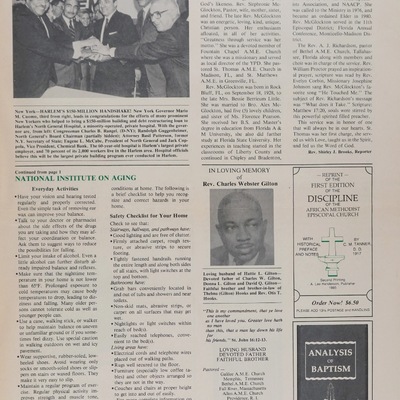
1986 Church Membership Holds at 1985 Levels
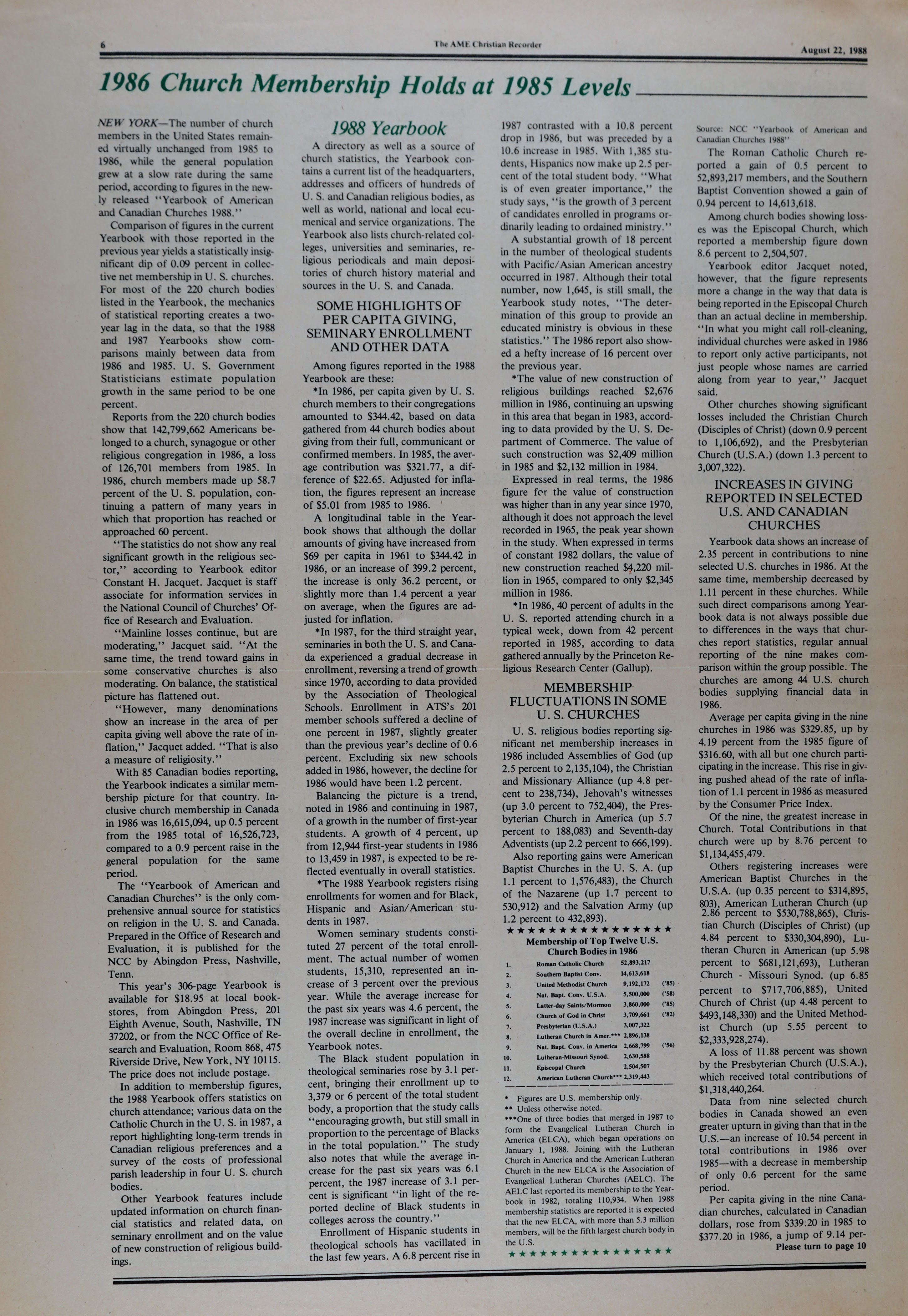
NEW YORK—The number of church
members in the United States remain-
ed virtually unchanged from 1985 to
1986, while the general population
grew at a slow rate during the same
period, according to figures in the new-
ly released ‘‘Yearbook of American
and Canadian Churches 1988.’’
Comparison of figures in the current
Yearbook with those reported in the
previous year yields a statistically insig-
nificant dip of 0.09 percent in collec-
tive net membership in U. S. churches.
For most of the 220 church bodies
listed in the Yearbook, the mechanics
of statistical reporting creates a two-
year lag in the data, so that the 1988
and 1987 Yearbooks show com-
parisons mainly between data from
1986 and 1985. U. S. Government
Statisticians estimate population
growth in the same period to be one
percent.
Reports from the 220 church bodies
show that 142,799,662 Americans be-
longed to a church, synagogue or other
religious congregation in 1986, a loss
of 126,701 members from 1985. In
1986, church members made up 58.7
percent of the U. S. population, con-
tinuing a pattern of many years in
which that proportion has reached or
approached 60 percent.
“‘The statistics do not show any real
significant growth in the religious sec-
tor,’’ according to Yearbook editor
Constant H. Jacquet. Jacquet is staff
associate for information services in
the National Council of Churches’ Of-
fice of Research and Evaluation.
‘‘Mainline losses continue, but are
moderating,’’ Jacquet said. ‘‘At the
same time, the trend toward gains in
some conservative churches is also
moderating. On balance, the statistical
picture has flattened out.
‘““However, many denominations
show an increase in the area of per
capita giving well above the rate of in-
flation,’’ Jacquet added. ‘‘That is also
a measure of religiosity.”
With 85 Canadian bodies reporting,
the Yearbook indicates a similar mem-
bership picture for that country. In-
clusive church membership in Canada
in 1986 was 16,615,094, up 0.5 percent
from the 1985 total of 16,526,723,
compared to a 0.9 percent raise in the
general population for the same
period.
The ‘‘Yearbook of American and
Canadian Churches’’ is the only com-
prehensive annual source for statistics
on religion in the U. S. and Canada.
Prepared in the Office of Research and
Evaluation, it is published for the
NCC by Abingdon Press, Nashville,
Tenn.
This year’s 306-page Yearbook is
available for $18.95 at local book-
stores, from Abingdon Press, 201
Eighth Avenue, South, Nashville, TN
37202, or from the NCC Office of Re-
search and Evaluation, Room 868, 475
Riverside Drive, New York, NY 10115.
The price does not include postage.
In addition to membership figures,
the 1988 Yearbook offers statistics on
church attendance; various data on the
Catholic Church in the U. S. in 1987, a
report highlighting long-term trends in
Canadian religious preferences and a
survey of the costs of professional
parish leadership in four U. S. church
bodies.
Other Yearbook features include
updated information on church finan-
cial statistics and related data, on
seminary enrollment and on the value
of new construction of religious build-
1988 Yearbook
A directory as well as a source of
church statistics, the Yearbook con-
tains a current list of the headquarters,
addresses and officers of hundreds of
U.S. and Canadian religious bodies, as
well as world, national and local ecu-
menical and service organizations. The
Yearbook also lists church-related col-
leges, universities and seminaries, re-
ligious periodicals and main deposi-
tories of church history material and
sources in the U. S. and Canada.
SOME HIGHLIGHTS OF
PER CAPITA GIVING,
SEMINARY ENROLLMENT
AND OTHER DATA
Among figures reported in the 1988
Yearbook are these:
*In 1986, per capita given by U. S.
church members to their congregations
amounted to $344.42, based on data
gathered from 44 church bodies about
giving from their full, communicant or
confirmed members. In 1985, the aver-
age contribution was $321.77, a dif-
ference of $22.65. Adjusted for infla-
tion, the figures represent an increase
of $5.01 from 1985 to 1986.
A longitudinal table in the Year-
book shows that although the dollar
amounts of giving have increased from
$69 per capita in 1961 to $344.42 in
1986, or an increase of 399.2 percent,
the increase is only 36.2 percent, or
slightly more than 1.4 percent a year
on average, when the figures are ad-
justed for inflation.
*In 1987, for the third straight year,
seminaries in both the U. S. and Cana-
da experienced a gradual decrease in
enrollment, reversing a trend of growth
since 1970, according to data provided
by the Association of Theological
Schools. Enrollment in ATS’s 201
member schools suffered a decline of
one percent in 1987, slightly greater
than the previous year’s decline of 0.6
percent. Excluding six new schools
added in 1986, however, the decline for
1986 would have been 1.2 percent.
Balancing the picture is a trend,
noted in 1986 and continuing in 1987,
of a growth in the number of first-year
students. A growth of 4 percent, up
from 12,944 first-year students in 1986
to 13,459 in 1987, is expected to be re-
flected eventually in overall statistics.
*The 1988 Yearbook registers rising
enrollments for women and for Black,
Hispanic and Asian/American stu-
dents in 1987.
Women seminary students consti-
tuted 27 percent of the total enroll-
ment. The actual number of women
students, 15,310, represented an in-
crease of 3 percent over the previous
year. While the average increase for
the past six years was 4.6 percent, the
1987 increase was significant in light of
the overall decline in enrollment, the
Yearbook notes.
The Black student population in
theological seminaries rose by 3.1 per-
cent, bringing their enrollment up to
3,379 or 6 percent of the total student
body, a proportion that the study calls
“encouraging growth, but still small in
proportion to the percentage of Blacks
in the total population.’’ The study
also notes that while the average in-
crease for the past six years was 6.1
percent, the 1987 increase of 3.1 per-
cent is significant ‘‘in light of the re-
ported decline of Black students in
colleges across the country.’’
Enrollment of Hispanic students in
theological schools has vacillated in
the last few years. A 6.8 percent rise in
1987 contrasted with a 10,8 percent
drop in 1986, but was preceded by a
10.6 increase in 1985, With 1,385 stu-
dents, Hispanics now make up 2.5 per-
cent of the total student body. ‘‘What
is of even greater importance,’’ the
study says, ‘‘is the growth of 3 percent
of candidates enrolled in programs or-
dinarily leading to ordained ministry.’’
A substantial growth of 18 percent
in the number of theological students
with Pacific/Asian American ancestry
occurred in 1987. Although their total
number, now 1,645, is still small, the
Yearbook study notes, ‘‘The deter-
mination of this group to provide an
educated ministry is obvious in these
statistics.’’ The 1986 report also show-
ed a hefty increase of 16 percent over
the previous year.
*The value of new construction of
religious buildings reached $2,676
million in 1986, continuing an upswing
in this area that began in 1983, accord-
ing to data provided by the U. S. De-
partment of Commerce. The value of
such construction was $2,409 million
in 1985 and $2,132 million in 1984.
Expressed in real terms, the 1986
figure fer the value of construction
was higher than in any year since 1970,
although it does not approach the level
recorded in 1965, the peak year shown
in the study. When expressed in terms
of constant 1982 dollars, the value of
new construction reached $4,220 mil-
lion in 1965, compared to only $2,345
million in 1986.
*In 1986, 40 percent of adults in the
U. S. reported attending church in a
typical week, down from 42 percent
reported in 1985, according to data
gathered annually by the Princeton Re-
ligious Research Center (Gallup).
MEMBERSHIP:
FLUCTUATIONS IN SOME
U.S. CHURCHES
U. S. religious bodies reporting sig-
nificant net membership increases in
1986 included Assemblies of God (up
2.5 percent to 2,135,104), the Christian
and Missionary Alliance (up 4.8 per-
cent to 238,734), Jehovah’s witnesses
(up 3.0 percent to 752,404), the Pres-
byterian Church in America (up 5.7
percent to 188,083) and Seventh-day
Adventists (up 2.2 percent to 666,199).
Also reporting gains were American
Baptist Churches in the U. S. A. (up
1.1 percent to 1,576,483), the Church
of the Nazarene (up 1.7 percent to
530,912) and the Salvation Army (up
1.2 percent to 432,893).
KKK KKK KKK KKK KKK
Membership of Top Twelve U.S.
Church Bodies in 1986
1. Roman Catholic Church 52,893,217
2g Southern Baptist Conv. 14,613,618
ae United Methodist Church 9,192,172 (85)
4. Nat. Bapt. Cony. U.S.A. 5,500,000 (58)
5. Latter-day Saints/Mormon — 3,860,000 (85)
6. Church of God in Christ 3,709,661 (’82)
gh Presbyterian (U.S.A.) 3,007,322
8. Lutheran Church in Amer.*** 2,896,138
9. Nat. Bapt. Cony. in America 2,668,799 —_('56)
10. Lutheran-Missouri Synod. 2,630,588
11. Episcopal Church 2,504,507
12. American Lutheran Church*** 2,319,443
* Figures are U.S. membership only.
** Unless otherwise noted.
***One of three bodies that merged in 1987 to
form the Evangelical Lutheran Church in
America (ELCA), which began Operations on
January 1, 1988. Joining with the Lutheran
Church in America and the American Lutheran
Church in the new ELCA is the Association of
Evangelical Lutheran Churches (AELC). The
AELC last reported its membership to the Year-
book in 1982, totaling 110,934. When 1988
membership statistics are reported it is expected
that the new ELCA, with more than 5.3 million
members, will be the fifth largest church body in
the U.S.
RIKKI KKK KKK KK
August 22, 1988
Source: NCC ‘Yearbook of American and
Canadian Churches 1988"’
The Roman Catholic Church re-
ported a gain of 0.5 percent to
52,893,217 members, and the Southern
Baptist Convention showed a gain of
0,94 percent to 14,613,618,
Among church bodies showing loss-
es was the Episcopal Church, which
reported a membership figure down
8.6 percent to 2,504,507.
Yearbook editor Jacquet noted,
however, that the figure represents
more a change in the way that data is
being reported in the Episcopal Church
than an actual decline in membership.
‘In what you might call roll-cleaning,
individual churches were asked in 1986
to report only active participants, not
just people whose names are carried
along from year to year,’’ Jacquet
said.
Other churches showing significant
losses included the Christian Church
(Disciples of Christ) (down 0.9 percent
to 1,106,692), and the Presbyterian
Church (U.S.A.) (down 1.3 percent to
3,007,322).
INCREASES IN GIVING
REPORTED IN SELECTED
U.S. AND CANADIAN
CHURCHES
Yearbook data shows an increase of
2.35 percent in contributions to nine
selected U.S. churches in 1986. At the
same time, membership decreased by
1.11 percent in these churches. While
such direct comparisons among Year-
book data is not always possible due
to differences in the ways that chur-
ches report statistics, regular annual
reporting of the nine makes com-
parison within the group possible. The
churches are among 44 U.S. church
bodies supplying financial data in
1986. :
Average per capita giving in the nine
churches in 1986 was $329.85, up by
4.19 percent from the 1985 figure of
$316.60, with all but one church parti-
cipating in the increase. This rise in giv-
ing pushed ahead of the rate of infla-
tion of 1.1 percent in 1986 as measured
by the’ Consumer Price Index.
Of the nine, the greatest increase in
Church. Total Contributions in that
church were up by 8.76 percent to
$1,134,455,479.
Others registering increases were
American Baptist Churches in the
U.S.A. (up 0.35 percent to $314,895,
803), American Lutheran Church (up
2.86 percent to $530,788,865), Chris-
tian Church (Disciples of Christ) (up
4.84 percent to $330,304,890), Lu-
theran Churcn in American (up 5.98
percent to $681,121,693), Lutheran
Church - Missouri Synod. (up 6.85
percent to $717,706,885), United
Church of Christ (up 4.48 percent to
$493, 148,330) and the United Method-
ist Church (up 5.55 percent to
$2,333,928,274).
A loss of 11.88 percent was shown
by the Presbyterian Church (U.S.A.),
which received total contributions of
$1,318,440,264.
Data from nine selected church
bodies in Canada showed an even
greater upturn in giving than that in the
U.S.—an increase of 10.54 percent in
total contributions in 1986 over
1985—with a decrease in membership
of only 0.6 percent for the same
period.
Per capita giving in the nine Cana-
dian churches, calculated in Canadian
dollars, rose from $339:20 in 1985 to
$377.20 in 1986, a jump of 9.14 per-
Please turn to page 10
SSS —ssns0—Ooeeeeeeee
===== DSC05593.JPG =====
August 22, 1988
the AME Christian Recorder
$150-Million Handshake
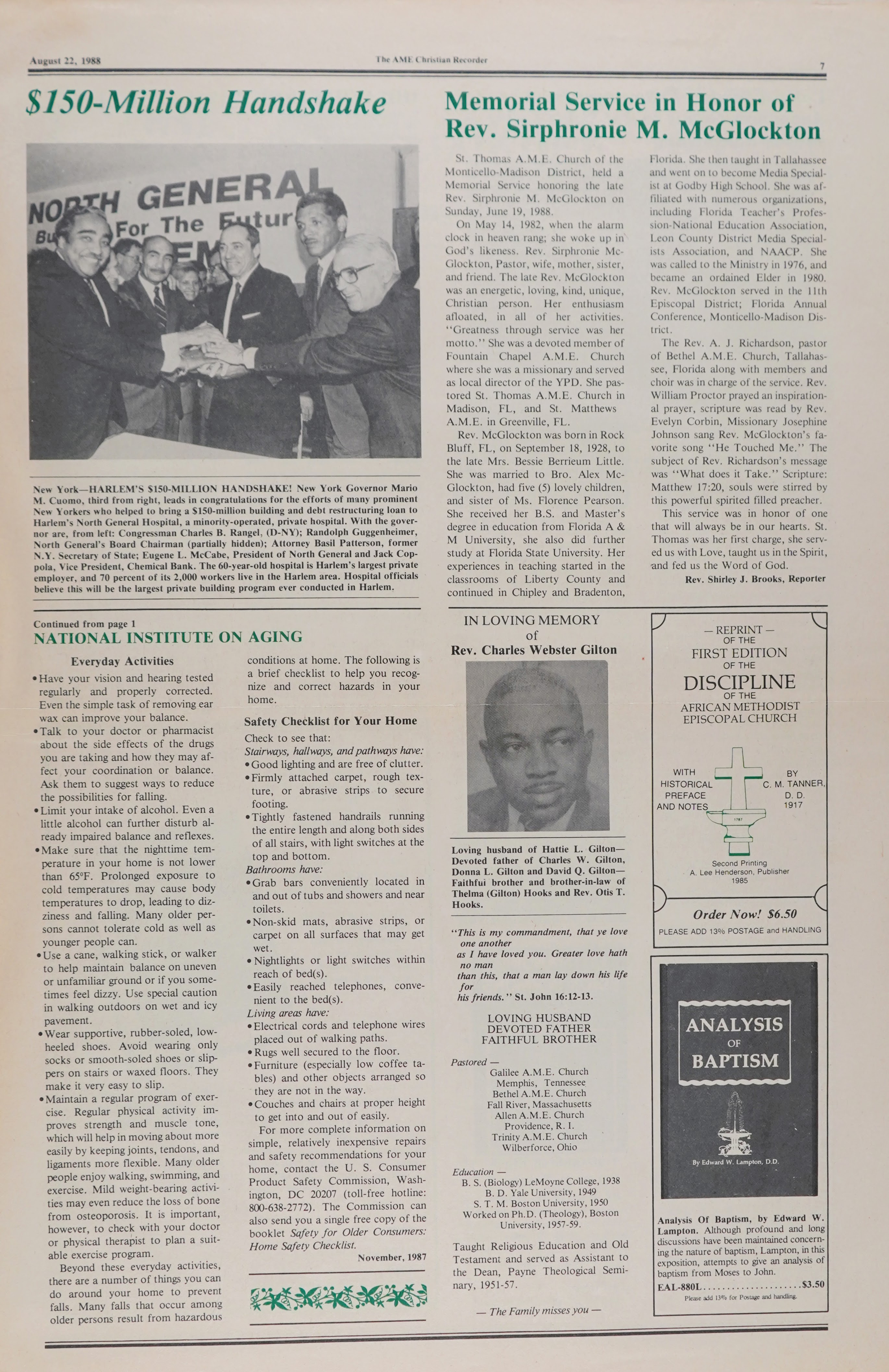
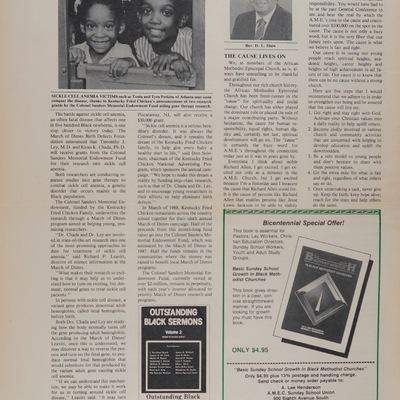
New York—HARLEM’S $150-MILLION HANDSHAKE! New York Governor Mario
M. Cuomo, third from right, leads in congratulations for the efforts of many prominent
New Yorkers who helped to bring a $150-million building and debt restructuring loan to
Harlem’s North General Hospital, a minority-operated, private hospital. With the gover-
nor are, from left: Congressman Charles B. Rangel, (D-NY); Randolph Guggenheimer,
North General’s Board Chairman (partially hidden); Attorney Basil Patterson, former
N.Y. Secretary of State; Eugene L. McCabe, President of North General and Jack Cop-
pola, Vice President, Chemical Bank. The 60-year-old hospital is Harlem’s largest private
employer, and 70 percent of its 2,000 workers live in the Harlem area. Hospital officials
believe this will be the largest private building program ever conducted in Harlem.
Continued from page 1
NATIONAL INSTITUTE ON AGING
Everyday Activities
Have your vision and hearing tested
regularly and properly corrected.
Even the simple task of removing ear
wax can improve your balance.
eTalk to your doctor or pharmacist
about the side effects of the drugs
you are taking and how they may af-
fect your coordination or balance.
Ask them to suggest ways to reduce
the possibilities for falling.
¢ Limit your intake of alcohol. Even a
little alcohol can further disturb al-
ready impaired balance and reflexes.
eMake sure that the nighttime tem-
perature in your home is not lower
than 65°F. Prolonged exposure to
cold temperatures may cause body
temperatures to drop, leading to diz-
ziness and falling. Many older per-
sons cannot tolerate cold as well as
younger people can.
¢ Use a cane, walking stick, or walker
to help maintain balance on uneven
or unfamiliar ground or if you some-
times feel dizzy. Use special caution
in walking outdoors on wet and icy
pavement.
¢ Wear supportive, rubber-soled, low-
heeled shoes. Avoid wearing only
socks or smooth-soled shoes or slip-
pers on stairs or waxed floors. They
make it very easy to slip.
e Maintain a regular program of exer-
cise. Regular physical activity im-
proves strength and muscle tone,
which will help in moving about more
easily by keeping joints, tendons, and
ligaments more flexible. Many older
people enjoy walking, swimming, and
exercise. Mild weight-bearing activi-
ties may even reduce the loss of bone
from osteoporosis. It is important,
however, to check with your doctor
or physical therapist to plan a suit-
able exercise program.
Beyond these everyday activities,
there are a number of things you can
do around your home to prevent
falls. Many falls that occur among
older persons result from hazardous
conditions at home. The following is
a brief checklist to help you recog-
nize and correct hazards in your
home.
Safety Checklist for Your Home
Check to see that:
Stairways, hallways, and pathways have:
¢ Good lighting and are free of clutter.
eFirmly attached carpet, rough tex-
ture, or abrasive strips to secure
footing.
eTightly fastened handrails running
the entire length and along both sides
of all stairs, with light switches at the
top and bottom.
Bathrooms have:
Grab bars conveniently located in
and out of tubs and showers and near
toilets.
eNon-skid mats, abrasive strips, or
carpet on all surfaces that may get
wet.
e Nightlights or light switches within
reach of bed(s).
eEasily reached telephones, conve-
nient to the bed(s).
Living areas have:
electrical cords and telephone wires
placed out of walking paths.
¢ Rugs well secured to the floor.
eFurniture (especially low coffee ta-
bles) and other objects arranged so
they are not in the way.
¢Couches and chairs at proper height
to get into and out of easily.
For more complete information on
simple, relatively inexpensive repairs
and safety recommendations for your
home, contact the U. S. Consumer
Product Safety Commission, Wash-
ington, DC 20207 (toll-free hotline:
800-638-2772). The Commission can
also send you a single free copy of the
booklet Safety for Older Consumers:
Home Safety Checklist.
November, 1987
i
LENORE
Memorial Service in Honor of
Rev. Sirphronie M. McGlockton
St. Thomas A.M.E, Church of the
Monticello-Madison District, held a
Memorial Service honoring the late
Rev, Sirphronie M. McGlockton on
Sunday, June 19, 1988.
On May 14, 1982, when the alarm
clock in heaven rang; she woke up in
God’s likeness. Rey. Sirphronie Mc-
Glockton, Pastor, wife, mother, sister,
and friend. The late Rev. McGlockton
was an energetic, loving, kind, unique,
Christian person. Her enthusiasm
afloated, in all of her activities,
‘‘Greatness through service was her
motto.’’ She was a devoted member of
Fountain Chapel A.M.E. Church
where she was a missionary and served
as local director of the YPD. She pas-
tored St. Thomas A.M.E. Church in
Madison, FL, and St. Matthews
A.M.E. in Greenville, FL.
Rev. McGlockton was born in Rock
Bluff, FL, on September 18, 1928, to
the late Mrs. Bessie Berrieum Little.
She was married to Bro. Alex Mc-
Glockton, had five (5) lovely children,
and sister of Ms. Florence Pearson.
She received her B.S. and Master’s
degree in education from Florida A &
M University, she also did further
study at Florida State University. Her
experiences in teaching started in the
classrooms of Liberty County and
continued in Chipley and Bradenton,
Florida, She then taught in Tallahassee
and went on to become Media Special-
ist at Godby High School, She was af-
filiated with numerous organizations,
including Florida Teacher's Profes-
sion-National Education Association,
Leon County District Media Special-
ists Association, and NAACP. She
was called to the Ministry in 1976, and
became an ordained Elder in 1980,
Rev. McGlockton served in the 11th
Episcopal District; Florida Annual
Conference, Monticello-Madison Dis-
trict,
The Rev. A. J. Richardson, pastor
of Bethel A.M.E. Church, Tallahas-
see, Florida along with members and
choir was in charge of the service. Rev.
William Proctor prayed an inspiration-
al prayer, scripture was read by Rev.
Evelyn Corbin, Missionary Josephine
Johnson sang Rev. McGlockton’s fa-
vorite song ‘‘He Touched Me.’’ The
subject of Rev. Richardson’s message
was ‘‘What does it Take.’’ Scripture:
Matthew 17:20, souls were stirred by
this powerful spirited filled preacher.
This service was in honor of one
that will always be in our hearts. St.
Thomas was her first charge, she serv-
ed us with Love, taught us in the Spirit,
and fed us the Word of God.
Rev. Shirley J. Brooks, Reporter
IN LOVING MEMORY
of
Rev. Charles Webster Gilton
Loving husband of Hattie L. Gilton—
Devoted father of Charles W. Gilton,
Donna L. Gilton and David Q. Gilton—
Faithfui brother and brother-in-law of
Thelma (Gilton) Hooks and Rey. Otis T.
Hooks.
“This is my commandment, that ye love
one another
as I have loved you. Greater love hath
no man :
than this, that a man lay down his life
for
his friends.’ St. John 16:12-13.
LOVING HUSBAND
DEVOTED FATHER
FAITHFUL BROTHER
Pastored —
Galilee AM.E. Church
Memphis, Tennessee
Bethel A.M.E. Church
Fall River, Massachusetts
Allen A.M.E. Church
Providence, R. I.
Trinity A.M.E. Church
Wilberforce, Ohio
Education —
B. S. (Biology) LeMoyne College, 1938
B. D. Yale University, 1949
S. T. M. Boston University, 1950
Worked on Ph.D. (Theology), Boston
University, 1957-59.
Taught Religious Education and Old
Testament and served as Assistant to
the Dean, Payne Theological Semi-
nary, 1951-57.
— The Family misses you —
— REPRINT —
OF THE
FIRST EDITION
OF THE
DISCIPLINE
OF THE
AFRICAN METHODIST
EPISCOPAL CHURCH
WITH BY
HISTORICAL C. M. TANNER,
PREFACE DED;
AND NOTES ASIe,
S [oe
A
ioe
Second Printing
A. Lee Henderson, Publisher
1985
Order Now! $6.50
PLEASE ADD 13% POSTAGE and HANDLING
ANALYSIS
OF
BAPTISM
By Edward W. Lampton, D.D.
Analysis Of Baptism, by Edward W.
Lampton. Although profound and long
discussions have been maintained concern-
ing the nature of baptism, Lampton, in this
exposition, attempts to give an analysis of
baptism from Moses to John.
EAL-880L
Please add 13% for Postage and handling.
===== DSC05594.JPG =====
8
The AME Christian Recorder
August 22, 1988
Colonel Sanders Endowment Fund
Announces Grants to Aid Sickle Cell
Disease Researchers
SICKLE CELL ANEMIA VICTIMS such as Tonia and Tyra Perkins of Atlanta may soon
conquer the disease, thanks to Kentucky Fried Chicken’s announcement of two research
grants by the Colonel Sanders Memorial Endowment Fund aiding gene therapy research.
The battle against sickle cell anemia,
an often fatal disease that affects one
in five hundred Black newborns, is one
step closer to victory today. The
March of Dimes Birth Defects Foun-
dation announced that Timonthy J.
Ley, M.D. and Kiran K. Chada, Ph.D.
will receive grants from the Colonel
Sanders Memorial Endowment Fund
for their research into sickle cell
anemia.
Both researchers are conducting se-
parate studies into gene therapy to
combat sickle cell anemia, a genetic
disorder that occurs mainly in the
Black population.
The Colonel Sanders Memorial En-
dowment, funded by the Kentucky
Fried Chicken Family, underwrites the
research through a March of Dimes
program aimed at helping young, pro-
mising researchers.
“‘Dr. Chada and Dr. Ley are involv-
ed in state-of-the-art research into one
of the most promising approaches to
date for treatment of sickle cell
anemia,’’ said Richard P. Leavitt,
director of science information at the
March of Dimes.
’*What makes their research so exci-
ting is that it may help us to under-
stand how to turn on existing, but dor-
mant, normal genes to treat sickle cell
patients.”’
In persons with sickle cell disease, a
variant gene produces abnormal adult
hemoglobin, called fetal hemoglobin,
before birth.
Both Drs, Chada and Ley are study-
ing how the body normally turns off
the gene producing adult hemoglobin.
According to the March of Dimes’
Leavitt, once this is understood, we
may discover a way to reverse the pro-
cess and turn on the fetal gene, to pro-
duce normal fetal hemoglobin that
would substitute for that produced by
the variant adult gene causing sickle
cell anemia.
“If we can understand this mechan-
ism, we may be able to make it work
for us in turning around sickle cell
disease,’’ Leavitt said. ‘‘It may turn
out to be a simpler and safer therapy
than using gene transplants.’’
Ley, an assistant professor in the
Department of Medicine at Washing-
ton University Medical Center, St.
Louis, MO, will receive a $30,000 grant
from the Colonel Sanders Memorial
Endowment Fund. Chada, an assistant
professor in the Department of Bio-
chemistry at the University of
Medicine and Dentistry of New Jersey,
Piscataway, NJ, will also receive a
$30,000 grant.
“Sickle cell anemia is a serious here-
ditary disorder. It was always the
Colonel’s dream, and it remains the
dream of the Kentucky Fried Chicken
family, to help give every baby a
healthy start in life,’’ said Don Solo-
mon, chairman of the Kentucky Fried
Chicken National Advertising Pro-
gram, which sponsors the annual cam-
paign. ‘‘We hope to make this dream a
reality by funding important research,
such as that of Dr. Chada and Dr. Ley,
and to encourage young researchers in
their efforts to help eliminate birth
defects.’’
In March of 1988, Kentucky Fried
Chicken restaurants across the country
joined together for their ninth annual
March of Dimes campaign. Half of the
proceeds from this month-long fund
raiser go into the Colonel Sanders Me-
morial Endowment Fund, which was
estimated by the March of Dimes in
1987. Half the funds remains in the
communities where the money was
raised to benefit local March of Dimes
programs.
The Colonel Sanders Memorial En-
dowment Fund, currently vested at
over $2-million, remains in perpetuity,
with each year’s interest allocated to
priority March of Dimes research and
programs.
OUTSTANDING
BLACK SERMONS
| Volume 2
Walter B Hoard ectitor
Cont
4 Venches! Booth James N Micheli
doh: ter
hy Mtlos Srnith
| 'e We. levies
Mors Hornon Tynes
Outstanding Black
Sermons, Volume 2
by Walter B. Hoard
A new collection of sixteen ser-
mons by outstanding preachers
from the Black Christian com-
munity. A helpful sermon
development resource for all
preachers
WBH-123A . 2.0 cncess $4.95
Please add 13% postage and handling.
L
DID YOU KNOW THESE FACTS?
by Rev. Dale L. Shaw, Pastor
Mt. Zion A.M.E. Church
Jacksonville (Mandarin) FL
Rev. D. L. Shaw
THE CAUSE LIVES ON
We, as members of the African
Methodist Episcopal Church, as is, al-
ways have something to be thankful
and gratified for.
Throughout our rich church history,
the African Methodist Episcopal
Church has been front-runner in the
“cause’’ for spirituality and social
change. Our church has either played
the dominant role or played the role of
a major contributing party. Without
hesitation, the cause for human re-
sponsibility, equal rights, human dig-
nity and, certainly not last, spiritual
development will go on. The ‘“‘cause”’
is certainly the buzz word for
A.M.E.’s throughout the connection
today just as it was in years gone by.
Everytime I think about noble
Richard Allen, I get excited. I get ex-
cited not only as a minister in the
A.M.E. Church, but I get excited
because I’m a historian and I treasure
the cause that Richard Allen stood for.
It is the cause of persons like Richard
Allen that enables persons like Jesse
Lewis Jackson to be able to viabily
seek the Presidency of the United
States of America.
You would have had to be at the
past General Conference in Fort
Worth, Texas, to hear Rev. Jesse
Jackson thrill us in social and spiritual
responsibility. You would have had to
be at the past General Conference to
see and hear the zeal by which the
A.M.E.’s rose to the cause and contri-
buted over $100,000 on the spot to the
cause. The cause is not only a buzz
word, but it is the very fiber that our
future rests upon. The cause is what
we believe is fair and right.
Our cause is in seeing our young
people reach spiritual heights, aca-
demic heights, career heights and
heights of high achievement in all fa-
cets of life. Our cause is to know that
there can be no cause without a strong
church.
Here are five steps that I would
recommend that we adhere to in order
to strengthen our being and be assured
that the cause will live on:
1. Get right and stay right with God.
Activate your Christian values into
a daily reality to help uplift others.
2. Become civilly involved in various
church and community activities
that are concerned with helping to
develop education and uplift the
downtrodden.
3. Be a role model to young people
and don’t hesitate to share with
them positive values.
4. Go the extra mile for what is fair
and right, regardless of what others
say or do.
5. Once undertaking a task, never give
up. Keep the faith; keep hope alive;
reach for the stars and help others
do the same.
Bicentennial Special Offer!
This book is essential for
Pastors, Lay Workers, Chris-
tian Education Directors,
Sunday School Workers,
Youth and Adult Study
Groups.
Basic Sunday School
Growth In Black Meth-
odist Churches
This book gives direc-
tion in a clear, con-
cise straightforward
manner. If you are
looking for growth
you must have this
book.
ONLY $4.95
“Basic Sunday School Growth in Black Methodist Churches”
Only $4.95 plus 13% postage and handling charge.
Send check or money order payable to:
A. Lee Henderson
A.M.E.C. Sunday School Union
500 Eighth Avenue South
Nashville, Tennessee 37203-4181
***
Please print
Name
Address
eee SSSSS:CCSCSC
===== DSC05595.JPG =====
|
August 22, 1988
The AME Christian Recorder
Burger King/Scholastic Youth Poll Finds Race or Ethnic Heritage No Bar to Presidency
ATLANTA, GA—Two out of three
teenagers said they were likely to see a
Black President in the next five years,
according to a youth poll sponsored by
Burger King Corporation and Scho-
lastic, Inc.
More than 13,000 high school stu-
dents throughout the U. S. were sur-
veyed on their political views and per-
sonal goals during a survey in con-
junction with Update magazine, a
Scholastic publication distributed in
high school social studies classes.
Students polled reside in all demo-
graphic regions of the country, includ-
ing cities, suburbs, small towns and
rural areas. The study reached a cross-
section of American teenagers from
various ethnic groups, including
Blacks, Whites, Hispanics, American
Indians and Asians.
Among Blacks and Hispanics, 65.5
percent of those students polled over-
whelmingly agreed that it was ‘‘very
likely’’ or ‘‘somewhat likely’’ that a
Black American could become Presi-
dent during their lifetime. Top-line
findings tallying the views of all
students show that 68 percent believe a
Black American is electable.
While recent media coverage of the
Presidential nomination has un-
doubtedly had an impact on American
teenagers, the majority of all students
polled (69.2 percent) did not feel a
Hispanic American would garner the
same broad-based support.
However, among the 623 Hispanic
students who participated in the
survey, more than half (51.2 percent)
were confident that a Hispanic could
be in the White House by 1992, lend-
ing credence to the assumption that
ethnic heritage can be a factor in the
electoral process. In contrast, 67.3
percent of the one thousand two hun-
dred forty-seven Black students polled
responded negatively to a Hispanic
President, and 71.2 percent of White
students surveyed felt the same way.
Among all students polled, only 29.8
percent believed a Hispanic could be
elected during their lifetime.
Nearly 60 percent of all students be-
lieved a female would serve as Presi-
dent, while they had less confidence in
seeing a handicapped or Jewish indivi-
dual in the oval office.
The survey found that 57.9 percent
of all students polled would not com-
mit to either the Republican or Demo-
cratic party when they register to vote.
However, study results show that 25.6
percent of Black students and 16.9
percent of Hispanic students would
‘very likely’’ register as Democrats,
compared to 12 percent of White
students. And, 8.3 percent of Black
students polled would ‘very likely’’
register as Republicans, compared to
12.2 percent for Hispanics and 18.7
percent for Whites.
Social issues of particular concern
to minority groups, such as food for
the hungry and shelter for the poor,
were on the minds of all teenagers, re-
gardless of ethnic origin. More than
half the students (55.1 percent) be-
lieved they could personally help alle-
viate these national problems, and 52.3
percent felt they could help reduce the
crime rate as well.
On the subject of improving public
education, the majority of Black and
Hispanic students polled (45.2 per-
cent—combined average) felt this issue
should be of primary concern for the
next President. Only one-third of
those White students surveyed (33.6
percent) felt strongly about this sub-
ject.
When asked if they would go to war
to protect the freedom of U, S, citi-
zens if they were President, students
responded positively, on the average.
However, 67.9 percent of White stu-
dents responded yes, compared to 49,3
percent of Black students and 57.8 per-
cent of Hispanic students who answer-
ed the four-page questionnaire in
April.
Minority students were on par with
the national averages regarding know-
ledge of current events (54.4 percent),
community service (46 percent), sports
participation (37.3 percent), and the
amount of effort they put forward in
school (57 percent).
With a high school diploma, their
future and education were top priority
issues in the minds of teenagers; health
matters also rated high. In fact, the
survey found that 43 percent of Black
teenagers were very concerned about
the AIDS crisis. Hispanics also felt
strongly (37.4 perc. .«), while only 29
percent of Whites were as deeply con-
cerned about AIDS.
THE OBITUARY
The Reverend John Wesley John-
son, Sr., son of the late Reverend John
and Ella Johnson, the youngest of ten
children, was born in Marion, South
Carolina. Upon moving to Trenton,
New Jersey, he was educated in the
Trenton Public School System. He
furthered his educational aspirations
by attending Wilberforce University
and Payne Theological Seminary,
where he received his B.S. and B.D.
Degrees. He also attended Princeton
Theological Seminary, Princeton, New
Jersey. From Edward Waters College,
Jacksonville, Florida, he received an
Honorary Doctor of Humanities De-
gree.
In 1943, he married Catherine Gib-
son, who became not only his wife,
but his friend, companion and help-
mate, for they labored together forty-
five years. This union was blessed with
two lovely children, John W., Jr., and
Betty.
He was converted at an early age
and received his early Christian educa-
tion and spiritual guidance at Mt. Zion
African Methodist Episcopal Church,
Trenton, New Jersey, where he was
very active in the church, especially in
the Sunday School where he faithfully
served as a teacher and, subsequently,
superintendent.
In 1929, he was presented to the
congregation of Mt. Zion for his trial
sermon. Following this, he was licens-
ed to preach by Dr. R. B. Smith in the
Quarterly Conference. Upon receiving
the ‘‘call to preach,’’ he began his min-
istry at Mt. Pisgah A.M.E. Church,
Haddonfield, NJ. He later served as
pastor of Mt. Pisgah, Lawnside; Mt.
Pisgah, Princeton; Mt. Zion, Plain-
field, and Mt. Zion, Trenton. Subse-
quently, he was appointed Presiding
Elder of the Newark, New Burnswick
and Camden-Trenton Districts. Rever-
end Johnson spent fifty-nine years in
the ministry. His philosophy was ‘‘The
preacher is God’s partner in helping to
make men better; the world can be a
better place.’’
Through the years, he became inter-
ested and involved in social, eco-
nomic, educational and, to a degree,
the political life of the many commu-
nities where he served as pastor and
presiding elder. He was a member of
many professional, social and religious
organization, which included The Ur
ban League Board of Directors; Life
Member of the NAACP; member and
chaplain of Phi Beta Sigma Fraternity,
Inc.; Board of Managers of Kingsbury
Housing, Trenton Council of Human
Relations; Trenton Ministerial Al-
liance; Princeton Housing Authority;
and the Trenton Council of Churches.
He enjoyed extensive travel through-
out the United States and abroad. It is
noteworthy to mention that in 1979 he
celebrated his Golden Ministry Anni-
versary, where he stated, ‘‘It has been
through the church that God has used
me to His honor and glory. My great-
est desire in life has been my relation-
ship with and to people.”’
God made him an instrument of His
peace, and it was through this peace
that Reverend Johnson’s character
touched and influenced the lives of
many.
The summons to enter His Master’s
joy came on Monday, July 25, 1988, at
the Mercer Medical Center, Trenton,
New Jersey. He leaves to cherish his
memory his wife, Catherine Johnson;
ason, John W., Jr. of Trenton, NJ; a
daughter, Betty Sullivan of Pro-
vidence, RI; a sister, Nona Snipes of
Trenton; seven grandchildren, Carl
Anthony, Walter, Barry, Nicole, Pa-
tience, Monique and Kedrick; one
great-granddaughter, Dominique;
several nieces, nephews, cousins, a
host of other relatives; a godson,
Stephen L. Savage of Trenton; and the
constituency of the African Methodist
Episcopal Church which he served with
such great devotion.
NOTICE
Sunday School
Workers Should
Send A Brief Resume
And A Black And
White Picture
To:
Dr. A. Lee Henderson
AMEC
SUNDAY SCHOOL UNION
500 8th Avenue, South
Nashvilie, TN 37203
Annual Conference Schedule
THIRD EPISCOPAL DISTRICT
A.M.E. CHURCH
ANNUAL CONFERENCE
BISHOP 8. A. HILDEBRAND
WEST VIRGINIA
ANNUAL CONFERENCE
September 14-18, 1988
Young Chapel A.M.E. Church
836 Eighteenth St.
Huntington, WV
Church Phone: (304) 522-9035
Pastor’s Phone: (304) 522-3250
The Rev. Fred Dokes, Jr., Host Pastor
The Rev. Joe L. Jordan, Host P.E.
PITTSBURGH
ANNUAL CONFERENCE
September 21-25, 1988
St. Paul A.M.E. Church
1350 Locust St.
McKeesport, PA
Church Phone: (412) 672-3303
Pastor’s Phone: (412) 672-6812
The Rev. John K. Frazier, Host Pastor
The Rev. W. S. Hopson, Host P.E.
OHIO
ANNUAL CONFERENCE
October 5, 1988
Trinity A.M.E, Church
64 E. Church Street
Newark, OH
Church Phone: (614) 345-1965
Pastor’s Phone: (614) 253-2550
The Rev. H. G. Perkins, Host Pastor
The Rev. W. C. T. Ayres, Host P.E.
SOUTH OHIO
ANNUAL CONFERENCE
October 12-16, 1988
Greater Allen A.M.E. Church
1620 W. Fifth Street
Dayton, OH
Church*Phone: (513) 223-5115
Pastor’s Phone: (513) 274-7717
The Rev. Charles L. Scott, Host Pastor
The Rev. Virgil E. Cummings, Host P.E.
NORTH OHIO
ANNUAL CONFERENCE
October 26, 1988
Grace A.M.E, Church
1137 Main St. SW
Warren, OH
Church Phone: (216) 394-6270
Pastor’s Phone: (216) 394-5875
The Rev. Ernest Dokes, Host Pastor
The Rey. S. E. Lancaster, Host P.E.
FOURTH EPISCOPAL DISTRICT
A.M.E. CHURCH
ANNUAL CONFERENCE
BISHOP S. S. MORRIS
ILLINOIS ANNUAL CONFERENCE
August 30-31, 1988
WMS Conference
September 1-4, 1988
St. Paul A.M.E. Church
1130 South 16th Street
Springfield, IL 62703
Church Phone: (217) 522-4769
Pastor’s Phone: (217) 529-4053
The Rey. J. S. Benn III, Host Pastor
The Rev. Ivan J. Johnson, Host P.E.
The Rev. Richard D. Smith, Assoc. P.E.
MICHIGAN ANNUAL CONFERENCE
September 6-7, 1988
WMS Conference
September 8-11, 1988
St. John A.M.E. Church
505 Beechwood Street
River Rouge, MI 48218
Church Phone: (313) 386-2288
Pastor’s Phone: (313) 861-0281
The Rey. Armistice R. Polk, Host Pastor
The Rey. Martin L. Simmons, Host P.E.
The Rev. J. Allen Parker, Assoc. P.E.
CHICAGO ANNUAL CONFERENCE
September 20-21, 1988
WMS Conference
September 22-25, 1988
St. John A.M.E. Church
142 South Fourth Street
Aurora, IL 60505
Church Phone: (312) 898-5333
Pastor’s Phone: (312) 896-0696
The Rey. Jesse Hawkins, Host Pastor
The Rey. W. D. Davis, Jr., Host P.E.
The Rev. Roy L. Miller, Assoc. P.E.
The Rev. David C. Coleman, Assoc. P.E.
PLANNING COUNCIL
October 14-15, 1988
Bethel A.M.E. Church
414 West Vermont Street
Indianapolis, IN 46204
Church Phone: (317) 634-7002
Pastor’s Phone: (317) 251-4777
The Rev. W. W. Reid, Sr., Host Pastor
Please turn to page 10
Attend Annual
Conference
——————
===== DSC05596.JPG =====
10
The AME Christian Recorder
Bishop Talbot Urges
Continued Social Action
by Jim Jones
Bishop F. H. Talbot
The African Methodist Episcopal
Church is one of the largest Con-
ferences to convene in Fort Worth,
Texas. The delegates were urged to
continue the church’s tradition of
200 years of social action.
“‘God has been good to us, and we
must rekindle our passion in this third
century,’’ Bishop Frederick Talbot of
Atlanta said in the opening sermon.
“We must carry out the work of social
salvation.’’
About 25,000 are attending the gen-
eral conference, a group large enough
to tax hotel and eating accommoda-
tions.
The church will discuss social issues
during the meeting, including problems
with the homeless, homosexuality,
abortion and apartheid in South
Africa. Also, church bishops plan to
issue a formal statement today ex-
pressing sorrow for the loss of human
life in the downing of the Iranian pas-
senger jet and the need for an end to
hostilities in the Persian Gulf.
Talbot said members of the 3.5 mil-
lion-member denomination, which has
been a leader in overseas mission work
and in creating schools for Black,
should resist the temptation to take
credit for the church’s progress.
‘All of our achievements are simply
the expressions of God’s enduring
friendship,’’ he said. ‘‘We’ve reached
the third century not because of our
own strength. We are not self-invent-
ed. It is God who gives power. We are
God’s doing. We are God’s people.’’
Before Talbot’s sermon, the 25
bishops, dressed in purple and black
vestments, kneeled on stage at the Fort
Worth-Tarrant County Convention
Center. In the foreground was a large
painting of the church’s founder, the
Rev. Richard Allen. The church was
founded in social protest in 1787, when
Allen, a freed slave, walked out of a
Methodist church in Philadelphia in
anger at rules requiring Blacks to wor-
ship in designated areas of the church.
He first began holding worship services
in a blacksmith shop.
The size of the Fort Worth conven-
tion is stretching hotel capacity to the
limit. The overflow of guests from the
Fort Worth Hyatt Regency was sent to
the Dallas/Fort Worth Hyatt Regency
Hotel at the airport, and delegates
were given free transportation to and
from the hotel.
Free bus transportation also was be-
ing provided to Arlington hotels, said
Dr. Joseph McKinney, treasurer of the
denomination. He said about 300
delegates are staying at the Arlington
Roadway Inn.
During opening ceremonies, bishops
were given keys to the City of Fort
Worth.
Continued from page 6
1986 Church Membership Holds
at 1985 Levels
cent, well ahead of the inflation rate of
4.1 percent.
All of the nine churches showed
some gain. Among those registering
the most significant gains were the
Lutheran Church—Canada (up 17.79
percent with total contributions of
$31,144,548), Presbyterian Church in
Canada (up 28.61 percent to $68,040,
295), Seventh-day Adventist Church in
Canada (up 27.05 percent to $38,455,
408), United Baptist Convention of the
Atlantic Provinces (up 27.89 percent
to $29,040,438) and the United Church
of Canada (up 11.29 percent to $255,
370,969).
PROFESSIONAL PARISH
LEADERSHIP COSTS
SURVEYED
A recent survey by Jackson W. Car-
roll, Dean R. Hoge and Francis K.
Scheets, O.S.C., compared the costs
of staffing parishes in several denom)-
nations depending on whether one or
more full-time ordained clergy, part-
time clergy or lay professionals were
employed.
Churches surveyed included the Ro-
man Catholic Church, The Episcopal
Church, Lutheran Church in Amenca
(prior to its merger with other
Lutheran bodies in the Evangelical
Lutheran Church in America) and The
United Methodist Church.
The study was prompted, the au
thors noted, by the widespread need
for an alternative to the employment
of full-time clergy in parish leadership
positions, The need is apparent, they
said, whether it stems from a shortage
of priests, as in the Roman Catholic
Church, or from the inability of many
small congregations to support a full-
time leader, as is frequently the case in
Protestant denominations.
Among the findings of the study was
that, overall, full-time Catholic priests
received less total compensation ($26,
376 on average) than their Protestant
counterparts. Episcopal priests re-
ceived the highest average total com-
pensation ($45,005), followed by Lu-
therans ($39,059) and United Method-
ists ($35,308). The Catholic-protestant
difference held for a variety of staffing
patterns in parishes
The clergy compensation, which in
cludes housing, travel, continuing edu-
cation, health care and retirement
benefits, was termed ‘‘low relative to
other professions,’’ by the authors
The study also found that ‘‘the use
of full-time lay professionals by Ca-
tholics in nonsacramental leadership
roles will cost slightly less than
the use of full-time priests.’’ For the
Protestant groups studied, ‘‘use ol
part-time clergy in small parishes ap-
pears to be slightly less costly than
full-time lay professionals,”’
Research on attitudes among the lai
ty revealed ‘‘a strong preference for
ordained leadership’ for all groups
RELIGIOUS AFFILIATION
IN CANADA
The 1988 Yearbook also contains in
formation on ‘Religious Affiliation in
Canada,”’ based on that country’s cen
Continued from page 9
August 22, 1988
Annual Conference Schedule
FIFTH EPISCOPAL DISTRICT
A. M. E. CHURCH
ANNUAL CONFERENCE
BISHOP VINTON R. ANDERSON
SOUTHERN CALIFORNIA
ANNUAL CONFERENCE
August 22-28, 1988
Ward A.M.E. Church
1177 W. 25th Street
Los Angeles, California 90007
The Rev. Frank M. Reid, III, Pastor
Church Phone: (213) 747-1367
Pastor’s Phone: (213) 732-5284
The Rev. J. Austell Hall, Host P.E.
The Rev. E. P. Williams, Co-Host P.E.
The Rey. A. A. Morgan, Co-Host P.E.
COLORADO
ANNUAL CONFERENCE
September 6-11,1988
Campbell A.M.E. Church
1500 E. 22nd Avenue
Denver, Colorado 80205
The Rev. Ezekiel Habersham, Pastor
Church Phone: (303) 839-5058
Pastor’s Phone: (303) 751-0653
The Rev. M. L. Shakespeare, Host P.E.
The Rev. L. K. Williams, Co-Host P.E.
KANSAS/NEBRASKA
ANNUAL CONFERENCE
September 12-18, 1988
St. John A.M.E. Church
2402 North 22nd Street
Omaha, Nebraska 68110
The Rev. Dorsey McCullough, Pastor
Church Phone: (402) 345-1070
Pastor’s Phone: (402) 451-3733
The Rev. T. R. Evans, Host P.E.
Rev. A. T. Taylor, Co-Host PE.
NORTHWEST MISSOURI
ANNUAL CONFERENCE
September 19-25, 1988
Bethel A.M.E. Church
2329 Flora Avenue
Kansas City, Missouri 64141
The Rev. George R. Reid, Pastor
Church Phone: (816) 231-3555
Pastor’s Phone: (816) 474-6722
The Rev. E. Lewis Branch, Host P.E.
The Rev. P. A, Williams, Co-Host PE.
MISSOURI
ANNUAL CONFERENCE
October 3-9, 1988
St. John A.M.E. Church
1908 North Kingshighway Blvd.
St. Louis, Missouri 63113
The Rev. Lee Norris May, Pastor
Church Phone: (314) 361-8236
Pastor’s Phone: (314) 361-6487
The Rev. Grady Brown, Host PE.
The Rev. O. H. Brown, Co-Host PE
FIFTH DISTRICT EVALUATION
PLANNING MEETING
October 10, 1988 — 10:00 a.m.
Wayman A.M.E, Church
Rev, Lonnie C. Wormiey, Sr., Pastor
Church Phone; (314) 361-4123
Pastor’s Phone: (314) 991-0966
ECONOMIC DEVELOPMENT
FUND MEETING
October 10, 1988
sus and updated with a 1985 General
Social survey conducted by the Statis-
ties Canada organization in Ottawa
The article summanzes information
compiled by George A. Mori, an
analyst with Statistics Canada, the first
published in the fall of 1987 in that
group’s journal, Canadian Social
Trends
The study notes the growth of the
Roman Catholic Church in Canada
and a decline in the Protestant portion
of the population, Predominantly Pro-
testant for much of its history,
Canada’s population was only slightly
more than 40 percent Protestant in
1981, while Roman Catholics account-
SEVENTH EPISCOPAL DISTRICT
A.M.E. CHURCH
ANNUAL CONFERENCE
BISHOP FREDERICK C. JAMES
PALMETTO SOUTH CAROLINA
ANNUAL CONFERENCE
September 14-18, 1988
Ebenezer A.M.E. Church
44 Nassau Street
Charleston, South Carolina 29403
The Rev. C. C. McLamore, Host Pastor
Church Phone: (803) 723-4660
Pastor’s Phone: (803) 723-5684
The Rev. B. J. Finklea, Host P. E.
NORTHEAST SOUTH CAROLINA
ANNUAL CONFERENCE
September 21-25, 1988
Saint John A.M.E. Church
702 Mill Street
Marion, South Carolina 29571
The Rev. Johnny Yeadon, Host Pastor
Church Phone: (803) 423-2221
Pastor’s Phone: (803) 423-6592
The Rey. M. W. Singleton, Host P.E.
COLUMBIA SOUTH CAROLINA
ANNUAL CONFERENCE
October 5-9, 1988
Miller Chapel A.M.E. Church
500 Caldwell Street
Newberry, South Carolina 29108
The Rev. E. A. Vance, Host Pastor
Church Phone: (803) 276-9598
Pastor’s Phone: (803) 649-3775
The Rey. W. Raymond Strom, Host P.E.
SOUTH CAROLINA
ANNUAL CONFERENCE
October 19-23, 1988
St. Stephens A.M.E. Church
Main Street (Highway 46)
Hardeeville, South Carolina 29448
The Rev. Thomas McClary, Host Pastor
Church Phone: (803) 784-3224
Pastor’s Phone: (803) 726-3231
The Rev. Levern Stevenson, Host P.E.
PIEDMONT SOUTH CAROLINA
ANNUAL CONFERENCE
October 25-30, 1988
Friendship A.M.E. Church
104 South Bell Street
Clinton, South Carolina 29325
The Rev. W. B. Brown, Hast Pastor
Church Phone: (803)
Pastor’s Phone: (803) 276-8645
The Rev. G. T. Dewiin, Jr., Host PE.
CENTRAL SOUTH CAROLINA
ANNUAL CONFERENCE
November 9-13, 1988
Liberty Hill A.M.E, Church
Liberty Hill Road
Summerton, South Carolina 29148
The Rev. George F. Flowers, Host Pastor
Church Phone; (803) 478-4812
Pastor's Phone: (803) 722-8462
The Rev. W. W. Miller, Host P. E.
THE 1988-1989 SEVENTH DISTRICT
PLANNING SESSION
November 25-26, 1988
Please turn to page 11
ed for about 47 percent of the popu-
lation.
The article also tracks some trends
within the Protestant sector and
among those reporting no religious
preference,
eee
‘*There Is No
Beauty So Great
As Beauty
Shared.”’
she
===== DSC05597.JPG =====
August 22, 1988
Continued from page 10
ANNUAL CONFERENCE SCHEDULE
The Rey. Joshua D Watkins, Assoc. P.E.
The Rev. John W. Jenkins, Host Pastor
NORTHEAST-WEST MISSISSIPPI
The Rev. E. C. Taylor, II, Associate P.E.
The Rev. Lorenzo G. Clarke, Host Pastor
The Rev. N. R. West, Sr.,Associate P.E.
The Rev. David J. Campbell, Host Pastor
The Rey. T. C. Johnson, Associate P.E.
The Rey. J. H. Cyprain, Associate P.E.
EIGHTH EPISCOPAL DISTRICT
AME CHURCH
ANNUAL CONFERENCE
CONFERENCE MISSIONARY
MEETINGS
September 7, 1988
Mississippi Conference
September 14, 1988
East Mississippi Conference
September 21, 1988
Northeast-West MS Conference
October 5, 1988
Central North MS Conference
October 12, 1988
North Louisiana Conference
October 19, 1988
Central Louisiana Conference
November 8, 1988
Louisiana Conference
BISHOP DONALD G. MING
MISSISSIPPI
ANNUAL CONFERENCE
September 8-11, 1988
Bethel A.M.E. Church
508 First Street
Brookhaven, MS 39120
Church Phone: (601) 833-7740
Pastor’s Phone: (601) 835-3221
The Rev. R. M. Morrow, Host Pastor
The Rev. James Manley, Host P.E.
TENTH EPISCOPAL DISTRICT
A.M.E. CHURCH
ANNUAL CONFERENCE
EAST MISSISSIPPI
ANNUAL CONFERENCE
September 15-18, 1988
Turner Chapel A.M.E. Church
719 Walthall Street
Greenwood, MS 38930
Church Phone: (601) 455-4745
BISHOP J. HASKELL MAYO
WEST TEXAS
ANNUAL CONFERENCE
August 30-September 2, 1988
The Rey. Earl A. James, Host P.E. re Chapel Al ME. Church
The Rey. George W. Tyler, Associate 2519 Avenue B
PE. Bay City, Texas 77414
The Rev. Roy Brown, Host Pastor
409/245-2800
The Rev. F. D. McDonald, Host P.E.
The Rev. Bennie Wilson, Associate P.E.
ANNUAL CONFERENCE
September 22-25, 1988
Friendship A.M.E. Church
120 Fourth Street
Clarksdale, MS 38614
Church Phone: (601) 624-2245
The Rev. Leon Cleaves, Host Pastor
The Rev. C. L. Woodley, Host P.E.
SOUTHWEST TEXAS
ANNUAL CONFERENCE
September 6-9, 1988
St. Joseph A.M.E. Church
506 Montana Street
San Antonio, Texas 78203
The Rev. H. H. Jones, Host Pastor
512/223-1574
The Rev. O. W. Hodges, Host P.E.
The Rev. Lloyd Chenault, Associate P.E.
CENTRAL NORTH MISSISSIPPI
ANNUAL CONFERENCE
October 6-9, 1988
Bethel A.M.E. Church
805 Monroe Street TEXAS
picks, MS 0160 ANNUAL CONFERENCE
Coaeel: Eno (001) S77 tt September 20-23, 1988
The Rev. E. D. Scott, Host Pastor St. Paul A.M.E. Church
The Rey. Licious L. Gay, Host P.E. 3320 Waverly Street
Beaumont, Texas 77705
The Rev. W. O. Johnson, Host Pastor
409/842-1080
The Rev. X. L. Williams, Host P.E.
The Rev. Leland Jenkins, Associate P.E.
The Rev. O. L. Dawson, Associate P.E.
NORTH LOUISIANA
ANNUAL CONFERENCE
October 13-16, 1988
St. Matthews A.M.E. Church
1610 Murphy Street
Shreveport, LA 71103
Church Phone: (318) 221-4593
CENTRAL TEXAS
Pastor’s Phone: (318) 424-9448
ANNUAL CONFERENCE
September 27-30, 1988
St. Luke A.M.E. Church
117 Church Street
Waco, Texas 76704
The Rev. L. H. McCloney, Host Pastor
817/752-0502
The Rev. C. C. Johnson, Host P.E.
The Rev. Duyber Harris, Associate P.E.
The Rev. G. K. Tomkies, Host P.E.
CENTRAL LOUISIANA
ANNUAL CONFERENCE
October 20-23, 1988
St. Paul A.M.E. Church
1104 Jackson Street
Lake Charles, LA 70601
Phone: (318) 789-5763
The Rev. Jesse Adams, Host Pastor
The Rey. E. D. Williams, Host P.E.
LOUISIANA
ANNUAL CONFERENCE
November 9-13, 1988
Saint James A.M.E. Church
222 North Roman
New Orleans, LA 70112
Church Phone: (504) 522-6619
Pastor’s Phone: (504) 586-8381
NORTH TEXAS
ANNUAL CONFERENCE
October 11-14, 1988
Wesley Chapel A.M.E. Church
711 N. W. 29th Street
Fort Worth, Texas 76106
The Rev. W. B. Langham, Host Pastor
817/626-1985
The Rev. Jno D. Walker, Host P.E.
The Rev. H. F. Dodson, Associate P.E.
The Rev. F. D. Thomas, Associate P.E.
PLANNING MEETING
October 20-21, 1988
Budget Report—February 16-17, 1989
May Day Report—May 10-11, 1989
Convocation ’88—July 27-29, 1989
LIFE.
BEINIT.
The Rey. C. Collins, Host P.E.
DISTRICT PLANNING
MEETING
November 18-19, 1988
Bonner-Campbell College
Edwards, Mississippi
‘“Most People Are About As Happy As
They Make Up Their Minds To Be.”’
—Abraham Lincoln
The AME Christian Recorder
ELEVENTH EPISCOPAL DISTRICT
A.M.E. CHURCH
ANNUAL CONFERENCE
BISHOP P, R. COUSIN
WEST FLORIDA CONFERENCE
August 25-28, 1988
Greater Bethel A.M.E. Church
Panama City, Florida
The Rev. F. C. Griffin, Pastor
Church Phone: (904) 763-3536
CENTRAL FLORIDA CONFERENCE
September 8-11, 1988
New Bethel A.M.E. Church
4202 Columbia Street
Orlando, Florida 32811
The Rev. R. D. Daniels, Pastor
Church Phone: (305) 299-3792
Pastor’s Phone: (904) 787-1720
ORLANDO FLORIDA CONFERENCE
September 15-18, 1988
New Bethel A.M.E. Church
2122 Martin Luther King Drive
Lakeland, Florida 33801
The Rev. Jimmy Thompson, Pastor
Church Phone: (813) 687-1994
Pastor’s Phone: (813) 687-1671
SOUTH FLORIDA CONFERENCE
October 5-9, 1988
Bethel A.M.E. Church
405 N. W. 3rd Avenue
Pompano Beach, Florida 33060
The Rey. F. R. Satchel, Pastor
Church Phone: (305) 943-6220
TAMPA FLORIDA CONFERENCE
October 13-16, 1988
Mt. Zion A.M.E. Church
919 20th Street South
St. Petersburg, Florida 33712
The Rev. Sam Green, Pastor
Church Phone: (813) 894-1393
Pastor’s Phone: (813) 894-3835
EAST FLORIDA CONFERENCE
October 26-30, 1988
St. Stephens A.M.E. Church
913 W. Sth Street
Jacksonville, Florida 32209
The Rev. R. V. Webster, Pastor
Church Phone: (904) 354-5201
Pastor’s Phone: (904) 764-3771
BAHAMA ISLANDS CONFERENCE
November 11-13, 1988
Robinson-Morris Chapel
Nassau, Bahamas
The Rev. Howard Williamson, Pastor
1-809-323-7637
PLANNING CONFERENCE
November 18-19, 1988
JACKSONVILLE HOTEL
565 South Main Street
Jacksonville, Florida
(904) 398-8800
THIRTEENTH EPISCOPAL DISTRICT
A.M.E CHURCH
ANNUAL CONFERENCE
BISHOP C, E. THOMAS
KENTUCKY
ANNUAL CONFERENCE
September 8 through 11, 1988
St. John A.M.E. Church
Frankfort, KY
The Rev. K. Paris, Pastor
The Rev. H. L. Parks, Host P.E.
(502) 223-5752
WEST KENTUCKY
ANNUAL CONFERENCE
September 15-18, 1988
Burks Chapel A.M.E. Church
Paducah, K Y 40223
Church Phone: (502) 444-6195
The Rev. Willie Wood, Host Pastor
The Rev. Wallace Garner, Host P.E.
The Rev. H. M. Green, Sr., Co-Host
EAST TENNESSEE
ANNUAL CONFERENCE
September 22-25, 1988
St. Paul A.M.E. Church
517 W. College St.
Fayetteville, TN 37334
Church Phone: (615) 629-5597
The Rev. J. K. Brown, Pastor
The Rev. O. Mason, Host P.E.
2 WEST TENNESSEE
ANNUAL CONFERENCE
October 6-9, 1988
Brown Chapel A.M.E. Church
Union City, TN
Church Phone: (901) 479-6652
The Rev. W. T. Atkins, Pastor
The Rev. J. L. Gleese, Host P.E.
The Rev. J. C. Miller, Co-Host P.E.
TENNESSEE
ANNUAL CONFERENCE
October 20-23, 1988
Ebenezer A.M.E. Church
131 Edmonson Ferry Road
Clarksville, TN 37040
Church Phone: (615) 648-0881
Pastor’s Phone: (615) 385-0453
The Rev. Willie S. Love, Pastor
The Rev. W. F. Scruggs, Host P.E.
The Rev. B. R. Booker, Sr., Co-Host P.E.
DISTRICT PLANNING MEETING
November 9, 1988
Greater Bethel A.M.E. Church
Nashville, TN
Church Phone: (615) 292-1959
The Rev. Henry L. Wilson, Pastor
The Rev. W. F. Scruggs, Host P.E.
The Rev. B. R. Booker, Sr. Co-Host P.E.
Attend Annual
Conference
Souvenir Booklet
43rd Session of the General Conference
African Methodist Episcopal Church
@ee@8 BY POPULAR DEMAND @°°®®
Theme: Retooling with Christ for The Third
ONLY
Century... JULY 6-14, 1988...
Tarrant County Convention Center
Fort Worth, Texas
500 Eighth Avenue, South
$500
Nashville, Tennessee 37203-4181
(615) 256-5882
QUANTITY 43RD SOUVENIR BOOKLET(S)
Name
Address
City State Zip
===== DSC05598.JPG =====
12
The AME. Christian Recorder
August 22, 1988
Ernest Lowery accepts his $10,000 check from AT&T managers. From left, Robert
Aquilina, division manager for consumer market development; David Cannady, national
market manager; Lowery; Robert Ranalli, vice president consumer markets and services.
*‘Family and Friends’’ Grand Prize Winner
BASKING RIDGE, NJ—A Virginia
man says he will spend the $10,000
grand prize he won in the AT&T Black
History Month Sweepstakes on ‘‘fam-
ily and friends.’
Ernest Lowery, a Ford Motor Co.
employee from Chesapeake, Va.,
entered the contest earlier this year
when he saw a toll-free number adver-
tised in Ebony magazine. Lowery and
other callers heard a taped message
highlighting some famous Black
Americans, and then were asked to
provide their names, addresses and
phone numbers to enter the sweep-
stakes.
When AT&T managers presented
the $10,000 grand prize, Lowery said,
“T plan to spend some on my family
and give the rest away to people who
supported me when I needed it.’’
The sweepstakes attracted more
than 100,000 callers. Other prizes in-
cluded ten AT&T personal computers
(the 6312 WorkGroup System), twen-
ty-five AT&T Model 5500 answering
machines, fifty AT&T Model 4400
Cordless Telephones and one hundred
$25 AT&T Long Distance Gift Certi-
ficates.
NAACP Leader Decries Black
Self-Destruction
by Jim Jones
Blacks who fought for racial justice
in the 1960’s are in danger of wiping
out those gains through street vio-
lence, drug use and sexual irresponsi-
bility, a national Black leader told
delegates to the general conference of
the African Methodist Episcopal
Church yesterday.
“Somehow, my brothers and sis-
ters, we must stop talking all the time
about what White folks are doing to us
and spend some time talking about
what we (Blacks) are doing to our-
selves,’’ said Benjamin Hooks, execu-
tive director of the National Associa-
tion for the Advancement of Colored
People.
Blacks have risen economically and
politically but are hurting themselves
through their own actions, said
Hooks, who made a surprise ap-
pearance at the conference at the Fort
Worth-Tarrant County Convention
Center.
Hooks urged predominantly Black
church groups such as. the 3.5-million
member African Methodist Episcopal
- Church to form an alliance with
secular groups such as the NAACP to
address problems in Black communi-
ties. Hooks said that more than half
the people in prison are Blacks and
that more than fifty percent of Black
families are headed by single females.
“We must let it be known that the
biggest cause of death among young
Black men is being killed by another
young Black man,”’ he said.
Racism ‘<still rears its ugly head,’’
said Hooks, and denounced President
Reagan’s administration, which he said
attempted to turn the clock back and
to wipe out progress made in civil
rights in the last three decades. Those
who say no progress has been made are
lying to themselves, however, Hooks
said.
“Think of the one million Black
youngsters in post-secondary educa-
tion; remember and celebrate the 203
Black mayors, the 7,000 local Black
officials,’’ he said. ‘‘Look at Jesse
Jackson making a brilliant run for the
Democratic presidential nomination.
A few short years ago we were strug-
gling to be a part of the political
system.”’
Blacks have the opportunity for
racial equality, but many are engaged
in self-destructive behavior, he said.
“TI wonder if we are going to let co-
caine, and crack, and dope and sexual
irresponsibility and Black-on-Black
crime, do to us what the KKK (Ku
Klux Klan) cound not do, what the
White Citizens Council could not do,
what slavery could not do,”’ he said.
More than 20,000 people are attend-
ing the conference, which continues
through Wednesday, and delegates are
working long hours in business ses-
sions. The Wednesday night business
session continued until 2 a.m. yester-
day.
The Rev. O. U. Ifill, pastor of the
A.M.E. Union Church in Philadel-
phia, was elected general secretary of
the denomination yesterday. His du-
ties include keeping official records of
the denomination and presiding over
the quadrennial general conference.
He defeated two other candidates, the
Rev. Cecil Howard of St. Louis and
the Rev. Charles Jones of Nashville,
TN.
Campaigns for bishop are under
way. Voting on new bishops will begin
Monday.
Congressman William Gray Speaks to Church
Fort Worth, TX—The Honorable Wil-
liam H, Gray, III, Chairman of the
United States House Budget Commit-
tee, enthusiastically challenged more
than ten thousand delegates and mem-
bers attending the African Methodist
Episcopal Church 43rd quadrennial
session of the general conference to
continue to develop a sense of both
social and economic independence,
rather than to depend on the United
States government.
“*We can’t depend on others to start
the rebuilding process for us;’’ Gray
said, ‘‘we must first search deep within
our souls to develop the courage to
make changes.”’
The congregation responded en-
thusiastically with praise and joy as
Congressman Gray delivered a vigo-
rous 45-minute oratory in a style com-
mon to his own Baptist heritage.
Congressman Gray addressed com-
mon concerns, including the U. S.
military spending, nuclear warfare,
care for the afflicted and the plight of
the homeless in America.
“We've got to confront Black on
Black crime in our country,’’ Gray
said, ‘beginning with mutual respect.
Adults must respect children just as
children should respect adults.’’
Gray said Blacks must develop a
sense of urgency to invest in the
future, just as their ancestors once did
when forming some of the leading edu-
cational and financial institutions.
‘‘New and better insight and positive
directions have taken Blacks to greater
accomplishments,’’ he explained. Bill
Cosby, star of the number one rated
television show; the twenty-three
Black representatives who have been
elected to Congress; the more than
two dozen mayors of our nation’s
cities; Reggie Lewis, owner of TLC
Group, Ltd., and Beatrice Foods, a
corporation worth more than $1
billion, were just a few success stories
Gray used to illustrate how much dedi-
cation and determined individuals can
accomplish.
The A.M.E. Church honors
Dr. Ezra M. Johnson
The Rt. Reverend. H. Hartford
Brookins, visiting Bishops of the
Church, General Officers, Mrs. E. M.
Johnson, Mrs. Delores L. Kennedy
Williams, Mrs. Flossie Walker, and all
who are gathered here tonight!
Question: Are men born and nur-
tured and molded by surrounding
counter-parts of constituents, thereby,
forming the basis for greatness?
Or are men born great and flaunt
their greatness as they play the role on
this vast staze of life?
The Honoree tonight is a man born
—then nurtured and shaped and mold-
ed—first! By the hand of God, then by
surrounding counterparts and con-
stituents!
Dr. Ezra M. Johnson is a native son
of the Twelfth Episcopal District! The
“Black Gold’’ soils of Oklahoma and
the diamond fields of Arkansas are
richer because he passed this way.
My voice may not be a familiar one
to Dr. Johnson, and my face, when
meeting his eyes, might not flicker with
immediate recognition, but, I too, like
most of you here tonight, have been
touched by this genteel man, as he
made his way up the mountain and
passed my little house beside the road.
Enjoy this night and live long Dr.
Ezra Johnson, and may the God of
Allen walk with you—talk with you—
and forever encircle you with his loving
and protective arms.
And as the pharoah always stated, as
he made laws governing his people, the
Egyptians, and I’ll paraphrase, ‘‘so
whatever has been said here tonight
Dr. Johnson—‘‘so shall it be written!
And you will take your rightful place
in the annals of African Methodism.”’
The BIG NEWS Breaking Tomorrow
We should know. We are writing the
lead story on it today!
All with the help of a qualified staff, a
prominent editor and an efficient pub-
lisher/manager. A publisher who
knows what it means to meet a dead-
line. A seasoned professional who
knows his business.
We are ready to supply a// of your
printing and publishing needs — bro-
chures, calenders, labels, church pro-
grams, cards, certificates: Baptismal,
Stewardess, Steward, Trustees, Class
Leader, Election, Appointment, Dedi-
cation, License to Preach, Ordination,
and many others.
Or better yet, call us at:
(615) 256-5882
The sooner you
involve us, the
faster you get the
finished product!
It is because of our unique experi-
ence in this area that we understand
fully the complex nature of the chal-
lenge of growth. When you are ready to
start thinking about tomorrow, we
would like to share in your thoughts to-
day. Write us at:
AME Sunday School Union
500 Eighth Avenue South
Nashville, Tennessee 37203-4181
nn SSS oooorse,—.0”—C_C_0—0—©00€0—0
oe ee
Re
|