-
Title
-
August 8, 1988
-
Description
-
===== DSC05575.JPG =====
The AME Christian Recorder
GOD OUR
THE OFFICIAL ORGAN
OF Uth AFRICAN METHODIST EPISCOPAL
, ECORDER
)UR BROTHE
MAN ( R
Vol. 137, No. 23
Board of
Incorporators
Announces
Barton Scholarship
The Board of Incorporators of the
African Methodist Episcopal Church
is announcing the establishment of the
Barton Scholarship for theological stu-
dents, effective the 1988-89 academic
year. The Barton Scholarship Fund
was made possible through a bequest
in the will of Reverend D. B. Barton.
Scholarships will be awarded to:
e A theological student working to-
ward a divinity degree or a person inte-
rested in doing so
e An African Methodist communicant
® One committed to a ministerial ca-
reer in the A.M.E. Church
© One who has demonstrated academ-
ic potential through the GPA
@ One who can show financial need
Applications and additional proce-
Please turn to page 4
August 8, 1988
PRICE: 50 CENTS
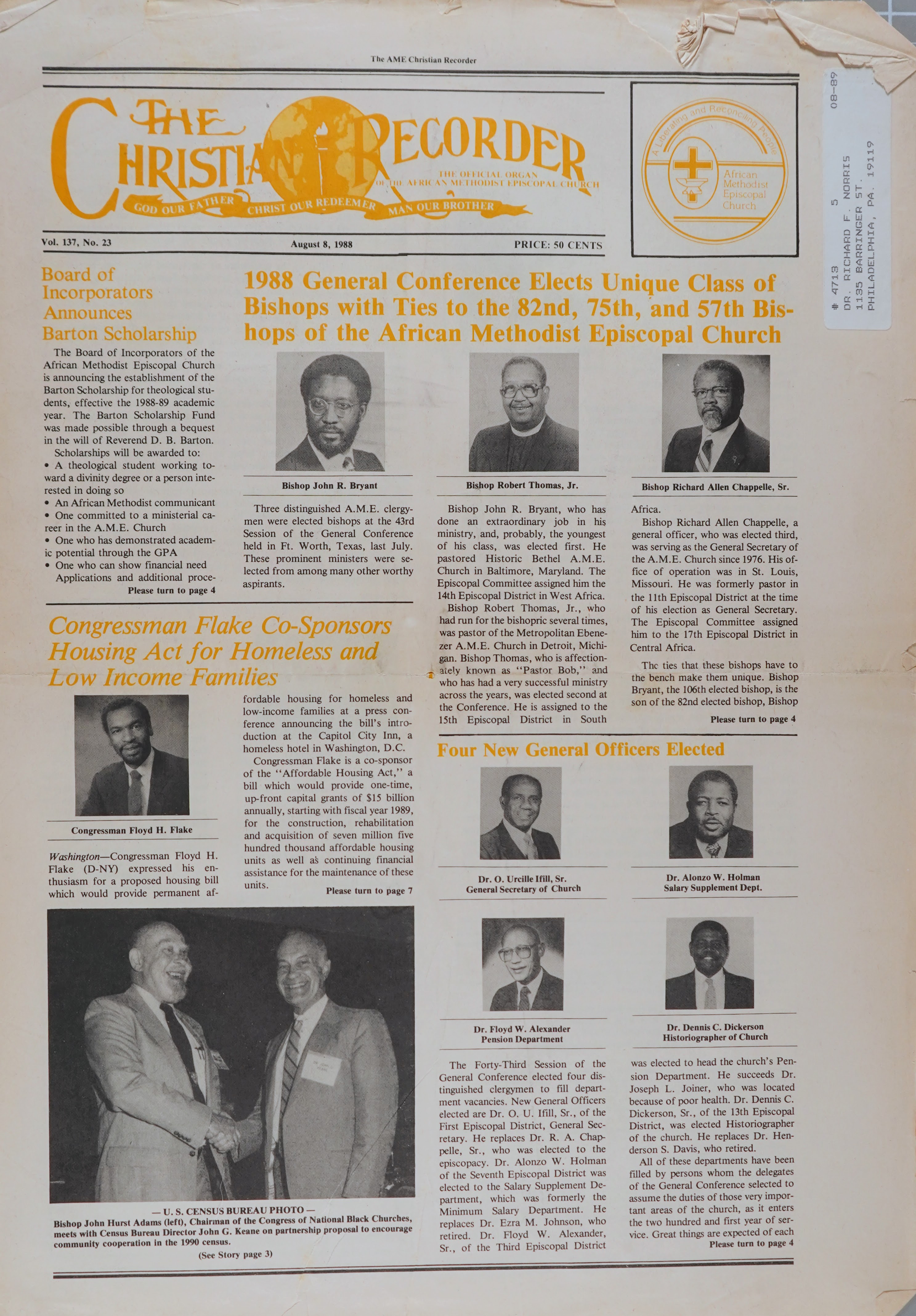
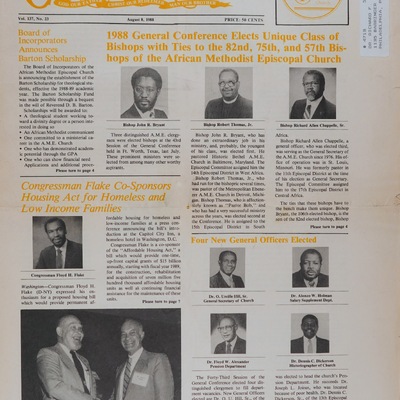
1988 General Conference Elects Unique Class of
Bishops with Ties to the 82nd, 75th, and 57th Bis-
hops of the African Methodist Episcopal Church
ae
Bishop John R. Bryant
Bishop Robert Thomas, Jr.
Bishop Richard Allen Chappelle, Sr.
Three distinguished A.M.E. clergy-
men were elected bishops at the 43rd
Session of the General Conference
held in Ft. Worth, Texas, last July.
These prominent ministers were se-
lected from among many other worthy
aspirants.
Congressman Flake Co-Sponsors
Housing Act for Homeless and
Low Income Families
Congressman Floyd H. Flake
Washington—Congressman Floyd H.
Flake (D-NY) expressed his en-
thusiasm for a proposed housing bill
which would provide permanent af-
fordable housing for homeless and
low-income families at a press con-
ference announcing the bill’s intro-
duction at the Capitol City Inn, a
homeless hotel in Washington, D.C.
Congressman Flake is a co-sponsor
of the ‘‘Affordable Housing Act,’’ a
bill which would provide one-time,
up-front capital grants of $15 billion
annually, starting with fiscal year 1989,
for the construction, rehabilitation
and acquisition of seven million five
hundred thousand affordable housing
units as well a&’ continuing financial
assistance for the maintenance of these
units.
Please turn to page 7
— U.S. CENSUS BUREAU PHOTO —
Bishop John Hurst Adams (left), Chairman of the Congress of National Black Churches,
meets with Census Bureau Director John G. Keane on partnership proposal to encourage
community cooperation in the 1990 census.
(See Story page 3)
Bishop John R. Bryant, who has
done an extraordinary job in his
ministry, and, probably, the youngest
of his class, was elected first. He
pastored Historic Bethel A.M.E.
Church in Baltimore, Maryland. The
Episcopal Committee assigned him the
14th Episcopal District in West Africa.
Bishop Robert Thomas, Jr., who
had run for the bishopric several times,
was pastor of the Metropolitan Ebene-
zer A.M.E. Church in Detroit, Michi-
gan. Bishop Thomas, who is affection-
. ately known as ‘‘Pastor Bob,’’ and
who has had a very successful ministry
across the years, was elected second at
the Conference. He is assigned to the
15th Episcopal District in South
Africa.
Bishop Richard Allen Chappelle, a
general officer, who was elected third,
was serving as the General Secretary of
the A.M.E. Church since 1976. His of-
fice of operation was in St. Louis,
Missouri. He was formerly pastor in
the 11th Episcopal District at the time
of his election as General Secretary.
The Episcopal Committee assigned
him to the 17th Episcopal District in
Central Africa.
The ties that these bishops have to
the bench make them unique. Bishop
Bryant, the 106th elected bishop, is the
son of the 82nd elected bishop, Bishop
Please turn to page 4
Four New General Officers Elected
Dr. O. Urcille Ifill, Sr.
General Secretary of Church
Dr. Alonzo W. Holman
Salary Supplement Dept.
Dr. Floyd W. Alexander
Pension Department
Dr. Dennis C. Dickerson
Historiographer of Church
The Forty-Third Session of the
General Conference elected four dis-
tinguished clergymen to fill depart-
ment vacancies. New General Officers
elected are Dr. O. U. Ifill, Sr., of the
First Episcopal District, General Sec-
retary. He replaces Dr. R. A. Chap-
pelle, Sr., who was elected to the
episcopacy. Dr. Alonzo W. Holman
of the Seventh Episcopal District was
elected to the Salary Supplement De-
partment, which was formerly the
Minimum Salary Department. He
replaces Dr. Ezra M. Johnson, who
retired. Dr. Floyd W. Alexander,
Sr., of the Third Episcopal District
was elected to head the church’s Pen-
sion Department. He succeeds Dr.
Joseph L. Joiner, who was located
because of poor health. Dr. Dennis C.
Dickerson, Sr., of the 13th Episcopal
District, was elected Historiographer
of the church. He replaces Dr. Hen-
derson S. Davis, who retired.
All of these departments have been
filled by persons whom the delegates
of the General Conference selected to
assume the duties of those very impor-
tant areas of the church, as it enters
the two hundred and first year of ser-
vice. Great things are expected of each
Please turn to page 4
a
471.3
DR.
NORRIS
PA.
Dr.
BARRING
cf
¢
PHILADELPHIA ,
a
35
tVilty
Rg
===== DSC05576.JPG =====
The AME Christian Recorder
August 8, 1988
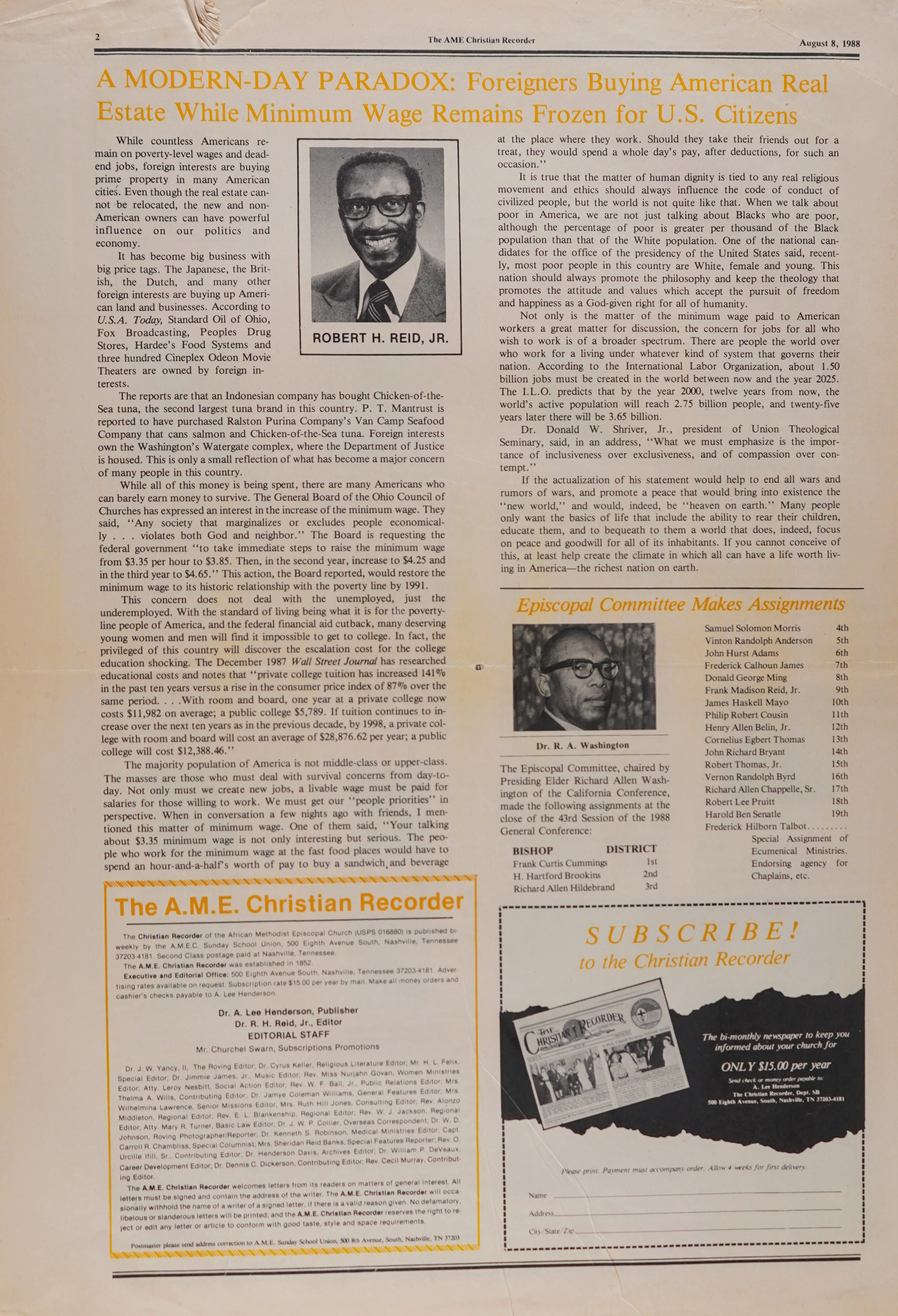
A MODERN-DAY PARADOX: Foreigners Buying American Real
Estate While Minimum Wage Remains Frozen for U.S. Citizens
While countless Americans re-
main on poverty-level wages and dead-
end jobs, foreign interests are buying
prime property in many American
cities. Even though the real estate can-
not be relocated, the new and non-
American owners can have powerful
influence on our politics and
economy.
It has become big business with
big price tags. The Japanese, the Brit-
ish, the Dutch, and many other
foreign interests are buying up Ameri-
can land and businesses. According to
U.S.A. Today, Standard Oil of Ohio,
Fox Broadcasting, Peoples Drug
Stores, Hardee’s Food Systems and
three hundred Cineplex Odeon Movie
Theaters are owned by foreign in-
terests.
The reports are that an Indonesian company has bought Chicken-of-the-
Sea tuna, the second largest tuna brand in this country. P. T. Mantrust is
reported to have purchased Ralston Purina Company’s Van Camp Seafood
Company that cans salmon and Chicken-of-the-Sea tuna. Foreign interests
own the Washington’s Watergate complex, where the Department of Justice
is housed. This is only a small reflection of what has become a major concern
of many people in this country.
While all of this money is being spent, there are many Americans who
can barely earn money to survive. The General Board of the Ohio Council of
Churches has expressed an interest in the increase of the minimum wage. They
said, ‘‘Any society that marginalizes or excludes people economical-
ly . . . violates both God and neighbor.’’ The Board is requesting the
federal government ‘‘to take immediate steps to raise the minimum wage
from $3.35 per hour to $3.85. Then, in the second year, increase to $4.25 and
in the third year to $4.65.’’ This action, the Board reported, would restore the
minimum wage to its historic relationship with the poverty line by 1991.
This concern does not deal with the unemployed, just the
underemployed. With the standard of living being what it is for the poverty-
line people of America, and the federal financial aid cutback, many deserving
young women and men will find it impossible to get to college. In fact, the
privileged of this country will discover the escalation cost for the college
education shocking. The December 1987 Wall Street Journal has researched
educational costs and notes that ‘‘private college tuition has increased 141%
in the past ten years versus a rise in the consumer price index of 87% over the
same period. . . .With room and board, one year at a private college now
costs $11,982 on average; a public college $5,789. If tuition continues to in-
crease over the next ten years as in the previous decade, by 1998, a private col-
lege with room and board will cost an average of $28,876.62 per year; a public
college will cost $12,388.46.”
The majority population of America is not middle-class or upper-class.
The masses are those who must deal with survival concerns from day-to-
day. Not only must we create new jobs, a livable wage must be paid for
salaries for those willing to work. We must get our ‘‘people priorities’ in
perspective. When in conversation a few nights ago with friends, I men-
tioned this matter of minimum wage. One of them said, ‘Your talking
about $3.35 minimum wage is not only interesting but serious. The peo-
ple who work for the minimum wage at the fast food places would have to
spend an hour-and-a-half’s worth of pay to buy a sandwich, and beverage
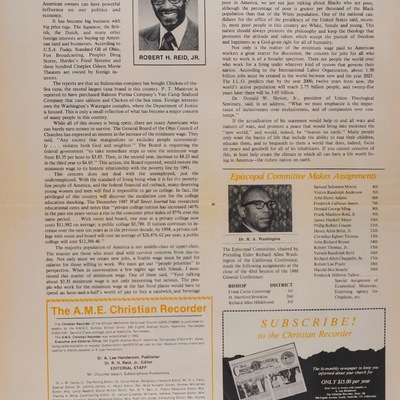
ROBERT H. REID, JR.
The A.M.E. Christian Recorder
The Christian Recorder of the African Methodist Episcopal Church (USPS 016880) is published bi
weekly by the A.M.E.C. Sunday School Union 500 Eighth Avenue South, Nashville Tennessee
37203-4181. Second Class postage paid at Nashville, Tennessee
The A.M.E. Christian Recorder was established in 1852
Executive and Editorial Office: 500 Eighth Avenue South, Nashville, Tennessee 37203-4181, Adver
tising rates available on request Subscription rate $15.00 per year by mai Make all money orders and
cashier's checks payable to A. Lee Henderson
Dr. A. Lee Henderson, Publisher
Dr. R. H. Reid, Jr., Editor
EDITORIAL STAFF
Mr. Churchel Swarn, Subscriptions Promotions
Or. J. W. Yancy, ll, The Roving Editor, Dr, Cyrus Keller, Religious Literature Editor, Mr. H. L. Felix
Special Editor, Or. Jimmie James, Jr., Music Editor, Rev. Miss Nurjann Govan Women Ministries
Editor, Atty. Leroy Nesbitt, Social Action Editor, Rev. W, F. Bal Public Relations Editor, Mrs
Theima A. Wills, Contributing Editor Dr. Jamye Coleman Willia General Features Editor, Mrs
Wilhelmina Lawrence, Senior Missions Editor, Mrs. Ruth Hi onsulting Editor, Rev. Alonzo
Middleton, Regional Editor, Rev, E. L Blankenship, Regional Editor, Rev. W. J. Jackson Regiona
Editor, Atty. Mary R. Turner Basic Law Editor, Dr. J, W. P. Collier Overseas Corr ent, Or W. D0
Robinson, Medical Ministries Editor, Capt
Johnson, Roving Photographer Reporter, Dr. Kenneth S
Sheridan Reid Banks, Special Features Reporter, Rev.O
William P. DeVeaux
Carroll R. Chambliss, Special Columnist Mrs
Urcille Ifill, Sr., Contributing Editor, Dr. Henderson Davis, Archives Editor, Dr
Career Development Editor, Dr. Dennis C. Dickerson, Contributing Editor, Rev Cecil Murray, Contribut
ing Editor
The A.M.E. Christian Recorder welcomes letters from its readers on matters of general interest, All
letters must be signed and contain the address of the writer. The A.M.E. Christian Recorder wil! occa
sionally withhold the name of a writer of a signed letter, if there is a valid reason given No defamatory
libelous or slanderous letters will be printed, and the A.M.E. Christian Recorder reserves the right to re
ject or edit any letter or article to conform with good taste, style and space requirements
‘ ¢, So ‘ y7203
Postmaster please send address correction to A.M.E. Sunday Schoo! Union, $00 Bth Avenue, Se with, Nashville, TN 3720
at the place where they work. Should they take their friends out for a
treat, they would spend a whole day’s pay, after deductions, for such an
occasion.”’
It is true that the matter of human dignity is tied to any real religious
movement and ethics should always influence the code of conduct of
civilized people, but the world is not quite like that. When we talk about
poor in America, we are not just talking about Blacks who are poor,
although the percentage of poor is greater per thousand of the Black
population than that of the White population. One of the national can-
didates for the office of the presidency of the United States said, recent-
ly, most poor people in this country are White, female and young. This
nation should always promote the philosophy and keep the theology that
promotes the attitude and values which accept the pursuit of freedom
and happiness as a God-given right for all of humanity.
Not only is the matter of the minimum wage paid to American
workers a great matter for discussion, the concern for jobs for all who
wish to work is of a broader spectrum. There are people the world over
who work for a living under whatever kind of system that governs their
nation. According to the International Labor Organization, about 1.50
billion jobs must be created in the world between now and the year 2025.
The I.L.O. predicts that by the year 2000, twelve years from now, the
world’s active population will reach 2.75 billion people, and twenty-five
years later there will be 3.65 billion.
Dr. Donald W. Shriver, Jr., president of Union Theological
Seminary, said, in an address, ‘‘What we must emphasize is the impor-
tance of inclusiveness over exclusiveness, and of compassion over con-
tempt.’’
If the actualization of his statement would help to end all wars and
rumors of wars, and promote a peace that would bring into existence the
“‘new world,’’ and would, indeed, be ‘‘heaven on earth.’’ Many people
only want the basics of life that include the ability to rear their children,
educate them, and to bequeath to them a world that does, indeed, focus
on peace and goodwill for all of its inhabitants. If you cannot conceive of
this, at least help create the climate in which all can have a life worth liv-
ing in America—the richest nation on earth.
Episcopal Committee Makes Assignments
Samuel Solomon Morris 4th
Vinton Randolph Anderson Sth
John Hurst Adams 6th
Frederick Calhoun James 7th
Donald George Ming 8th
Frank Madison Reid, Jr. 9th
James Haskell Mayo 10th
Philip Robert Cousin llth
Henry Allen Belin, Jr. 12th
oa 5! Wabiieion Cornelius Egbert Thomas 13th
a a a ae - - John Richard Bryant 14th
The Episcopal Committee, chaired by Robert Thomas, Jr. 15th
Presiding Elder Richard Allen Wash- Vernon Randolph Byrd 16th
ington of the California Conference, Richard Allen Chappelle, Sr. 17th
made the following assignments at the Robert Lee Pruitt 18th
close of the 43rd Session of the 1988 Harold Ben Senatle 19th
Frederick Hilborn Talbot.........
Special Assignment of
General Conference:
BISHOP DISTRICT Ecumenical Ministries.
Frank Curtis Cummings Ist Endorsing agency for
H. Hartford Brookins 2nd Chaplains, etc.
Richard Allen Hildebrand ard
Raabe |
SUBSCRIBE!
to the Christian Recorder
The bi-monthly newspaper to keep you
informed about your church for
ONLY $15.00 per year
Send check or money order payable 10.
A, Lee Henderson
The Christian Recorder, Dept, SB
S00 Righth Avenue, South, Nashville, TN 37203-4181
i
i
; i
H r
; i
' H
rl
! Please print, Pavenent mm accompany order. Allow 4 weeks for first delivery 1
3 i
: 1
: i
3 Name nee = er
i
H i
' Address. — oe '
1
i ; :
' City State £ip i
; i
: 4
===== DSC05577.JPG =====
August 8, 1988
The AME Christian Recorder
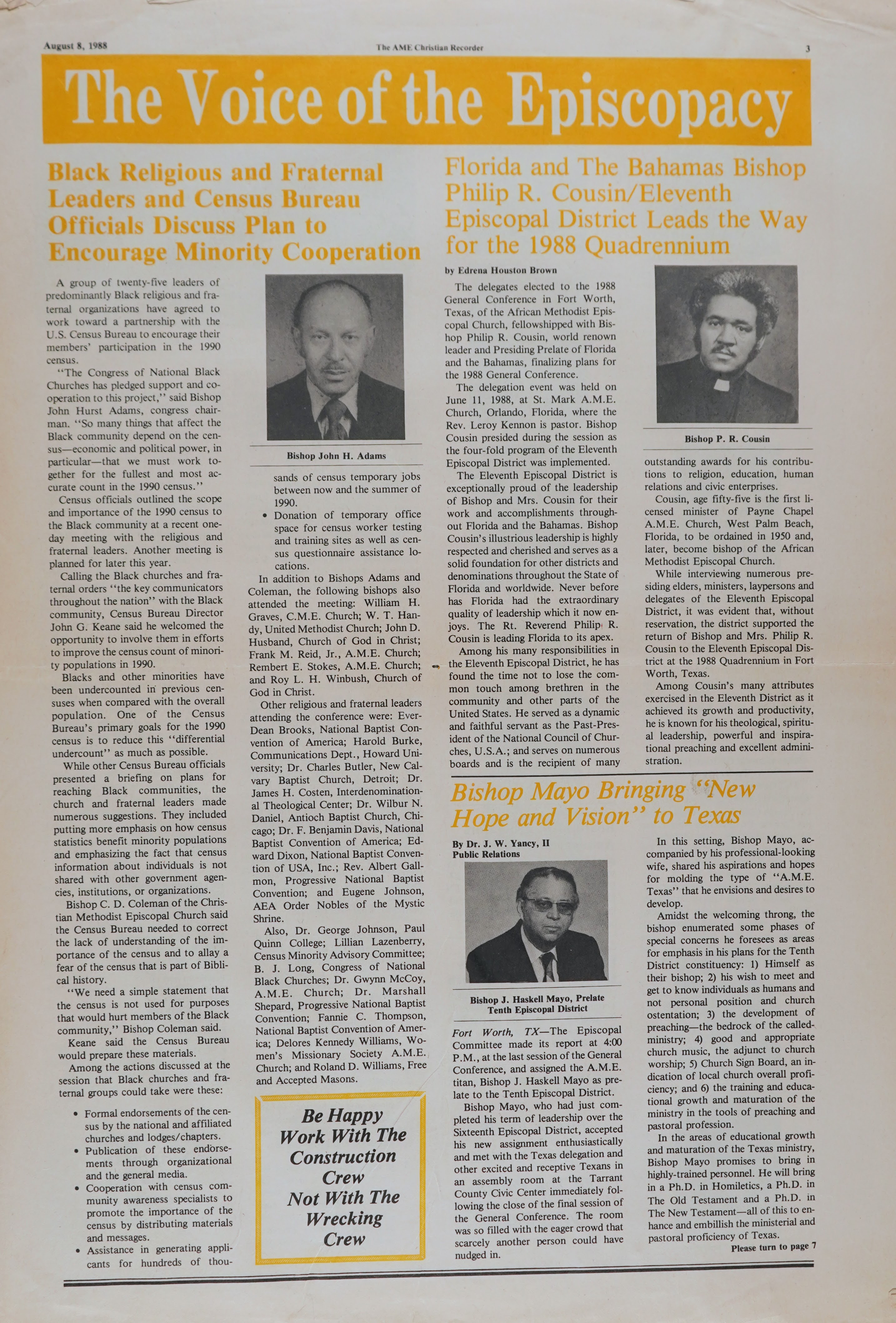
The Voice of the Episcopacy
Florida and The Bahamas Bishop
Black Religious and Fraternal
Leaders and Census Bureau
Officials Discuss Plan to
Encourage Minority Cooperation
A group of twenty-five leaders of
predominantly Black religious and fra-
ternal organizations have agreed to
work toward a partnership with the
U.S. Census Bureau to encourage their
members’ participation in the 1990
census.
“The Congress of National Black
Churches has pledged support and co-
operation to this project,’’ said Bishop
John Hurst Adams, congress chair-
man. ‘‘So many things that affect the
Black community depend on the cen-
sus—economic and political power, in
particular—that we must work to-
gether for the fullest and most ac-
curate count in the 1990 census.”’
Census officials outlined the scope
and importance of the 1990 census to
the Black community at a recent one-
day meeting with the religious and
fraternal leaders. Another meeting is
planned for later this year.
Calling the Black churches and fra-
ternal orders ‘‘the key communicators
throughout the nation’’ with the Black
community, Census Bureau Director
John G. Keane said he welcomed the
opportunity to involve them in efforts
to improve the census count of minori-
ty populations in 1990.
Blacks and other minorities have
been undercounted in previous cen-
suses when compared with the overall
population. One of the Census
Bureau’s primary goals for the 1990
census is to reduce this ‘‘differential
undercount’’ as much as possible.
While other Census Bureau officials
presented a briefing on plans for
reaching Black communities, the
church and fraternal leaders made
numerous suggestions. They included
putting more emphasis on how census
statistics benefit minority populations
and emphasizing the fact that census
information about individuals is not
shared with other government agen-
cies, institutions, or organizations.
Bishop C. D. Coleman of the Chris-
tian Methodist Episcopal Church said
the Census Bureau needed to correct
the lack of understanding of the im-
portance of the census and to allay a
fear of the census that is part of Bibli-
cal history.
“We need a simple statement that
the census is not used for purposes
that would hurt members of the Black
community,’ Bishop Coleman said.
Keane said the Census Bureau
would prepare these materials.
Among the actions discussed at the
session that Black churches and fra-
ternal groups could take were these:
e Formal endorsements of the cen-
sus by the national and affiliated
churches and lodges/chapters.
e Publication of these endorse-
ments through organizational
and the general media.
e Cooperation with census com-
munity awareness specialists to
promote the importance of the
census by distributing materials
and messages.
e Assistance in generating appli-
ts for hundreds of thou-
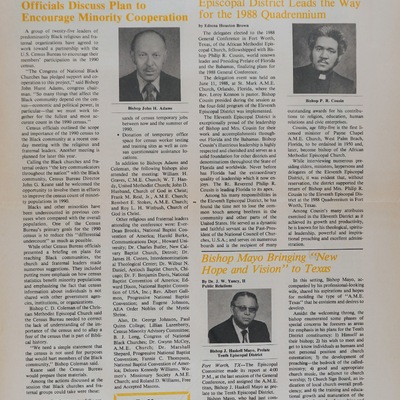
Bishop John H. Adams
sands of census temporary jobs
between now and the summer of
1990.
e Donation of temporary office
space for census worker testing
and training sites as well as cen-
sus questionnaire assistance lo-
cations.
In addition to Bishops Adams and
Coleman, the following bishops also
attended the meeting: William H.
Graves, C.M.E. Church; W. T. Han-
dy, United Methodist Church; John D.
Husband, Church of God in Christ;
Frank M. Reid, Jr., A.M.E. Church;
Rembert E. Stokes, A.M.E. Church;
and Roy L. H. Winbush, Church of
God in Christ.
Other religious and fraternal leaders
attending the conference were: Ever-
Dean Brooks, National Baptist Con-
vention of America; Harold Burke,
Communications Dept., Howard Uni-
versity; Dr. Charles Butler, New Cal-
vary Baptist Church, Detroit; Dr.
James H. Costen, Interdenomination-
al Theological Center; Dr. Wilbur N.
Daniel, Antioch Baptist Church, Chi-
cago; Dr. F. Benjamin Davis, National
Baptist Convention of America; Ed-
ward Dixon, National Baptist Conven-
tion of USA, Inc.; Rev. Albert Gall-
mon, Progressive National Baptist
Convention; and Eugene Johnson,
AEA Order Nobles of the Mystic
Shrine.
Also, Dr. George Johnson, Paul
Quinn College; Lillian Lazenberry,
Census Minority Advisory Committee;
B. J. Long, Congress of National
Black Churches; Dr. Gwynn McCoy,
A.M.E. Church; Dr. Marshall
Shepard, Progressive National Baptist
Convention; Fannie C. Thompson,
National Baptist Convention of Amer-
ica; Delores Kennedy Williams, Wo-
men’s Missionary Society A.M.E.
Church; and Roland D. Williams, Free
and Accepted Masons.
DILL LLLL LL tpal ail
Be Happy
Work With The
Construction
Crew
Not With The
Wrecking
Crew
Philip R. Cousin/Eleventh
Episcopal District Leads the Way
for the 1988 Quadrennium
by Edrena Houston Brown
The delegates elected to the 1988
General Conference in Fort Worth,
Texas, of the African Methodist Epis-
copal Church, fellowshipped with Bis-
hop Philip R. Cousin, world renown
leader and Presiding Prelate of Florida
and the Bahamas, finalizing plans for
the 1988 General Conference.
The delegation event was held on
June 11, 1988, at St. Mark A.M.E.
Church, Orlando, Florida, where the
Rev. Leroy Kennon is pastor. Bishop
Cousin presided during the session as
the four-fold program of the Eleventh
Episcopal District was implemented.
The Eleventh Episcopal District is
exceptionally proud of the leadership
of Bishop and Mrs. Cousin for their
work and accomplishments through-
out Florida and the Bahamas. Bishop
Cousin’s illustrious leadership is highly
respected and cherished and serves as a
solid foundation for other districts and
denominations throughout the State of
Florida and worldwide. Never before
has Florida had the extraordinary
quality of leadership which it now en-
joys. The Rt. Reverend Philip: R.
Cousin is leading Florida to its apex.
Among his many responsibilities in
the Eleventh Episcopal District, he has
found the time not to lose the com-
mon touch among brethren in the
community and other parts of the
United States. He served as a dynamic
and faithful servant as the Past-Pres-
ident of the National Council of Chur-
ches, U.S.A.; and serves on numerous
boards and is the recipient of many
Bishop P. R. Cousin
outstanding awards for his contribu-
tions to religion, education, human
relations and civic enterprises.
Cousin, age fifty-five is the first li-
censed minister of Payne Chapel
A.M.E. Church, West Palm Beach,
Florida, to be ordained in 1950 and,
later, become bishop of the African
Methodist Episcopal Church.
While interviewing numerous pre-
siding elders, ministers, laypersons and
delegates of the Eleventh Episcopal
District, it was evident that, without
reservation, the district supported the
return of Bishop and Mrs. Philip R.
Cousin to the Eleventh Episcopal Dis-
trict at the 1988 Quadrennium in Fort
Worth, Texas.
Among Cousin’s many attributes
exercised in the Eleventh District as it
achieved its growth and productivity,
he is known for his theological, spiritu-
al leadership, powerful and inspira-
tional preaching and excellent admini-
stration.
Bishop Mayo Bringing “‘New
Hope and Vision”’ to Texas
By Dr. J. W. Yancy, Il
Public Relations
Bishop J. Haskell Mayo, Prelate
Tenth Episcopal District
Fort Worth, TX—The Episcopal
Committee made its report at 4:00
P.M.., at the last session of the General
Conference, and assigned the A.M.E.
titan, Bishop J. Haskell Mayo as pre-
late to the Tenth Episcopal District.
Bishop Mayo, who had just com-
pleted his term of leadership over the
Sixteenth Episcopal District, accepted
his new assignment enthusiastically
and met with the Texas delegation and
other excited and receptive Texans in
an assembly room at the Tarrant
County Civic Center immediately fol-
lowing the close of the final session of
the General Conference. The room
was so filled with the eager crowd that
scarcely another person could have
nudged in.
In this setting, Bishop Mayo, ac-
companied by his professional-looking
wife, shared his aspirations and hopes
for molding the type of ‘‘A.M.E.
Texas’’ that he envisions and desires to
develop.
Amidst the welcoming throng, the
bishop enumerated some phases of
special concerns he foresees as areas
for emphasis in his plans for the Tenth
District constituency: 1) Himself as
their bishop; 2) his wish to meet and
get to know individuals as humans and
not personal position and church
ostentation; 3) the development of
preaching—the bedrock of the called-
ministry; 4) good and appropriate
church music, the adjunct to church
worship; 5) Church Sign Board, an in-
dication of local church overall profi-
ciency; and 6) the training and educa-
tional growth and maturation of the
ministry in the tools of preaching and
pastoral profession.
In the areas of educational growth
and maturation of the Texas ministry,
Bishop Mayo promises to bring in
highly-trained personnel. He will bring
in a Ph.D. in Homiletics, a Ph.D. in
The Old Testament and a Ph.D. in
The New Testament—all of this to en-
hance and embillish the ministerial and
pastoral proficiency of Texas.
Please turn to page 7
SSD
>
===== DSC05578.JPG =====
The AME Christian Recorder
August 8, 1988
Continued from page 1
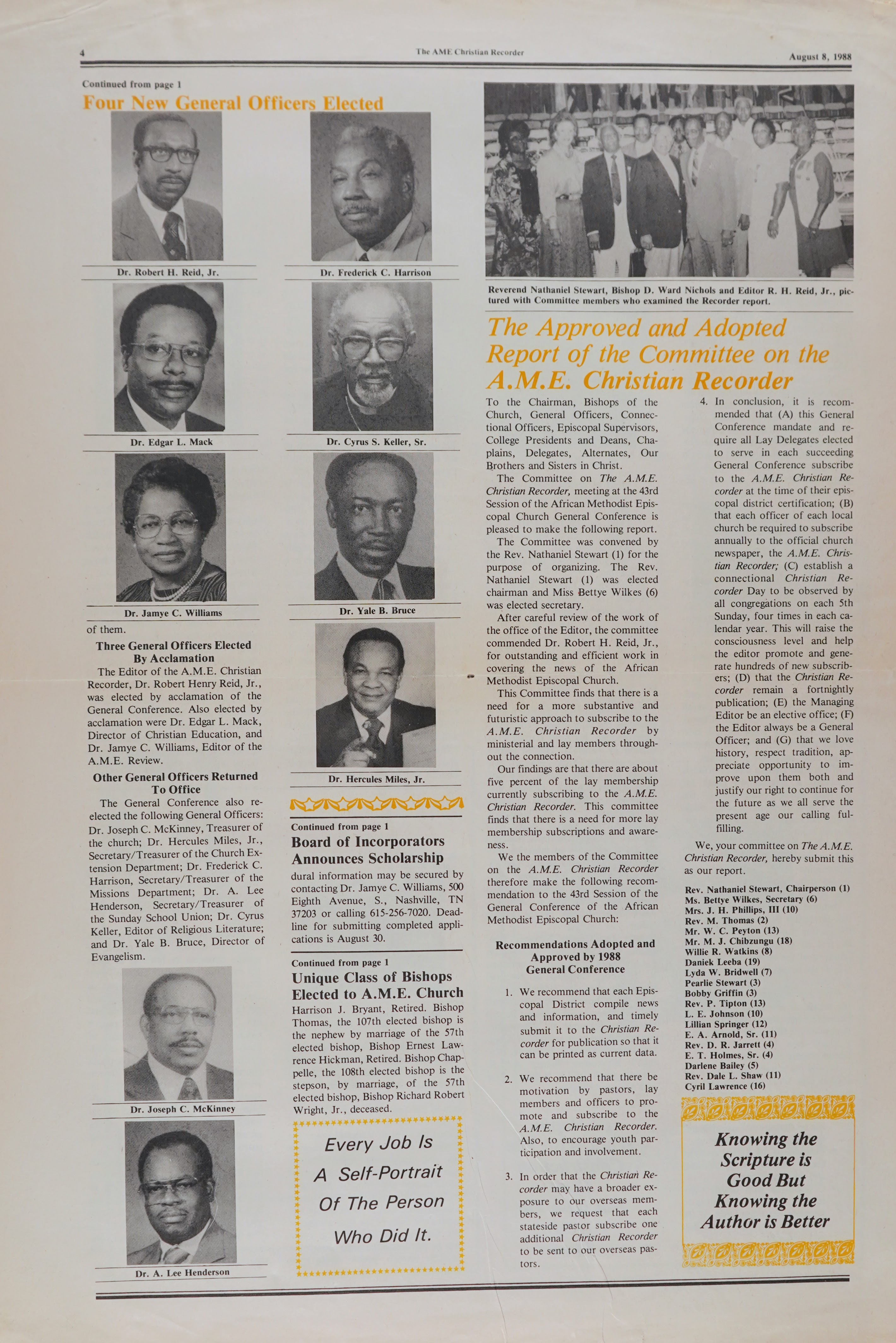
Four New General Officers Elected
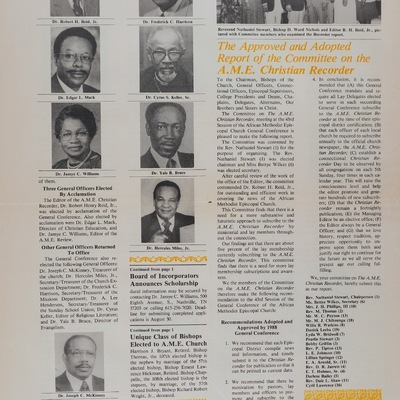
Dr. Edgar L. Mack
.
et
i"
V
Dr. Cyrus S. Keller, Sr.
Dr. Jamye C. Williams
Dr. Yale B. Bruce
of them.
Three General Officers Elected
By Acclamation
The Editor of the A.M.E. Christian
Recorder, Dr. Robert Henry Reid, Jr.,
was elected by acclamation of the
General Conference. Also elected by
acclamation were Dr. Edgar L. Mack,
Director of Christian Education, and
Dr. Jamye C. Williams, Editor of the
A.M.E. Review.
Other General Officers Returned
To Office
The General Conference also re-
elected the following General Officers:
Dr. Joseph C. McKinney, Treasurer of
the church; Dr. Hercules Miles, Jr.,
Secretary/Treasurer of the Church Ex-
tension Department; Dr. Frederick C.
Harrison, Secretary/Treasurer of the
Missions Department; Dr. A. Lee
Henderson, Secretary/Treasurer of
the Sunday School Union; Dr. Cyrus
Keller, Editor of Religious Literature;
and Dr. Yale B. Bruce, Director of
Evangelism.
Dr. Joseph C. McKinney
—_
&
(eet "
A
Dr. A. Lee Henderson
Dr. Hercules Miles, Jr.
NYNANYNYRA
Continued from page 1
Board of Incorporators
Announces Scholarship
dural information may be secured by
contacting Dr. Jamye C. Williams, 500
Eighth Avenue, S., Nashville, TN
37203 or calling 615-256-7020. Dead-
line for submitting completed appli-
cations is August 30.
Continued from page 1
Unique Class of Bishops
Elected to A.M.E. Church
Harrison J. Bryant, Retired. Bishop
Thomas, the 107th elected bishop is
the nephew by marriage of the 57th
elected bishop, Bishop Ernest Law-
rence Hickman, Retired. Bishop Chap-
pelle, the 108th elected bishop is the
stepson, by marriage, of the 57th
elected bishop, Bishop Richard Robert
Wright, Jr., deceased.
EAE EE FREE ERED ALE RECEIIRE
Pa
: Every Job Is
4
* A Self-Portrait
*
bd
? Of The Person }
: *
* ; *
: Who Didit. }
III IIT IIIA I ISAS I ISIS
a
error terrle,
Reverend Nathaniel Stewart, Bishop D. Ward Nichols and Editor R. H. Reid, Jr., pic-
tured with Committee members who examined the Recorder report.
The Approved and Adopted
Report of the Committee on the
A.M.E. Christian Recorder
To the Chairman, Bishops of the
Church, General Officers, Connec-
tional Officers, Episcopal Supervisors,
College Presidents and Deans, Cha-
plains, Delegates, Alternates, Our
Brothers and Sisters in Christ.
The Committee on The A.M.E.
Christian Recorder, meeting at the 43rd
Session of the African Methodist Epis-
copal Church General Conference is
pleased to make the following report.
The Committee was convened by
the Rev. Nathaniel Stewart (1) for the
purpose of organizing. The Rev.
Nathaniel Stewart (1) was elected
chairman and Miss Bettye Wilkes (6)
was elected secretary.
After careful review of the work of
the office of the Editor, the committee
commended Dr. Robert H. Reid, Jr.,
for outstanding and efficient work in
covering the news of the African
Methodist Episcopal Church.
This Committee finds that there is a
need for a more substantive and
futuristic approach to subscribe to the
A.M.E. Christian Recorder by
ministerial and lay members through-
out the connection.
Our findings are that there are about
five percent of the lay membership
currently subscribing to the A.M.E.
Christian Recorder. This committee
finds that there is a need for more lay
membership subscriptions and aware-
ness.
We the members of the Committee
on the A.M.E. Christian Recorder
therefore make the following recom-
mendation to the 43rd Session of the
General Conference of the African
Methodist Episcopal Church:
Recommendations Adopted and
Approved by 1988
General Conference
1. We recommend that each Epis-
copal District compile news
and information, and timely
submit it to the Christian Re-
corder for publication so that it
can be printed as current data.
2. We recommend that there be
motivation by pastors, lay
members and officers to pro-
mote and subscribe to the
A.M.E. Christian Recorder.
Also, to encourage youth par-
ticipation and involvement.
3. In order that the Christian Re-
corder may have a broader ex-
posure to Our overseas mem-
bers, we request that each
stateside pastor subscribe one
additional Christian Recorder
to be sent to our Overseas pas-
tors.
4. In conclusion, it is recom-
mended that (A) this General
Conference mandate and re-
quire all Lay Delegates elected
to serve in each succeeding
General Conference subscribe
to the A.M.E. Christian Re-
corder at the time of their epis-
copal district certification; (B)
that each officer of each local
church be required to subscribe
annually to the official church
newspaper, the A.M.E. Chris-
tian Recorder; (C) establish a
connectional Christian Re-
corder Day to be observed by
all congregations on each Sth
Sunday, four times in each ca-
lendar year. This will raise the
consciousness level and help
the editor promote and gene-
rate hundreds of new subscrib-
ers; (D) that the Christian Re-
corder remain a fortnightly
publication; (E) the Managing
Editor be an elective office; (F)
the Editor always be a General
Officer; and (G) that we love
history, respect tradition, ap-
preciate opportunity to im-
prove upon them both and
justify our right to continue for
the future as we all serve the
present age our calling ful-
filling.
We, your committee on The A.M.E.
Christian Recorder, hereby submit this
as Our report.
Rev. Nathaniel Stewart, Chairperson (1)
Ms. Bettye Wilkes, Secretary (6)
Mrs. J. H. Phillips, II (10)
Rev. M. Thomas (2)
Mr. W. C. Peyton (13)
Mr. M. J. Chibzungu (18)
Willie R. Watkins (8)
Daniek Leeba (19)
Lyda W. Bridwell (7)
Pearlie Stewart (3)
Bobby Griffin (3)
Rev. P. Tipton (13)
L. E. Johnson (10)
Lillian Springer (12)
E. A. Arnold, Sr. (11)
Rey. D. R. Jarrett (4)
E. T. Holmes, Sr. (4)
Darlene Bailey (5)
Rev. Dale L. Shaw (11)
Cyril Lawrence (16)
Knowing the
Scripture is
Good But
Knowing the
Author is Better
===== DSC05579.JPG =====
August 8, 1988
The AME Christian Recorder
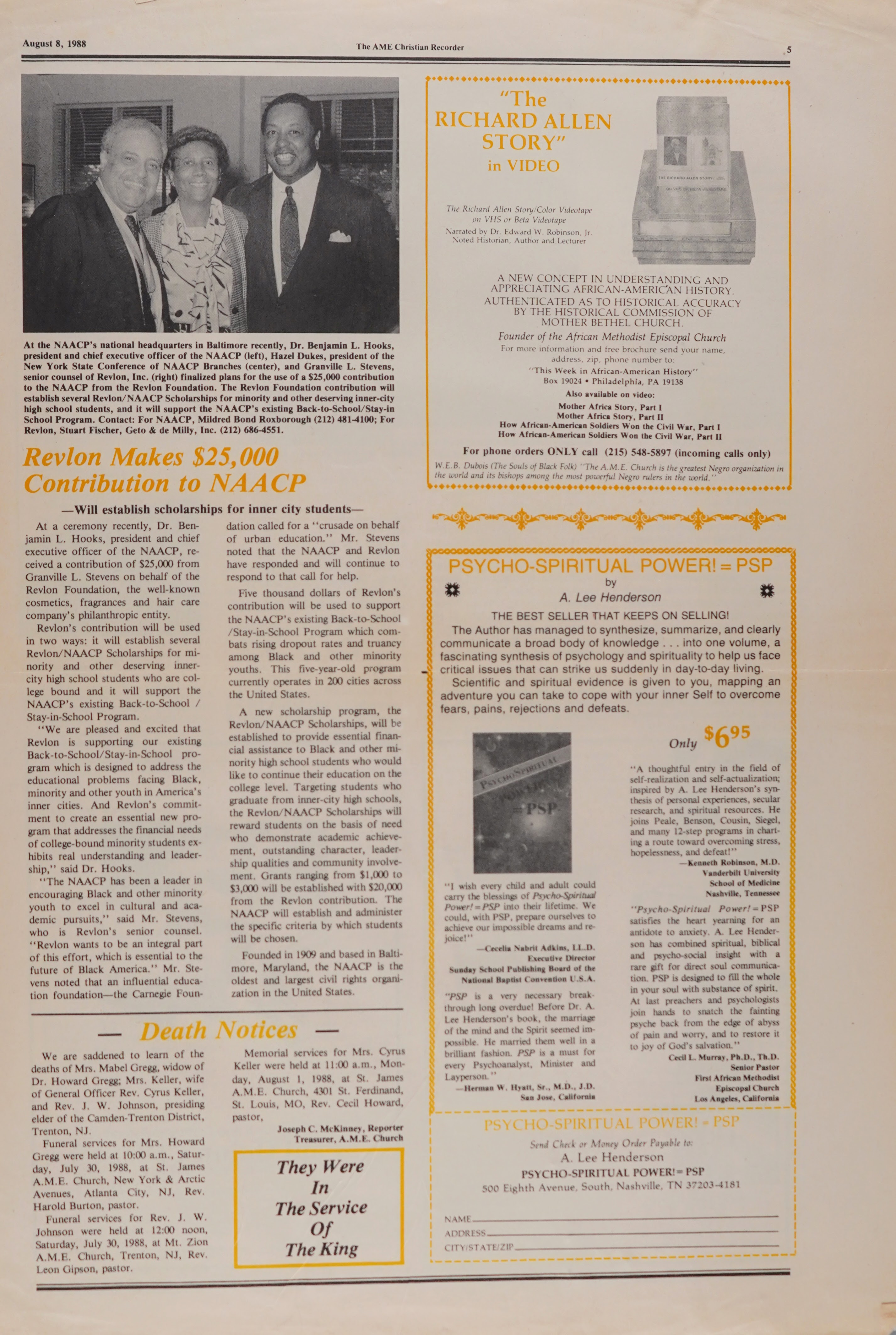
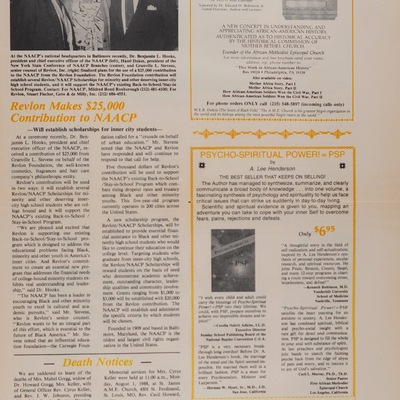
At the NAACP’s national headquarters in Baltimore recently, Dr. Benjamin L. Hooks,
president and chief executive officer of the NAACP (left), Hazel Dukes, president of the
New York State Conference of NAACP Branches (center), and Granville L. Stevens,
senior counsel of Revlon, Inc. (right) finalized plans for the use of a $25,000 contribution
to the NAACP from the Revion Foundation. The Revlon Foundation contribution will
establish several Revion/ NAACP Scholarships for minority and other deserving inner-city
high school students, and it will support the NAACP’s existing Back-to-School/Stay-in
School Program. Contact: For NAACP, Mildred Bond Roxborough (212) 481-4100; For
Revlon, Stuart Fischer, Geto & de Milly, Inc. (212) 686-4551.
Revlon Makes $25,000
Contribution to NAACP
—wWill establish scholarships for inner city students—
At a ceremony recently, Dr. Ben-
jamin L. Hooks, president and chief
executive officer of the NAACP, re-
ceived a contribution of $25,000 from
Granville L. Stevens on behalf of the
Revlon Foundation, the well-known
cosmetics, fragrances and hair care
company’s philanthropic entity.
Revlon’s contribution will be used
in two ways: it will establish several
Revlon/NAACP Scholarships for mi-
nority and other deserving inner-
city high school students who are col-
lege bound and it will support the
NAACP’s existing Back-to-School /
Stay-in-School Program.
“We are pleased and excited that
Revion is supporting our existing
Back-to-School/Stay-in-School _ pro-
gram which is designed to address the
educational problems facing Black,
minority and other youth in America’s
inner cities. And Revion’s commit-
ment to create an essential new pro-
gram that addresses the financial needs
of college-bound minority students ex-
hibits real understanding and leader-
ship,’”’ said Dr. Hooks.
“The NAACP has been a leader in
encouraging Black and other minority
youth to excel in cultural and aca-
demic pursuits,’ said Mr, Stevens,
who is Revlon’s senior counsel.
“‘Revion wants to be an integral part
of this effort, which is essential to the
future of Black America.’’ Mr. Ste-
vens noted that an influential educa-
tion foundation—the Carnegie Foun-
dation called for a ‘‘crusade on behalf
of urban education.’’ Mr. Stevens
noted that the NAACP and Revlon
have responded and will continue to
respond to that call for help.
Five thousand dollars of Revion’s
contribution will be used to support
the NAACP’s existing Back-to-School
/Stay-in-School Program which com-
bats rising dropout rates and truancy
among Black and other minority
youths. This five-year-old program
currently operates in 200 cities across
the United States.
A new scholarship program, the
Revion/NAACP Scholarships, will be
established to provide essential finan-
cial assistance to Black and other mi-
nority high school students who would
like to continue their education on the
college level. Targeting students who
graduate from inner-city high schools,
the Revion/NAACP Scholarships will
reward students on the basis of need
who demonstrate academic achieve-
ment, outstanding character, leader-
ship qualities and community involve-
ment. Grants ranging from $1,000 to
$3,000 will be established with $20,000
from the Revlon contribution. The
NAACP will establish and administer
the specific criteria by which students
will be chosen.
Founded in 1909 and based in Balti-
more, Maryland, the NAACP is the
oldest and largest civil rights organi-
zation in the United States.
— Death Notices —
We are saddened to learn of the
deaths of Mrs. Mabel Gregg, widow of
Dr. Howard Gregg; Mrs. Keller, wife
of General Officer Rev. Cyrus Keller,
and Rev. J. W. Johnson, presiding
elder of the Camden-Trenton District,
Trenton, NJ.
Funeral services for Mrs. Howard
Gregg were held at 10:00 a.m., Satur-
day, July 30, 1988, at St. James
A.M.E. Church, New York & Arctic
Avenues, Atlanta City, NJ, Rev.
Harold Burton, pastor.
Funeral services for Rev, J, W.
Johnson were held at 12:00 noon,
Saturday, July 30, 1988, at Mt. Zion
A.M.E. Church, Trenton, NJ, Rev.
Leon Gipson, pastor.
Memorial services for Mrs, Cyrus
Keller were held at 11:00 a.m., Mon-
day, August 1, 1988, at St. James
A.M.E. Church, 4301 St. Ferdinand,
St. Louis, MO, Rev. Cecil Howard,
pastor,
Joseph C. McKinney, Reporter
Treasurer, A.M.E. Church
They Were
In
The Service
Of
The King
Oooo PESOS PSOSP SOSH SOG POHOEGs Os SeHoHeSe Hee SoHo SeHsHsoreeoeoe
RICHARD ALLEN
STORY”
in VIDEO
The Richard Allen Story/Color Videotape
on VHS or Beta Videotape
Narrated by Dr. Edward W. Robinson, Jr
Noted Historian, Author and Lecturer
A NEW CONCEPT IN UNDERSTANDING AND
APPRECIATING AFRICAN-AMERICAN HISTORY.
AUTHENTICATED AS TO HISTORICAL ACCURACY
BY THE HISTORICAL COMMISSION OF
MOTHER BETHEL CHURCH.
Founder of the African Methodist Episcopal Church
For more information and free brochure send your name,
address, zip, phone number to:
“This Week in African-American History’’
Box 19024 ¢ Philadelphia, PA 19138
Also available on video:
Mother Africa Story, Part I
Mother Africa Story, Part II
How African-American Soldiers Won the Civil War, Part I
How African-American Soldiers Won the Civil Wars Part Il
For phone orders ONLY call (215) 548-5897 (incoming calls only)
W.E.B. Dubois (The Souls of Black Folk) ‘‘The A.M.E. Church is the greatest Negro organization in
the world and its bishops among the most powerful Negro rulers in the world.’’
SOPOP OPPOSE DEGSeGeOeGeGe Ge Ge Ge Ge SsGeSeGe Ge Se SeGeHo Ho Ge Soros
ot oe ee ee ee ae
PSYCHO-SPIRIT
zs
“I wish every child and adult could
carry the blessings of Psycho-Spiritual
Power! = PSP into their lifetime. We
could, with PSP, prepare ourselves to
achieve our impossible dreams and re-
joice!””
—Cecelia Nabrit Adkins, LL.D.
Executive Director
Sunday Schoo! Publishing Board of the
National Baptist Convention U.S.A.
“PSP is a very necessary break
through long overdue! Before Dr. A
Lee Henderson's book, the marriage
of the mind and the Spirit seemed im-
possible, He married them well in a
brilliant fashion. PSP is a must for
every Psychoanalyst, Minister and
Layperson, "”
Herman W. Hyatt, Sr., M.D, J.D.
San Jose, California
POWE
R! = PSP
A. Lee Henderson be
THE BEST SELLER THAT KEEPS ON SELLING!
The Author has managed to synthesize, summarize, and clearly
communicate a broad body of knowledge . . . into one volume, a
fascinating synthesis of psychology and spirituality to help us face
critical issues that can strike us suddenly in day-to-day living.
Scientific and spiritual evidence is given to you, mapping an
adventure you can take to cope with your inner Self to overcome
fears, pains, rejections and defeats.
$695
“A thoughtful entry in the field of
self-realization and self-actualization;
inspired by A. Lee Henderson’s syn-
thesis of personal experiences, secular
research, and spiritual resources. He
joins Peale, Benson, Cousin, Siegel,
and many 12-step programs in chart-
ing a route toward overcoming stress,
hopelessness, and defeat!”
—Kenneth Robinson, M.D.
Vanderbilt University
School of Medicine
Nashville, Tennessee
Only
“*Psycho-Spiritual Power! =PSP
satisfies the heart yearning for an
antidote to anxiety. A. Lee Hender-
son has combined spiritual, biblical
and psycho-social insight with a
rare gift for direct soul communica-
tion. PSP is designed to fill the whole
in your soul with substance of spirit.
At last preachers and psychologists
join hands to snatch the fainting
psyche back from the edge of abyss
of pain and worry, and to restore it
to joy of God's salvation.”’
Ceell L, Murray, Ph.D., Th.D.
Episcopal Church
Los Angeles, California
PSYCHO-SPIRITUAL POWER! « PSP
Send Check or Money Order Payable te.
A. Lee Henderson
PSYCHO-SPIRITUAL POWER! = PSP
500 Eighth Avenue, South Nashville, TN 37203-4181
NAME . —_ —
ADDRESS cree
CITY/STATE/ZIP
ee ee ee eee ee eee eee == ee SS = Se
===== DSC05580.JPG =====
The AME Christian Recorder
August 8, 1988
St. Luke
Observes
Men’s Day
by Monic Hargrove
Newark, NJ—The annual Men’s Day
was recently celebrated at St. Luke
A.M.E. Church with Bishop Frank C.
Cummings, presiding bishop of the
First Episcopal District addressing a
receptive congregation at the morning
worship service. Rev. John G. Ragin
presided for the occasion that had as
its theme ‘‘Men Surviving in a Critical
World.”’
Bishop Cummings offered an an-
swer to today’s problems as he spoke
on the subject ‘‘There’s an Open Way
to Survive in this Critical Way.’’ As he
referred to the crime that is invading
the neighborhoods of the country and
the fear imposed on their residents, he
reminded his hearers that ‘‘We must
survive because, in this critical time,
there is Someone bigger than you and I
who controls this world and who died
for us. There is no way,”’ he said, ‘‘for
you to look at the evil of your time
and not believe that judgment is com-
ing. Judgment belongs to God; it will
come in His time.”’
The sermon delivered by the bishop
encouraged the worshipers not to give
up, but to ‘“‘hold on a little longer,’’
and to learn how to forgive. ‘‘ You can-
not,’’ he said, ‘‘survive on your own
strength.’’ As he proceeded to extend
the invitation to Christian discipleship,
the congregation applauded and shout-
ed approvingly.
The services of the morning were en-
hanced by the singing of the Male
Chorus, which lifted the church up in
its debut performance, making the day
extra special.
Serving as chairperson and co-chairs
for the Men’s Day were Mr. Alonzo
Dixon and Messrs. Eddie Robinson
and Isiah Green.
Toll Free No, 1-800-221-3197
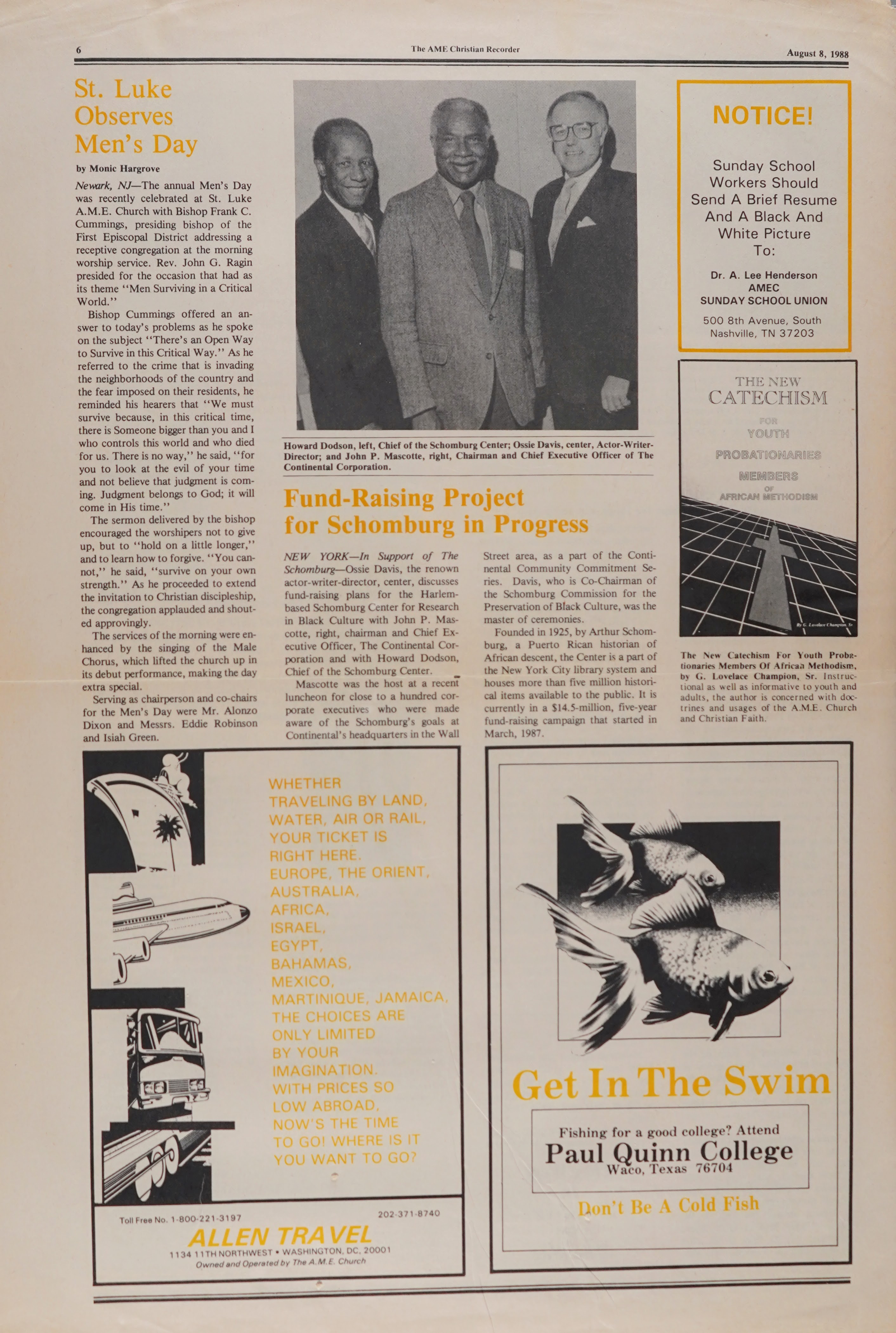
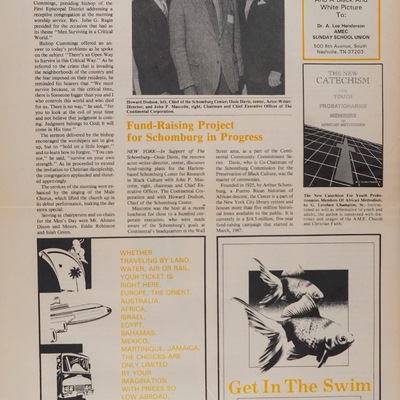
Howard Dodson, left, Chief of the Schomburg Center; Ossie Davis, center, Actor-Writer-
Director; and John P. Mascotte, right, Chairman and Chief Executive Officer of The
Continental Corporation.
Fund-Raising Project
for Schomburg in Progress
NEW YORK—In Support of The
Schomburg—Ossie Davis, the renown
actor-writer-director, center, discusses
fund-raising plans for the Harlem-
based Schomburg Center for Research
in Black Culture with John P. Mas-
cotte, right, chairman and Chief Ex-
ecutive Officer, The Continental Cor-
poration and with Howard Dodson,
Chief of the Schomburg Center.
Mascotte was the host at a recent
luncheon for close to a hundred cor-
porate executives who were made
aware of the Schomburg’s goals at
Continental’s headquarters in the Wall
WHETHER
TRAVELING BY LAND,
WATER, AIR OR RAIL,
YOUR TICKET IS
RIGHT HERE.
EUROPE, THE ORIENT,
AUSTRALIA,
AFRICA,
ISRAEL,
EGYPT,
BAHAMAS,
MEXICO,
MARTINIQUE, JAMAICA,
THE CHOICES ARE
ONLY LIMITED
BY YOUR
IMAGINATION.
WITH PRICES SO
LOW ABROAD,
NOW’S THE TIME
TO GO! WHERE IS IT
YOU WANT TO GO?
ALLEN TRAVEL
1134 11TH NORTHWEST * WASHINGTON, DC, 20001
Owned and Operated by The A M.E. Chure
A
Street area, as a part of the Conti-
nental Community Commitment Se-
ries. Davis, who is Co-Chairman of
the Schomburg Commission for the
Preservation of Black Culture, was the
master of ceremonies.
Founded in 1925, by Arthur Schom-
burg, a Puerto Rican historian of
African descent, the Center is a part of
the New York City library system and
houses more than five million histori-
cal items available to the public. It is
currently in a $14.5-million, five-year
fund-raising campaign that started in
March, 1987.
NOTICE!
Sunday School
Workers Should
Send A Brief Resume
And A Black And
White Picture
lifer:
Dr. A. Lee Henderson
AMEC
SUNDAY SCHOOL UNION
500 8th Avenue, South
Nashville, TN 37203
THE NEW
CATECHISM
iM ME
The New Catechism For Youth Probs-
tionaries Members Of African Methodism,
by G. Lovelace Champion, Sr. Instruc-
tional as well as informative to youth and
adults, the author is concerned with doc-
trines and usages of the A.M.E. Church
and Christian Faith.
Paul
Get In The Swim
| Fishing for a good college? Attend
Quinn College
Waco, Texas 76704
Don’t Be A Cold Fish
===== DSC05581.JPG =====
August 8, 1988
A Century-Plus of
Christian Service
Philadelphia, PA—On a recent Sun-
day, Trinity African Methodist Episco-
pal Church reviewed its history of
more than a century as the church cele-
brated its one hundred ninth anniver-
sary.
Sister Beatrice Smith, a steward at
Trinity, recounted the church’s history
from its inception until the present.
Under the present leader, Rev. E. W.
Saunders, and with God’s help, great
things have been accomplished: new
pews and new carpeting have been add-
ed, flooring installed in the lower audi-
torium and the mortgage burned.
Members thank God for a spirit-filled,
dedicated man who has the wisdom to
guide the church constituency to high-
er heights—a true pastor in every sense
of the word.
Dr. Jeffrey Leath, pastor of Mt.
Zion A.M.E. Church, Norristown,
PA, was speaker for the eleven o’clock
service. He lifted the congregation to
the mountain-top with a powerful ser-
mon on ‘‘The Church: a Place, a Peo-
ple, a Presence,’ His Scriptural text
was from II Samuel 6:15. Surely, the
angels in heaven must have rejoiced
when a soul came forward to accept
Christ.
The day of celebration proved to be
successful both spiritually and finan-
cially, and all praise goes to God for
having brought his congregation of
people to this place of growth and de-
velopment as they look forward to
celebrating their one hundred tenth an-
niversary.
Helen Spivey, Reporter
<
Continued from page 1
Congressman Flake Co-
Sponsors Housing Act
for Homeless and Low
Income Families
“If the housing crisis continues
as it is now, nearly nineteen million
Americans will be faced with the
prospect of homelessness at the
turn of the century,’’ Congressman
Flake said. ‘‘It is clearly the respon-
sibility of every American to help
homeless individuals and low-income
families. Now is the time to initiate a
solution.”’
The Affordable Housing Act is bas-
ed on the premise that those in the
greatest need should be helped first.
“‘Homeless people are human beings
and they have human rights, too,”
Congressman Flake said. The bill pro-
vides assistance first to the homeless
and then to low-income families living
in overcrowded, substandard housing.
It is designed to create a permanent
stock of low-cost housing.
The bill specifies that construction
and rehabilitation grants must be
awarded to those who can demonstrate
the capacity to manage and maintain
assisted projects and who agree to pro-
vide twenty percent of project costs
with non-federal sources.
At least fifty percent of the yearly
$15 billion in grants is earmarked
for newly constructed units, while the
balance is set aside for repair and
maintenance of units created by the
bill. f
Funding for the bill would come
from a three part tax program made up
of an alternative minimum tax which
inhibits taxpayer’s ability to take ad-
vantage of loopholes, a carryover basis
for tax treatment of inherited capital
assets, and an increase in the tax on
cigarettes.
The AME Christian Recorder
The NFIB Survey on Senator Lloyd Bentsen
ATLANTA—Senate Finance Commi-
tee Chairman Lloyd Bentsen of Texas
may be popular with Wall Street, but
his selection as Gov. Michael Duka-
kis’ vice presidential running mate
creates little excitement on Main
Street, according to a weekend survey
released here today by the nation’s
largest small-business advocate, the
National Federation of Independent
Business.
“Senator Bentsen’s name on the
Democratic Party ballot makes no dif-
ference to more than two thirds (sixty-
nine percent) of the small-business
owners surveyed,’’ NFIB President
John Sloan said during a press confe-
rence in Atlanta today. ‘‘Only sixteen
percent indicated they would vote for
the ticket because Bentsen was in-
cluded.””
Researchers also discovered that
among the nine percent who said they
would be less likely to vote Demo-
cratic because Bentsen is on the ballot,
most were from the Midwest region of
the nation.
Tarrance & Associates of Houston,
nationally-known political pollsters,
surveyed eight hundred NFIB mem-
bers to obtain the data. The survey has
a 3.5 percent margin of error.
Who would be the best opponent of
Bentsen on the Republican ticket?
More than half (fifty-two percent)
picked Kansas Senator Bob Dole and
more than two-thirds (sixty-eight per-
Continued from page 3
Bishop Mayo Bringing
“New Hope and Vision’’
to Texas
He emphasized that, as he goes
about his episcopal duties in Texas, he
is not concerned about meeting and
knowing ‘‘church position,’ such as
“seniority of position’’—how long
one has been over this board or group
in local, district or episcopal district
levels, nor how many auxiliaries one
heads, nor how long. He just wants to
meet plain people—humanity—and
find what office incumbents are doing
to enhance the kingdom-building on
earth throughout the A.M.E. Church
in Texas.
Bishop Mayo is possessed of many
personable attributes. He. is a play-
wright and dramatist, and has written a
church worship play, ‘‘God’s Lonely
Man’’ (based on the Book of Job),
which he, himself, directs. Many chur-
ches and agencies have already incor-
porated Bishop Mayo’s Drama of
Worship into their church program
agenda.
Mrs. Theodora Mayo, proficient
wife of Bishop Mayo, unfolded her
aspirations as the bishop’s wife, Mis-
sionary Supervisor and sponsor of the
Texas Ministers’ Wives. Alert and
knowledgeable, Mrs. Mayo wrote in
her notebook many names of the
women who came forward to register
their identity for her use.
Leaving the meeting room, the
crowd departed, seemingly full of en-
thusiasm and eager to fulfill the desires
of Bishop and Mrs. Mayo. Rev. Albert
Dunn, pastor of the Flagship Church
of Texas Northwest, Bethel of Lub-
bock, where the first annual con-
ference will be held, having hit the
ground running, dashed back to Lub-
bock to ‘“‘get his act together’’ for the
exciting first annual conference to be
held under Bishop J. Haskell Mayo.
cent) said Dole’s name on the ballot
would favorably influence their vote.
Among small-business owners,
Senator Bentsen’s image is somewhat
mixed. While most (eighty percent)
know who he is, more than one-third
(thirty-seven percent) are uncertain
about him, one-fourth (twenty-six per-
cent) like him and eighteen percent
have an unfavorable impression, Near-
ly one-fifth (nineteen percent) said
they had never heard of the Texas
Senator.
Nearly half of those surveyed said
they were unsure if Senator Bentsen
shared the same values and ideas of
Gov. Dukakis. More than one-fourth
(twenty-nine percent) said he did not,
while twenty-three percent answered
yes.
‘*There apparently is a great oppor-
tunity here for Senator Bentsen to in-
form small-business owners about
himself and his political beliefs,’’
Sloan said.
NFIB, which has more than five
hundred thousand members in all fifty
states and Puerto Rico, began releas-
ing surveys of small-business owners
at the Atlanta Democratic convention
Friday as a_ kick-off to ‘Small
Business Speaks Out,’’ an effort
designed to communicate the concerns
of small-business owners to the
leaders of both political parties. The
organization will conduct a similar ef-
fort this month in New Orleans when
the Republicans convene.
Che History
of the
Purchase Yours Today
No Home or Library should be without one of these Historical
Treasures—
Published by
The AMEC Sunday School Union
and Publishing House
A. Lee Henderson, Secretary-Treasurer
500 Eighth Avenue South
Nashville, Tennessee 37203-4181
Order Now—Limited Quantity
Price $12.00, plus 13% for postage and handling
ae
Fn IL I I a oe et
— A
The Irony of Afro-American History
An Overview of AME History and Related Developments
THE
BICENTENNIAL
PRIMER
by
Robert Henry Reid, Jr., D.D.
Editor of the A.M.E. Christian Recorder
$7.85
($6.95 plus 90¢ for postage & handling)
ORDER TODAY
Please print. Enclose payment with your order. Allow 3 weeks for delivery.
Send order and check to: A.M.E. Christian Recorder, Dept. BKS
500 Eighth Avenue South, Nashville, Tennessee 37203-4181
_—————————
===== DSC05582.JPG =====
The AME Christian Recorder
August 8, 1988
Tithing in Place of Ticket-Selling Successful
Nashville, TN—Black congregations
seeking better ways to raise money for
local needs and mission outreach will
find help in a new video resource called
“Beyond Mere Words,” according to
a United Methodist stewardship execu-
tive.
The twenty-five minute video de-
scribes how four Black United Meth-
Odist churches successfully use tithing
in place of ‘“‘selling tickets for pro-
jects’’ to meet their budgetary needs,
says Juanita Locker Ivie, a director in
the Section of Stewardship of the
denomination’s General Board of Dis-
cipleship. Produced by United Meth-
odist Communications (UMCom), the
video features short statements by
church members and pastors about
stewardship and the meaning of church
membership,
Songs performed by the New Ad-
vent Choir of Cascade United Meth-
odist Church, Atlanta, Georgia, are
woven throughout to help deliver the
video’s message.
Although those who appear in ‘‘Be-
yond Mere Words’’ are Black United
Methodists, and stewardship principles
presented in the video are applicable to
all churches, regardless of denomina-
tion or racial composition, Ms. Ivie
emphasizes.
‘*Beyond Mere Words’’ is based on
the belief that traditional fundraising
techniques practiced in many Black
congregations drain energy and time
from other acts of Christian disciple-
St. Luke’s Young People’s Choir Celebrates
Twenty-fourth Anniversary
by Monic Hargrove
Newark, NJ—The Young People’s
Choir of St. Luke A.M.E. Church,
where the Rev. John G. Ragin is
pastor, were exceptionally proud of
their efforts this year as they cele-
brated the twenty-fourth anniversary
of the singing aggregation. They raised
money to purchase beautiful lavender
and purple robes, which were officially
presented to Rev. Ragin and the con-
gregation with a sense of accomplish-
ment and pride. The robes were ac-
cepted and blessed for all those mem-
bers who would wear them both today
and tomorrow.
The joyful anniversary celebration
began with a procession of all partici-
pating choirs, to the selection ‘‘Sign
Me Up.”’ In the lead was the Young
People’s Choir, made up of youths
ranging in age from five through sev-
enteen, who marched with excitement
and enthusiasm around St. Luke, The
cheers of proud parents, other family
members and friends were heard
throughout the church.
Other participating choirs included
St. Luke’s Senior Choir, Herring
Gospel Choir and the Inspirational
Choir, each of which sang two selec-
tions.
Presentations of appreciation were
made to Mamie Griner, director; Ken-
neth Rayborn and Steve Moore, musi-
cians; Rev. Ragin, pastor, and Rev.
Harding Dunlop, assistant to the
pastor.
In her closing remarks, Ms. Griner
said, ‘‘These children are my heart,
since I don’t have any of my own, and
if I ever had to stop directing them,
then my heart would probably stop,
too.”’
Once these young people reach the
age of seventeen, they may either join
another choir or continue until they
are graduated from high school.
Update Report from Anti-
Defamation League
New York, NY—A state chairman of
the U.S. Commission on Civil Rights
whose suitability for the office was
challenged by the Anti-Defamation
League for favorably reviewing an
antisemitic and racist book has re-
signed his post, the League has learn-
ed.
The announcement of the departure
of Dr. Ralph Scott, chairman of the
Iowa State Advisory Committee to the
Civil Rights Commission, came ina
letter (dated July 5) to Jeffery RP
Sinensky, director of ADL’s Civil
Rights Division, from Murray Fried-
man, acting chairman of the Commis-
sion.
Mr. Sinensky had told the Commis-
sion in early May that Dr. Scott was
unsuited for the post because of his
“insensitivity’’? to racial and religious
minorities. In his review of the ‘‘Dis-
possessed Majority,’’ a 584-page book
written under the pseudonym of
Wilmot Robertson, Dr. Scott called
the volume ‘‘valuable’”? because it
throws a ‘bright, clear light on facts
which our politicians have kicked into
dark corners. For those ‘Majority’
Americans who seek to understand
their cultural heritage, this book is a
family must.”’
“‘The Dispossessed Majority’’ char-
ges that the United States has degene-
rated over time because its Northern
European majority has been displaced
by such ‘‘inferior’’ peoples as Blacks,
Hispanics, Jews and persons of Medi-
terranean origin.
e book vilifies Jews as having
such traits as ‘‘intrusiveness, disputa-
tiousness and haggling’? and alleges
that they are disproportionately repre-
sented in the ‘‘inner circles’’ of the
American government. In discussing
the Jewish ‘‘problem,”’ the book de-
clares that ‘‘separation is obviously
part of the solution.”’
The book also asserts that the
Northern European race ‘‘has man-
aged to soar a little higher above the
animal kingdom than the other divi-
sions of mankind.’’ The author also
claims that ‘‘the more Negroes are
helped...the more they progress, the
more America as a nation seems to re-
trogress.”’
In his letter to the League, Mr.
Friedman thanked ADL for its dis-
closures about Dr. Scott and said he
concurred with the agency’s assess-
ment that Scott’s ‘‘enthusiastic re-
view of a bigoted book is inconsistent
with the attitudes and role of a civil
rights official.”’
Expressing his gratification that Dr.
Scott has resigned, Mr. Sinensky said
the continued presence in an important
civil rights post of a person who de-
fends racist views is an ‘‘affront to
those working to advance the cause of
civil rights in this country.”
Mr. Sinensky pointed out that the
‘author’ of ‘‘The Dispossessed Ma-
jority,’’ Wilmot Robertson, is the pen-
name of ‘‘a Southern-based propagan-
dist who also published Jnstauration,
an equally racist and anti-Semitic
magazine.’”
ship.
These fundraising activities draw
heavily on the history and tradition of
the Black church, Ms. Ivie notes,
‘“‘When there were no restaurants to
which Blacks could go for a ‘night
out,’ there was the Black church!
When downtown social clubs or hotels
did not permit access to places for
assembly other than for worship, there
was the Black church! When Black
musicians had no other arena to
showcase their talents, there was the
Black church!’’
Although ‘‘selling tickets for pro-
jects’’ helped churches raise money for
local needs and mission and became
Getting the Most
from
Nonprescription
Drugs
Most medicine cabinets look like
miniature drugstores .. . chock-full
of nonprescription painkillers, cough
syrups, cold medicines, antacids and
laxatives. But wait a minute! Before
you reach for a bottle in your col-
lection—or add another to it—there
are some things you should know.
‘* Although these drugs don’t require
a prescription, you should still use
them with care. Know what you’re
taking!’’ recommended Carol Wicks,
pharmacist with Walgreens, the na-
tionwide drugstore chain.
Before taking a nonprescription
medicine:
© Consider you symptoms. It’s best
to take medicine only for what ails
you—if you have a cold but not a
cough, avoid products, that treat both.
“If you’re not sure which medication
to choose, ask your pharmacist. He or
she can help tailor products to your
needs,’’ Wicks said. ;
e Read the label to check ingre-
dients, directions and warnings. ““You
want to avoid taking two products
with the same ingredients,’’? Wicks
said. ‘‘And if you’re being treated for
diabetes, high blood pressure, asthma
or some other health condition, you
should avoid certain nonprescription
drugs.”
eCheck the expiration date if the bot-
tle has been in your medicine chest for
some time. Older ingredients can lose
some of their effectiveness.
Nonprescription drugs can give you
a trip to your physician—but a visit is
necessary whenever your condition is
severe. ‘‘You should also see a doctor
if you’re not getting better after taking
a nonprescription drug for four or five
days,’ Wicks recommended.
“Instead of using a laxative, try
prune juice, yogurt and bulk-produc-
ing foods such as bran, broccoli and
spinach!’”
HEALTH CARE NEWS is a compli-
mentary service of the Deerfield, IL-
based Walgreen Co., one of the na-
tion’s leading drugstore chains. For
further information, contact
Maryellen T. Kari, (312) 940-2925.
a
“(4 Person’s Wealth Can
Be Measured By The
Love Of Their Children.”
almost a means of survival, many
Black churches today acknowledge
that there is a better way, according to
Ms. Ivie. The four Black congre-
gations featured in ‘‘Beyond Mere
Words”’ discovered that tithing not on-
ly provides the financial resources
needed but ‘‘increases the spirit of the
church as it involves individuals in its
life and work. As more people become
involved—physically and spiritually—
money is more easily secured,’’ Ms.
Ivie notes in narration of the video,
The video’s title and theme are
taken from St. Paul’s letter to the
church at Corinth, Pointing to the ex-
ample of the churches of Macedonia
who gave beyond their means and of
their own free will, Paul writes to the
Corinthians: ‘‘I am not giving you an
order. I am not saying you must do it.
But others are eager for it. This is one
way to prove that your love is real,
that it goes beyond mere words’’ (2
Corinthians 8:8, The Living Bible).
The four congregations featured in
“Beyond Mere Words’’ are Bethel
United Methodist Church, Flint,
Michigan, the Rev. Russell McRey-
nolds, pastor; Cascade United Meth-
odist Church, Atlanta, Georgia, the
Rev. Joseph E. Lowery, pastor;
pickett Rucker Memorial United
Methodist Church, Lebanon, Tennes-
see, the Rev. Lillian Wynn, pastor;
and University United Methodist
Church, Indianapolis, Indiana, the
Rev. Harry A. Coleman, pastor.
‘“‘Beyond Mere Words’’ was pro-
duced and directed by UMCom staff
member Robert Woods. Ms. Ivie serv-
ed as executive producer.
United Methodist Communications
is the agency of the church responsible
for providing leadership in the field of
communication. Its activities include
the production and distribution of
audiovisuals, interpretation and pro-
motion of general funds, news dissemi-
nation, and a television and telecom-
muications ministry.
The video and leaders guide may be
ordered from Discipleship Resources,
P.O. Box 189, 1908 Grand Avenue,
Nashville, TN 37202.
Shari
Gath ae
others.
African Methodist
Episcopal Church
===== DSC05583.JPG =====
August 8, 1988
The AME Christian Recorder
(The A.M.E. Church and the Negro Problem of the Nineteenth Century)
The Formulation of Faith in African Methodism
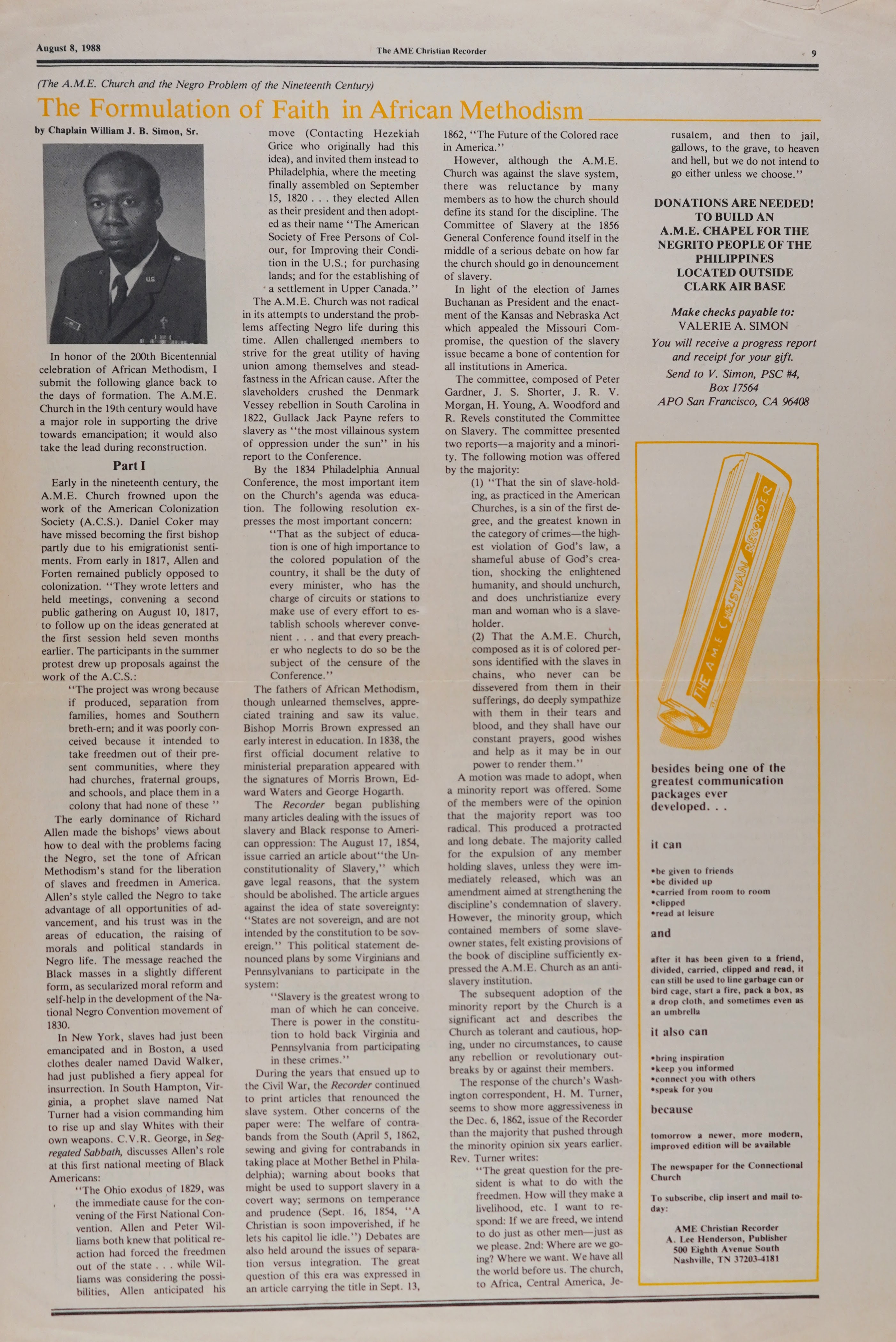
by Chaplain William J. B. Simon, Sr.
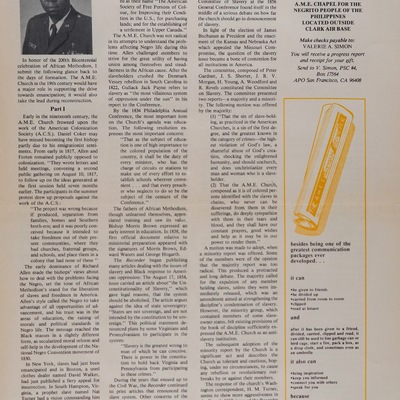
In honor of the 200th Bicentennial
celebration of African Methodism, I
submit the following glance back to
the days of formation. The A.M.E.
Church in the 19th century would have
a major role in supporting the drive
towards emancipation; it would also
take the lead during reconstruction.
Part I
Early in the nineteenth century, the
A.M.E. Church frowned upon the
work of the American Colonization
Society (A.C.S.). Daniel Coker may
have missed becoming the first bishop
partly due to his emigrationist senti-
ments. From early in 1817, Allen and
Forten remained publicly opposed to
colonization. ‘‘They wrote letters and
held meetings, convening a second
public gathering on August 10, 1817,
to follow up on the ideas generated at
the first session held seven months
earlier. The participants in the summer
protest drew up proposals against the
work of the A.C.S.:
“‘The project was wrong because
if produced, separation from
families, homes and Southern
breth-ern; and it was poorly con-
ceived because it intended to
take freedmen out of their pre-
sent communities, where they
had churches, fraternal groups,
and schools, and place them in a
colony that had none of these ”’
The early dominance of Richard
Allen made the bishops’ views about
how to deal with the problems facing
the Negro, set the tone of African
Methodism’s stand for the liberation
of slaves and freedmen in America.
Allen’s style called the Negro to take
advantage of all opportunities of ad-
vancement, and his trust was in the
areas of education, the raising of
morals and political standards in
Negro life. The message reached the
Black masses in a slightly different
form, as secularized moral reform and
self-help in the development of the Na-
tional Negro Convention movement of
1830.
In New York, slaves had just been
emancipated and in Boston, a used
clothes dealer named David Walker,
had just published a fiery appeal for
insurrection. In South Hampton, Vir-
ginia, a prophet slave named Nat
Turner had a vision commanding him
to rise up and slay Whites with their
own weapons. C.V.R. George, in Seg-
regated Sabbath, discusses Allen’s role
at this first national meeting of Black
Americans:
“The Ohio exodus of 1829, was
the immediate cause for the con-
vening of the First National Con-
vention, Allen and Peter Wil-
liams both knew that political re-
action had forced the freedmen
out of the state... while Wil-
liams was considering the possi-
bilities, Allen anticipated his
move (Contacting Hezekiah
Grice who originally had this
idea), and invited them instead to
Philadelphia, where the meeting
finally assembled on September
15, 1820... they elected Allen
as their president and then adopt-
ed as their name ‘‘The American
Society of Free Persons of Col-
our, for Improving their Condi-
tion in the U.S.; for purchasing
lands; and for the establishing of
“a settlement in Upper Canada.’’
The A.M.E. Church was not radical
in its attempts to understand the prob-
lems affecting Negro life during this
time. Allen challenged members to
strive for the great utility of having
union among themselves and stead-
fastness in the African cause. After the
slaveholders crushed the Denmark
Vessey rebellion in South Carolina in
1822, Gullack Jack Payne refers to
slavery as ‘‘the most villainous system
of oppression under the sun’’ in his
report to the Conference.
By the 1834 Philadelphia Annual
Conference, the most important item
on the Church’s agenda was educa-
tion. The following resolution ex-
presses the most important concern:
“‘That as the subject of educa-
tion is one of high importance to
the colored population of the
country, it shall be the duty of
every minister, who has the
charge of circuits or stations to
make use of every effort to es-
tablish schools wherever conve-
nient . . . and that every preach-
er who neglects to do so be the
subject of the censure of the
Conference.”’
The fathers of African Methodism,
though unlearned themselves, appre-
ciated training and saw its value.
Bishop Morris Brown expressed an
early interest in education. In 1838, the
first official document relative to
ministerial preparation appeared with
the signatures of Morris Brown, Ed-
ward Waters and George Hogarth.
The Recorder began publishing
many articles dealing with the issues of
slavery and Black response to Ameri-
can oppression: The August 17, 1854,
issue carried an article about‘‘the Un-
constitutionality of Slavery,’’ which
gave legal reasons, that the system
should be abolished. The article argues
against the idea of state sovereignty:
“States are not sovereign, and are not
intended by the constitution to be sov-
ereign.’’ This political statement de-
nounced plans by some Virginians and
Pennsylvanians to participate in the
system:
‘Slavery is the greatest wrong to
man of which he can conceive.
There is power in the constitu-
tion to hold back Virginia and
Pennsylvania from participating
in these crimes.”’
During the years that ensued up to
the Civil War, the Recorder continued
to print articles that renounced the
slave system. Other concerns of the
paper were: The welfare of contra-
bands from the South (April 5, 1862,
sewing and giving for contrabands in
taking place at Mother Bethel in Phila-
delphia); warning about books that
might be used to support slavery in a
covert way; sermons on temperance
and prudence (Sept. 16, 1854, cet
Christian is soon impoverished, if he
lets his capitol lie idle.’’) Debates are
also held around the issues of separa-
tion versus integration, The great
question of this era was expressed in
an article carrying the title in Sept. 13,
1862, ‘‘The Future of the Colored race
in America.’’
However, although the A.M.E.
Church was against the slave system,
there was reluctance by many
members as to how the church should
define its stand for the discipline. The
Committee of Slavery at the 1856
General Conference found itself in the
middle of a serious debate on how far
the church should go in denouncement
of slavery.
In light of the election of James
Buchanan as President and the enact-
ment of the Kansas and Nebraska Act
which appealed the Missouri Com-
promise, the question of the slavery
issue became a bone of contention for
all institutions in America.
The committee, composed of Peter
Gardner, J. .S. Shorter, J. R. V.
Morgan, H. Young, A. Woodford and
R. Revels constituted the Committee
on Slavery. The committee presented
two reports—a majority and a minori-
ty. The following motion was offered
by the majority:
(1) ‘‘That the sin of slave-hold-
ing, as practiced in the American
Churches, is a sin of the first de-
gree, and the greatest known in
the category of crimes—the high-
est violation of God’s law, a
shameful abuse of God’s crea-
tion, shocking the enlightened
humanity, and should unchurch,
and does unchristianize every
man and woman who is a slave-
holder.
(2) That the A.M.E. Church,
composed as it is of colored per-
sons identified with the slaves in
chains, who never can be
dissevered from them in their
sufferings, do deeply sympathize
with them in their tears and
blood, and they shall have our
constant prayers, good wishes
and help as it may be in our
power to render them.”’
A motion was made to adopt, when
a minority report was offered. Some
of the members were of the opinion
that the majority report was too
radical. This produced a protracted
and long debate. The majority called
for the expulsion of any member
holding slaves, unless they were im-
mediately released, which was an
amendment aimed at strengthening the
discipline’s condemnation of slavery.
However, the minority group, which
contained members of some slave-
owner states, felt existing provisions of
the book of discipline sufficiently ex-
pressed the A.M.E. Church as an anti-
slavery institution,
The subsequent adoption of the
minority report by the Church is a
significant act and describes the
Church as tolerant and cautious, hop-
ing, under no circumstances, to cause
any rebellion or revolutionary out-
breaks by or against their members.
The response of the church's Wash-
ington correspondent, H. M. Turner,
seems to show more aggressiveness in
the Dec. 6, 1862, issue of the Recorder
than the majority that pushed through
the minority opinion six years earlier.
Rev. Turner writes:
‘The great question for the pre-
sident is what to do with the
freedmen. How will they make a
livelihood, etc. I want to re-
spond: If we are freed, we intend
to do just as other men—just as
we please. 2nd: Where are we go-
ing? Where we want. We have all
the world before us. The church,
to Africa, Central America, Je-
rusalem, and then to jail,
gallows, to the grave, to heaven
and hell, but we do not intend to
go either unless we choose.”’
DONATIONS ARE NEEDED!
TO BUILD AN
A.M.E. CHAPEL FOR THE
NEGRITO PEOPLE OF THE
PHILIPPINES
LOCATED OUTSIDE
CLARK AIR BASE
Make checks payable to:
VALERIE A. SIMON
You will receive a progress report
and receipt for your gift.
Send to V. Simon, PSC #4,
Box 17564
APO San Francisco, CA 96408
besides being one of the
greatest communication
packages ever
developed. . .
it can
*be given to friends
*be divided up
ecarried from room to room
*clipped
eread at leisure
and
after it has been given to a friend,
divided, carried, clipped and read, it
can still be used to line garbage can or
bird cage, start a fire, pack a box, as
a drop cloth, and sometimes even as
an umbrella
it also can
*bring inspiration
*keep you informed
*connect you with others
espeak for you
because
tomorrow a newer, more modern,
improved edition will be available
The newspaper for the Connectional
Church
To subscribe, clip insert and mail to-
day:
AME Christian Recorder
A. Lee Henderson, Publisher
500 Eighth Avenue South
Nashville, TN 37203-4181
===== DSC05584.JPG =====
10
The AME Christian Recorder
National Institute On Aging
Getting Your Affairs in Order
One thing each of us, young and old,
can do to plan for the future is to get
our financial and personal records in
order, These records can be useful for
budgeting income, for making invest-
ments, or for retirement and estate
planning.
Relatives and friends sometimes
must help older people manage their
legal or financial affairs temporarily or
even gradually assume these responsi-
bilities. Often the person who provides
care has little knowledge of vital infor-
mation and records. If papers are in
order, the task is much simpler.
Although each situation is different,
the following suggestions can help
most people begin creating a financial
and a personal record.
Personal Records
A personal records file should in-
clude the following information:
¢ Full legal name
Social Security number
Legal residence
Date and place of Birth
Names and addresses of spouse and
children (or location of death certi-
ficates if any are deceased)
¢ Location of will or trust
e Location of birth certificate and cer-
tificates of marriage, divorce, and
citizenship
List of employers and dates of em-
ployment
¢ Education and military records
e Religious affiliation, name of
church or synagogue, and names of
clergy (if desired)
Memberships in organizations and
awards received
e Names and addresses of close
friends, relatives, doctors, and law-
yers of financial advisors
e Requests, preferences, or prear-
rangements for burial.
A family member or friend should
know the location of this personal
records file and the location of all im-
portant papers and documents, al-
though it is not necessary to reveal the
contents of wills or trusts.
Financial Records
In making a financial records file,
list information about insurance poli-
cies, bank accounts, deeds, invest-
ments, and other valuables, using this
outline:
© sources of income and assets (pen-
sion funds, interest income, etc.)
e Social Security and Medicare infor-
mation
e Investment income (stocks, bonds,
property)
Insurance information (life, health,
and property), with policy num-
bers
e Bank accounts (checking, savings,
and credit union)
© Location of safe deposit boxes
© Copy of most recent income tax re-
turn
e Liabilities—what is owed to whom
and when payments are due
© Mortgages and debts—how and
when paid
Credit card and charge account
names and numbers
Property taxes
Location of personal items such as
jewelry or family treasures.
Having this information available
can help you plan for any change in
your later years—retirement, a move,
a death in your family—and can help
you make wise decisions.
An important consideration in fi-
nancial planning is the cost of medical
services and long-term care, although
there is often no easy or simple way to
determine or meet these future needs,
It is especially important to know what
Medicare does and does not cover, At
the present time, Medicare does not
cover most nursing home or home care
for older people. Medicaid is a pro-
gram for people with limited income
and pays for some community ser-
vices. Although new laws may change
Medicare and Medicaid coverage, you
may wish to explore the long-term care
insurance options which are beginning
to develop. State laws vary; therefore,
it is important to check with your area
office on aging, a lawyer, or financial
planner for information related to
estates, inheritance taxes, insurance,
Medicaid, or Medicare.
Caring for an older person or pre-
paring for our own aging can be more
successfully managed by making deci-
sions and arrangements before a crisis
develops. Three legal documents
(power of attorney, durable power of
attorney, and living will) can be helpful
in assuming responsibility for another
person’s affairs. A standard power of
attorney or durable power of attorney
can be established to authorize one
person to handle personal or financial
matters for another. Because the stan-
dard power of attorney loses its effec-
tiveness if the principal becomes legal-
ly incompetent, a durable power of at-
torney is usually recommended. A
durable power of attorney will con-
tinue in force if a person becomes in-
capacitated. A living will provides writ-
ten instructions concerning health care
in the event of terminal illness. Living
wills are recognized in most, but not
all, states. The living will makes it
easier for you to know how to make
difficult health care decisions on a
relative’s behalf and can help avoid
family conflict.
Resources
It is advisable to consult a lawyer
before setting up power of attorney,
durable power of attorney, joint ac-
counts, trusts, or guardianships. Be
sure to ask for the cost of a legal con-
sultation before you visit a lawyer.
Most libraries have legal directories or
you can contact the American Bar As-
sociation, Lawyer Referral and Infor-
mation Service, 750 North Lake Shore
Drive, Chicago, IL 60611 (312/988-
5760) and ask for help in locating a
lawyer.
Free legal and financial services are
often available to help older people
and their familites. For assistance, you
can call or write the following organi-
zation to be referrred to your local,
area, or state Agency on Aging:
Nat. Assoc. of Area Agencies on Aging
600 Maryland Avenue SW., Suite 208
Washington, DC 20024
(202)484-7520
August 8, 1988
Highlights of the West Florida
Conference A.M.E. Church
by Christine White
Allen Chapel A.M.B. Church,
Panama City, Florida, was the scene
of the Annual Panama City District
Sunday School and A.C.E, Fellowship
Institute during the week of June
15-17, 1988.
The honorable, dynamic leader of
the conference, Presiding Elder J. L.
Nealy, called the official institute to
order, From then on the business of
saving souls, promoting stewardship
and financing the program was in full
bloom.
The theme for the event was ‘‘A
Close Encounter with AMEism—-
Jesus is the Answer.’’ During the con-
vention all participants definitely had a
closer encounter with AMEism and
with our Lord and Savior Jesus Christ.
Presiding for the opening session
was the Reverend Charles Clark, with
first sermon given by Sister Omega
Collier. What a soul-stirring and
beautiful testimony we enjoyed! Her
subject was ‘‘Walking By Faith With
The Lord,’’ with scriptures Romans
10:17 and Corinthians 5:7. Sister Col-
lier said the message of her life has
been a test of her own life. She said
further that if we will walk in faith,
with God, and not in our own ways,
then our lives will have better meaning.
She further stated that the reason we
are what we are is because of our faith
in God.
On Thursday afternoon the Rever-
end Hayward Sheard presided, while
we were blessed with a sermon by the
Reverend F. C. Griffin. Rev. Griffin’s
sermon was entitled ‘‘It Makes A Dif-
ference If We Walk With God.’’ He
compiled his text on the basis of John
8:12. Rev. Griffin said every true born-
again Christian should walk with God.
Our lives will reflect whether we walk
with God or not, he said.
Later in the day the workshop work
began. ‘‘Before It’s Too Late,’’ was
developed through an open forum
which involved the mock Philip
Donahue show. Youth and ministers
formed a panel in which the audience
participated in discussions involving
problems of today’s teens, i.e., drugs,
pre-marital sex, dirty dancing, etc.
The seven o’clock service had as its
presiders Reverend William Collier
and Ms. Tracy Fields. The sermon was
furnished by the Reverend W. C. Carr
who used as his theme: ‘“‘Check Out
Your Mind.’’ Luke 1:35 was the scrip-
tural text for this forceful sermon.
Rev. Carr opened the minds of both
the young and old, and said that it
takes a well made up mind to serve the
Lord. He said, ‘‘It takes a good,
strong, determined mind not to fall in-
to the crowd of destruction.’’ He
pleaded with the youth of today to
check out their minds and make sound
judgment and decisions,
The final day was in no way less
spiritual and rewarding than the other
days. Reverend J. Barkley presided
and Reverend William K. Brown
preached the sermon. His subject was:
‘Are You Going To Heed Or Not.’’
Rev. Brown used the scripture; Matt.
26:31-43, 69-75. His main thoughts—
were that we are always given advice,
from parents, from loved ones, from
teachers, etc., but will be heed (listen)
or not. He said we must pray to resist
temptations because the direction we
take is our choice. Rev. Brown is a
young minister himself.
Throughout the convention Mrs.
Sharon Sheffield, who is Director of
the Young People’s Department and
Superintendent of Sunday Schools,
complimented the young folk present,
that she was indeed proud of them and
admired them for their attendance and
behavior. Also, Presiding Elder Nealy
complimented the youth delegates for
being the best. The Presiding Elder
thanked Mrs. Sheffield and Mrs.
Ramona Conley, (President of A.C.E.
Fellowship) for maintaining such pro-
gressive Sunday School Departments
and A.C.E. Fellowship groups re-
spectively.
Youth served in various aspects of
the convention such as pianists, mar-
shalls, choir members, secretaries, and
so on.
To end the convention the youth,
under the directorship of Ms. Denise
Williams, rendered a most beautiful
program. Youth of the area prayed,
sang, played selections of pianos,
presented poems (composed and writ-
ten by themselves in memory of
someone), etc. The program was one
of the best ever. The entire audience
was blessed by the program and the en-
tire Sunday School, and A.C.E.
Fellowship Institute will be one to be
remembered in the years ahead.
Some guests included Rev. and Mrs.
C. E. Nichols of the Pensacola
District; Rev. J. Allen of the Marianna
District; Mrs. Price; Rev. T. Andrews;
Rev. David Rhone, Jr.; Rev. and Mrs.
Calvin Griffin, and many others.
Reverend Charles Clark, Host
Pastor, with the help of his loyal and
dedicated members of Allen Chapel
A.M.E. Church, proved to be the
most gracious and generous hosts.
In West Florida, we are winners!
re nnn nnnn ne SELES EEyEEIEnEISIESEEEREEEENSSSIIIESIEY
Gone From Labor To Eternal Rest
Few people have such enormous im-
pact on the lives of their fellowman as
did H. N. Crawford. His sixty-two
earthly years spanned generations of
Christian growth and nutriment. In
many instances he married his mem-
ber’s children, baptized their grand-
children, stood by their sick beds, and
supported them from court room gal-
leries. During his pastorate he was ap-
pointed in every Conference in the
Ninth Episcopal District. He taught at
Daniel Payne College for many years
and gave generously of his time and
service for the betterment of African
Methodism. Henry Nixon Crawford
was a Giant! A Preacher, a Teacher, a
Counselor, A Leader and an unselfish
Man of God No task too small—No
challenge too great! H. N. Crawford
leaves with us a legacy of hope that
moves us to press on toward the mark
for the prize of the high calling of God
in Christ Jesus.
He was educated in the public
school system of the State of Ala-
bama, received his B.S. from Daniel
Payne College, and his Masters Degree
from the Alabama State University in
Birmingham. His fraternal affiliations
include the Masonic Lodge and the
Golden Rule Society.
His loving wife Mary Mays Craw-
ford; brothers Ed and Willie Gene;
sister Mary Forest; daughters Theresa
and Mary; and sons Robert Earl,
James Anthony, Sherman, and Henry,
Jr., will forever cherish his loving
“If You Would
Avoid Criticism
Say Nothing,
Do Nothing And
Be Nothing”
Le TTT
===== DSC05585.JPG =====
August 8, 1988 The AME Christian Recorder
11
Putting your ANNUAL CONFERENCE SCHEDULE
belie S to FIFTH EPISCOPAL DISTRICT
TENTH EPISCOPAL DISTRICT ELEVENTH EPISCOPAL DISTRICT
A. M. E. CHURCH A.M.E. CHURCH A.M.E. CHURCH
the test. ANNUAL CONFERENCE ANNUAL CONFERENCE ANNUAL CONFERENCE
BISHOP VINTON R. ANDERSON BISHOP J. HASKELL MAYO BISHOP P. R. COUSIN
PUGET SOUND NORTHWEST TEXAS
ANNUAL CONFERENCE ANNUAL CONFERENCE August 1-4th
August 9-14, 1988 August 9-12, 1988 11TH DISTRICT
Bethel A.M.E. Church Bethel A.M.E. Church Christian Education Congress
5828 N. E. 8th Avenue 2200 Southeast Drive Hyatt Hotel, Orlando, Florida
Portland, Oregon 97211 Lubbock, Texas 79404
The Rev. Milton Green, Pastor The Rev. D. A. Smith, Host Pastor FLORIDA CONFERENCE
Church Phone:(503) 288-5429 806/744-7552 August 17-21, 1988
Pastor’s Phone: (503) 282-0067 Rev. I. C. Cooper, Host P. E. Mt. Pisgah A.M.E. Church
The Rev. Jewel B. Dewitty, Host P.E. Lake City, Florida
NORTHEAST TEXAS The Rev. Charles Graham Pastor
CALIFORNIA ANNUAL CONFERENCE Church Phone: (904) 752-1930
ANNUAL CONFERENCE August 16-19, 1988 Pastor’s Phone: (904) 755-6674
August 15-21, 1988 Quinn Chapel A.M.E. Church
St. Paul A.M.E. Church 710 West Elm Street WEST FLORIDA CONFERENCE
2024 Ashby Avenue Denison, Texas 75020 August 25-28, 1988
Berkeley, California 94703 The Rev. C. O. Epps, Host Pastor Greater Bethel A.M.E. Church
The Rev. Felix Dancy, Pastor 1-214/463-5084 Panama City, Florida
Church Phone: (415) 848-2050 The Rey. A. L. Brown, Host P.E. The Rey. F. C. Griffin, Pastor
Pastor’s Phone: (415) 632-3156 The Rev. L. E. Reid, Associate P.E. Church Phone: (904) 763-3536
The Rev. R. A. Washington, Host P.E. The Rey. G. B. Bailey, Sr., Associate P.E.
CENTRAL FLORIDA CONFERENCE
SOUTHERN CALIFORNIA WEST TEXAS September 8-11, 1988
ANNUAL CONFERENCE ANNUAL CONFERENCE New Bethel A.M.E. Church
August 22-28, 1988 August 30-September 2, 1988 4202 Columbia Street
Ward A.M.E. Church Tyree Chapel A.M.E. Church Orlando, Florida 32811
1177 W. 25th Street 2519 Avenue B The Rey. R. D. Daniels, Pastor
It Is Not : Los Angeles, California 90007 Bay City, Texas saad Church Phone: (305) 299-3792
. The Rev. Frank M. Reid, III, Pastor The Rev. Roy Brown, Host Pastor Pastor’s Phone: 787-1720
Enough To Aim, Church Phone: (213) 747-1367 409/245-2800 ~
You Must Hit! Pastor’s Phone: (213) 732-5284 The Rev. F. D. McDonald, Host P.E. ORLANDO FLORIDA CONFERENCE
The Rev. J. Austell Hall, Host P.E. The Rey. Bennie Wilson, Associate P.E. September 15-18, 1988
The Rev. E. P. Williams, Co-Host P.E. New Bethel A.M.E. Church
The Rev. A. A. Morgan, Co-Host P.E. SOUTHWEST TEXAS
2122 Martin Luther King Drive
ANNUAL CONFERENCE Lakeland, Florida 33801
* a7
ECONOMIC DEVELOPMENT Conference
FUND MEETING
October 10, 1988
William James
COLORADO September 6-9, 1988 The Rev. Jimmy Thompson, Pastor
ANNUAL CONFERENCE St. Joseph A.M.E. Church Church Phone: (813) 687-1994
September 6-11,1988 506 Montana Street Pastor’s Phone: (813) 687-1671
Campbell A.M.E, Church San Antonio, Texas 78203
1500 E. 22nd Avenue The Rev. H. H. Jones, Host Pastor SOUTH FLORIDA CONFERENCE
W Denver, Colorado 80205 512/223-1574 October 5-9, 1988
NO The Rev. Ezekiel Habersham, Pastor The Rev. O. W. Hodges, Host P.E. Bethel A.M.E. Church
SOUVENIR Church Phone: (303) 839-5058 The Rev. Lloyd Chenault, Associate P.E. 405 N. W. 3rd Avenue
Pastor’s Phone: (303) 751-0653 Pompano Beach, Florida 33060
BOOKLET The Rev. M. L. Shakespeare, Host P.E. TEXAS The Rev. F. R. Satchel, Pastor
of the The Rev. L. K. Williams, Co-Host P.E. ANNUAL Sieh Church Phone: (305) 943-6220
September 20-23,
GENKERATL CONFERENCE KANSAS/NEBRASKA St, Paul A.M.E. Church TAMPA FLORIDA CONFERENCE
of the ANNUAL CONFERENCE —— ager Street October 4 = k
September 12-18, 1988 eaumont, Texas 77705 Mt. Zion A.M.E. Churc:
AFRICAN METHODIST St. John A.M.E. Church The Rev. W. O. Johnson, Host Pastor 919 20th Street South
EPISCOPAL CHURCH 2402 North 22nd Street 409/842-1080 St. Petersburg, Florida 33712
BY POPU i AR Omaha, Nebraska 68110 The Rev. X. L. Williams, Host PS. The Rev. Sam Green, Pastor
The Rev. Dorsey McCullough, Pastor The Rev. Leland Jenkins, Associate P.E. Church Phone: (813) 894-1393
DEMAND Church Phone: (402) 345-1070 The Rev. O. L. Dawson, Associate PE. Pastor's Phone: (813) 894-3835
Theme Pastor’s Phone: (402) 451-3733 carat varus a.
; The Rev. T. R. Evans, Host P.E. “EN mid iss EAST FLORIDA v
Retooling with Christ for The Rev. A. T. Taylor, Co-Host PE. ANNUAL CONFERENCE October 26-30, 1988
Third Century September 27-30, 1988 St. Stephens A.M.E. Church
July 6-14, 1988 NORTHWEST MISSOURI St. Luke A.M.E. Church 913 W. Sth Street
y ‘ 1 ANNUAL CONFERENCE 117 Church Street Jacksonville, Florida 32209
Tarrant County Convention September 19-25, 1988 Waco, Texas 76704 The Rev. R. V, Webster, Pastor
Center Bethel A.M.E. Church The Rev. L. H. McCloney, Host Pastor Church Phone: (904) 354-5201
Fort Worth, Texas 2329 Flora Avenue 81 nese wns Pastor's Phone: (904) 764-3771
Kansas City, Missouri 64141 The Rev. C. C. Joi nson, Hast PE.
ONLY abe "Church Phone: (816) 313555 a BAHAMA ISLANDS CONFERENCE
Church Phone: (816) 231-3555 — November 11-13, 1988
Pastor’s Phone: (816) 474-6722 NORTH TEXAS Salt Robinson-Morris Chapel
Ord Toda First The Rev, E. Lewis Branch, Host P.E. ANNUAL CONFERENCE Nassau, Bahamas
Seige or. i The Rey, P. A. Williams, Co-Host P.E. October 11-14, 1988 The Rev. Howard Williamson, Pastor
Come. . . First Served! Wesley Chapel A.M.E. Church 1-809-323-7637
a Oe a ae ee ye ee ee MISSOURI 711 N. W. 29th Street
! ek om ANNUAL CONFERENCE Fort Worth, Texas 76106 PLANNING CONFERENCE
| A.M.E.C, Sunday School Union | October 3-9, 1988 The Rey. W. B. Langham, Hast Pastor November 18-19, 1988
' 500 Eighth Avenue South 1 St. John A.M.E. Church 817/626-1985 ‘ JACKSONVILLE HOTEL
| Nashville, Tennessee 37203-4181 | 1908 North Kingshighway Blvd. The Rev. John D, Walker, Host PE $65 South Main Street
' 615) 256-5882 1 st. Louis, Missouri 63113 The Rev. H. F, Dodson, Associate P.E. Jacksonville, Florida
1 (615) St. Louis, : :
1 The Rev. Lee Norris May, Pastor The Rev. F. D. Thomas, Associate PE. (904) 398-8800
| Quantity H Church Phone: (314) 361-8236 <p Yee
! 43rd Souvenir Booklet(s) Pastor’s Phone: (314) 361-6487 PLANNING MEETING
! : The Rev. Grady Brown, Host PE. October 20-21, 1988 R
! The Rev. O. H. Brown, Co-Host P.E. Budget Report—February 16-17, 188 <><
! | May Day Report—May 10-11, 1989
Name | May Day ort—Ma} ; ‘“s
: | FIFTH DISTRICT EVALUATION/ Convocation '88—July 27-29, 1989 People Can
H \ PLANNING MEETING : :
| | October 10, 1988 Ee. 10:00 a.m, Att d Alter Their Lives
iin | Wayman A.M.E. Church en ° °
| Rey. Lonnie Cc. Wormley, Sr., Pastor A i ‘ By Altering Their
Church Phone: (314) 361-4123 nnua ’ « 99
Address Pastor’s Phone: (314) 991-0966 A ttitudes.
: i
! 1
: \
; |
! J
-
===== DSC05586.JPG =====
12
The AME Christian Recorder
August 8, 1988
National Federation Independent Workers Win on Plant Closing
Business Survey
NFIB POLLS PRESIDEN
TIAL CANDIDATES
How will the presidential election affect your bottom line? See where
George Bush and Michael Dukakis stand on issues critical to you.
Will the next president of the United States push for mandated benefits, sup-
port a health insurance deduction for the self-employed or raise taxes to balance the
budget? Take a look at NFIB’s chart showing where George Bush and Michael
Dukasis stand on the issues that affect your bottom line.
COMPARE THE CANDIDATES
Budget and Taxes
1. How would you balance the
federal budget?
BUSH
crease.
2. If you would cut spending,
where would you cut it? creases
3. If you would increase reve- N/A
nues, how would you raise
them?
4. Do you support a value-
added or business transfer
tax?
5. Will you seek a line-item
veto?
6. Do you support a con-
stitutional amendment
to require a
balanced budget?
7. Do you support restoring a
capital-gains differential?
Yes
8. Should self-employed indi- Yes
viduals be allowed to deduct
100 percent of the premium
cost of their health insurance
as corporations can?
Mandated Benefits
1. Should employees be required
to provide health insurance
for all employees?
2. Should employees be entitled
to unpaid parental and
medical leaves with
guaranteed job
rights and employer-paid
fringe benefits?
3. Do you support an increase
in the minimum wage?
General
1. Do you support federal pro-
duct-liability reform?
No
Yes
2. Would you tell a new White Yes
House Conference on small
business during your ad-
Cut spending. I will
not support a tax in-
Block spending in-
Yes. Many governors
have proven this to
be a useful tool.
Yes. I would reduce
from 28% to 15%
DUKAKIS
Cut spending, im-
prove IRS enforce-
ment, raise taxes.
Slow growth in de-
fense, help welfare
families become in-
dependent.
Improve IRS enforce-
ment
everywhere.
No
Yes
No. This is an ex-
cuse for inaction
Not yet. I oppose
frequent changes in
tax law.
Yes
Yes
Yes
Yes
No. This is a state
issue. I would en-
courage states to
write and adopt a
uniform code.
Yes
ministration?
Veterans Can File New Disability Claims
The National Archives has discov-
ered duplicate military medical records
that will enable thousands of World
War II and Korean Conflict Army and
Army Air Corps veterans to file for
Veterans Administration disability
compensation payments, according to
Robert S. Bielak, Director of Nash-
ville’s VA Regional Office.
The National Archives and Records
Administration advised the VA that it
had located a collection of computer
tape containing some ten million Army
medical records that partially fill a gap
created when a 1973 fire distroyed
millions of military files at a federal
warehouse in St. Louis. ‘‘The newly
found records cover the years from
1942 to 1945 and from 1950 to 1954.”
Bielak said. This computerized infor-
mation reflects battle injuries treated
in Army hospitals and a sample of
hospitalizations for other reasons. The
records cover personnel who served in
the Army and Army Air Corps.
“For certain veterans whose claims
for disability compensation were
denied since the fire,’’ he added, ‘‘the
may now be able to establish doc-
umentary evidence to support their
claims.”’
To speed these claims, the VA has
introduced special procedures, col-
lectively called Project Expedite,
which involves a massive cross-check-
ing of files to determine cases that can
be reopened.
Using the new records, VA benefits
counselors now hope to assist many
veterans whose claims had been denied
because no record was available to
confirm medical disabilities that oc-
curred during military service.
Bielak advised that veterans and sur-
vivors unsure whether their disability
compensation claims are affected
should contact the VA Regional Of-
fice, 110 Ninth Avenue, South, Nash-
ville, Tennessee 37203. Toll-free tele-
phone numbers to the Nashville office
are available at:
Chattanooga........+> 267-6587
Knoxville. .......++++> 546-5700
Memphis.......--.++> 527-4583
Nashville........+++5: 736-5251
All other areas in Tennessee
1-800-342-8330
(Reprint from AFL-CIO News,
Vol. 33, No, 29)
286-136 House Vote Sends Fairness
Measure Back to Reagan
by David L. Perlman
The House joined the Senate in
sending an election year message of
fairness for America’s workers, and
the AFL-CIO called on President Rea-
gan to finally accept the verdict of
Congress and sign the plant closing
notification bill into law.
As in the Senate, a substantial bloc
of Republicans broke away from the
Reagan-Bush position to muster an ap-
parent veto-proof majority, Both the
286-136 House vote and the earlier 72-
23 Senate vote for the plant closing bill
exceed the two-thirds needed to over-
ride a threatened veto.
Advance warning of closings and
mass layoffs is ‘fan issue of para-
mount concern to working people,
their families and their communities,”’
AFL-CIO President Lane Kirkland
wrote House members before the
vote.
He hailed its passage ‘‘by a veto-
proof margin’ as a “‘strong message”’
to Reagan to let the bill become law.
Reagan has sought to kill the plant
closing notification provision by veto-
ing the omnibus trade bill that includ-
ed it.
Reagan ploy backfires
After the Senate last month failed to
override the veto, the Administration’s
allies sought to get Congress to drop
the plant closing provision as the price
for passage of a widely supported trade
bill. Reagan would be willing to sign a
toothless ‘‘voluntary notification’ bill
supported by Vice President Bush. But
the Administration strategy backfired.
Opinion polls continued to show pub-
lic support for a plant closing notifica-
tion law running above eighty percent,
and labor’s allies in Congress were
willing to go to the mat once more.
A trade bill without plant closing
provisions but otherwise virtually un-
changed from the vetoed bill was intro-
duced in both the House and Senate—
with the understanding that it would
not be acted on until a separate plant
closing bill had been passed. A number
of senators who had voted to sustain
the trade bill veto said they did so for
reasons other than the plant closing
provision. Others were willing to ac-
cept minor changes in the plant closing
language as a face-saving excuse for
supporting a free-standing bill. After
weakening amendments were beaten
back, the two-thirds margin was reach-
ed with votes to spare.
But while all Senate Democrats vot-
ed for the bill, the old conservative
coalition was still a factor in the
House. As it had in other phases of the
plant closing and trade battle, the
AFL-CIO and affiliated unions
mounted a national effort in support
of the legislation. A full-page news-
paper advertisement the day of the
vote and radio spots in targeted con-
gressional districts were part of the ef-
fort.
There were sixteen Democratic de-
fections on the House vote, a sign that
the once formidable conservative coa-
lition was not dead. But fifty-four
Republicans joined two hundred thir-
ty-two Democrats to go over the two-
thirds mark in support for the bill.
Just hours after the plant closing noti-
fication bill was cleared for the White
House, the House took up and passed
intact the other elements of the trade
bill by a 376-45 vote. The Senate is cer-
tain to do likewise later this summer,
Both issues have been high on
labor's legislative agenda for many
years, and the two are linked even
though the plant closing notification
isn’t limited to layoffs resulting from
imports. The trade bill includes an ex-
panded program of job training for
displaced workers, which clearly will
work most effectively when workers
and communities have early warning
of job losses.
The first plant closing bill—stronger
than the version Congress has now
passed —dates back to 1974. For
years, sponsors William D, Ford (D-
Mich.), William L. Clay (D-Mo.) and
Silvio O.Conte (R-Mass.) held hearings
and news conferences to point up the
need for the legislation. In 1985, their
bill was narrowly beaten in the House.
All three played leading roles in the
House debate, as did the chairman and
ranking Republican on the House edu-
cation and Labor Committee—Augus-
tus F. Hawkins (D-Calif.) and James
M. Jeffords (R-Vt.), both supporters
of the measure.
Veto campaign
Some Republicans on both sides of
the issue were urging Reagan to accept
defeat and let the bill become law
without his signature in an effort to di-
minish its impact on the presidential
and congressional campaigns. But
other hard-core opponents were press-
ing for a veto, coupled with strong
White House carrot-and-stick pressure
to persuade some GOP congressmen
to switch positions on an override
vote.
The technicalities of enrolling a bill
passed by Congress may delay its for-
mal delivery to the White House.
After a bill reaches his desk, the Presi-
dent has ten legislative days to sign it,
veto it, or allow it to become law
without his signature.
A.M.E. Authors
Book:
““<Combatting
Teenage
Pregnancies”’
Mrs. Isceola W. Johnson, First
Lady of First A.M.E. Church, Rich-
mond, California, writer and educator,
has written a book on the subject of
teenage pregnancy, which has affected
this nation. The content of the book is
born of many years of observations,
professional training and research. The
book gives a message to: teenage girls,
parents, community, church and the
schools. The messages in each area are
worthy of note.
The book can be used for public ad-
dress, workshops and for reference
material. The content of the book is
sensitive to the needs and problems of
teenage girls and speaks to the various
organizations in our society and the
role each can and should play to help
this group to become a dynamic soci-
etal segment of this decade.
Read: “Combatting Teenage Preg-
nancies”
For more information contact:
Mrs. Isceola W. Johnson
888 Foster City Blvd. #K-1
Foster City, California 94404
VA a